

Affinity vs HubSpot: The Honest Comparison Nobody Else Will Give You
Affinity vs HubSpot sounds like a straightforward CRM shootout - until you realize these tools aren't really competing head-to-head. Affinity is a relationship intelligence platform built for VC and PE teams that live in their inbox and calendar and care about "who knows whom." HubSpot is a general-purpose CRM that scales from free to a full GTM suite. The right choice depends entirely on the job you're hiring the system to do.
30-Second Verdict
- Choose Affinity if you're a VC, PE, or IB team running relationship-driven deal flow. Auto-capture and network mapping are non-negotiable for you.
- Choose HubSpot if you're a startup or SMB sales team that needs pipeline management, marketing automation, and a broad integration ecosystem.
- Skip both if your real problem is contact data quality for outbound. Fix the data layer first and see if the CRM was ever the actual bottleneck.
Pricing Breakdown
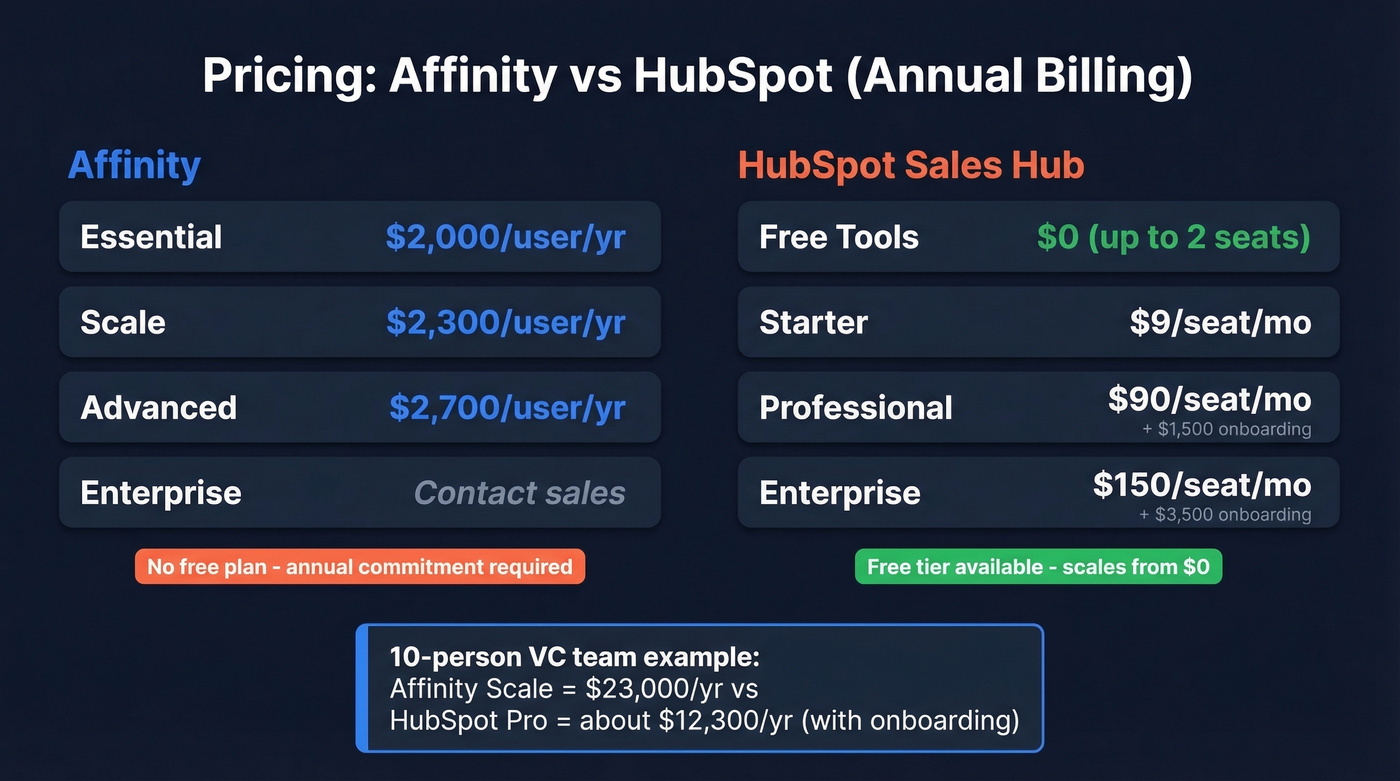
Pricing is where these two diverge sharply. Affinity charges per user annually with no free tier. HubSpot starts at zero and scales from there - but onboarding fees and seat-type complexity add up fast.
Affinity Pricing
| Tier | Annual Cost |
|---|---|
| Essential | $2,000/user/yr |
| Scale | $2,300/user/yr |
| Advanced | $2,700/user/yr |
| Enterprise | Contact sales |
No free plan. You're committing annually from day one.
HubSpot Sales Hub Pricing (Annual Billing)
| Tier | Annual Billing | Onboarding Fee |
|---|---|---|
| Free tools | $0 (up to 2 seats) | None |
| Starter | $9/seat/mo | None |
| Professional | $90/seat/mo | $1,500 |
| Enterprise | $150/seat/mo | $3,500 |
HubSpot Sales Hub Pricing's Pro and Enterprise tiers split seats into Sales Seats (full access) and Core Seats (limited). Not every user needs a full sales seat, which can lower your actual bill.
Let's do the math on a real scenario. A 10-person VC team on Affinity Scale pays $23,000/year. The same team on HubSpot Professional pays roughly $10,800/year plus $1,500 onboarding. But HubSpot won't natively auto-capture relationship context the way a VC-native CRM does, won't enrich from private capital sources like PitchBook and Dealroom - as part of its core enrichment. HubSpot can integrate with tools like PitchBook, but you're bolting them on yourself and paying separately.
Feature Comparison
| Capability | Affinity | HubSpot |
|---|---|---|
| Relationship intelligence | Yes | No |
| Auto-capture (inbox/cal) | Yes | Partial |
| Marketing automation | No | Yes |
| Deal pipeline | Yes | Yes |
| Enrichment sources | 40+ sources | Limited native |
| API access | 100K calls/mo | Public API available |
| Integration ecosystem | VC-focused | 1,000+ apps |
| Implementation time | ~2 months | Days to weeks |
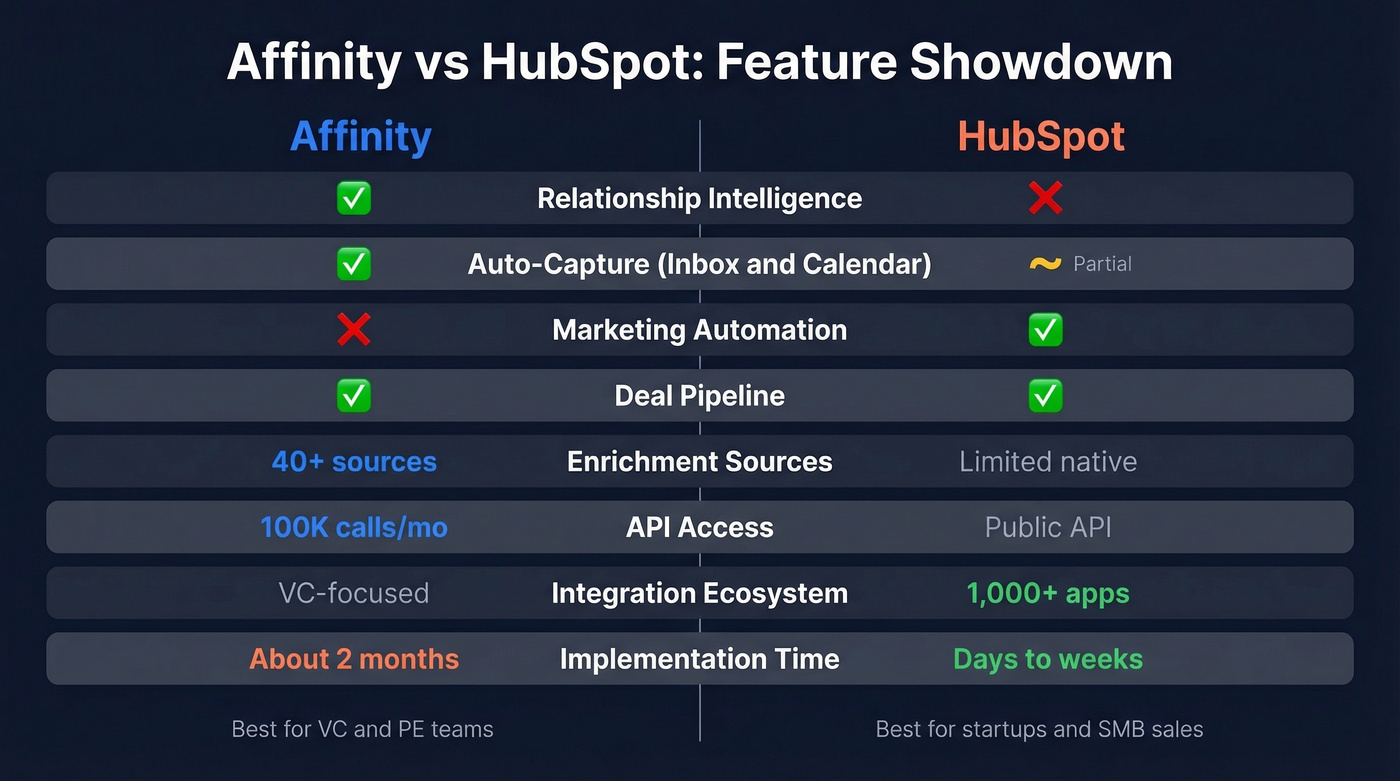
The enrichment gap is the headline here. Affinity pulls from 40+ private capital data sources - including PitchBook and Dealroom - as part of its core enrichment. HubSpot can integrate with tools like PitchBook, but you're bolting them on yourself and paying separately.

Both Affinity and HubSpot leave enrichment gaps. Prospeo fills them with 300M+ profiles, 98% email accuracy, and a 7-day refresh cycle - 6x faster than the industry average. Native HubSpot integration means verified data flows straight into your CRM records.
Stop blaming your CRM for what bad data caused.
What Users Actually Say
Affinity
Affinity holds a 4.4/5 on G2 from 71 reviews and a 9.2/10 on TrustRadius. Users praise the Gmail integration and automatic data capture. The recurring complaints: it's expensive, and customization is limited.
One practitioner documented enriched data being "extremely unreliable" for industries and locations, lists taking 20-30 seconds to load, and teammates losing meeting notes - forcing them to draft notes elsewhere before pasting into Affinity. That last one is the kind of friction that quietly kills adoption.
HubSpot
HubSpot Sales Hub also scores 4.4/5 on G2 - but from 13,567 reviews, plus an 8.8/10 on TrustRadius. That's a 190x review volume gap, and it matters. HubSpot is far more battle-tested across use cases.
Top praise: ease of use (1,430 mentions) and time-saving automation (831 mentions). Top complaints: missing features (500 mentions), features gated behind upgrades (472), and costs escalating as you grow (344). The pattern is clear - teams love HubSpot until they outgrow Starter and hit the Professional paywall.
A Real Migration Story
Foothill Ventures ($250M AUM) migrated from Affinity to HubSpot after deciding in early 2024 and pulling the trigger that March. The move took about a month before the team was fully operational.
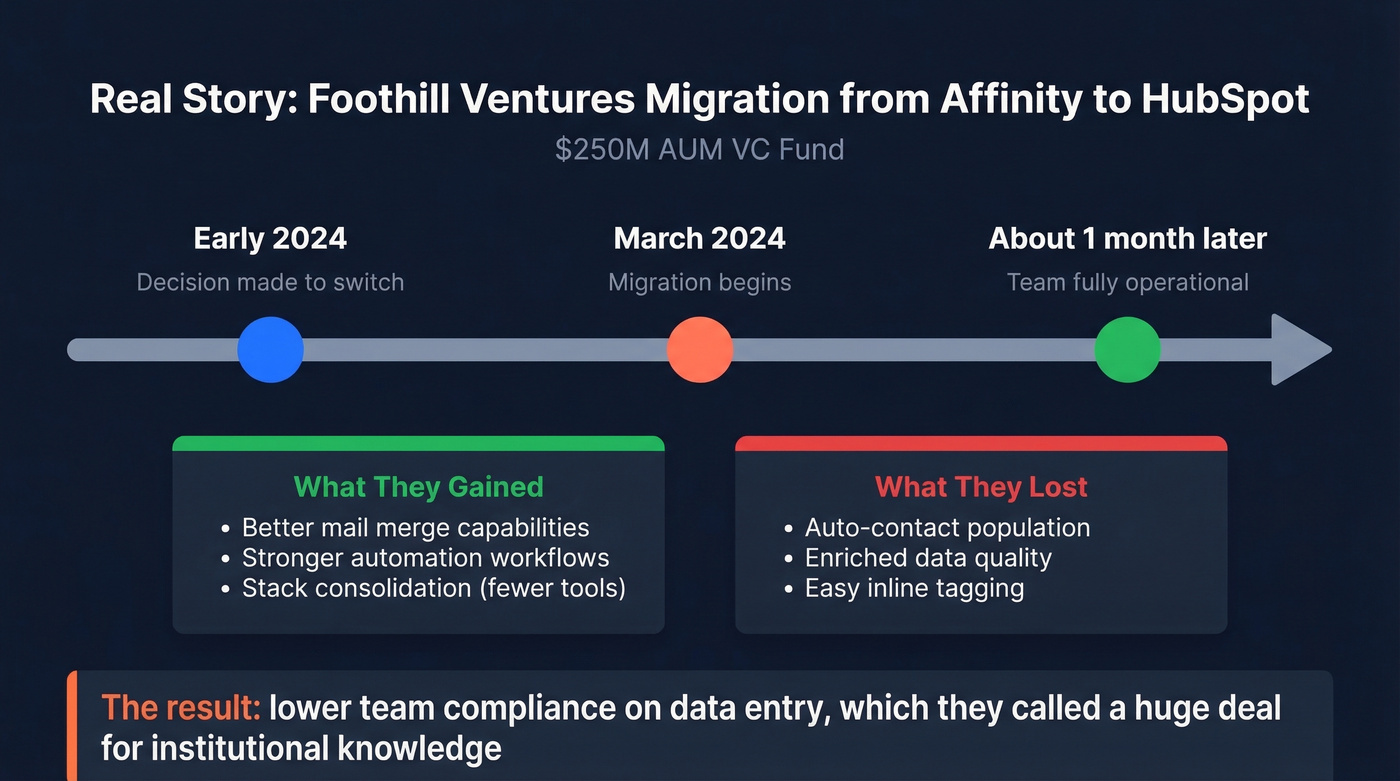
What they gained: far better mail merge, stronger automation, and stack consolidation. What they lost: auto-contact population, enriched data quality, and easy inline tagging. Creating new tag values in HubSpot requires editing field properties, refreshing, then applying. In Affinity, it's inline and instant.
The result was lower team compliance on data entry, which they called "a huge deal" for institutional knowledge. Here's the thing: if your firm's competitive advantage is who-knows-whom, that compliance drop isn't a minor inconvenience. It's an existential risk to your deal flow intelligence.
Our take: The CRM choice matters less than most teams think. We've seen firms agonize over this decision for months while their outbound runs on stale emails and unverified phone numbers. Pick either one in a week. Spend the time you saved fixing your data.
The Data Quality Gap Neither CRM Solves
Neither CRM is an email verification tool. Affinity enriches with deal-level intelligence from sources like PitchBook and Dealroom. HubSpot is strong on marketing automation and lifecycle tracking. But neither one is built to confirm that the email you're about to send will actually land in someone's inbox.

In our experience, this is where most CRM implementations quietly fail. Teams invest five figures in a platform, import thousands of contacts, and then watch bounce rates climb because nobody verified the underlying data. We've seen it happen with both Affinity and HubSpot deployments - the CRM gets blamed for what's really a data quality problem.
Prospeo fills that gap with 98% email accuracy and a 7-day data refresh cycle (the industry average is six weeks). It returns enrichment at scale - 83% of leads come back with contact data - and supports CRM workflows with 50+ data points per contact. For HubSpot users specifically, Prospeo integrates natively so verified emails and enrichment flow directly into records instead of living in spreadsheets.
VC teams on Affinity and sales teams on HubSpot hit the same wall: unverified contacts tank deliverability. Prospeo returns contact data on 83% of leads with 50+ data points per record - at $0.01 per email, no contracts, no sales calls.
Pick your CRM in a week. Fix your data today.
Who Should Choose What
VC/PE firm with 5+ investment professionals - go with Affinity. The relationship intelligence and auto-capture justify the premium. Nothing else on the market replicates that "who knows whom" layer as well.
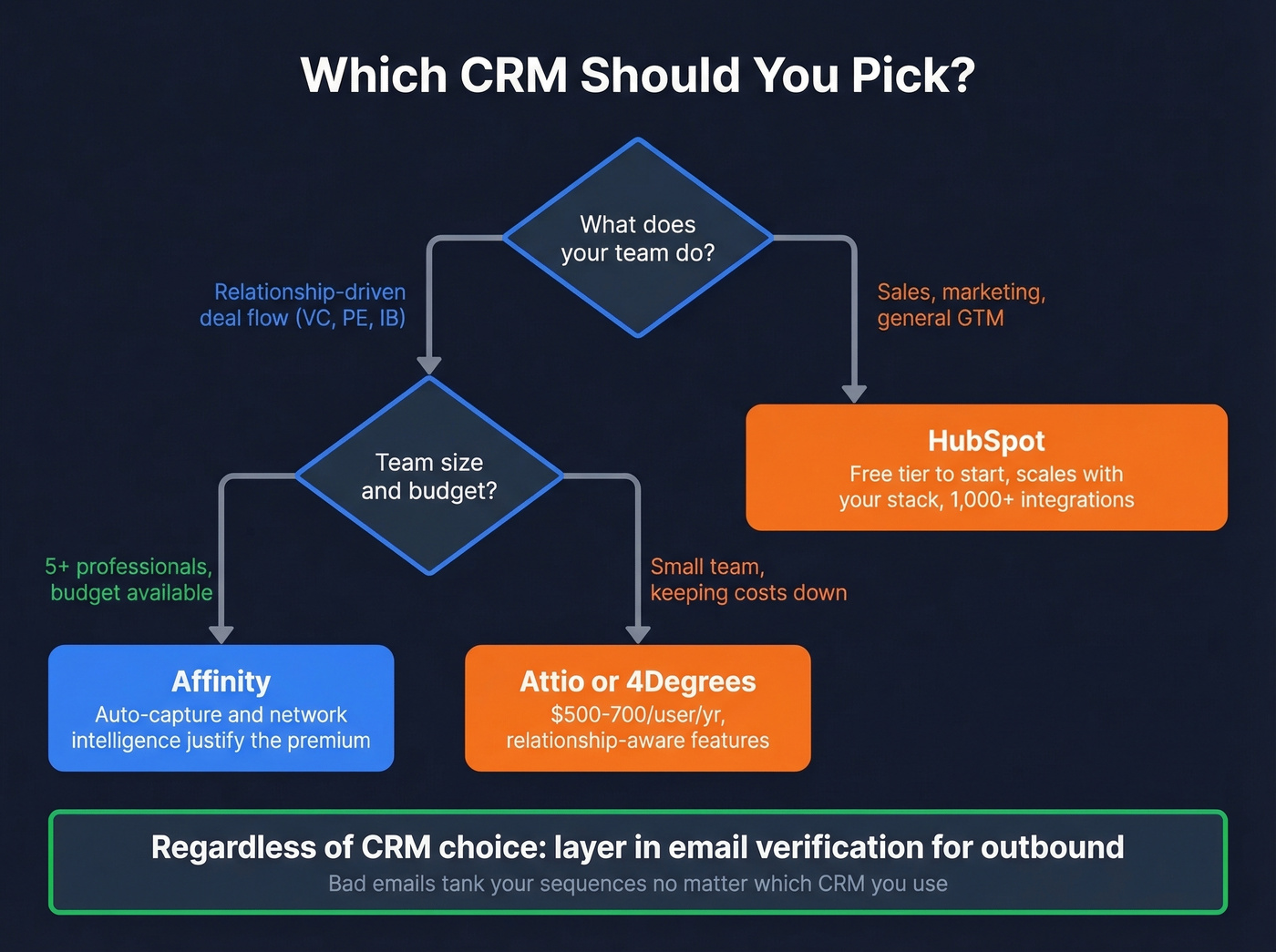
Startup or SMB sales team - HubSpot. The free tier gets you moving, and the ecosystem scales with you. It's the safer default for a reason.
Early-stage VC keeping costs down - look at Attio or 4Degrees before committing to Affinity's per-user pricing. Both offer relationship-aware CRM features starting around $500-700/user/year, which is a meaningful difference when you're a three-person team.
Running outbound on either platform - layer in a dedicated contact verification tool. Bad emails tank your sequences regardless of which CRM you're using, and the consensus on r/sales is that most CRM-native enrichment isn't enough for serious outbound volume.
FAQ
Can HubSpot replace Affinity for a VC firm?
It can, and some VC teams run HubSpot successfully. But you'll give up auto-capture, network mapping, and VC-native relationship intelligence, which usually means more manual tagging and lower data-entry compliance. Foothill Ventures made the switch in about a month but called the compliance drop "a huge deal" for institutional knowledge.
Is Affinity worth $2,000/user/year?
For relationship-led investing teams that use auto-capture daily, yes. The time saved and the network context typically outweigh the per-seat cost. If you mainly need a pipeline and a contact database, you're paying a premium for features you won't fully use.
How do I keep CRM contact data accurate?
Use a verification and enrichment layer, because neither platform is built for real-time email validation. A tool like Prospeo delivers 98% email accuracy, refreshes data every seven days, and enriches at scale with an 83% match rate - keeping bounce rates down and protecting deliverability regardless of which CRM you're running.
The Bottom Line
Affinity vs HubSpot doesn't have a universal winner - there's only "best for the job." If your workflow is relationship-driven deal flow, Affinity's auto-capture and network intelligence are the point. If you need a flexible CRM that can grow into marketing automation and a broader GTM stack, HubSpot is the safer default.
Either way, don't ignore the data layer. Verified emails and fresh enrichment are what keep outbound performance from quietly collapsing after the CRM rollout. That's the part most comparison articles skip, and it's the part that actually determines whether your CRM investment pays off.