

Territory Planning: The Practitioner's Playbook for 2026
You've got a $750K quota, 45 accounts, and a "territory plan" that's really just a tab in someone's master spreadsheet from last year. The accounts haven't been re-scored, three of your Tier 1s churned, and nobody updated the contact data. That's not a plan - it's a liability.
A Sales Ops lead on r/SalesOperations described their territory design process as a "massive Excel sheet" of zip codes where splits were done by "eyeballing it" - some reps swamped, others starving, and nobody confident the assignments were fair. Reps on r/sales call territory plans "management theater" - something that exists to make your boss look better, not to help you close deals.
Both sides are right. Most plans are broken because they're built on tribal knowledge, stale data, and gut-feel tiering. Territory planning done well drives 10-20% increases in sales productivity. Done poorly, it's the reason reps burn quota coverage on dead accounts while whitespace sits untouched.
This playbook fixes that for both audiences: the ops leader designing territories and the rep who has to execute one.
What a Working Territory Plan Needs
Three things separate a real territory plan from a slide deck:
A scoring model that goes beyond geography. Zip codes don't predict revenue. You need a formula that weights opportunity probability, win rates, and deal size. We'll build one below.
A filled template you can drop into your CRM today. Not a blank framework - a working example with real numbers, tier splits, and pipeline math. Scroll to the template section if that's what you're here for.
Verified contact data so your plan doesn't die on first outreach. A territory plan with stale emails is a strategy document that never becomes pipeline. You should target 3x-5x pipeline coverage to hit quota, and effective realignment alone can lift revenue 2-7% without adding headcount.
What Is Territory Planning?
Territory planning is the process of dividing your total addressable market into manageable segments, assigning them to reps, and building the scoring, targeting, and pipeline math that turns those segments into revenue. It answers three questions: who to target, where to focus, and how to assign.
For most organizations it sits at the intersection of sales strategy and operations - bridging the gap between high-level revenue goals and the day-to-day account prioritization reps actually execute.
The IC sentiment on Reddit is blunt: territory plans feel like "management theater." This playbook serves both audiences. If you're in ops, you'll get the scoring model, template, and software comparison. If you're a rep, skip to the IC playbook section - it's built for you, with a 30-60-90 framework and a "know your numbers" table you can fill in today.
Types of Sales Territories
Not all territories are carved the same way. The model you pick shapes everything downstream - rep workload, account overlap, and how fairly quota gets distributed.
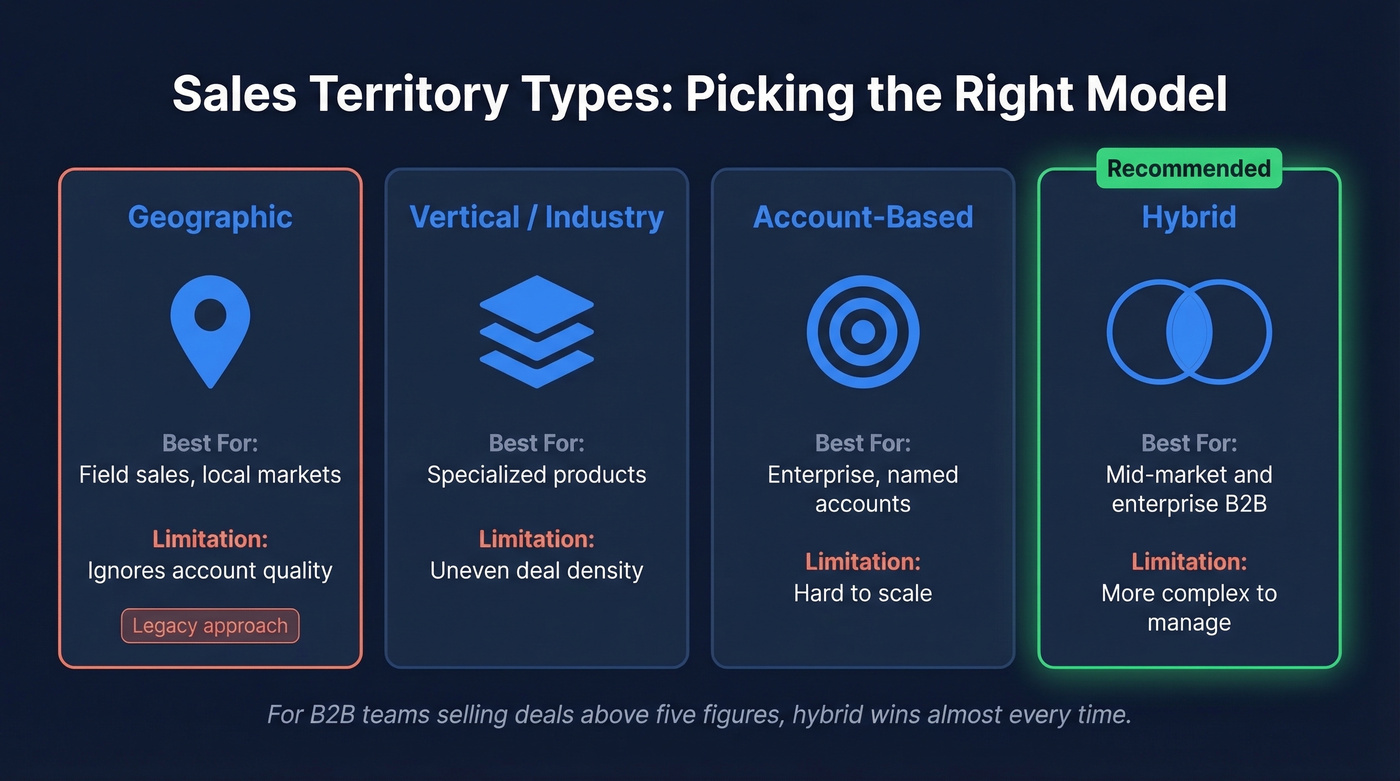
| Type | Best For | Key Limitation |
|---|---|---|
| Geographic | Field sales, local markets | Ignores account quality |
| Vertical/Industry | Specialized products | Uneven deal density |
| Account-Based | Enterprise, named accounts | Hard to scale |
| Hybrid | Mid-market & enterprise B2B | More complex to manage |
Here's the thing: for B2B teams selling deals above five figures, hybrid is the right answer almost every time. Pure geographic splits create the exact problem that Sales Ops lead described - a massive Excel sheet of zip codes where splits are done by "eyeballing it," leaving some reps swamped and others starving. Hybrid models layer account-based tiering on top of geography, so you're balancing on TAM, lead flow, and realistic opportunity count - not just postal codes.
Geographic-only works fine for field sales teams covering retail locations or SMB door-to-door. For everyone else, it's a legacy approach that creates more problems than it solves.
How to Build a Territory Plan
Define Your ICP and Segment the Market
Before you assign a single account, you need clarity on who you're actually selling to. Your ICP definition drives every downstream decision - scoring, tiering, pipeline targets, and rep allocation.
Start with these segmentation inputs:
- Firmographic: industry, employee count (use categorical bands: VSB, SMB, mid-market, enterprise, strategic), annual revenue, HQ location
- Technographic: current tech stack, competitor products installed, infrastructure signals
- Intent: first-party engagement like website visits and content downloads, plus third-party intent signals from Bombora topics, G2 research, and job postings that signal buying behavior
- Historical performance: win rates by segment, average deal size by company size, sales cycle length by vertical
Move from "eyeballing it" to a repeatable framework. It doesn't need to be perfect on day one - it gets smarter each quarter as you feed it closed-won and closed-lost data.
The Scoring Formula Most Plans Skip
This is where most territory plans fall apart. Teams either skip scoring entirely or use a subjective "A/B/C" system that's really just gut feel with labels.
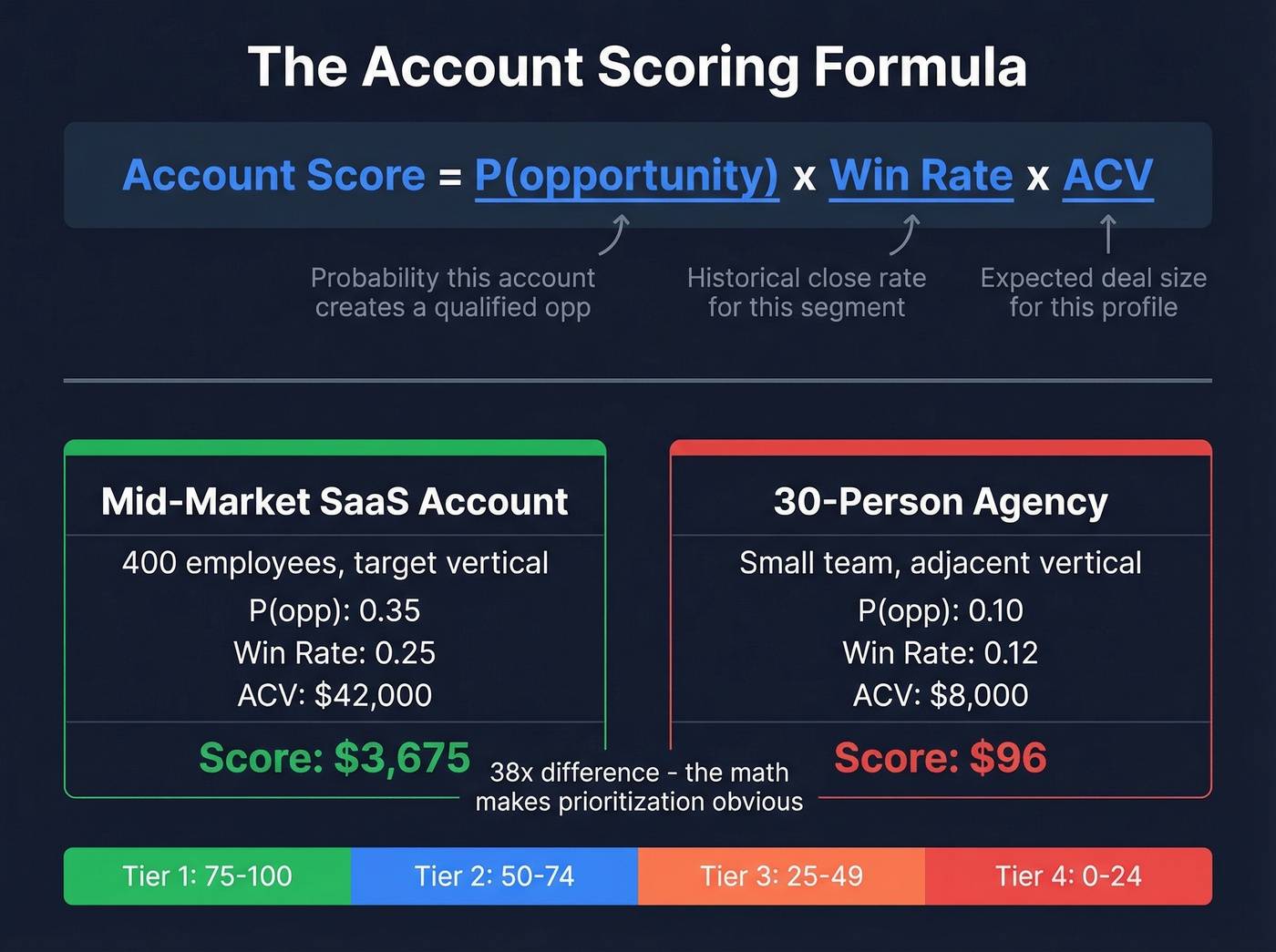
Most guides stop at "tier your accounts A/B/C." Let's use actual math.
The core formula:
Account Score = P(opportunity) x Win Rate x ACV
P(opportunity) is the probability this account generates a qualified opportunity. Model it using firmographic fit, technographic signals, and intent data. If you're early-stage, start with simple heuristics: industry match + size band + one intent signal. As you mature, you can run logistic regression against your closed-won data.
Win Rate is your historical close rate for accounts in this segment. ACV is the expected deal size for this account profile.
Sum raw scores across all accounts to get your SOM - serviceable obtainable market. Normalize to a 0-100 scale for rep usability, then tier:
| Tier | Score Range | Definition | Action |
|---|---|---|---|
| Tier 1 | 75-100 | High fit, high intent | Full pursuit, multi-thread |
| Tier 2 | 50-74 | Good fit, moderate signal | Active outreach cadence |
| Tier 3 | 25-49 | Possible fit, low signal | Nurture, revisit quarterly |
| Tier 4 | 0-24 | Poor fit | Do not engage |
A worked example makes this concrete. A mid-market SaaS account with 400 employees in your target vertical: P(opportunity) = 0.35, win rate = 0.25, ACV = $42,000. Score = 0.35 x 0.25 x $42,000 = $3,675. Compare that to a 30-person agency: 0.10 x 0.12 x $8,000 = $96. The math makes the prioritization obvious in a way that "A/B/C" labels never do.
In our experience, teams that skip the math and go straight to subjective labels end up re-tiering within 60 days - usually after a rep wastes a month chasing accounts that looked good on paper but had no real buying signal.
Assign Territories and Set Pipeline Targets
With scored and tiered accounts, you can now assign territories that are actually balanced. The goal isn't equal account counts - it's equal opportunity value.
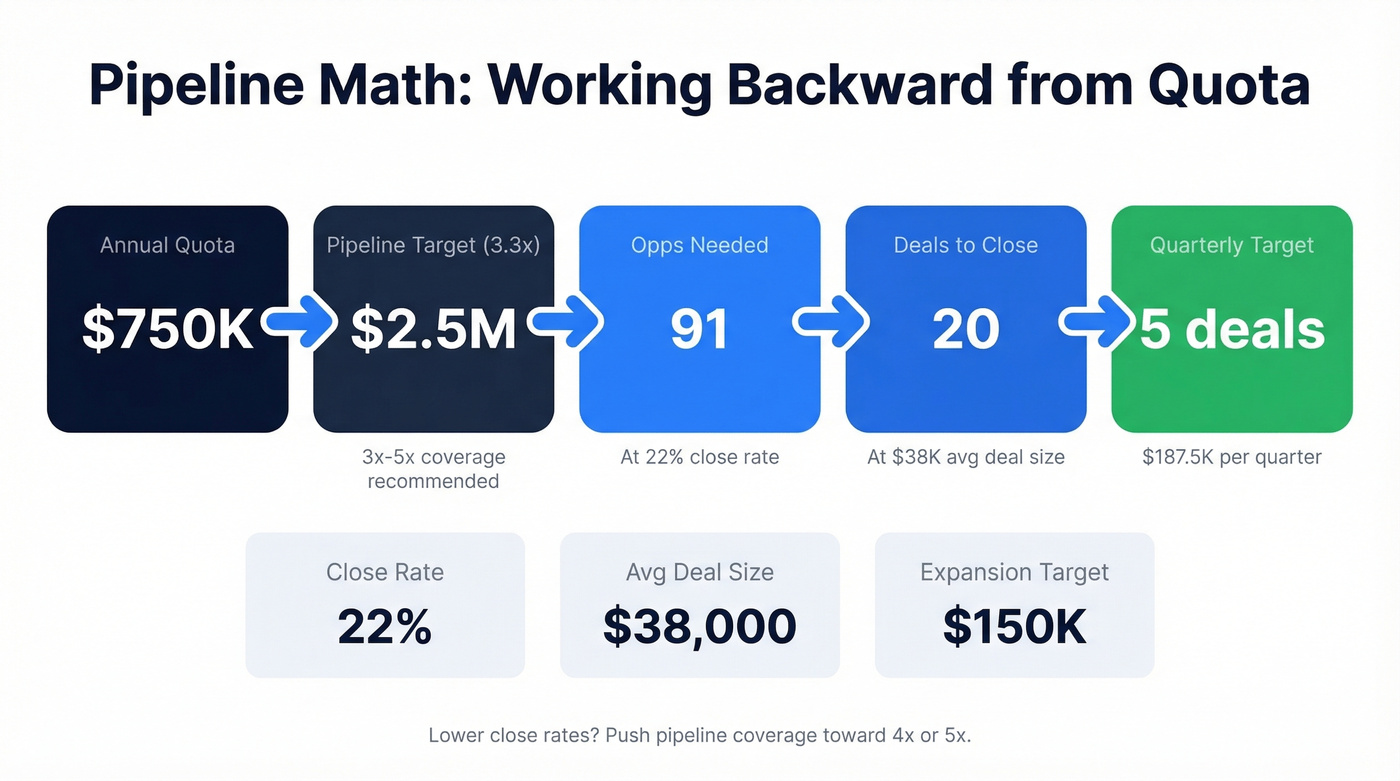
Use territory balancing indices that weight multiple variables: total scored value, account count by tier, geographic spread, and travel time for field teams. A territory with 8 Tier 1 accounts and 12 Tier 2s could carry the same opportunity value as one with 4 Tier 1s and 25 Tier 2s - but the rep capacity required is very different.
Pipeline math is straightforward. If a rep's quota is $750K and your average close rate is 22% with $38K average deal size, you need about 20 closed deals. At 22%, that's roughly 91 qualified opportunities across the year. Set pipeline targets at 3.3x quota - so $2.5M - and work backward to quarterly activity targets.
Build a capacity model alongside this. How many hours per week does each rep spend on prospecting vs. engaged selling vs. admin? If travel eats 30% of a field rep's week, that territory can't carry the same account load as an inside rep's patch.

You just built a scoring model. Now you need contact data that doesn't bounce. Prospeo delivers 98% email accuracy with a 7-day refresh cycle - so your Tier 1 accounts have verified emails and direct dials, not stale data from last year's spreadsheet.
Stop letting dead contacts kill your territory plan.
Territory Plan Template (Filled Example)
Here's a complete, filled template for a mid-market SaaS rep. Copy it into your CRM or spreadsheet and adjust the numbers.
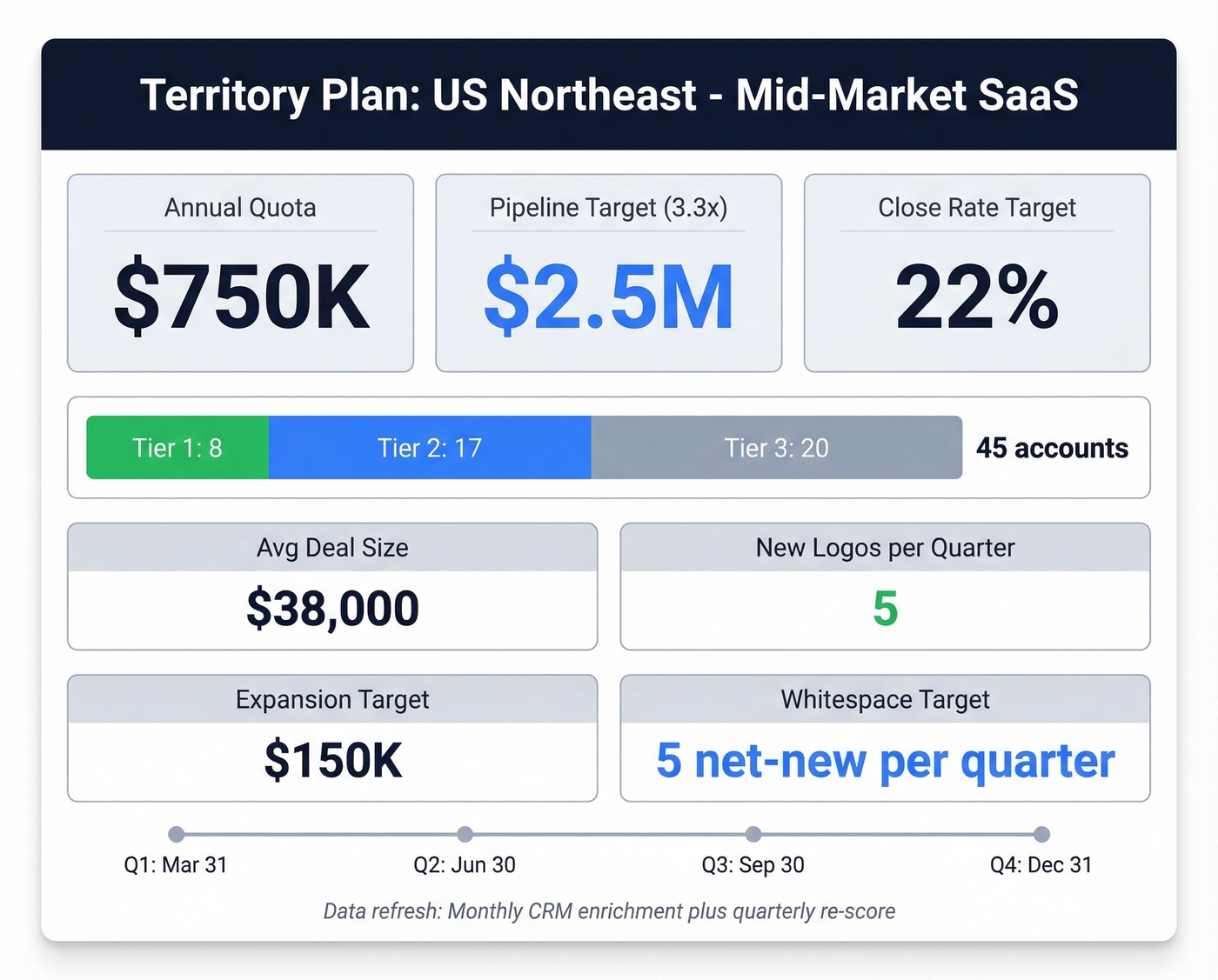
| Field | Value |
|---|---|
| Territory Name | US Northeast - Mid-Market SaaS |
| Assigned Rep | [Rep Name] |
| Region | Northeast US |
| Annual Quota | $750,000 |
| Total Accounts | 45 |
| Tier 1 Accounts | 8 |
| Tier 2 Accounts | 17 |
| Tier 3 Accounts | 20 |
| Pipeline Target | $2,500,000 (3.3x quota) |
| Whitespace Target | 5 net-new accounts/quarter |
| Expansion Target | $150,000 |
| Close Rate Target | 22% |
| Avg Deal Size | $38,000 |
| New Logo Target | 5/quarter |
| Quarterly Reviews | Mar 31, Jun 30, Sep 30, Dec 31 |
| Data Refresh | Monthly CRM enrichment + quarterly re-score |
The pipeline target of $2.5M at 3.3x quota sits at the conservative end of the 3x-5x range. If your close rates are lower or deal cycles stretch longer, push toward 4x or 5x.
The whitespace target is critical and often missing. Five net-new accounts per quarter forces the rep to prospect beyond the existing book - that's where growth lives. The expansion target of $150K acknowledges that upsell and cross-sell within existing accounts is usually the highest-ROI motion in any territory.
Review dates aren't optional. A plan built in January and ignored until December isn't a plan.
How to Attack a New Territory as a Rep
If you're a rep who just got handed a territory, the scoring model and template above are useful context. But what you actually need is a 90-day execution plan. McKinsey research shows teams that apply disciplined territory execution are 1.3x more likely to outperform peers in revenue growth.
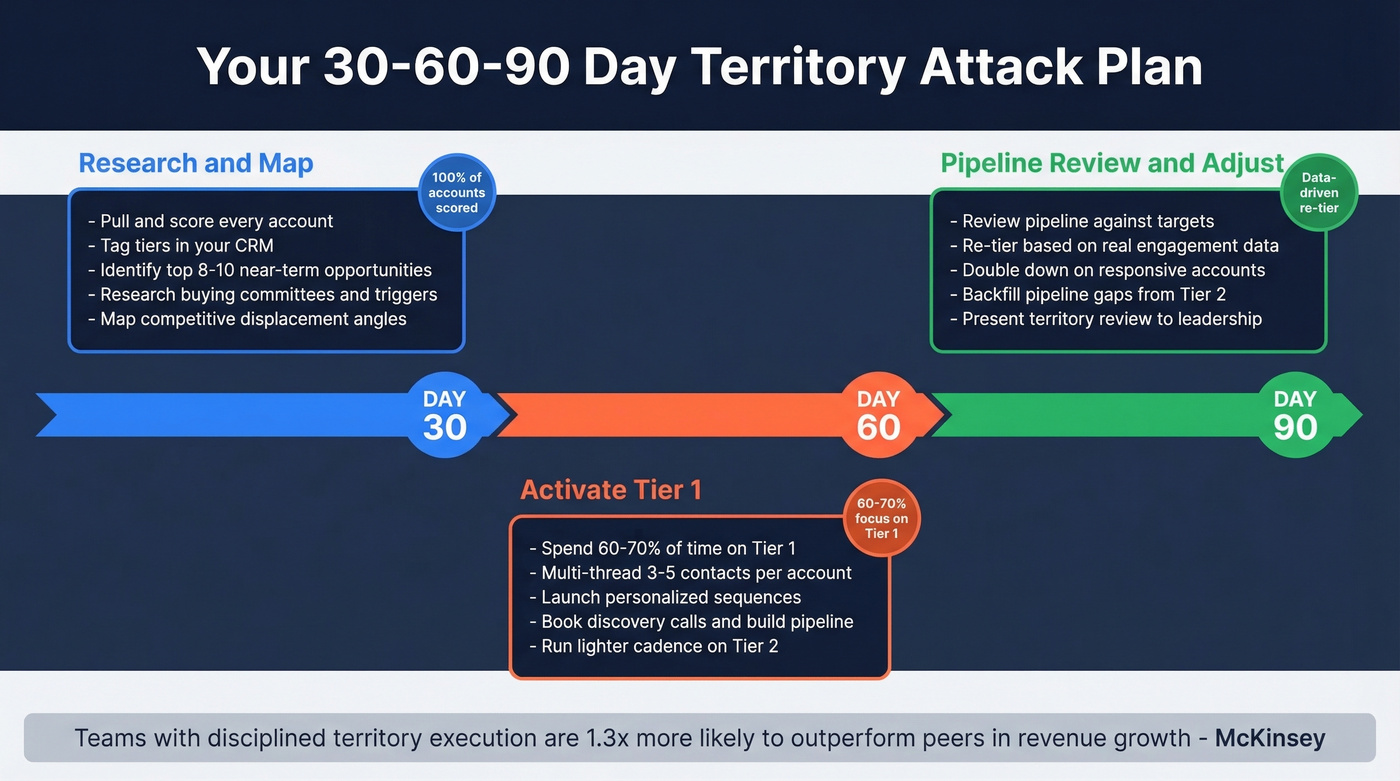
Days 1-30: Research and map. Pull every account in your territory. Score them using the formula above or your manager's version of it. Tag tiers in your CRM. Identify the 8-10 accounts that represent the biggest near-term opportunity. Research buying committees, recent triggers like funding rounds, leadership changes, and hiring surges, plus competitive displacement angles.
Days 31-60: Activate Tier 1. Spend 60-70% of your time on Tier 1 accounts. Multi-thread into each one - you need 3-5 contacts per account, not just one champion. Launch personalized sequences. Book discovery calls. Start building pipeline. Run a lighter cadence against Tier 2 to warm them up simultaneously.
Days 61-90: Pipeline review and adjust. By now you should have enough data to know which accounts are real and which are dead weight. Re-tier based on actual engagement. Double down on what's working. Flag accounts that need to be swapped out.
Before you do anything else, fill in this table and keep it updated weekly:
| Metric | Your Number |
|---|---|
| Annual Quota | $ |
| Closed Business YTD | $ |
| Gap to Quota | $ |
| Weighted Pipeline | $ |
| Pipeline Coverage Ratio | x |
If your coverage ratio drops below 3x, that's a red flag. You either need more pipeline or your weighted values are too optimistic. Most reps don't track this rigorously enough, and it's the single best predictor of whether you'll hit quota.
Mistakes That Kill Quota
Static territory models. Markets shift. Competitors enter. Accounts churn. A plan that doesn't get revisited quarterly is already wrong. Effective realignment lifts revenue 2-7% without adding headcount - that's free money left on the table.
Eyeballing the splits. If your territory design process involves a Sales Ops lead staring at a spreadsheet and "just knowing" which rep should get which accounts, you're building on tribal knowledge. It doesn't scale, and it creates the thin-vs-swamped imbalance that tanks morale.
Ignoring drive time and logistics. For field sales teams, a territory that looks balanced on a map can be a nightmare in practice. Two accounts 90 minutes apart with a Tier 3 prospect in between isn't efficient - it's a windshield tour.
Designing around people, not strategy. "Sarah's always had the Northeast" isn't a territory strategy. When you design territories around individual reps instead of business opportunity, you inherit every historical imbalance and make it structural.
Neglecting whitespace. The easiest trap: over-indexing on existing accounts and ignoring untapped market segments. If your plan doesn't include a net-new target, you're managing a book of business, not growing one.
Skipping data verification. Your territory plan is a strategy document until someone actually emails or calls those accounts. If 15-20% of your contact data is stale - wrong emails, departed contacts, outdated titles - your plan fails at execution. Before you launch a single sequence, run the list through a verification tool. Prospeo's 7-day data refresh cycle and 98% email accuracy catch dead contacts before they tank your deliverability. It takes minutes and saves weeks of wasted outreach.
Treating it as annual-only. 20-30% of territories constrain growth when they're not periodically adjusted. Quarterly reviews are the minimum. Trigger a mid-quarter review if a rep leaves, a major account churns, or pipeline coverage drops below 3x in any patch.
Territory Planning Software in 2026
The sales territory mapping software market crossed $2.5B in 2025 and is projected to hit $7B by 2033. That growth reflects a real shift: teams are moving from spreadsheets to purpose-built tools. But you don't necessarily need an enterprise platform to start.
| Tool | Best For | Starting Price |
|---|---|---|
| Prospeo | Contact data + execution | Free tier; ~$0.01/email |
| Spotio | Field sales mapping | $39/user/mo |
| Badger Maps | Field sales routing | $49/user/mo |
| MapBusinessOnline | SMB territory mapping | $29/mo |
| Mapline | Visual territory mapping | $99/mo |
| Xactly AlignStar | Enterprise SPM + comp | ~$30K+/yr |
| Anaplan | Enterprise scenario modeling | ~$30K+/yr |
| Salesforce Sales Cloud | Mid-market/enterprise CRM | $25/user/mo |
| HubSpot | SMB CRM | Free; Sales Hub from ~$20/user/mo |
For most teams, the right stack is a CRM (Salesforce or HubSpot) plus a contact data layer plus a mapping tool if you have field reps. Skip the mapping tool entirely if your team is inside sales only - it won't add value.
Enterprise SPM platforms like Xactly AlignStar and Anaplan make sense when you're managing 100+ reps and need scenario modeling tied to compensation plans. For teams under 50 reps, they're overkill - and I've watched multiple mid-market companies burn six figures on Anaplan implementations they never fully adopted.
Territory plans need 3-5x pipeline coverage to hit quota. That math breaks when 35% of your emails bounce. Prospeo's 300M+ profiles with 30+ filters - intent data, technographics, headcount growth - let you fill every tier with real, reachable buyers at $0.01 per email.
Turn your account tiers into pipeline, not bounced emails.
How to Keep Territories Healthy
A territory plan isn't a deliverable - it's a living document. The teams that treat it like a quarterly slide deck for leadership are the ones where 20-30% of territories end up constraining growth.
Set a quarterly review cadence at minimum. During each review, run through this checklist:
- Pipeline coverage by territory: Is every patch above 3x? If not, why?
- Rep capacity vs. workload: Has account volume or complexity shifted?
- Account tier accuracy: Do the scores still reflect reality, or have signals changed?
- Whitespace progress: Are reps hitting net-new targets, or just farming existing accounts?
- Contact data freshness: When was the last enrichment pass? Stale data compounds fast.
Trigger a mid-quarter rebalance when a rep leaves, a major account churns or gets acquired, or a new market segment opens up. We've seen teams lose an entire quarter of pipeline because they waited for the "official" review cycle to reassign orphaned accounts.
The best territory plans we've encountered share one trait: they're updated in the CRM, not in a PowerPoint. If your plan lives in a slide deck that gets presented once and forgotten, it's not a plan. Tag tiers in your CRM, set pipeline dashboards by territory, and make the data visible to reps - not just managers.
FAQ
What's the difference between a territory plan and a territory map?
A territory map is the visual layer - who owns which geography or accounts. A territory plan includes scoring models, tier definitions, pipeline targets, cadence rules, and review schedules on top of that map. You need both, but the map without the plan is just a pretty picture.
How often should you rebalance territories?
Quarterly at minimum. Trigger a mid-quarter review if a rep leaves, a major account churns, or pipeline coverage drops below 3x. Static territories constrain growth in 20-30% of patches - waiting for the annual cycle costs real revenue.
What data do you need before building a sales territory plan?
Firmographic data (industry, employee count, revenue), technographic signals, intent data, and historical win rates by segment. You also need verified contact data - a plan built on stale emails fails the moment a rep starts outreach.
Can you do territory planning without expensive software?
Yes. A CRM (even free HubSpot), a spreadsheet for scoring, and a contact verification tool cover 80% of what most teams need. Enterprise SPM platforms help at 100+ reps, but a solid plan requires clean data, a scoring model, and quarterly review discipline - not a six-figure software investment.