

Top of Funnel vs Bottom of Funnel: What the Data Actually Says
The top of funnel vs bottom of funnel debate shows up in every budget meeting. Someone - usually the CFO - argues that awareness spend is just burning money. As one PPC practitioner put it on r/PPC: platforms push awareness campaigns because it increases ad spend, not because it improves your results. That skepticism is earned. But the data says most teams are making the opposite mistake.
The Short Version
TOFU builds the audience. BOFU converts it. Most marketers over-invest in BOFU - 68.8% of budget goes to short-term performance - largely because it's easier to measure. The research says aim for 60/40 brand-to-performance. If your CAC is rising quarter over quarter, the problem is usually your TOFU, not your BOFU.
TOFU vs BOFU at a Glance
| Dimension | TOFU | BOFU |
|---|---|---|
| Goal | Awareness, reach | Conversion, revenue |
| Tactics | Content, video, social | Demos, outbound, retargeting |
| KPIs | Impressions, brand lift | Pipeline, closed-won |
| Timeline | 4-12 weeks for early signals; 3-6 months for sustained impact | Days to weeks |
| Cost profile | Lower CPM | Higher CPM |
| Audience mindset | "Never heard of you" | "Comparing options" |
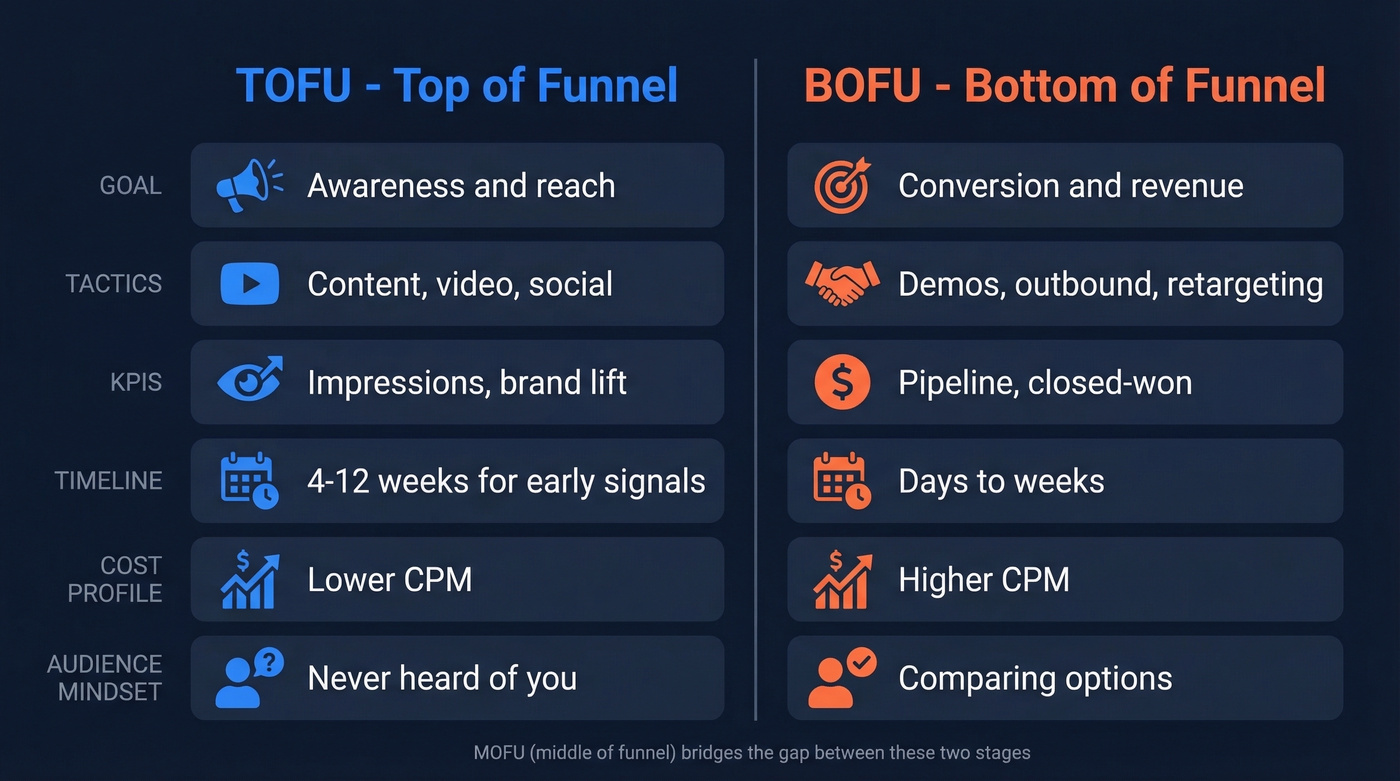
MOFU sits between these two - think case studies, comparison guides, webinars, and nurture sequences. It's the bridge that turns awareness into consideration. This article focuses on the TOFU/BOFU tension because that's where the budget fights happen.
What the Numbers Actually Show
Conversion Rates by Stage
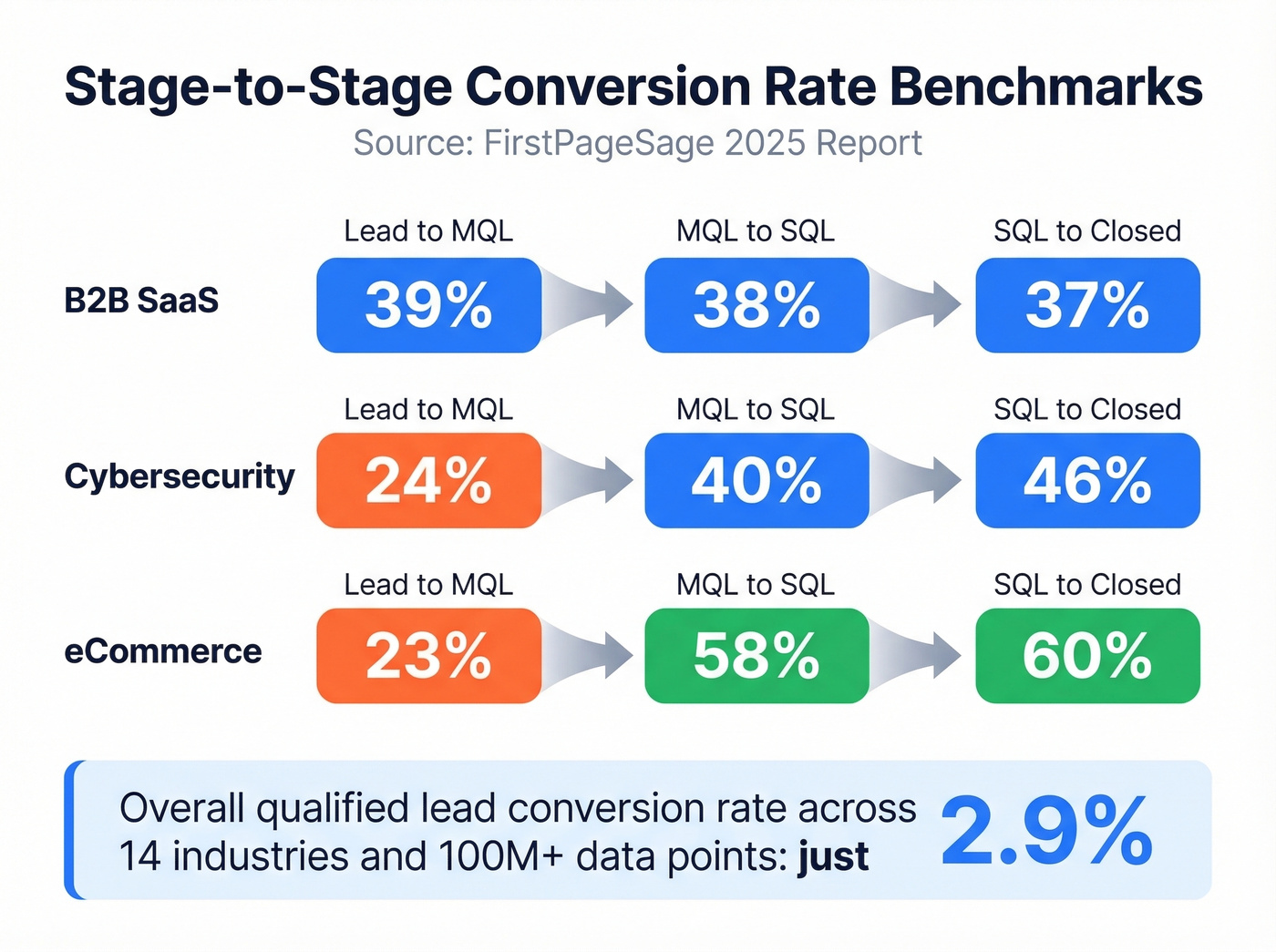
The drop-off between stages is where the real story lives. FirstPageSage's benchmark report breaks it down by industry:
| Industry | Lead-to-MQL | MQL-to-SQL | SQL-to-Closed |
|---|---|---|---|
| B2B SaaS | 39% | 38% | 37% |
| Cybersecurity | 24% | 40% | 46% |
| eCommerce | 23% | 58% | 60% |
These are stage-to-stage rates, not visitor-to-lead rates - those are far lower. Across 14 industries and 100M+ data points, the overall qualified-lead conversion rate sits at just 2.9%. That's the number your TOFU has to work with. Every percentage point of improvement at the top compounds through every stage below it.
Paid Media Performance
A Confect study across 550M Meta impressions quantified what most media buyers already feel: upper-funnel conversion rates run about 47% lower than lower-funnel, but lower-funnel CPM is 35% higher. CTR is nearly identical between the two.
The interpretation is straightforward. TOFU is cheaper per eyeball but converts less. BOFU is expensive but closes. Neither works in isolation - cheap impressions without conversion infrastructure waste budget, and expensive retargeting without a fresh audience pool burns out fast.
Why the Funnel Isn't Really a Funnel
Here's the thing: people don't move neatly from awareness to consideration to purchase. Google's Decoding Decisions research describes what actually happens as a "messy middle" - buyers loop between exploration and evaluation, bouncing back and forth rather than sliding down a linear path.
Your TOFU content doesn't just create awareness and disappear. A blog post written for awareness gets pulled into evaluation cycles. A brand video someone saw three months ago influences which demo they request. The funnel is really a loop, and the boundaries between stages are far blurrier than any framework suggests. You can't cleanly separate upper-funnel and lower-funnel impact - they feed each other constantly.

The messy middle punishes stale data. Buyers loop between exploration and evaluation for weeks - and if your contact data decayed in that window, your BOFU never fires. Prospeo refreshes 300M+ profiles every 7 days (industry average: 6 weeks) so the leads you built awareness with are still reachable when they're ready to convert.
Stop losing BOFU conversions to outdated contact data.
Why BOFU Flatlines Without TOFU
Think of your BOFU campaigns as drawing from a reservoir. Every conversion depletes it. TOFU is what refills the pool - without replenishment, your retargeting audiences shrink, your outbound lists get stale, and your cost per acquisition climbs.
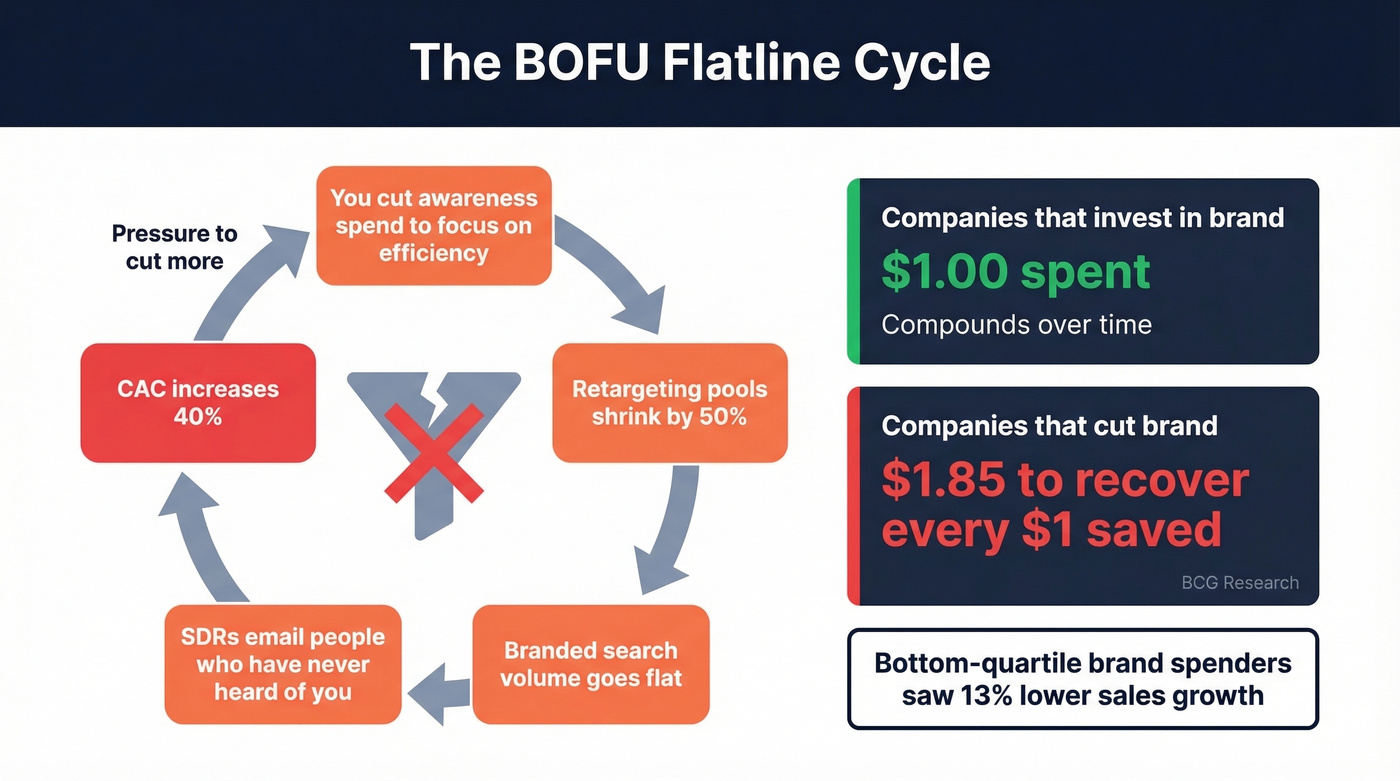
BCG's analysis makes the cost of neglecting this painfully clear: companies that cut brand marketing had to spend $1.85 to regain every $1 they saved. Bottom-quartile brand spenders saw sales growth rates 13% lower than top-quartile spenders and 6% weaker conversion from awareness to purchase.
Then there are halo effects. Someone sees your YouTube ad, doesn't click. Two weeks later they Google your brand name, click a paid search ad, and convert. SEM gets the credit. TOFU did the work. We've seen this pattern across dozens of B2B accounts - the channel that gets attribution credit is rarely the channel that created the demand.
Let's make this concrete. It's Q3 planning and your CEO asks why CAC increased 40%. You cut awareness spend in Q1 to "focus on efficiency." Now your retargeting pools are half the size, branded search volume is flat, and your SDRs are emailing people who've never heard of you. That's the BOFU flatline in action.
How to Split Your Budget
The Allocation Framework
Binet and Field's research established the benchmark: roughly 60% of budget toward brand building and 40% toward activation. It's not a rigid rule - it shifts by category, sales cycle length, and market maturity. But it's the best starting point the industry has, and the reality is far from it. A 2024 CMO survey found the average paid media allocation sits at 31.2% brand versus 68.8% performance. That gap is expensive.
Hot take: If your average deal size is under $10K, you probably don't need a sophisticated full-funnel media strategy. You need a great product page, a tight retargeting loop, and enough content marketing to keep the pipeline warm. Save the 60/40 framework for when you're spending enough that allocation actually matters.
Budget by Company Stage
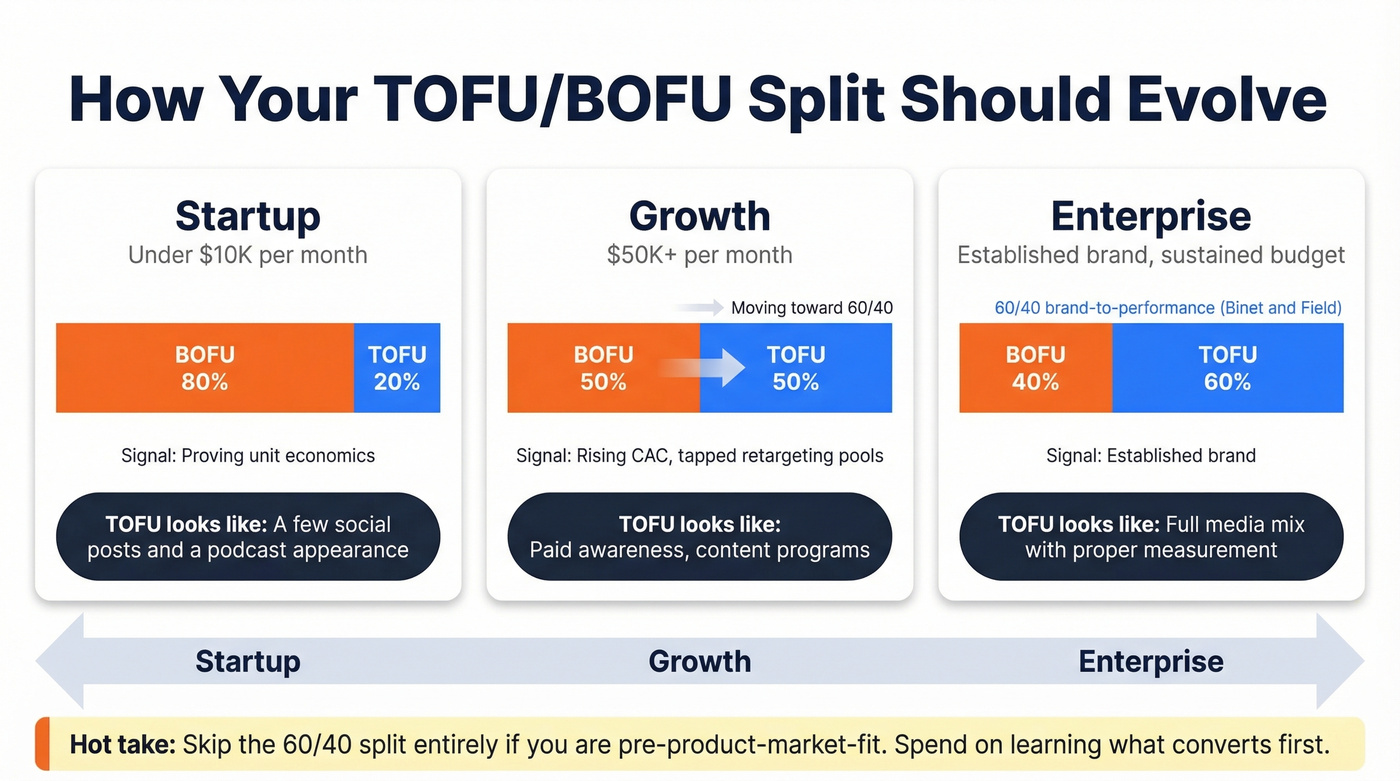
In our experience, it often takes two full quarters for a 60/40 shift to show up in pipeline numbers. Not every company should run it from day one.
| Stage | Signal | Allocation | What TOFU Looks Like |
|---|---|---|---|
| Startup (<$10K/mo) | Proving unit economics | 80% BOFU | A few social posts and a podcast appearance |
| Growth ($50K+/mo) | Rising CAC, tapped retargeting pools | 50/50 moving to 60/40 | Paid awareness, content programs |
| Enterprise | Established brand, sustained budget | 60/40 with incrementality testing | Full media mix with proper measurement |
Skip the 60/40 split entirely if you're pre-product-market-fit. Spend on learning what converts, not on brand awareness for a product that's still changing every sprint.
Measuring TOFU Without Losing Your Mind
TOFU measurement is hard because standard attribution windows - 7-day click, 1-day view - miss most of the impact. B2B journeys involve roughly 60 touchpoints before a deal closes. A one-week window captures a fraction of that.
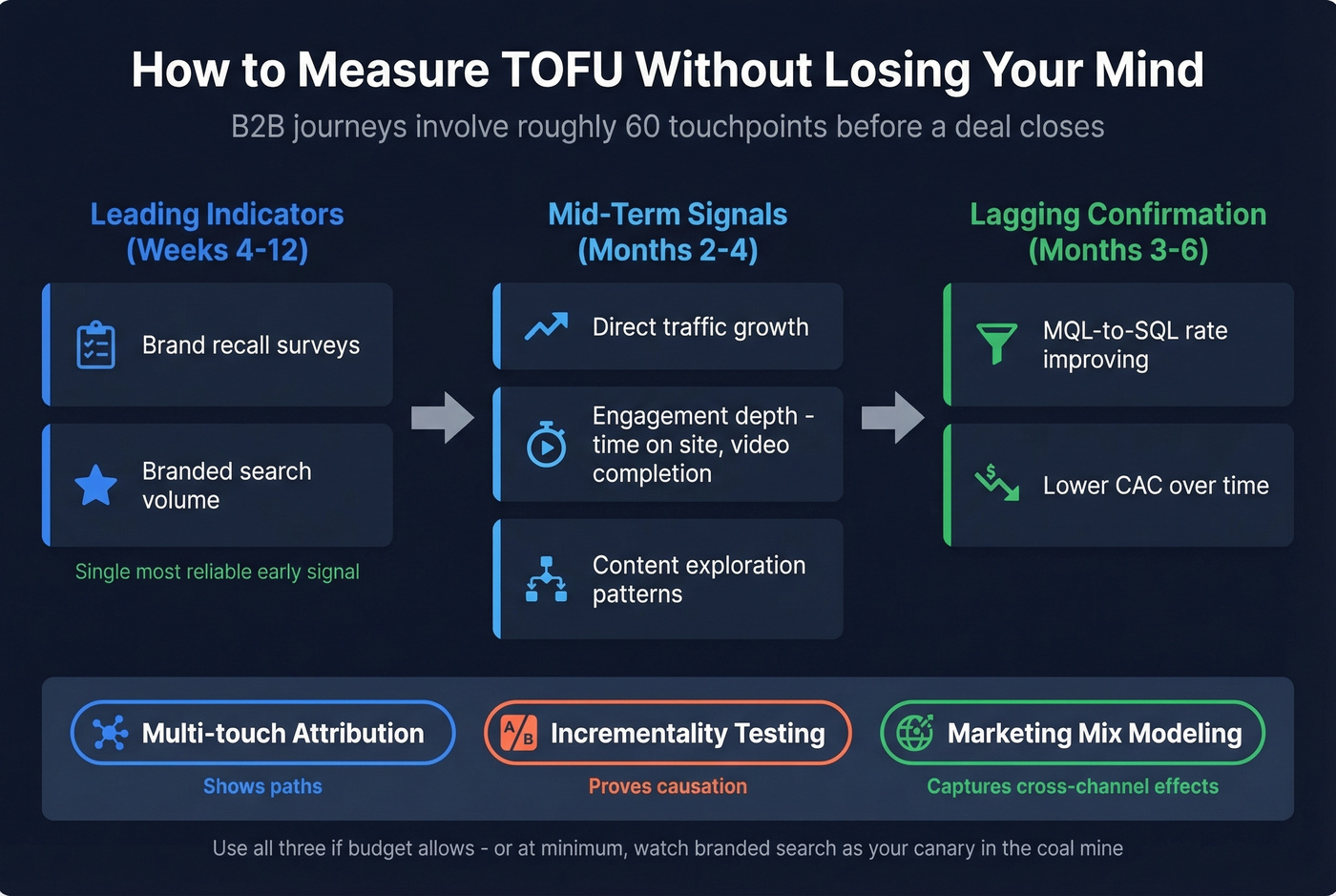
Start with brand recall surveys and branded search volume as your leading indicators. We've found branded search to be the single most reliable early signal that awareness campaigns are working. As those stabilize, track direct traffic growth and engagement depth - time on site, video completion, content exploration patterns. Lead quality, specifically your MQL-to-SQL conversion rate improving over time, is your lagging confirmation.
The recommended approach combines multi-touch attribution with incrementality testing and marketing mix modeling. No single method captures the full picture. Multi-touch shows paths. Incrementality proves causation. MMM captures offline and cross-channel effects. Use all three if you can afford to - or at minimum, watch branded search volume as your TOFU canary in the coal mine.
Full-Funnel Strategy in Action
The Humble Co. Results
The Humble Co. shifted from conversion-only campaigns to a full-funnel approach on Amazon. The results: +58% revenue, +229% sessions, and +28% conversion rate. Subscribers grew 241%. The key insight wasn't that awareness campaigns drove direct sales - it's that awareness campaigns made the conversion campaigns more efficient. More people in the pool meant lower cost per conversion at the bottom.
Your BOFU Data Problem
Your SDR team's reply rates dropped from 8% to 3% over the past two quarters. You assume it's messaging. It might be - but more often, it's data.
B2B contact data decays 30-40% annually. People change jobs, companies restructure, email addresses go stale. Your TOFU campaigns might be generating awareness perfectly, but if your BOFU outreach hits bounced emails, none of that awareness converts. Snyk's 50-person sales team was bouncing 35-40% of outbound emails before switching to Prospeo, which dropped bounces below 5% and grew AE-sourced pipeline 180%. The difference comes down to a 7-day data refresh cycle versus the 6-week industry average, with 98% email accuracy. Their free tier gives you 75 verified emails per month to test before committing.
Look, you can build the most sophisticated funnel strategy in the world, but it breaks at the point of contact. Stale data is the silent killer of BOFU performance.
Rising CAC is a TOFU problem - but bad data makes it worse. When 35% of your outbound emails bounce, you're burning the pipeline your awareness spend built. Prospeo delivers 98% email accuracy and under 4% bounce rates, so every dollar you invest at the top actually compounds through to closed-won.
Protect your full-funnel investment starting at $0.01 per verified email.
FAQ
What's the difference between TOFU and MOFU?
TOFU targets people who don't know you exist - pure awareness through content, video, and social. MOFU targets people who recognize your brand but are still evaluating, using case studies, comparison guides, and nurture sequences that move leads toward a buying decision.
How long does TOFU take to show results?
Paid awareness lifts branded search volume within 4-12 weeks. Sustained effects like organic traffic growth and lower CAC take 3-6 months. Enterprise B2B teams with longer sales cycles should expect the upper end of that range.
How do you know if you're over-investing in BOFU?
Rising CAC quarter over quarter, shrinking retargeting audiences, and declining outbound reply rates are the clearest signals. If your conversion campaigns cost more but your total addressable audience isn't growing, you're under-investing in awareness and need to rebalance toward a 60/40 split.