

Stop Writing "Touching Base" - These Subject Lines Actually Work
A Glassdoor UK survey found 24% of employees rank "touch base" as the single most annoying phrase at work. Yesware's analysis of 100M+ emails across 7,839 companies confirmed the instinct: "touching base" falls flat about half the time.
There's a better way. Actually, there are five.
Why "Touching Base" Subjects Fail
Yesware's dataset shows an average open rate of 51.86% and an average reply rate of 29.79%. "Touching base" can't even clear that bar.
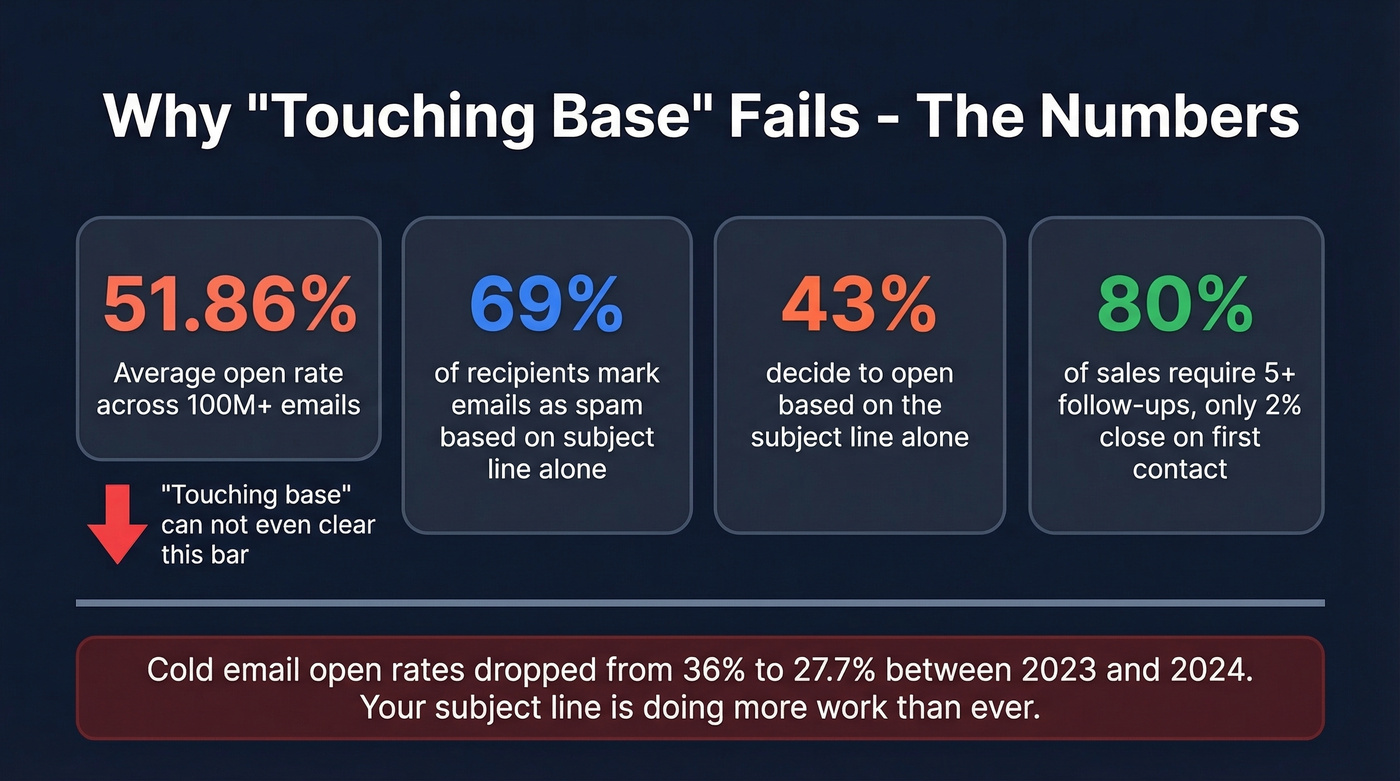
It gets worse. Open rates for cold email dropped from 36% to 27.7% between 2023 and 2024 according to Instantly's analysis, and filters keep tightening. 43% of recipients decide whether to open based on the subject line alone, and 69% will mark you as spam based on nothing but those few words. Meanwhile, 80% of sales require five or more follow-ups, and only 2% happen on the first contact. Your follow-up subject line isn't optional - it's the majority of your outreach.
When your touch base email subject says "touching base," you're promising the recipient nothing. No value, no urgency. It's the email equivalent of a shrug.
5 Frameworks That Replace "Touching Base"
Each framework gives the recipient a specific reason to open - and the data backs every one.
1. The Specific Ask
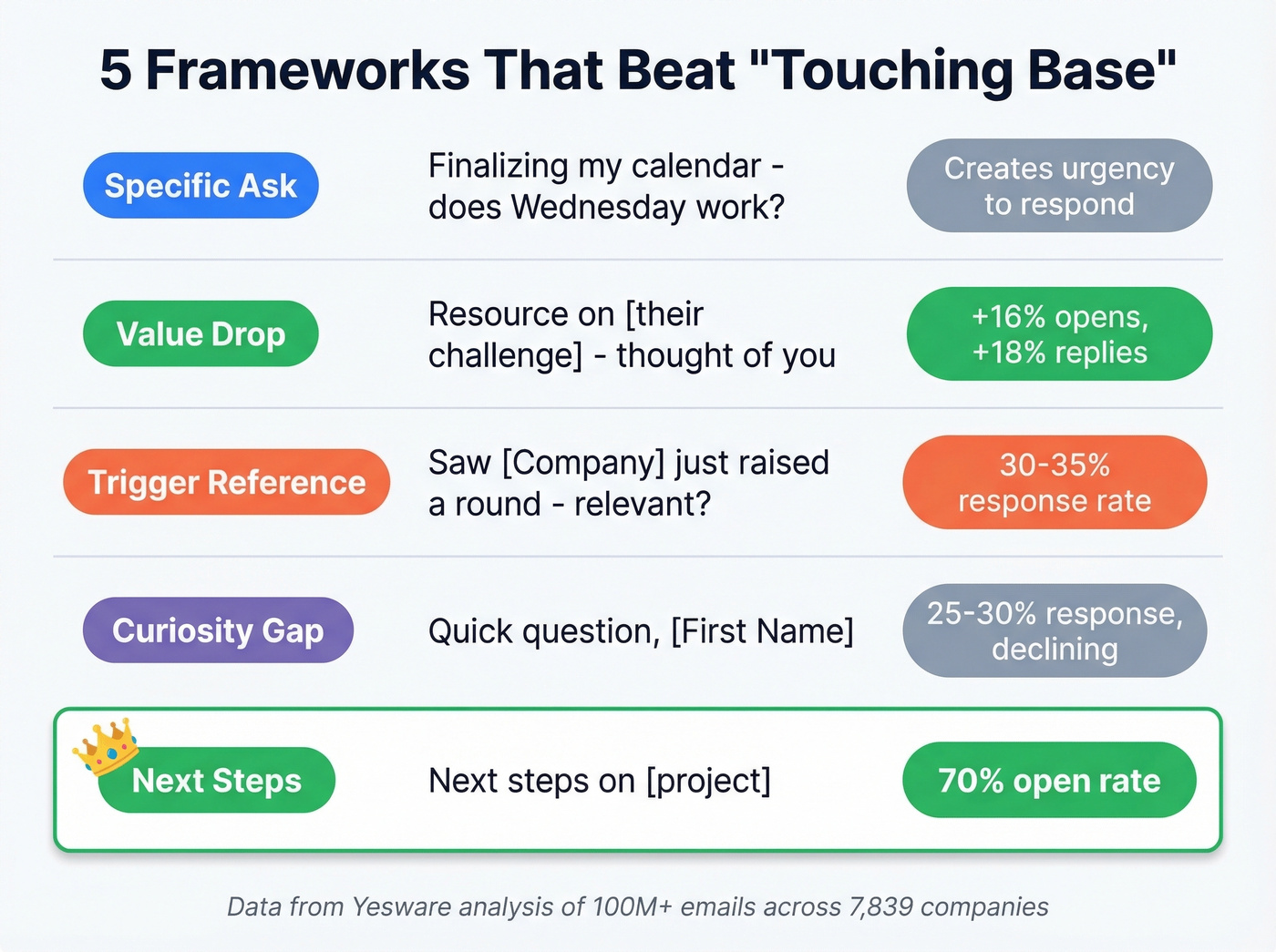
"Finalizing my calendar - does Wednesday work?"
This works because it implies a decision is happening with or without the recipient. A practitioner on r/sales uses this framing: give them a concrete logistical question, and it creates a gentle pull to respond before the window closes. No one ignores a scheduling question the way they ignore "just checking in."
2. The Value Drop
Subject lines containing "Follow-up" (hyphenated) see 16% more opens and 18% more replies. The principle: lead with something useful - a resource, a benchmark, an insight - instead of a request. We've seen this framework turn cold re-engagement threads into actual conversations, especially when the resource is genuinely relevant and not a thinly disguised pitch deck.
Example: "Resource on [their challenge] - thought of you"
3. The Trigger Reference
Referencing something specific the prospect recently did - a post, a podcast appearance, a funding round - proves you actually paid attention. Practitioners on r/b2bmarketing report 30-35% response rates with this approach, and in our experience that tracks. It's the highest-performing framework on this list when done well.
The catch? It requires real research per prospect. You can't fake specificity.
Example: "Congrats on the new role, [Name]" or "Saw [Company] just raised a round - relevant?"
4. The Curiosity Gap
"Quick question, [First Name]" can pull roughly 25-30% response rates. But practitioners on r/coldemail flagged it as declining in effectiveness through 2025 and into 2026. Use it sparingly, and make sure the question is genuine - not a disguised pitch.
A related pattern: "[Their Company] and [Your Company]" can hit 20-25% response rates. It works because it implies a mutual connection worth exploring.
5. The Next Steps
This is the single best replacement for a generic follow-up subject. "Next steps" in a subject line can hit a roughly 70% open rate with reply rates 20% above average. It implies momentum - a shared agenda already in motion.
Here's the thing: we've seen it work even when the prior conversation was lukewarm. The phrase "next steps" carries an assumption of forward motion that recipients feel compelled to either confirm or correct. Either way, they open.
Example: "Next steps on [project]" or "Next steps from our Tuesday call"

Trigger-based subject lines outperform everything else on this list - but they require knowing when prospects change jobs, raise funding, or hit growth milestones. Prospeo tracks all of these across 300M+ profiles with 30+ filters, refreshed every 7 days. Build a list of prospects with fresh trigger events, get their verified emails at 98% accuracy, and write subject lines that reference something real.
Stop faking specificity. Get real trigger data for every prospect.
20 Subject Lines by Scenario
Post-meeting follow-up
| Subject Line | Framework |
|---|---|
| Next steps from Tuesday's call | Next Steps |
| One thing I forgot to mention | Curiosity Gap |
| The [resource] I promised you | Value Drop |
| [Their company] + [your company] action items | Specific Ask |
| Quick question from our chat, [Name] | Curiosity Gap |
Cold prospect re-engagement
| Subject Line | Framework |
|---|---|
| Quick question, [First Name] | Curiosity Gap |
| [Their Company] and [Your Company] | Curiosity Gap |
| Saw your post on [topic] | Trigger Reference |
| Resource on [their challenge] | Value Drop |
| Saw [Company] just raised a round - relevant? | Trigger Reference |
Client check-in
| Subject Line | Framework |
|---|---|
| Next steps on [project name] | Next Steps |
| [Deliverable] update - need your input | Specific Ask |
| Scheduling the [next milestone] | Specific Ask |
| Quick win I spotted for [their company] | Value Drop |
| Finalizing the timeline - does [date] work? | Specific Ask |
Post-demo / proposal
| Subject Line | Framework |
|---|---|
| Next steps on the proposal | Next Steps |
| One question before I finalize pricing | Specific Ask |
| The ROI numbers you asked about | Value Drop |
| [Their company] implementation timeline | Next Steps |
| Congrats on the new role, [Name] | Trigger Reference |
4 Rules for Every Follow-Up Subject
Keep it under 33 characters. Mobile inboxes truncate aggressively. If your key message gets cut off, it might as well not exist.
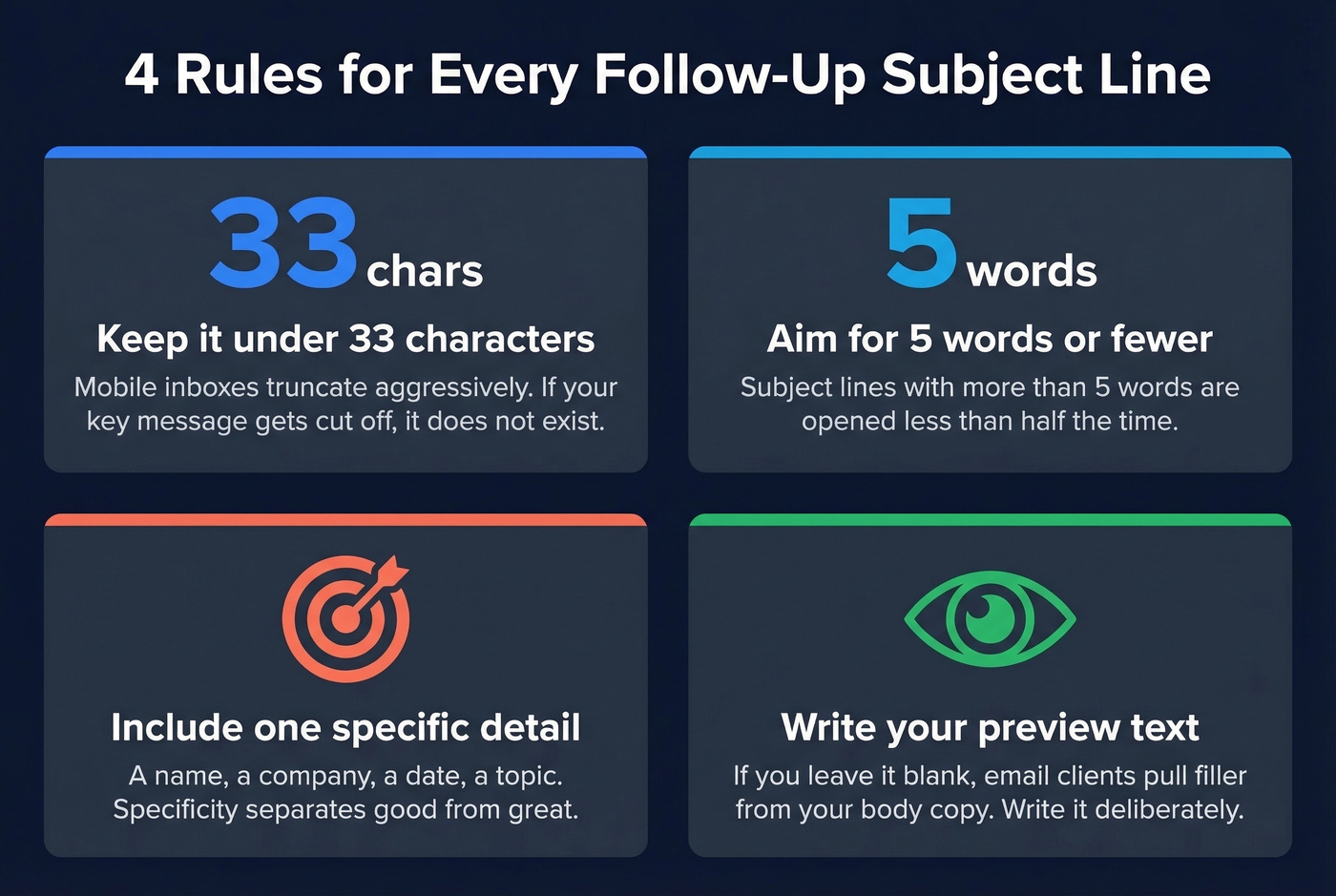
Aim for 5 words or fewer. Subject lines with more than five words are opened less than half the time. Every word needs to earn its spot.
Include one specific detail. A name, a company, a date, a topic. Specificity is what separates "following up" from "following up on Thursday's pricing discussion." The second one gets opened.
Don't ignore preview text. It's the second line recipients see. If you leave it blank, email clients pull the first line of your body copy - which is often a greeting or filler. Write it deliberately.
Let's be honest: most people obsess over subject lines but send to garbage lists. A perfect subject line delivered to a dead inbox is worth exactly nothing. Fix the data first, then optimize the copy.
Why Templated Subjects Stop Working
Even a great subject line degrades over time. Email providers use fuzzy hashing and similarity fingerprinting to detect bulk-template behavior. When thousands of emails hit inboxes with identical or near-identical subject lines, filters flag them as bulk sends - regardless of content quality.
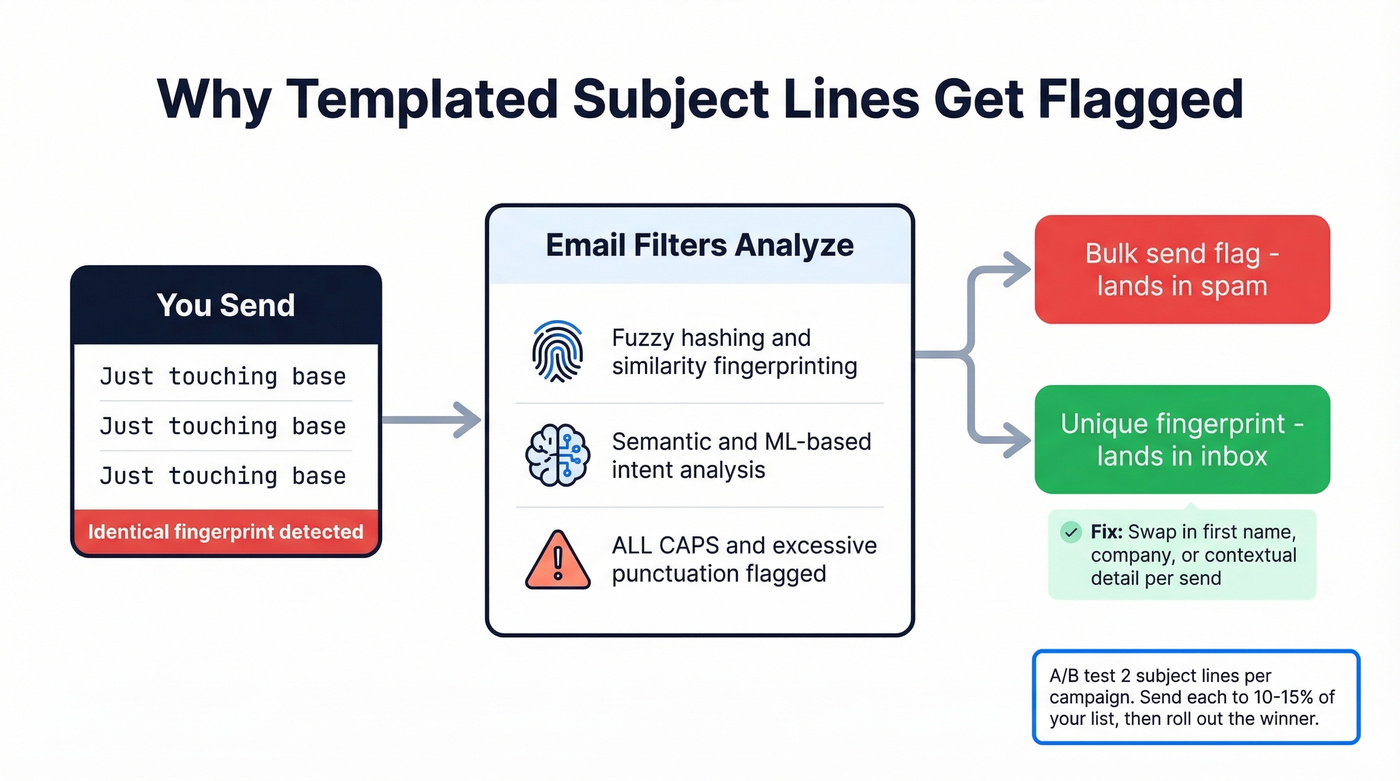
The fix is straightforward: swap in the recipient's first name, company, or a contextual detail so each send looks unique at the fingerprint level. Modern filters also run semantic and ML-based intent analysis, evaluating context, formatting, and sender reputation together. ALL CAPS and excessive punctuation are stronger negative signals than any individual "spam trigger word."
Test two subject lines per campaign. Most email platforms support A/B testing - send each variant to 10-15% of your list, then roll out the winner.
But deliverability isn't just about what you write - it's about where you send it. Your subject line is irrelevant if the email bounces. Prospeo's real-time verification catches dead addresses before you hit send, with 98% email accuracy on a 7-day data refresh cycle. The free tier covers 75 email verifications per month, enough to clean your next campaign list before launch.
You just read that 69% of recipients mark emails as spam based on the subject line alone - but bad data is the silent killer underneath. Every bounced email tanks your sender reputation, making even your best subject lines land in spam. Prospeo's 5-step verification and 7-day refresh cycle keep your bounce rate under control at roughly $0.01 per email. The free tier gives you 75 verifications per month.
Fix the data first. Your subject lines will thank you.
FAQ
What should I write instead of "touching base"?
Use "Next steps on [topic]" - it hits a 70% open rate across 100M+ emails studied. It implies momentum and a shared agenda, two things a vague touch base email subject completely lacks.
What's the best follow-up subject line for sales?
"Next steps on [project]" paired with a specific meeting date or deliverable outperforms every vague alternative. Combine it with verified contact data so the message actually reaches the inbox.
How many characters should a follow-up subject line be?
Under 33 characters. Subject lines with more than five words are opened less than half the time. Shorter and more specific always wins on mobile.