

Trigger Events in Marketing: A Data-Backed Guide (2026)
A Series B company raises $40M. You see the announcement on Monday. By Wednesday, three competitors have already emailed the new VP of Engineering - but your CRM still has the old CTO's personal Gmail. That's the gap trigger events in marketing are supposed to close, and it's the gap where most teams fail.
The Short Version
Triggered campaigns outperform batch sends by ~3.3x on clicks and ~13x on conversions - the data across 183,000+ brands is unambiguous. But the trigger itself is just step one. Verified contact data and a 24-48 hour response window are steps two and three. You don't need a $5K/mo signal platform to make this work. Google Alerts, a solid enrichment tool, and a response SLA will get you 80% of the way.
What Are Trigger Events?
Trigger events are discrete, observable occurrences - a funding round, a cart abandonment, a leadership change, a pricing page visit - that create a window of opportunity for a marketing or sales action. They're not the same as intent signals, which are behavioral patterns (content consumption, keyword searches) that suggest buying interest over time. Triggers create urgency. Signals confirm momentum. The best teams use both, but triggers are where the immediate action happens.
Some guides lump in "emotional triggers" - fear, FOMO, urgency - as a category here. Those are messaging tactics, not trigger events. A trigger is something that happens. An emotional frame is how you respond to it. Conflating the two muddies your playbook.
Types of Trigger Events Worth Tracking
Event-Based Triggers (B2B)
These are external business events: funding rounds, leadership changes, tech stack adoption, geographic expansion, regulatory shifts. They're powerful because they disrupt the status quo. A new CTO doesn't keep the old CTO's vendor stack - they evaluate.
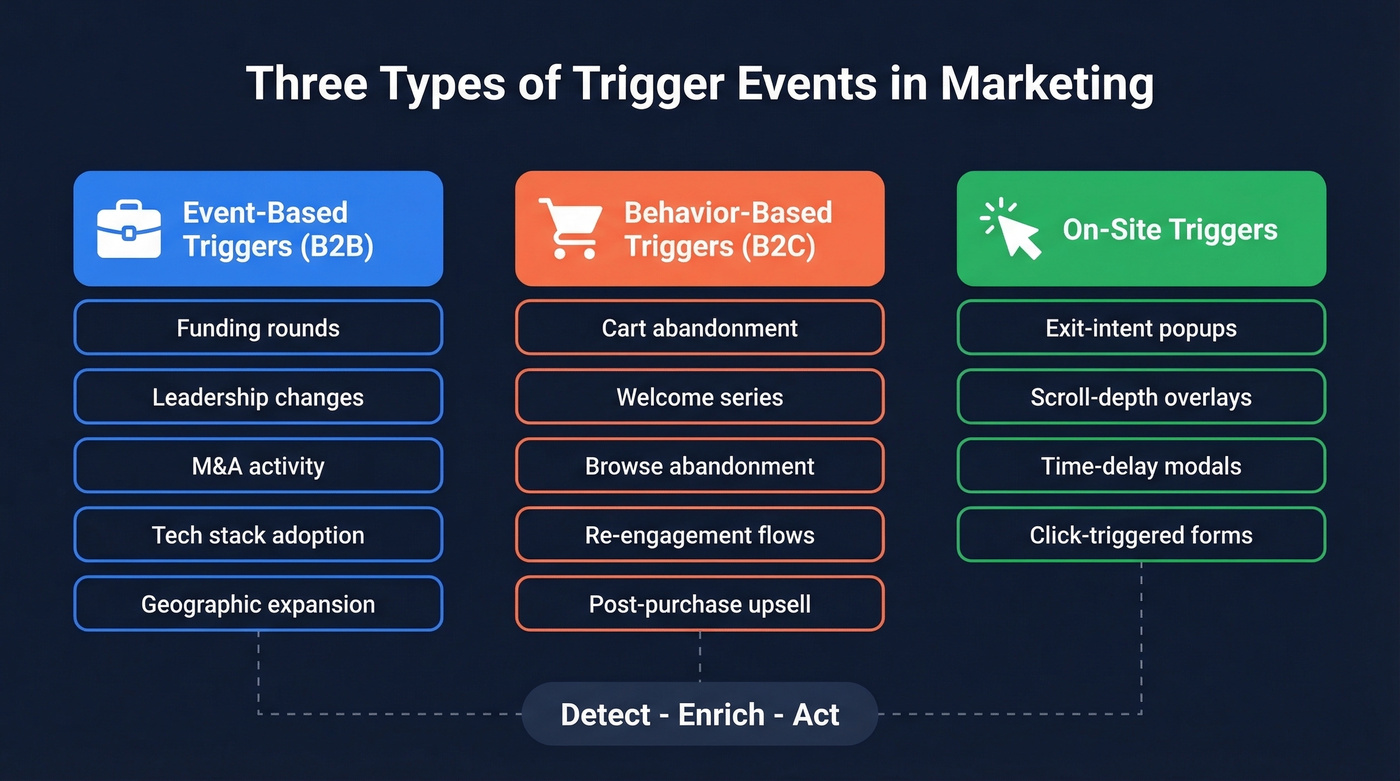
One SaaS company tracked CEOs publicly discussing "innovation" and found those accounts had 400% higher buying probability versus accounts without that trigger. Funding announcements, M&A activity, and new job postings all fall into this category, and in our experience, funding rounds are the single most reliable B2B trigger because they create budget and urgency simultaneously.
Behavior-Based Triggers (B2C Lifecycle)
Cart abandonment is the obvious one, but the category runs deeper: welcome series after signup, browse abandonment when someone views a product page without buying, re-engagement flows for lapsed customers, and post-purchase upsell sequences. These drive the majority of automated email revenue for ecommerce brands, and they're where the biggest benchmarked performance gaps show up.
On-Site Triggers
Popups, overlays, and embedded forms that fire based on visitor behavior. The conversion rates vary dramatically by mechanism:
| Trigger Type | Avg. Conversion Rate |
|---|---|
| Click-triggered | 4.1% |
| Exit-intent | 3.8% |
| Time-delay (5-10s) | 2.9% |
| Scroll-depth (50%) | 2.4% |
| Cart abandoner targeting | 6.5% |
Data from 14.7M impressions across 214 sites, discussed on r/Emailmarketing
Cart abandoner targeting at 6.5% is roughly three times the rate of generic "all visitors" popups at 2.1%. The trigger's specificity is driving that gap.

Trigger events are only valuable if you can reach the right person before the window closes. Prospeo's 300M+ profiles refresh every 7 days - not 6 weeks - so the VP who just got hired is already in your search results with a 98% accurate email.
Stop losing deals to stale data. Act on triggers the same day.
Triggered vs. Batch: The Real Numbers
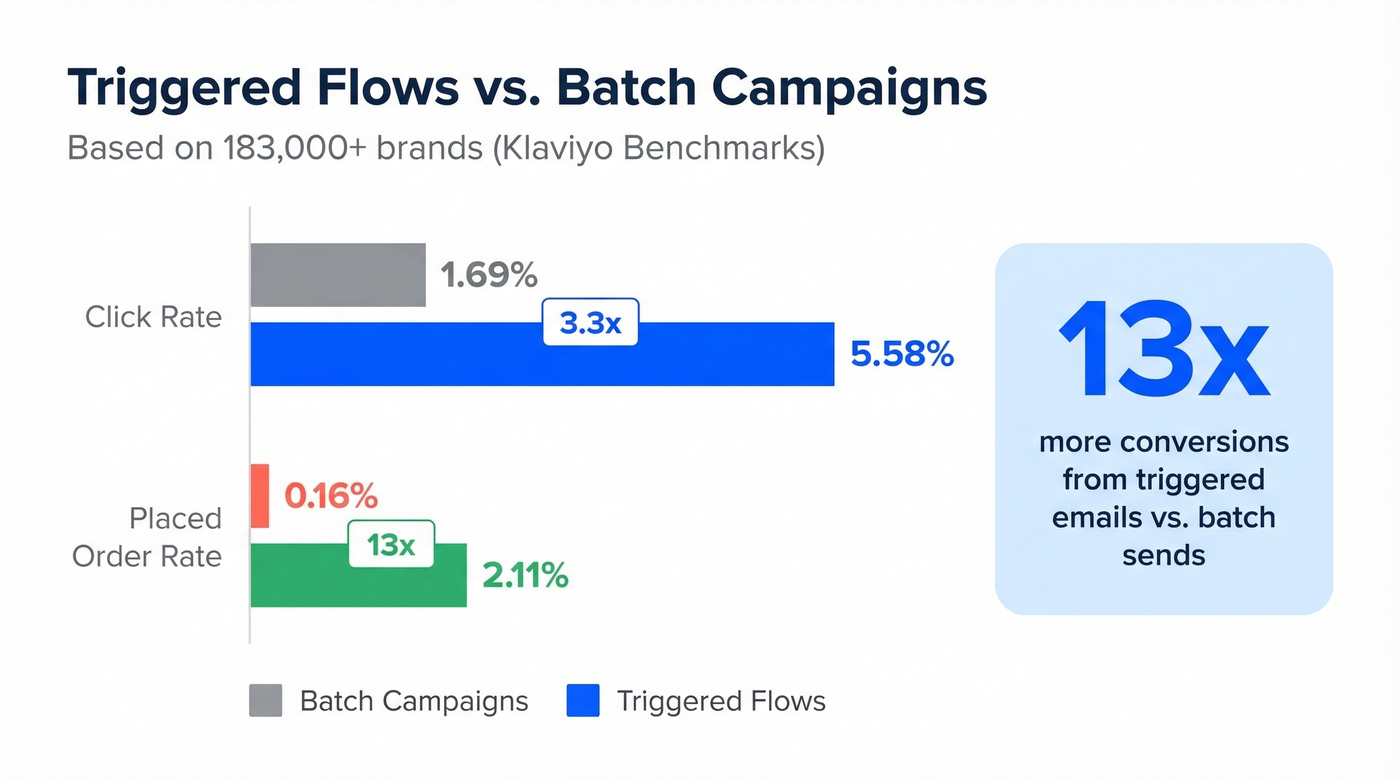
Klaviyo analyzed 183,000+ brands for its latest benchmarks. The gap between batch campaigns and triggered flows is stark:
| Metric | Batch Campaigns | Triggered Flows | Difference |
|---|---|---|---|
| Click rate | 1.69% | 5.58% | 3.3x |
| Placed order rate | 0.16% | 2.11% | 13x |
| Top 10% flow click rate | - | 10.48% | - |
That 13x difference in placed order rate isn't a rounding error. It's the difference between sending a generic newsletter and sending a message that arrives at the exact moment someone's ready to act.
You'll see the stat that "trigger-based emails are 497% more effective" repeated everywhere. It comes from a Blueshift study of 14.9B messages, and it's directionally true - but the study doesn't disclose volume breakdowns. Triggered messages are inherently lower-volume and higher-intent, which inflates the comparison. The Klaviyo data is more honest because it separates the metrics cleanly. L'Oreal saw 3x higher conversion rates after deploying AI-driven product recommendations, and Farfetch reported 31% higher open rates and up to 38% better CTR on triggered emails through Phrasee. The pattern holds across industries.
Here's the thing: if your average deal size is under $10K, you probably don't need a $3K/mo signal platform. Google Alerts, a CRM with basic automation, and a reliable enrichment tool will outperform an expensive platform your team barely logs into.
Trigger Marketing Examples Across the Funnel
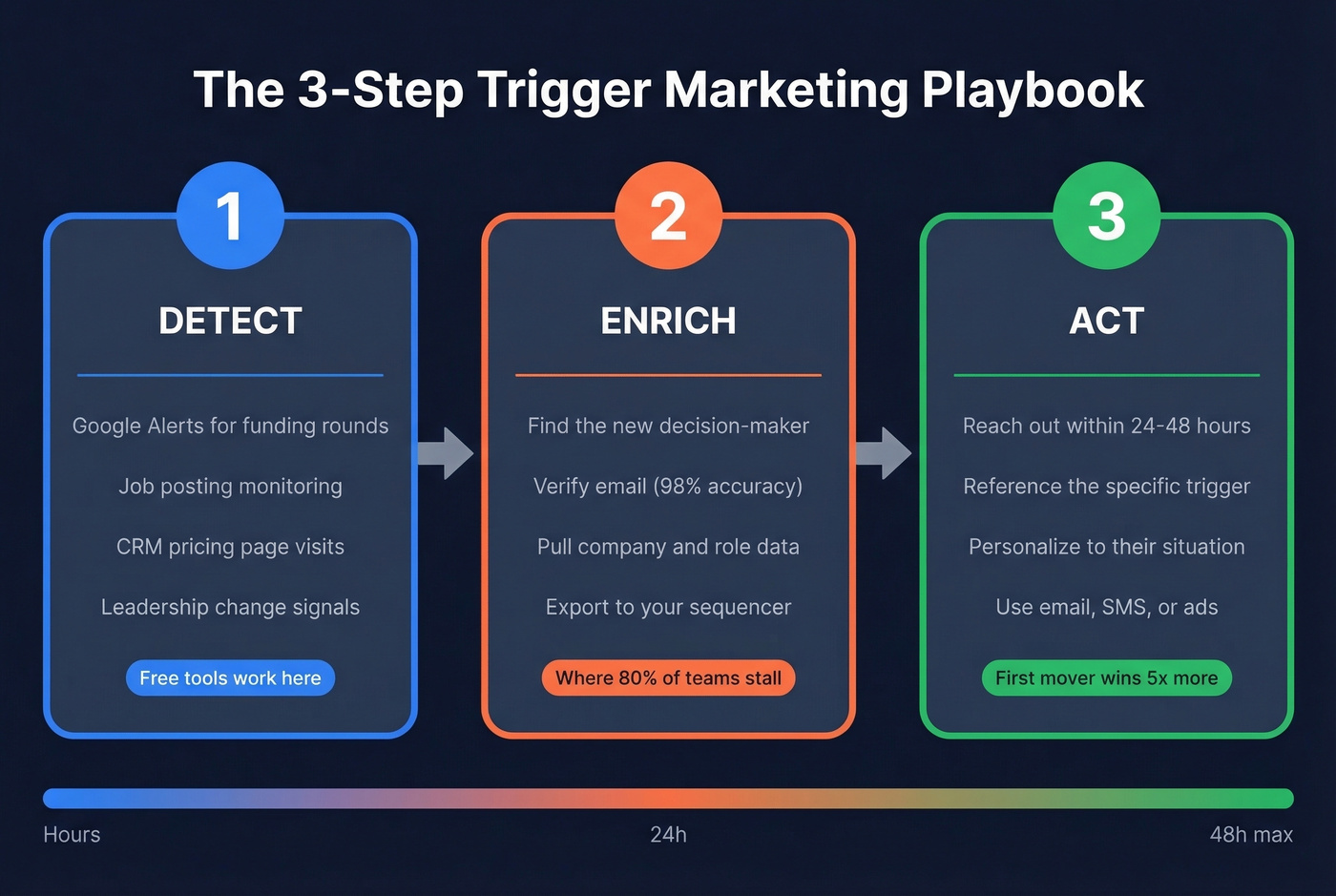
Most guides stop at "set up a welcome email." That's table stakes. The real workflow for B2B trigger events has three steps, and the enrichment step is where we've seen 80% of teams stall.
Step 1: Detect
Set up Google Alerts for funding announcements, leadership changes, and expansion signals at target accounts. Monitor job postings - one practitioner on r/MarketingAutomation called job posting triggers "sneaky good," running alerts into a Google Sheet and enriching from there. CRM signals like pricing page visits and demo requests add another layer. Free tools get you surprisingly far. These marketing sales triggers - from hiring surges to tech stack changes - are the raw material your outbound team needs.
Step 2: Enrich
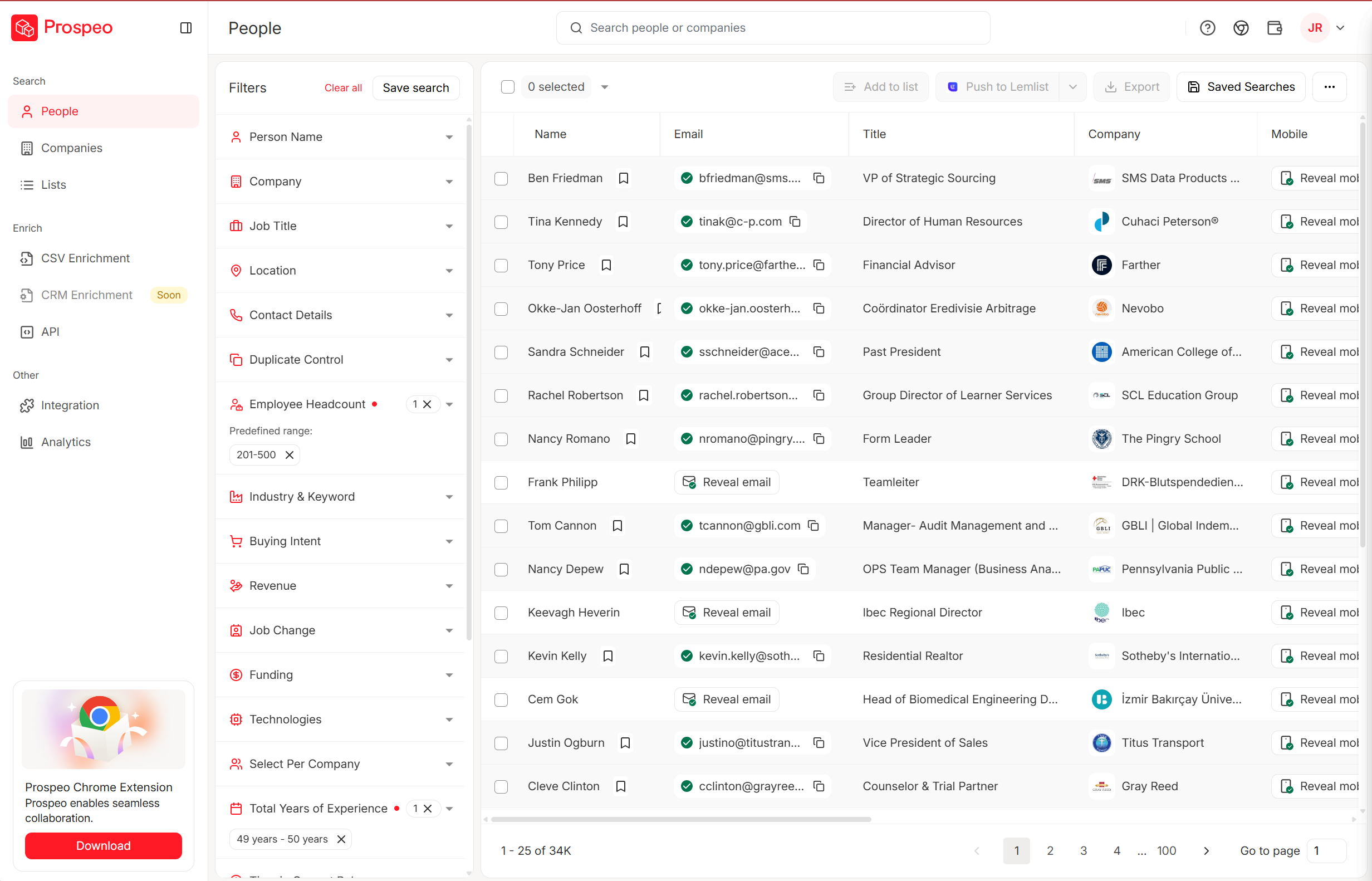
A trigger is useless if you can't reach the right person. When a company announces a new VP of Marketing, you need that person's verified email within hours, not weeks. Prospeo covers 300M+ professional profiles and 143M+ verified emails on a 7-day refresh cycle with 98% accuracy - search by company, role, and 30+ filters, then export verified contacts directly to your sequencer. At roughly $0.01/email, it's a fraction of what enterprise signal platforms charge.
Step 3: Act
Contact the prospect within 24-48 hours referencing the specific trigger. The first seller to reach out after a trigger event is 5x more likely to win the deal. New executives evaluate vendors within their first 90 days - that window closes fast. A personalized email that says "Congrats on the Series C - here's how we help teams scaling from 50 to 200 reps" beats a generic pitch every time.
Triggers don't have to route to email, either. SMS, retargeting ads, and Slack alerts to sales reps are all valid response channels. Pick the one that matches the trigger's urgency.
Three Mistakes That Kill Trigger Campaigns
Stale data. The industry average data refresh cycle is six weeks. If your enrichment tool runs on that cadence, the contact info you pull after a trigger fires is already decaying. We've watched teams burn through entire trigger windows because their CRM data was outdated - reaching the predecessor instead of the new hire. Look for data enrichment providers that refresh weekly, not monthly.

Over-triggering. Unsubscribe rates are climbing - MailerLite's 2025 benchmark hit 0.22%, partly driven by Gmail's one-click unsubscribe button making it frictionless to opt out. Without frequency caps and suppression rules, your beautifully timed trigger emails become noise. Set hard limits on how many triggered messages any single contact receives per week. And if you're operating in GDPR or CCPA jurisdictions, every triggered message needs a clear consent basis - not just a suppression rule.
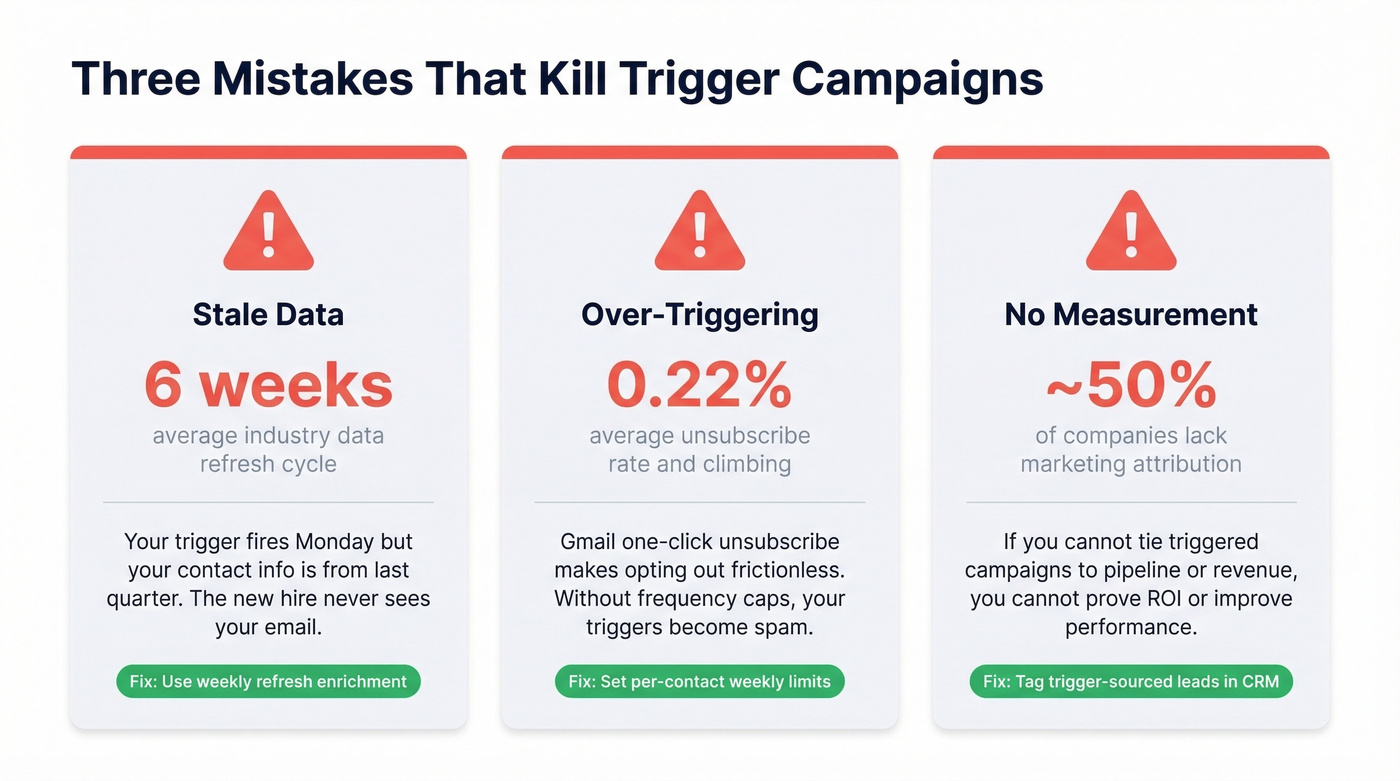
No measurement. Only around half of companies use marketing attribution tools. If you can't tie a triggered campaign back to pipeline or revenue, you can't prove it works and you can't improve it. Tag every trigger-sourced lead in your CRM from day one. Skip this step and even the best trigger campaign examples in your swipe file are worthless - you'll never know what actually produced results.
Step 2 is where most trigger campaigns die: you spot the funding round, but your data provider returns a bounced email. Prospeo's proprietary verification and 143M+ verified emails at ~$0.01 each mean you enrich and reach decision-makers in hours, not weeks.
Turn every trigger event into a sent email that actually lands.
FAQ
What's the difference between trigger events and intent signals?
Trigger events are discrete occurrences - a funding round, a job change, a product launch - that open a specific outreach window. Intent signals are behavioral patterns like content consumption or keyword searches suggesting buying interest over time. The best outbound teams layer both: triggers for timing, intent data for prioritization.
Do I need expensive software to run trigger campaigns?
No. Google Alerts and job posting monitoring are free, and 76% of businesses already use some form of marketing automation. Pair free detection with an enrichment tool at ~$0.01/email and a CRM like HubSpot or Brevo for automation. Enterprise signal platforms at $1,000-5,000+/mo add scale but aren't prerequisites.
How fast should I act on a trigger event?
Within 24-48 hours. The first seller to contact a prospect after a trigger event is 5x more likely to win the deal. New executives evaluate vendors within their first 90 days - waiting even a week often means a competitor already has the meeting booked.