

The Trusted Advisor Equation: How to Score Yourself and Why the Denominator Is the Entire Game
You nailed the presentation. The slides were tight, the case studies were relevant, you answered every question with precision. And you still lost the deal.
You didn't lose on competence - you lost on trust. The trusted advisor equation, introduced by David Maister, Charles H. Green, and Robert Galford in The Trusted Advisor back in 2000, explains exactly why this happens. The framework has only gotten sharper since - over 70,000 professionals have taken the Trust Quotient assessment based on their equation. It still shows up in r/sales threads asking which methodologies "stand the test of time," and for good reason. Every other article tells you to "increase credibility" and "reduce self-orientation" without telling you what that actually looks like on a Tuesday morning. This one does.
The Formula at a Glance
The Trust Equation:
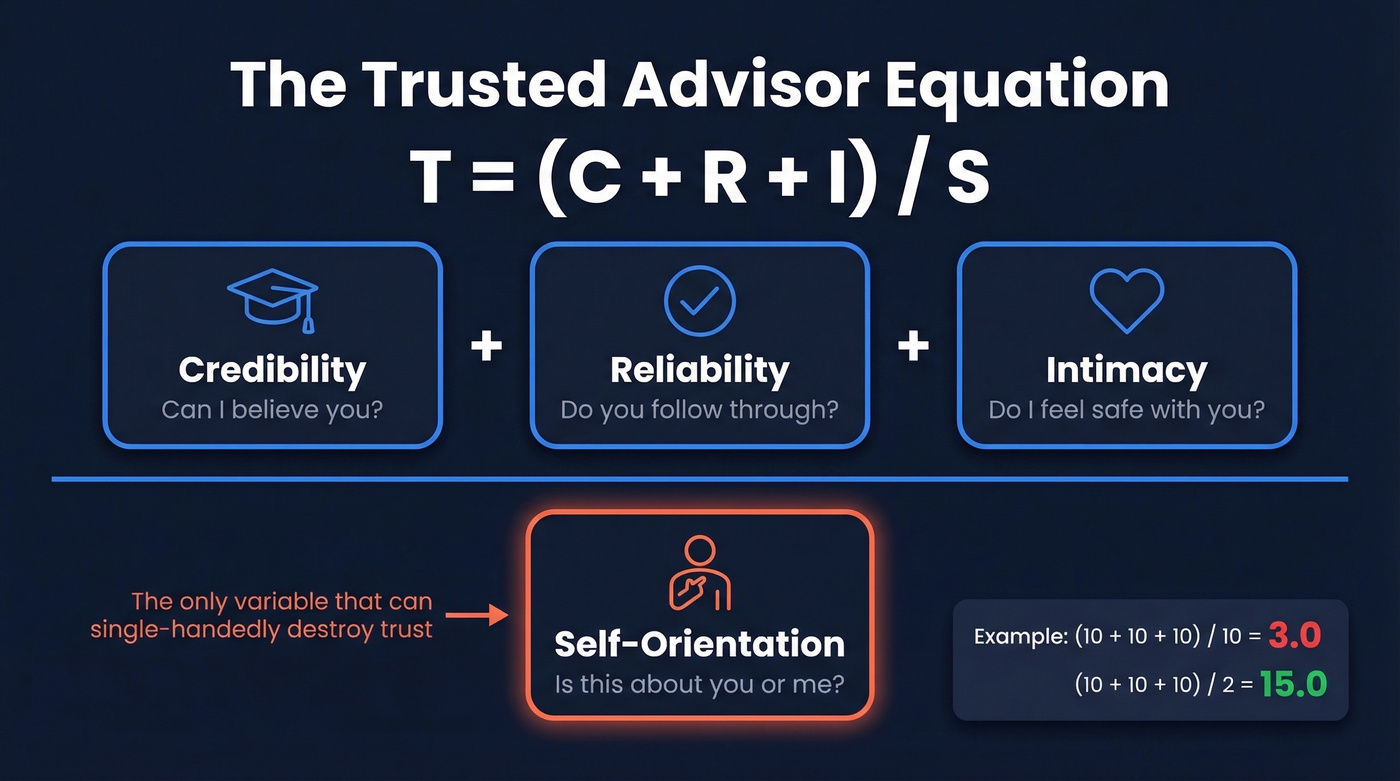
T = (C + R + I) / S
Credibility + Reliability + Intimacy, divided by Self-Orientation.
The single most important takeaway: Self-orientation sits alone in the denominator. It's the only variable that can single-handedly destroy trust - no matter how strong your numerator is. A score of 10 in credibility, reliability, and intimacy still produces a trustworthiness score of only 3 if your self-orientation is 10.
Your one action today: Score yourself on all four variables using the rubric in Section 6 below. Be honest about the denominator.
The Four Variables Explained
The Trust Equation breaks trustworthiness into four components. Three live in the numerator. One lives alone in the denominator, and it's the one that matters most.
Credibility - "Can I Believe You?"
Credibility is about the words you speak. When it's high, people trust your expertise, your data, your recommendations. You speak with authority on your subject and you don't overreach into areas where you're guessing. When it's low, people fact-check you in real time. They cc their colleague on the email. Here's the subtle tell: they stop asking follow-up questions, because they've already decided your answers aren't worth pursuing.
Reliability - "Do You Follow Through?"
Reliability is about actions, not words. Do you deliver when you say you will? This is the most straightforward variable - and the one 53% of professionals identify as their top strength. When reliability is high, people stop worrying about you. They don't follow up on deadlines because they know you'll hit them. When it's low, they build buffer time into every project you touch and quietly stop giving you the important stuff.
Intimacy - "Do I Feel Safe With You?"
Picture this: your client knows the project is off track, but in your status meeting, they say "everything's fine." That's an intimacy failure. They don't feel safe enough to tell you the truth.
As the authors note, people rarely trust institutions - they trust other people. Intimacy and self-orientation are the exclusively human variables in this equation. When intimacy is high, people share what's actually going on: the internal politics, the budget constraints, the fear that this project might fail. When it's low, you get polished answers and surface-level conversations. You never learn what's really driving the decision.
Self-Orientation - "Is This About You or Me?"
Do the math before reading the definition. If your credibility, reliability, and intimacy each score 7, your numerator is 21. With a self-orientation of 3, your trust score is 7.0. Bump self-orientation to 7 and it drops to 3.0. Same person, same skills, same warmth - half the trust.
Self-orientation measures your focus: are you paying attention to the other person, or thinking about how you're being perceived? This variable sits alone in the denominator because it's the most powerful. High self-orientation doesn't just reduce trust - it divides everything else you've built.
The S Trap - Why Smart People Fail
The obvious version of self-orientation is rare. Most professionals aren't walking into meetings thinking "how do I extract maximum value from this person." The subtle version is everywhere.
Charles Green tracked his own behavior after proposals for a month. He counted 10 episodes of post-proposal anxiety - that gnawing "why haven't they called back?" feeling. In 9 out of 10 cases, the prospect was just busy. The anxiety wasn't about the client. It was about him.
The subtle behaviors that signal high S don't look selfish. Wanting to be the one who solves the problem. Competing for recognition in a meeting. Needing to be right more than needing to be helpful. Even wanting to be liked - that's self-orientation wearing a friendly mask. Green's heuristic is blunt: "Get Off Your S."
We've seen this pattern destroy deals that should've been easy wins. The rep who keeps steering the conversation back to their product's features instead of sitting with the buyer's problem. The consultant who answers a question the client didn't ask, because the answer makes them look smart. The attention is pointed inward, and the other person can feel it every time.
What 70,000 Trust Assessments Reveal
The Trust Quotient assessment has been taken by over 70,000 people. Trusted Advisor Associates describes its 2010 study of 12,000+ respondents as the largest ever on the subject of trustworthiness.
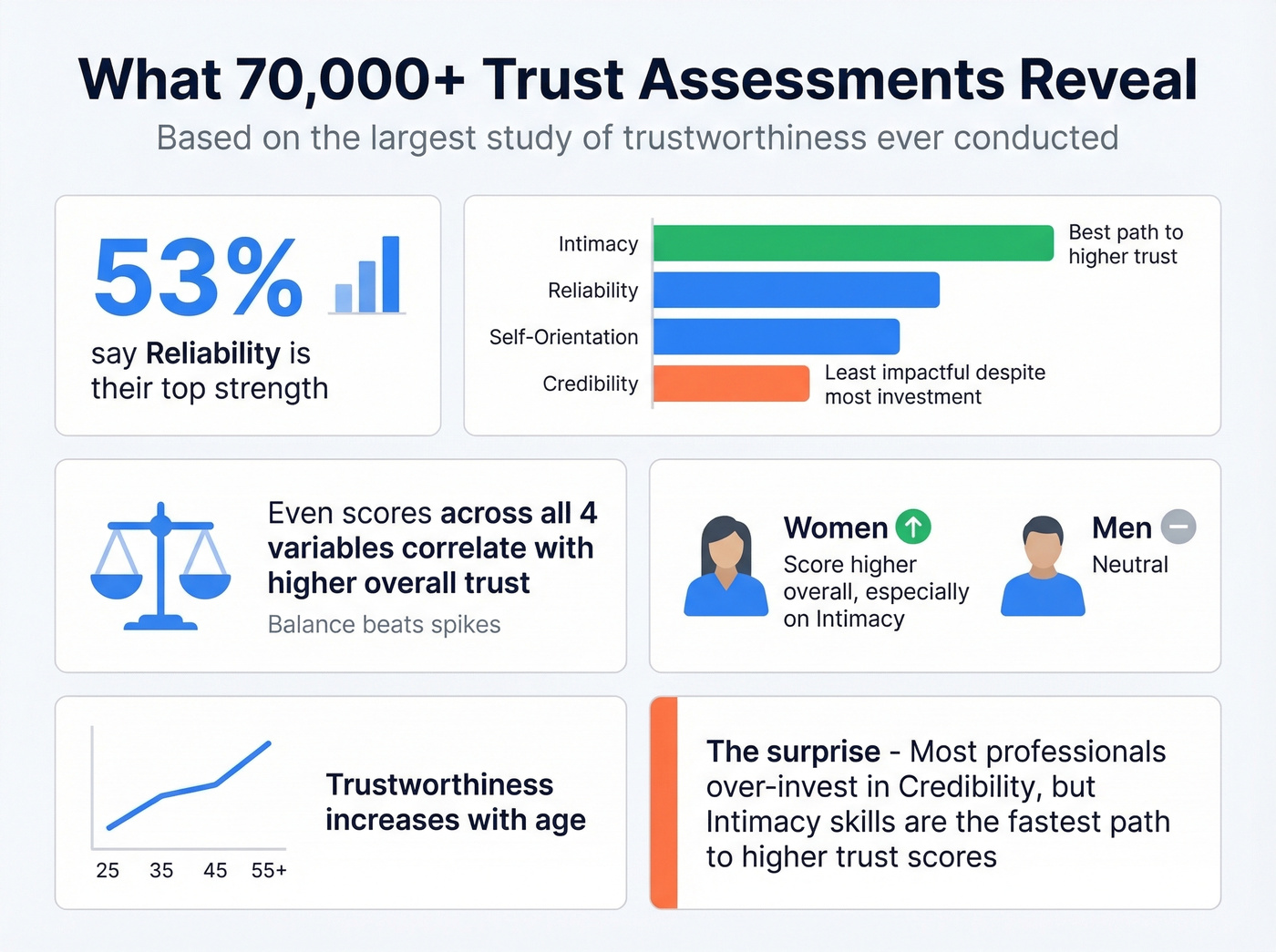
| Finding | Detail | |---|---|---| | Most common strength | Reliability (53%) | | Least impactful for building trust | Credibility (despite being the most invested-in) | | Best path forward | Intimacy skills | | Gender gap | Women score higher, especially on intimacy | | Age effect | Trustworthiness increases with age | | Consistency bonus | Even scores across all four variables correlate with higher TQ |
The credibility finding surprises people. Most professionals - especially in consulting, sales, and technical roles - over-invest in credibility. More certifications, more case studies, more proof points. But credibility is the least helpful factor in building trust. Intimacy skills, meanwhile, can be quickly taught, yet organizations do almost nothing to develop them. Trust scores don't vary much by industry, though high-interaction fields like healthcare, retail banking, and consulting score slightly higher.

High self-orientation kills deals. So does bad data. When your emails bounce 35%, you're not a trusted advisor - you're noise. Prospeo's 98% email accuracy and 7-day data refresh mean every outreach lands with the right person, so you can focus on intimacy and credibility instead of cleaning lists.
Stop losing trust before the conversation even starts.
How to Score Yourself
Rate yourself 1-10 on each variable, then do the math.
| Score | Credibility | Reliability | Intimacy | Self-Orientation |
|---|---|---|---|---|
| 1-3 | Often wrong or unsure | Frequently miss deadlines | People share nothing real | Focused on yourself |
| 4-6 | Solid in your domain | Usually deliver on time | Some people open up | Catch yourself refocusing |
| 7-9 | Deep, trusted expertise | Consistently dependable | People share real problems | Genuinely focused on others |
| 10 | Authority in your field | Never miss, ever | Total emotional safety | Ego completely absent |
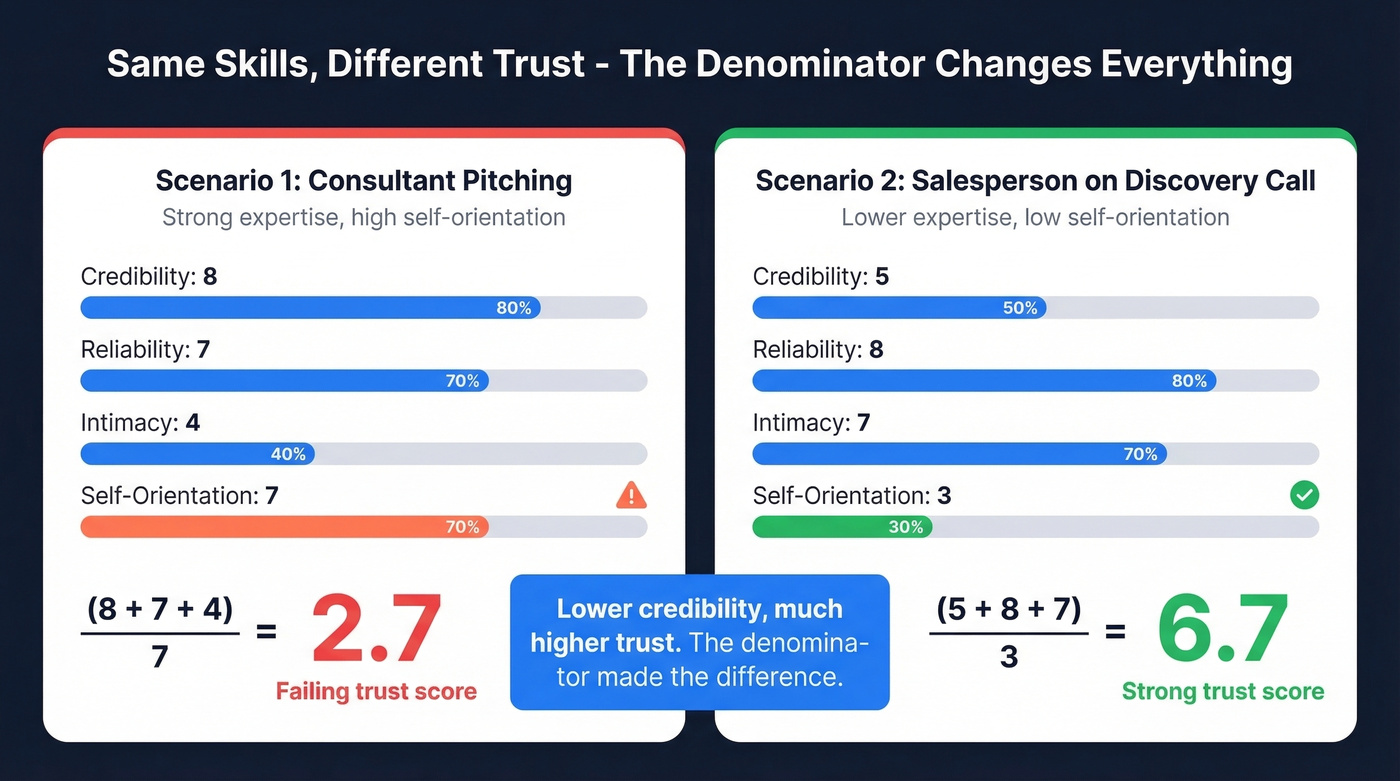
Scenario 1: Consultant pitching a new client. Strong domain knowledge (C=8), showed up prepared and on time (R=7), but it's a first meeting so intimacy is low (I=4). Spent most of the meeting talking about methodology instead of asking about their problems (S=7).
T = (8 + 7 + 4) / 7 = 2.7
That's a failing trust score despite strong credibility. The denominator ate everything.
Scenario 2: Salesperson on a discovery call. Newer to the industry (C=5), but followed up on every pre-call promise (R=8), the prospect clearly felt comfortable sharing real challenges (I=7), and spent 80% of the call listening (S=3).
T = (5 + 8 + 7) / 3 = 6.7
Lower credibility, much higher trust. The denominator made the difference. This is the journey from sales rep to trusted advisor - trading the urge to impress for the discipline to listen.
If you only improve one variable, reduce your self-orientation. The math demands it. In our experience, people consistently overrate themselves on self-orientation by 2-3 points. If you scored yourself a 3 on S, ask a trusted colleague whether they'd agree. You might not love the answer.
The numerator variables do compensate for each other, though. A project manager notorious for missing deadlines (R=4) can maintain trust if their problem-solving is exceptional (C=9) and they genuinely care about the team (I=8). But if that same PM starts prioritizing their own visibility over the project's success (S=8), no amount of credibility or intimacy saves them.
The Six Trust Temperaments
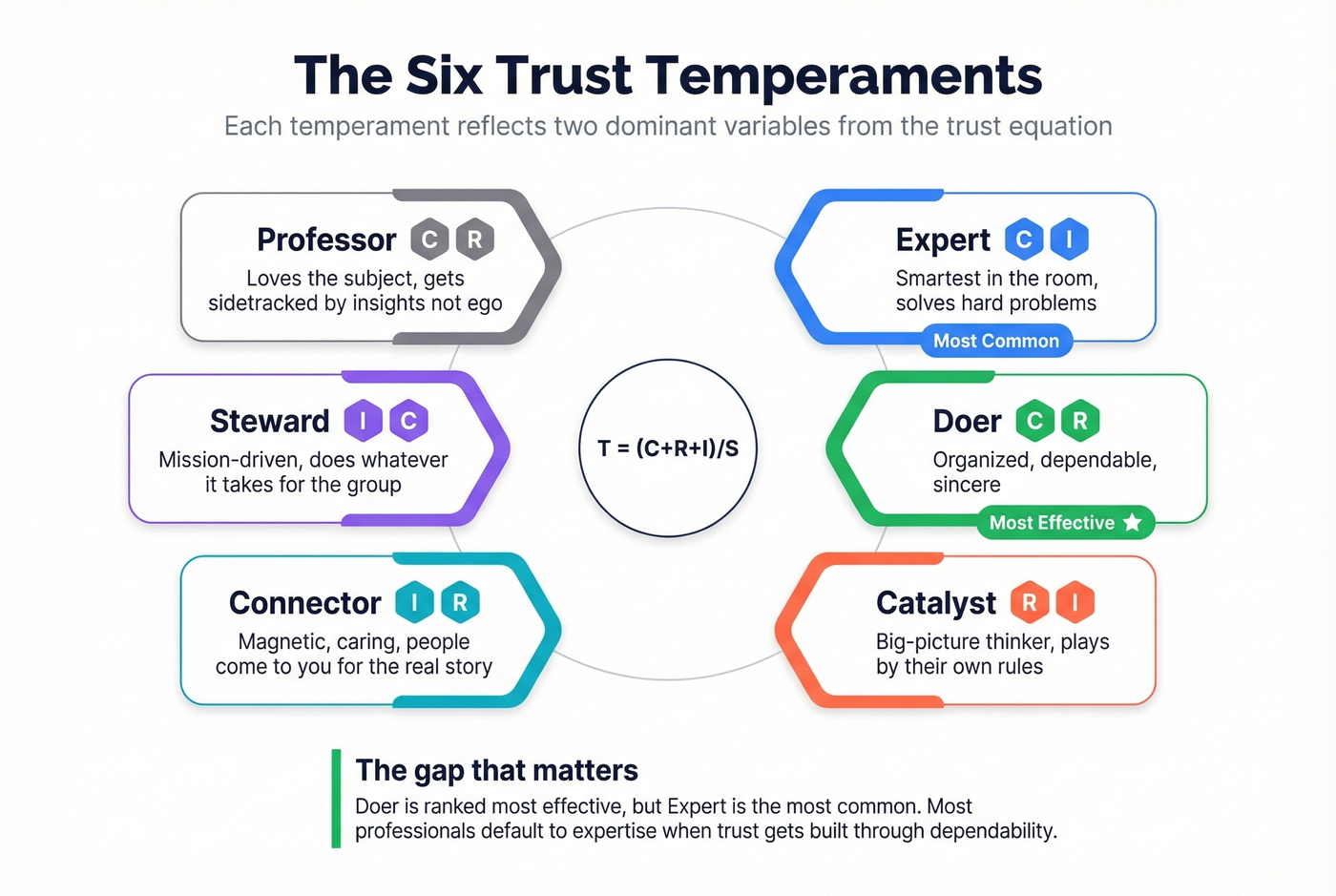
Beyond raw scores, Trusted Advisor Associates identifies six Trust Temperaments - each reflecting two dominant variables from the equation.
| Temperament | Profile | Behavioral Cue |
|---|---|---|
| Expert | Smartest in the room, solves hard problems | Cares what others think of their work |
| Doer | Organized, dependable, sincere | The PTA president or Little League coach |
| Catalyst | Big-picture thinker, loves brainstorming | Plays by their own rules |
| Connector | Magnetic, caring, accomplishes through others | People come to you for what's "really going on" |
| Steward | Mission-driven, servant leader | Does whatever it takes for the group |
| Professor | Loves the subject (maybe more than people) | Gets sidetracked by insights, not ego |
The Doer temperament is ranked most effective. The Expert is the most common. That gap tells you something important about where most professionals default versus where trust actually gets built. Which one sounds like you? Your growth edge is usually the opposite temperament's strengths.
Applying the Framework to Sales Outreach
Here's the thing: most sales teams spend 90% of their training budget on credibility - product knowledge, objection handling, competitive intel - and almost nothing on reducing self-orientation. They're optimizing the wrong variable. Trusted advisor selling means flipping that ratio, making the buyer's problem the center of every interaction instead of your solution.
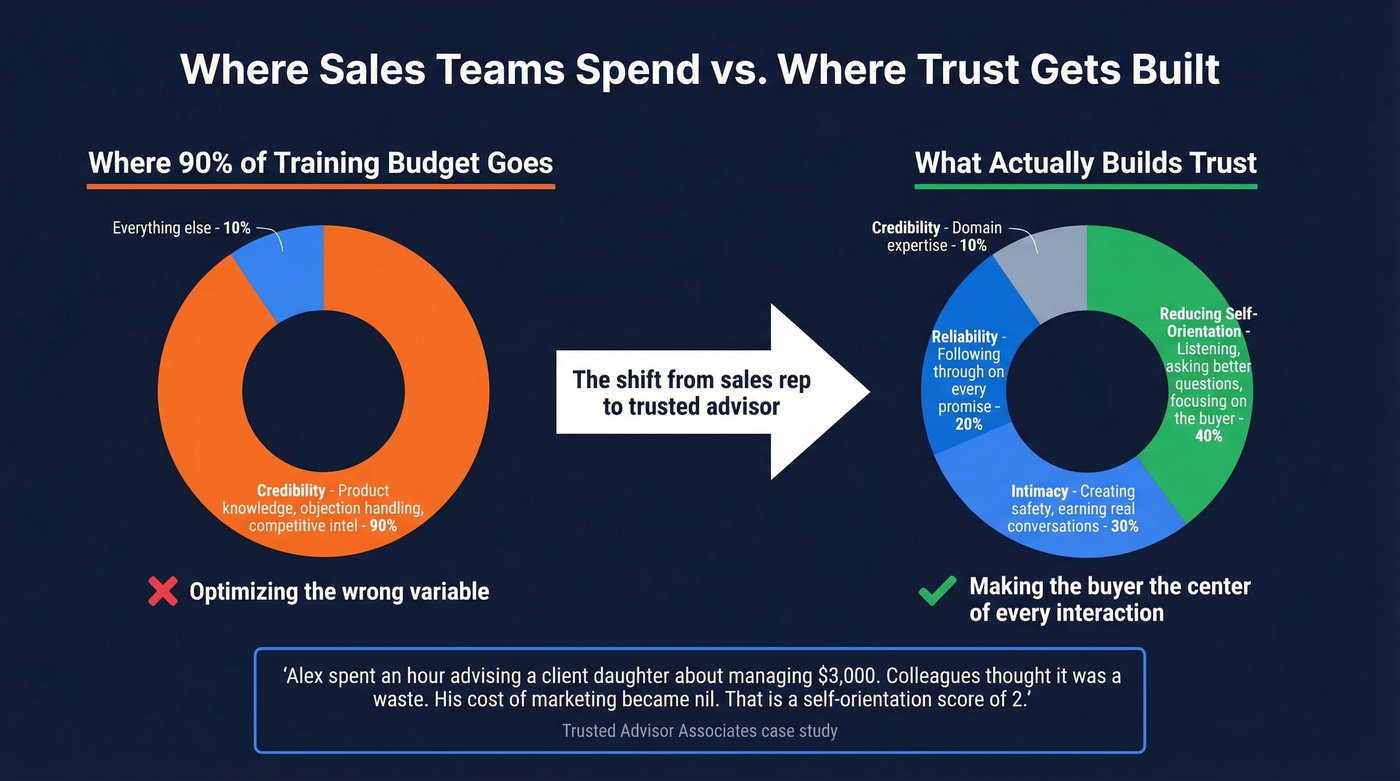
The wealth advisor case study from Trusted Advisor Associates makes this concrete. "Alex" spent an hour advising a client's 19-year-old daughter about managing $3,000. Colleagues thought it was a waste of time. Alex's response: the relationship with the family deepened, referrals followed, and "my cost of marketing is nil." That's what a self-orientation score of 2 looks like in practice - doing the uneconomic thing because it's right for the other person. When you become a trusted source in sales, the economics follow the relationship, not the other way around.
But trust doesn't start at the first meeting. It starts before the first conversation. When your cold email uses someone's old title, or bounces because the address is stale, or misspells their company name - you've already failed the credibility test. Bad data communicates carelessness, which is high self-orientation in disguise: you didn't care enough to get the basics right. Tools like Prospeo verify contact data in real time so your first touchpoint signals competence, not sloppiness. Getting someone's name, title, and email right isn't impressive. Getting it wrong is disqualifying.
The trust equation proves that showing up reliably matters more than showing off credentials. Reliability in sales starts before the first call - with verified contact data that actually connects you to decision-makers. Prospeo gives you 300M+ profiles, 125M+ verified mobiles, and 30+ filters so you reach the right buyer every time.
Advisors who reach real buyers book 35% more meetings than Apollo users.
Limitations and Modern Extensions
Let's be honest about the equation's boundaries. The book itself (page 69) describes it as "a framework... and not a scientific conclusion."
One thoughtful critique proposes a fifth element: Adaptability - the willingness to adjust your approach as client needs evolve. When buyer expectations shift mid-engagement, rigidity erodes trust even when the other three numerator variables are strong. Philosophers like Georg Simmel would argue the equals sign itself is misleading - trust is a wager on an uncertain future, not a calculable output. The equation is useful precisely because it simplifies; just don't mistake the map for the territory.
There's also the self-assessment bias problem. People rate themselves higher than others would, and self-orientation is notoriously hard to self-diagnose. Cultural considerations matter too - intimacy norms vary globally. What signals emotional safety in the US might feel intrusive in Japan or presumptuous in Germany. The equation's variables are universal, but the behaviors that move them are culturally specific.
For teams that want to go deeper, Stephen Covey's Speed of Trust, Brene Brown's BRAVING inventory, and Patrick Lencioni's Five Dysfunctions of a Team all explore trust through different lenses. The trusted advisor equation remains the most practical for one-on-one professional relationships because it gives you a number - and numbers focus attention.
FAQ
Who created the trust equation?
David Maister, Charles H. Green, and Robert Galford introduced it in their 2000 book The Trusted Advisor. Green later founded Trusted Advisor Associates and built the Trust Quotient assessment around it, now taken by over 70,000 professionals.
What is the Trust Quotient assessment?
A 20-question self-assessment that scores you on credibility, reliability, intimacy, and self-orientation, then identifies your dominant Trust Temperament. It takes about 5 minutes and produces a numerical trustworthiness score.
Can you have high trust with low credibility?
Yes - strong intimacy and reliability offset weaker credibility. The data from 12,000+ respondents shows credibility is actually the least impactful variable. A self-orientation score above 7, however, overrides everything regardless of numerator strength.
How does the trusted advisor sales process work?
It centers on reducing self-orientation and increasing intimacy - stop pitching and start listening. Make the buyer feel safe sharing real problems. It also means getting the basics right before the first conversation: verified contact data signals you've done your homework. The framework applies whether you're in enterprise consulting or running a 10-person SDR team.
What are the six Trust Temperaments?
Expert, Doer, Catalyst, Connector, Steward, and Professor - each combining two dominant variables. The Doer is ranked most effective; the Expert is most common. That gap suggests most professionals default to credibility when trust is actually built through reliability and intimacy.