

Best Twenty Alternatives in 2026 (7 CRMs Compared)
Most "Twenty alternatives" lists are auto-generated garbage - mortgage software, video platforms, and dairy market reports mixed in with actual CRMs. Twenty is an open-source CRM that scored 9/10 in Marmelab's 2026 benchmark. It deserves a real comparison.
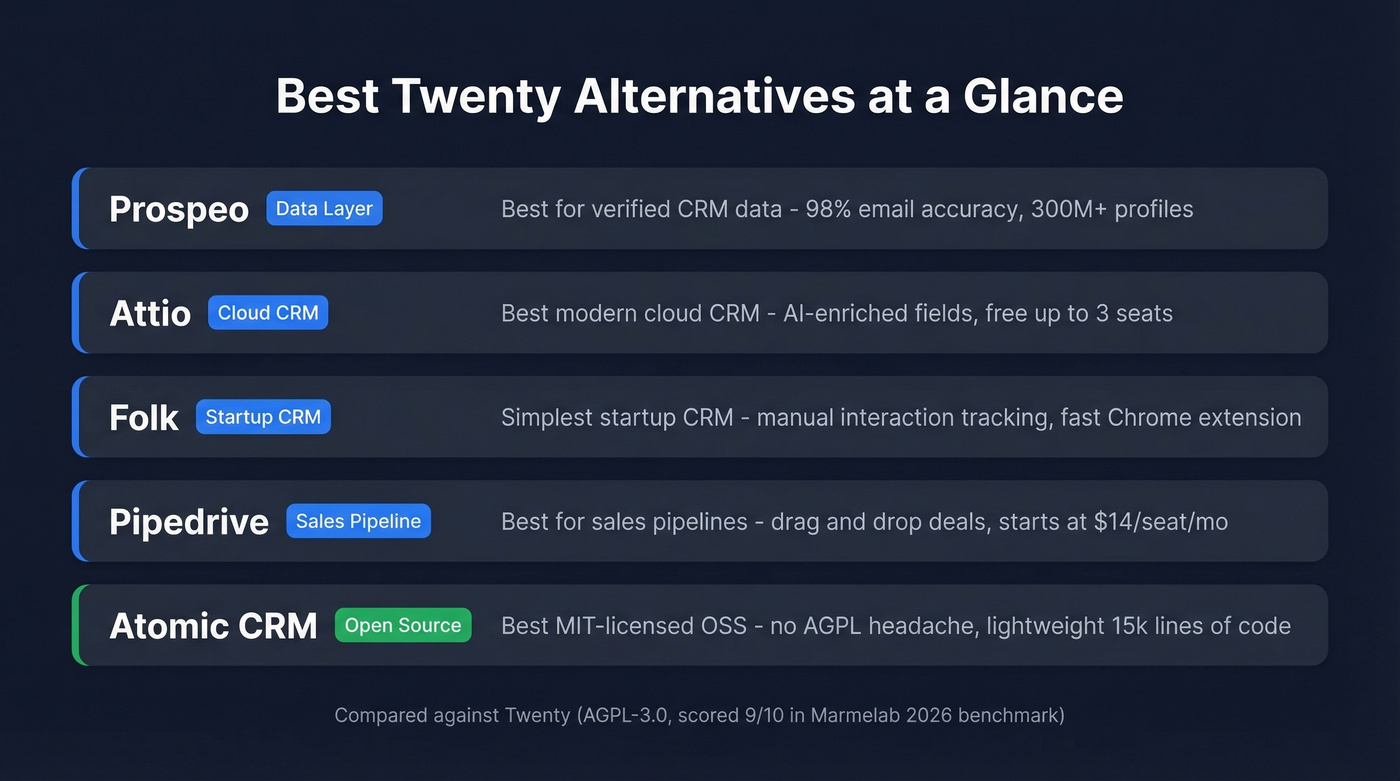
Here are seven alternatives that actually make sense, sorted by what you need.
Our Picks (TL;DR)
| Use Case | Pick |
|---|---|
| Best for verified CRM data | Prospeo |
| Best modern cloud CRM | Attio |
| Simplest startup CRM | Folk |
| Best for sales pipelines | Pipedrive |
| Best open-source (MIT) | Atomic CRM |
Why Switch From Twenty?
Twenty is genuinely impressive for an open-source CRM. One Reddit user switching from HubSpot and Salesforce put it simply: "Twenty has been AMAZING." But "amazing" doesn't mean it fits every team.
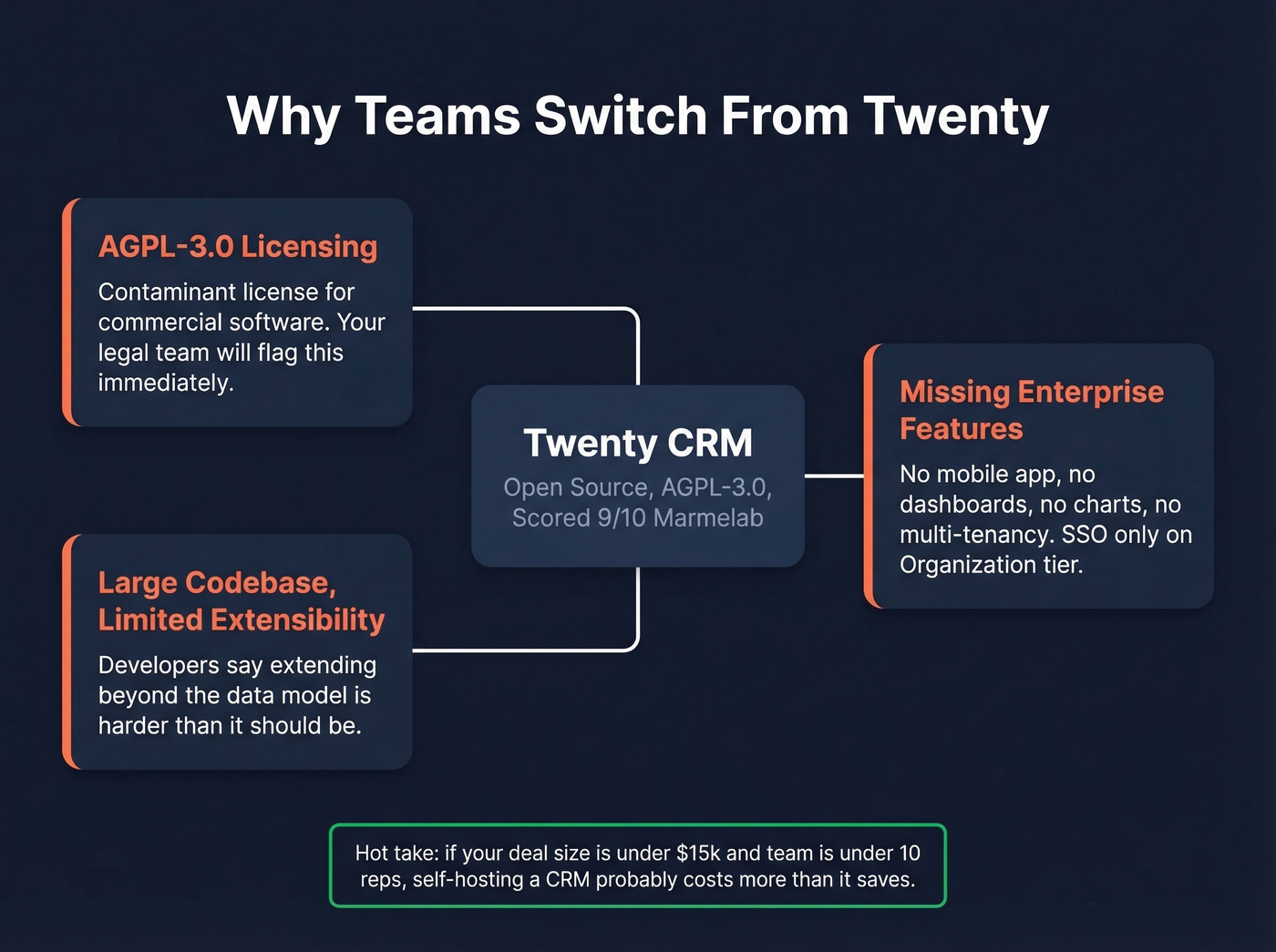
Three issues keep coming up:
- AGPL-3.0 licensing. If you're building commercial software that touches Twenty's codebase, your legal team will have strong opinions. It's a contaminant license with real consequences.
- Missing enterprise features. No mobile app, SSO only on the Organization tier, no dashboards, no charts, no multi-tenancy. These gaps have persisted across both the 2025 and 2026 Marmelab benchmarks - they're not getting fixed fast.
- Large codebase relative to feature set. Developers consistently flag this. Extending it beyond the data model is harder than it should be.
And if you've tried other OSS CRMs, you know the pain. SuiteCRM requires too many clicks for basic actions. Odoo upsells you constantly. ERPNext tries to do a million things and does none of them well. Twenty is better than all of those - but "better than SuiteCRM" isn't always enough.
Here's our hot take: if your average deal size is under $15k and your team is fewer than 10 reps, you almost certainly don't need to self-host a CRM. The operational overhead eats the cost savings alive.

Every CRM on this list has the same weakness: the data inside it decays fast. Prospeo's 7-day refresh cycle keeps 300M+ profiles current - while the industry average lets contacts go stale for 6 weeks. Native HubSpot and Salesforce integrations push verified emails (98% accuracy) straight into your pipeline.
Stop feeding your CRM dead contacts. Fix the data layer first.
The Best Twenty Alternatives for 2026
Prospeo - Best for CRM Data Quality
Prospeo isn't a CRM - it's the data layer that makes your CRM actually useful. Your pipeline is only as good as the contacts inside it, and most CRMs ship with stale, unverified data within weeks of import.
The database covers 300M+ professional profiles with 98% email accuracy and a 7-day data refresh cycle. That refresh cadence is the real differentiator: the industry average is six weeks, which means most CRM databases are already decaying by the time reps start working them. Native integrations with HubSpot and Salesforce - plus tools like Zapier, Make, Smartlead, Instantly, and Lemlist - mean enriched data flows directly into your pipeline without CSV gymnastics. One customer, Snyk, saw their AE-sourced pipeline jump 180% and bounce rates drop from 35-40% to under 5% after switching their data layer.
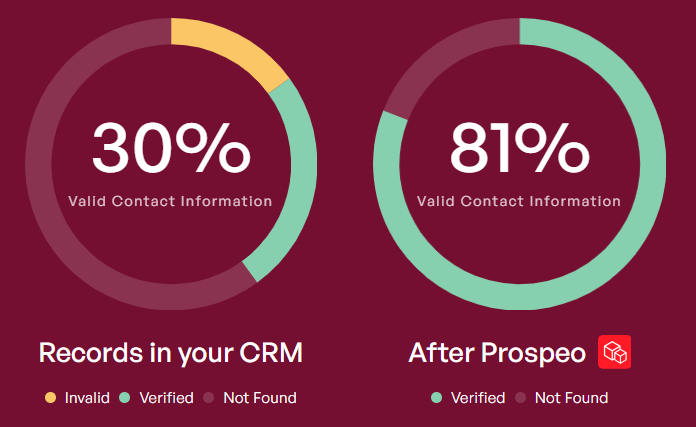
Use this if your CRM is full of bouncing emails and disconnected phone numbers. Pair it with any CRM on this list and your data quality problem disappears.
Skip this if you need the CRM itself - this is the data engine, not the database of record.
Free tier gives you 75 verified emails and 100 Chrome extension credits per month. Paid plans run ~$0.01/email with no contracts.
Attio - Best Data-First Cloud CRM
Attio is the modern CRM that most closely matches Twenty's data-centric philosophy, except it's fully hosted and doesn't require you to manage infrastructure. In our testing, teams switching from Twenty to Attio adapted within a week - the mental model is similar enough that the learning curve barely registers.
AI-enriched fields, real-time contact syncing, and custom objects make it feel developer-friendly without actually requiring developers. The free tier supports up to 3 seats with 50,000 records - generous enough for early-stage teams to run a real evaluation. Paid plans start at $29/user/mo on annual billing, jumping to $69/user/mo for Pro.

One Reddit user comparing Attio and Folk noted Attio has "way more features" and stronger meeting integrations. The tradeoff? Attio's last interaction attribute only updates via email sync - you can't manually edit it. If your team tracks interactions across channels beyond email, that's a real limitation.
Best for teams wanting a modern, data-rich CRM without self-hosting overhead. Not ideal if you need manual control over interaction tracking across every channel.
Folk - Simplest Startup CRM
Folk wins on simplicity, and for early-stage founders, that's the whole game. A Reddit user comparing Folk and Attio chose Folk specifically because you can manually enter last interactions across any channel - not just email. The Chrome extension is also noticeably faster than Attio's, which matters more than you'd think when you're prospecting at speed.
The credit-based model is where it gets tricky. Standard plans at $24/member/mo include 500 enrichment lookups and 2,000 messages per month. Premium doubles those caps at $48/member/mo. If you're running heavy outbound, you'll burn through credits fast on lower tiers. Folk stays out of your way and lets you track interactions however you want - just watch the credit meter.
Pipedrive - Best Visual Pipeline CRM
Pipedrive is the CRM for teams who think in deal stages. The drag-and-drop pipeline view is genuinely intuitive - reps adopt it faster than almost any other tool we've seen. Starting at $14/seat/mo, it's one of the most affordable paid CRMs on the market, with an aggregated rating of 4.2/5 across 1,732 reviews on Findstack. Mid-tier plans run roughly $29-49/seat/mo depending on feature needs.
The limitation is straightforward: it's not open-source, and customization options are shallow compared to Twenty. If you chose Twenty because you wanted to own and modify your CRM, Pipedrive won't scratch that itch. But if you chose Twenty because it was free and you just needed a pipeline tool - Pipedrive is the better product for pure sales execution.
Close - Best CRM with Built-In Dialer
Close is the obvious pick for phone-heavy sales teams. Built-in calling, SMS, and email come standard in every plan - no third-party dialer integration required. The Solo tier at $9/seat/mo is a cheap way to test it (limited to 1 user on annual billing), and Essentials at $35/seat/mo opens up team features.
Look, Close gets expensive fast. Growth runs $99/seat/mo and Scale hits $139/seat/mo. A 5-person team on Growth is paying nearly $6,000/year. That's real money for a startup that was considering a free open-source CRM.
HubSpot CRM - Best Free Full-Suite Option
HubSpot's free CRM tier is genuinely free - contact management, deal tracking, email integration, no credit card required. HubSpot Sales Hub carries a 4.4/5 rating across 11,019 reviews on Findstack. Paid plans start around $20/user/mo.
Let's be honest, though: HubSpot's "overwhelming, tries to do everything" approach is exactly what drives people to Twenty in the first place. If you left HubSpot for Twenty, going back probably isn't the answer.
Atomic CRM - Best MIT-Licensed Open Source
Atomic CRM exists for teams who want open-source without the AGPL headache. MIT license, lightweight ~15k lines of code, Supabase backend, and it's the only OSS CRM offering SSO per Marmelab's benchmark. The tradeoffs are significant: no workflow automation, no email-calendar sync, and a small community. Self-hosting infra runs $20-200/mo depending on scale.
This is a CRM for developers who want a clean starting point, not a finished product. Skip it if you need something production-ready out of the box.
Honorable mention: Salesflare ($29/user/mo annual) is worth a look for SMBs wanting automated data entry, but it's not open-source and doesn't compete on the same axis as Twenty.
Pricing Comparison
All prices reflect annual billing where available.
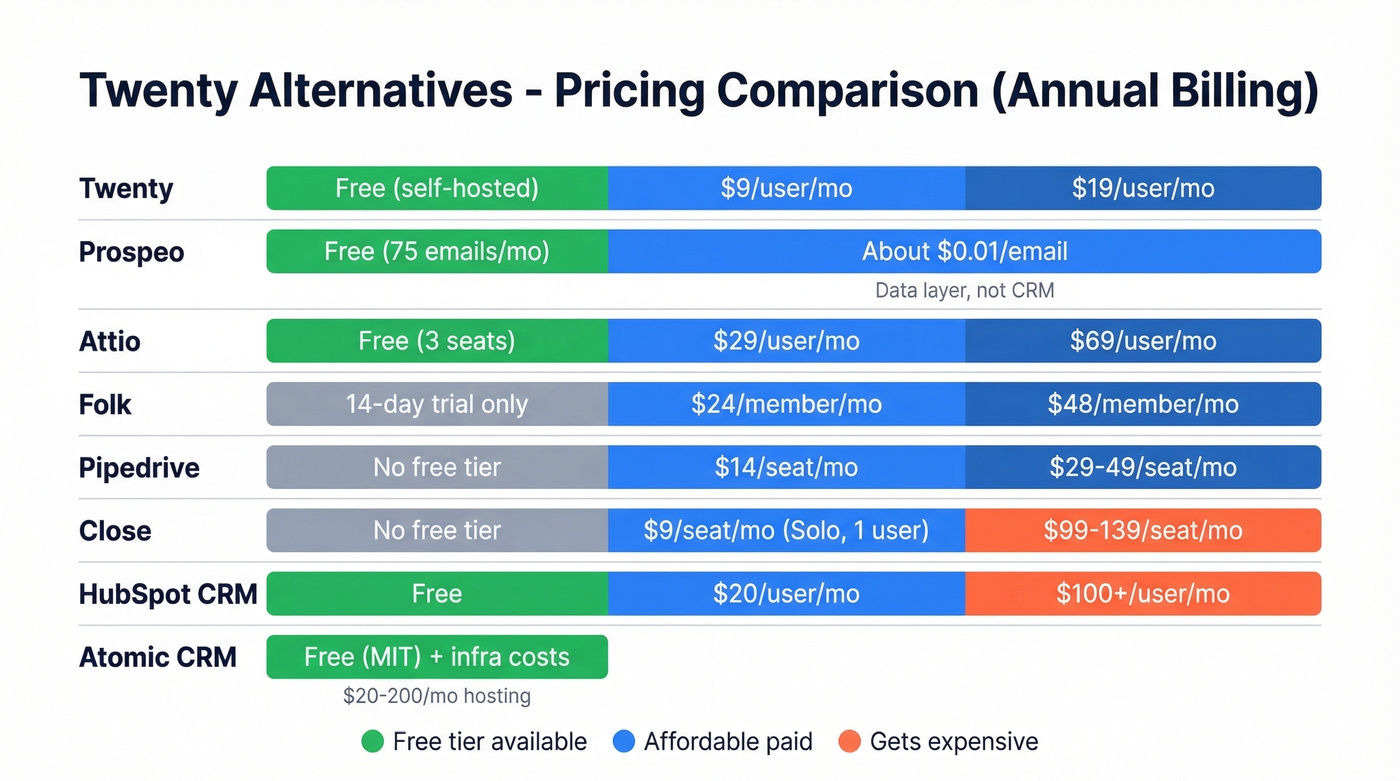
| Tool | Free Tier | Starting Paid | Mid-Tier | Notes |
|---|---|---|---|---|
| Twenty | Yes (self-hosted) | $9/user/mo | $19/user/mo | -25% annual billing |
| Prospeo | Yes (75 emails/mo) | ~$0.01/email | - | Data layer, not CRM |
| Attio | Yes (3 seats) | $29/user/mo | $69/user/mo | Record limits per tier |
| Folk | 14-day trial | $24/member/mo | $48/member/mo | Credit-based caps |
| Pipedrive | No | $14/seat/mo | ~$29-49/seat/mo | - |
| Close | No | $9/seat/mo (Solo) | $99/seat/mo | Solo = 1 user only |
| HubSpot CRM | Yes | ~$20/user/mo | $100+/user/mo | Enterprise = custom |
| Atomic CRM | Yes (MIT) | $0 + infra | - | Minimal features |
How to Choose the Right Alternative
The right pick depends on your team type:
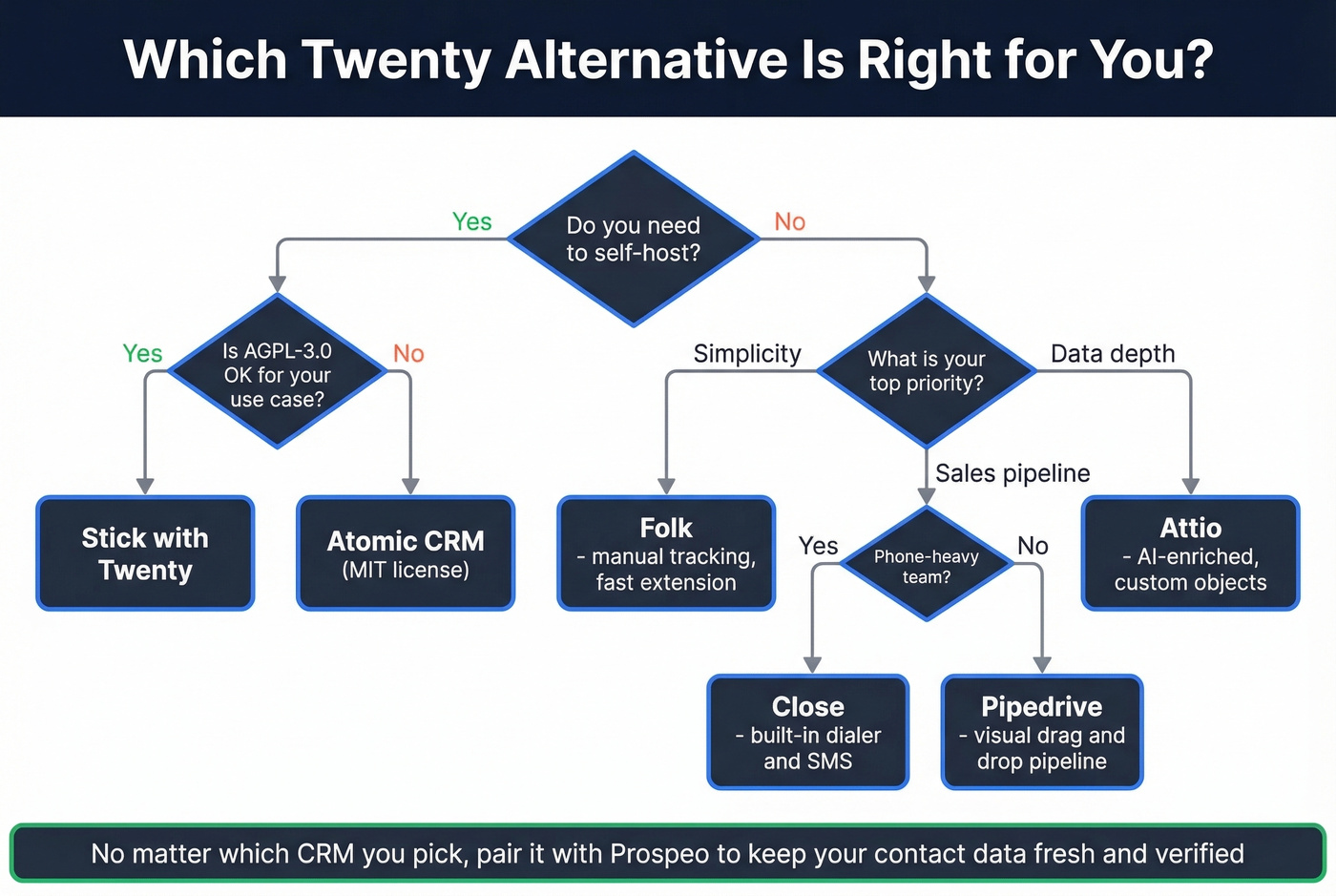
- Developer/self-hosted team - Stick with Twenty, or try Atomic CRM if AGPL is a dealbreaker.
- Startup wanting simplicity - Folk for flexibility, Attio for depth.
- Sales-pipeline-focused team - Pipedrive for visual workflows, Close if your reps live on the phone.
- Free ecosystem play - HubSpot, if you can tolerate the bloat.

Whichever CRM you pick, your pipeline is only as good as the data inside it. We've seen teams triple their pipeline just by fixing the data layer - the CRM you choose matters less than whether the contacts in it are real and current. If you're evaluating contact management options, prioritize how clean the underlying records stay over time.
Snyk's 50 AEs cut bounce rates from 35-40% to under 5% and grew AE-sourced pipeline 180% - just by switching their data layer. Whether you pick Attio, Folk, Pipedrive, or Twenty itself, pair it with Prospeo's 143M+ verified emails and 125M+ mobile numbers at ~$0.01/email. No contracts.
Pick any CRM you want. Just don't fill it with bad data.
FAQ
Is Twenty CRM really free?
Yes - Twenty is open-source under AGPL-3.0 and free to self-host. The hosted cloud version starts at $9/user/mo (Pro) and $19/user/mo (Organization). Self-hosting requires your own infrastructure, typically $20-200/mo for a VPS depending on team size and traffic.
What's the best open-source alternative to Twenty?
Atomic CRM is the closest open-source option with an MIT license, removing the AGPL restriction concern. It's lightweight at ~15k lines of code and the only OSS CRM with SSO, but it lacks workflow automation and email-calendar sync. Think of it as a clean foundation, not a finished product.
How do I keep CRM data accurate after switching?
Pair your CRM with a data enrichment tool that refreshes records on a weekly cycle rather than the 6-week industry average. With 98% email accuracy and 50+ verified data points per contact, reps always have current emails and direct dials - regardless of which CRM you choose.