

HubSpot vs Nimble: Honest CRM Comparison (2026)
This isn't a fair fight - and that's the point. Comparing HubSpot vs Nimble means weighing an enterprise platform that happens to have a free tier against a small-team CRM that's quietly evolved far beyond its old "social CRM" label. We've run both side by side for small sales teams, and the right pick comes down to where you are today, not where you dream of being in three years.
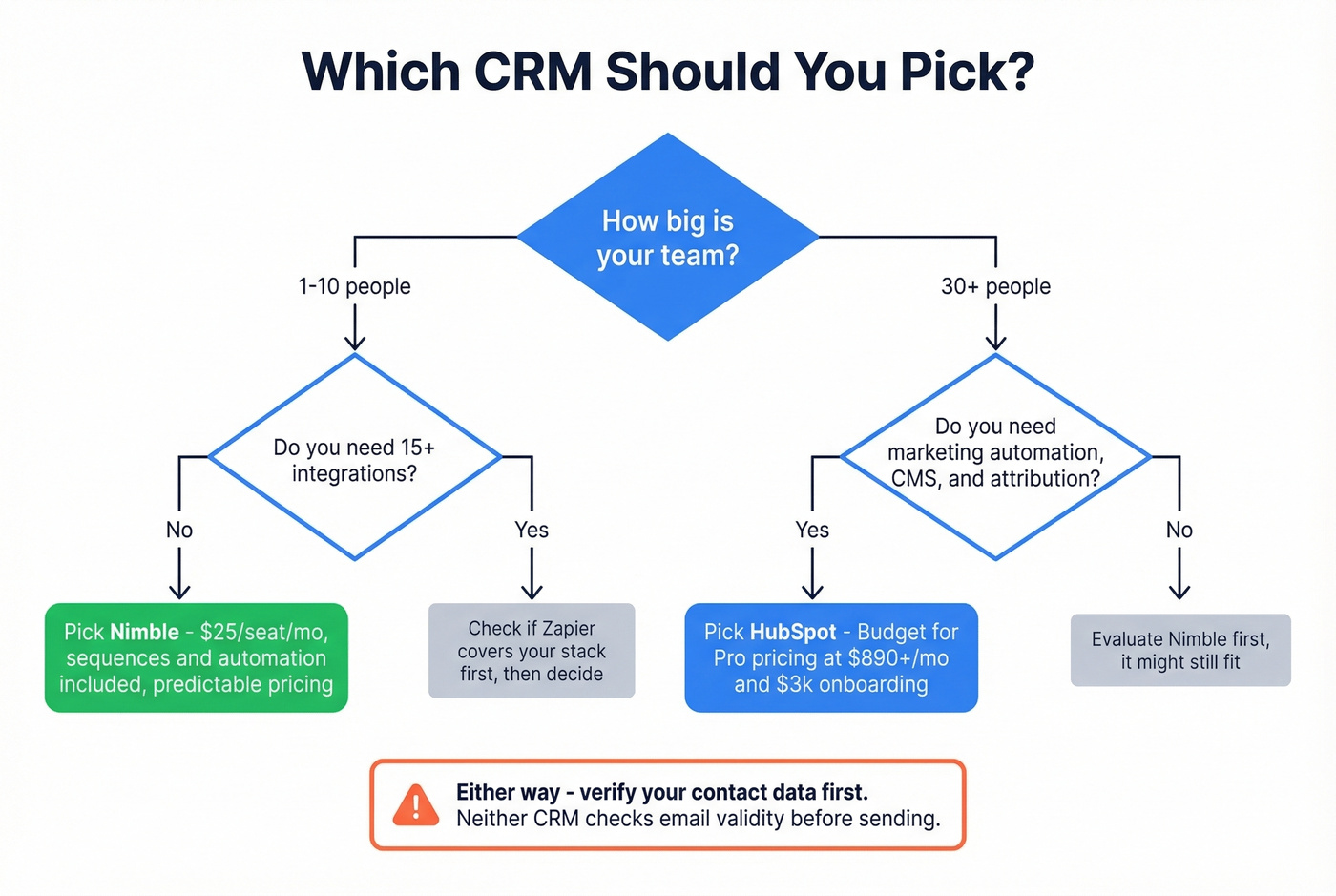
Pick HubSpot if you need marketing automation, a content CMS, and a platform that scales past 50 people. Pick Nimble if you're a team of 1-10, you live in email and calendar, and you want pricing you can actually predict.
Skip both if your real problem is bad contact data. Neither CRM verifies emails - a gap that'll tank your sender reputation faster than any feature gap will slow your pipeline. (If deliverability is the fire, start with an email deliverability guide.)
Pricing: One Plan vs a Pricing Maze
Nimble keeps it simple: one plan, two billing options. $24.90/seat/month on annual billing, $29.90 monthly. You get 25,000 contacts at the account level and 2 GB of storage per seat. Add-ons are straightforward - $15/month for email marketing, $10 per 100 enrichment credits, $12/month for web forms, $10/month per extra 10,000 contacts, $10/month per extra 10 GB storage.
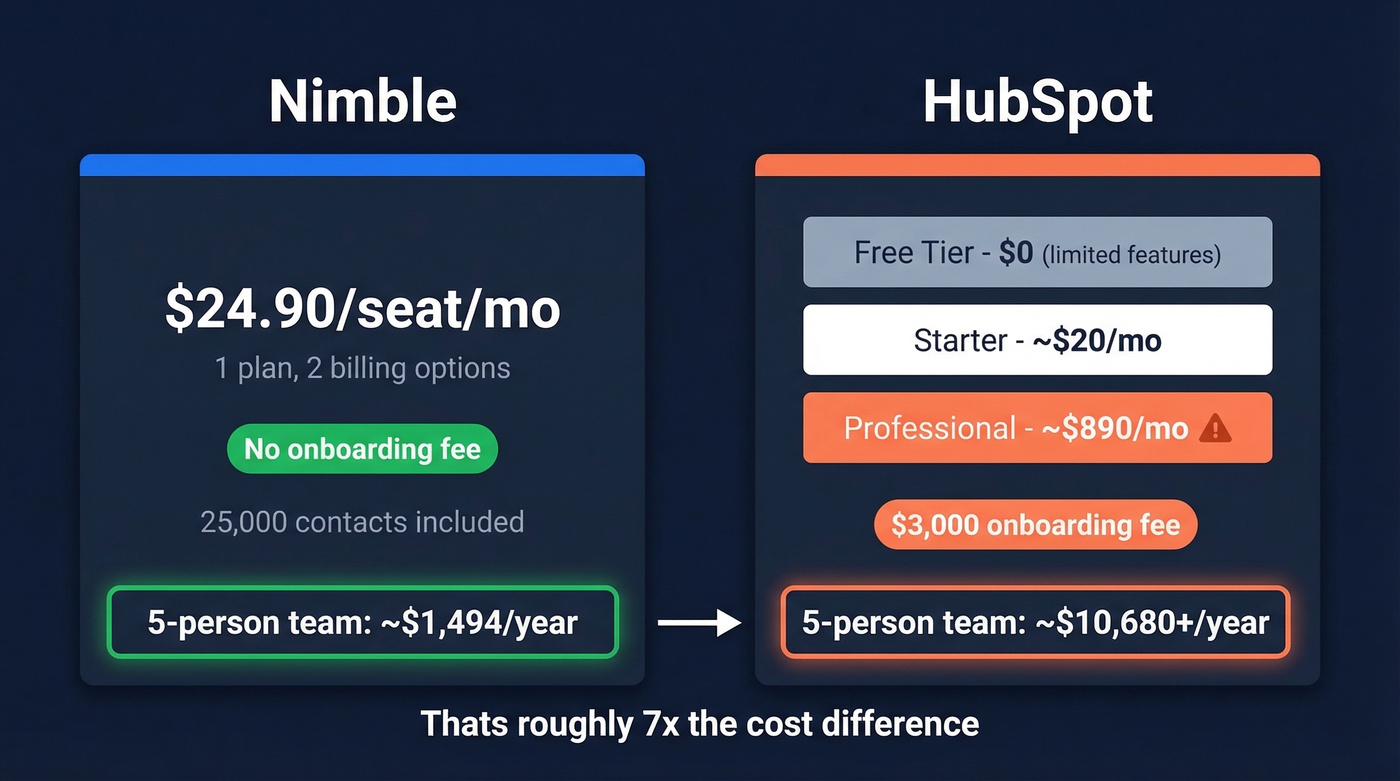
HubSpot's pricing is a different animal entirely. The free tier is genuinely generous - unlimited users, up to 1M contacts. Starter plans begin around ~$20/month. But here's the cliff: Marketing Hub Professional jumps to ~$890/month plus a mandatory $3,000 onboarding fee. Sales Seats are required for full Sales Hub Professional/Enterprise functionality, and credits reset monthly with no rollover. That escalation catches a lot of teams off guard.
| Nimble Business | HubSpot Free | HubSpot Starter | HubSpot Pro | |
|---|---|---|---|---|
| Price/seat/mo | $24.90 (annual) | $0 | ~$20 | ~$890/mo (flat) |
| Contacts included | 25,000 (account-level) | Up to 1,000,000 | Varies by tier | Varies by tier |
| Onboarding fee | $0 | $0 | $0 | $3,000 |
| 5-person team/year | ~$1,494 | $0 | ~$1,200 | ~$10,680+ |
The five-person math makes the gap concrete. Nimble costs under $1,500/year. HubSpot Professional runs $10,680+ before add-ons. That's roughly 7x.
Feature Comparison
HubSpot's feature breadth is unmatched if you use the full stack. But most features small teams actually want - email sequences, workflow automation, custom pipelines - sit behind Professional pricing. (If you're evaluating options broadly, it helps to look at a few examples of a CRM first.)
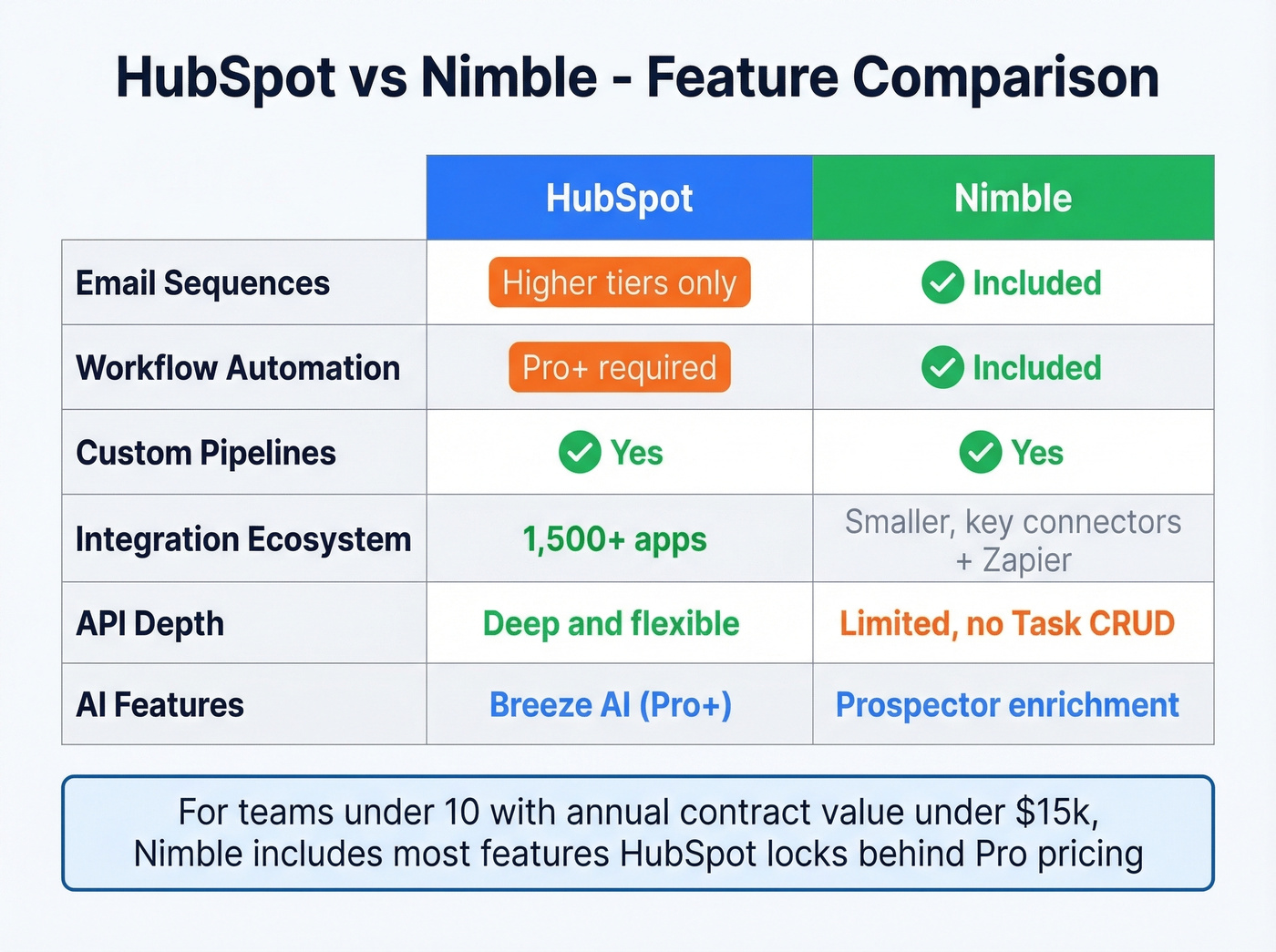
Nimble has closed the gap fast. Across 2024-2025, it shipped workflow automation, engagement-based email sequences, a built-in email marketing add-on, web forms, deal dashboards with team reporting, multiple custom pipelines with auto-updating close probability, and an AI-driven Prospector for contact enrichment. That's a lot of ground covered in a short window, and it explains why Nimble's user sentiment has shifted so noticeably. (If enrichment is a core need, compare data enrichment services.)
| Feature | HubSpot | Nimble |
|---|---|---|
| Email sequences | Higher tiers | Included |
| Custom pipelines | Yes | Yes |
| Workflow automation | Pro+ | Included |
| Integration ecosystem | 1,500+ apps | Smaller (key connectors + Zapier) |
| API depth | Deep | Limited (no Task CRUD) |
| AI features | Breeze AI (Pro+) | Prospector enrichment |
In our testing, Nimble's sequences work well for teams under 10 - you get automation at ~$25/seat that HubSpot typically reserves for higher tiers. The integration ecosystem is where HubSpot genuinely wins: 1,500+ apps versus Nimble's Microsoft 365, Google Workspace, PhoneBurner, and Zapier connectors. If your tech stack has 15 tools that need to talk to each other, that difference matters. (For more on building repeatable outreach, see sequence management.)
Here's the thing: if your annual contract value is under $15k and your team is under 10 people, HubSpot Professional is almost certainly overkill. You're paying enterprise prices for features Nimble now includes at a fraction of the cost.
One dealbreaker for technical teams - Nimble's API doesn't support CRUD operations for Tasks. If you're building custom automations that touch task management, that's a hard wall you can't work around. (If you're wiring tools into your CRM, use this connect outreach tool to CRM setup guide.)

You just read that neither CRM verifies emails before sending. That's how teams end up with 30% bounce rates and torched domains. Prospeo's 5-step verification delivers 98% email accuracy - enrich your HubSpot or Nimble contacts with 50+ data points via native integrations.
Stop blaming your CRM for what bad data caused.
Sending Limits and Email Quality
Nimble includes 1,000 group messages per license per month. The upgrade ladder is clear: $15/month for 2,000, $69/month for 10,000, $99/month for 25,000. One-time bulk options run $19-$110. You're also constrained by your SMTP provider - Gmail caps at 500/day, Microsoft 365 at 5,000/day.
HubSpot's seat model adds its own complexity: Sales Seats are required for full Sales Hub Professional/Enterprise functionality, and credits reset monthly with no rollover.
Neither platform verifies emails before sending. You're trusting whatever data you imported - garbage in, garbage out, regardless of which CRM you choose. We've seen teams blame their CRM for poor deliverability when the real culprit was a 30% bounce rate on unverified imports. (If you're diagnosing bounces, start with email bounce rate benchmarks and fixes.)
What Real Users Say
The G2 head-to-head tells a clear story. HubSpot has the volume - 13,567 reviews at 4.4/5. Nimble has fewer reviews (1,110) but a higher rating at 4.5/5. Nimble's scores come from a smaller sample, but the consistency across dimensions is notable.
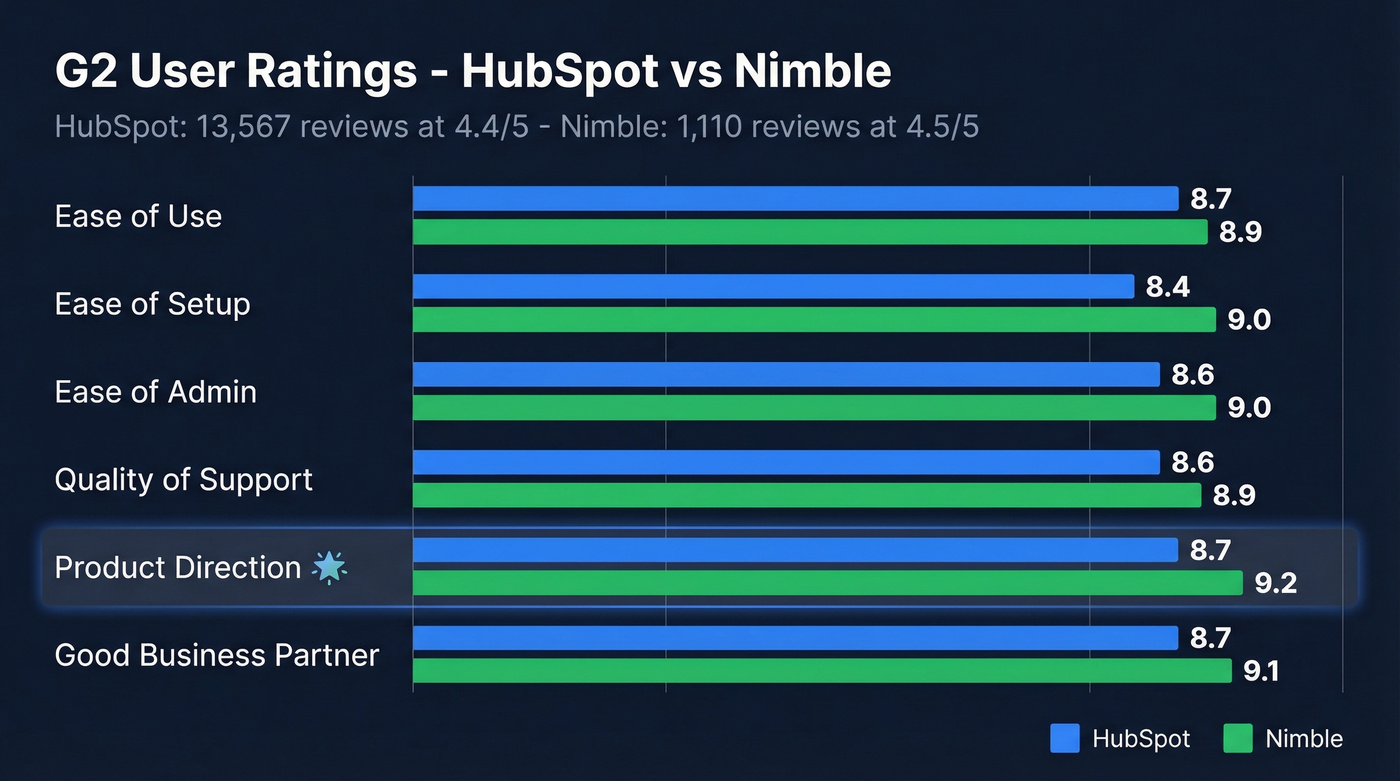
| Dimension | HubSpot | Nimble |
|---|---|---|
| Ease of Use | 8.7 | 8.9 |
| Ease of Setup | 8.4 | 9.0 |
| Ease of Admin | 8.6 | 9.0 |
| Quality of Support | 8.6 | 8.9 |
| Product Direction | 8.7 | 9.2 |
| Good Business Partner | 8.7 | 9.1 |
That Product Direction score - 9.2 vs 8.7 - reflects real momentum. Nimble's roadmap includes AI agents and unified omnichannel communication, which explains the optimism from their user base.
On Reddit, the top HubSpot frustration is pricing complexity - users describe "rocket science-level complicated packages" and a free tier that feels like a trap once you need anything beyond basics. Nimble's Reddit complaints center on API limitations and a tag export quirk where tags split into separate columns, making segmentation outside Nimble messy. If you export regularly, use custom fields instead. (If you're building a prospecting motion, these sales prospecting techniques help.)
Who Should Pick Which
HubSpot: The 30+ Person Growth Play
If you're a 30-person SaaS company with a marketing team that needs landing pages, blog hosting, and attribution reporting alongside your CRM, HubSpot is the only platform here that does all of that under one roof. The Starter-to-Pro cliff is brutal, but the 1,500+ integration ecosystem is genuinely irreplaceable for complex tech stacks. Just go in with your eyes open about what Professional pricing actually looks like once you add Sales Seats, marketing contacts, and onboarding fees.
Nimble: The Lean Team's CRM
If you're a 3-person agency or a solo consultant who lives in Outlook and Google Calendar, Nimble is the better fit. We've seen teams waste months configuring HubSpot workflows they never use. Nimble's value is that there's nothing to configure - one plan, predictable pricing, and the features most small teams actually need are already included. The tradeoff is a smaller integration ecosystem and limited API, so make sure those aren't blockers before committing. (If your main need is staying organized, compare contact management software.)
When Neither Solves the Real Problem
Let's be honest - if your outbound emails bounce at 15%+ because you imported unverified contacts, switching CRMs won't fix anything. That's a data quality problem. Run your list through Prospeo's bulk verification before pushing contacts into whichever CRM you pick. With 98% email accuracy and a 7-day data refresh cycle, you're starting with clean data instead of hoping your CRM somehow compensates for bad inputs. Prospeo integrates natively with HubSpot and works with any CRM via CSV enrichment. (To protect your domain long-term, follow this guide on how to improve sender reputation.)

Whether you pick HubSpot or Nimble, your CRM is only as good as the contacts inside it. Prospeo plugs directly into both via Zapier and enriches every record with verified emails, direct dials, and intent signals - at $0.01 per email with 92% match rates.
Fill your new CRM with contacts that actually connect.
FAQ
Is Nimble still just a social CRM?
No. Nimble added email sequences, workflow automation, email marketing, web forms, deal dashboards, and AI enrichment across 2024-2025. It's a full small-team CRM now - the "social CRM" label is years outdated.
Can I use HubSpot's free CRM forever?
Yes - unlimited users and up to 1M contacts, indefinitely. But Professional tiers jump to ~$890/month plus $3,000 onboarding for Marketing Hub Professional, and Sales Hub Pro/Enterprise requires paid Sales Seats. The free tier is real, but the upgrade path is steep.
How do I keep contact data clean in either CRM?
Neither CRM includes built-in email verification. Run your list through a dedicated verification tool before importing. This keeps bounce rates under 4% and protects your sender reputation regardless of which platform you choose.
Which CRM is better for teams under five people?
Nimble wins for teams under five. At ~$1,494/year for five seats with sequences and automation included, it costs a fraction of HubSpot Professional's $10,680+. HubSpot Free works too, but you'll hit feature walls on sequences and reporting quickly.