

Every Type of Sales Objection (And How Top Reps Handle Each One)
Your CRM captures only 1% of customer interactions. The other 99% - the hesitation in a prospect's voice, the budget conversation you weren't invited to, the Slack thread where they trashed your competitor - lives outside your system. And yet most objection-handling advice boils down to memorizing scripts.
Scripts are training wheels. The real skill is diagnosis: knowing which types of sales objections you're facing, why they're surfacing now, and what the prospect actually means when they say "we're all set." Reps who master that diagnosis close at rates above 64%.
Quick Version
- There are 6 categories of sales objections - not 4. Most guides miss competition and authority entirely.
- Objections shift by sales stage. A prospecting brush-off requires a completely different response than a closing stall.
- One framework to learn first: LAER (Listen, Acknowledge, Explore, Respond). It works because it forces diagnosis before prescription.
- The single biggest objection-prevention move: better discovery and verified contact data so you're talking to the right person in the first place.
The Psychology Behind Every Objection
Here's the thing most reps miss: roughly two-thirds of objections aren't actually about price. Price is the easiest thing to say. It's socially acceptable, it ends the conversation fast, and it doesn't require the prospect to admit they're scared of making the wrong decision.
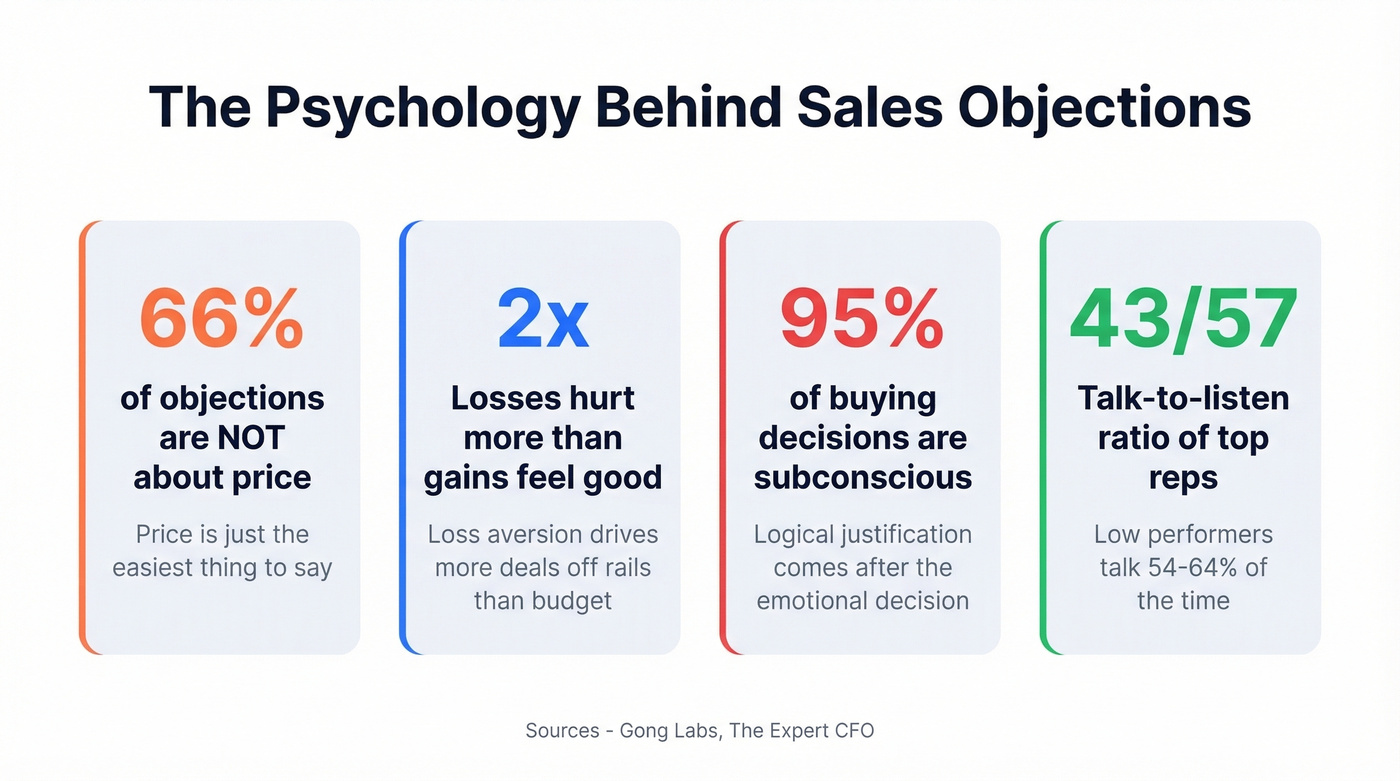
Loss aversion drives more deals off the rails than budget ever will. People fear losses roughly 2x more than they value equivalent gains - so "what if this doesn't work" carries twice the emotional weight of "what if this works great." Add status quo bias - the gravitational pull of doing nothing - and you start to see why 95% of purchasing decisions happen subconsciously before the logical justification kicks in. That's not a small edge case. That's nearly every deal you'll ever work.
This is why the best objection handlers talk less than they listen. Gong Labs data shows top performers maintain a 43/57 talk-to-listen ratio, while low performers swing between 54% and 64% talk time. When a VP says "we need to think about it," they're not thinking about your product. They're thinking about what happens to their reputation if the implementation fails. Your job isn't to overcome the objection - it's to surface the real fear underneath it.
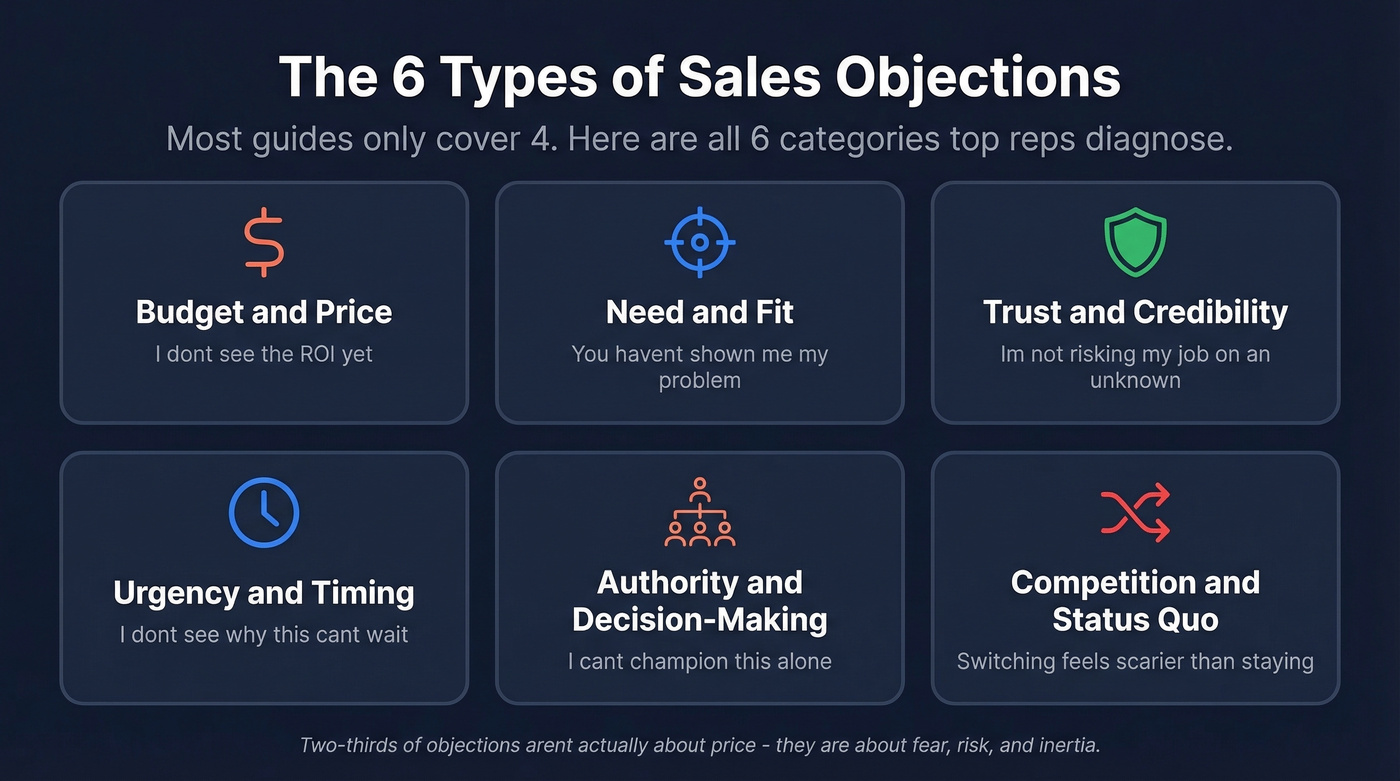
The 6 Categories of Sales Objections
Most guides list four types - budget, need, trust, and timing. That's incomplete. Competition and authority objections are distinct categories with their own diagnostic patterns, and lumping them in with "need" or "trust" leads to the wrong response. Let's break them down.
Budget and Price Objections
| What They Say | What They Mean | How to Respond |
|---|---|---|
| "It's too expensive" | I don't see ROI for my situation | Quantify their cost of inaction |
| "We don't have budget" | This isn't a priority right now | Tie to a pain they've already admitted |
Price objections are the most common - and the most frequently misdiagnosed. Discounting before you've established value is the fastest way to kill your margins and your credibility. We've seen reps slash 20% off a deal in the first five minutes of pushback, only to discover the prospect's real concern was implementation timeline. That discount bought nothing.
Need and Fit Objections
A prospect who says "we don't need this" is really saying "you haven't shown me my problem." That's a discovery failure, not a product failure. Go back to their workflow pain. Ask what they're doing manually today. If a prospect doesn't see the problem, no amount of feature selling will create urgency.
| What They Say | What They Mean | How to Respond |
|---|---|---|
| "We don't need this" | You haven't shown me my problem | Revisit discovery; ask about current workflow pain |
| "We're too small for this" | I'm worried about complexity | Show a comparable customer at their stage |
Trust and Credibility Objections
We've watched deals die because a rep responded to "I've never heard of you" with a feature dump. The prospect didn't need features - they needed proof. Trust objections spike in enterprise and regulated industries, and the antidote is always specificity: case studies with numbers, named logos, a reference call with someone in their vertical. Vague testimonials do nothing.
| What They Say | What They Mean | How to Respond |
|---|---|---|
| "I've never heard of you" | I'm not risking my job on an unknown | Lead with social proof and named logos |
| "How do I know this works?" | I need evidence, not promises | Offer a pilot, POC, or reference call |
Urgency and Timing Objections
| What They Say | What They Mean | How to Respond |
|---|---|---|
| "Not the right time" | I'm worried about change management | Map a low-friction implementation path |
| "Call me next quarter" | I don't see why this can't wait | Quantify the cost of delay |
Timing objections feel reasonable, which makes them the hardest to crack. The prospect isn't saying no - they're saying later. Your job is to make "later" feel expensive. Only 2% of sales close on the first contact, and 35-50% go to the first vendor who responds. Delay has a real cost. Help them see it.
Authority and Decision-Making Objections
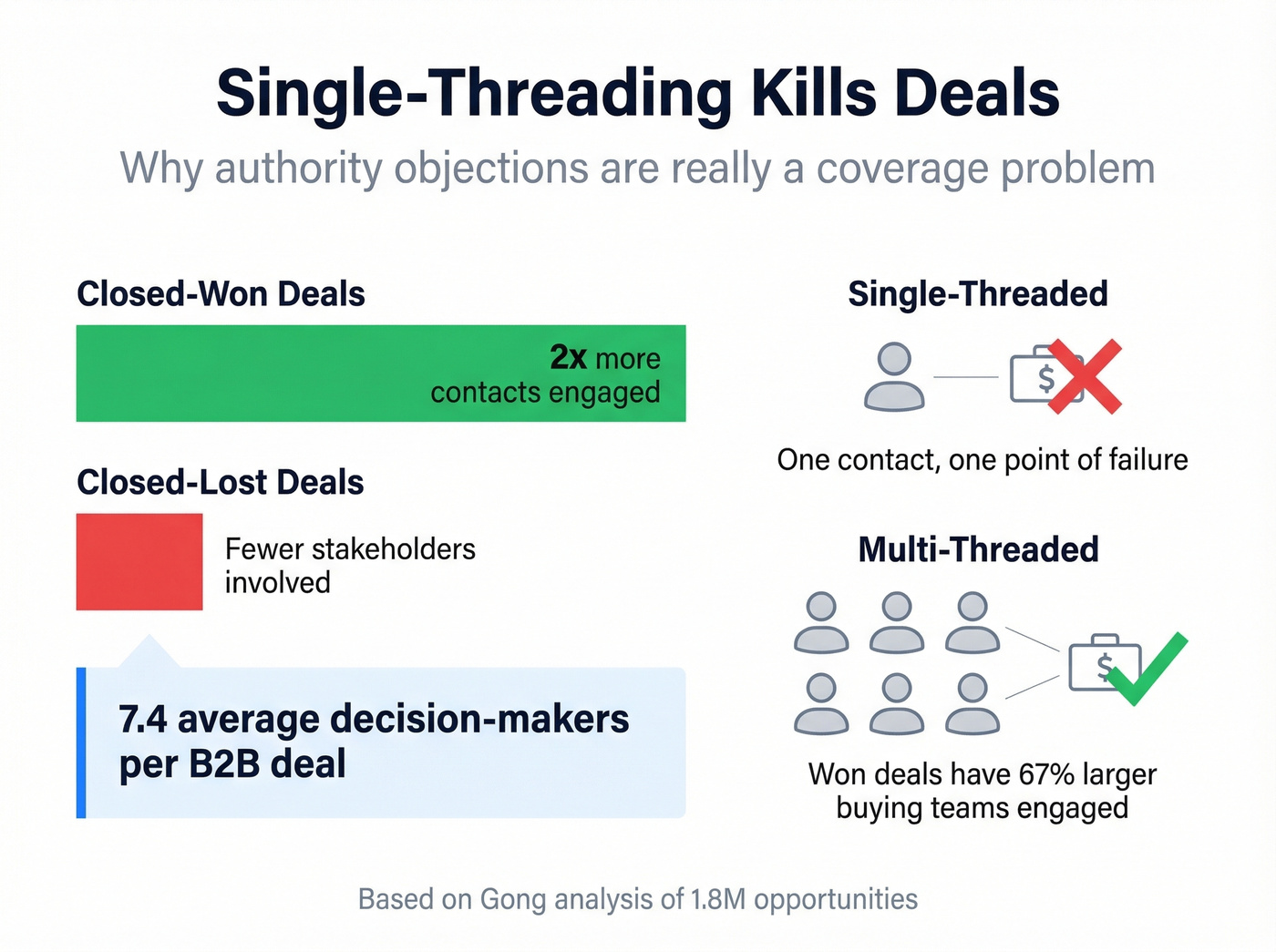
The average B2B purchase involves 7.4 decision-makers. If you're only talking to one, authority objections are inevitable. Gong's analysis of 1.8M opportunities found that closed-won deals have roughly 2x as many buyer contacts as closed-lost - and won deals involve teams that are 67% larger on average. Single-threading is gambling.
| What They Say | What They Mean | How to Respond |
|---|---|---|
| "I need to run this by my boss" | I can't or won't champion this alone | Offer to join the next conversation |
| "Our team needs to align" | There's internal resistance I haven't told you about | Ask who else is involved and what their concerns are |
Competition and Status Quo
Look - the status quo is your biggest competitor in every deal, not the other vendor. "We're happy with our current vendor" is one of the hardest objections to crack because the prospect isn't evaluating your product against a competitor. They're evaluating the pain of switching against the comfort of doing nothing. Focus on gaps their current vendor can't fill, not on why you're "better."
| What They Say | What They Mean | How to Respond |
|---|---|---|
| "We're happy with our current vendor" | I'm afraid of disruption | Surface gaps they've accepted as normal |
| "We're evaluating other options" | You haven't differentiated enough | Ask what criteria matter most |
Objections Mapped by Sales Stage
Categorizing objections by type is useful. Categorizing them by when they appear is even more useful, because the response strategy changes completely depending on the stage.
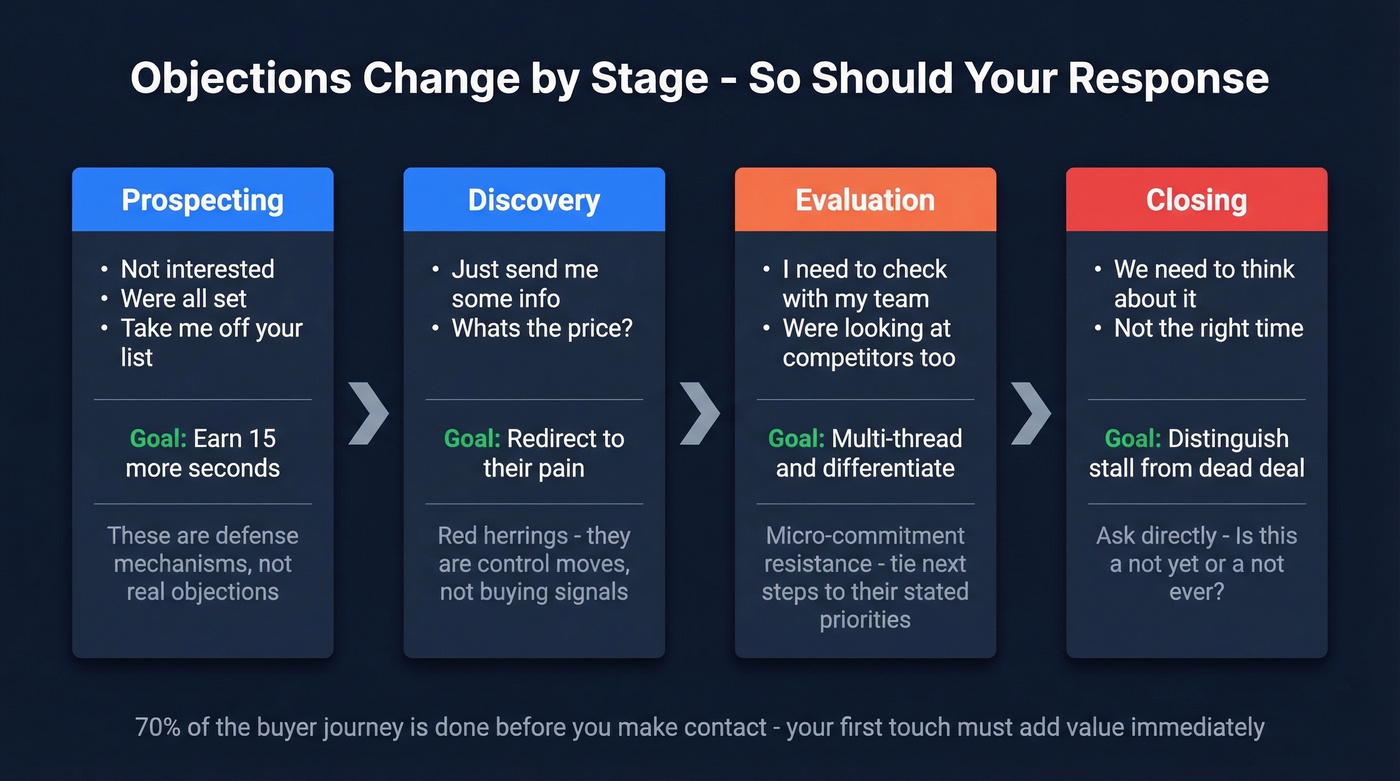
Prospecting objections are fast, harsh, and reflexive. "Not interested." "We're all set." "Take me off your list." These aren't real objections - they're defense mechanisms. The goal isn't to overcome them; it's to earn 15 more seconds with a pattern interrupt or a hyper-relevant insight. Nearly 70% of the buyer journey is complete before a rep even makes contact, so your first touch needs to add value immediately or you're dead on arrival.
Red herring objections appear early in a call. "Just send me some info" or "What's the price?" before you've discussed their situation. These aren't buying signals - they're control moves. Acknowledge, then redirect to discovery.
Micro-commitment objections surface when you ask for a next step - a demo, a meeting with their team, a technical review - and get pushback. The prospect doesn't see enough value to invest more time. Tie the next step to something they've told you they care about.
Closing objections are the most dangerous because they've consumed the most pipeline time. "We need to think about it" at the proposal stage is fundamentally different from the same words on a cold call. Distinguish between a real objection you can solve and an obstruction where the deal is dead but nobody wants to say it. If you can't tell the difference, ask directly: "Is this a 'not yet' or a 'not ever'?" You'll be surprised how often people just tell you.

Authority objections happen when you're single-threaded. With 7.4 decision-makers per deal, you need verified contact data for every stakeholder - not just the one who replied. Prospeo gives you 300M+ profiles with 30+ filters to map the full buying committee before your first call.
Stop guessing who owns the budget. Build the full buyer map in minutes.
What They Say vs. What They Mean
| What They Say | What They Mean | Right Response |
|---|---|---|
| "Too expensive" | I don't see ROI | Quantify cost of inaction |
| "Not the right time" | Change management scares me | Show a phased rollout plan |
| "Happy with current solution" | I'm afraid of disruption | Surface accepted gaps |
| "Send me more info" | I want to end this call | Earn 15 more seconds with a sharp insight |
| "I need to talk to my team" | I can't champion this alone | Offer to present jointly |
| "We tried something like this" | I got burned before | Ask what went wrong |
| "Not a priority right now" | You haven't created urgency | Connect to a metric they own |
| "Just not interested" | You haven't earned my attention | Lead with a specific pain point |
That translation is the skill. Once you hear what they mean, the response writes itself.
Objection-Handling Frameworks Compared
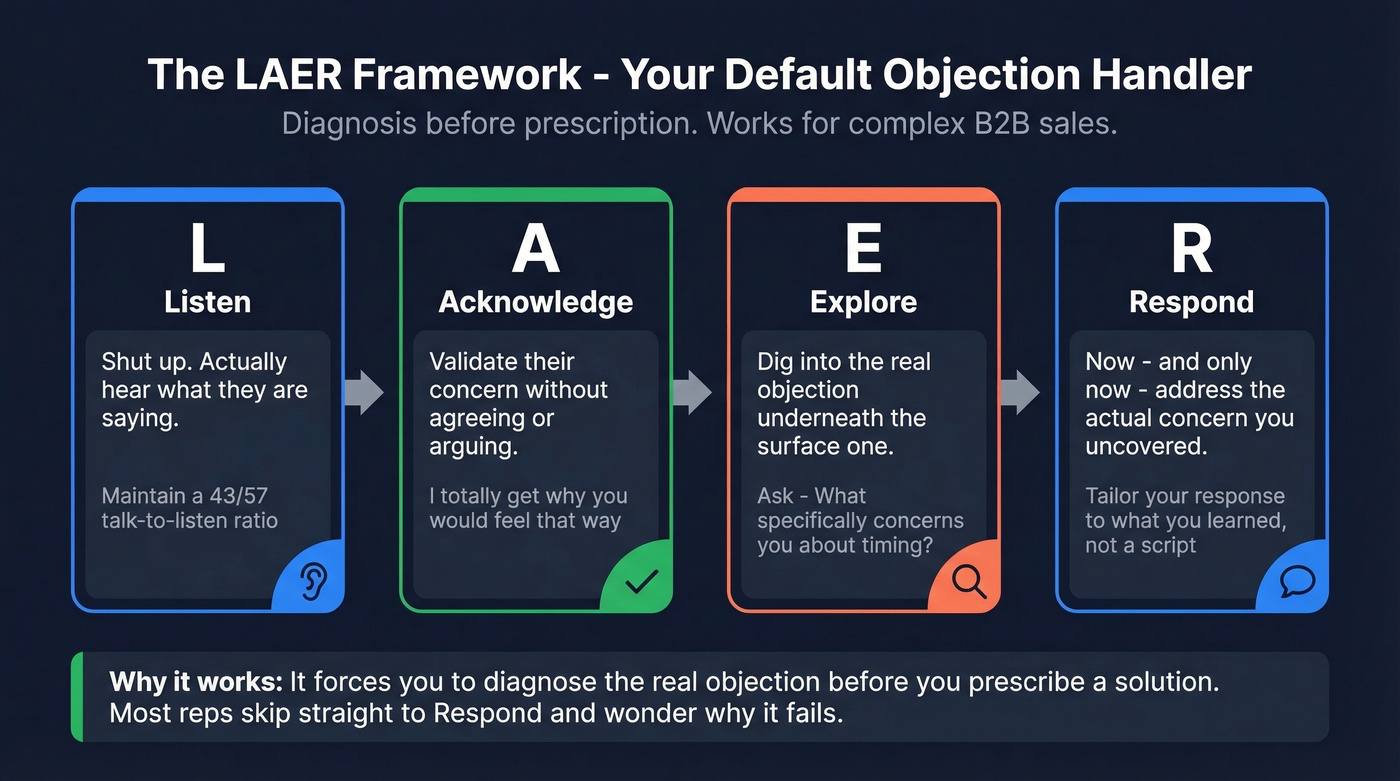
There's no shortage of acronyms. The question is which framework fits your selling motion. In our experience testing several across different deal types, LAER - popularized by Carew International - is the best default for consultative B2B sales.
| Framework | Steps | Best For | Watch Out For |
|---|---|---|---|
| LAER | Listen, Acknowledge, Explore, Respond | Complex B2B sales | Can feel like interrogation |
| ARC | Acknowledge, Respond, Close | Transactional / short cycles | Skips diagnosis entirely |
| Feel-Felt-Found | Empathize, Normalize, Resolve | Emotional buyers | Can sound rehearsed |
| LAARC | Listen, Acknowledge, Assess, Respond, Confirm | Enterprise multi-stakeholder | Too heavy for simple deals |
| LAIR | Listen, Acknowledge, Identify, Reverse | Competitive displacement | Aggressive if misapplied |
| LACE | Listen, Accept, Commit, Explicit Action | Account management / renewals | Too passive for new business |
LAER wins because of the "Explore" step. Most frameworks jump from acknowledgment straight to response. LAER forces open-ended questions before you prescribe anything - which aligns with the 43/57 talk-to-listen ratio that separates top performers from everyone else.
If your team only learns one framework, make it LAER. ARC is fine for transactional deals where speed matters more than depth. Feel-Felt-Found works in consumer-facing or highly emotional sales. Skip LAARC unless you're running enterprise deals with five-plus stakeholders and need the extra "Assess" and "Confirm" steps to keep everyone aligned. For B2B deals with six-figure contracts, LAER is the right tool.
5 Mistakes That Kill Deals
1. Believing the first objection is real. Surface objections are smoke screens. "Too expensive" often means "I don't trust you enough to spend this much." Dig before you respond.
2. Rushing to respond without diagnosing. A short pause before responding signals confidence and gives you time to think. Most reps fill that silence with a discount.
3. Arguing or getting defensive. The moment you argue, you've lost. Resistance breeds resistance.
4. Discounting too soon. Lead with ROI first. Quantify the cost of their current problem. Discounting should be your last move, not your first - the consensus on r/sales is that premature discounting trains buyers to always push back on price.
5. Ignoring emotional drivers. Fear of making the wrong decision. Fear of looking bad internally. These aren't logical objections, and logical responses won't resolve them. Name the emotion: "It sounds like there's concern about implementation risk - is that fair?" That one sentence can unlock a stalled deal.
How to Prevent Objections Entirely
The best objection is the one that never surfaces. Strong discovery prevents late-stage surprises. Multi-threading boosts win rates by 130% in deals over $50K, and adding a sales engineer can increase win rates by up to 30%. Persistence matters more than most reps realize: 80% of sales require 5+ follow-ups, but 92% of reps quit after 4. Leads contacted within 5 minutes are 9x more likely to convert than those left waiting.

But there's one objection-prevention move that's embarrassingly simple and still overlooked: making sure your reps reach the right person with accurate contact data. Bad data manufactures objections that have nothing to do with your product. Wrong email? Bounced sequence, burned domain, wasted week. Wrong person? "I'm not the right contact" isn't an objection - it's a data failure.
We've seen teams cut their objection rate in half just by fixing their contact data. Prospeo handles this with 98% email accuracy across 143M+ verified emails and 125M+ verified mobile numbers, all refreshed on a 7-day cycle versus the 6-week industry average. The free tier gives you 75 verified emails per month plus 100 Chrome extension credits - no contract, cancel anytime.
Master the diagnosis of every type of sales objection, and the scripts take care of themselves.
The article says it plainly: the single biggest objection-prevention move is better discovery and verified contact data. Prospeo delivers 98% email accuracy and 125M+ verified mobile numbers so you reach the right person, at the right level, before objections ever surface.
Prevent objections at the source - start with data that actually connects.
FAQ
What is a customer objection?
A customer objection is any concern, hesitation, or pushback a prospect raises during the sales process that signals they aren't ready to move forward. It can be explicit - "it's too expensive" - or implicit, like going silent after a proposal. Diagnosing the root cause behind the surface statement is what separates closers from script-readers.
What are the most common sales objection categories?
Six categories cover virtually every B2B objection: budget/price, need/fit, trust/credibility, urgency/timing, authority/decision-making, and competition/status quo. Price objections are the most frequent, but roughly two-thirds of pushback isn't actually about cost - it's about risk, trust, or internal politics.
What's the best framework for handling objections?
LAER (Listen, Acknowledge, Explore, Respond) is the strongest default for consultative B2B sales. The "Explore" step forces reps to ask open-ended diagnostic questions before prescribing a solution, which prevents the most common mistake - solving the wrong problem. ARC works better for short transactional cycles where speed matters more than depth.
How do you prevent objections before they surface?
Multi-thread across 7+ stakeholders, run thorough discovery, and verify your contact data before outreach. Accurate emails and direct dials eliminate "wrong person" and "bounced email" problems entirely - issues that have nothing to do with your product and everything to do with bad data.