

18 Unique Selling Proposition Examples That Actually Work - And How to Build Yours
A RevOps Manager lead we know ran a positioning workshop last quarter. She asked twelve salespeople to describe what made their product different. She got twelve different answers, and none were specific enough to put on a homepage.
That's the USP problem in a nutshell: everyone thinks they have one, almost nobody can articulate it.
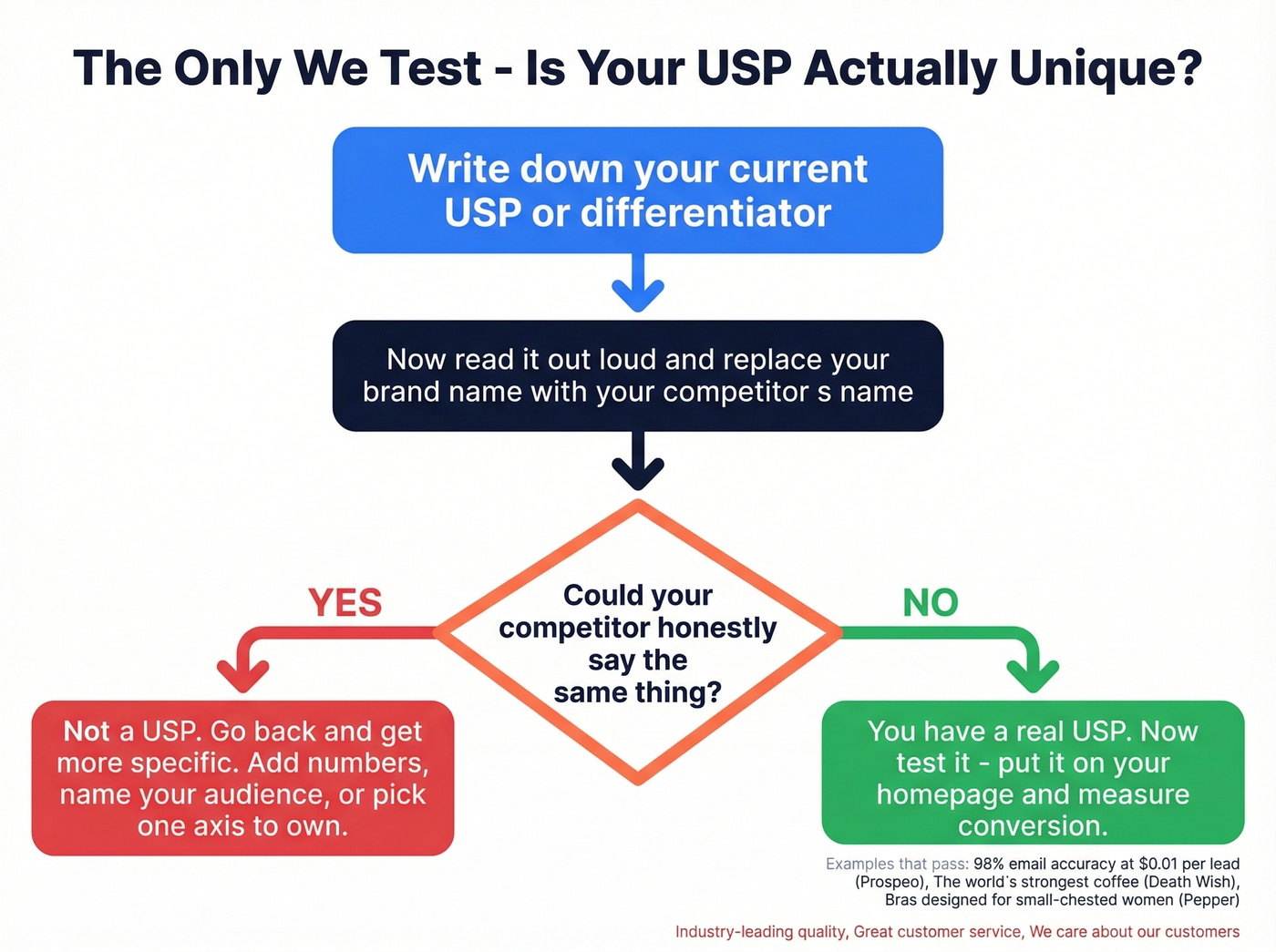
Specificity beats cleverness every time. That's the single most important thing we can tell you upfront. If you just want inspiration, jump to the 18 examples below. If your current USP feels generic, run it through the "Only we..." test - if your competitor could say the exact same sentence, it's not a USP. And if you want to build one from scratch, skip to the 5-step framework.
Why Your USP Matters More in 2026
The market for attention has never been more compressed. Indeed's developer demand index dropped from roughly 170 in early 2022 to 83 by mid-2024. Demand for copywriting and coding skills fell 21% within eight months of ChatGPT's launch, based on an analysis of 1.3M job postings. Similar contractions hit design, consulting, and freelance services across the board. When supply outpaces demand, differentiation isn't a branding exercise - it's survival.
At a German freelancer conference, roughly one-third of attendees could clearly articulate what made their service special. The other two-thirds defaulted to "quality work" and "great communication." Those aren't USPs. Those are table stakes.
Here's the payoff for getting this right: Susty Party, an eco-friendly party supplies brand, redesigned their homepage around a clearer USP and saw a 250% increase in homepage conversion rate. That's not a typo. We'll break down why that happened - and how to replicate it.
What Is a USP? (And What It Isn't)
The term traces back to advertising pioneer Rosser Reeves in the 1940s. His idea was simple: every ad should make a proposition to the customer that competitors either can't or don't make. Decades later, the concept still holds - but it gets confused with three related-but-different things.
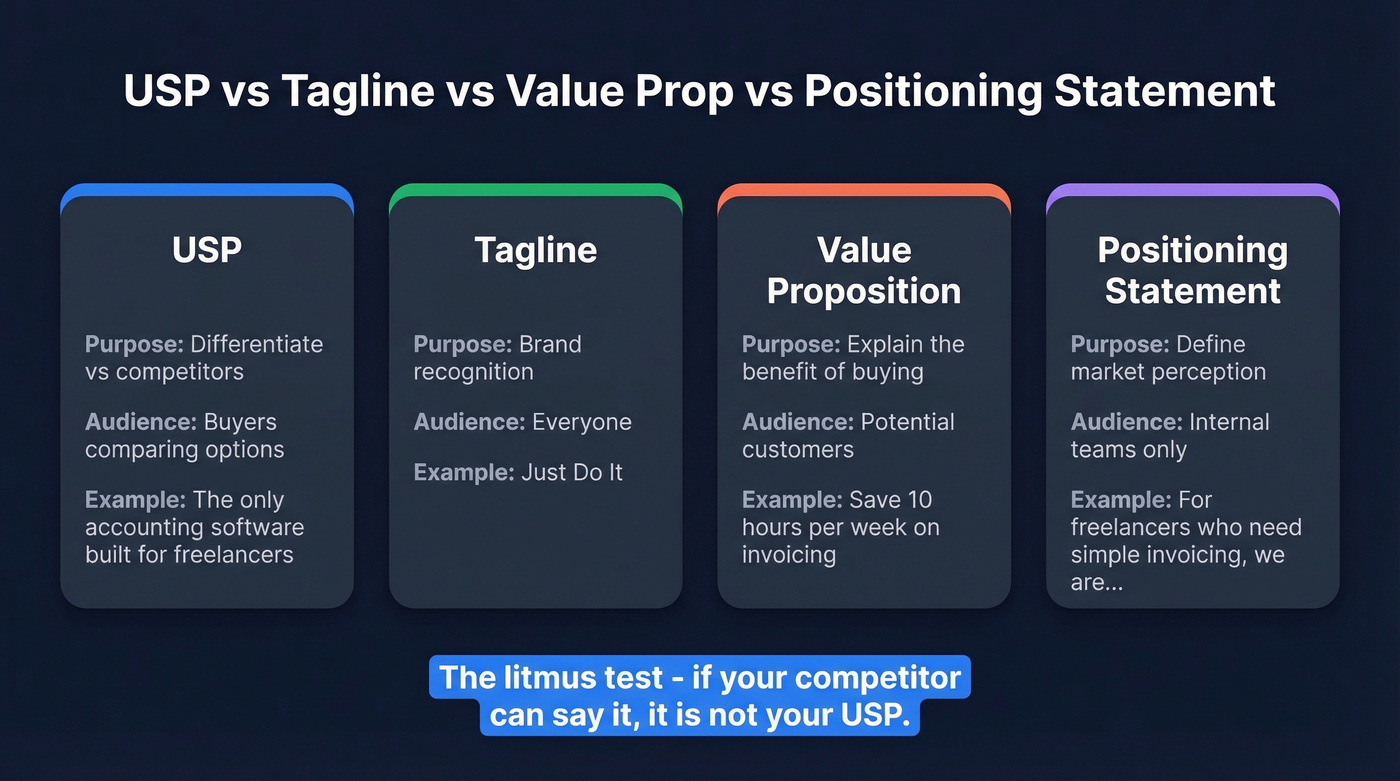
| Term | Purpose | Audience | Example |
|---|---|---|---|
| USP | Differentiate vs. competitors | Buyers comparing options | "The only accounting software built for freelancers" |
| Tagline | Brand recognition | Everyone | "Just Do It" |
| Value proposition | Explain the benefit of buying | Potential customers | "Save 10 hours/week on invoicing" |
| Positioning statement | Define market perception | Internal teams | "For freelancers who need simple invoicing, we are..." |
Your tagline can express your USP, but most taglines don't. A value proposition explains why to buy; a USP explains why you, specifically. And a positioning statement is an internal document - customers never see it.
The litmus test is dead simple: if your competitor can say it, it's not your USP.
Do USPs Actually Move Revenue?
Short answer: yes, measurably.
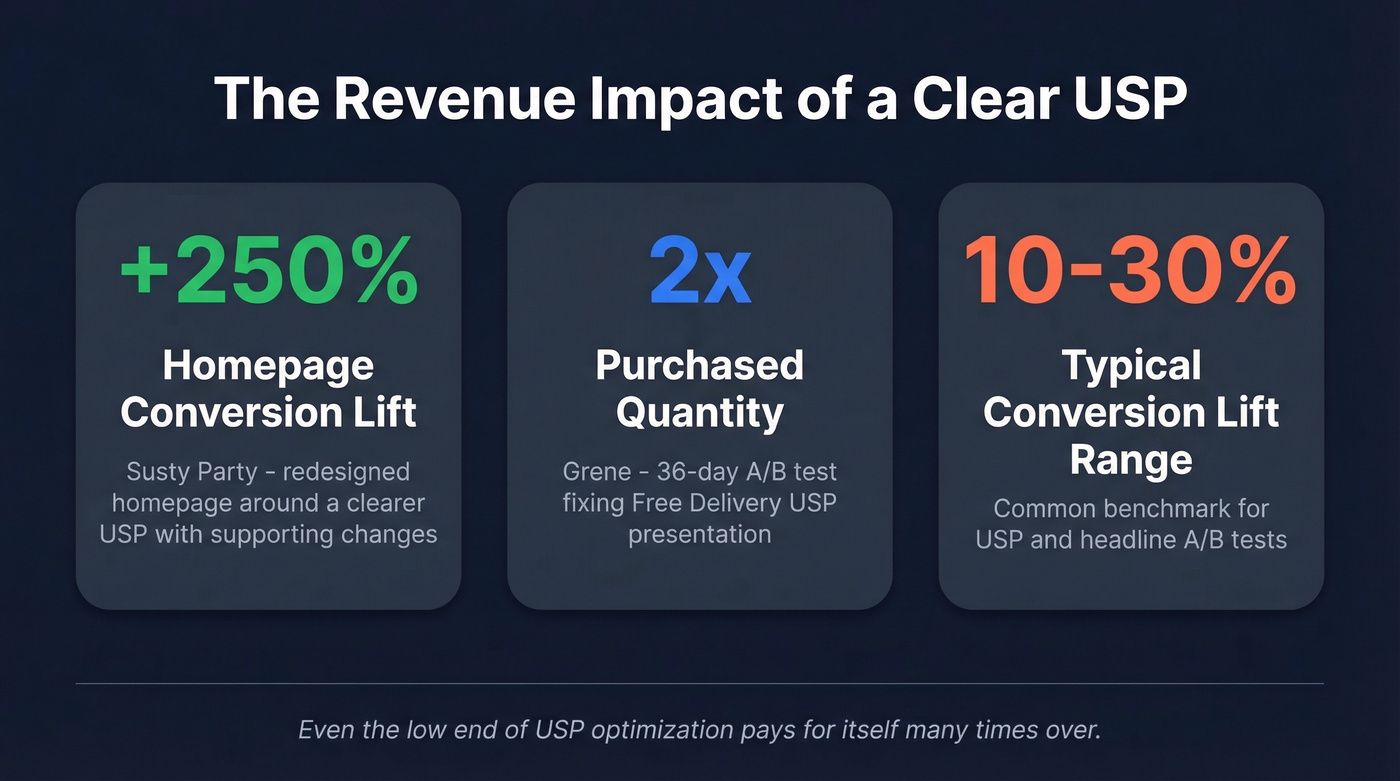
Susty Party's 250% conversion lift came from clarifying their homepage USP alongside supporting changes - testimonials, a stronger CTA, and reduced distractions. That's a bundled test, which is common. Most real-world case studies combine multiple changes, so isolating the exact contribution of USP clarity alone is tricky.
Grene, a Polish garden retailer, ran a 36-day A/B test that doubled total purchased quantity after fixing a friction issue with their "Free Delivery" USP presentation. Their ecommerce conversion rate ticked up from 1.83% to 1.96% - modest in percentage terms, massive in revenue when multiplied across tens of thousands of sessions.
When you isolate USP and headline changes in A/B tests, a common conversion-lift benchmark is 10-30% depending on traffic volume and offer maturity. That range is wide because context matters enormously. But even the low end pays for itself many times over.
18 USP Examples That Work
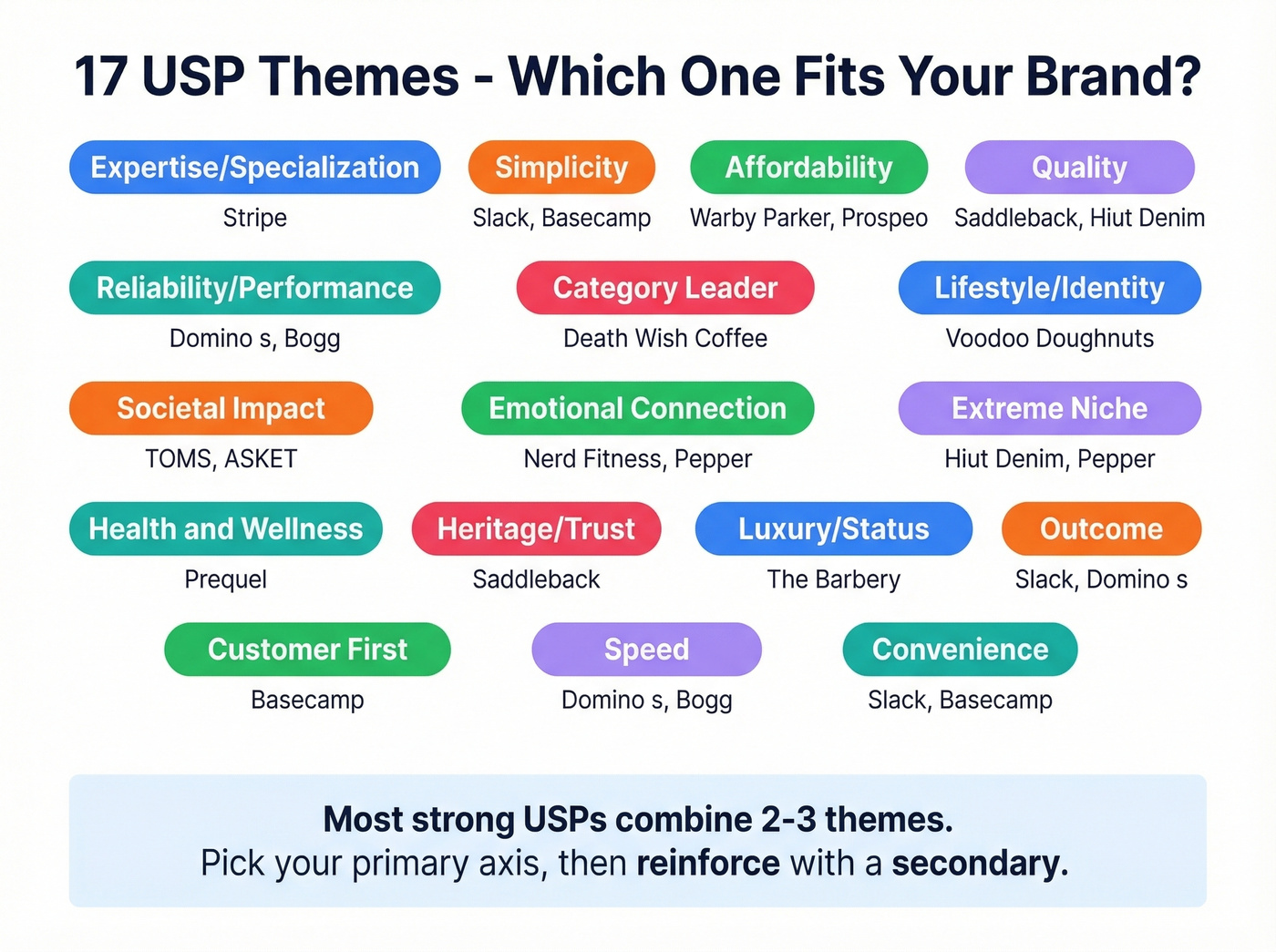
Each example below includes the brand, their USP statement, why it works, and which of the 17 USP themes it uses - drawn from a 129-company analysis shared on r/marketing.
B2B & SaaS
Stripe - "Financial infrastructure to grow your revenue."
Where PayPal positioned around "easy payments" for everyone, Stripe went straight at developers. The entire brand - docs, API design, homepage copy - speaks to technical buyers who want to build on top of a payments layer, not just plug one in. Stripe's homepage leads with developer-focused copy and API documentation links, with no generic "easy payments" messaging in sight. That specificity turned Stripe into the default for SaaS companies, and it's a textbook case of how picking a narrower audience can actually expand your market.
Themes: Expertise/Specialization, Simplicity.
Prospeo - "98% email accuracy. 7-day refresh. $0.01/lead."
In a market where industry data is often refreshed every 4-6 weeks, Prospeo leads with three verifiable numbers: 98% email accuracy, a weekly data refresh cycle, and a cost per lead that's 90% cheaper than ZoomInfo. Every claim is testable - sign up for the free tier and check. Compare that to competitors hiding behind "talk to sales" gates and vague "industry-leading data" copy. "90% cheaper with higher accuracy" is provable; "affordable data solutions" is not.
Themes: Affordability, Quality, Reliability/Performance.
Slack - "Where work happens."
Simple and outcome-driven. Instead of leading with a feature list, Slack leads with a clear promise about what the product becomes inside a team: the place work actually happens. Three words. No jargon.
Themes: Simplicity, Outcome.
Basecamp - "The All-In-One Toolkit for Working Remotely."
Basecamp's entire brand is anti-complexity. Their USP is essentially "we won't overwhelm you" - a direct response to the bloat in project management tools. It resonates with teams who just want to get work done without learning a new operating system every quarter.
Themes: Simplicity, Customer First.
DTC & E-commerce
Death Wish Coffee - "The World's Strongest Coffee."
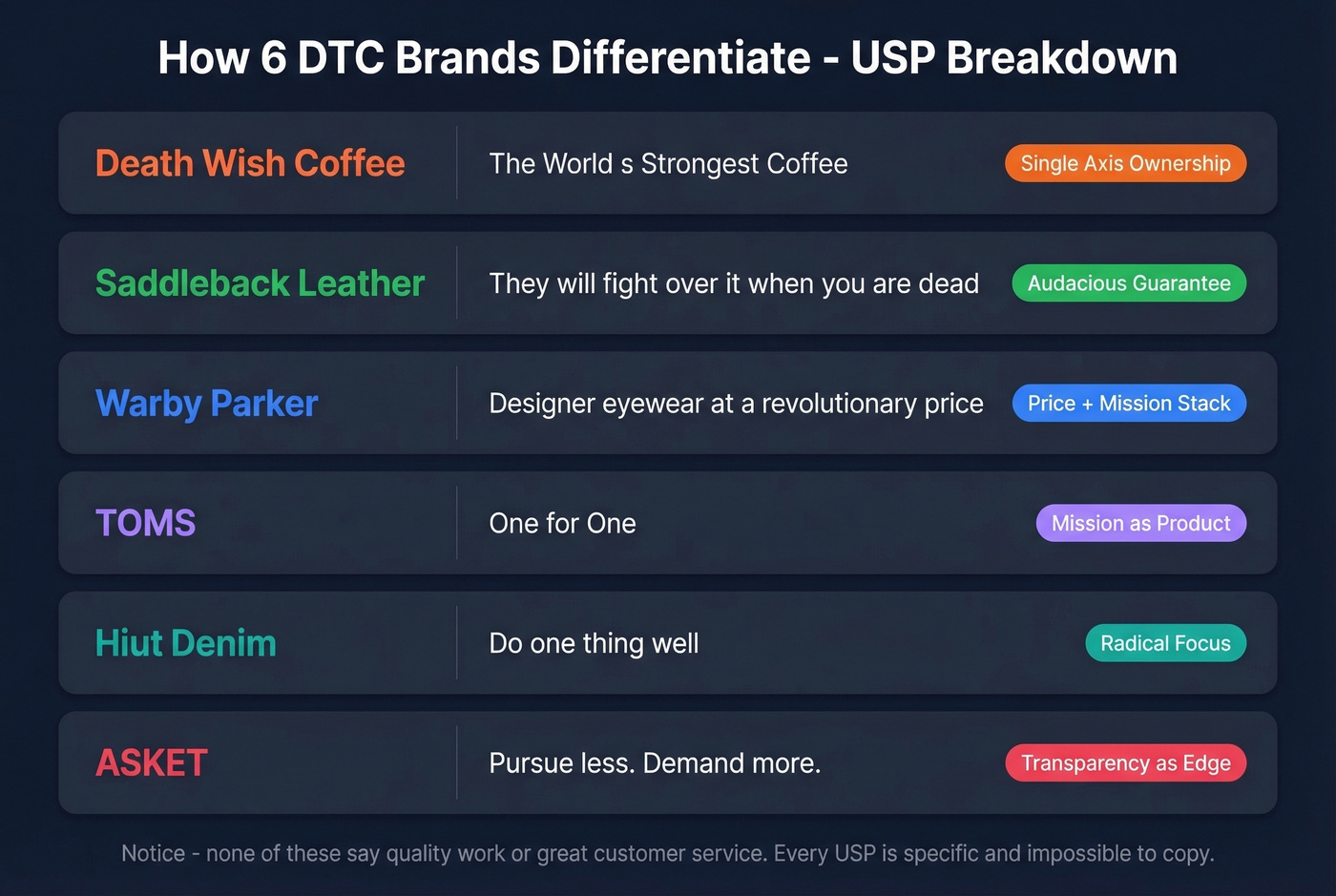
Extreme niche, zero ambiguity. You know exactly what you're getting. Death Wish picked one axis - strength - and owned it completely. For smaller brands competing in crowded categories, this is the kind of single-axis clarity you should aim for. Pick one thing and make it undeniable.
Themes: Category Leader, Lifestyle/Identity.
Before you read the next example, consider this: Saddleback Leather's founder once said his competitors started copying his designs. His response? He published a video called "How to Knock Off a Saddleback Bag," showing exactly how his manufacturing process was impossible to replicate cheaply. That's confidence in your USP.
Saddleback Leather - "They'll fight over it when you're dead."
A 100-year warranty on leather goods. The USP isn't just durability - it's the audacity of the claim, delivered with humor. It makes you believe the product is built to outlast you, which is exactly the point.
Themes: Quality, Heritage/Trust.
Warby Parker - "Designer eyewear at a revolutionary price, while leading the way for socially conscious businesses."
Warby Parker stacks affordability with societal impact - two themes that reinforce each other. The pricing angle is specific and concrete, which is exactly what makes it usable as a USP rather than a vague mission statement.
Themes: Affordability, Societal Impact.
TOMS - "One for One."
TOMS popularized the buy-one-give-one model. The mission isn't a footnote - it's the USP.
Themes: Societal Impact, Emotional Connection.
Hiut Denim - "Do one thing well."
Hiut only makes jeans. Nothing else. In a world of brand extensions and lifestyle empires, that constraint is the USP. It signals obsessive quality and focus - you trust a company that refuses to dilute its attention.
Themes: Extreme Niche, Quality.
ASKET - "Pursue less. Demand more."
Transparency-forward positioning in clothing. In an industry built on opacity and overproduction, ASKET's USP pushes you to buy less and expect more from what you do buy. It's a bet that honesty about consumption can be a competitive advantage - and so far, that bet is paying off.
Themes: Societal Impact, Quality.
Fresh Brands (2025-2026)
Prequel - "Solution-focused skincare."
This brand launched in July 2023 and saw +925.1% year-over-year U.S. traffic growth by December. The founder emphasizes products you use "before you ever need to see a dermatologist." That reframe - prevention over treatment - helped drive rapid growth and expansion into Target.
Themes: Health & Wellness, Outcome.
Bogg - "The original, washable, tip-proof bag."
Indestructible, washable, and designed for beach, pool, and outdoor use. Bogg was expected to hit $100M+ in sales in 2024 and has kept growing. The USP is functional specificity - this isn't a fashion bag, it's a bag that survives everything you throw at it.
Themes: Reliability/Performance, Lifestyle/Identity.
Pepper - "Bras designed for small-chested women."
Pepper explicitly rejected "aspirational body standards" and built bras for a market that traditional brands ignored or treated as an afterthought. They hit their $10,000 Kickstarter goal in 10 hours. When your audience has been underserved for decades, naming the problem is the USP.
Themes: Extreme Niche, Emotional Connection.
Service Businesses & Freelancers
Domino's - "30 minutes or it's free."
The original delivery USP. Domino's didn't claim to make the best pizza - they promised speed with a guarantee. It's a masterclass in picking one axis and making it measurable. The USP has evolved since, but the principle holds.
Themes: Reliability/Performance, Outcome.
Voodoo Doughnuts - "The magic is in the hole."
Bizarre flavors, weird decor, a line around the block. Voodoo Doughnuts turned the product into an experience and an identity marker. You don't go there for a doughnut - you go for the story.
Themes: Lifestyle/Identity, Extreme Niche.
The Barbery - "A premium men's grooming experience."
Not a barbershop. An experience. The Barbery charges more because the USP isn't a haircut - it's the environment, the attention, the ritual. For service businesses, the experience around the service is often the strongest differentiator.
Themes: Luxury/Status, Expertise/Specialization.
Nerd Fitness - "We help nerds, misfits, and mutants lose weight, get strong, and get healthy permanently."
Fitness for people who hate gyms. By naming the audience and the emotional barrier of feeling out of place, Nerd Fitness created a community, not just a program. The USP is belonging.
Themes: Emotional Connection, Extreme Niche.

Most B2B data providers claim "industry-leading accuracy." That's not a USP - it's filler. Prospeo leads with three numbers anyone can verify: 98% email accuracy, a 7-day data refresh cycle, and $0.01 per lead. Sign up for the free tier and test it yourself.
A USP only works if the product backs it up. This one does.
The 17 USP Themes (From 129 Companies)
A practitioner analysis of 129 company USPs across 10 industries identified 17 recurring themes. Many USPs use two or three simultaneously - the best ones almost always stack.
| Theme | Count | % | Example Brand |
|---|---|---|---|
| Emotional Connection | 27 | 20.9% | Nerd Fitness |
| Lifestyle/Identity | 20 | 15.5% | Voodoo Doughnuts |
| Simplicity | 16 | 12.4% | Slack |
| Quality | 10 | 7.8% | Saddleback Leather |
| Outcome | 10 | 7.8% | Domino's |
| Health & Wellness | 10 | 7.8% | Prequel |
| Societal Impact | 10 | 7.8% | TOMS |
| Expertise/Specialization | 9 | 7.0% | Stripe |
| Category Leader | 9 | 7.0% | Death Wish Coffee |
| Opportunity | 7 | 5.4% | Warby Parker |
| Customer First | 6 | 4.7% | Basecamp |
| Luxury/Status | 6 | 4.7% | The Barbery |
| Affordability | 5 | 3.9% | Warby Parker |
| Reliability/Performance | 4 | 3.1% | Bogg |
| Heritage/Trust | 3 | 2.3% | Saddleback Leather |
| Extreme Niche | 3 | 2.3% | Hiut Denim |
| Security | 2 | 1.6% | PayPal |
The top three - Emotional Connection, Lifestyle/Identity, and Simplicity - account for 43.8% of all theme appearances. In the tech subset specifically, Simplicity dominated at 46.6%. If you're building a SaaS product, that's your most likely winning angle.
Don't pick just one theme. The strongest USPs in this dataset stacked two or three complementary themes. Death Wish stacks Category Leader + Lifestyle/Identity. Warby Parker stacks Affordability + Societal Impact. Look for combinations that reinforce each other rather than dilute.
How to Build Your USP in 5 Steps
Let's start with a foundational question: what's your unique selling proposition right now? If you can't answer in one sentence - or if the answer sounds like something a competitor could also claim - these five steps will fix that.
Step 1: Map Features to Benefits
List every feature of your product or service. Then translate each one into a customer benefit. This sounds basic, but most teams skip it and end up with USPs that describe what they built rather than what the customer gets.
| Feature | Customer Benefit |
|---|---|
| 7-day data refresh | Your prospect lists are never stale |
| 100-year warranty | You'll never buy another one |
| Solution-focused formulas | Address concerns early, before they become bigger problems |
The benefit column is your pool of USP candidates.
Step 2: Interview 5-15 Customers
Ask two questions that matter more than any others: "What almost stopped you from buying?" and "What sealed the deal?" The gap between those answers is where your USP lives. Five interviews will surface patterns. Fifteen will confirm them.
In our experience, teams that skip customer interviews end up with USPs that sound great in a conference room but fall flat on the homepage. The internal perspective is always more generous than the market's.
Step 3: Mine Competitor Reviews
Pull up your competitors' 1-star and 2-star reviews on G2, Capterra, Amazon, or Yelp. List every recurring complaint. As one r/copywriting practitioner put it, "The fastest way to find your USP is to read your competitors' 1-star reviews - every recurring complaint is a positioning opportunity."
If three competitors get hammered for slow response times, your USP is a guaranteed response window. If they all get dinged for stale data, your USP is freshness. The market is telling you what it wants - you just have to listen in the right places.
Step 4: Run the "Only We..." Test
Frame your candidate USP as: "Only we [do this specific thing] for [these specific customers]."
If you can't complete that sentence honestly - if a competitor could say the same thing - go back to step 1. Build your USP with numbers, not adjectives. "98% accuracy" is verifiable. "Industry-leading accuracy" is not.
Step 5: Draft With a Template
Three fill-in-the-blank formulas that work:
- For [audience], we're the only [category] that [unique differentiator].
- Unlike [competitor/status quo], we [specific benefit] so you can [outcome].
- [Product] helps [audience] [achieve outcome] by [unique method], without [common pain point].
Draft three to five versions. Test them. Don't fall in love with the first one.
Common USP Mistakes (With Fixes)
Too Vague
Before: "The Best Accounting Software for Online Businesses" After: "The Only Accounting Software Built Specifically for Freelancers and Creators"
The first version has no defined audience and competes with everyone. The second feels tailor-made. As Claude Hopkins warned decades ago, superlatives like "best" actually reduce credibility - they signal exaggeration, not confidence.
Over-Promising
Claiming you're "the fastest, cheapest, and highest-quality" option strains belief. Pick one axis. Own it. Quantifiable claims beat superlatives every time - "30 minutes or it's free" is infinitely more persuasive than "the fastest delivery in town."
Wrong Audience
A USP that resonates with enterprise buyers will alienate startups, and vice versa. If you serve multiple segments, deploy different USPs by audience - but keep one primary USP for your homepage. Skip the temptation to write a USP that tries to speak to everyone; it'll end up speaking to no one.
Even a strong USP can backfire if it's presented poorly. Grene's "Free Delivery" USP looked like a clickable button, which created friction and confused users. After redesigning the presentation, purchased quantity doubled. The USP was fine. The execution was the problem.
How to Test Your USP
Don't guess. Test.
A/B test your homepage headline. Swap your current hero copy for your new USP statement. Run it for at least two weeks with meaningful traffic. If you don't have enough traffic for statistical significance, extend to four weeks or use a tool like VWO or Optimizely that calculates confidence intervals for you.
Run 5-15 customer interviews. Ask if the new USP matches why they bought. If it doesn't resonate with existing customers, it won't resonate with prospects.
Track the right metrics. Conversion rate, bounce rate, and time on page are your primary signals. A good USP should lift conversion and reduce bounce simultaneously. If one moves but not the other, you've changed the message without improving clarity. If you're tying this to pipeline, align it with your funnel metrics so you can see where lift actually shows up.
Isolate the variable. Susty Party's 250% lift bundled multiple changes. Grene's test was cleaner. When possible, change only the USP messaging so you know what actually moved the needle.
Most teams skip testing because they're emotionally attached to their positioning. Don't be that team. The best unique selling proposition examples in this guide share one trait: they were tested, refined, and sharpened over time - not born perfect in a brainstorm.
You just read 18 USP examples. Now apply the "Only we" test to your outbound data. Only Prospeo refreshes 300M+ profiles every 7 days - not the 6-week industry average. That's why teams book 26% more meetings than with ZoomInfo.
Stop sending emails to stale data. Start with contacts that actually connect.
FAQ: USP Examples & Strategy
What's the difference between a USP and a slogan?
A USP is your core competitive differentiator - the specific, provable reason a customer should choose you over alternatives. A slogan is a memorable branding phrase like Nike's "Just Do It." Your slogan can express your USP, but many don't. A USP must be verifiable; a slogan just needs to stick.
Can a business have more than one USP?
Yes, especially when serving multiple segments. A B2B SaaS company might lead with "fastest implementation" for enterprise buyers and "no-contract pricing" for startups. Deploy different USPs by audience, but keep one primary for your homepage.
How often should you revisit your USP?
Review annually or whenever competitors start matching your claim. A differentiator that was unique two years ago is often table stakes today. Run the "Only we..." test each quarter - if you can't pass it anymore, it's time to find a new angle. Always A/B test before committing to a change.