

The Upfront Contract: A Sales Playbook With Scripts You Can Steal
You had a great discovery call. The prospect was engaged, asked smart questions, even laughed at your joke about their CRM. Then: "This is really interesting - send me some info and we'll circle back." That was three weeks ago. The deal didn't die to a competitor. It died to ambiguity - what Sandler calls "mutual mystification," where both sides leave a meeting with completely different assumptions about what happens next.
The upfront contract in sales exists to kill that ambiguity before it kills your pipeline.
Here's a contrarian take: stop writing longer discovery questions. Write a better UFC. In our experience, teams that implement upfront contracts consistently see fewer "send me info" endings because the conversation gets structured around a real outcome, not a vague handshake.
What Is an Upfront Contract?
An upfront contract (UFC) is a verbal agreement you set at the start of any sales conversation that locks in expectations - what you'll cover, how long it'll take, and what happens at the end. It's not a legal document. Sandler UK makes this explicit: a UFC can be agreed via a quick phone call, email, or during the meeting itself. Think of it as a micro-agenda with teeth.
The critical difference between a UFC and a normal agenda? The outcome clause. A UFC doesn't end with "any questions?" It ends with a clear Yes, No, or a dated next step.
The 5-Part UFC Framework
Every upfront contract covers five elements:
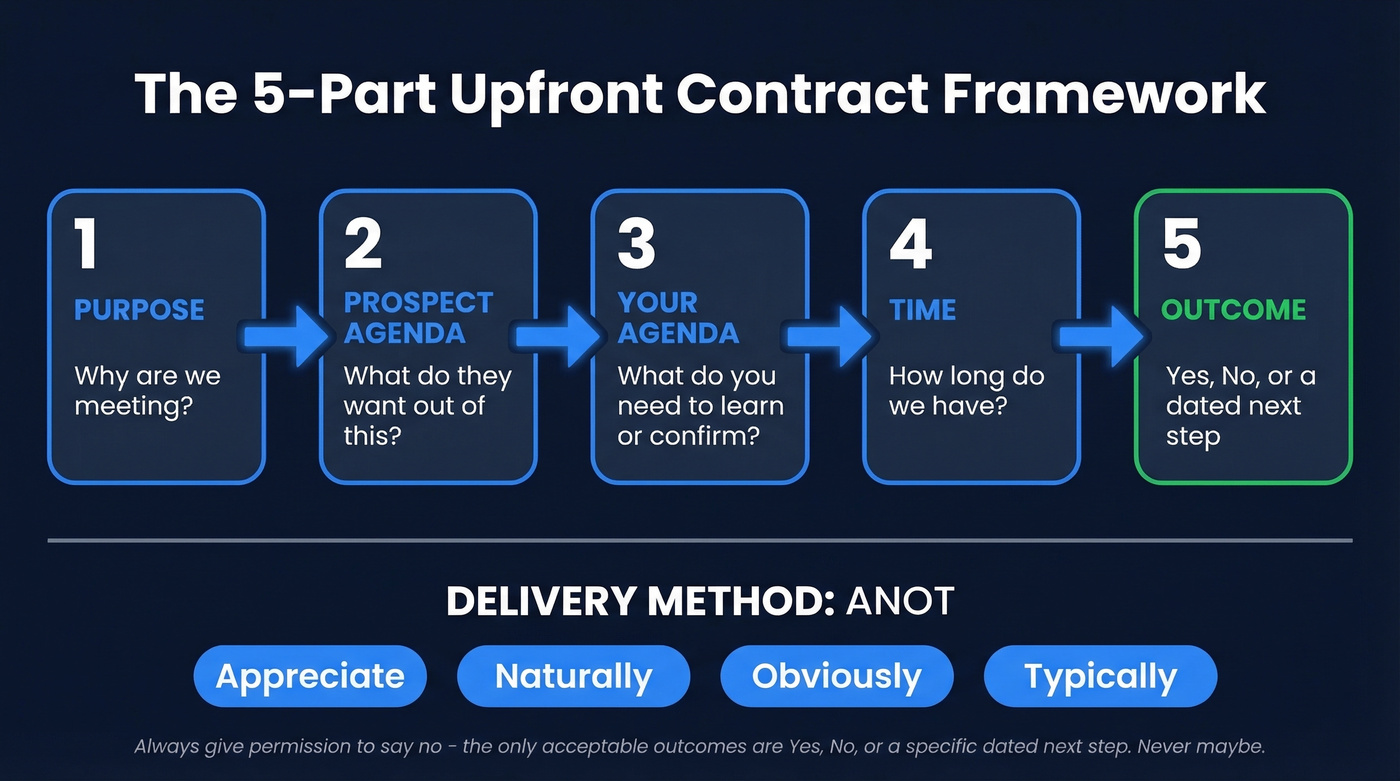
- Purpose - Why are we meeting?
- Prospect's agenda - What do they want out of this?
- Your agenda - What do you need to learn or confirm?
- Time - How long do we have?
- Outcome - What happens at the end? Yes, No, or a dated next step.
The delivery method is ANOT - Appreciate, Naturally, Obviously, Typically. It's a framing device you'll see in the discovery script below. The "permission to say no" principle is what separates a UFC from a pushy agenda. Three acceptable outcomes exist: yes, no, or a specific dated next step. Never "maybe."
Copy-Paste UFC Scripts
Discovery Call
This script uses the ANOT framework with permission to say no:
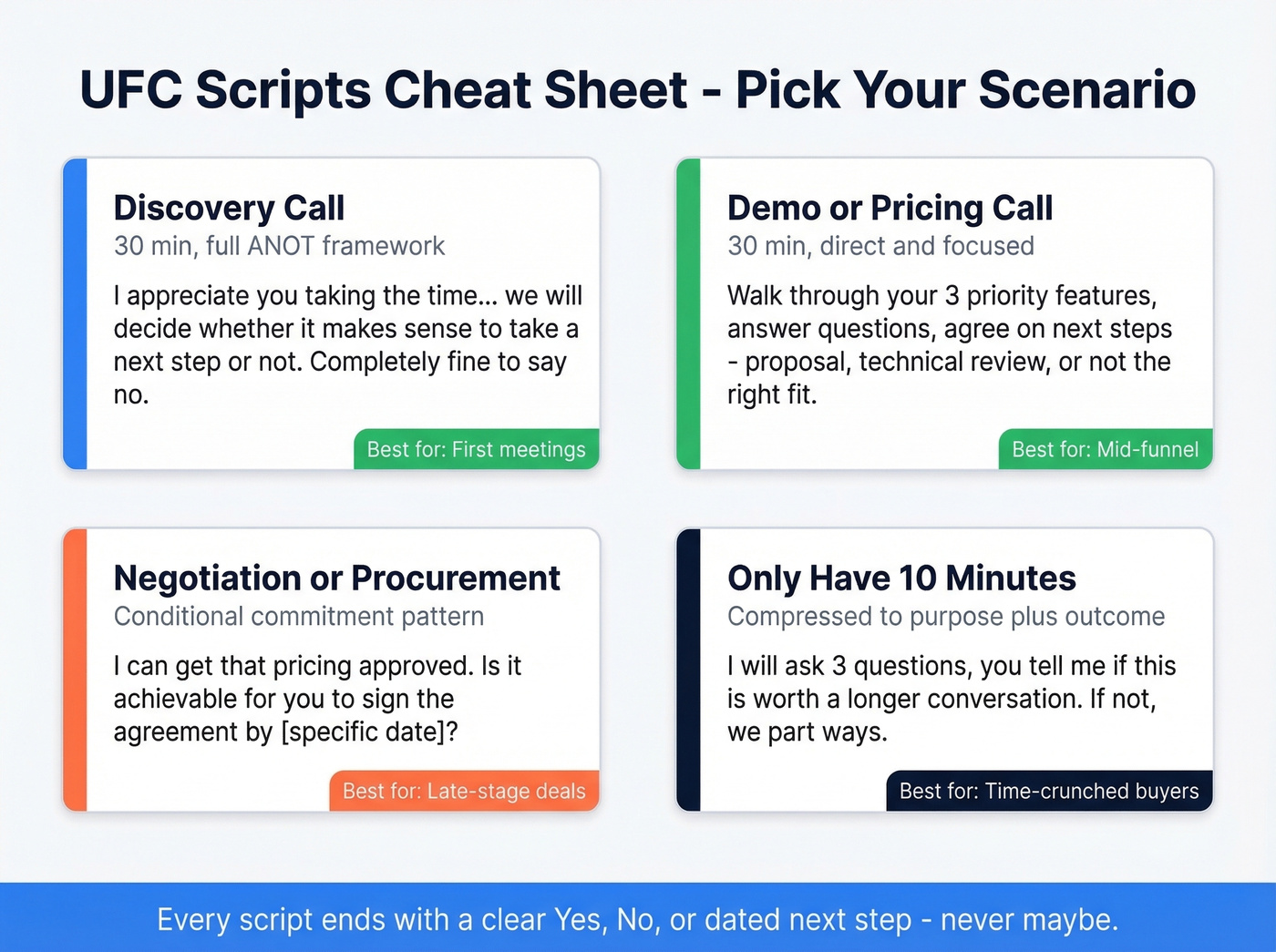
"I appreciate you taking the time today. Naturally, you probably want to understand whether we can actually help with [specific problem]. Obviously, I'd love to learn more about your situation too. Typically, what works best is if we spend the first 20 minutes on your challenges, then I'll share how we've helped similar teams - and by the end of our 30 minutes, we'll decide whether it makes sense to take a next step or not. If it doesn't, feel free to let me know - it's completely fine to say no. Does that sound fair?"
That last line is the whole game. It reframes the call from a pitch into a mutual evaluation.
Demo / Pricing Call
"We've got 30 minutes. I'd like to walk through the three features you flagged as priorities, answer your questions, and by the end, we'll either agree on next steps - whether that's a proposal, a technical review, or deciding this isn't the right fit. Fair?"
Short. Direct. No one's confused about what happens at minute 31.
Negotiation / Procurement
Discounts without a signed-by date are donations, not negotiation. Use the conditional commitment pattern:
"I can get that pricing approved. Is it achievable for you to sign the agreement by [specific date]?"
If they can't commit to a date, don't commit to a discount. The reciprocity is the point.
One critical pitfall here: don't set a deadline the buyer can't actually hit. Asking an enterprise prospect to sign today when their procurement cycle runs six weeks makes you look like you've never sold to their segment. We've seen reps blow deals this way - the UFC should match the buyer's reality, not just your quota timeline.
"We Only Have 10 Minutes"
Compress to purpose + outcome: "Understood - let's make it count. I'll ask three questions, you tell me if this is worth a longer conversation. If not, we part ways. Good?" This works because you're respecting their constraint while still contracting for a clear outcome.
Multi-Stakeholder / Enterprise
"Before we get started - who else needs to weigh in before a decision gets made? I want to make sure we're building toward a meeting that includes the right people, not one that creates another meeting."
This prevents the "I need to run this by my VP" stall. It's also the single most underused UFC move in enterprise sales.

Your upfront contract locked in Thursday at 2pm. But the email bounces and the direct dial is dead. Prospeo refreshes 300M+ contacts every 7 days with 98% email accuracy - so your follow-up actually lands.
Stop losing contracted next steps to bad data.
Handling Prospect Pushback
"Just show me the demo." - "Happy to - let's agree on what a good outcome looks like after you see it."
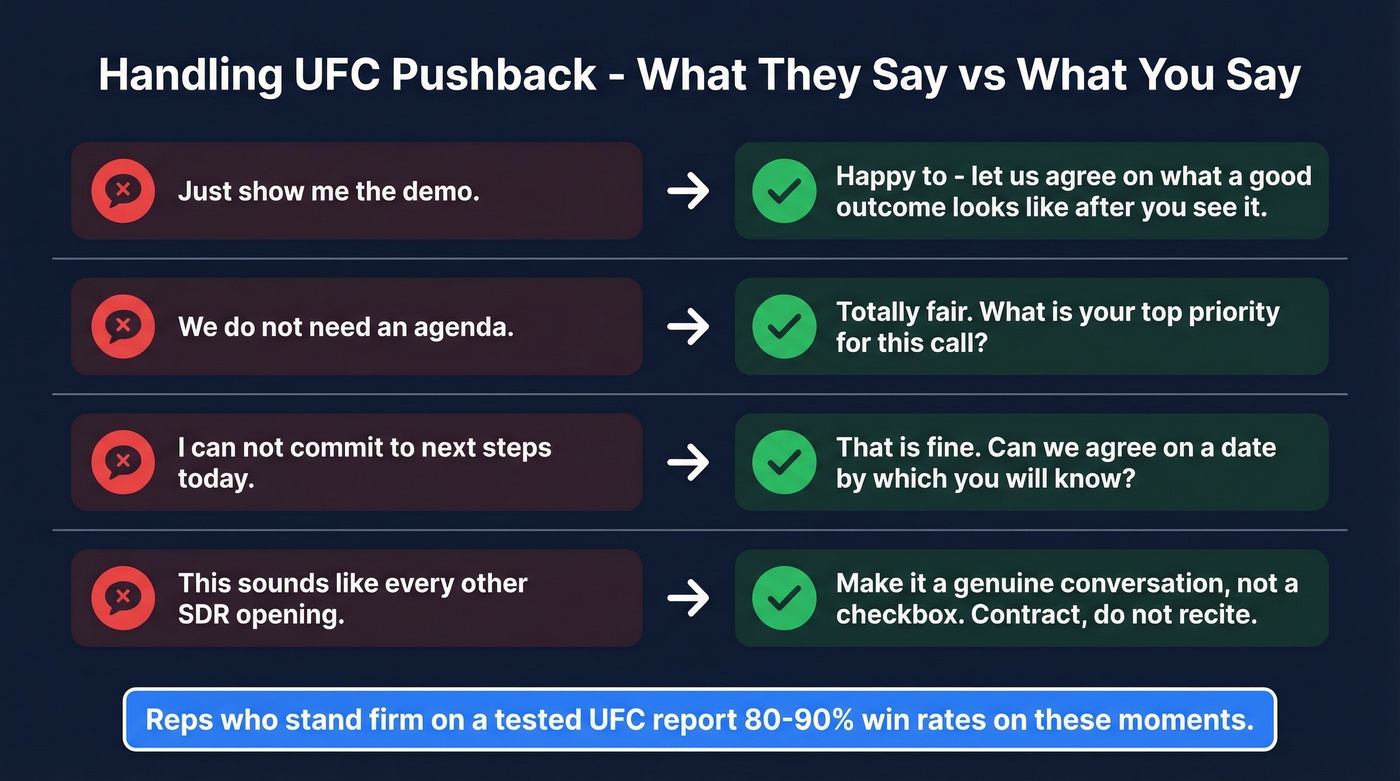
"We don't need an agenda." - "Totally fair. What's your top priority for this call?"
"I can't commit to next steps today." - "That's fine. Can we agree on a date by which you'll know?"
"This sounds like every other SDR's opening." - Look, if your UFC sounds scripted, the problem isn't the framework. It's that you're reciting instead of contracting. One rep on r/salestechniques put it simply: UFCs made calls "cleaner and more predictable." But only when they felt like a genuine conversation, not a checkbox.
If you enforce the contract - especially in procurement and discount scenarios - you'll win a lot of these moments. One experienced Sandler practitioner puts their personal win rate at 80-90% when they stand firm on a tested UFC.
Make the Next Step Real
A perfectly executed upfront contract is worthless if you can't reach the buyer for the follow-up. You contracted for Thursday at 2pm - but the email bounces, the phone number goes to a generic line, and you're back to guessing.
HubSpot's State of Sales Report found that 58% of reps say landing best-fit deals is their most effective technique. But "best-fit" requires verified contact data, not stale records from last quarter's org chart. We've watched reps nail the UFC, get a firm next step, and then lose the thread because their data was garbage. That's a solvable problem - tools like Prospeo refresh contact data every 7 days and verify emails at 98% accuracy, so your follow-up actually lands.

UFCs Across Sales Methodologies
Stop thinking of the UFC as a Sandler-only tool.
SPIN Selling was built on 35,000+ sales calls across 20+ countries over 12 years. Challenger was validated across 6,000+ reps - Xerox saw a 17% sales lift and $65M in contract value after implementing it. Both still need a structured opening and agreed-upon outcomes. That's the UFC.
The upfront contract is the operating system. The methodology is the app. TDIndustries went from 5% to 50% conversion in three years using the full Sandler framework, and the UFC was the first piece they implemented. Let's be honest - if you're running any structured sales process without contracting for outcomes upfront, you're leaving pipeline to chance.
Quick Coaching Checklist
Score every call on these five items:
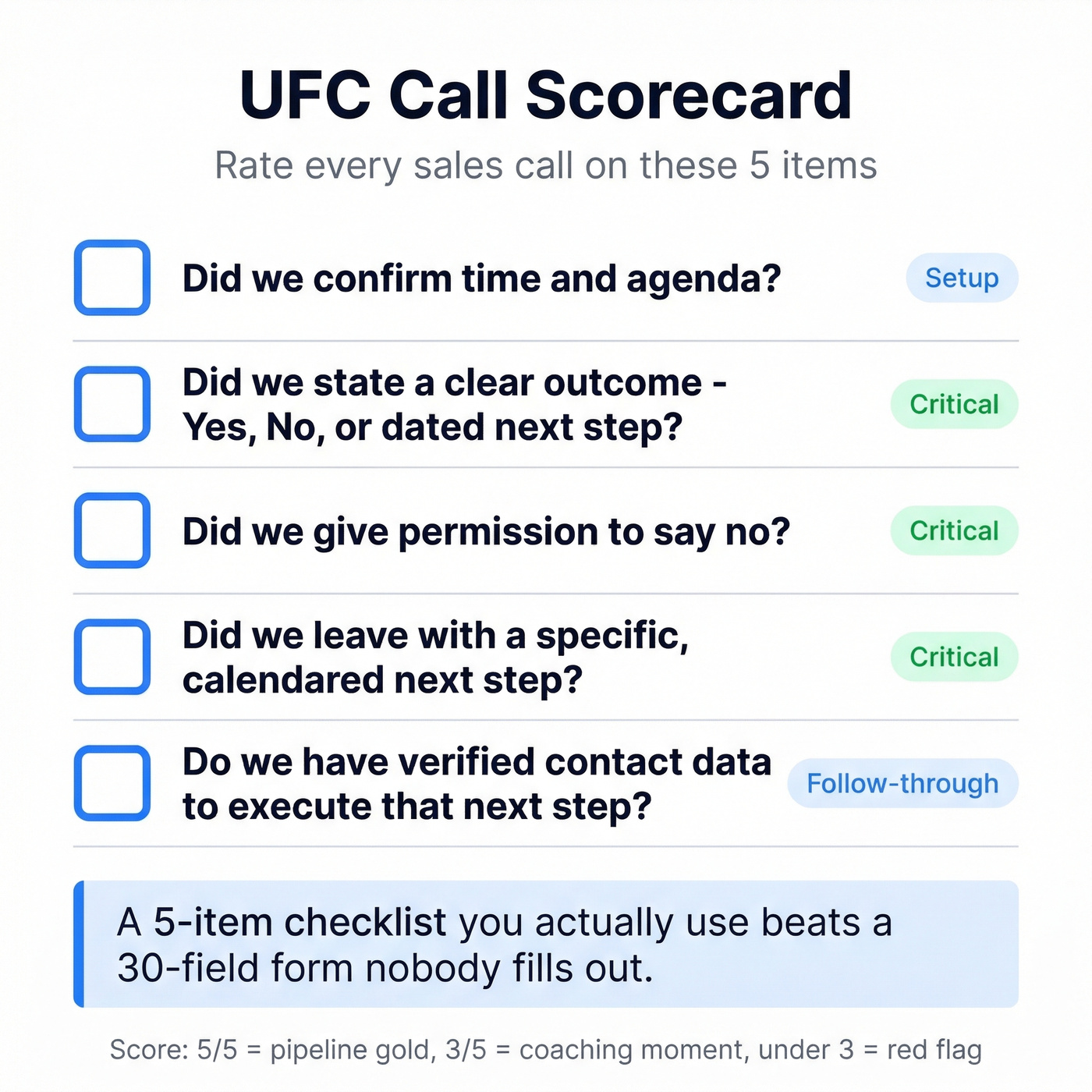
- ✅ Did we confirm time and agenda?
- ✅ Did we state a clear outcome - Yes, No, or dated next step?
- ✅ Did we give permission to say no?
- ✅ Did we leave with a specific, calendared next step?
- ✅ Do we have verified contact data to execute that next step?
A five-item checklist you actually use beats a 30-field form nobody fills out.
Skip this framework if your sales cycle is purely inbound self-serve with no human touchpoint. UFCs are built for conversations. If there's no conversation, there's nothing to contract.
You just got a firm 'yes' from the decision-maker. Now you need verified contact data for every stakeholder in the room. Prospeo gives you emails, direct dials, and 50+ data points per contact - at $0.01 per email.
Close the deal your UFC opened. Start with real contact data.
FAQ
Is an upfront contract a legal document?
No. It's a verbal or written agreement setting expectations for a sales conversation - not a binding legal contract. "Contract" here means mutual commitment to an agenda and outcome, not legal enforceability. You can set one via email, phone, or the first 60 seconds of a meeting.
What if the prospect refuses to agree to an outcome?
That's a disqualification signal. A buyer who won't commit to a yes, no, or dated next step typically isn't serious about evaluating your solution. Protect your pipeline and redirect time toward engaged prospects.
Does the UFC work for cold calls?
It does, but you've got about 15 seconds to earn the right to set one. Lead with a relevant pain point, then compress the UFC to its core: "I've got a quick question - if it's not relevant, I'll let you go. Fair?" That's a UFC in one sentence.
What tools help upfront contracts actually stick?
Any tool that ensures your contracted next step reaches the right person with verified contact info. Prospeo refreshes data every 7 days and offers a self-serve free tier with no commitments - so your Thursday 2pm follow-up actually lands in a real inbox.