

How to Verify an Email Address - And Which Tools Actually Work
You uploaded 5,000 leads and 800 bounced on the first send. Your domain reputation tanked, your sequences stalled, and now you're explaining to your manager why half the pipeline is frozen. We've watched this happen to teams over and over - only about 81% of stored email addresses are valid, which means nearly 1 in 5 will bounce. With 392.5 billion emails sent daily in 2026, the margin for error is razor-thin: cross the 2% bounce threshold and inbox providers start throttling you. Some industries average nearly 9% bounce rates, four times the safe limit.
The fix is simple: verify every email address before you hit send.
Quick Version
Email marketing returns $36-$40 per dollar spent - but only if your emails actually land. Three scenarios, three approaches:
- Checking a single address before sending? Use a free tool like Hunter's verifier or ZeroBounce's free checker (100 monthly credits with a business domain signup). Paste, check, done.
- Cleaning an existing list of thousands? Bulk verifiers like NeverBounce or ZeroBounce will scrub your CSV for about $8-$10 per thousand emails.
How Email Verification Works
Every verification tool runs roughly the same four-step process behind the scenes. Understanding it helps you spot where tools cut corners.
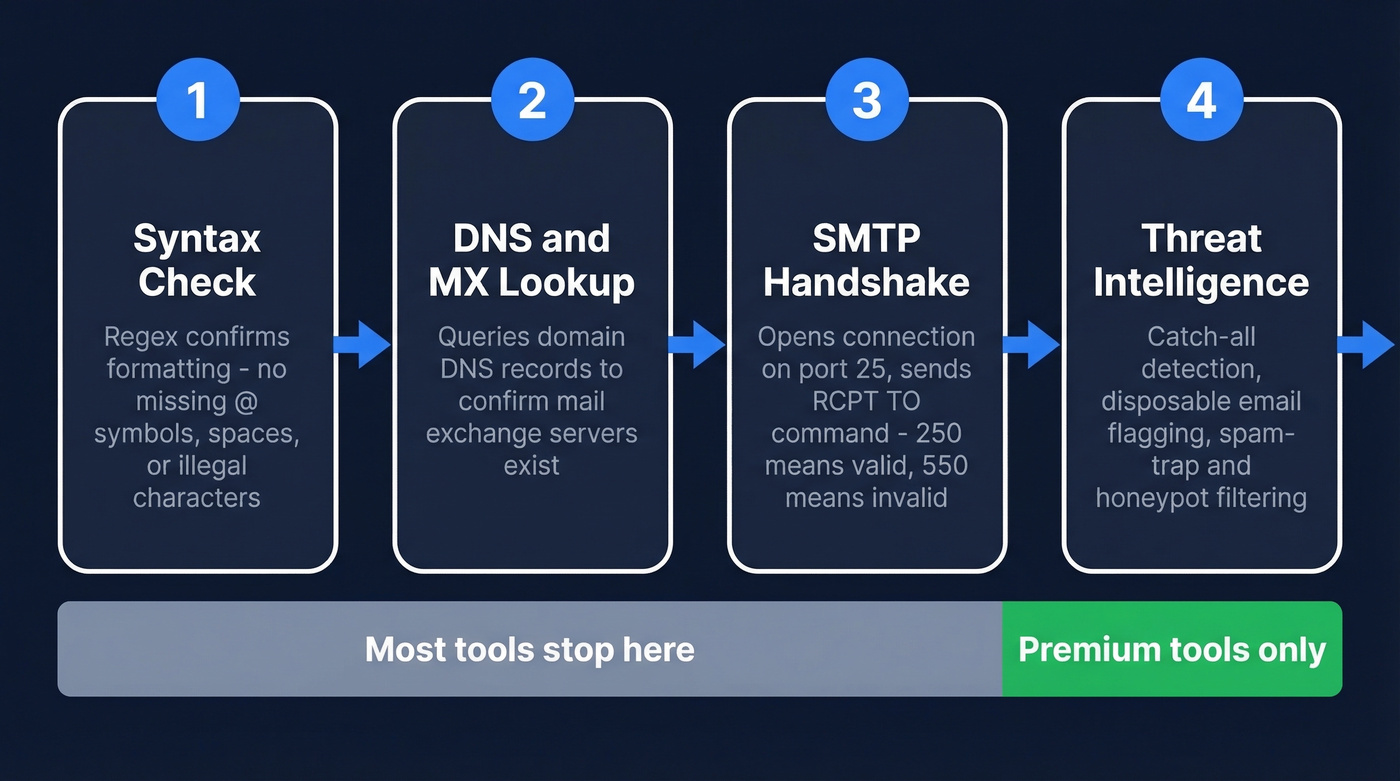
Step 1: Syntax check. The tool runs a regex pattern to confirm the address is formatted correctly - no missing @ symbols, no spaces, no illegal characters. This catches obvious typos and junk entries.
Step 2: DNS and MX lookup. The tool queries the domain's DNS records to confirm mail exchange servers exist. No MX record means the domain can't receive email. Dead end.
Step 3: SMTP handshake. This is where the real work happens. The tool opens a connection to the mail server on port 25, initiates a handshake, and issues a RCPT TO command with the target address. A 250 response means the mailbox is accepted; a 550 means it doesn't exist. The tool disconnects before actually sending anything - no email message is delivered during verification.
Step 4: Threat intelligence. The best tools add a final layer: catch-all detection, disposable email flagging, spam-trap identification, and honeypot filtering. This is where quality diverges sharply between cheap and premium verifiers.

One important warning: running large-scale SMTP probing from your own server will trigger Directory Harvest Attack detection and get your IPs blacklisted. Dedicated verification tools exist specifically because they rotate infrastructure to avoid this.

Most teams find emails, then pay again to verify them, then still get bounces from catch-all domains. Prospeo's proprietary 5-step verification - including catch-all resolution and spam-trap removal - runs before you ever see the email. 98% accuracy across 143M+ emails, refreshed every 7 days.
Stop running emails through two tools. Get them verified at the source.
The Catch-All Problem
You ran the same 100 emails through three different verifiers and got three different answers. The consensus on r/coldemail is that this happens constantly, and it's maddening.
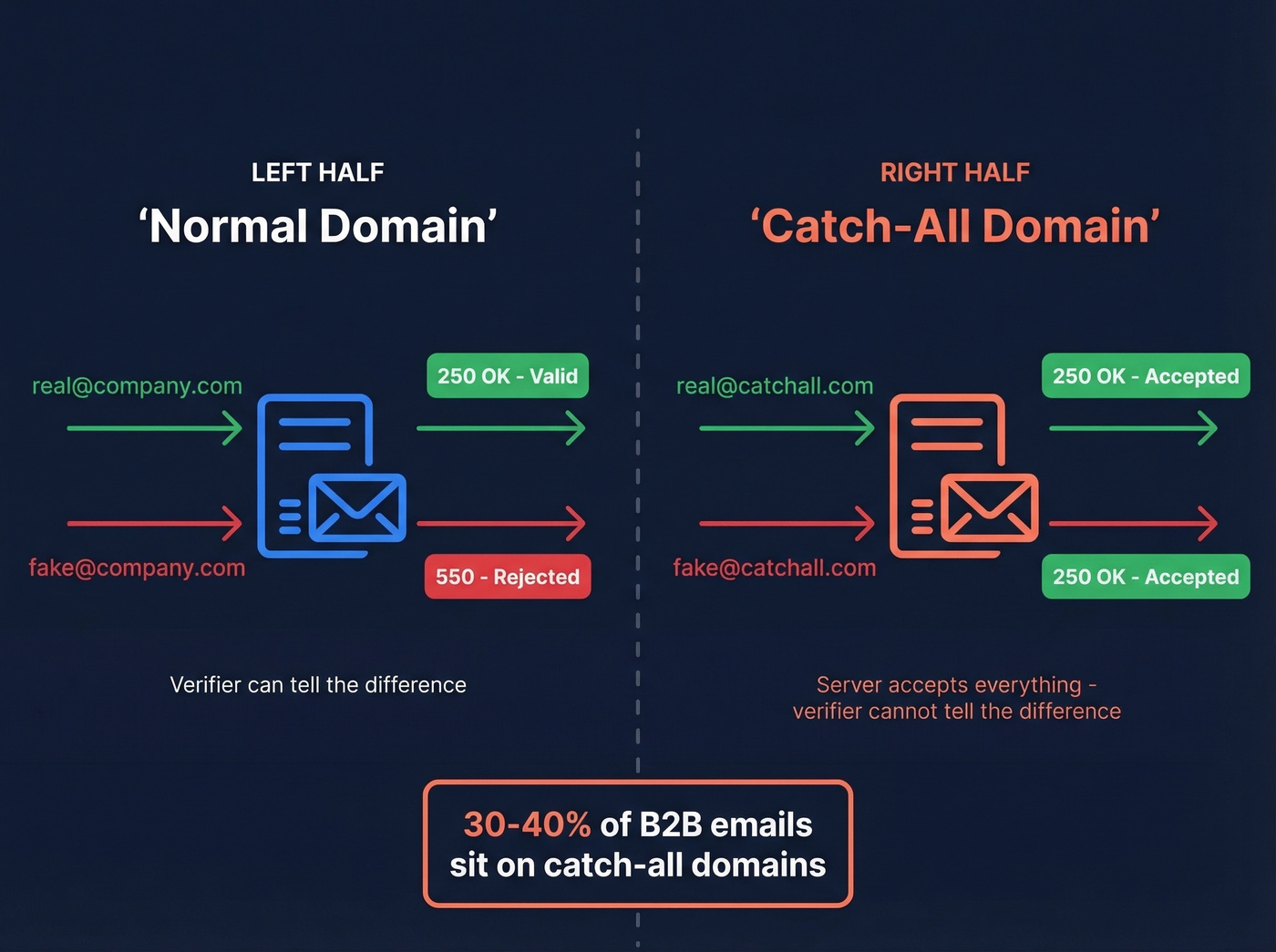
Here's why. Between 30-40% of B2B email addresses sit on catch-all domains - servers configured to accept mail for any address, real or fake. When a verifier sends that RCPT TO command, the server returns 250 OK regardless. The tool can't distinguish a real inbox from a black hole, so it returns "unknown" or "risky."
In our testing, the catch-all problem is the single biggest source of tool disagreement. Most verifiers stop at that "unknown" verdict and leave you guessing. If a tool returns "unknown," don't automatically discard the address - but don't blast it from a brand-new cold domain either. Route unknowns through a second verifier, or treat them as lower-priority until you have more signals.
Let's be honest: the accuracy numbers every vendor plasters on their homepage are meaningless without catch-all resolution rates. A tool that claims 99% accuracy but punts on every catch-all domain is just ignoring the hardest third of your list.
Best Tools to Verify an Email Address
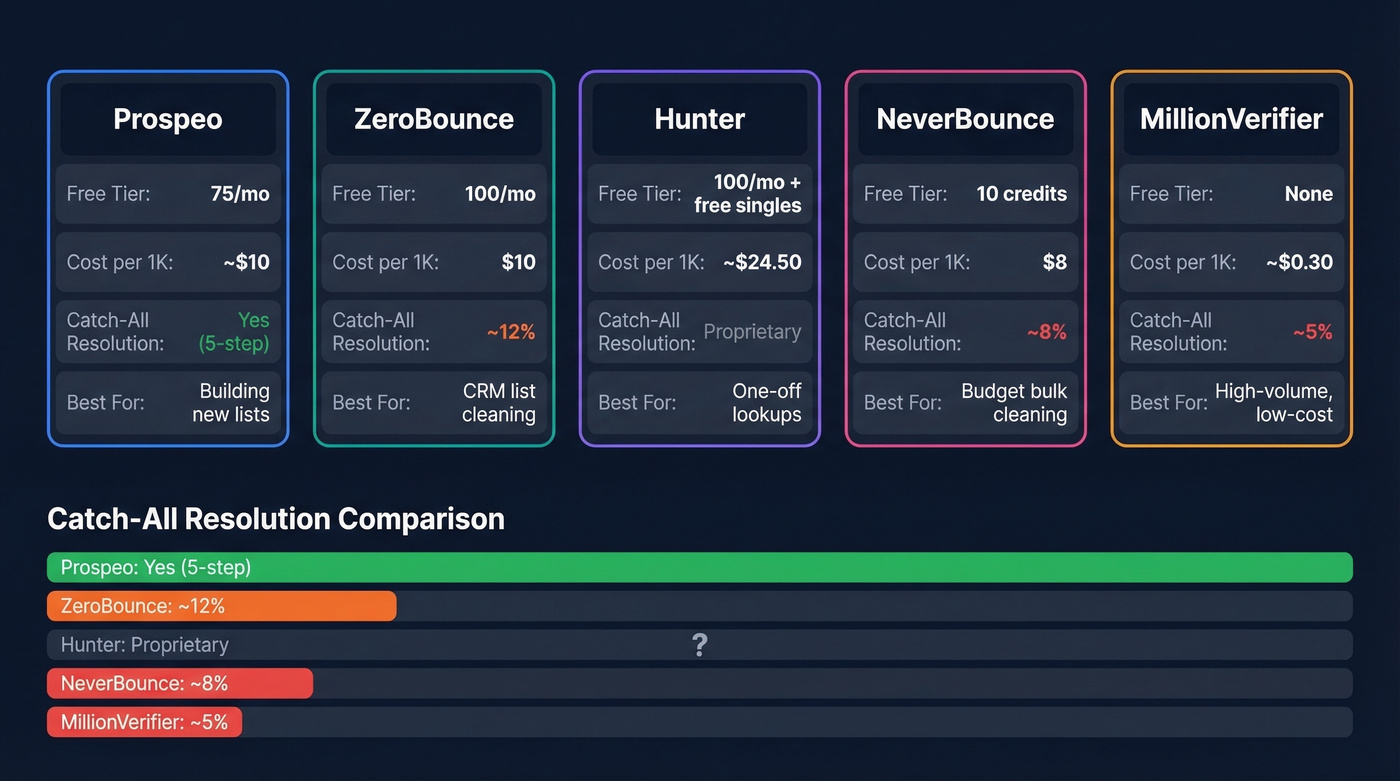
| Tool | Free Tier | Cost per 1K | Catch-All Resolution | Best For |
|---|---|---|---|---|
| Prospeo | 75/mo | ~$10 | Yes (5-step) | Building new lists |
| ZeroBounce | 100/mo | $10 | ~12% | CRM list cleaning |
| Hunter | 100/mo + free single checks | ~$24.50 | Proprietary | One-off lookups |
| NeverBounce | 10 credits | $8 | ~8% | Budget bulk cleaning |
| MillionVerifier | None | ~$0.30 | ~5% | High-volume, low-cost |
Prospeo
If your problem is "I need verified emails for outbound," Prospeo eliminates the extra verification step entirely. You search for contacts across 300M+ professional profiles, and every email comes back pre-verified through a proprietary 5-step process - syntax, DNS, SMTP, catch-all resolution, and threat intelligence. The result is 98% email accuracy across 143M+ verified emails, with data refreshed every 7 days versus the 6-week industry average.
The free tier gives you 75 emails per month to test. Paid plans start at roughly $0.01 per email with no annual contracts. For outbound teams, this is the difference between "find emails, then verify them" and just having verified emails ready to go. One of our users, Stack Optimize, built to $1M ARR while maintaining 94%+ deliverability and sub-3% bounce rates across all their clients - that's the kind of downstream impact clean data has.
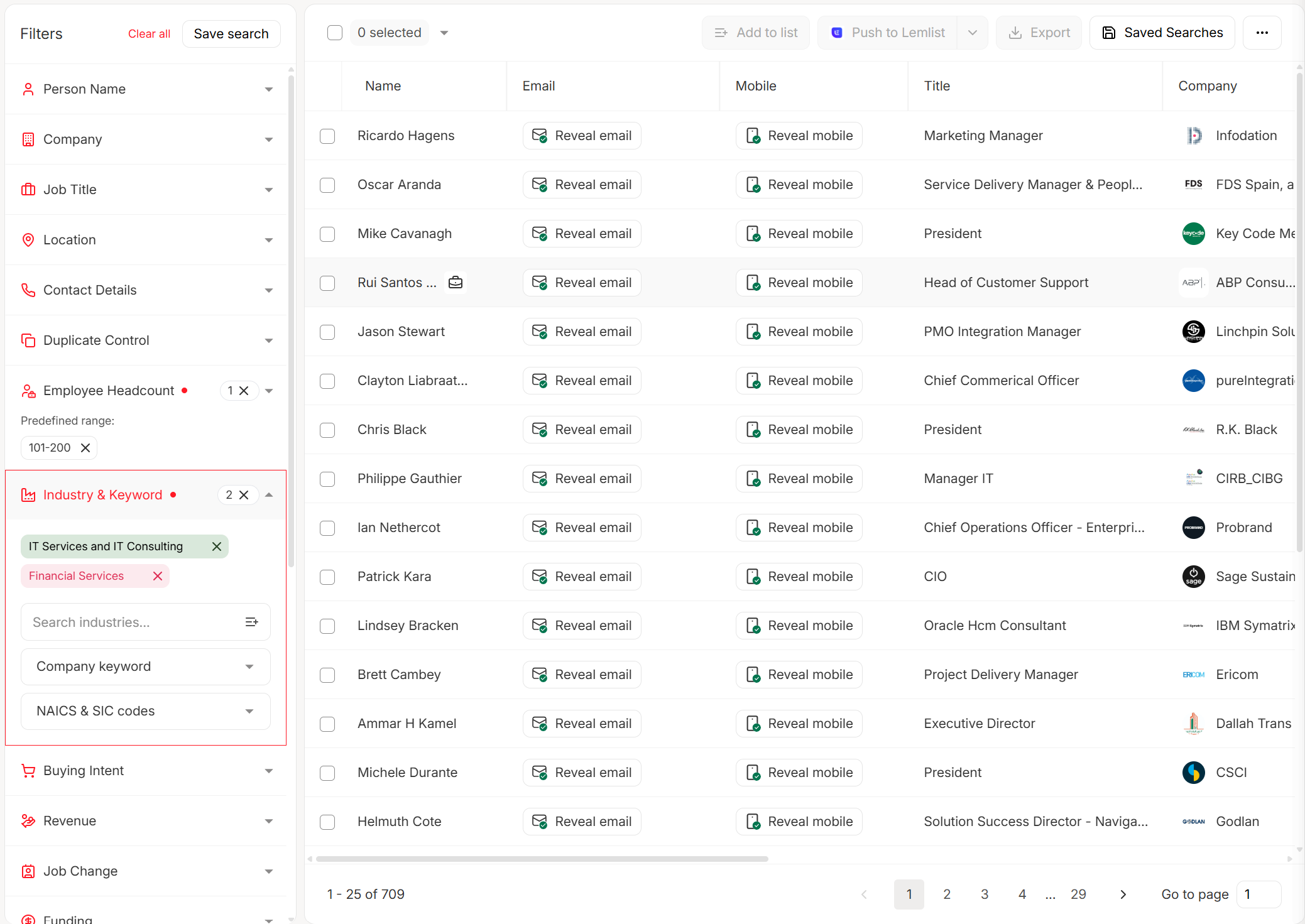
The catch-all problem tanks most verifiers. Prospeo doesn't punt on unknowns - our 5-step process resolves catch-all domains so you're not guessing on 30-40% of your list. That's why teams like Stack Optimize maintain sub-3% bounce rates across every client campaign.
Kill your bounce rate for $0.01 per email. No contracts, no sales calls.
ZeroBounce
ZeroBounce is the go-to standalone verifier for teams cleaning existing CRM lists. You get 100 free verifications per month with a business domain signup, and bulk pricing runs about $10 per 1,000 emails. They market a 99.6% accuracy rate to their 500K+ customers.
Here's the thing: in Hunter's benchmark of 3,000 real business emails, the best performer hit just 70% overall accuracy. That 99.6% is a marketing number, not a field result. A separate 10,000-email bake-off puts ZeroBounce's catch-all resolution at roughly 12%, with a 0.9% false positive rate and 1.3% false negative rate. ZeroBounce is still solid for basic list hygiene - just calibrate your expectations against real-world benchmarks, not homepage claims.
Hunter
Most verification tools lead with inflated accuracy numbers. Hunter does the opposite - and that's why they're worth the premium for certain use cases.
Hunter benchmarked 15 tools against 3,000 real business email addresses, and the top score was 70% overall accuracy. That was Hunter's own score. They acknowledge their "ground truth" labeling may give Hunter an edge if addresses overlap with their database, but the overall accuracy ceiling is the real takeaway. Nobody is close to perfect.
You get free single checks with no signup, plus up to 100 verifications per month on their free plan. Bulk pricing is around $24.50 per 1,000 - the most expensive option on this list. What you're paying for is their proprietary catch-all verification, which uses partnerships with major email providers. Over 6M users and strong G2/Capterra ratings back it up. Worth it for teams that need high-confidence single lookups, less so for bulk cleaning where cheaper options perform comparably.
NeverBounce
Skip this if more than 20% of your list sits on catch-all domains.
NeverBounce is a reliable bulk cleaner at $8 per 1,000 emails, but bake-off testing puts catch-all resolution around 8%. For straightforward valid/invalid sorting on large lists where catch-all isn't a major concern, it gets the job done at a fair price. For anything else, you'll want a second pass with a tool that handles catch-alls better.
MillionVerifier
The budget option. At $0.30 per 1,000 emails, it's an order of magnitude cheaper than everything else on this list. Catch-all handling sits around 5% resolution.
We've seen teams use MillionVerifier as a first pass to strip obvious invalids, then run the remaining "unknowns" through a more capable verifier. That two-step approach keeps costs down without sacrificing too much accuracy - and for high-volume, low-stakes list cleaning where you'd rather save money and accept some unknowns, it's a perfectly reasonable starting point.
How Often to Re-Verify
Professional turnover hit 41% in recent years, with 38% of employees leaving within their first year. Your "verified" list from six months ago has already decayed significantly.
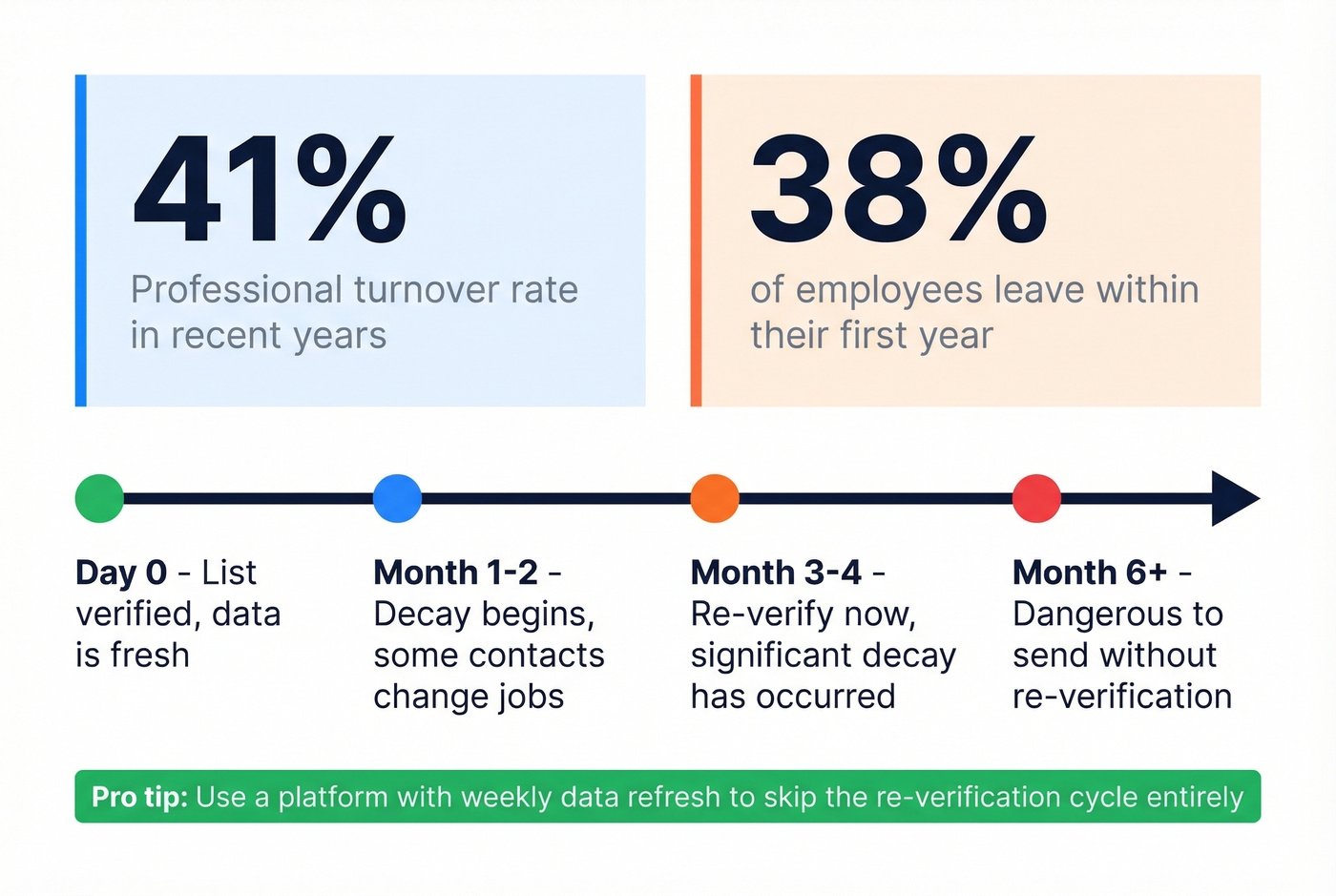
Re-verify every 3-4 months at minimum. Or sidestep the problem entirely by sourcing contacts from a platform with a weekly data refresh cycle, so the emails you pull are already current when they hit your outreach tool.
For more on keeping bounces low, see our guide to bounce rate benchmarks and fixes, plus the full email deliverability playbook.
FAQ
Is email verification legal?
Yes. Verification checks whether a mailbox can receive email without delivering a message. Whether your overall workflow is compliant depends on your jurisdiction and how you use the data, especially for outreach and storage under GDPR or CAN-SPAM.
Can I verify emails for free?
Most tools offer free tiers: 75/month from Prospeo, 100/month from ZeroBounce (business domain signup required), and free single checks plus up to 100/month from Hunter. For bulk verification of thousands, expect paid plans ranging from $0.30 to $24.50 per 1,000 emails depending on catch-all capabilities.
What's the difference between validation and verification?
Validation checks formatting - does the address follow proper syntax rules like a valid local part and domain? Verification goes further by contacting the mail server via SMTP to confirm the mailbox exists and can receive email. Every modern verification tool runs validation automatically as its first step.
Which free email checker handles catch-all domains best?
Among free tiers, Prospeo's 75 monthly credits include full 5-step verification with catch-all resolution - most free tools skip that step entirely. Hunter's free plan uses proprietary catch-all handling but limits you to 100 checks. ZeroBounce's free tier resolves roughly 12% of catch-alls, which still leaves most unknowns unresolved.