

Website Deanonymization: What Actually Works in 2026
Website deanonymization is a $1B industry built on a shaky promise: tell you who's visiting your site. Industry testing from vendor reports puts most providers around 5-30% accuracy at person-level identification. The #1 Google result for the topic is literally a 404 page. That tells you everything about the maturity of this space.
The Short Version
Before we get into the weeds:
- Company-level identification - knowing which companies visit - works. In good conditions, expect 30-65% company identification. If you want to test cheaply, start with RB2B's Free plan (150 company-level resolutions/month) or Leadinfo for EU-focused coverage.
- Person-level identification is mostly hype. Realistic accuracy is 5-20%, often US-only, and vendors commonly pad results with "likely" contacts that are educated guesses, not confirmed visitors.
- To actually reach people at identified companies, pair any visitor identification tool with a B2B data platform like Prospeo for verified emails and direct dials. Deanonymization tells you where to look - you still need accurate contact data to start conversations.
How Visitor Identification Actually Works
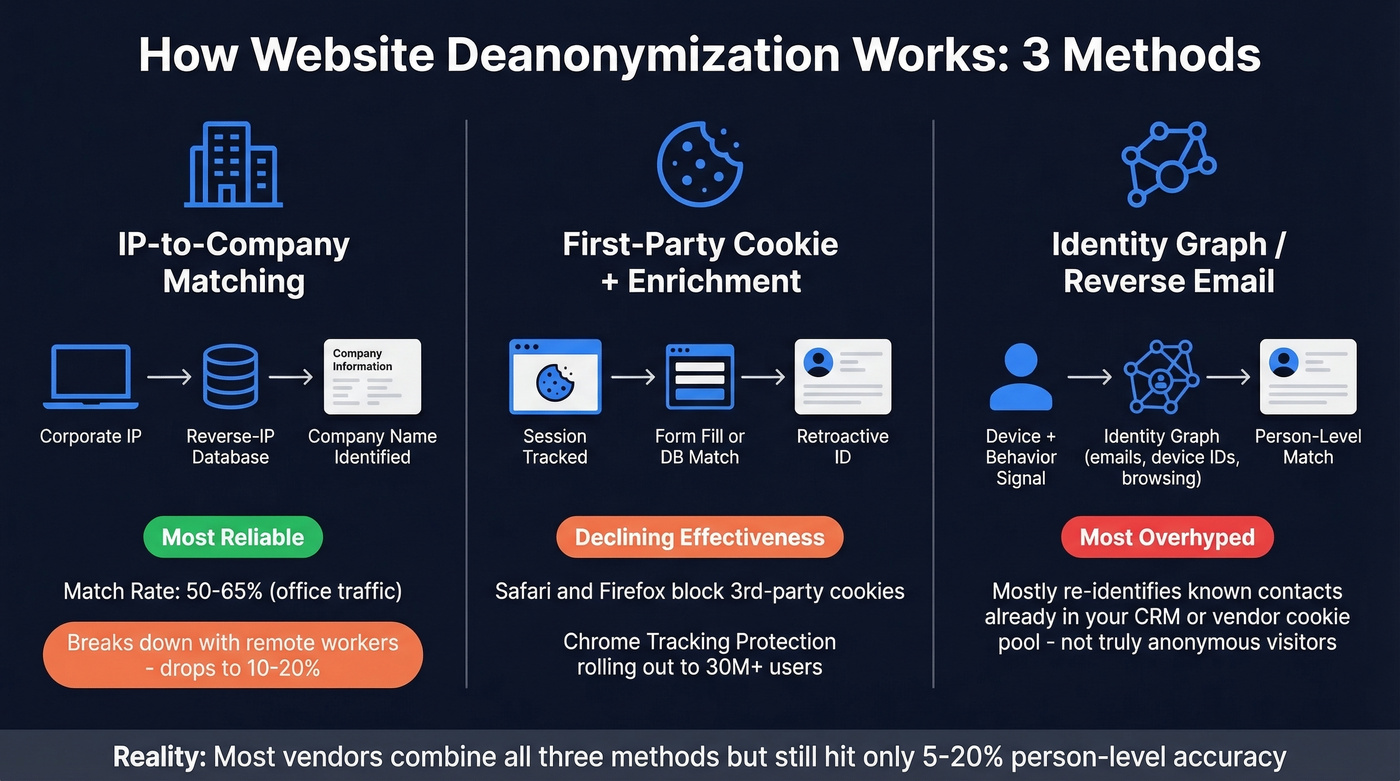
Three methods power every tool on the market. Understanding them explains why accuracy varies so wildly - and why many practitioners suspect vendors are reselling data from the same one or two underlying providers.
IP-to-Company Matching
Every organization with an office has a fixed IP range. When someone visits from a corporate network, the tool maps that IP to a company database - providers like Demandbase maintain large reverse-IP datasets for exactly this purpose.
This is the most reliable method. It's also the most limited. A common 2026 benchmark in vendor testing frameworks is that 60%+ of knowledge workers are remote or hybrid, which means a huge chunk of traffic comes from residential IPs that can't be mapped cleanly. Enterprise office IP traffic can hit 50-65% match rates. Remote workers at the same company? 10-20%.
First-Party Cookie + Enrichment
When a visitor lands on your site, a first-party cookie tracks their session. If that visitor later fills out a form or matches against an enrichment database, the tool retroactively identifies them.
But Safari and Firefox already block third-party tracking cookies, and Chrome - with ~65% global browser share - has rolled out Tracking Protection to roughly 30 million users, with broader restrictions coming. Cookie-based identification is getting harder, not easier.
Identity Graph / Reverse Email Lookup
This is where "person-level" claims come from. Vendors maintain identity graphs linking email addresses, device IDs, and browsing behavior. When a visitor matches a record, you get a name.
In practice, this mostly means recognizing known contacts - people already in your CRM or the vendor's cookie pool - rather than discovering truly anonymous visitors. As one Reddit practitioner put it, these tools "need access to your CRM" and that CRM data becomes the "genesis" for identification. Not magic.
The Accuracy Reality Check
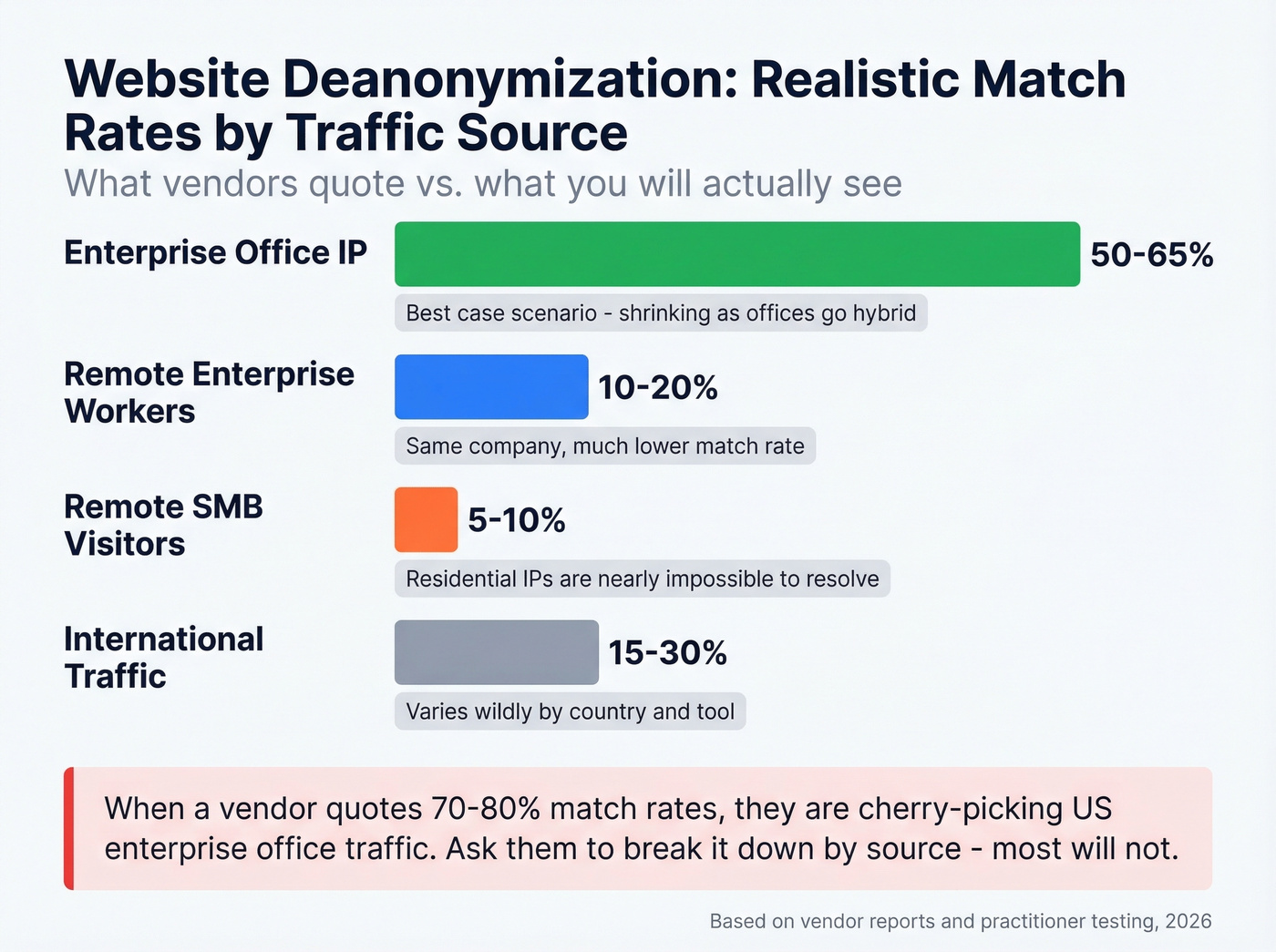
Match rates depend almost entirely on who's visiting your site:
| Traffic Source | Expected Match Rate |
|---|---|
| Enterprise office IP | 50-65% |
| Remote enterprise | 10-20% |
| Remote SMB | 5-10% |
| International | 15-30% |
When a vendor quotes "70-80% identification rates," they're usually talking about premium resolution against US-heavy enterprise traffic. That's the best case, not the norm. Factors.ai claims match rates of up to 64% using data partners like 6sense and Clearbit - impressive for company-level identification, but still company-level.
We've seen this play out firsthand in practitioner tests shared across communities. In one early comparison, RB2B identified fewer visitors but matched accurately against form submissions, while Visual Visitor produced inaccurate results in the first 24 hours. The person-level results that do appear often include "likely" contacts - vendor-speak for "we're guessing based on job title and seniority." That's very different from definitively knowing who visited.
Here's the thing: any vendor claiming 90%+ match rates without publishing methodology is waving a red flag. Ask them to break it down by traffic source. Most won't.
Even Lead Forensics, with 1,000+ G2 reviews, has recurring complaints about lead quality, missing information, and outdated contacts. The data quality problem is industry-wide.

Visitor ID tools tell you a company visited - not who to email. Prospeo bridges that gap with 300M+ profiles, 98% verified emails, and 125M+ direct dials. Layer 30+ filters like buyer intent and job title to find the exact decision-maker at every identified company.
Turn anonymous traffic into booked meetings for $0.01 per verified email.
What It Costs
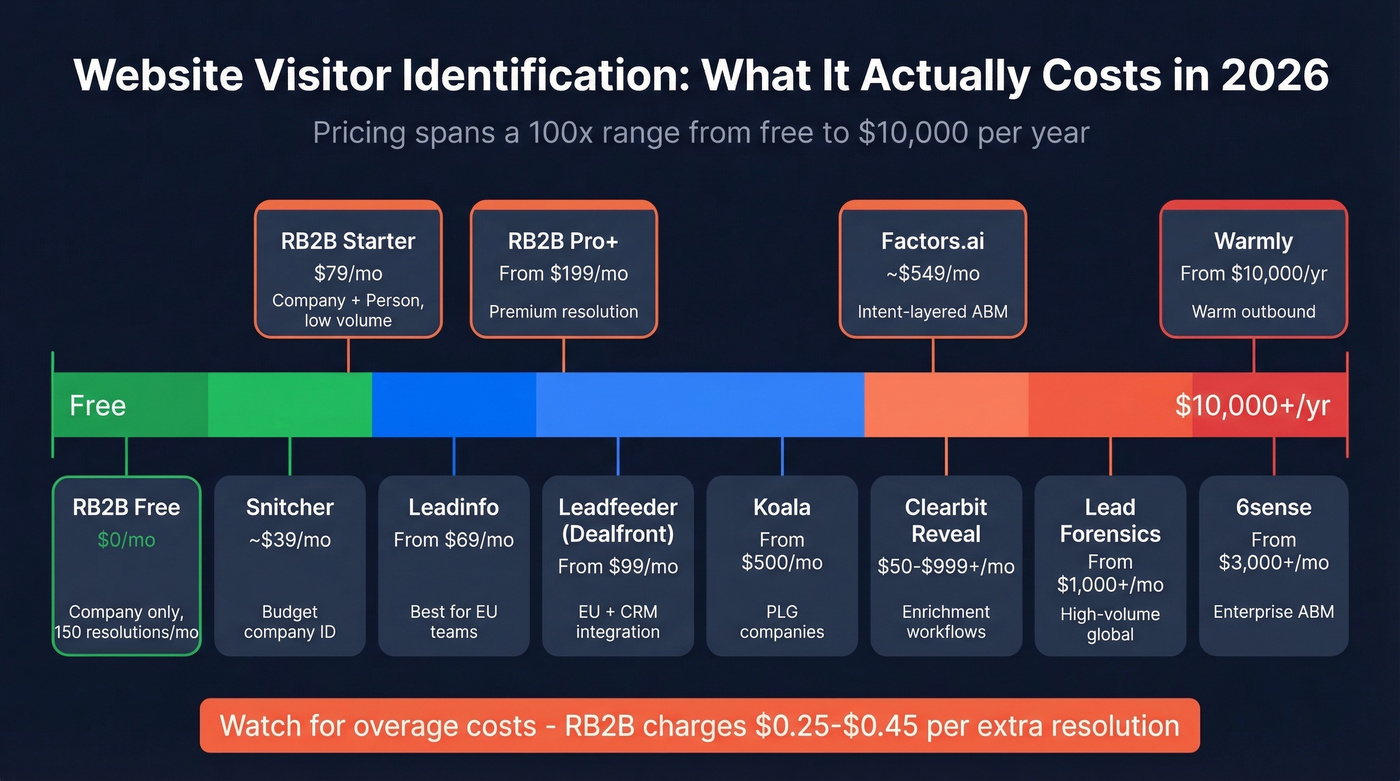
Pricing spans a 100x range depending on whether you need company-level or person-level identification:
| Tool | Level | Starting Price | Best For |
|---|---|---|---|
| RB2B (Free) | Company | $0/mo | Testing the concept |
| Snitcher | Company | ~€39/mo | Budget company ID |
| Leadinfo | Company | From €69/mo | EU teams |
| RB2B (Starter) | Company + Person | $79/mo | Low-volume testing |
| Leadfeeder (Dealfront) | Company | From €99/mo | EU + CRM integration |
| RB2B (Pro+) | Person + Company | From $199/mo | Higher coverage + premium resolution |
| Koala | Company | From $500/mo | PLG companies |
| Factors.ai | Company + Intent | ~$549/mo | Intent-layered ABM |
| Clearbit Reveal | Company | $50-$999+/mo | Enrichment workflows |
| Lead Forensics | Company | From €1,000+/mo | High-volume global |
| 6sense | Company + Intent | From $3,000+/mo | Enterprise ABM |
| Warmly | Person + Company | From $10,000/yr | Warm outbound |
Watch out for overage costs. RB2B charges $0.25-$0.45 per resolution beyond your plan limit, and that adds up fast on high-traffic sites.
Privacy and Compliance in 2026
Two legal frameworks define very different standards for de-anonymizing website traffic. GDPR's anonymization standard is stricter - Recital 26 says data is anonymous only when a person isn't identifiable by any reasonable means. CCPA uses a softer "cannot reasonably" standard for de-identified information. That gap is why many person-level tools restrict to US traffic. RB2B, for example, uses IP ringfencing to only resolve US traffic and doesn't touch EU visitors at the person level.
The regulatory environment is tightening. Updated CCPA regulations took effect January 1, 2026, with automated decision-making requirements hitting January 2027 and audit certifications due by April 2028. If you're running person-level identification, update your privacy policy now - not later.
When It's Right (and When to Skip It)
Use it if you want company-level intent signals. Knowing which accounts are researching you is genuinely valuable for account-based selling prioritization and sales timing. Pair it with your CRM to flag target accounts showing interest, then route those signals to reps who can act on them the same day.
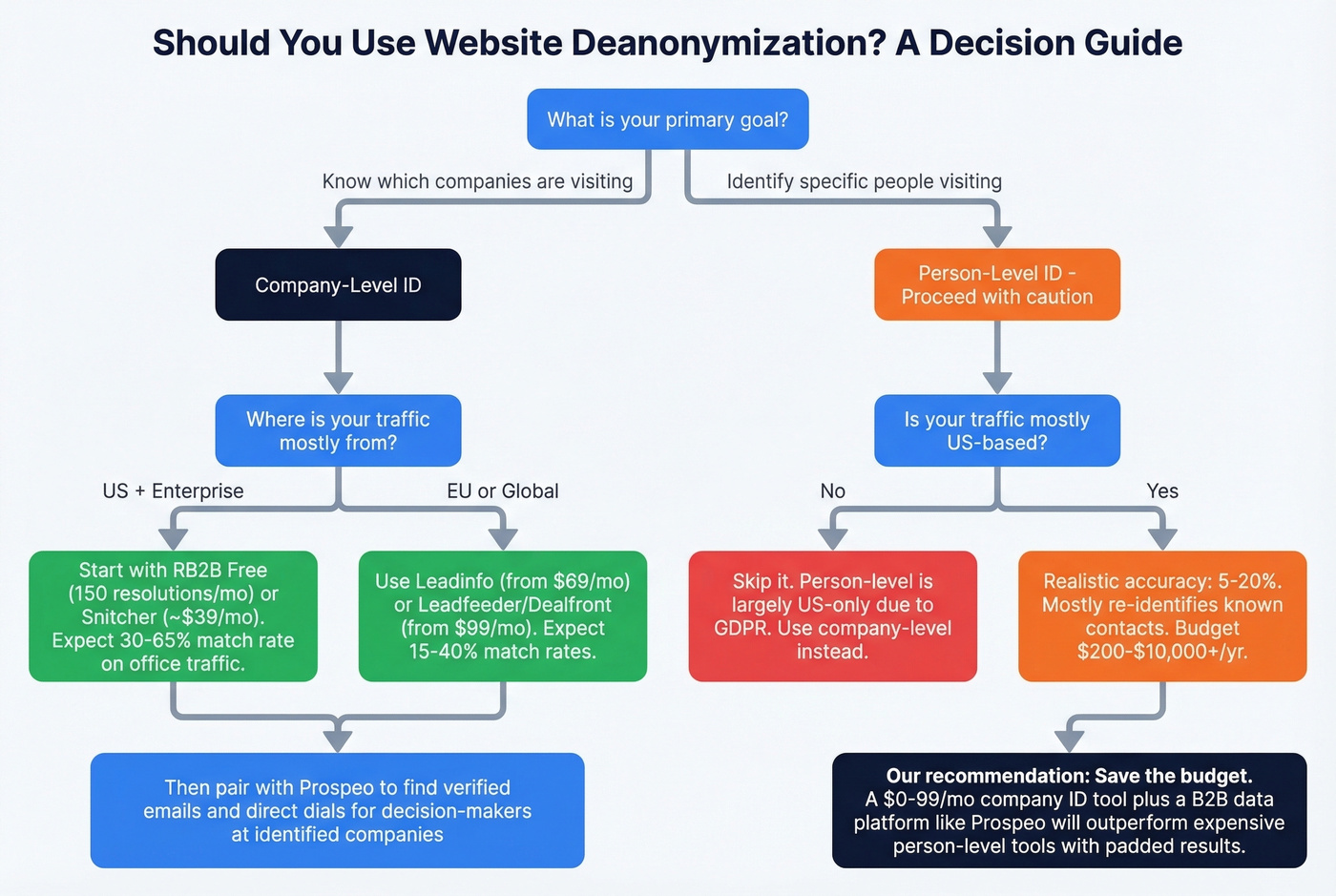
Skip it if you think it'll replace prospecting. It won't. Visitor identification is a signal source, not a lead gen engine.
Some vendors like Lift AI argue you should skip identification entirely and focus on behavioral intent scoring - routing visitors to chat or offers based on browsing patterns rather than identity. That's a valid approach for high-traffic PLG sites, but it sidesteps the core question most B2B teams have: which accounts are looking at us? Common Room takes a different angle, consolidating deanonymization signals alongside product usage, community activity, and social signals into one platform. Both perspectives have merit, but neither eliminates the need for accurate contact data once you've identified a target account.
Let's be honest about what our team has seen work best: most teams don't need person-level identification at all. A $0-99/mo company identification tool paired with a strong B2B lead generation solution will outperform a $10,000/yr person-level tool that surfaces "likely" contacts you can't trust. The winning workflow is straightforward - identify the company, then find verified contacts for the right people at that company using Prospeo, which returns 50+ data points per contact at a 92% API match rate with emails verified on a 7-day refresh cycle.

Person-level deanonymization hits 5-20% accuracy on a good day. Skip the guesswork. When visitor ID flags a company, use Prospeo's database - refreshed every 7 days - to pull verified emails and mobiles for the right buyers. 92% match rate on enrichment, no padded "likely" contacts.
Stop guessing who visited. Start reaching the people who matter.
FAQ
Is website deanonymization legal?
Company-level identification via reverse-IP is broadly legal in most jurisdictions. Person-level triggers CCPA and GDPR obligations depending on visitor location - many person-level tools restrict to US traffic to reduce GDPR exposure. Review your privacy policy either way.
What's a realistic match rate?
Company-level: 30-65% for office-based enterprise traffic, dropping to 5-10% for remote SMB visitors. Person-level: 5-20%. Vendors quoting 70%+ usually mean premium resolution against favorable US traffic. Always ask for a breakdown by traffic source.
Can these tools identify individuals or just companies?
Most tools reliably identify companies via IP. Person-level identification mostly re-identifies known contacts - people already in the vendor's cookie pool or your CRM - not truly anonymous visitors.
How do I turn identified companies into conversations?
Pair your visitor identification tool with a B2B data platform to find verified emails and direct dials for decision-makers at those accounts. That's where the real ROI lives - the identification signal is just the starting point.
Do visitor identification tools work outside the US?
Company-level works globally, with identification rates commonly between 20% and 40% depending on tool and region. Leadinfo and Leadfeeder/Dealfront are strong options for European traffic. Person-level is largely US-only due to GDPR constraints.