

What Does a Sales Engineer Do? A Practitioner's Guide for 2026
A RevOps lead we work with describes sales engineers as "the people who actually win the deal before the AE closes it." If you've got a technical brain and a knack for explaining complex things to people who only care about the outcome, this role pays $120K-$200K+ OTE and it's one of the few in B2B sales getting more valuable in the AI era, not less.
Quick Version
Sales engineers are the technical half of a B2B sales team. They don't cold-call. They don't negotiate contracts. They prove the product works. The AE owns the commercial relationship and the signature; the SE owns the "technical win" - convincing the buyer's technical stakeholders that the solution actually solves their problem.
Most SEs don't carry a direct revenue quota. They're measured on technical win rate, demo-to-opportunity conversion, and deal velocity. Total comp in SaaS runs $140K-$200K+ OTE, with top performers clearing $320K+. The role is growing - the BLS projects 5% growth through 2034 - and in AI-native companies, SE headcount is being protected far more aggressively than SDR/BDR headcount.
What Is a Sales Engineer?
They get the technical win. That means proving - through demos, proof-of-concept environments builds, technical deep dives, and objection handling - that the product meets the buyer's requirements.
The Bureau of Labor Statistics counts 56,800 sales engineer jobs in the US, with a median salary of $121,520. That number understates the real tech SE market because it includes hardware, manufacturing, and wholesale roles alongside SaaS. In software, the comp floor is meaningfully higher.
Here's what SEs don't do: they don't prospect, they don't send cold emails, and they don't carry a bag in the traditional sense. They're the reason a buyer says "yes, this works" before the AE asks them to sign.
Sales Engineer vs. Solutions Engineer
The title doesn't matter - the job description does. We've seen identical roles called five different things across five companies.
| Title | Typical Meaning | Watch Out For |
|---|---|---|
| Sales Engineer | Pre-sales technical role | Most straightforward title |
| Solutions Engineer | Same role, different label | Common at SaaS companies |
| Solutions Consultant | Same role, consulting flavor | Sometimes post-sales at SIs |
| Customer Engineer | Google's pre-sales title | Rare outside Google ecosystem |
| Application Engineer | Pre-sales (hardware/legacy) | Can be R&D at some firms |
| Solutions Architect | Pre-sales at AWS-style orgs | Post-sales at many others |
The biggest trap is "Solutions Architect." At AWS, it's a pre-sales role. At a systems integrator, it's typically post-sales implementation. "Systems Engineer" is even worse - at half the companies using that title, it's an infrastructure/R&D role with zero customer interaction. Filter job boards by responsibilities, not titles. If the description mentions demos, POCs, and working alongside account executives, it's a pre-sales SE role regardless of what they call it.
Day-to-Day Responsibilities
The Deal Cycle
Qualification is where you first appear. The AE has a promising lead, and they need you to assess whether the product can actually solve the prospect's technical problem. Sometimes that takes 10 minutes. Sometimes an hour.
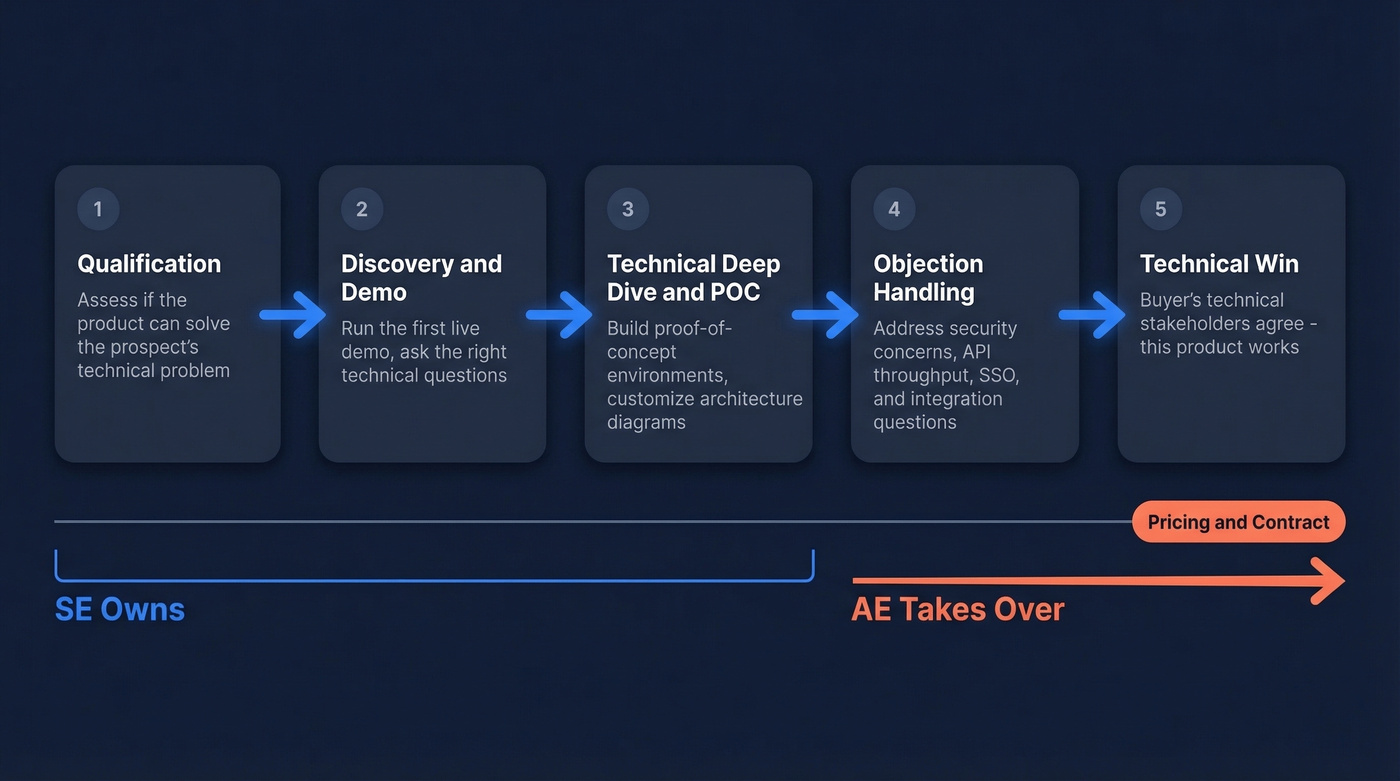
Discovery and demo is where you earn your keep. You're running the first live demo, but more importantly, you're asking the right questions. What's their current stack? Where does it break? What does success look like for their engineering team, not just their VP?
Technical deep dive and POC is the heavy lift. You're building proof-of-concept environments, customizing architecture diagrams, and sometimes writing integration code. For enterprise deals, this phase can last weeks - and it's where you'll spend most of your mental energy.
Objection handling peaks here. The prospect's security team has concerns. Their architect doesn't believe your API can handle their throughput. Their IT team wants to know about SSO. You're fielding all of it. This is where the inherent tension of the SE role surfaces: you're simultaneously advocating for the customer's needs and selling the product. The best SEs navigate this by being honest about limitations early, which paradoxically builds the trust that wins deals.
Technical win is the milestone. The buyer's technical stakeholders agree: this product works. The AE takes over for pricing and contract negotiation.
A Typical Tuesday
Here's what an actual day looks like for a mid-market SaaS SE, based on patterns we see across dozens of teams:
8:30 AM - Inbox and Slack triage. Three AEs need things. One wants a custom demo for a healthcare prospect. Another needs you on a call in 45 minutes. The third forwarded an RFP due Friday.
9:15 AM - Stand-up with your AE pod. Pipeline review, flagging deals that need technical attention, prioritizing the week.
10:00 AM - First demo. Mid-market fintech company, 6 people on the call. Thirty minutes of screen-sharing, twenty minutes of questions. Someone asks about SOC 2 compliance and you pull up the trust center mid-call.
11:00 AM - Customizing an architecture diagram for an enterprise prospect with non-standard integration requirements. You loop in your product team because one edge case doesn't have a clean answer yet.
1:30 PM - Internal call with Product and Engineering about a feature gap from yesterday's POC. You're advocating for the customer's use case while trying not to sound like you're just complaining.
3:00 PM - RFP scramble. Forty technical questions, pulling from your response library, writing custom answers for the 8 that don't have templates. End-of-quarter RFP overload is one of the fastest ways for an SE team to burn out, and everyone on r/salesengineers knows it.
4:30 PM - Building a POC environment. This is the quiet, heads-down work most people don't associate with "sales."
5:30 PM - Updating Salesforce. If it didn't happen in the CRM, it didn't happen.
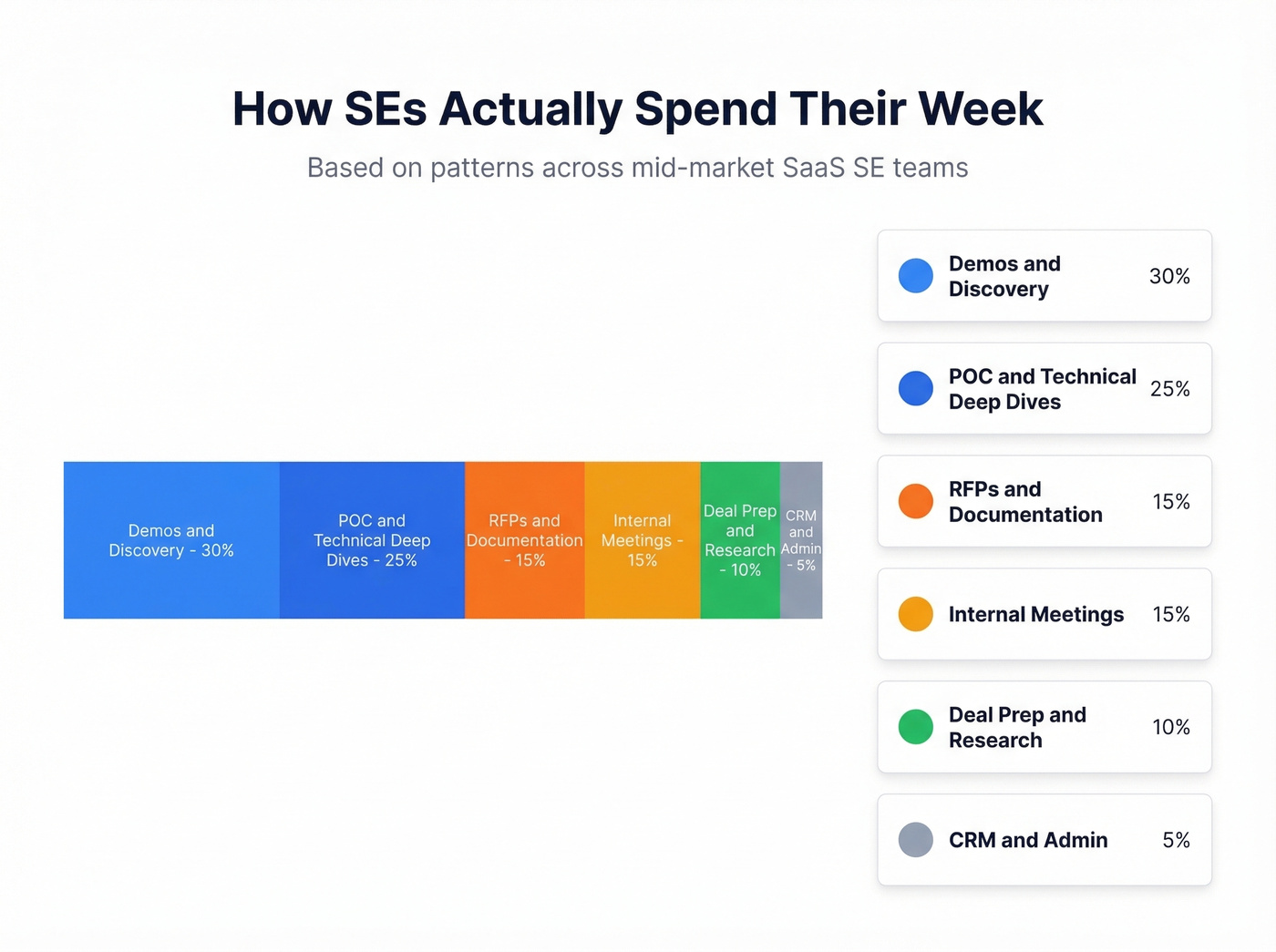
Rough weekly time split: demos and discovery (30%), POC and technical deep dives (25%), RFPs and documentation (15%), internal meetings (15%), deal prep and research (10%), CRM and admin (5%).
Core Skills
Sales engineering sits at the intersection of three skill sets, and the balance matters more than depth in any single one.
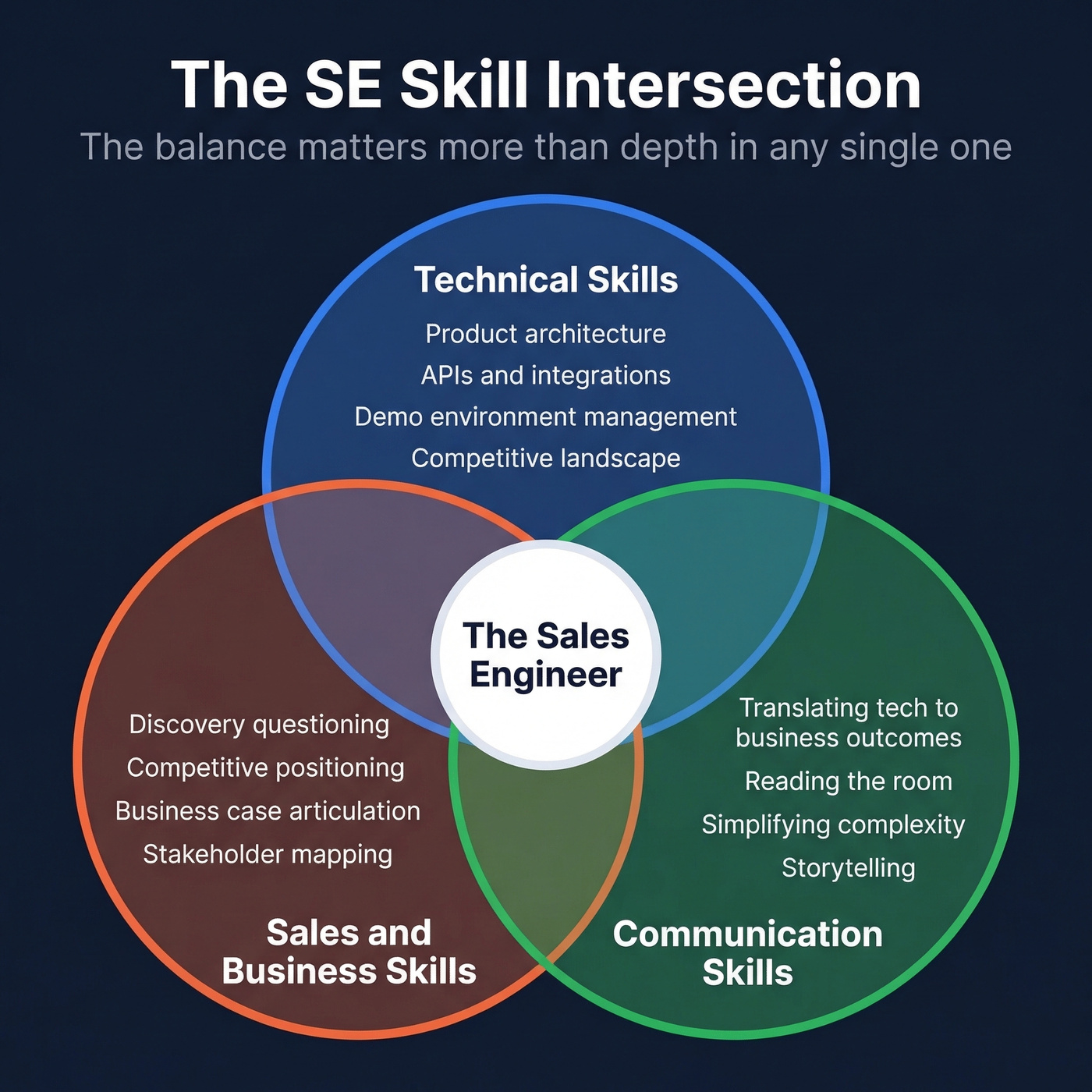
Technical skills are table stakes. You need to understand your product's architecture, APIs, integration patterns, and competitive landscape well enough to answer hard questions live. You don't need to be a software engineer, but you need to hold your own with one. Demo environment management - spinning up instances, configuring them, troubleshooting when things break mid-call - is a daily reality.
Sales and business skills separate a good SE from a great one. Discovery questioning is the single highest-leverage skill. Competitive positioning matters too: you need to know not just your product, but why a prospect would choose you over the two alternatives they're also evaluating. I've watched SEs lose deals they should've won because they couldn't articulate the business case in language a CFO cared about.
Communication skills are the most underrated category. Translating a complex technical architecture into a business outcome that a VP of Operations cares about - that's the whole job. We've seen brilliant technologists fail as SEs because they couldn't simplify. And we've seen average engineers thrive because they could read a room and adjust on the fly.
Where Sales Engineers Work
Most people assume SEs are a SaaS phenomenon. Not quite.
| Industry | Share of SE Jobs |
|---|---|
| Durable goods wholesale | 21% |
| Computer systems design | 20% |
| Manufacturing | 18% |
| Wholesale agents/brokers | 6% |
| Software publishers | 5% |
BLS data shows only 25% of sales engineer jobs sit in computer systems design and software publishing combined. A manufacturing SE might spend 40% of their time on-site doing physical product demonstrations, while a SaaS SE might never leave their home office. Enterprise SaaS deals often run 3-9 months; industrial equipment sales can stretch 12-18 months with multiple site visits.

Sales engineers spend 10% of their week researching prospects before demos and POCs. Prospeo's 30+ search filters - including technographics, buyer intent, and department headcount - let SEs pull the exact technical stakeholders they need in minutes, not hours.
Stop researching prospects manually. Start every demo with full context.
Salary and Compensation
What Sales Engineers Earn
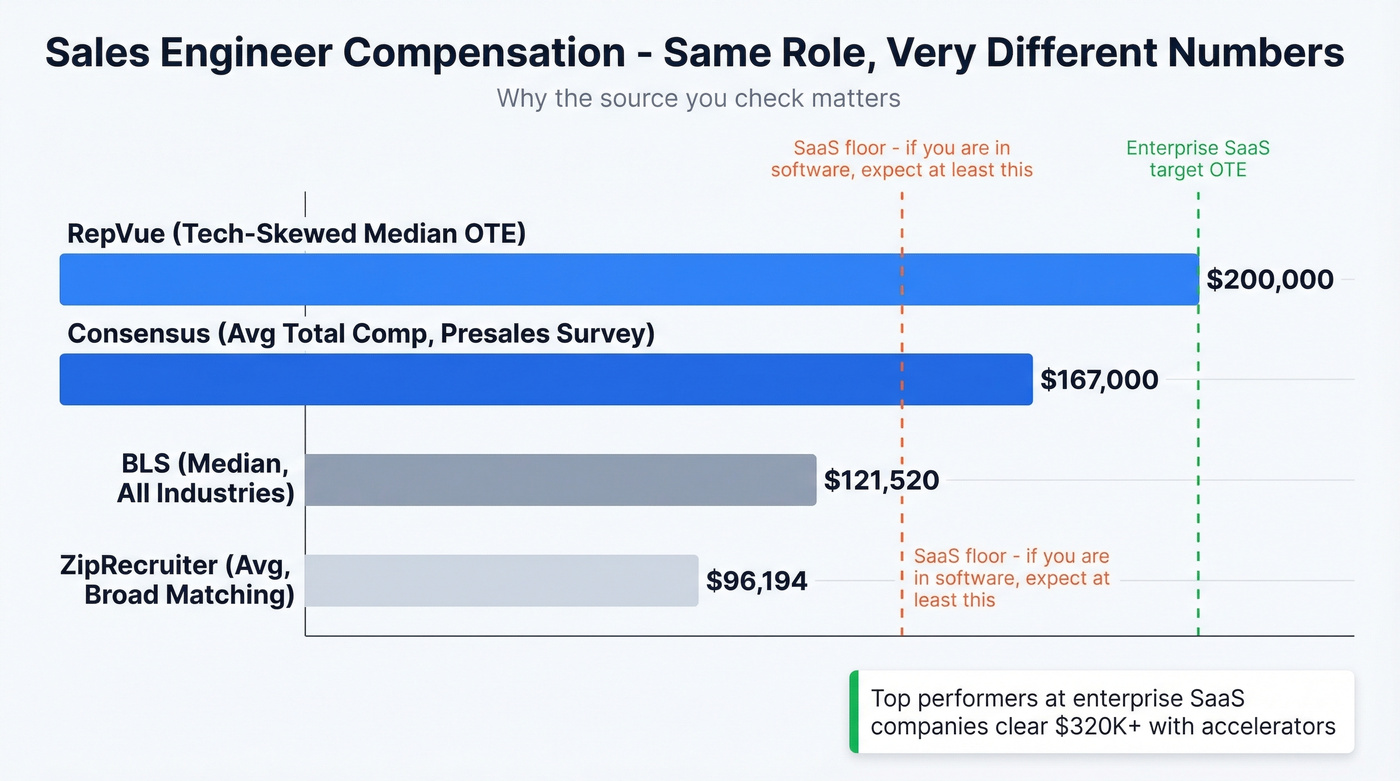
Salary data for SEs is all over the map, and the discrepancies aren't random - they reflect different methodologies and sample populations.
| Source | Figure | What It Measures |
|---|---|---|
| BLS | $121,520 | Median, all industries |
| RepVue | $200,000 OTE | Median, tech-skewed |
| Consensus | ~$167,000 | Avg total comp, presales survey |
| ZipRecruiter | $96,194 | Average, broad matching |
ZipRecruiter's $96K is misleading - it includes entry-level roles and non-tech industries that drag the average down. If you're in SaaS, expect $140K-$200K+ OTE depending on company stage, deal size, and geography. Bay Area and NYC push higher. Remote roles at mid-market companies typically land $150K-$180K.
How SE Pay Works
The most common comp structure is 80/20 - 80% base salary, 20% variable. Some companies run 70/30 or 90/10. The variable component is almost always tied to your AE's or team's quota attainment, not your own direct quota.
Accelerators are where top performers separate from the pack. Say your variable target is $30K at 100% quota attainment. Hit 120%, and you get a 1.5x multiplier on the overage. Hit 150%, the multiplier jumps to 2x. Top SE earners clear $320K+. That's not typical, but it's achievable at enterprise SaaS companies with large deal sizes. The path to $300K+ usually involves moving into enterprise/strategic accounts or taking on a player-coach SE manager role.
How Sales Engineers Are Measured
The old way of measuring SEs was activity-based: how many demos did you run? Those metrics are dying. The shift is toward outcome and buyer-engagement metrics that actually correlate with revenue.
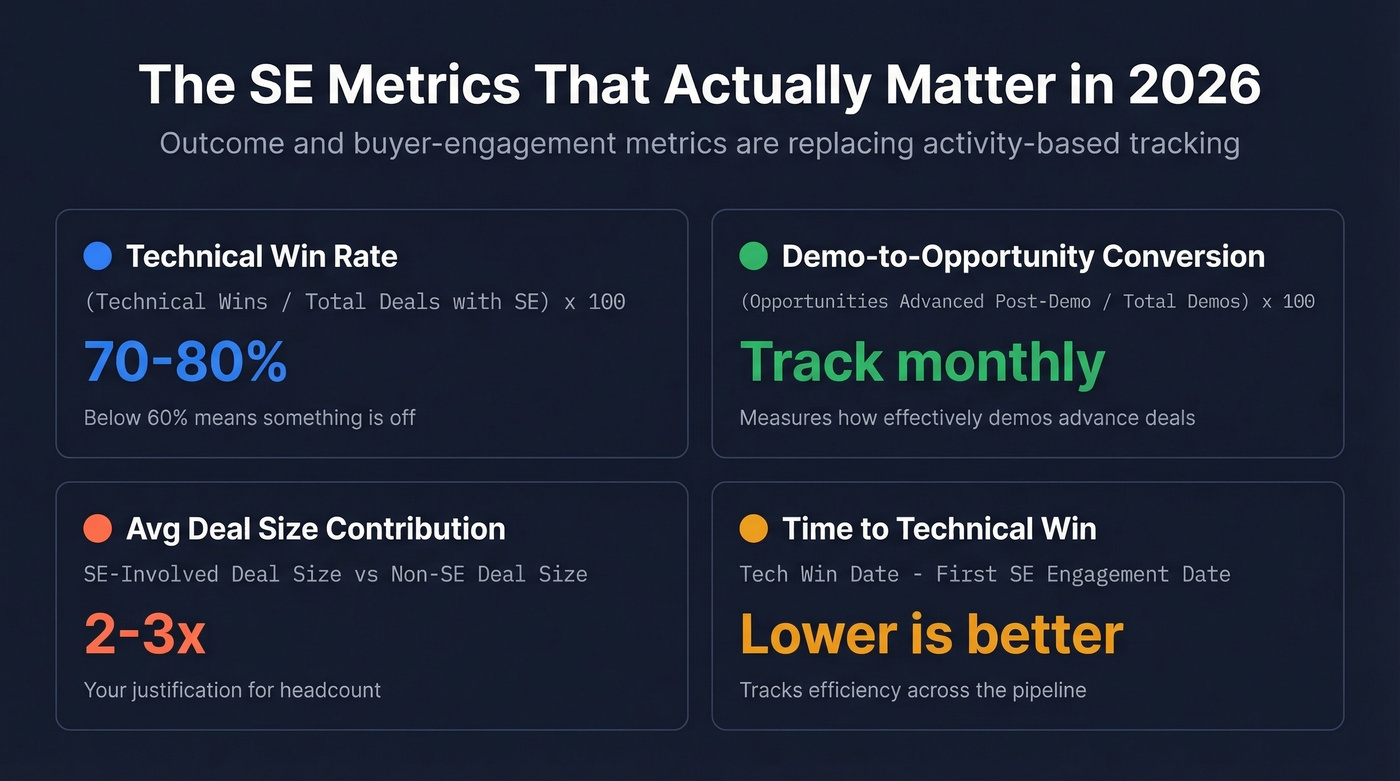
Technical Win Rate is the north star. Formula: (Technical Wins / Total Deals with SE Involvement) x 100. A strong SE runs 70-80%. Below 60% means something's off - either deal qualification is broken or the product has a gap.
Demo-to-Opportunity Conversion Rate measures how effectively your demos advance deals. Formula: (Opportunities Advanced Post-Demo / Total Demos) x 100.
Average Deal Size Contribution compares SE-involved deals vs. non-SE deals. If deals where an SE is engaged close at 2-3x the average, that's your justification for headcount.
Time to Technical Win tracks efficiency: technical win date minus first SE engagement date, averaged across deals.
The most interesting shift is toward buyer-engagement metrics. Consensus found that deals with 12+ demo views have a 72% close probability. That's a fundamentally different measurement - not "how many demos did you give?" but "how engaged is the buyer with the content you created?"
The SE Tech Stack in 2026
According to Demostack's market analysis, the presales software market is projected to grow from $94B to $179B by 2031. SEs are swimming in tools. Here's what actually matters.
| Category | Tools | What SEs Use It For |
|---|---|---|
| CRM | Salesforce, HubSpot | Deal tracking, activity logging |
| Conversation Intel | Gong, Chorus | Call review, coaching, deal intel |
| Demo Platforms | Reprise, Demostack, Consensus | Interactive demos, leave-behinds |
| CPQ/Proposals | PandaDoc, DealHub | Pricing configs, proposals |
| RFP/Security | Loopio, RFPIO | Response management |
| Prospecting & Data | Prospeo, ZoomInfo, Cognism | Contact data, account research |
| Enablement | Highspot, Guru | Content management, playbooks |

Before a discovery call, you need to know who's in the room. Prospeo pulls verified emails and mobile numbers with 98% accuracy on a 7-day data refresh cycle, so you're working with current contact data when prepping for calls. Starts free at 75 emails/month, paid plans from ~$39/mo.
Demo platforms like Reprise and Demostack let SEs create interactive product sandboxes buyers can explore on their own time - typically $500-$2,500+/mo per seat. Conversation intelligence tools like Gong, at roughly $100-$200/user/mo, are equally critical for reviewing calls and identifying what's working in your demos.
How AI Is Changing the Role
Here's the thing: AI is making SEs more valuable, not less.
A SaaStr analysis highlighted a Head of Sales Engineering at an AI dev tools company who closed a $3M+ annual deal largely end-to-end - running the pilot, building the business case, managing onboarding, and closing on-site. The sales team mainly helped with pricing. That's the direction the role is heading.
AI-native companies are running 2:1 or even 3:1 SE-to-AE ratios, inverting the traditional 4:1 AE-to-SE model. When buyers can self-educate through AI chatbots and documentation, the AE's "information gatekeeper" role shrinks. But the SE's "prove it works for your specific environment" role doesn't. A G2 trust study found that GenAI chatbots (17.2%) are now more trusted than vendor salespeople (9.3%) for purchase decisions. The human who still matters? The technical expert who can go deep.
The big open questions in the SE community right now: will AEs skill up technically and absorb part of the SE role? Will SEs support more AEs simultaneously? Or will SEs get pushed into full-cycle closing roles? Based on the data, the third scenario is already happening at AI-native companies - and it's the most lucrative path.
LLM-powered tools are also changing daily workflows. They draft RFP responses, summarize discovery calls, and personalize demo environments automatically. The SE who embraces these tools handles materially more deals. The one who doesn't gets left behind.
Let's be honest about one thing, though: if your company's average contract value sits below $25K, you probably don't need a dedicated SE. A well-trained AE with good demo skills and an AI copilot can handle the technical conversation. But the moment deal complexity crosses that threshold - multiple stakeholders, integration requirements, security reviews - an SE isn't a nice-to-have. They're the difference between winning and losing.
How to Become a Sales Engineer
Education and Background
A bachelor's degree is typical - BLS lists it as the standard entry requirement. Engineering, computer science, and information systems are the most common backgrounds, but many strong SEs come from IT, systems administration, customer success, or support engineering. The degree matters less than your ability to learn a product deeply and explain it clearly.
For certifications, start with AWS Certified Solutions Architect or Salesforce Certified Administrator. Both signal technical credibility across the industry and open doors regardless of the specific product you'll sell. For networking or infrastructure SE roles, Cisco certifications (CCNA, CCNP) carry weight. The newer CPSP (Certified Presales Professional) certification is gaining traction for presales-specific credibility.
The Interview Process
Most SE interviews follow a three-stage pattern: an HR/recruiter screen, a technical deep dive with the hiring manager or a senior SE, and a live demo presentation where you present a product to a mock buying committee. The demo round is where most candidates succeed or fail. Practice presenting to mixed audiences - technical and non-technical - and get comfortable fielding curveball questions mid-demo. If you freeze when someone asks "how does this handle our HIPAA requirements?" while you're mid-screen-share, that's a problem.
Career Progression
The IC track runs: SE to Senior SE (2-3 years) to Principal SE (4-6 years) to Distinguished/Staff SE (8+ years, rare). The management track branches at Senior SE: SE Manager to Director of Presales to VP of Solutions Engineering.
Common exits include Product Management (the most natural transition - you already know the product and the customer), Customer Success leadership, AE roles for SEs who want a direct quota, and Sales Enablement for those who'd rather build the playbook than run the plays. Timelines compress at startups and stretch at enterprises - a Senior SE title might take 18 months at a Series B company and 4 years at a Fortune 500.
Job Outlook
The BLS projects 5% growth for sales engineers through 2034, with roughly 5,000 openings per year. That's "about as fast as average" in government-speak, but it understates the opportunity in tech. Per SaaStr citing Emergence Capital data across 400+ B2B companies, 36% decreased SDR/BDR headcount last year while only 14% decreased SE headcount. The role is being protected - and in many AI-native organizations, expanded.
The combination of $150K+ OTE floors in SaaS, AI-driven headcount expansion, and natural exits into Product Management makes sales engineering one of the highest-optionality career paths in B2B right now. If you've been asking what a sales engineer does, the better question is: why aren't more technical people pursuing this path?
The article mentions SEs updating Salesforce at 5:30 PM. Prospeo's native Salesforce and HubSpot integrations enrich every contact with 50+ data points automatically - verified emails, direct dials, tech stack, and org structure - so your CRM stays current on a 7-day refresh cycle.
Arm your SE team with data that's never more than a week old.
FAQ
Is sales engineering more sales or more engineering?
Engineering dominates daily work. Expect roughly 70% technical activities - demos, POCs, architecture deep dives - and 30% sales-adjacent work like discovery calls and objection handling. The ratio shifts toward sales at smaller companies where SEs wear more hats.
Do sales engineers carry quotas?
Most don't carry a direct revenue quota. Variable comp is typically tied to your AE's or team's attainment, with an 80/20 base-to-variable split being most common. Some enterprise orgs are experimenting with SE-specific metrics like technical win rate targets.
Can you become a sales engineer without a CS degree?
Yes - many successful SEs come from IT, systems administration, or customer success. Certifications like AWS Solutions Architect or Salesforce Administrator carry more weight than a specific degree. The key is demonstrating you can learn a product deeply and explain it clearly under pressure.
What's the difference between a sales engineer and a solutions architect?
Often nothing. At AWS, "Solutions Architect" is the pre-sales title. At systems integrators, it's typically post-sales implementation. Always read the job description - if it mentions demos, POCs, and working with AEs, it's a pre-sales SE role regardless of title.
What tools do sales engineers use for account research?
Most SEs rely on a CRM (Salesforce or HubSpot), conversation intelligence (Gong), and a contact data platform for pre-call research. Demo platforms like Reprise and Demostack round out the stack, along with RFP tools like Loopio for managing the endless stream of security questionnaires.