

What Does an Account Manager Actually Do? (The Honest Guide)
Your biggest client just told you they're evaluating competitors at renewal. The contract's worth $480K a year. Your VP wants a save plan by Friday.
That's the job. You're simultaneously a strategist, therapist, and revenue protector - often in the same afternoon. Keeping existing clients is almost always cheaper than acquiring new ones, and that economic reality is the engine behind every account manager role. Here's what the job actually involves, what it pays, and whether it's the right career move for you.
Core Account Manager Responsibilities
If you've searched this before and gotten "manages client relationships," you've learned nothing. Every role in a company manages relationships. What makes an AM distinct is that every responsibility ties directly to a revenue outcome.
Retain revenue. You're the reason clients renew instead of churning. That means running quarterly business reviews (QBRs), catching dissatisfaction early, and making sure the product delivers on what the AE promised during the sales cycle.
Expand accounts. Upsells, cross-sells, and seat expansions are your growth levers. A good AM doesn't wait for the client to ask - they spot whitespace and propose solutions before the client realizes they need them.
Advocate internally. When a client needs a product fix, a billing adjustment, or an executive escalation, you're the one navigating your own company's bureaucracy to make it happen.
The role officially begins at the AE-to-AM handoff - the moment a closed deal becomes a live account. If your company doesn't have a structured handoff process, expect to spend your first month on damage control. And one thing most job descriptions underplay: some AM roles require substantial travel, especially at the enterprise level where you're regularly on-site for QBRs and renewal negotiations.
How the Role Varies by Industry
This guide leans SaaS because that's where the sharpest AM practices live, but the core job translates everywhere. Agency AMs manage client campaigns and creative timelines. Financial services AMs handle investment portfolios and regulatory compliance conversations. Healthcare AMs coordinate across complex provider networks where a single account might involve dozens of stakeholders. The KPIs shift - an agency AM tracks project profitability, not NRR - but the fundamental motion of retain, expand, and advocate stays the same.
A Day in the Life
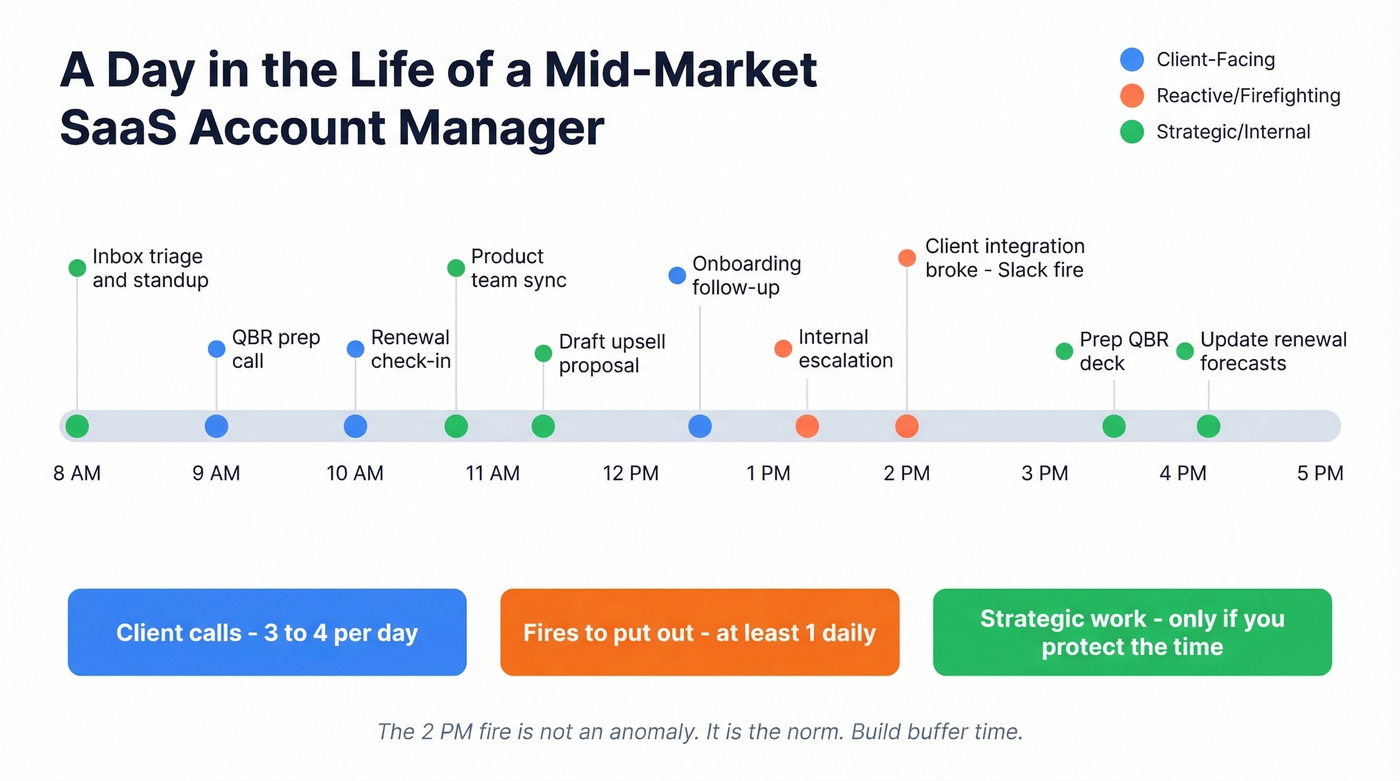
You just got promoted from SDR and your first day managing accounts is Monday. Here's what a typical Tuesday looks like for a mid-market SaaS AM handling 30-40 accounts.
| Time | Activity |
|---|---|
| 8:00 AM | Inbox triage, Slack catch-up |
| 8:30 AM | Team standup - pipeline review, at-risk flags |
| 9:00 AM | Client call - QBR prep review |
| 9:45 PM | CRM updates, log call notes |
| 10:00 AM | Client call - renewal check-in |
| 10:45 AM | Cross-functional sync with product |
| 11:30 AM | Upsell proposal draft |
| 12:00 PM | Lunch |
| 12:30 PM | Client call - onboarding follow-up |
| 1:15 PM | Internal escalation meeting |
| 2:00 PM | Slack fire - client's integration broke |
| 2:45 PM | Write up incident summary, loop in eng |
| 3:30 PM | Prep QBR deck for Thursday |
| 4:15 PM | Review renewal pipeline, update forecasts |
| 5:00 PM | End of day |
The 2:00 PM Slack fire isn't an anomaly. It's the norm. The best AMs build buffer time into their calendars because reactive work is unavoidable; the worst AMs let reactive work consume the entire day and never get to the strategic stuff.
Here's the thing: if you hate context-switching, this role will eat you alive. If you thrive on variety, it's one of the most engaging seats in a B2B org.
AM vs. AE vs. CSM
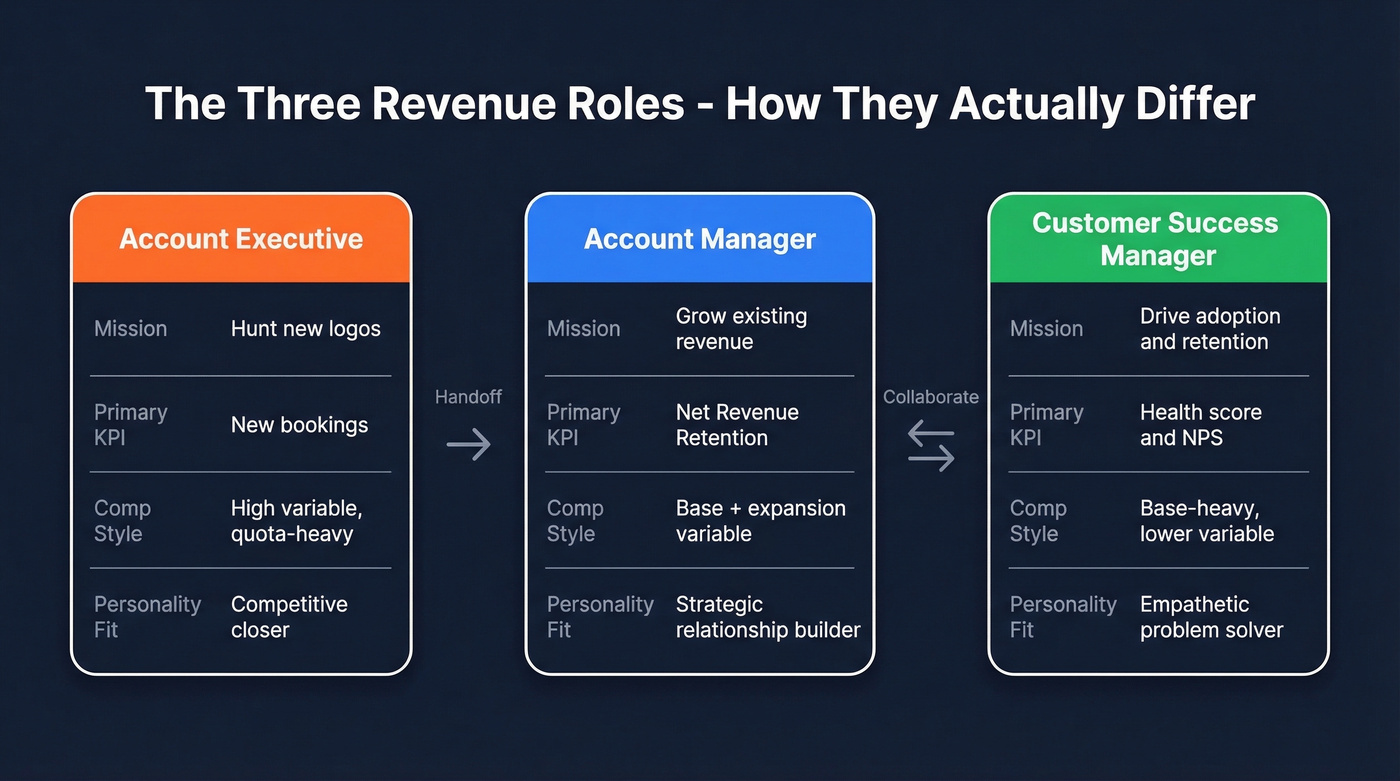
If your company doesn't distinguish these three roles, that's a red flag. It usually means one person is doing all three jobs and none of them well.
| Account Executive | Account Manager | Customer Success Manager | |
|---|---|---|---|
| Goal | Acquire new logos | Grow existing revenue | Retain via adoption and proactive service |
| Core work | Prospect, demo, close | Upsell, renew, advocate | Onboard, train, configure tools, prevent issues |
| KPIs | New bookings, win rate | NRR, churn, CLV, renewal | NPS, health score, CES |
| Tools | CRM, sales engagement | CRM, sales enablement | Onboarding, help desk |
| Comp structure | High variable (quota) | Base + variable (expansion) | Base-heavy, lower variable |
AEs are hunters. AMs are farmers. CSMs sit between the two - focused on adoption, satisfaction, and proactive service, while AMs focus on growing accounts through renewals and expansion.
The handoff from AE to AM is where most account relationships either solidify or fracture. When an AE oversells to hit quota, the AM inherits a client whose expectations don't match reality. We've seen this pattern kill retention rates at companies that don't have a formal transition process with documented commitments.
KPIs Every Account Manager Owns
The Core Five
These are the metrics your manager will evaluate you on. Learn the formulas - they'll come up in interviews and performance reviews.
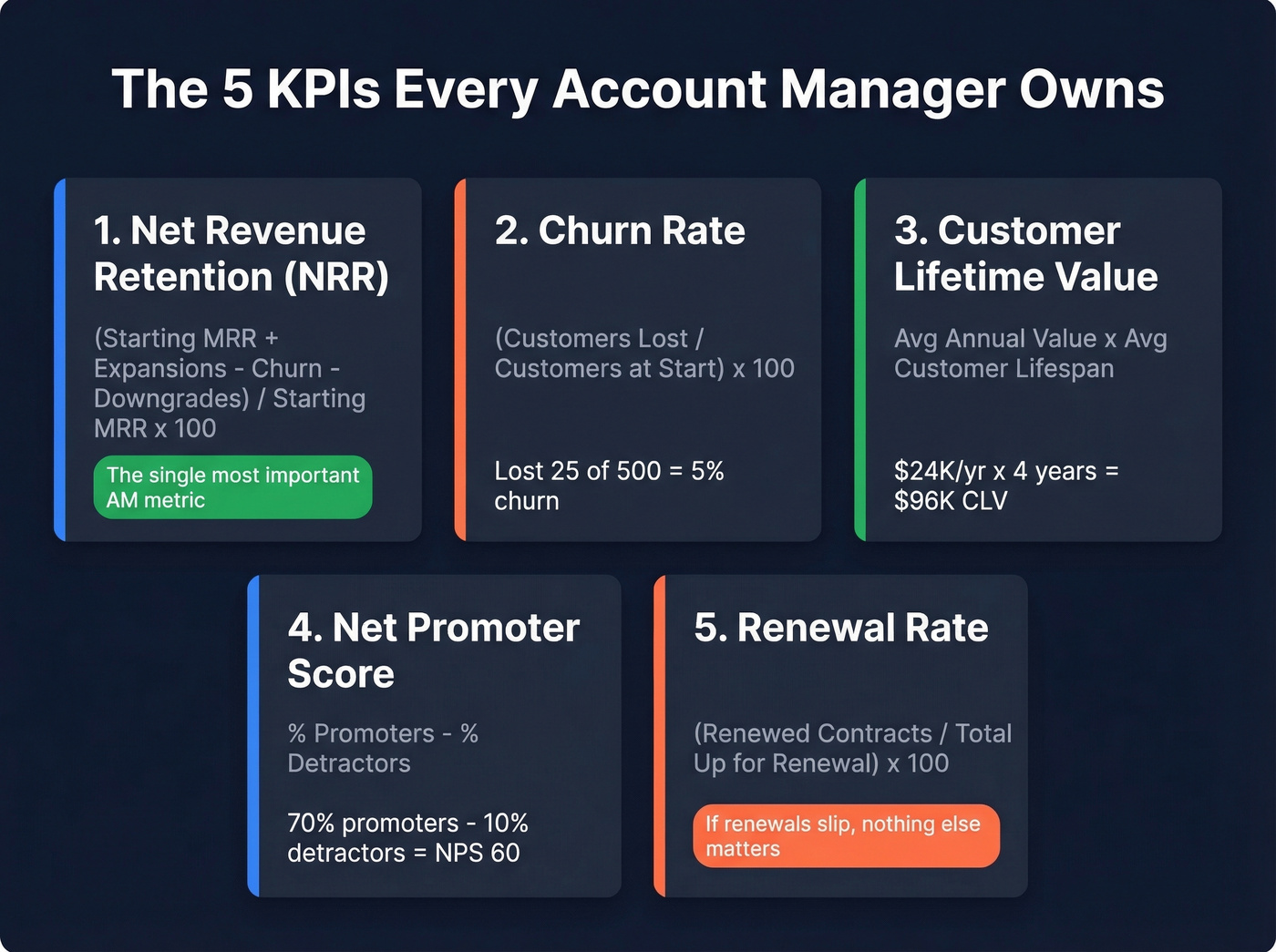
Net Revenue Retention (NRR) is the single most important metric for AM performance. It measures whether your book of business is growing or shrinking after accounting for churn, downgrades, and expansions.
Churn Rate:
(Customers Lost / Customers at Start of Period) x 100
You start Q1 with 500 accounts and lose 25. That's a 5% churn rate.
Customer Lifetime Value (CLV):
Average Annual Value x Average Customer Lifespan
A client paying $24,000/year who stays 4 years = $96,000 CLV. This number is how leadership decides which accounts deserve the most AM attention.
Net Promoter Score (NPS):
% Promoters - % Detractors
70% promoters, 10% detractors = NPS of 60.
Renewal Rate is the percentage of contracts that renew. This is the AM's bread and butter - if renewals are slipping, nothing else matters.
Beyond the Basics
The five metrics above are table stakes. AMs who get promoted track leading indicators too.
Referenceable clients - how many of your accounts would publicly endorse your product? Track this through case study participation, review site activity, and referral willingness. It's a proxy for genuine satisfaction that NPS alone can't capture.
Customer interaction frequency - long gaps between touchpoints are a risk signal. If you haven't talked to an account in 6 weeks, something's wrong.
Product engagement metrics like DAU, feature adoption rates, and time-in-app are leading indicators of renewal likelihood. If usage drops 30% in a quarter, the churn conversation is coming whether you initiate it or not. Your own team's morale matters too - burned-out AMs miss signals, skip prep, and lose clients, and it shows up in account outcomes faster than most leaders realize.

Upsells and expansions start with reaching the right stakeholders. Prospeo gives AMs 300M+ verified profiles with 30+ filters - find every decision-maker in your accounts, from department heads to C-suite, with 98% email accuracy.
Stop guessing who to contact. Map every account in minutes.
The Account Manager Tool Stack
CRM vs. Dedicated AM Software
CRMs were built for pipeline management and new logo acquisition. They're great at tracking deals through stages. They're mediocre at managing ongoing relationships, health scoring, and whitespace analysis.
Dedicated account management software fills the gaps: org maps showing decision-makers and influencers, health/risk models with automated alerts, whitespace analytics that surface expansion opportunities, and portfolio views organized around renewal timelines. Poor data quality costs businesses roughly $15 million per year, so the tooling investment pays for itself quickly.
CRM proficiency isn't optional - it's table stakes. But knowing when you need something beyond your CRM is what separates good AMs from great ones.
Pricing at a Glance
| Tool | Starting Price | Best For |
|---|---|---|
| HubSpot | Free | SMB teams starting out |
| monday CRM | $10/user/mo | Visual pipeline management |
| Zoho CRM | $14/user/mo | Budget-conscious teams |
| Pipedrive | $14/user/mo | Simple deal tracking |
| Salesforce | $25/user/mo | Mid-market to enterprise |
| Gainsight | ~$2,500-$10K+/mo | Enterprise CS/AM ops |
| Gong | ~$100-$150/user/mo | Conversation intelligence |
Keeping Your CRM Data Clean
Every AM has lived this scenario: you open an account, and the primary contact listed left the company six months ago. The org chart is wrong. The phone number goes to a general line. You're flying blind into a renewal conversation.
When your champion leaves and you need the replacement's verified email in seconds - not days - Prospeo handles that. It covers 300M+ professional profiles with 98% email accuracy and refreshes data every 7 days, so the contact info you pull today is still good next week. The free tier gives you 75 verified emails a month, enough to clean up your top accounts in your first week on the job.
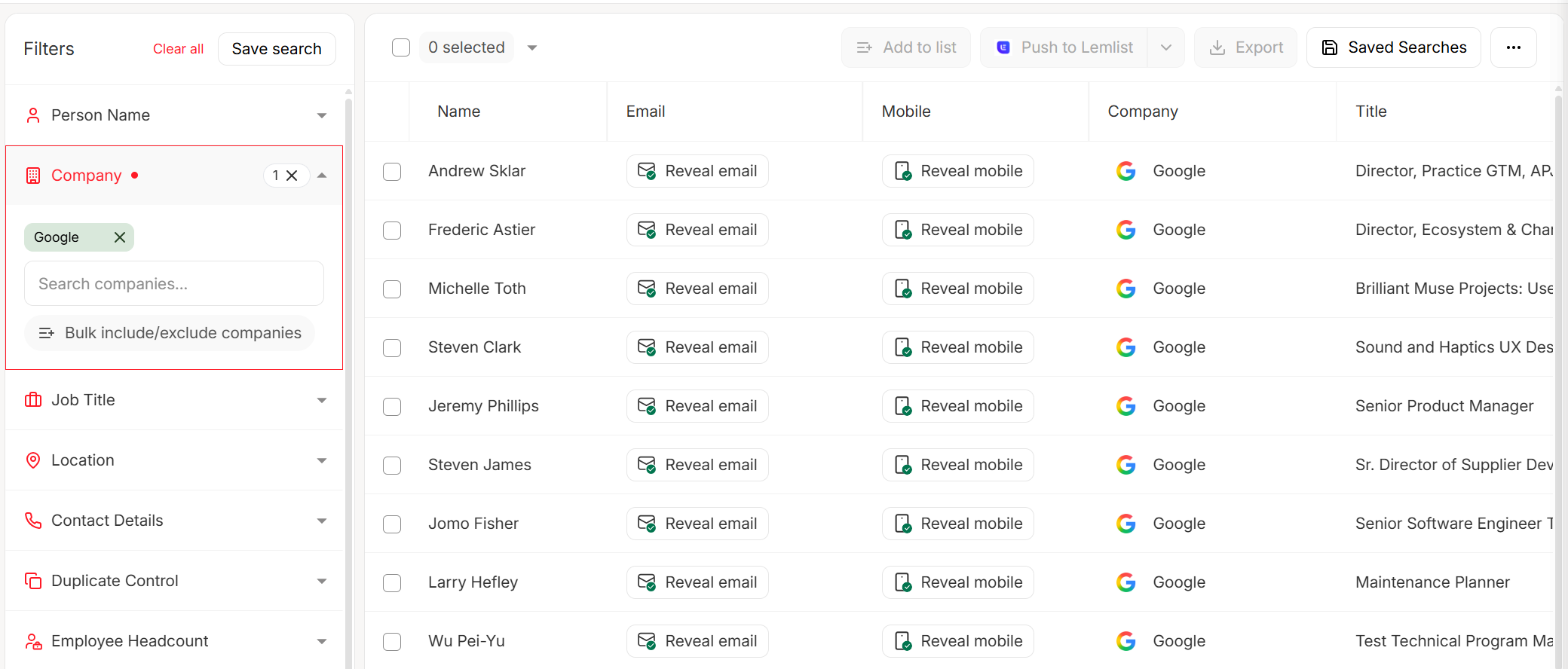
Your renewal pipeline is only as strong as your contact data. When champions leave and new buyers arrive, Prospeo's 7-day data refresh catches job changes before you lose the thread - so you never walk into a QBR blind.
Track job changes across your entire book of business for $0.01 per contact.
Account Manager Salary - Real Numbers
Every salary page gives you a different number. Here's what's actually going on: sources use different methodologies, and conflating base pay with total comp creates confusion. Watch out for guides that cite Bureau of Labor Statistics "sales manager" data and pretend it applies to account managers - it doesn't, and it inflates the numbers significantly.
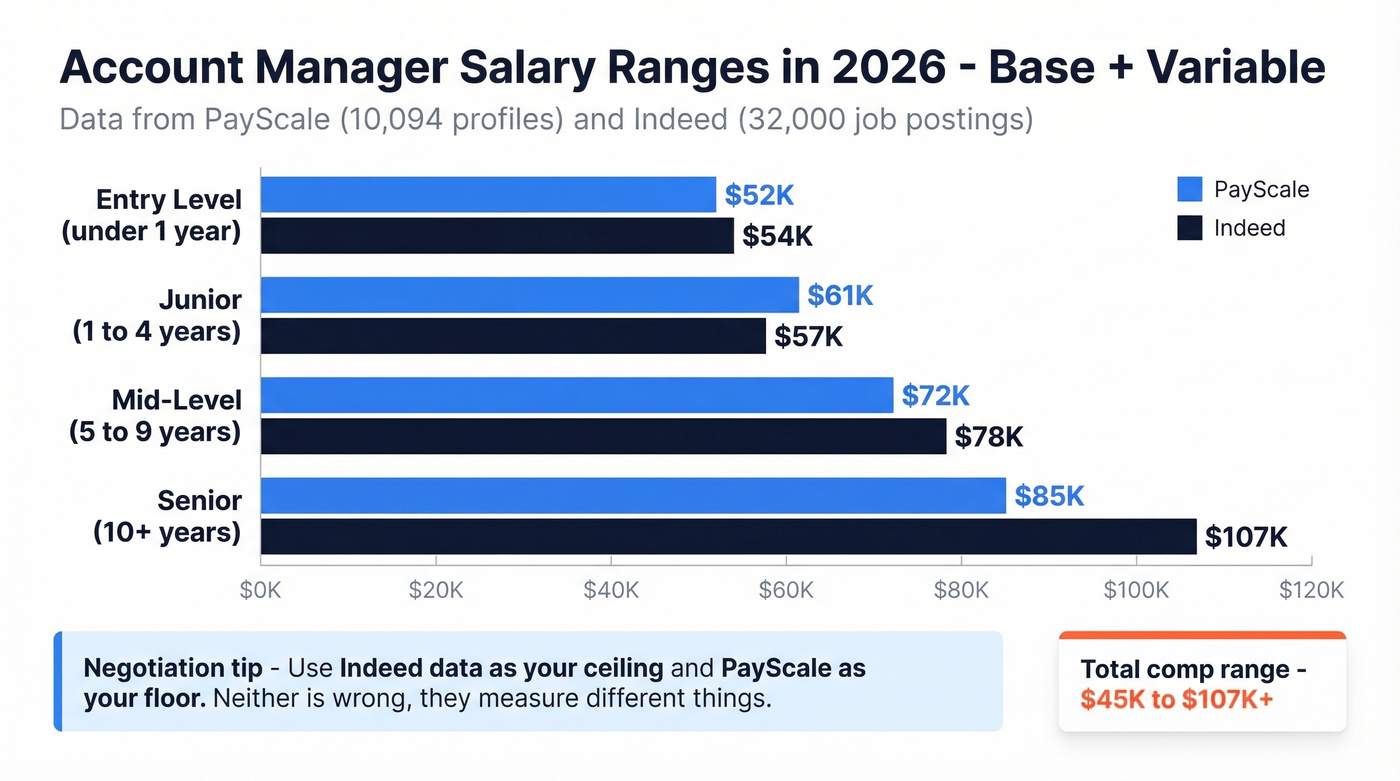
Base Salary + Variable Comp
PayScale reports a $66,196 average base salary across 10,094 profiles, updated February 2026. Variable comp ranges from $990-$22K in bonuses and $2K-$41K in commission, putting total pay between $45K and $103K.
Indeed's data - drawn from 32,000 job postings over the past 36 months - shows a higher $78,631 average base plus $18,000 in commission. The gap exists because Indeed pulls from job listings (which skew toward competitive offers), while PayScale relies on self-reported salaries from current employees.
Neither number is wrong. They're measuring different things. If you're negotiating an offer, use Indeed's range as your ceiling and PayScale's as your floor.
Salary by Experience
| Experience | PayScale Total | Indeed Equivalent | Notes |
|---|---|---|---|
| <1 year | $51,864 | $54,147 (entry) | 346 profiles |
| 1-4 years | $61,455 | $57,412 (junior) | 4,362 profiles |
| Mid-career | ~$66K-$78K | - | Median range |
| Senior AM | - | $107,150 | Significant jump |
How Location Changes the Math
NYC account managers earn an average base of $87,102 with $31,194 in additional cash compensation, bringing total comp to $118,296. The range stretches from $64K to $213K, with the most common band sitting at $90K-$100K. AMs with 7+ years in NYC average $135,568.
Let's be honest: market and industry matter more than experience. A 3-year AM at a well-funded SaaS company in San Francisco will out-earn a 7-year AM at a regional agency. If your company's average deal size is under $15K, it probably can't afford to pay AMs what the role is worth - factor that into your job search alongside cost of living.
The Bureau of Labor Statistics projects related management roles growing roughly 6% through 2032, in line with average job growth. The role isn't going anywhere.
Career Path - Entry to VP
The Typical Progression
The standard ladder: SDR or Customer Service -> Junior Account Manager -> Account Manager -> Senior Account Manager -> Strategic Account Manager -> Director of Account Management -> VP of Account Management.
About 73% of job postings for account managers ask for a bachelor's degree, often in business, communications, or marketing - but it isn't universally required. We've seen plenty of AMs who started in support or operations roles and moved laterally. A track record of retaining and growing accounts matters more than credentials.
Strategic Account Managers
A Strategic Account Manager (SAM) handles a smaller portfolio of the company's highest-value accounts. Where a standard AM manages 30-40 accounts, a SAM manages 5-10 - each worth significantly more revenue.
The work shifts from tactical relationship management to long-term strategic alignment. SAMs run executive-level QBRs, coordinate cross-functional teams across product, engineering, and finance, and develop multi-year account plans. The tool stack expands too - expect to use Tableau or Power BI for account analytics, data platforms for stakeholder mapping, and certifications like SAMA become relevant differentiators. Travel increases substantially.
Five Mistakes That Kill AM Careers
Being too reactive. If your entire day is firefighting, you're a support rep with a fancier title. Build proactive account plans before problems surface.
Confusing tactics with strategy. A check-in email isn't a strategy. A 12-month plan to grow an account's spend by 30% through a specific expansion path - that's a strategy.
Relying on email only. Tone gets lost. Urgency disappears. A 10-minute call resolves what a 15-email thread can't.
Not asking the right questions. Stop asking "Is everything going well?" Start asking "What's your biggest priority this quarter, and how are we helping you hit it?"
Not knowing customer goals. If you can't articulate your client's top three business objectives, you're not managing accounts - you're taking orders.
How to Ace the Interview
Hiring managers aren't looking for polished answers. They're looking for evidence that you think like an AM.
"How do you prioritize across your portfolio?" They want a framework. Mention revenue weighting, risk scoring, and renewal timelines.
"Tell me about a dissatisfied client you saved." Walk through the diagnosis, the action plan, and the outcome with numbers. Vague stories don't land.
"How do you track account success?" Name specific KPIs. Citing NRR, churn rate, and CLV formulas puts you ahead of 80% of candidates.
"Give me an upsell example." Show that you identified the opportunity proactively, not that the client asked for it.
"How do you handle the AE-to-AM handoff?" This separates experienced AMs from first-timers. Talk about documentation, intro calls, and expectation alignment (a simple handoff email goes a long way).
"What tools do you use?" CRM proficiency is assumed. Mention specific platforms - Salesforce, Gong, Gainsight - and explain how you use them, not just that you've heard of them.
FAQ
Is account management the same as customer success?
No. Account management focuses on revenue growth through upsells, cross-sells, and renewals. Customer success focuses on product adoption, satisfaction, and retention through proactive service - not direct selling. AMs own expansion revenue; CSMs own health scores and onboarding.
What degree do you need to become an account manager?
A bachelor's in business, communications, or marketing is common but not required. Many AMs enter from SDR, support, or operations backgrounds. A track record of retaining and growing accounts consistently outweighs formal credentials in hiring decisions.
How much do entry-level account managers make?
Entry-level AMs earn roughly $51,000-$54,000 in total compensation based on PayScale and Indeed data from early 2026. Add variable comp at a competitive SaaS company, and first-year total pay can reach $60K+.
What tools do account managers use daily?
CRMs like Salesforce or HubSpot are the foundation. Beyond that: conversation intelligence tools like Gong, account planning platforms like Gainsight, presentation software, and data enrichment tools for keeping contact records current when stakeholders change roles.
How do AMs keep CRM data accurate?
Regular audits, structured handoff documentation, and enrichment tools. Prospeo is one option AMs use to verify and refresh contact emails - its 7-day data refresh cycle and 98% email accuracy keep records current without manual research.