

What Is a Gatekeeper? Every Meaning Explained
A concept that took off in a 1943 academic paper about how food moves through households now gets hurled as an insult on TikTok when someone won't share their skincare routine. So what is a gatekeeper, really? The answer depends entirely on whether you're in a sales bullpen, a doctor's waiting room, a journalism lecture, or a group chat.
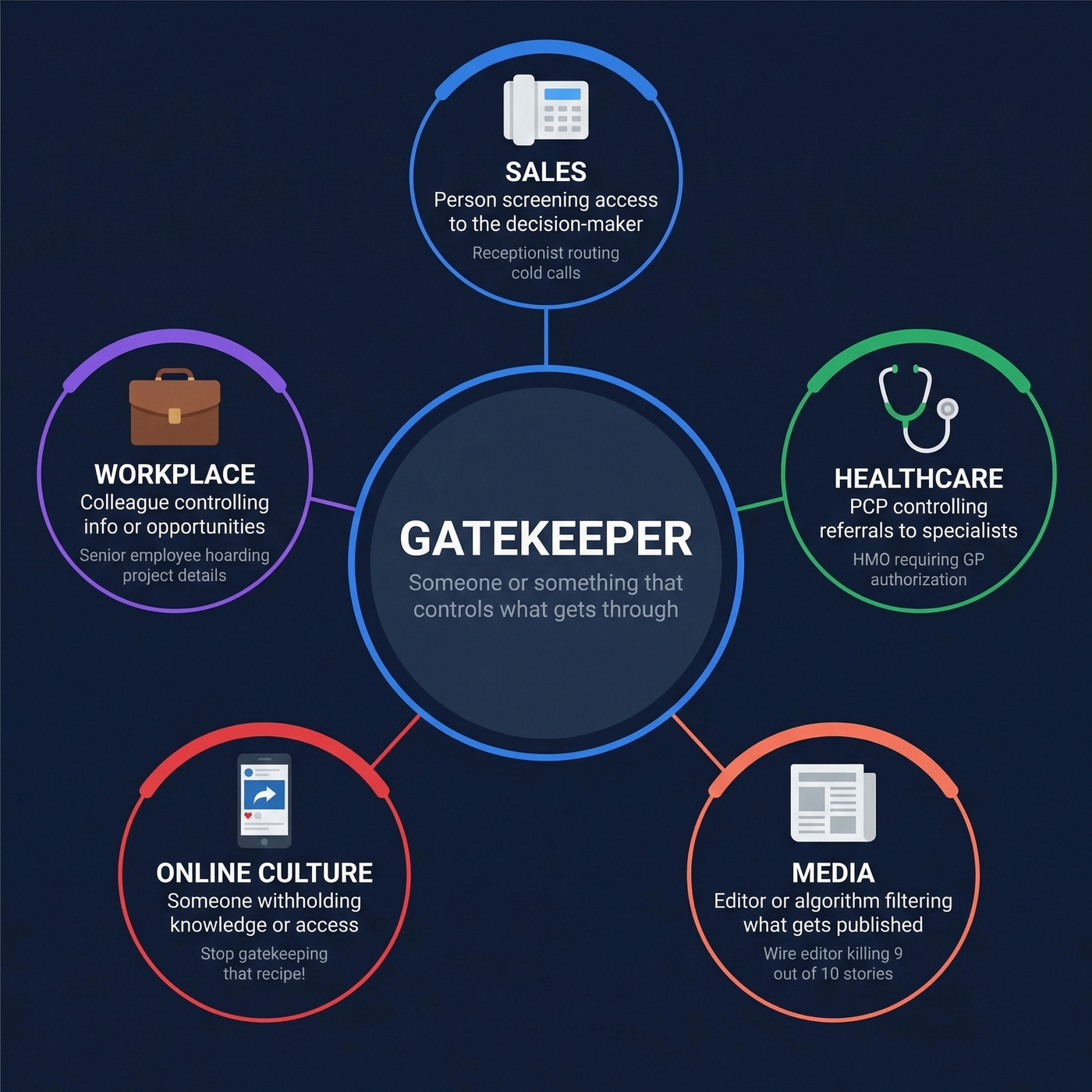
Quick-Reference Table
| Context | What "Gatekeeper" Means | Example |
|---|---|---|
| Sales | Person screening access to a decision-maker | Receptionist routing cold calls |
| Healthcare | PCP controlling referrals to specialists | HMO requiring GP authorization |
| Media Theory | Editor/algorithm filtering what gets published | Wire editor killing nine-tenths of stories |
| Online Culture | Someone withholding knowledge or access | "Stop gatekeeping that recipe!" |
| Workplace | Colleague controlling info or opportunities | Senior employee hoarding project details |
Where the Term Comes From
The idea of gatekeeping in modern social science traces back to social psychologist Kurt Lewin, who in 1943 studied how food travels from garden to dinner table. His key insight: "food does not move by its own impetus... [it is] affected by a 'gatekeeper.'" Lewin wasn't talking about media or sales - he was mapping the channels through which items pass, and the people who decide what gets through at each stage.
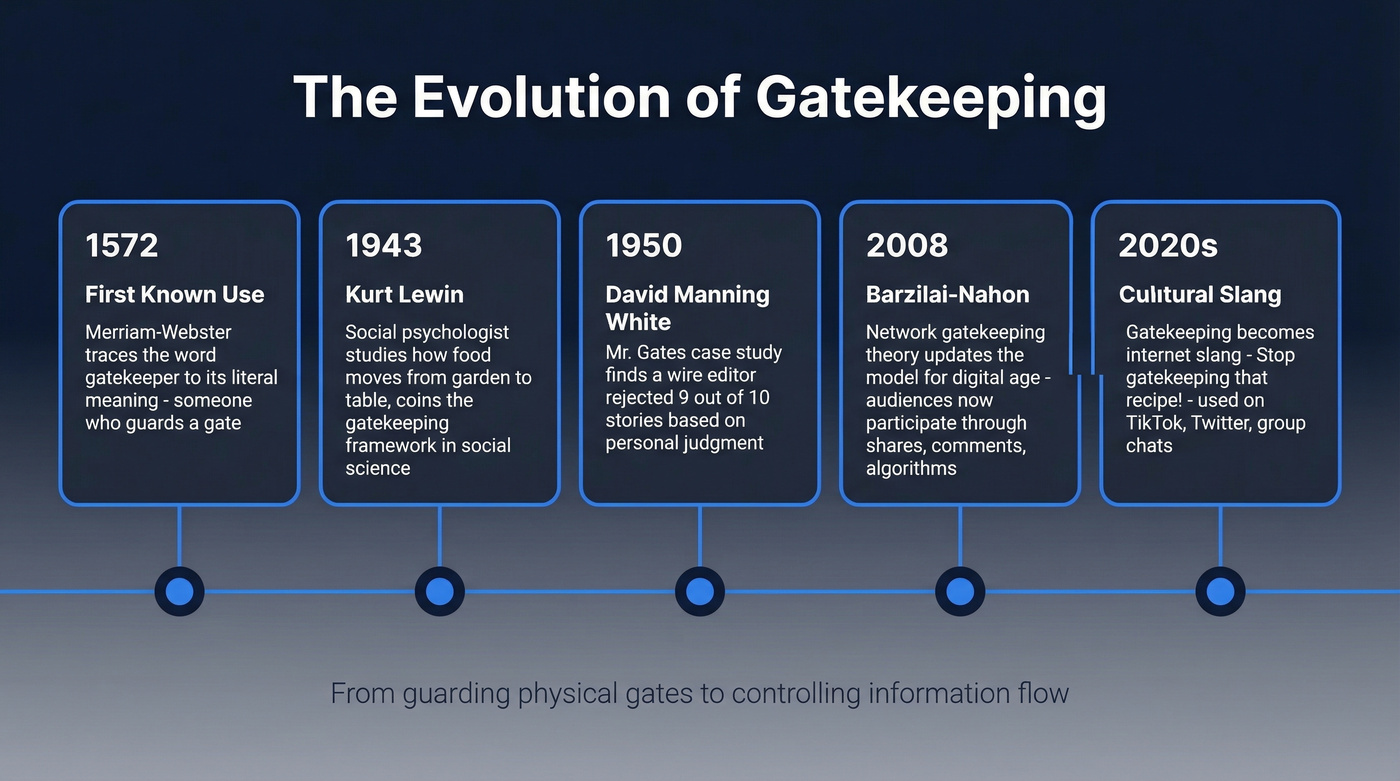
The word itself is much older. Merriam-Webster lists the first known use as 1572, originally in the literal sense of someone who guards a gate.
Seven years after Lewin's paper, David Manning White applied the framework to journalism. His famous "Mr. Gates" case study followed a wire editor at a newspaper with roughly 30,000 readers, and White found that nine-tenths of incoming wire copy got rejected, often for nakedly subjective reasons - "too Red," "don't care for suicides," or simply running out of space. The editor wasn't following a formula. He was exercising personal judgment, and that judgment shaped what an entire community knew about the world.
Pamela Shoemaker and Tim Vos later formalized the definition: gatekeeping is "culling and crafting countless bits of information into the limited number of messages that reach people every day." That framing held for decades - until the internet blew it up. Karine Barzilai-Nahon's network gatekeeping theory updated the model for the digital age, arguing that the audience now participates in the filtering process through shares, comments, and algorithmic feedback loops.
The theory isn't without critics. Three common objections surface in academic literature: it's descriptive rather than predictive, it can be too general to generate specific insights, and it struggles to account for digital contexts where everyone can publish and the "gates" are algorithmic rather than human. Still, the core metaphor - someone or something controls what gets through - remains remarkably durable.
Gatekeepers in Sales and Business
So what is a gatekeeper in a sales context? It's the person standing between you and the person who can actually sign a check. That's usually a receptionist, executive assistant, or office manager - but it can also be a junior team member who "handles vendor inquiries" or a spouse fielding calls for a small business owner. Their job is to protect the decision-maker's time, and they're good at it.
The common deflections are predictable. "They're in a meeting." "Can you send an email?" "They're not interested." And one rule shows up across every modern sales playbook we've read: don't pitch the gatekeeper. They don't have buying authority, and treating them like they do wastes everyone's time.
Types of Business Gatekeepers
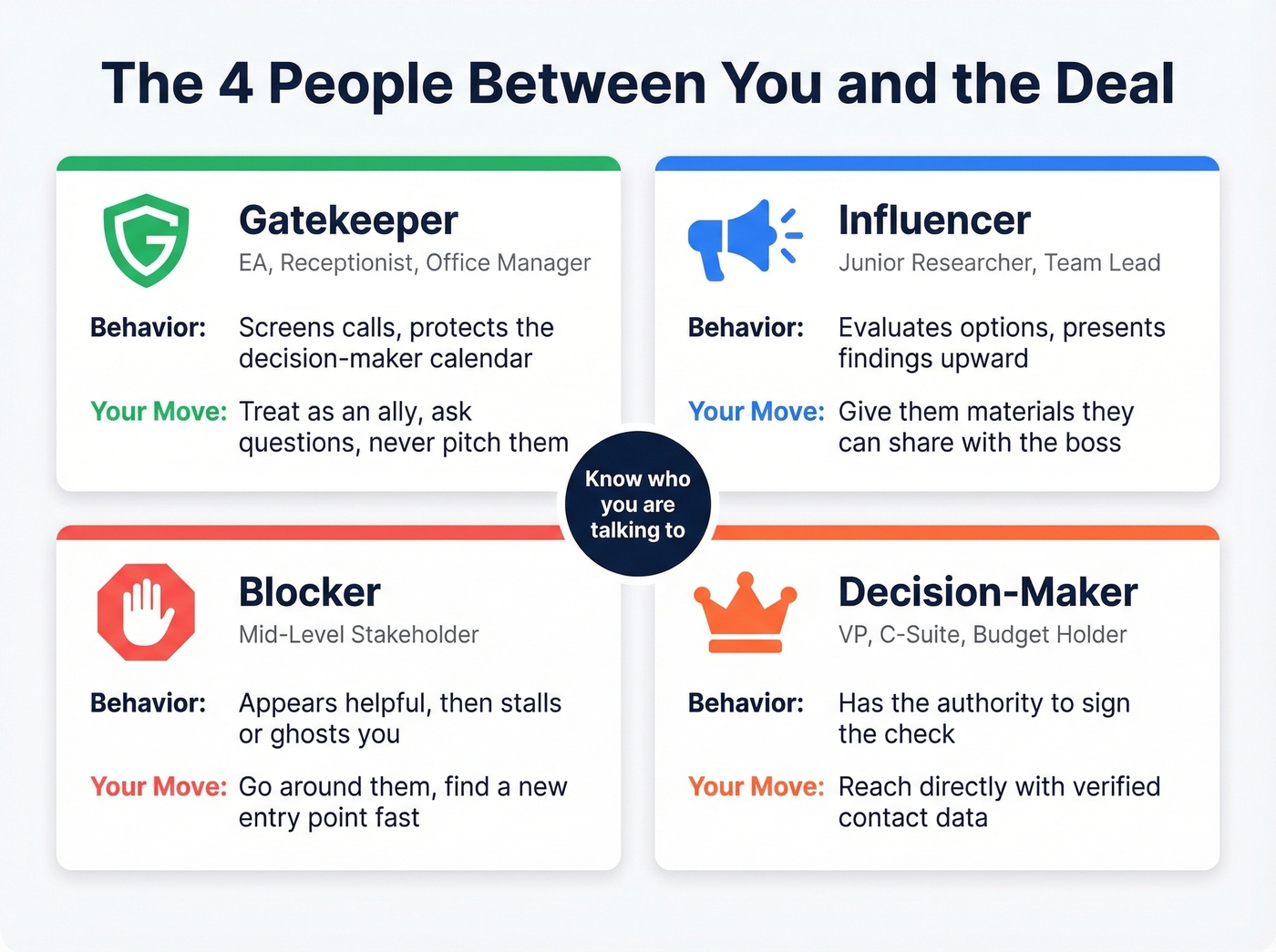
Not everyone blocking your path plays the same role. Understanding the difference changes your approach entirely.
| Persona | Typical Role | Behavior | How to Handle |
|---|---|---|---|
| Gatekeeper | EA, receptionist, office manager | Screens calls, protects DM's calendar | Treat as ally, ask questions, don't pitch |
| Influencer | Junior researcher, team lead | Evaluates options, presents to DM | Equip with materials they can share upward |
| Blocker | Mid-level stakeholder | Appears helpful, then stalls or ghosts | Go around them, find new entry points |
| Decision-Maker | VP, C-suite, budget holder | Has signing authority | Reach directly via verified contact data |
The blocker is the most dangerous persona because they look like an ally. We've seen teams waste entire quarters nurturing a blocker who never had influence or intent to move a deal forward. When someone ghosts after two follow-ups, it's time to multi-thread and find a different entry point.
Why Gatekeepers Exist
Modern B2B purchases involve roughly 10-11 stakeholders. That's 10-11 people who all get pitched, all get cold calls, all get "just checking in" emails. The gatekeeper exists because without one, a VP of Engineering would spend half their day declining demos for tools they'll never buy. It's a rational system - the problem is that it disproportionately punishes reps who rely on switchboard calls and generic outreach.
How to Get Past a Gatekeeper
Seven tactics, ranked by effectiveness:
Call the prospect's direct mobile. This makes the gatekeeper irrelevant entirely. Direct-dial connect rates crush switchboard rates - we'll get to the numbers below.
Research the prospect and gatekeeper beforehand. Know the prospect's name, title, and recent company news. Calling blind and asking "who handles your marketing?" signals zero homework.
Treat the gatekeeper as an ally. They know what tools the team uses, what pain points exist, and who actually makes decisions. Ask questions and build rapport instead of bulldozing through.
Use the prospect's first name. "Is Sarah available?" sounds like someone who knows Sarah. "Can I speak with the person in charge of marketing?" sounds like a cold caller reading a script.
Don't pitch the gatekeeper. Keep your message to one sentence of context and a clear ask: "I'm calling about [specific topic] - is Sarah available for two minutes?"
Call early morning or late afternoon. Before 8:30 AM and after 5 PM, decision-makers who arrive early or stay late often pick up their own phones.
Be honest and confident. If the gatekeeper asks if it's a sales call, say yes - then explain why it's worth the prospect's time. Confidence and honesty outperform tricks every time.
The call structure that works: greeting, one sentence of context, one sentence of value, clear ask. No rambling, no "how are you today," no fake familiarity.
The Modern Bypass - Direct Dials
Let's be honest about what the gatekeeper problem actually is. It's a data problem. Your SDR team burned through 200 switchboard calls this week and booked 3 meetings. A competitor with verified direct-dial numbers called 50 mobiles and booked 8. The math isn't close.
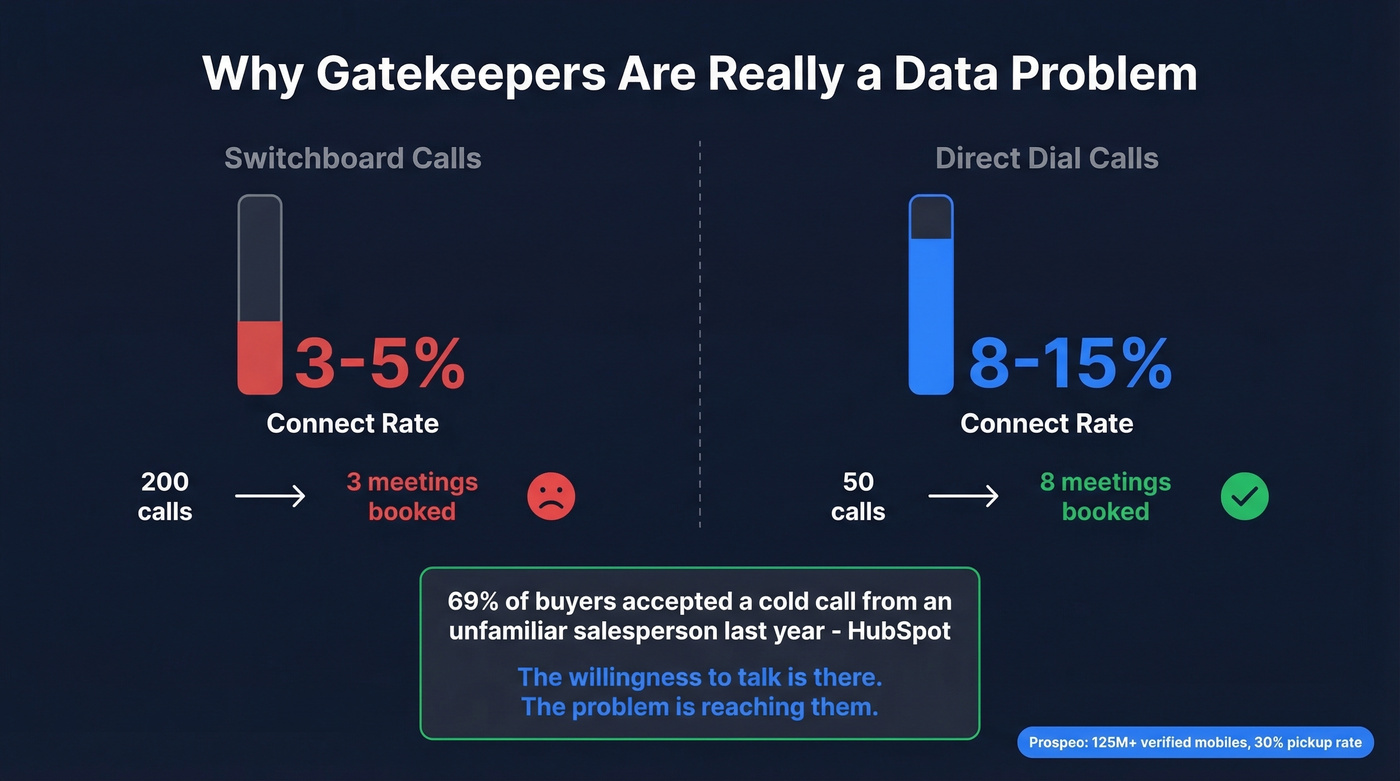
Connect rates on direct dials run 8-15% vs. 3-5% through a switchboard. And 69% of buyers accepted a cold call from an unfamiliar salesperson in the last year. The willingness to talk is there - the problem is reaching them without going through a switchboard.
Prospeo's database covers 125M+ verified mobile numbers with a 30% pickup rate - roughly triple what we've seen from legacy providers in head-to-head tests. The data refreshes every 7 days, which matters because phone numbers go stale fast. Pair that with 98% email accuracy across 143M+ verified addresses, and the entire gatekeeper conversation becomes optional.
Here's the thing: the whole gatekeeper-handling industry - the scripts, the training programs, the "7 magic phrases" blog posts - exists because contact databases have historically been garbage. Fix the data, and the problem largely disappears. If your team is still running gatekeeper-bypass workshops in 2026, you have a data vendor problem, not a skills problem.

You just read that direct dials crush switchboard connect rates 3-to-1. Prospeo gives you 125M+ verified mobile numbers with a 30% pickup rate - so your reps skip the gatekeeper entirely and land on the decision-maker's phone.
Stop pitching receptionists. Start calling the person who signs the check.
Gatekeepers exist because generic outreach wastes everyone's time. Prospeo's 30+ search filters - buyer intent, job changes, technographics - let you build lists so targeted that when you do reach the decision-maker, you sound like you belong on the line. 98% email accuracy. $0.01 per lead.
Research-grade data turns cold calls into warm conversations.
Gatekeepers in Healthcare
In healthcare, the gatekeeper model works completely differently. The gatekeeper is typically your primary care physician, and their job is to control access to specialists, hospitalizations, and lab studies. If you're on an HMO or managed care plan, you usually can't see a cardiologist or get an MRI without your PCP authorizing the referral first.
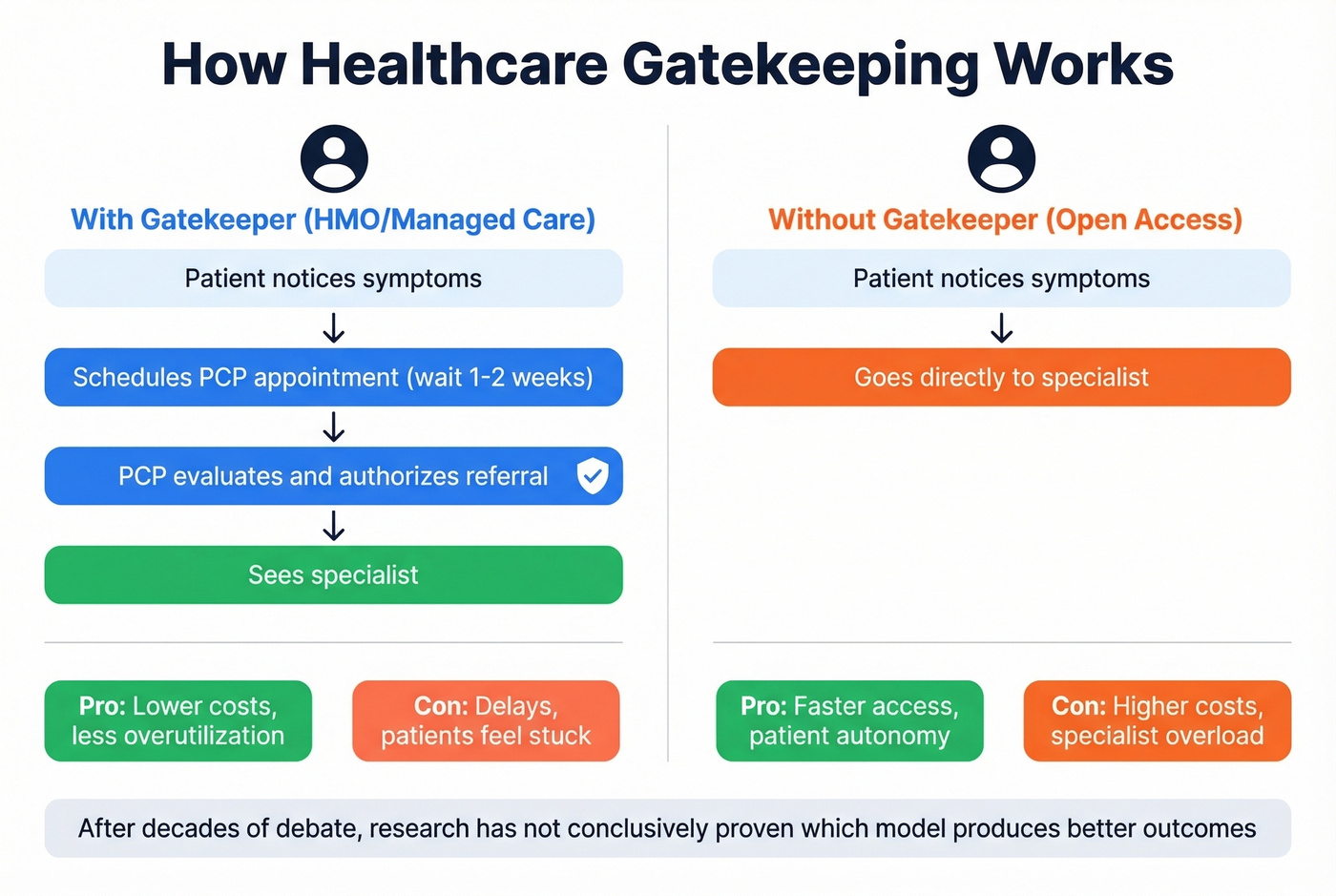
The cost-control rationale is straightforward. Primary care visits are cheaper than specialist visits. If every patient with a headache went straight to a neurologist, healthcare costs would spike and specialist availability would crater. A 2015 report comparing Austria - which has no gatekeeping - to systems with gatekeeping found that Austrian patients sought specialists far more frequently, leading to overutilization of secondary and tertiary facilities.
On the other side, patients hate it. The frustration is real: you know something's wrong, you know which specialist you need, and you're forced to schedule a PCP appointment first - wait two weeks, pay a copay, describe your symptoms to someone who's going to refer you anyway. Dutch research found that PCPs in gatekeeping systems felt reduced to administrators, rubber-stamping referrals rather than practicing medicine.
Nobody has conclusively proven whether gatekeeping improves outcomes. A 2024 peer-reviewed literature review comparing systems across the UK, Sweden, Netherlands, Germany, and Greece concluded that "evidence on gatekeeping's effects is conflicting and limited by low internal validity." After decades of debate, the data still doesn't clearly favor either model. The term also appears in long-term care insurance, where "gatekeepers" are eligibility requirements - like being unable to perform daily activities before coverage kicks in.
Gatekeepers in Media and Communication
Traditional media gatekeeping is the version Lewin and White studied. Editors, publishers, and producers decide what gets published, broadcast, or killed. A newspaper editor choosing which stories make the front page is gatekeeping. A TV news director deciding to lead with a political scandal instead of a climate report is gatekeeping. The power is concentrated in a small number of people who shape what millions of others know about the world.
The internet was supposed to eliminate this. In some ways, it did - anyone can publish a blog post, launch a podcast, or go viral on social media. The traditional gatekeepers lost their monopoly on distribution.
But new gatekeepers emerged immediately. Search engine algorithms decide which content appears on page one. Social media feeds curate what you see based on engagement signals, not editorial judgment. Platform moderation teams decide what's allowed and what gets removed. Algorithms curating social feeds are the modern equivalent of White's wire editor - except they operate at massive scale, with far less transparency about the criteria.
The shift from human to algorithmic gatekeeping didn't democratize information as much as it rearranged who controls the gates. An editor's biases were at least legible ("too Red," "don't care for suicides"). An algorithm's biases are opaque, optimized for engagement rather than importance, and nearly impossible for the average person to challenge.
"Stop Gatekeeping" - The Online Meaning
If you've spent any time on TikTok or Twitter in the last five years, you've heard "stop gatekeeping" used as an accusation. In internet slang, gatekeeping means intentionally withholding access, knowledge, or opportunity - pulling the ladder up behind you.
The examples range from trivial to serious. Kylie Jenner refused to share a favorite drink recipe and got accused of gatekeeping. Fans of Kate Bush accused longtime listeners of gatekeeping after "Running Up That Hill" went viral from Stranger Things. People accuse others of gatekeeping skincare routines, restaurant recommendations, career advice, and mental health resources.
Google Trends tells the story: search interest in "gatekeeping" rose starting in March 2020 and peaked in January 2022. The COVID era - when everyone was perpetually online and information-sharing became a social currency - poured fuel on the whole dynamic.
The counter-movement is called "gatebreaking." TikTok creators deliberately share previously inaccessible knowledge: how to negotiate a salary, how to get a restaurant reservation, how to format a resume for ATS systems. The consensus on r/NoStupidQuestions is that sharing restaurant recommendations counts as gatebreaking, though debates about whether it ruins the experience for regulars pop up constantly. Gen Z in particular treats information hoarding as a moral failing rather than a competitive advantage.
Some "gatekeeping" is protective, though. Native Hawaiians asking for tighter tourism regulation aren't hoarding access - they're protecting cultural and environmental resources. A community guarding its cultural origins from commodification is different from an institution restricting information to maintain power. The word has become so broad that it sometimes covers both, which can make the accusation meaningless.
Gatekeepers in the Workplace
Workplace gatekeeping is the version most people experience daily but rarely name.
When it works: A CEO's executive assistant filters meeting requests so the CEO can focus on decisions that actually need their attention. This is productive gatekeeping - it protects a scarce resource and makes the organization more efficient. Harvard Business Review has argued that learning to be your own gatekeeper is a critical leadership skill.
When it doesn't: A senior colleague withholds key project information from a newer team member - not because the information is sensitive, but because controlling access to it reinforces their position in the hierarchy. This is gatekeeping as a power move, and it's corrosive. Inclusive leadership - the opposite of information hoarding - improves teamwork, commitment, psychological safety, and innovation.
The difference isn't whether someone controls access. It's whether the control serves the organization or just the gatekeeper. When an assistant protects a calendar, that's structure. When a manager hoards context to stay indispensable, that's politics.
Skip the "all gatekeeping is bad" take if you're in a leadership role. Some filtering is necessary. The question is always: who benefits from the gate?
FAQ
What is a gatekeeper in simple terms?
A gatekeeper is anyone who controls access to a person, place, or piece of information - deciding who gets through and who doesn't. The role appears in sales, healthcare, media, and everyday online culture, always with the same core function: filtering.
Is gatekeeping always negative?
No. A CEO's assistant filtering low-priority meetings is productive - it protects a scarce resource. Withholding information to maintain personal power is harmful. Context and intent determine whether gatekeeping helps or hurts.
How do you get past a gatekeeper in sales?
Skip them entirely with a verified direct-dial number - connect rates run 8-15% on mobiles vs. 3-5% through a switchboard. If you must go through the front desk, research the prospect, use their first name, and never pitch the screener.
What does "stop gatekeeping" mean online?
It's an accusation that someone is intentionally withholding knowledge or access - popularized on TikTok starting in 2020 alongside Gen Z's anti-gatekeeping ethos. Google Trends shows the phrase peaked in January 2022 during the height of pandemic-era information sharing culture.
How are business and healthcare gatekeepers different?
In business, a gatekeeper screens access to decision-makers - think receptionists and executive assistants protecting a VP's calendar. In healthcare, the gatekeeper is your primary care physician controlling referrals to specialists under managed care plans. Both filter access, but the stakes and motivations are completely different.