

What Is B2B SaaS? The Data-Rich Guide Every Glossary Skips
The average company runs 106 SaaS applications. That's not a success story - it's a management crisis hiding behind convenient monthly invoices. Most definitions of B2B SaaS read like they were written for a college course in 2014, so we put together something with actual numbers, real adoption pain, and the benchmarks that matter in 2026.
The Short Answer
B2B SaaS - Business-to-Business Software as a Service - is cloud-based software sold on subscription to other businesses. No installation, no servers in your closet, no perpetual licenses. You pay monthly or annually, the vendor hosts everything, and updates roll out automatically.
The market hit $390B in 2025 and is projected at $492B in 2026, racing toward $1.58T by 2031. Every category from CRM to sales intelligence runs on this model now, and the average company uses 106 SaaS apps to keep things moving.
B2B SaaS Defined
B2B SaaS stands for Business-to-Business Software as a Service. A vendor builds an application, hosts it in the cloud, and sells access to business customers via subscription. The buyer never installs anything locally - they log in through a browser or app, and the vendor handles infrastructure, security, and updates.
This replaced the old on-premise model where you'd buy a perpetual license, install software on your own servers, and pray your IT team could keep it running. The shift wasn't subtle. Subscription revenue in software has grown 437% over the past decade.
The "B2B" part shapes everything downstream: pricing, sales cycles, support expectations, and how the product gets built. Selling to businesses means multi-stakeholder buying committees, longer evaluation cycles, and contracts that can run from $1,000 to $250,000+ per year. It's a fundamentally different game than selling a $9.99/month app to consumers.
Market Size in 2026
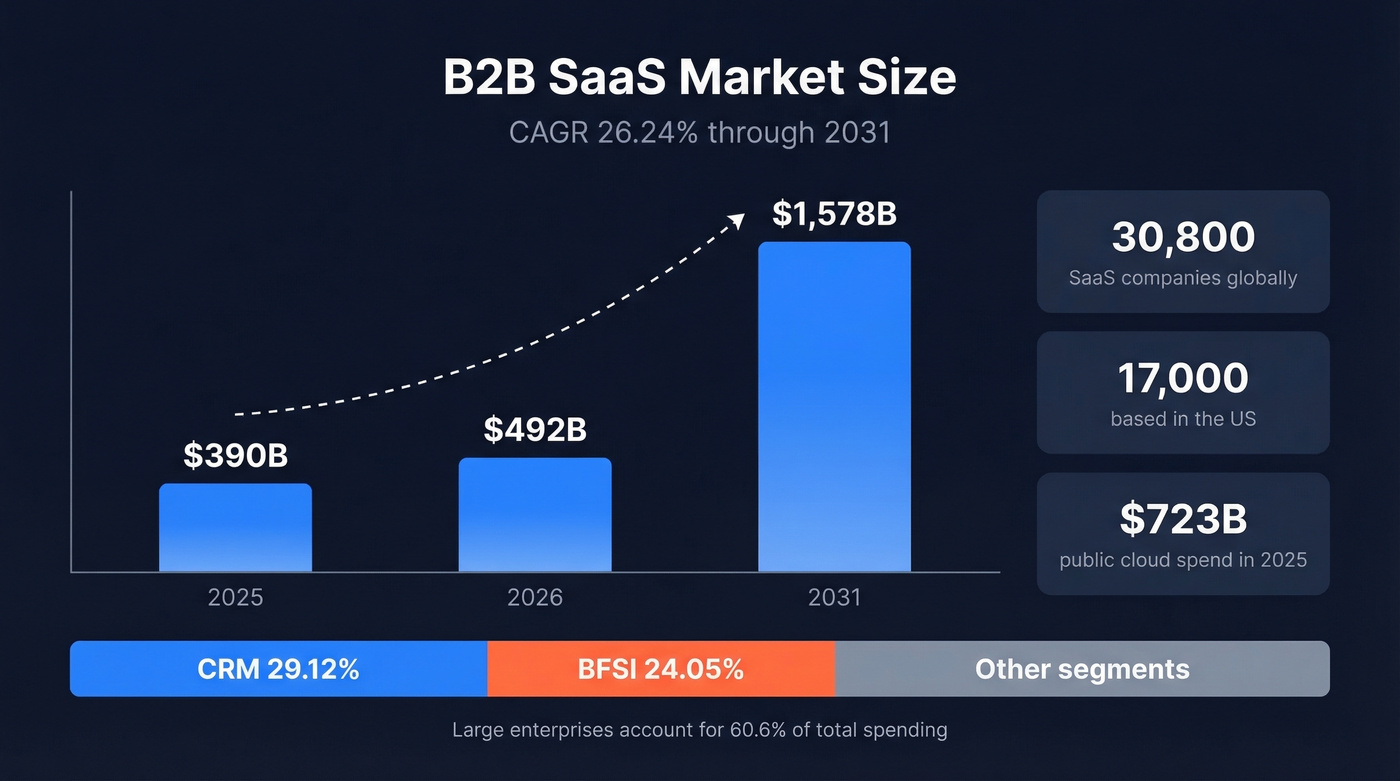
The market was valued at $390B in 2025 and is projected at $492.34B in 2026, with a CAGR of 26.24% through 2031 - putting it on track to reach $1,578.2B. There are roughly 30,800 SaaS companies globally, about 17,000 of them in the US.
| Segment | 2025 Share / Forecast Growth |
|---|---|
| CRM (by type) | 29.12% of market |
| BFSI (by end-user) | 24.05% share |
| Large enterprises | 60.60% of market |
| North America | 32.85% revenue share |
| Asia-Pacific | Fastest CAGR (24.60%) |
Worldwide public cloud spending - the infrastructure layer underneath all of this - hit $723.4B in 2025, up from $595.7B the year prior. That's the plumbing bill for the entire SaaS economy.
North America still dominates revenue, but Asia-Pacific is the growth story. Large enterprises account for over 60% of spending, which makes sense when enterprise contracts routinely run $60K-$250K+ per year. CRM alone captures nearly a third of the entire market. Salesforce's gravitational pull is real.
How B2B SaaS Works
Under the hood, B2B SaaS products share a common technical architecture. Understanding it helps you evaluate vendors more critically.
Cloud hosting is the foundation. Most products run on AWS, Azure, or GCP. The vendor manages servers, scaling, backups, and global availability so you don't have to.
Multi-tenancy vs. single-tenancy is the first architectural decision. Multi-tenant means all customers share the same infrastructure - cheaper and faster to update. Single-tenant gives each customer isolated resources, better for regulated industries. Most vendors default to multi-tenant unless you're paying enterprise prices.
The rest of the stack includes automatic updates via CI/CD pipelines, where features ship continuously instead of in annual release cycles. APIs and SDKs form the integration layer connecting SaaS tools to each other and to your internal systems. Security controls cover encryption in transit and at rest, MFA, role-based access, and increasingly zero-trust frameworks. Compliance frameworks like SOC 2, ISO 27001, GDPR, and HIPAA vary by industry. And SLAs guarantee uptime (99.9%+), support response times, and disaster recovery.
B2B SaaS vs. B2C SaaS
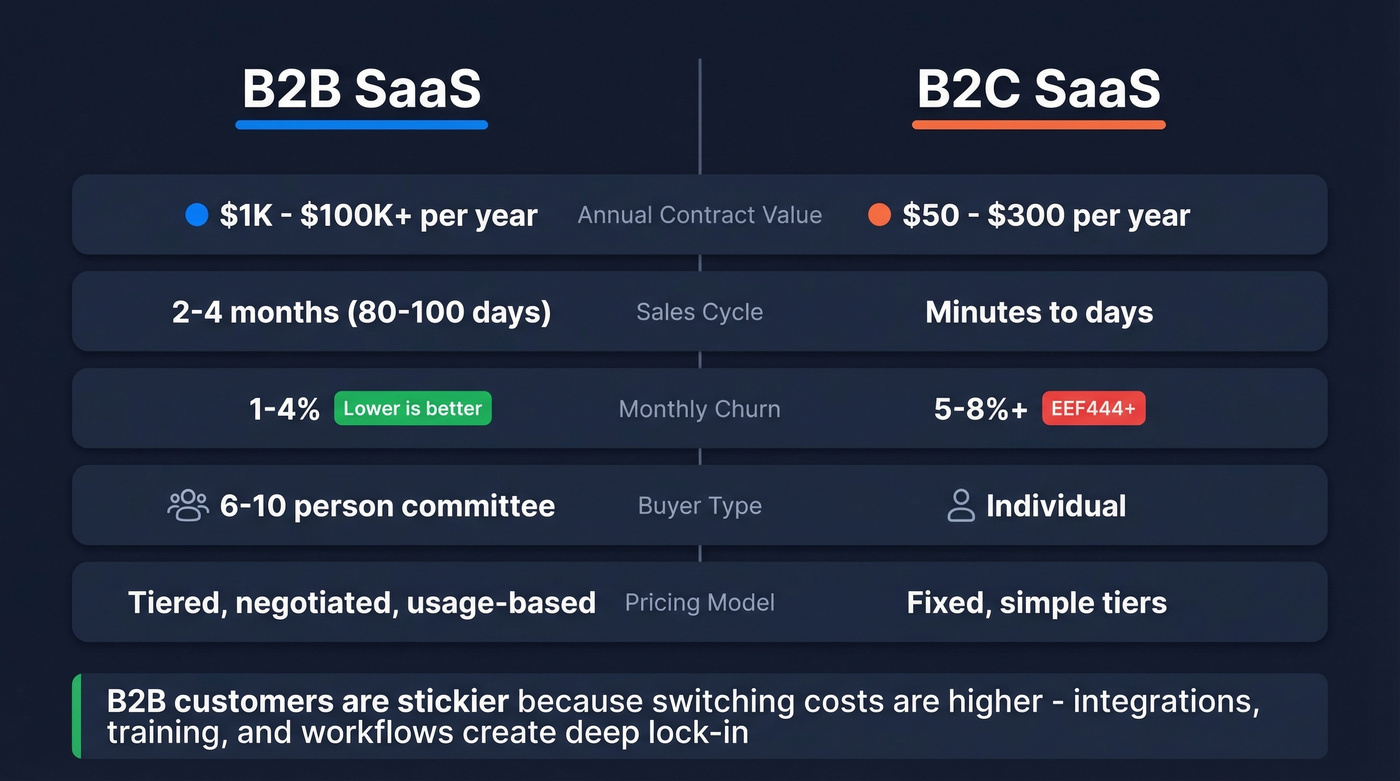
The label "SaaS" covers both, but B2B and B2C operate on completely different economics.
| Dimension | B2B SaaS | B2C SaaS |
|---|---|---|
| ACV | $1K-$100K+/yr | $50-$300/yr |
| Sales cycle | 2-4 months (80-100 days) | Minutes to days |
| Monthly churn | 1-4% | 5-8%+ |
| Buyer type | 6-10 person committee | Individual |
| Pricing | Tiered / negotiated | Fixed / simple |
The churn difference alone tells the story. B2B customers are stickier because switching costs are higher - you've integrated the tool into workflows, trained the team, and built processes around it. B2C users cancel when they forget to use the app for a month.
The buying committee dynamic is the other major differentiator. When 6-10 stakeholders need to align on a purchase, the sales process looks nothing like a consumer checkout page. That's why B2B SaaS companies invest heavily in demos, pilots, security reviews, and procurement workflows that B2C companies never think about.

You just read that the average company runs 106 SaaS apps. The best ones pay for themselves immediately. Prospeo gives you 300M+ verified profiles, 98% email accuracy, and a 7-day data refresh - at roughly $0.01 per lead. No annual contract, no sales call.
See why 15,000+ companies chose Prospeo as their sales intelligence layer.
Common Categories and Examples
B2B SaaS spans dozens of categories. Here are the ones that move the most revenue and shape how businesses actually operate.
CRM
What does 29.12% market share buy you? Apparently, a permanent seat at the head of the table. CRM is the single largest B2B SaaS category, with Salesforce as the incumbent, HubSpot owning the SMB-to-mid-market tier, and Close targeting high-velocity sales teams. If you're in B2B, you're paying for a CRM - the only question is which one.
ERP & Finance
Enterprise resource planning and financial software handle the operational backbone: accounting, payroll, HR, and supply chain. NetSuite is the mid-market standard, Workday dominates HR and finance for larger orgs, and Gusto has carved out the SMB payroll niche.
Marketing Automation
Campaign management, social scheduling, analytics, and lead nurturing. HubSpot Marketing Hub bundles this with CRM, while Sprout Social focuses on social media management for teams that need depth over breadth.
Project Management & Collaboration
Could your team function for a single day without Slack, Asana, or Zoom? Probably not - and that's exactly the point. This category exploded during remote work and never contracted. Asana and ClickUp compete on task management, Slack owns async communication, and Zoom became a verb. These tools are so embedded in daily workflows that switching costs are enormous.
Sales Intelligence & Prospecting
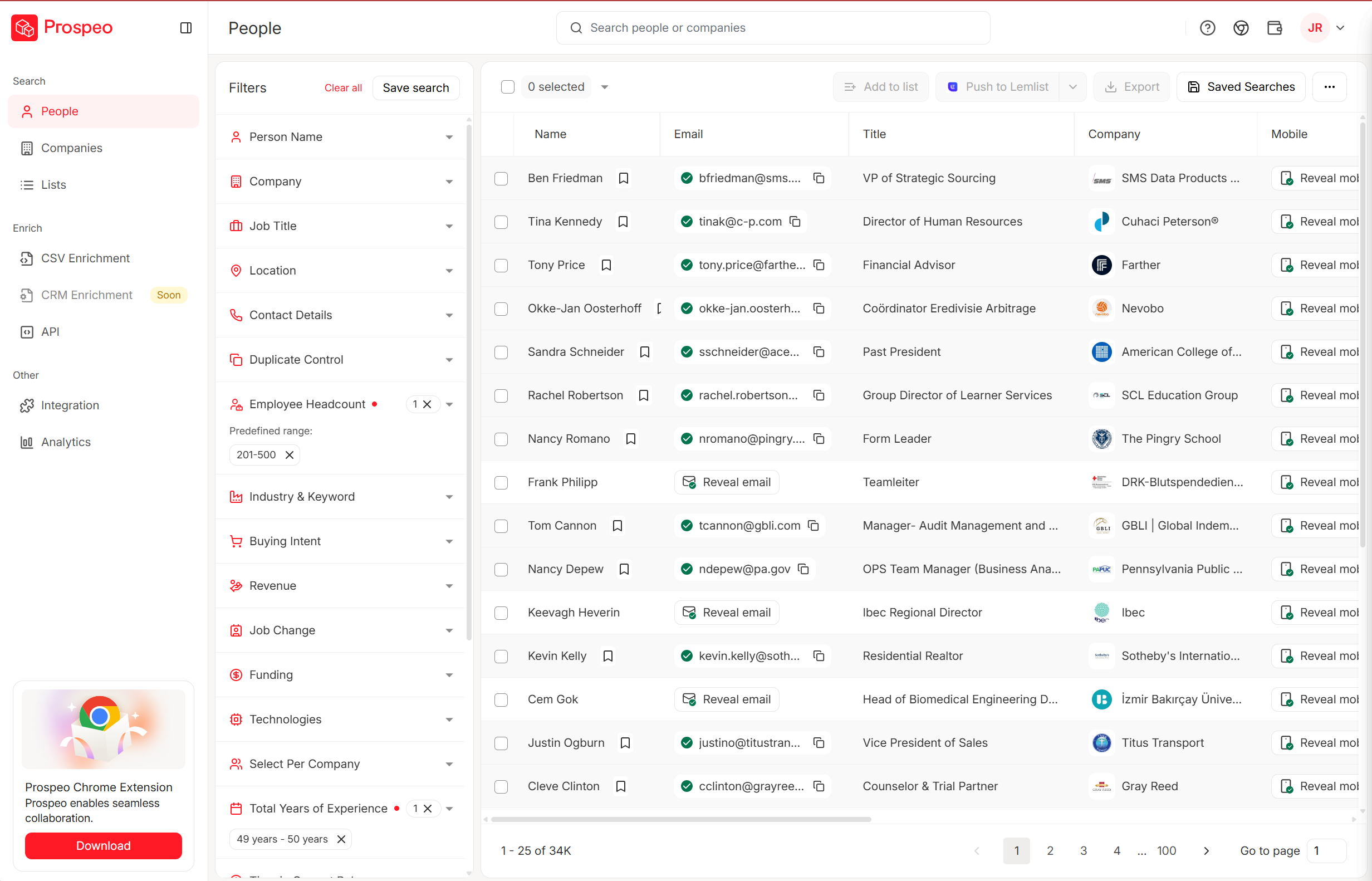
This is one of the fastest-growing segments, and it illustrates the modern subscription model perfectly. Prospeo, for example, gives you self-serve access to 300M+ professional profiles with 98% email accuracy and a 7-day data refresh cycle. No installation, no annual contract, no sales call required. You sign up, search using 30+ filters, and pay roughly $0.01 per verified email - with a free tier offering 75 verified emails plus 100 Chrome extension credits per month. It's the B2B SaaS model distilled: instant access, credit-based pricing, and value tied directly to usage.
DevOps & Infrastructure
Monitoring, observability, and operational technology. Datadog tracks infrastructure and application performance for engineering teams, while Samsara connects physical operations to cloud-based management.
How Pricing Works
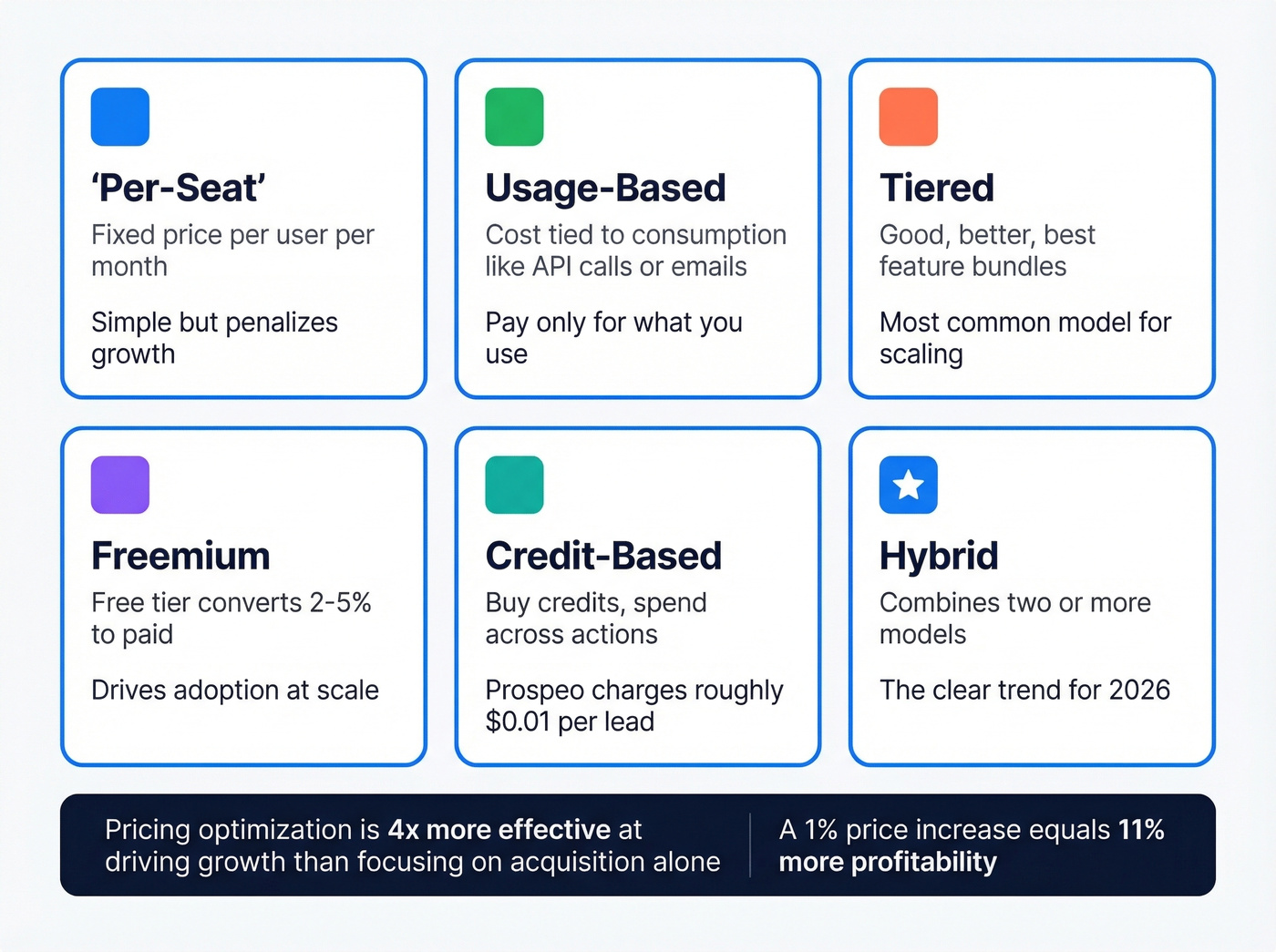
Here's the thing about SaaS pricing: most companies get it wrong. A study of 512 SaaS businesses found that pricing optimization is 4x more effective at driving growth than focusing solely on customer acquisition. McKinsey's data backs this up - a 1% price increase translates to an 11% increase in profitability.
The major pricing models:
- Per-seat - fixed price per user/month. Simple but penalizes growth.
- Usage-based - cost tied to consumption like API calls, data processed, or emails sent.
- Tiered - good/better/best feature bundles.
- Freemium - free tier drives adoption, converting 2-5% of self-serve users to paid.
- Credit-based - buy credits, spend them across different actions.
- Hybrid - combines two or more of the above.
The trend is clearly toward hybrid. Intercom prices its Fin AI agent at $0.99 per resolved customer conversation while keeping the core platform on per-seat pricing. Both approaches align cost with value delivered rather than arbitrary seat counts.
ACV ranges vary dramatically by segment: SMB deals run $1K-$12K/year, mid-market $12K-$60K/year, and enterprise $60K-$250K+/year. Knowing where your product sits on this spectrum determines everything from your sales motion to your support model.
Key Metrics That Matter
If you're operating or evaluating a B2B SaaS business, these are the numbers that separate healthy companies from struggling ones.
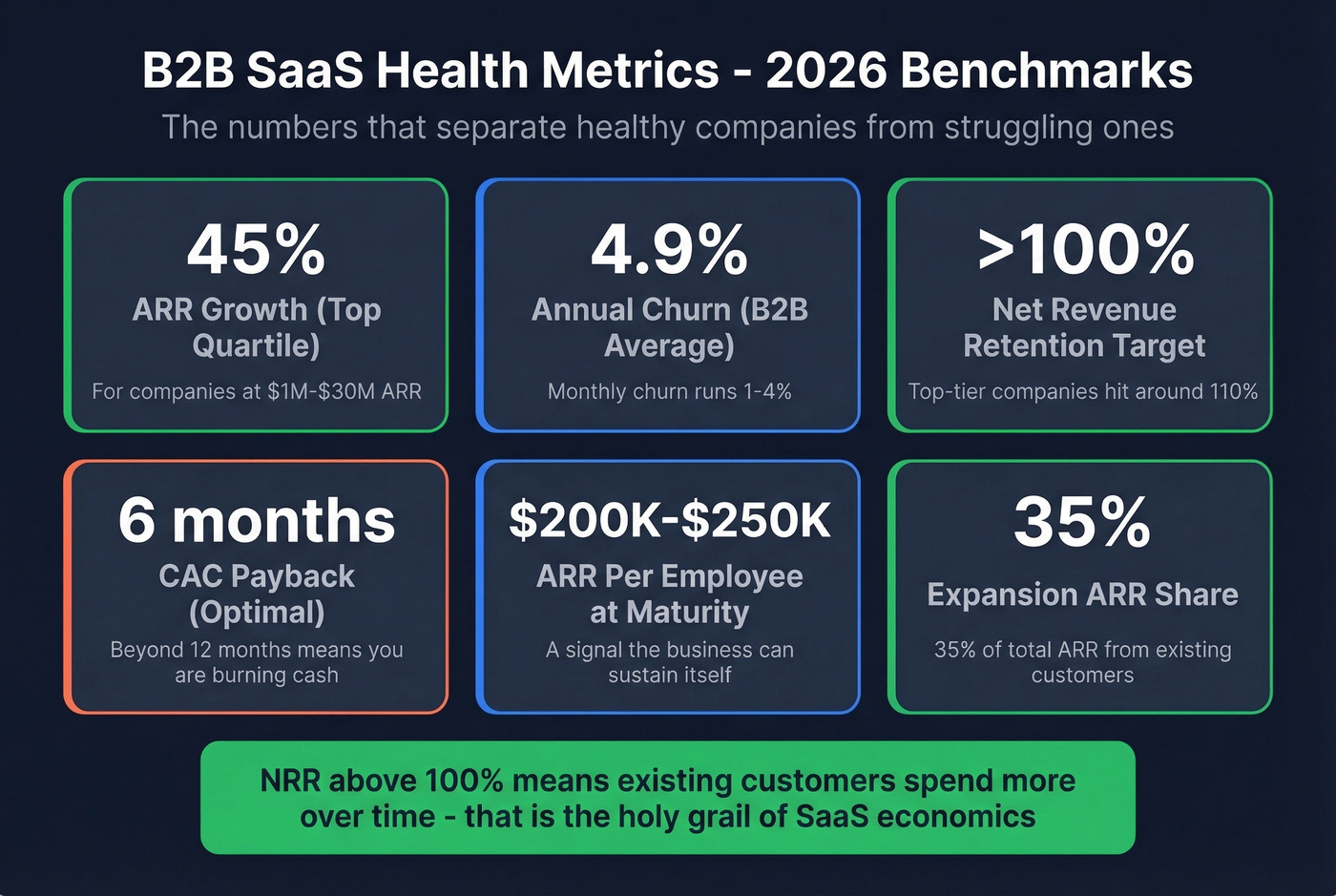
| Metric | Benchmark |
|---|---|
| ARR growth (top quartile, $1-30M) | 45% |
| Annual churn (B2B avg) | 4.9% |
| NRR target | >100% (top-tier ~110%) |
| CAC payback | ~6 months optimal |
| ARR per employee | $200K-$250K at maturity |
| Expansion ARR share | 35% of total ARR |
Let's break a few of these down. Net revenue retention above 100% means your existing customers are spending more over time - expansion revenue outpaces churn. That's the holy grail. Companies with $15-30M ARR that achieve negative net MRR churn (40% of them do) are growing on autopilot from their installed base.
CAC payback of six months means you recoup your customer acquisition cost in half a year. Go longer than 12 months and you're burning cash faster than you're building value. The ARR per employee target of $200K-$250K is a maturity signal - it tells you whether the business can sustain itself without constant fundraising.
The Reality of Adoption
Your company is running 106 SaaS apps. Finance flags that half the licenses haven't been used in 90 days. Sound familiar?
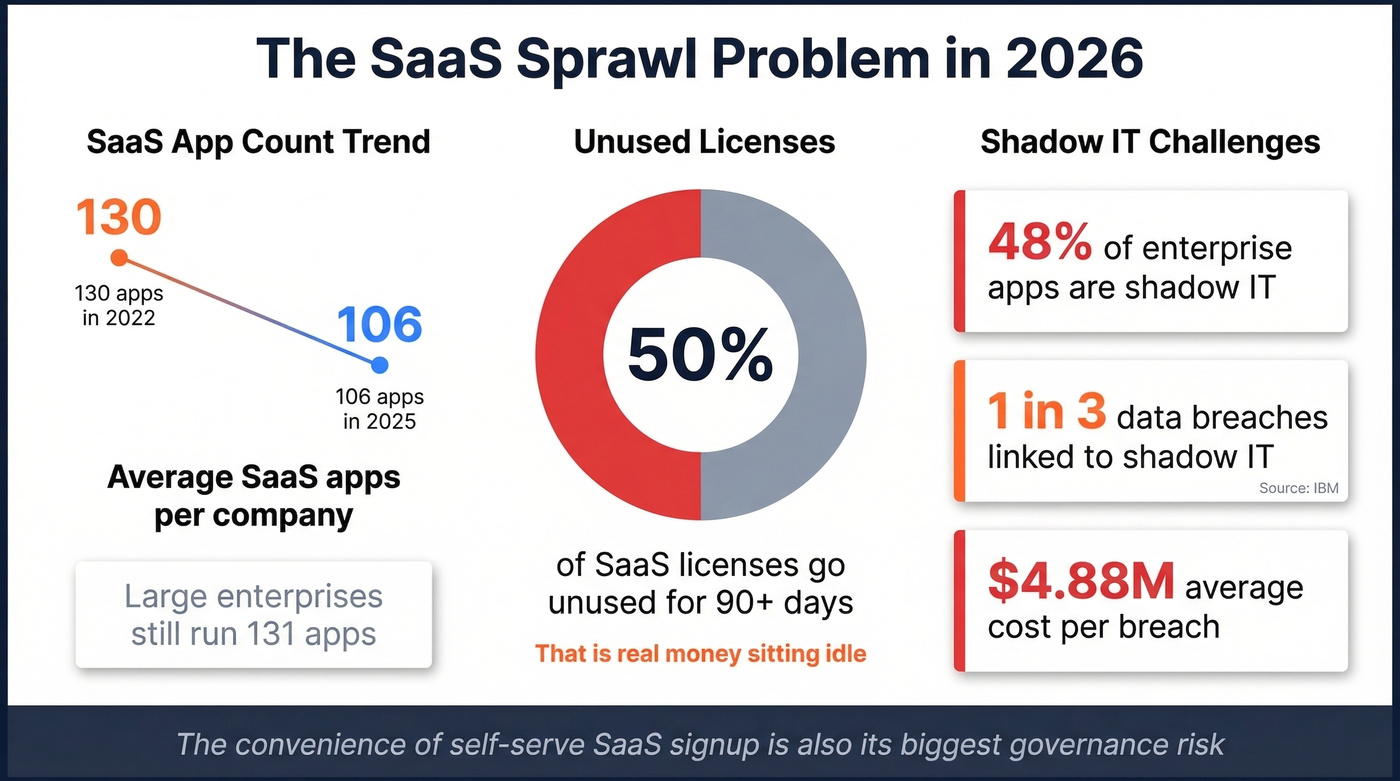
Companies averaged 130 apps at the 2022 peak and have trimmed to 106, but large enterprises still run 131. Nearly 50% of SaaS licenses go unused for 90+ days. That's not a rounding error - it's a line item that finance teams are increasingly scrutinizing.
Shadow IT makes it worse. 48% of enterprise applications are shadow IT - tools adopted without IT approval. IBM's data links 1 in 3 data breaches to shadow IT, with the average breach costing $4.88M. The convenience of self-serve SaaS sign-up is also its governance risk.
On the vendor side, implementation failures follow predictable patterns. Charging for implementation creates accountability and urgency. Closing customers outside your ICP causes downstream churn - early-stage companies are especially guilty of signing anyone willing to write a check. And poor sales-to-CS handoffs mean integration requirements get missed and timelines slip.
The consensus on r/SaaS paints a consistent picture from the founder side: builders spend 7-8 months developing a product, then 2-3 months pitching with no serious clients. The recurring theme? Domain expertise is a prerequisite, not a nice-to-have. Founders without industry experience struggle to identify real problems and reach the right buyers.
Where B2B SaaS Is Heading
The "growth at all costs" era is over. We're in the efficient growth era now, where retention metrics matter more than top-line ARR growth.
Vertical SaaS is winning. Vertical-specific platforms are growing 2-3x faster than horizontal tools. Building for construction, healthcare, or logistics - with deep domain workflows baked in - beats building another generic project management app. We'd bet that 50% of horizontal productivity apps get acquired or pivot by end of 2026.
Usage-based pricing is mainstream. 85% of companies have adopted some form of usage-based pricing. The pure per-seat model is fading because it doesn't align cost with value, especially as AI agents start doing work that humans used to do. Why pay per seat for a bot?
AI is shifting from demos to production. The 2024-2025 wave was AI feature announcements. The 2026 wave is about making AI observable, governable, and cost-controlled in production environments. Workflow orchestration - retries, routing, observability, governance - is becoming the "AI control plane" that enterprises actually need.
Security is a go-to-market differentiator. Auditability, compliance certifications, and data governance aren't just checkboxes anymore. They're selling points.
Here's our hot take: if your average deal size is under $10K, you probably don't need the complexity of an enterprise SaaS stack. A focused set of tools with clean data and tight integrations will outperform a bloated 130-app portfolio every time. The companies that'll thrive in 2026 aren't the ones with the flashiest AI demos - they're the ones with clean data, tight retention, and pricing that scales with customer value. Skip the shiny objects.
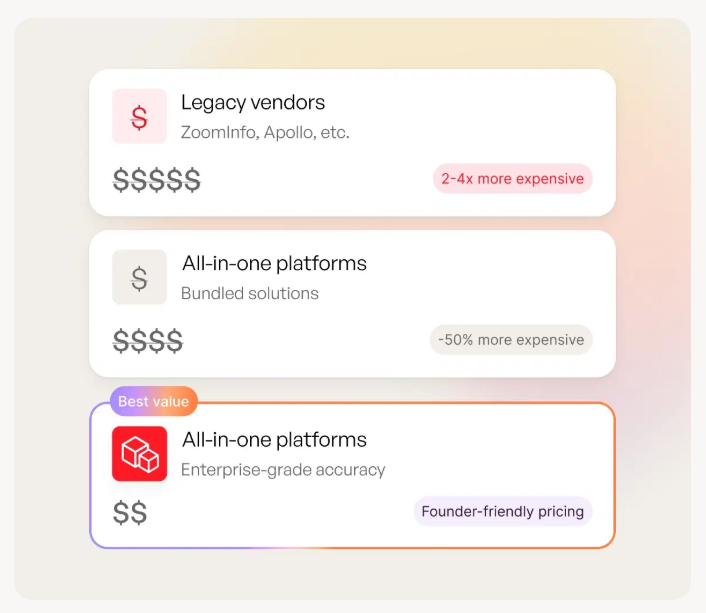
Sales intelligence is one of the fastest-growing B2B SaaS categories for a reason: pipeline depends on data quality. Prospeo delivers 98% email accuracy, 125M+ verified mobiles, and 30+ search filters - with transparent credit-based pricing that's 90% cheaper than legacy providers.
Stop overpaying for bad data. Start with 75 free verified emails today.
FAQ
Is Netflix a B2B SaaS company?
No. Netflix is B2C SaaS - it sells subscriptions directly to individual consumers. B2B SaaS sells to businesses, with examples like Salesforce, Slack, and Datadog. The distinction matters because B2B involves multi-stakeholder buying committees, longer sales cycles, and contracts averaging $12K-$60K/year at mid-market.
What's the difference between SaaS, PaaS, and IaaS?
SaaS delivers complete applications like HubSpot and Zoom. PaaS provides development platforms like Heroku and Google App Engine. IaaS provides raw compute infrastructure like AWS EC2 and Azure VMs. Most B2B buyers interact with SaaS; PaaS and IaaS are primarily for engineering teams building custom software.
How many SaaS apps does the average company use?
106 as of 2026 data, down from a peak of 130 in 2022. Large enterprises average 131. Nearly 50% of those licenses go unused for 90+ days, making SaaS spend audits a growing priority for finance teams.
What's a good churn rate for B2B SaaS?
Under 5% annually is the target. The B2B average sits at 4.9%. Top performers achieve negative net revenue churn, meaning expansion revenue from existing customers more than offsets cancellations - the clearest signal of product-market fit.
What's a good free tool for B2B SaaS prospecting?
Prospeo offers 75 free verified emails plus 100 Chrome extension credits per month with 98% email accuracy - no contract or sales call required. HubSpot CRM has a free tier for contact management. Apollo.io provides limited free searches, though its email accuracy trails dedicated verification tools.