

What Is Cold Calling in Sales - and Does It Still Work in 2026?
A RevOps lead we know ran a cold calling blitz last quarter: 40 reps, 2,000 dials a day, a brand-new dialer. They booked 11 meetings in the first week. Not because the dialer was bad - because 38% of the phone numbers were disconnected. The tool worked fine. The data didn't. That's the reality of cold calling in sales in 2026: the tactic works, but only when the inputs are right.
Cold calling is a live phone conversation with a prospect who hasn't expressed prior interest in your product. Top teams hit 6-11% success rates versus the 2.3% industry average, and the gap comes down to three things: data quality, a structured script, and persistence - eight attempts on average to reach someone.
What Is a Cold Call, Exactly?
Cold calling means picking up the phone and calling someone who hasn't asked to hear from you. No prior email exchange, no inbound form fill, no warm introduction. You're interrupting their day with a hypothesis: that you can solve a problem they have.
That's what separates it from warm and hot calling, which involve varying degrees of prior engagement:
| Cold Call | Warm Call | Hot Call | |
|---|---|---|---|
| Relationship | None | Some signal | Explicit interest |
| Data available | Name, title, company | + engagement history | + intent/request |
| Opener style | Permission-based | Reference trigger | Confirm interest |
| Goal | Qualify + book meeting | Advance conversation | Demo or next step |
| Conversion | 2-3% avg | Up to 15x higher | Highest conversion |
Warm outreach converts up to 15x more often than pure cold outreach - no surprise there. But most companies don't have enough warm leads to fill their pipeline. Cold calls exist to create conversations that wouldn't happen otherwise.
And 82% of buyers accept meetings at least occasionally when sellers reach out cold, per RAIN Group research. The door isn't closed. It's just not open yet.
Is Cold Calling Dead in 2026?
Every year, someone publishes a "cold calling is dead" article. Every year, the teams that actually dial keep booking meetings.
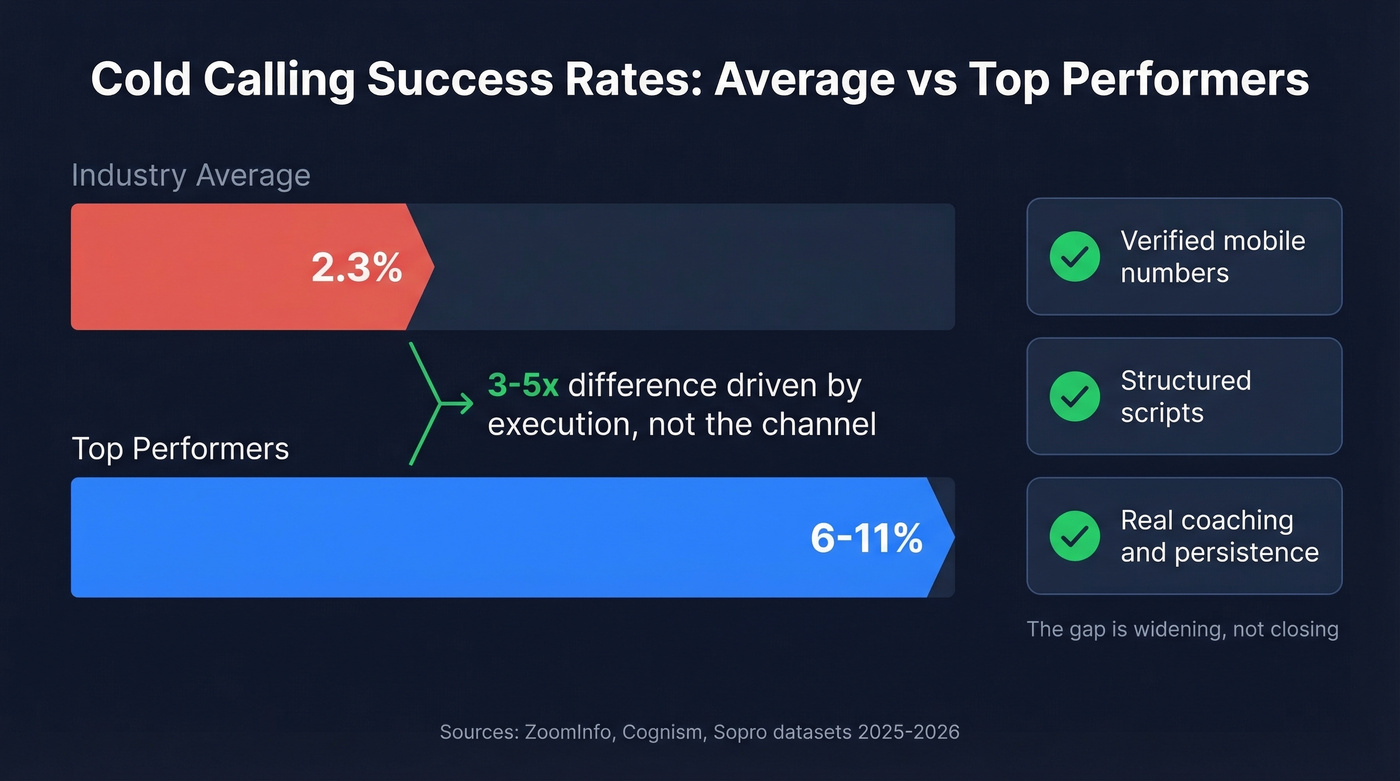
The average success rate is 2.3%. That's the number people cite when they want to kill the channel. But it's a vanity stat. It measures dials, not conversations. Most dials go to voicemail. Most connect attempts hit gatekeepers. The 2.3% includes every terrible list, every untrained SDR, every call made at 4:55 PM on a Friday.
Here's what matters: the gap between average and top performers is widening, not closing. Teams with verified mobile numbers, structured scripts, and real coaching hit 6-11% success rates - a 3-5x difference driven entirely by execution, not by the channel itself. And 49% of buyers actually prefer to be contacted through a phone call, not email, not social, per Sopro's dataset of 151 million outreach points.
Let's be honest: cold calling isn't dying. Mediocre cold calling is dying. If your average call success rate is 2.3% and the top performers hit 11%, the channel isn't broken. Your process is. The teams still treating outbound dialing like a volume game with garbage data are the ones writing the obituaries.
Cold Calling by the Numbers
Before you build a process, you need to know what "normal" looks like:
| Metric | Benchmark |
|---|---|
| Success rate (avg) | 2-3% of dials |
| Success rate (top) | 6-11%+ |
| Connect rate | 3-10% of dials |
| Avg call duration | 82-93 seconds |
| Attempts to reach | 8 on average |
| Calls to voicemail | 81% |
| VM check rate | 67% |
| Best time | 10-11 AM, 2-3 PM, 4-5 PM |
| Best days | Tue-Thu (Wednesday often leads) |
| Mobile vs landline | 4-10x higher pickup |
Benchmarks compiled from ZoomInfo, Cognism, and Sopro datasets, 2025-2026.
Now the math. If your connect rate is 7% and 15% of conversations convert to meetings, you need roughly 50 dials to book one meeting. At a fully loaded rep cost of $30/hour, that's about $37.50 per meeting booked - 50 dials at roughly 1.5 minutes each. With bad data doubling your dials, that cost doubles too.
One trend worth watching: recent data shows most conversations now happen within 1.55 dials, down from 2.9 previously - meaning reps with accurate mobile numbers are reaching prospects faster than ever. And successful calls average about 93 seconds. You don't need a 20-minute pitch. You need 90 seconds of sharp, relevant conversation that earns a calendar invite.
Your Data Is the #1 Variable
It's 10:15 AM on a Wednesday. Your SDR has 40 dials queued up. She's got a solid opener, she's done her research, and she's dialing with energy. Three hours later, she's connected with three people. Not because her technique is off - because 60% of the numbers were landlines that rang through to a general reception desk, and another 15% were disconnected entirely.
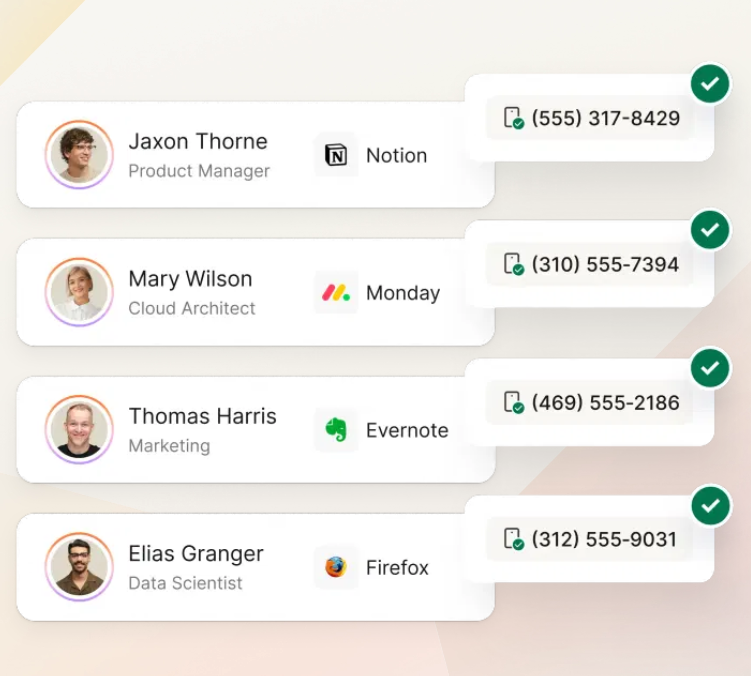
This is the most common failure mode we see. Reps waste 27.3% of their selling time on bad data - roughly 546 hours per year per rep spent dialing numbers that'll never connect. Mobile numbers yield 4-10x higher pickup rates than landlines, but most databases serve you a mix of both without telling you which is which.
Your data provider matters more than your script. Prospeo's database includes 125M+ verified mobile numbers with a 30% pickup rate, refreshed every 7 days rather than the industry-standard six weeks. When your numbers actually ring, your connect rate changes overnight.

The industry average refresh cycle for contact databases is six weeks. In six weeks, people change jobs, get new numbers, and leave companies. That lag is the difference between a 7% connect rate and a 3% connect rate - and it compounds across every rep on your team.
The Cold Calling Process
Cold calling isn't "pick up the phone and wing it." The teams that consistently book meetings follow a repeatable process.
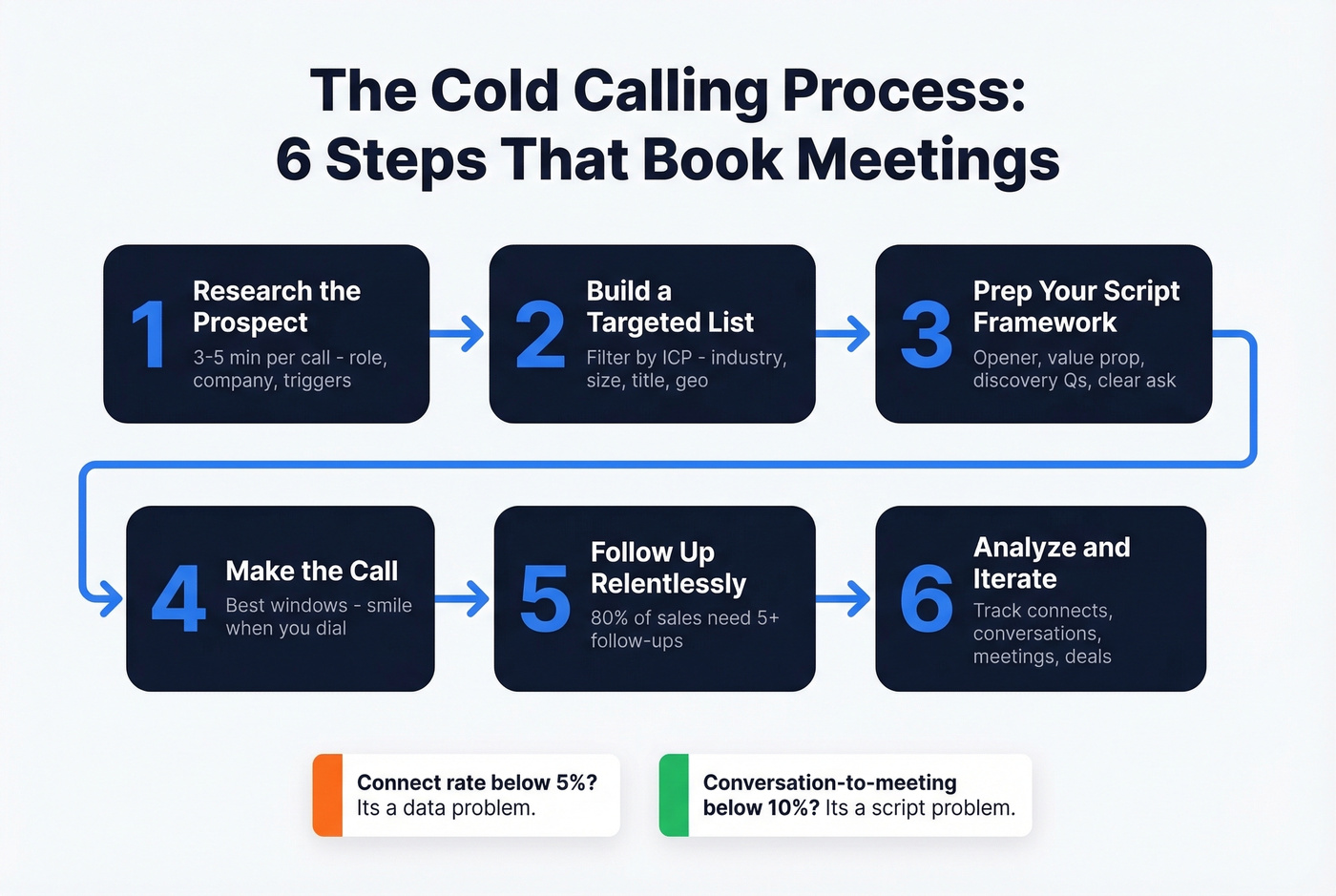
1. Research the prospect. Spend three to five minutes per call. Check their role, company size, recent news, and trigger events - a new hire, a funding round, a product launch. Three minutes of prep turns a cold dial into a relevant conversation.
2. Build a targeted list. Filter by industry, company size, revenue, title, and geography. The tighter your ICP filters, the higher your conversion rate. Calling the wrong people is the most expensive mistake in outbound.
3. Prep your script framework. Not a word-for-word teleprompter - a structured framework with your opener, value prop, two to three discovery questions, and a clear ask.
4. Make the call. Stick to your best timing windows. Smile when you dial - it genuinely changes your tone. If you hit voicemail, leave one. 67% of people check voicemails from unknown numbers.
5. Follow up relentlessly. 80% of sales require 5+ follow-up calls, yet most reps give up after two. Build a 10-14 day multi-touch cadence combining calls, emails, and social touches.
6. Analyze and iterate. Track connects, conversations, meetings booked, and deals won. If your connect rate is below 5%, it's a data problem. If your conversation-to-meeting rate is below 10%, it's a script or qualification problem.

Your cold calling success rate is only as good as your data. Prospeo gives you 125M+ verified mobile numbers refreshed every 7 days - not the 6-week-old landlines tanking your connect rate. Teams using Prospeo's mobiles see a 30% pickup rate, turning 50-dial meeting targets into reality.
Stop burning 546 hours a year dialing dead numbers.
Scripts That Actually Book Meetings
A cold calling script is a framework that keeps you on track when a prospect throws you a curveball. The best scripts have four components: opener, discovery, value delivery, and close.
The Opener
You have about five to seven seconds before a prospect decides whether to hang up. Two opener patterns consistently outperform everything else.
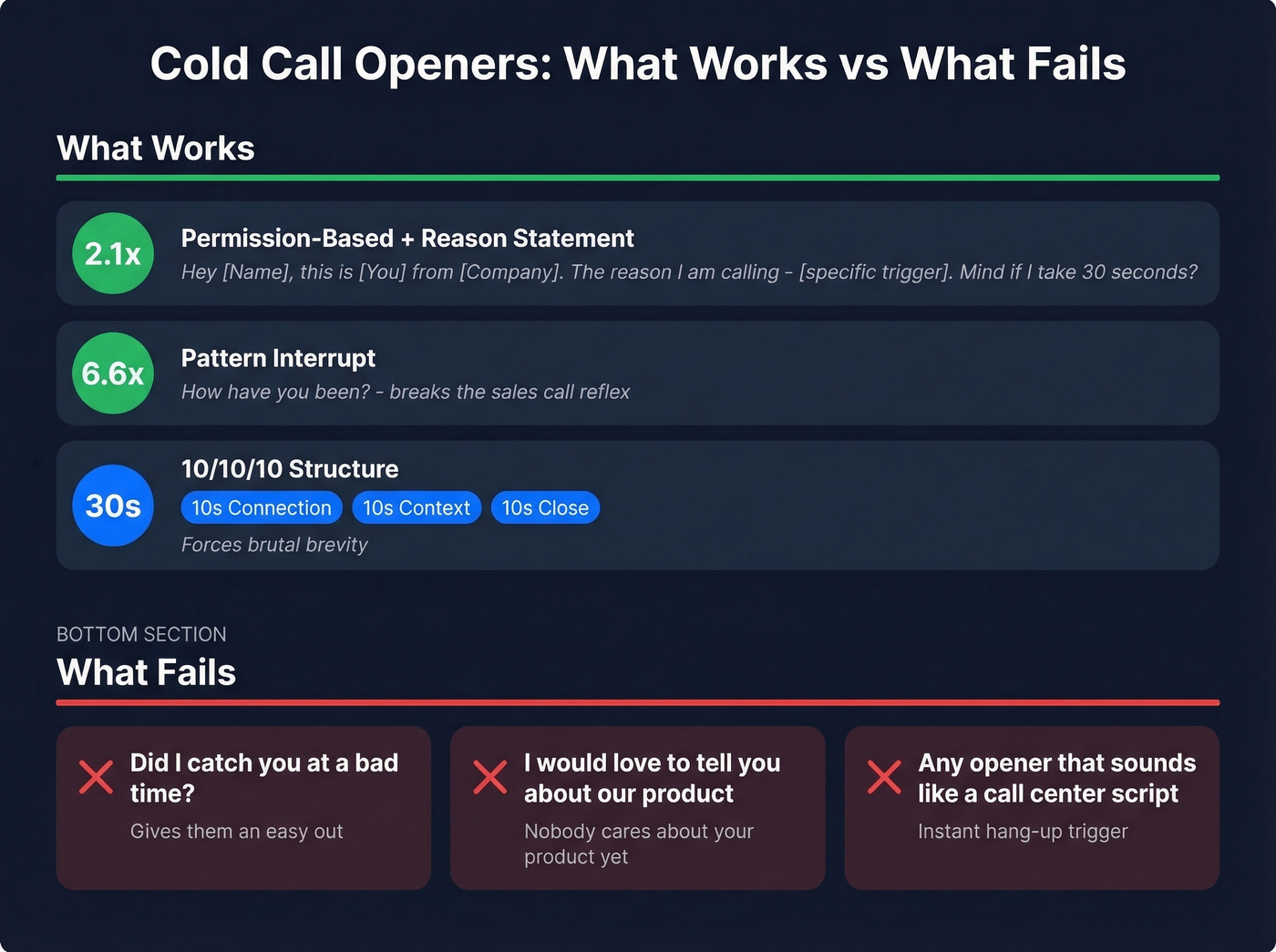
Permission-based + reason statement: "Hey [Name], this is [You] from [Company]. The reason I'm calling - [specific trigger]. Mind if I take 30 seconds?" The reason statement alone increases success rates 2.1x over generic openers. When your data includes accurate job titles and company details, that reason statement practically writes itself.
Pattern interrupt: Instead of launching into a pitch, open with something unexpected. "How have you been?" sounds casual, but it breaks the prospect out of their "this is a sales call" reflex. One study linked this pattern to 6.6x higher success rates - a big number, but even a fraction of that lift makes it worth testing.
A third approach worth stealing: the 10/10/10 structure from Salesforce's playbook. Spend 10 seconds on connection, 10 seconds on context, 10 seconds on the close. It forces brutal brevity and keeps you from rambling past the prospect's patience.
What doesn't work: "Did I catch you at a bad time?" gives them an easy out. "I'd love to tell you about our product" - nobody cares about your product yet. Any opener that sounds like it came from a call center script.
Discovery Questions
Once you've earned 30 seconds, ask questions - don't pitch. The 70/30 rule applies: the prospect should talk 70% of the time.
Good discovery questions cover process, time, blockers, and current handling. "How are you currently handling [problem area]?" and "What's the biggest bottleneck?" do double duty - they qualify the prospect and surface pain points you can reference later. Avoid yes/no questions. "Walk me through how your team handles X today" gets you information you can actually use.
One more angle: sharing a relevant insight earns more conversation time than asking for it. Offering an executive briefing on a trend in their industry - trading value instead of extracting it - flips the dynamic from "sales call" to "worth my time."
The Close
The goal of a cold call is never to close a deal. It's to book a meeting. Every call should end with a specific ask for time.
Choice framing works best: "Would Tuesday at 2 or Thursday at 10 work better for a 20-minute call?" Giving two options makes it easier to say yes than an open-ended "when are you free?"
Voicemail
With 81% of calls going to voicemail, your VM script matters. Keep it under 30 seconds: your name, one reason you're calling, one value hook, your callback number. Don't leave the same voicemail twice - rotate your value hooks across attempts.
Handling Objections
Most "objections" aren't actually objections - they're reflexive brush-offs. "I'm busy" isn't an objection. It's an obstruction designed to end the call. A real objection engages with your premise: "We already use [competitor]" or "We don't have budget." The distinction matters because you handle them differently.
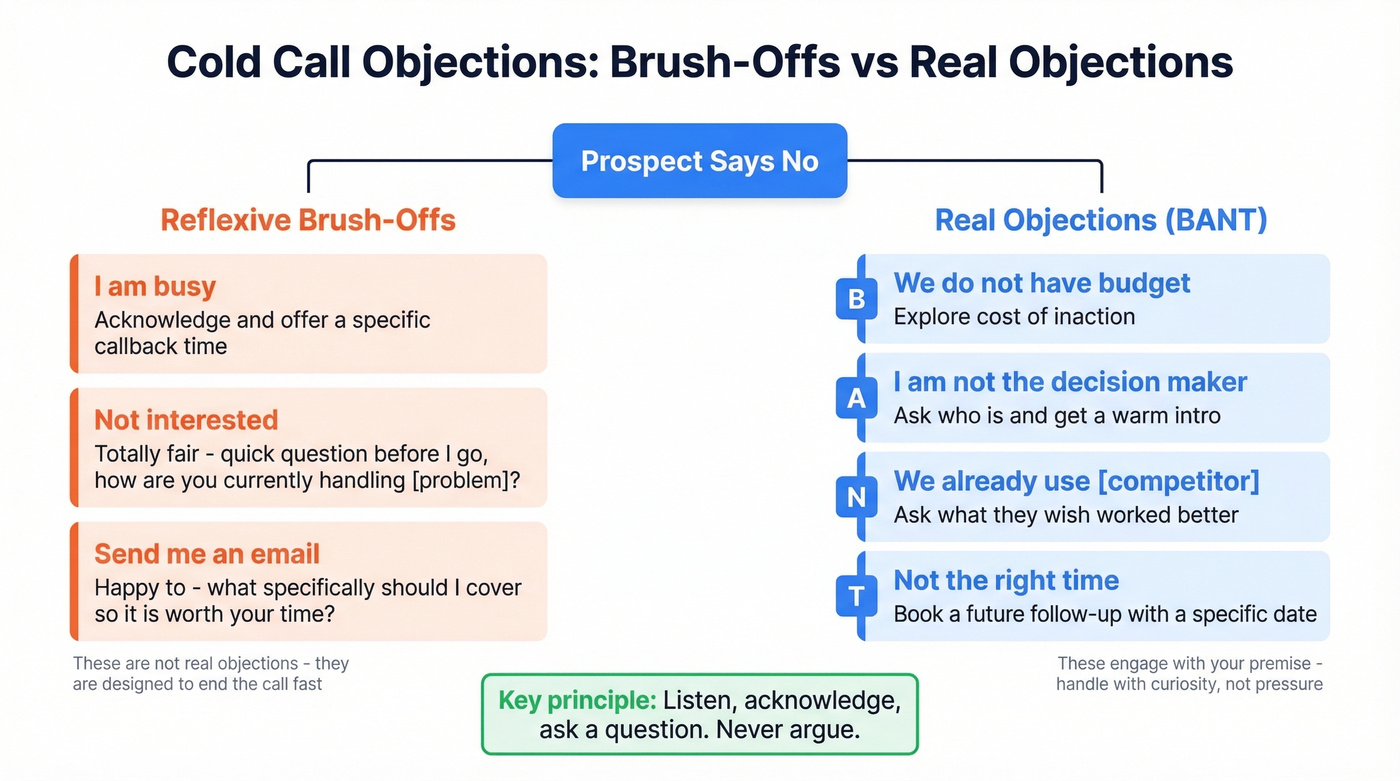
Here are the most common objections organized by BANT category:
"Not interested" - "Totally fair - most people say that before they hear the specific reason I called. Can I share it in 15 seconds?"
"We use [competitor]" - "Good - that tells me you take this seriously. Most of our customers used [competitor] before switching. What's working and what isn't?"
"We don't have budget" - "I hear you. We're not asking for budget today - just 15 minutes to see if it's worth putting on next quarter's roadmap."
"Send me an email" - "Happy to. So I send you something relevant - what's the biggest challenge your team's facing with [area] right now?"
"I'm busy" - "Completely understand. I'll be brief - 20 seconds. [Deliver value hook]. Worth a 15-minute call next week?"
"How'd you get my number?" - "Your profile came up when I was researching companies in [industry] dealing with [problem]. I figured a quick call was more respectful than a cold email." This one drops dramatically when you're calling verified direct dials rather than numbers scraped from random directories.
"Locked into a contract" - "When does it renew? I'd love to have a conversation 60 days before so you can compare."
The Feel-Felt-Found framework handles emotional objections well: "I understand how you feel. Other [role] felt the same way. What they found was [specific outcome]." It sounds formulaic on paper, but delivered naturally, it acknowledges the objection without being combative.
Cold Calling vs Cold Email
Cold calling and cold email aren't competing channels - they're complementary. Phone wins when you need immediate qualification and real-time objection handling. Email wins when you need scale and the prospect prefers async communication. Phone conversations convert up to 15% into meetings; cold email averages a 5.1% response rate with far more volume.
The real play is combining both. A call, then an email referencing the call, then another call two days later. The consensus on r/sales is pretty clear on this: single-channel outbound underperforms multi-touch sequences every time. Five to seven touchpoints across phone, email, and social over a 10-14 day cadence is the minimum for most sales cycles.
Where phone outreach has an underrated advantage: zero spam risk. Roughly 20% of cold emails get flagged as spam before anyone reads them. Your phone call always arrives.
The Outbound Tech Stack
You need four categories of tools, and you need them to work together.
| Category | Role | Price Range | Examples |
|---|---|---|---|
| Data provider | Verified emails + mobiles | Free tier-$99/mo to $15-40K/yr | Prospeo, ZoomInfo, Apollo, Cognism |
| Power dialer | Parallel/auto dialing | $50-150/user/mo | Orum, Nooks, PhoneBurner |
| CRM | Pipeline + activity tracking | Free (HubSpot) to $75-300/user/mo | HubSpot, Salesforce |
| Conversation intel | Call recording + coaching | $100-150/user/mo | Gong, Chorus |
The dialer and CRM are table stakes - pick whatever integrates with your workflow. The data provider is where most teams either save or waste the most money. A self-serve data subscription delivering verified mobile numbers will outperform a $15-40K/year platform full of stale landlines every single time.
AI in the Stack
AI has changed three parts of the cold calling workflow in the last year. First, conversation intelligence tools like Gong and Chorus now generate automatic call summaries and flag coaching moments - no more manually reviewing recordings. Second, AI role-play tools let reps practice objection handling against realistic simulated prospects before they ever pick up the phone. Third, AI-powered dialers are starting to detect voicemail versus live pickup in real time, saving reps from wasting the first five seconds of every call figuring out if anyone's there.
None of this replaces the human conversation. But it compresses the feedback loop from "weekly coaching session" to "after every call."
Compliance in 2026
Compliance rules have gotten meaningfully stricter. TCPA lawsuits surged roughly 95% year-over-year, with class actions spiking 285% in September 2025 alone. Understanding what cold calling in sales entails also means understanding the legal guardrails that govern it.
US Rules: TCPA + TSR
The basics: no calls before 8 AM or after 9 PM in the prospect's local time zone. Check the National DNC Registry before every campaign. No autodialers to cell phones without prior express consent. Maintain records for two years - call logs, consent records, DNC scrubs. For call recording, know whether you're in a one-party or two-party consent state; when in doubt, disclose at the top of the call.
What's new: the Supreme Court's McLaughlin v. McKesson decision means FCC guidance is no longer binding in civil TCPA cases, creating jurisdictional variability. Texas SB 140, effective September 2025, expanded the definition of solicitation to include text and image messages with treble damages under the Texas DTPA.
Here's the compliance angle most teams miss: verified, accurate contact data is itself a compliance tool. When you're calling confirmed direct business numbers rather than random cell phones from a scraped list, you reduce the risk of hitting DNC-registered personal numbers. Skip this step if you want to learn about TCPA penalties firsthand.
For teams running outbound at any scale, have your legal team review your compliance posture quarterly.
EU/International: GDPR
GDPR requires a lawful basis for processing personal data - typically legitimate interest for B2B cold calling, but rules vary by country. The UK's PECR has different rules than Germany's UWG. Get a legal review for any market outside the US.
The article math is clear: bad data doubles your cost per meeting booked. Prospeo's 7-day refresh cycle and 98% email accuracy mean your reps spend time in conversations, not listening to disconnection tones. At $0.01 per email and 10 credits per mobile, enterprise-grade data costs less than one wasted hour of dialing.
Give your SDRs numbers that actually ring on Wednesday morning.
Cold Calling FAQ
What's a good cold call success rate?
The industry average is 2-3% of dials converting to a booked meeting. Top-performing teams with verified mobile data and structured scripts hit 6-11%. Focus on your conversation-to-meeting rate rather than raw dial-to-meeting rate - it isolates selling skill from data quality.
How many dials does it take to book a meeting?
Roughly 50 dials on average, assuming a 5-10% connect rate and a 10-15% conversation-to-meeting rate. Teams using high-quality direct dials often book meetings in 25-35 dials because fewer numbers bounce or route to switchboards.
Is cold calling illegal?
No, but it's heavily regulated. In the US, TCPA and TSR set rules on timing, consent, and DNC compliance. In the EU, GDPR requires a lawful basis for processing personal data. Violations carry steep penalties - TCPA lawsuits surged 95% year-over-year recently.
What's the best time to make cold calls?
Mid-morning from 10-11 AM and mid-afternoon from 2-3 PM in the prospect's local time zone consistently perform best, with 4-5 PM also proving strong. Best days cluster mid-week, Tuesday through Thursday, and Wednesday often leads.
How do I get accurate phone numbers for cold calling?
Use a B2B data provider with verified mobile numbers refreshed weekly rather than monthly. Generic databases heavy on switchboard lines typically deliver under 5% connect rates - we've seen teams double or triple that number just by switching to a provider with genuine mobile verification.