

Warm Calling: The 2026 Playbook for Turning Signals Into Meetings
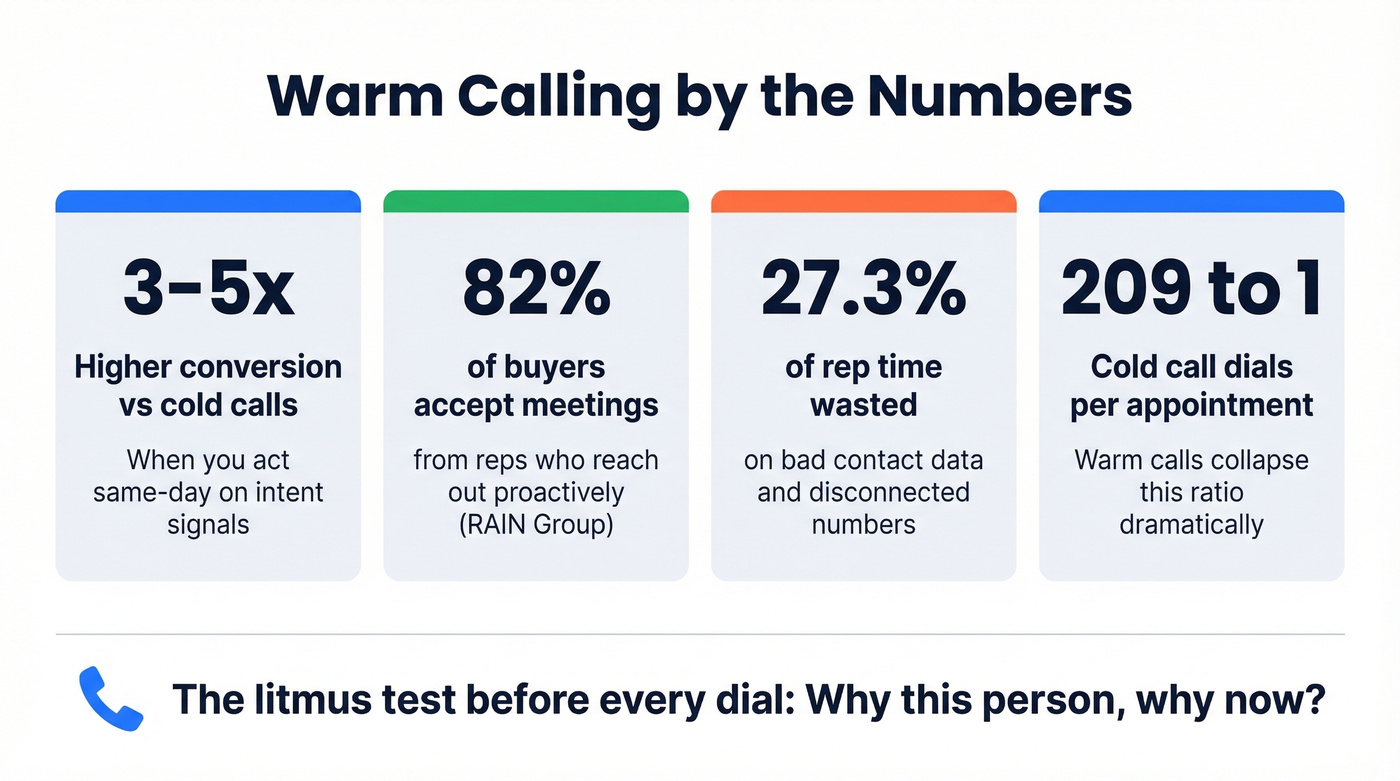
Most warm calling guides read like they were written by someone who's never dialed a phone. They'll tell you to "build rapport" and "personalize your opener" - advice so generic it could apply to a first date. Here's what they miss: warm calling isn't a friendlier version of cold calling. It's a speed-and-signal discipline. The only question that matters before you pick up the phone is why this person, why now?
If you can't answer that in one sentence, you're making a cold call with extra steps.
The Short Version
- Three signals that matter most: pricing page visits, champion job changes, and competitor evaluation activity. Everything else is noise until you've acted on these.
- The litmus test: "Why this person, why now?" - one sentence. If you can't say it, don't dial.
- Data quality beats scripts every time. A perfect opener on a disconnected number is worth exactly nothing. Reps lose 27.3% of productive time to bad contact data. Fix that first.
- Speed kills (in a good way): pricing-page intent decays fast over a 7-day window. Act within 24 hours on Tier 1 signals or watch your conversion rate collapse.
What Is a Warm Call?
The definition is straightforward: it's outreach to prospects who've already shown intent or engagement - they visited your pricing page, attended your webinar, downloaded a resource, or their company triggered a buying signal you can reference. The key distinction isn't how friendly you sound. It's whether you have a legitimate, specific reason to call this person right now.
| Cold Call | Warm Call | Hot Call | |
|---|---|---|---|
| Prior engagement | None | Intent signal or interaction | Hand-raise (demo request, trial) |
| Connect-to-meeting rate | ~1% | 10-25% | 40-60%+ |
| Example trigger | Bought a list, dialing down it | Pricing page visit, webinar attendance | Inbound demo request |
| Rep's edge | Volume | Context + timing | Urgency + explicit interest |
Warm calls convert 3-5x better than cold when you act fast. Same-day is table stakes, and 24-48 hours is the window where intent is still fresh. RAIN Group's research found that 82% of buyers accept meetings from reps who reach out proactively - the trick is having something worth saying when they pick up.
(Quick note: in education, "warm calling" means pre-notifying students they'll be called on in class - a different concept entirely. This guide covers the B2B sales practice.)
Why Context-Driven Calls Convert
Gong's analysis of call recordings shows successful calls average 5:50 in duration versus 3:14 for failed ones. That extra 2:36 is discovery time - the rep earned enough relevance to keep the conversation going.
Cold outreach requires roughly 209 dials per appointment. A warm sales call collapses that ratio because you're starting with context instead of a blank slate. Mentioning a mutual connection increases your meeting chances by 70%, and simply explaining why you're calling - the specific trigger - drives a 2.1x higher success rate.
Here's the thing: none of these advantages activate automatically. A signal sitting in your CRM for two weeks isn't warm anymore. It's lukewarm at best, and the advantage is perishable, which is why the signal stack matters more than the script.
How to Identify Warm Leads
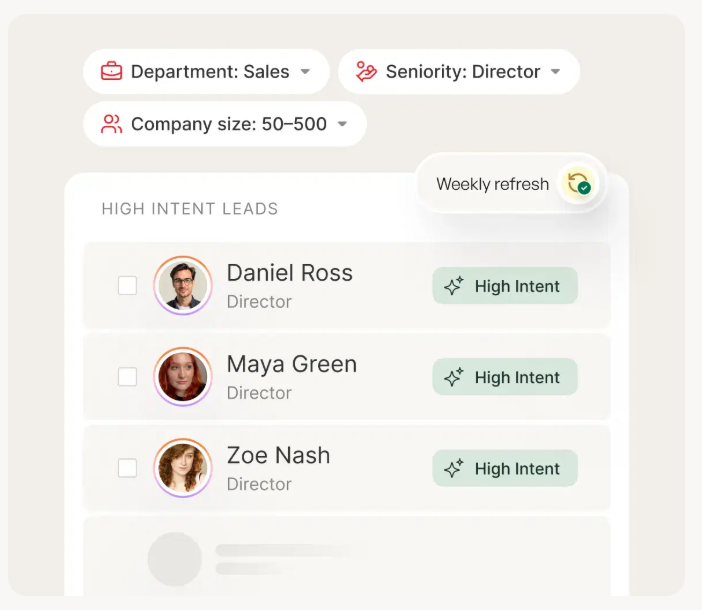
This is where most teams win or lose. The difference between a rep who books 15 meetings a week and one who books 3 usually isn't talent - it's signal quality and speed. One SDR on r/sales put it bluntly: when marketing lead quality drops, you go from 6-8 quality warm leads per day to 1-3, and suddenly outreach feels like cold calling. That's why your own signal scoring matters more than marketing's label.
First-Party vs. Third-Party Signals
First-party signals - repeat pricing page visits, product usage thresholds on a free tier, webinar attendance, chatbot interactions - are stronger because they represent direct engagement with your brand. Third-party signals cast a wider net: review-site activity on G2 or Capterra, keyword surges in your category, firmographic changes like funding or leadership turnover, and tech stack shifts. The prospect might be evaluating your category without knowing you exist yet.
The best programs blend both, weighting first-party signals higher.
Signal Scoring With Decay
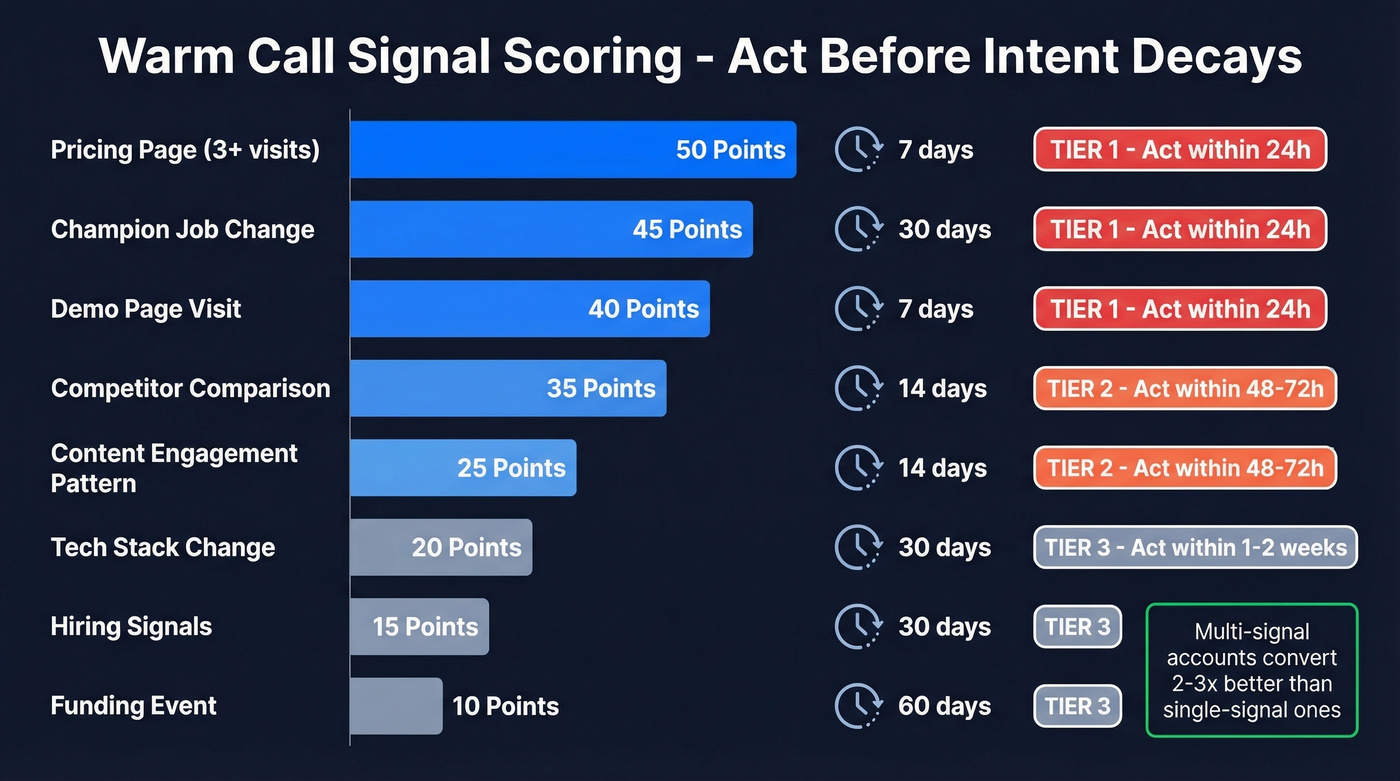
Not all signals are equal, and they all have a shelf life. Here's a scoring model adapted from MarketBetter's warm outbound playbook that we've tested with mid-market teams:
| Signal | Points | Decay Window | Action Tier |
|---|---|---|---|
| Pricing page, 3+ visits | 50 | 7 days | Tier 1: act within 24h |
| Demo page visit | 40 | 7 days | Tier 1: act within 24h |
| Champion job change | 45 | 30 days | Tier 1: act within 24h |
| Competitor comparison | 35 | 14 days | Tier 2: act within 48-72h |
| Content engagement pattern | 25 | 14 days | Tier 2: act within 48-72h |
| Tech stack change | 20 | 30 days | Tier 3: act within 1-2 weeks |
| Hiring signals | 15 | 30 days | Tier 3: act within 1-2 weeks |
| Funding event | 10 | 60 days | Tier 3: act within 1-2 weeks |
Funding scores low on urgency but high on budget potential - post-funding companies allocate 30-40% of new capital to sales and marketing, per First Round. It's a slow-burn signal worth tracking.
Multi-signal accounts consistently outperform single-signal ones. In our experience, they convert at 2-3x the rate. A prospect who visited your pricing page three times, works at a company that just raised a Series B, and whose predecessor at the role was a customer? That's a Tier 1 call you make before your morning coffee.
Per UserGems data, 70% of champions who change jobs evaluate their previous tools at the new company. That's one of the highest-intent signals in B2B, and most teams don't track it systematically.
The One-Sentence Litmus Test
"Their VP of Marketing visited our pricing page twice this week and they just switched from HubSpot to Salesforce" passes. "They're in our ICP" doesn't.
How to Prepare Before Dialing
The 2-Minute Research Checklist
You don't need 20 minutes of research. You need 2-3 focused minutes.
Company research: team size and growth trajectory, recent funding or expansion news, tech stack relevant to your product, any public challenges or strategic shifts. Prospect research: current role and tenure (someone new in a role is more open to change), shared connections or interests, public content they've created, previous interactions with your company.
Build a Context Card
Before you dial, fill in a one-screen context card that keeps your call focused:
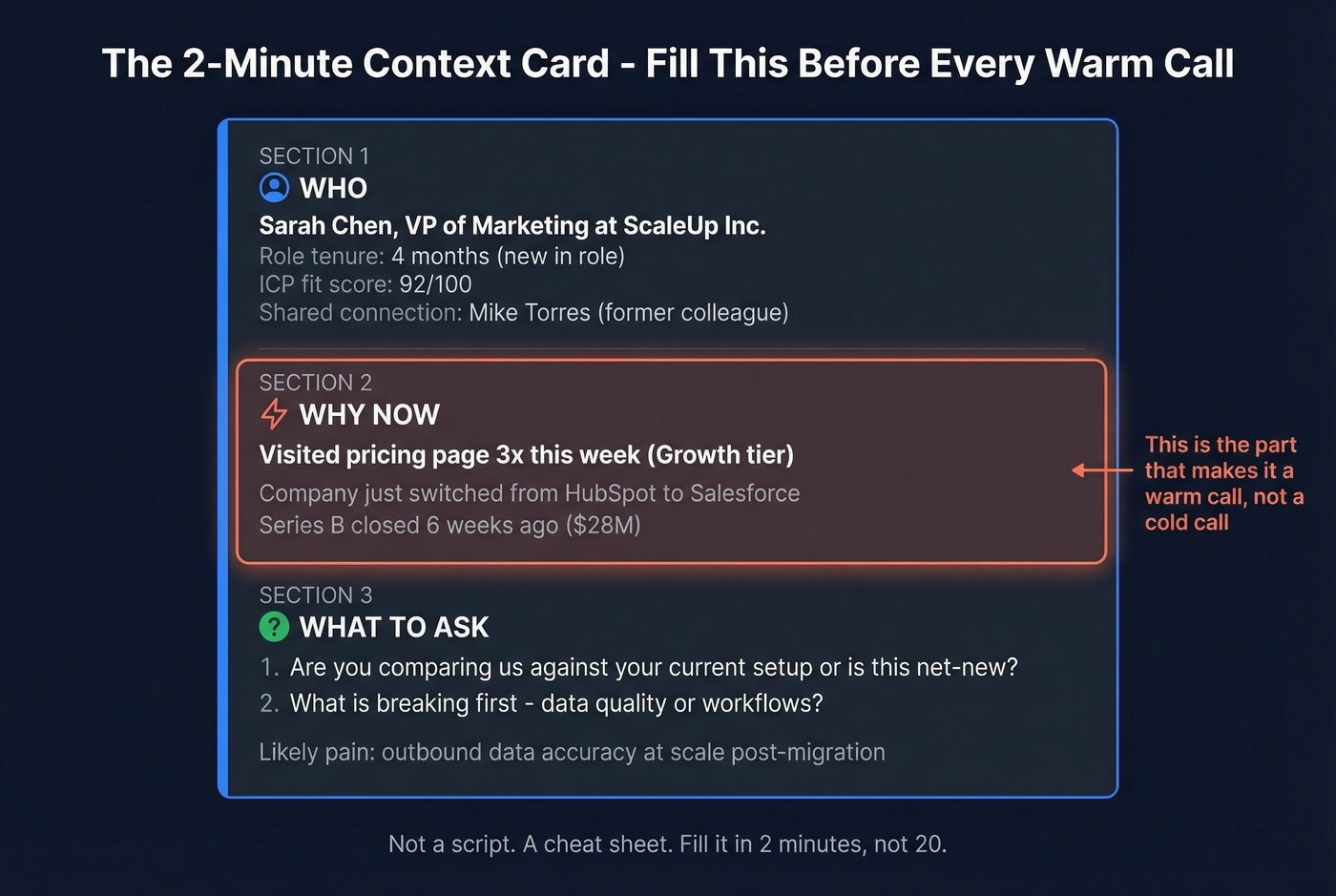
- Who: Role, tenure, ICP fit score
- Why now: The specific trigger that made this call worth making today
- What to ask: 1-2 discovery questions tied to the trigger, plus a likely pain point based on their role and stack
This isn't a script. It's a cheat sheet that keeps you from rambling when the prospect picks up.
Verify Before You Dial
Your CRM says the lead visited the pricing page yesterday. You call the number on file. Disconnected for three months.
B2B contact data decays at roughly 2.1% per month - that's 22.5% of your database going stale every year. A warm signal on a dead number is the most frustrating waste in sales. We've seen teams solve this with a 7-day data refresh cycle and real-time verification before dialing, which eliminates the #1 failure mode: right signal, wrong data.

You just read it: reps lose 27.3% of productive time to bad contact data. Prospeo's 125M+ verified mobile numbers hit a 30% pickup rate - and every record refreshes every 7 days, not 6 weeks. Your Tier 1 signals deserve numbers that actually connect.
Stop wasting warm signals on disconnected numbers.
The Warm Call Script
Based on EBQ's framework, keep the whole call under 5 minutes - you're booking a meeting, not giving a demo.
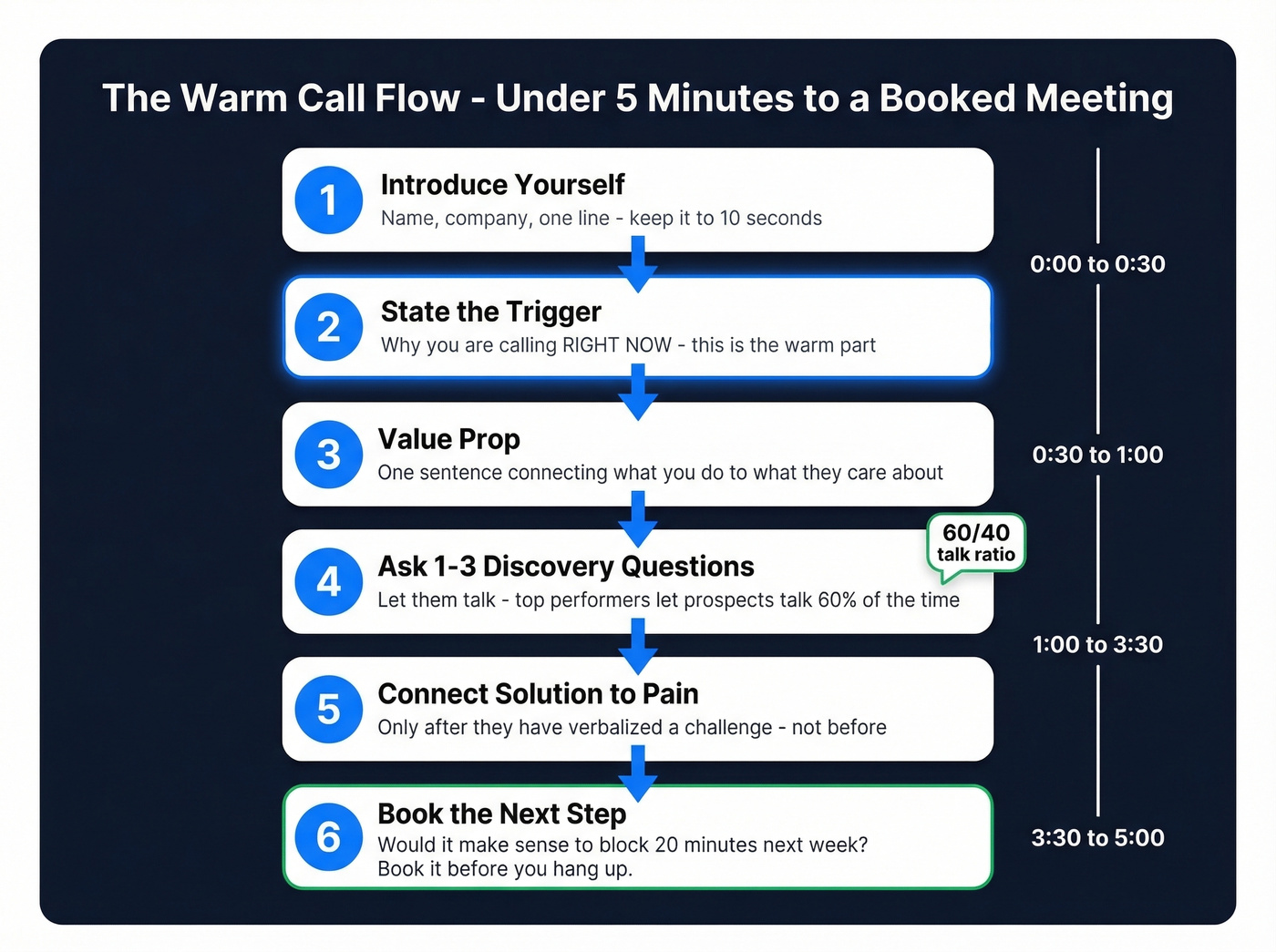
- Introduce yourself - name, company, one line.
- State the trigger - why you're calling right now. This is the warm part.
- Value prop - one sentence connecting what you do to what they care about.
- Ask 1-3 discovery questions - let them talk. Top performers let prospects talk roughly 60% of the time.
- Connect solution to pain - only after they've verbalized a challenge.
- Low-pressure next step - "Would it make sense to block 20 minutes next week?" Book it before you hang up.
Trigger-Specific Openers
Pricing page visitor: "Hey [Name], this is [You] from [Company]. I noticed your team's been looking at our pricing - specifically the [plan/tier]. I've got a 20-second thought on which option makes sense for teams your size. Mind if I share it?"
Event attendee: "Hi [Name], [You] from [Company]. You joined our [webinar/event] on [topic] last week. Curious - was there a specific challenge that brought you there?"
Review-site surge: "Hey [Name], [You] from [Company]. I saw [their company] has been evaluating tools in our space. Given you're scaling [relevant function], I wanted to see if it's worth a quick conversation."
Full Example Call
Rep: "Hey Sarah, this is Jake from Acme. I noticed your team's been on our pricing page a couple times this week - specifically the growth tier. Quick question: are you comparing us against your current setup, or is this a net-new evaluation?"
Prospect: "We're actually looking to replace what we have. It's not scaling well."
Rep: "Got it. What's breaking first - the data quality or the workflow side?"
Prospect: "Honestly, both. But data accuracy is killing our outbound."
Rep: "That's exactly what we hear from teams at your stage. Would it make sense to block 20 minutes Thursday to walk through how we handle the accuracy piece? I can show you real numbers."
Prospect: "Sure, Thursday afternoon works."
Under three minutes. The prospect talked more than the rep. Meeting booked.
Best Days and Times to Call
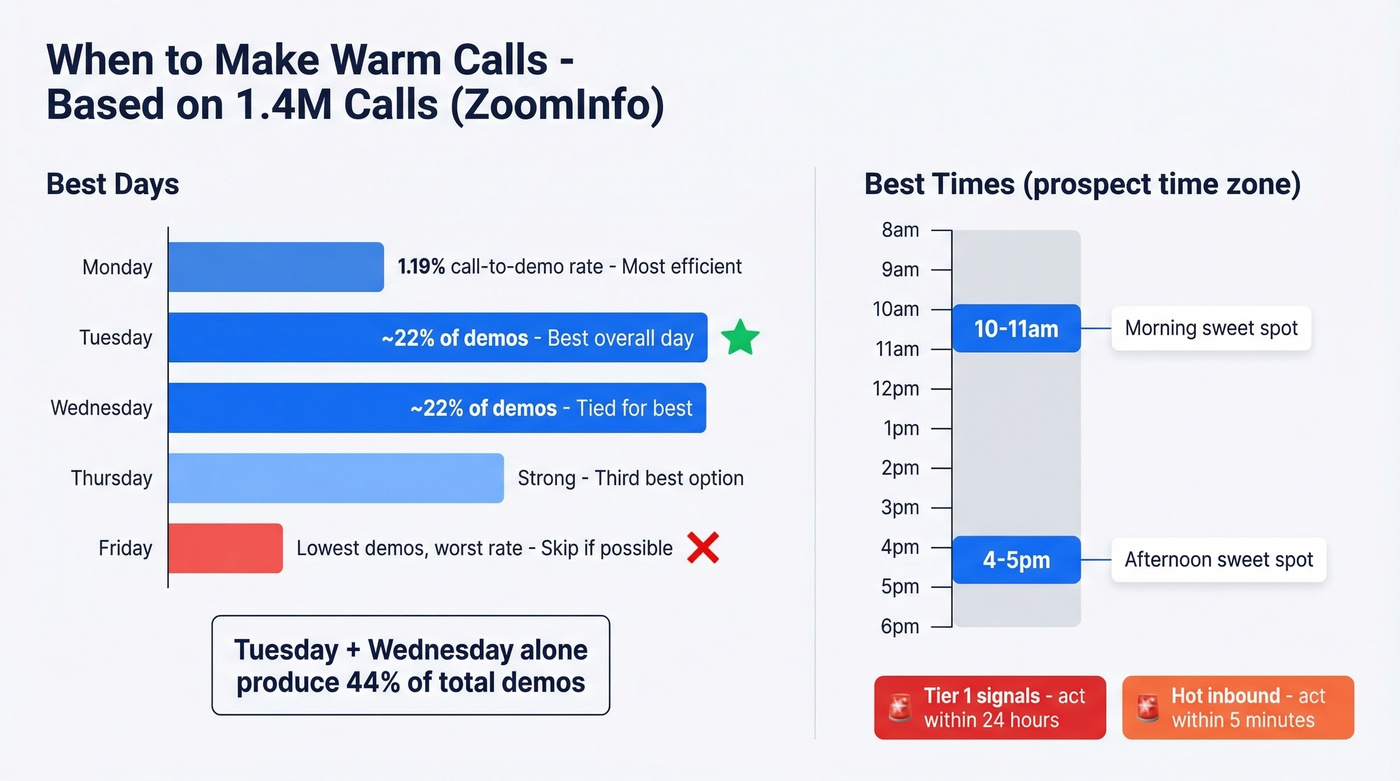
ZoomInfo's 1.4 million-call study gives us the clearest picture:
| Day | Demo Share | Call-to-Demo Rate | Verdict |
|---|---|---|---|
| Monday | Moderate | 1.19% (highest) | Efficient but lower volume |
| Tuesday | ~22% | High | Best overall day |
| Wednesday | ~22% | High | Tied for best |
| Thursday | Strong | Solid | Third-best option |
| Friday | Lowest | Worst | Skip if possible |
Tuesday and Wednesday alone produce 44% of total demos. Friday is dead weight across every metric.
For time of day, 10-11am and 4-5pm in the prospect's time zone are the sweet spots. For Tier 1 signals, act within 24 hours. For true hot inbound, aim for under 5 minutes.
Handling Objections on Warm Calls
Even with context, you'll still get pushback. The difference is you have ammunition. Use this framework: acknowledge, provide context, ask permission, ask a question.
"How did you get my info?" "Totally fair question. I came across your website and thought it made sense to reach out. Mind if I take 30 seconds to explain why I called?"
"I don't remember signing up / I was just browsing." "No worries - you didn't sign up for a call. I noticed some activity from your company on our pricing page and thought it was worth a quick conversation. Is evaluating [category] something on your radar right now?"
"I'm busy - send me an email." "Completely understand. I'll send something over in the next 10 minutes. Quick question so I can make the email actually useful: is [specific pain related to trigger] something your team's dealing with?"
"We already use [competitor]." "Makes sense - a lot of teams we work with started there. Out of curiosity, how's it performing on [specific dimension related to your differentiation]? That's usually where teams start looking for alternatives."
7 Mistakes That Kill Your Connect Rate
- Not researching. Spend 2-3 minutes minimum. Company + prospect, split evenly.
- Generic pitch. Reference the specific trigger in your first 15 seconds. "I noticed your team..." not "Companies like yours..."
- Sounding robotic. Use a framework, not a word-for-word script. The LARA method (Listen, Acknowledge, Respond, Ask) keeps you conversational.
- Pitching before discovery. Ask before you tell. Your value prop lands 10x harder after the prospect has verbalized their pain.
- Ignoring signal decay. A Tier 1 signal called on day 8 is a Tier 3 signal at best.
- Using outdated data. A warm signal on a dead number is a wasted signal. Verify before you dial.
- Failing to book next steps. Always close with a specific calendar invite. "I'll follow up" is where deals go to die.
Let's be honest about something: if your average deal size is under $8k, you probably don't need a complex sales cadence platform. You need accurate phone numbers, a signal stack, and a rep who can hold a conversation. The tooling obsession in sales development is a distraction from the fundamentals - research, relevance, and speed.
The 7-Touch Follow-Up Sequence
The call is just the beginning. Lead Forensics' follow-up framework maps out seven touches that keep momentum without being annoying:
- Confirmation email within 24 hours - summarize what you discussed and confirm next steps.
- Value-driven email - a personalized resource tied to the pain they mentioned on the call.
- Strategic follow-up call - a few days later, bring a new insight. No pressure, just relevance.
- Social engagement - connect on professional networks, engage with their content. Don't pitch.
- Industry news share - forward a relevant article tied to their stated challenge.
- Event invitation - webinar, roundtable, or Q&A. Low commitment, high value.
- Quarterly touchpoint - for longer-cycle prospects, stay on the radar without becoming background noise.
Record your warm calls and review one per day. Self-coaching compounds faster than any training program, and it's free.
Metrics That Matter
Benchmark targets for teams running signal-driven outbound in 2026:
| Metric | Target Range |
|---|---|
| Connect-to-meeting rate | 10-25% |
| Meetings held rate | 70-85% |
| SQL rate | 30-60% |
| Warm vs. cold conversion lift | 2-3x |
| Daily touches per rep | ~150 (calls + emails) |
The north-star metric is held meetings per rep hour. Not dials. Not connects. Held meetings - because a booked meeting that no-shows is worth zero. Track the whole funnel, optimize from the bottom up.
If you want to systematize this, start with lead scoring and a clear process for identifying buying signals. Then tighten your sales prospecting techniques so Tier 1 accounts get touched first, and use proven sales follow-up templates to keep momentum after the call.
Champion job changes are one of the highest-intent warm calling signals - but only if you have their new direct dial. Prospeo tracks 300M+ profiles with 98% email accuracy and verified mobiles, so you reach the right person before the signal decays.
Turn intent signals into conversations at $0.01 per lead.
FAQ
What's the difference between warm calling and cold calling?
Cold calling targets strangers with no prior engagement. Warm calling targets prospects who've shown intent - a pricing page visit, webinar attendance, or buying signal. That context lifts conversion rates 3-5x when you act within 24-48 hours of the trigger.
How long should a warm sales call last?
Under 5 minutes. The goal isn't a full demo - it's booking the next meeting. Ask 1-3 discovery questions, let the prospect talk 60% of the time, and close with a specific calendar invite before you hang up.
What's a good connect-to-meeting rate?
10-25% for signal-driven outreach, compared to roughly 1% for cold calls. Teams acting on Tier 1 signals within 24 hours consistently hit the upper end of that range.
How do I get verified phone numbers for warm leads?
Use a B2B data platform with real-time verification and a fast refresh cycle. Stale data kills the warm calling advantage because signals decay within a week - if your numbers are three months old, you're wasting every trigger you catch.
What are the best days to make warm calls?
Tuesday, Wednesday, and Thursday. Tuesday and Wednesday alone produce 44% of total demos per ZoomInfo's 1.4M-call study. Avoid Friday. Best time slots are 10-11am and 4-5pm in the prospect's local time zone.