

What Is Omnichannel Sales (And What Does It Actually Look Like in B2B)?
Your VP of Sales just told the team to "go omnichannel" after reading a McKinsey report. Now you're trying to figure out what that actually means for your Tuesday morning prospecting block. Most content on omnichannel sales focuses on retail - Starbucks loyalty cards and Disney wristbands. If you're selling B2B, those examples are useless.
Quick version: Omnichannel sales means your channels talk to each other instead of operating as separate campaigns. In B2B, that means giving email, phone, and social each a role in one coordinated sequence - triggered by buyer signals, not arbitrary timers.
Omnichannel Sales Defined
Omnichannel selling is an approach where every channel a buyer interacts with - email, phone, social, chat, in-person - shares context and feeds into one continuous conversation. The prospect doesn't start over when they move from one channel to another. Their history, engagement signals, and preferences carry forward.
This matters more than it used to. McKinsey's B2B Pulse survey found that B2B buyers now use an average of 10 interaction channels during their buying journey - up from 5 in 2016. That's a doubling of complexity in a decade. And a 1WorldSync survey cited by NetSuite found nearly half of sellers reported losing at least $1 million due to challenges enabling omnichannel. When channels don't connect, deals slip through handoff gaps.
Omnichannel vs. Multichannel
Most sales teams are doing multichannel and calling it omnichannel. Here's the actual difference:
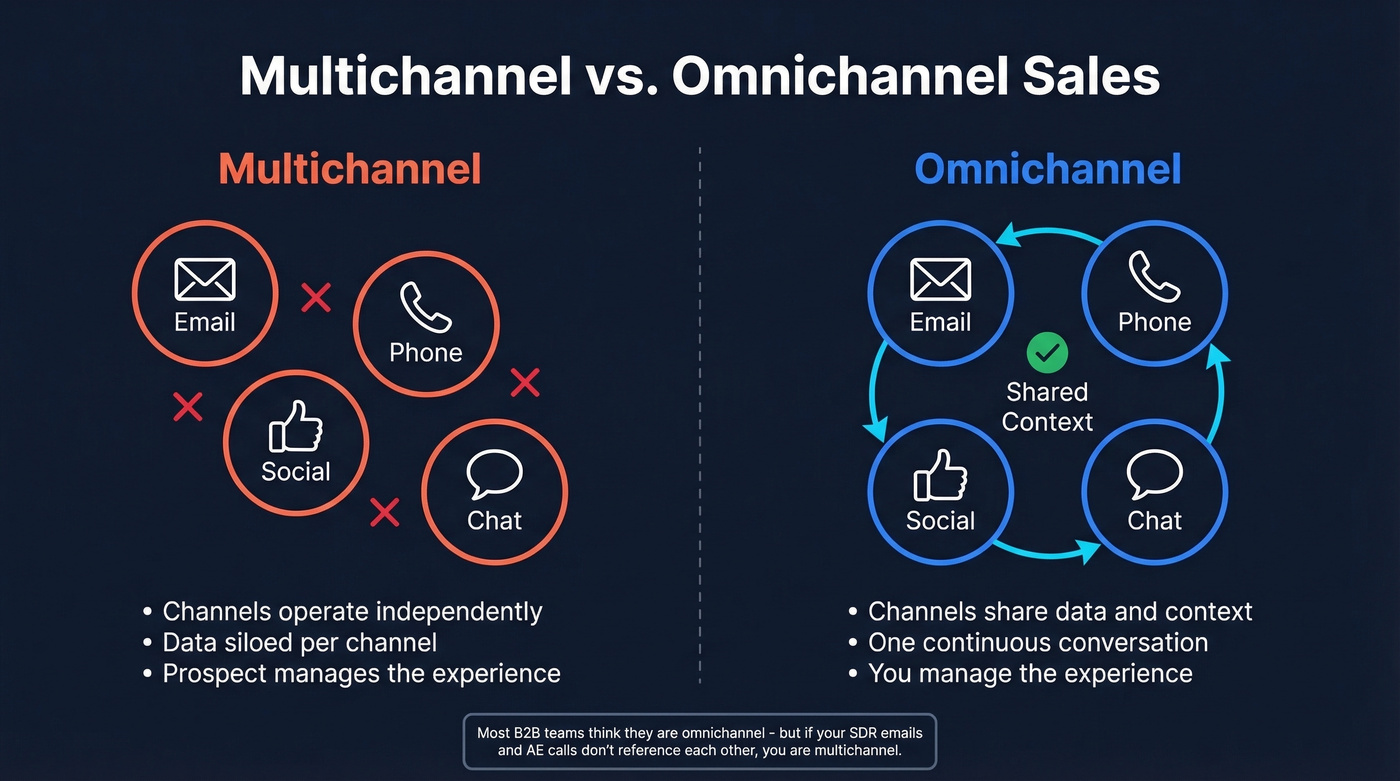
| Multichannel | Omnichannel | |
|---|---|---|
| Channels | Multiple, independent | Multiple, connected |
| Data | Siloed per channel | Shared across all |
| Experience | Prospect manages it | You manage it |
| B2B example | SDR emails, AE calls - neither knows what the other sent | SDR email triggers AE call referencing it |
Multichannel means being present everywhere. Omnichannel means those presences talk to each other. The distinction sounds subtle, but it's the difference between a coordinated sales motion and noise.
Why It Matters Now
B2B buying behavior has fundamentally changed. The "rule of thirds" shows that at any stage of the buying journey, roughly one-third of buyers prefer in-person, one-third prefer remote, and one-third prefer digital self-serve. This holds across geographies, industries, and company sizes.
39% of B2B buyers are now comfortable spending over $500,000 through self-serve digital commerce or remote interactions. More than half want a seamless cross-channel experience - and they'll switch suppliers if they don't get it. Teams blending personalization with GenAI are 1.7x more likely to increase market share. The gap between companies that orchestrate channels and companies that just show up on them is widening fast.
Here's the thing: if your deal size is under $25K and your outbound motion still treats email, phone, and social as separate campaigns run by separate people, you don't have an omnichannel problem. You have a coordination problem. And it's costing you pipeline right now.

Every channel in your omnichannel sequence depends on reaching the right person. Bounced emails kill your domain reputation. Wrong numbers waste your call blocks. Prospeo gives you 98% accurate emails and 125M+ verified mobile numbers - refreshed every 7 days - so your coordinated sequences actually connect.
Fix the foundation before you orchestrate the channels.
What the Motion Looks Like
Give Each Channel a Role
A practitioner on r/b2b_sales described the moment orchestration "clicked" - they stopped treating channels as separate campaigns and started assigning each one a specific job. Unlike the Starbucks examples you've read elsewhere, here's what that looks like for an SDR:
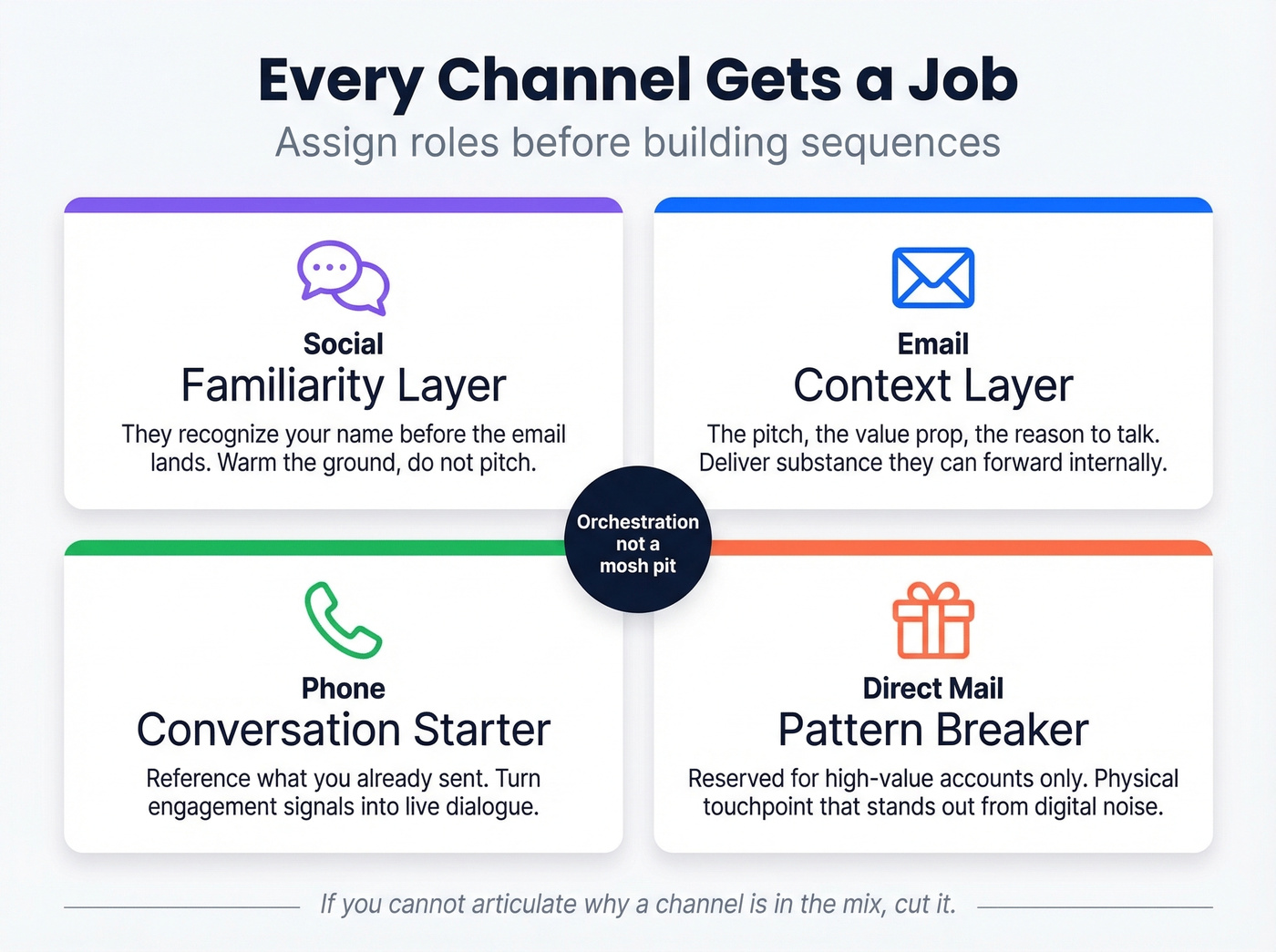
- Social = familiarity layer. They recognize your name before the email lands.
- Email = context layer. The pitch, the value prop, the reason to talk.
- Chat = friction remover. Answer objections in real time.
- Direct mail = pattern breaker, reserved for high-value accounts.
As Punch! B2B puts it, "true orchestration is a dance, not a mosh pit." Each channel leads into the next, triggered by buyer behavior, not a calendar.
A Sample 9-Touch Sequence
- Day 1: Personalized email - explain why you're reaching out
- Day 2: Social connect request, no pitch
- Day 4: Value-add email sharing something useful
- Day 5: Phone call referencing the email - "I sent you something Tuesday about..."
- Day 7: Engage with their social content
- Day 9: Social proof email with a relevant case study
- Day 10: Social DM, short and casual, referencing the email thread
- Day 11: Second call attempt
- Day 14: Breakup email
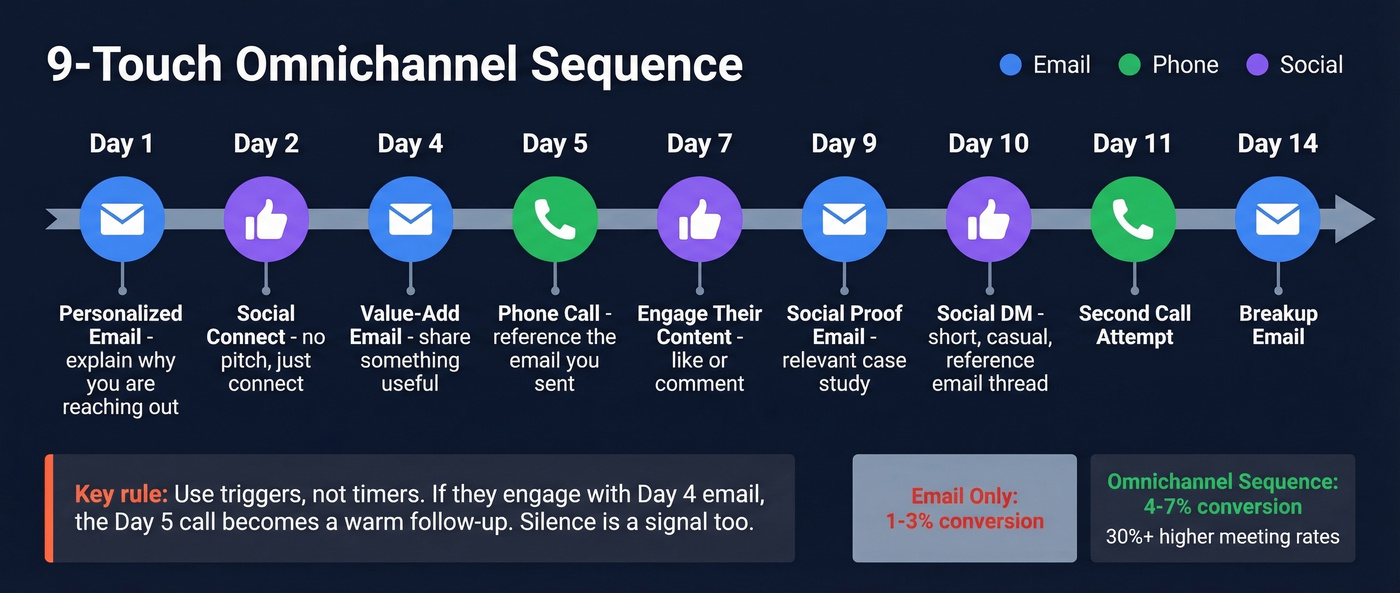
The key mechanic is triggers, not timers. If they engage with your email on Day 4, the call on Day 5 becomes a warm follow-up. If there's zero engagement by Day 7, you pause and reassess. Silence is a signal too.
The benchmarks back this up. Email alone converts at 1-3%. Multi-channel coordinated sequences hit 4-7%, with 30%+ higher meeting conversion rates.
Common Mistakes
Confusing multichannel presence with omnichannel connection. Having a social profile, an email sequence, and a dialer doesn't make you omnichannel. If those tools don't share data, you're just multichannel with more invoices.
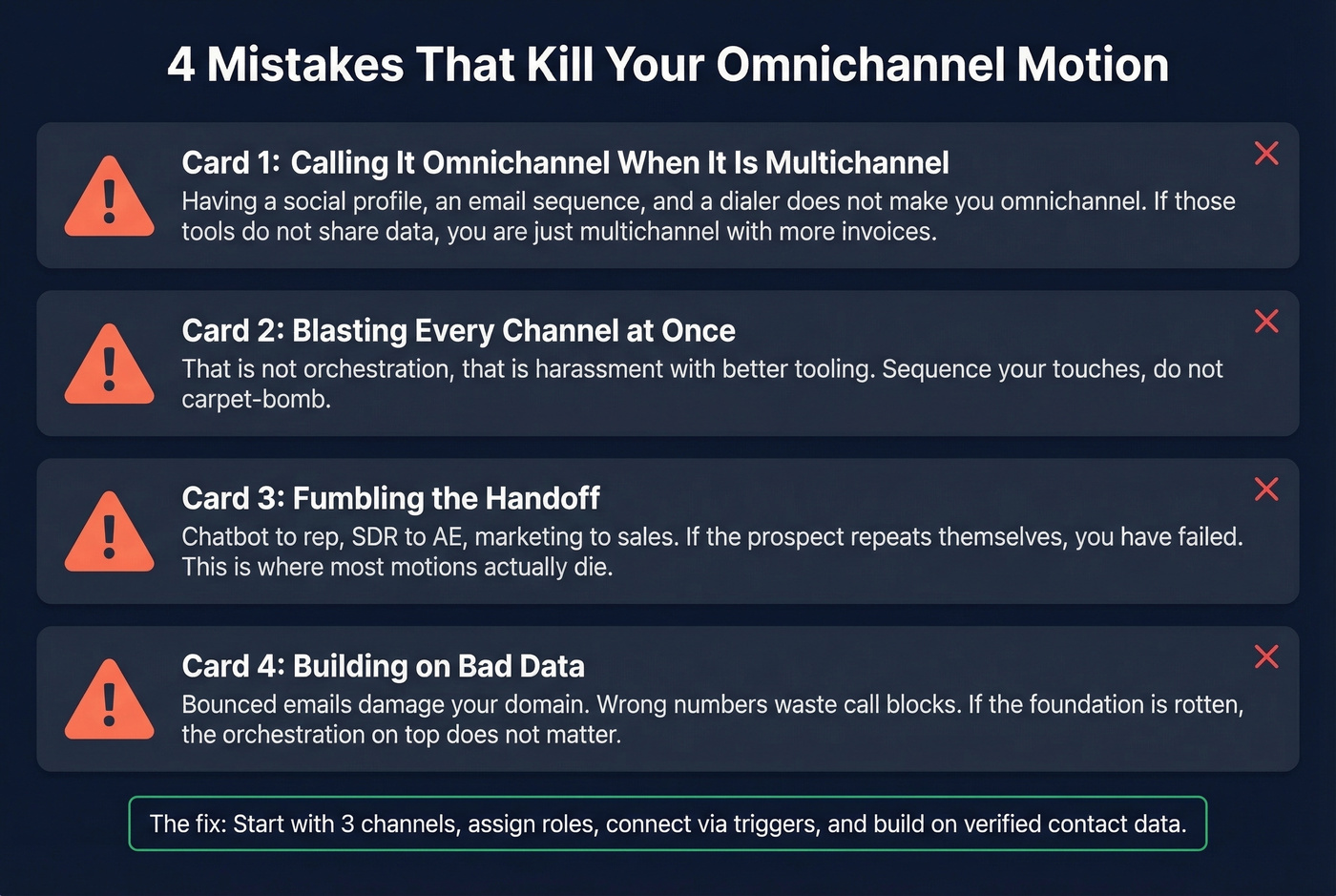
Blasting every channel simultaneously. Real talk: that's harassment with better tooling. Sequence your touches; don't carpet-bomb.
Ignoring handoffs. In our experience, the handoff gap is where most coordinated sales motions actually die. Chatbot-to-rep, SDR-to-AE, marketing-to-sales - if the prospect repeats themselves, you've failed. We've seen teams nail the sequencing but completely fumble the moment a prospect moves from one person to another, and the whole motion collapses because the AE asks the same discovery questions the SDR already covered.
Neglecting data quality. Bounced emails damage your domain. Wrong numbers waste call blocks. Every channel in your sequence depends on accurate contact data, and if the foundation is rotten, the orchestration on top doesn't matter.
How to Build Your Omnichannel Strategy
You don't need a $100K platform. We've seen teams materially lift meeting conversion just by connecting their existing channels. Here's the practical path:
Start with three channels. Email, phone, and social. Master the orchestration before adding complexity. Skip direct mail and chat until you've proven the core loop works - adding channels too early just creates more things to break.
Assign each channel a role. Familiarity, context, proof, friction removal - decide what each channel does before building sequences. If you can't articulate why a channel is in the mix, cut it.
Connect via triggers, not timers. "They opened the email, so call within 4 hours" beats "call on Day 5 regardless." Most sequencing tools - Salesloft, Outreach, Instantly - support conditional logic. Use it.
Build on clean data. This is where most motions quietly fail. Bounced emails don't just waste a touch; they torch your sender reputation and make every future email less likely to land. Prospeo's 98% email accuracy and 7-day data refresh cycle mean your sequences reach real inboxes instead of bouncing into the void.
Measure and iterate. Track reply rates and meetings booked per channel, not just total activity. Kill channels that aren't earning their role. If social DMs are getting zero traction after 60 days, reallocate those touches to phone or a different email angle.
That 9-touch sequence above falls apart if your Day 1 email bounces or your Day 5 call hits a dead number. Prospeo's 5-step verification and 30% mobile pickup rate mean your omnichannel motion reaches real buyers across every channel - at $0.01 per email, not $1.
Stop orchestrating sequences built on bad data.
FAQ
Is omnichannel the same as multichannel?
No. Multichannel means being present on multiple channels independently. Omnichannel means those channels share context so one interaction informs the next - the buyer never repeats themselves. In practice, most B2B teams are multichannel and don't realize it.
How many channels do B2B buyers use?
B2B buyers now use 10 channels on average during their purchase journey, up from 5 in 2016. That means your outbound motion needs to meet prospects across at least 3-4 coordinated touchpoints to stay competitive.
What tools do I need to start?
At minimum, a CRM, a sequencing tool (Salesloft, Outreach, or Instantly), and a data provider for verified contacts. Prospeo integrates natively with Salesforce, HubSpot, Smartlead, Instantly, and Lemlist, so you can build trigger-based sequences on accurate data without stitching together a custom stack.
What if I only have budget for one channel?
Start with email. It's the cheapest to scale and the easiest to measure. But don't stay there - even adding a single phone touch after an email open can double your reply rate. The point isn't to be everywhere on day one; it's to build toward connected channels over time.