

What Is SLED in Sales? Definition, Market Data & a Complete 2026 Playbook
Your VP just told you the company's expanding into public sector. "Go after SLED," they said - like it's a single account, not a sprawling universe of 90,000+ government entities with different rules, budgets, and buying cycles. Most reps coming from commercial or federal backgrounds find it's a completely different animal. The deals are real, the money is enormous, and the process will humble you if you don't understand it.
The Short Version
SLED = State, Local, and Education - 90,000+ entities spending $3.96T/year combined. That's not a niche. That's the largest addressable market most sales teams ignore.
SLED deals are won pre-RFP. If you're waiting for the solicitation to drop, you're already behind the vendor who helped shape it. Cooperative purchasing contracts through Sourcewell, OMNIA, and NASPO ValuePoint are one of the fastest paths in - they let agencies buy off existing awards without running a new RFP. And the biggest buying surge is March through May, since most state and education budgets close June 30.
SLED Meaning: State, Local & Education
SLED stands for State, Local, and Education. It's the catch-all term for every layer of U.S. government that isn't federal - governors' offices, county sheriffs, city IT departments, public school districts, state universities, water districts, transit authorities, all of it.
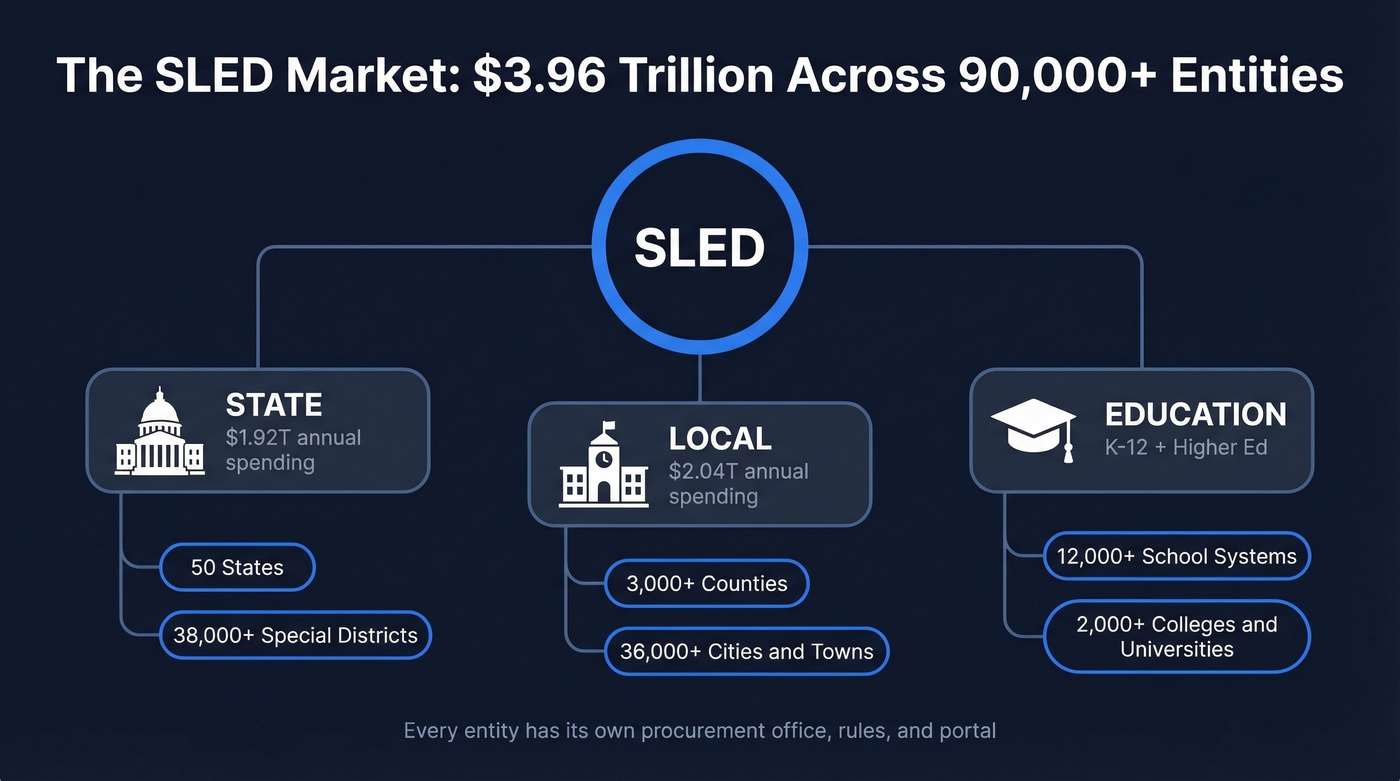
The U.S. has over 90,000 state and local government entities employing nearly 20 million people. Combined annual spending hits $3.96T - $1.92T at the state level, $2.04T at the local level.
| Entity Type | Approximate Count |
|---|---|
| States | 50 |
| Counties | 3,000+ |
| Cities & towns | 36,000+ |
| Public school systems | 12,000+ |
| Higher education | 2,000+ |
| Special districts | 38,000+ |
That fragmentation is both the opportunity and the challenge. There's no single "SLED buyer." Every entity has its own procurement office, its own rules, and its own portal. But the sheer volume of contracts means there's always something to bid on.
SLED vs Federal vs Commercial
If you're coming from federal sales, don't expect FAR compliance and SAM.gov to be your day-to-day. Coming from commercial? Forget your 2-week close cycles. SLED sits in a middle ground that confuses both camps.
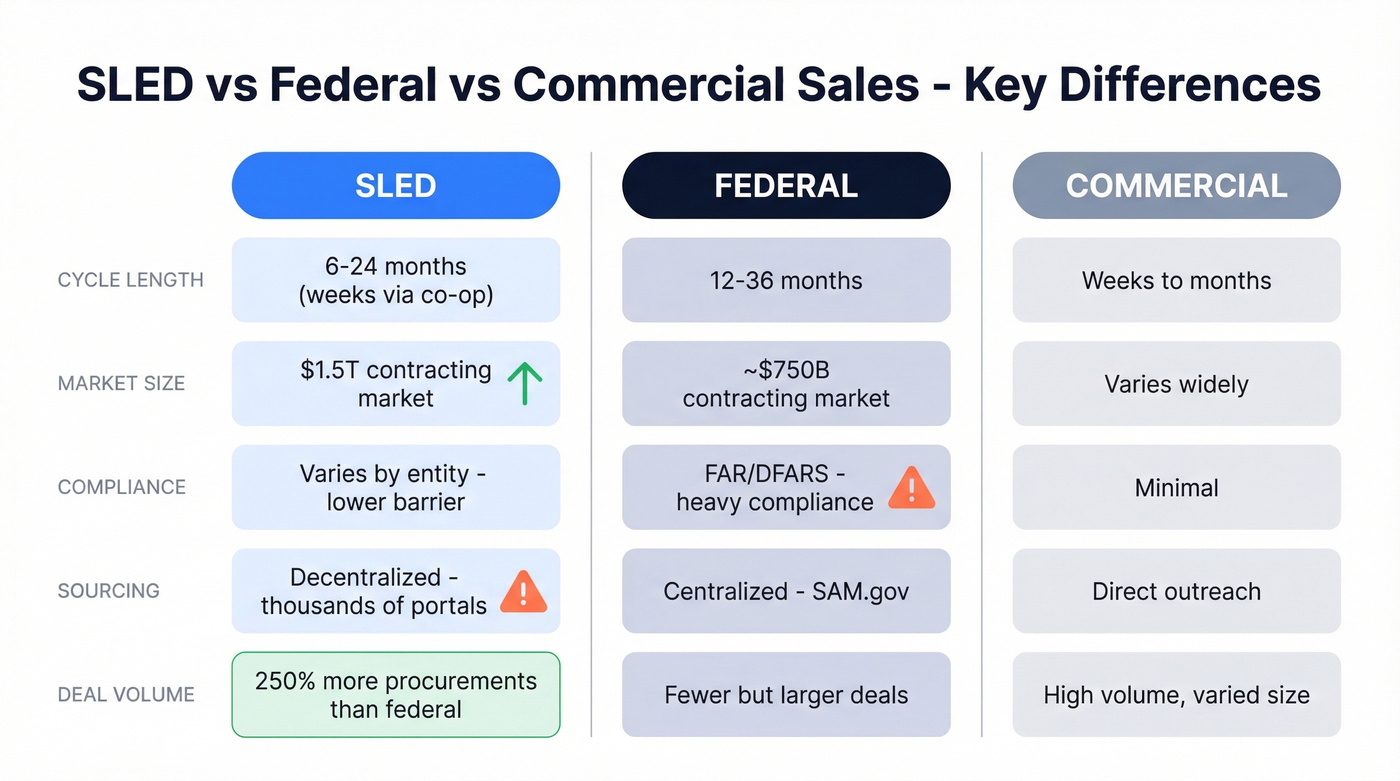
| Dimension | SLED | Federal | Commercial |
|---|---|---|---|
| Cycle length | 6-24 months (weeks via co-op) | 12-36 months | Weeks to months |
| Avg deal size | Many under $100K | Often $250K+ | Varies widely |
| Compliance | Varies by entity | FAR/DFARS | Minimal |
| Sourcing | Decentralized portals | Centralized federal portals | Direct outreach |
| Decision drivers | Lowest responsible bid (commodities), references | Technical merit, compliance | ROI, speed |
The SLED contracting market runs ~$1.5T annually - roughly twice the federal market. In 2024, there were ~250% more SLED procurements than federal, excluding minor DoD acquisitions. Average deal sizes skew smaller, but the volume is massive. That stat alone should reframe how your team allocates territory resources.
Here's the thing: there's no single SAM.gov-style centralized portal for SLED. Federal opportunities are centralized. SLED opportunities are scattered across thousands of portals, each with different formats and timelines. That decentralization is why most teams either need aggregation software or a very organized spreadsheet habit.
How SLED Procurement Works
Every SLED entity runs its own procurement shop. A county in Texas doesn't follow the same rules as a school district in Oregon. Thresholds for competitive bidding vary. Terminology shifts - one agency's "RFP" is another's "ITB" or "RFQ."
Two primary purchasing paths exist. For commoditized products like laptops, office supplies, and standard software licenses, agencies use state-level General Services Agreements where the lowest responsible bid wins. For complex solutions - cybersecurity platforms, ERP implementations, managed services - agencies issue RFPs that evaluate technical merit, references, and pricing together.
A typical RFP-driven deal moves through predictable stages, though timelines vary wildly by entity size and complexity:
- RFP open period: 3-6 weeks for vendors to respond
- Evaluation: 4-10 weeks (committee reviews, demos, reference checks)
- Contracting & award: 4-12 weeks (legal review, board approval, signatures)
Many contracts land under $100K, which means fewer barriers to entry than federal work. There's typically no FAR compliance, no SAM.gov registration requirement, and less bonding overhead. For small and mid-size vendors, that accessibility is the whole appeal.
The 2026 SLED Budget Calendar
Miss the budget window and you're waiting 12 months for the next one. The majority of state governments, K-12 districts, and higher ed institutions operate on a July-June fiscal year, so March through May is the high-velocity buying season. Agencies are racing to obligate funds before the June 30 cutoff.
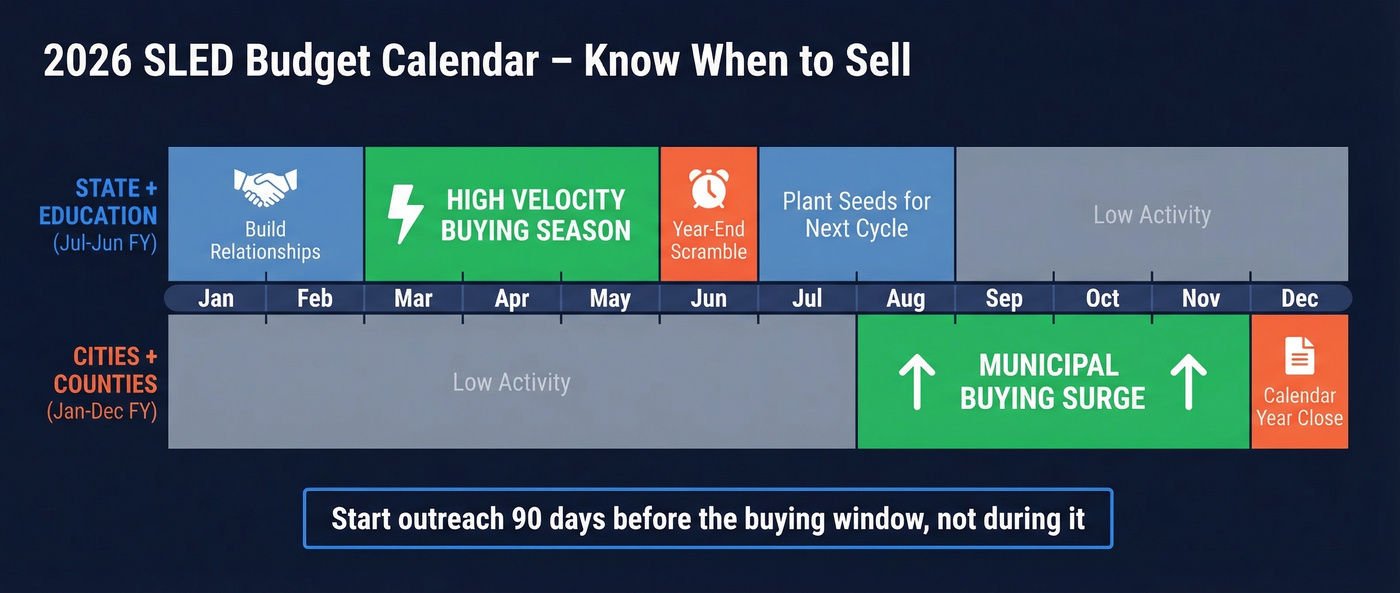
Cities, counties, and many special districts run on a calendar-year budget (January-December), creating a secondary surge from August through November.
| Period | What's Happening | Your Action |
|---|---|---|
| Jan-Feb | Budgets finalized, needs identified | Build relationships, pre-RFP work |
| Mar-May | High-velocity buying season | Respond fast, close awards |
| June | Fiscal year-end scramble | Clear admin hurdles, close deals |
| Jul-Aug | New fiscal year begins | Plant seeds for next cycle |
| Aug-Nov | Municipal/county buying surge | Target calendar-year entities |
| Dec | Calendar-year close | Close municipal deals |
We've seen teams lose winnable deals simply because they started outreach in April for a June 30 deadline. By then, the evaluation committee has already shortlisted vendors. Start 90 days before the buying window, minimum.

90,000+ SLED entities means 90,000+ procurement offices with outdated staff directories. Prospeo gives you 98% accurate emails and verified direct dials for government decision-makers - so you're building relationships months before the RFP, not scrambling after it posts.
Start the pre-RFP work with contacts you can actually reach.
How to Win SLED Deals
Engage Before the RFP Drops
The pre-RFP phase is where SLED deals are actually won. By the time a formal solicitation hits a portal, the requirements have been shaped - often with input from the vendor who'll eventually win. Show up at school board meetings, city council sessions, and procurement briefings. Build relationships with department heads and IT directors before they write the spec.
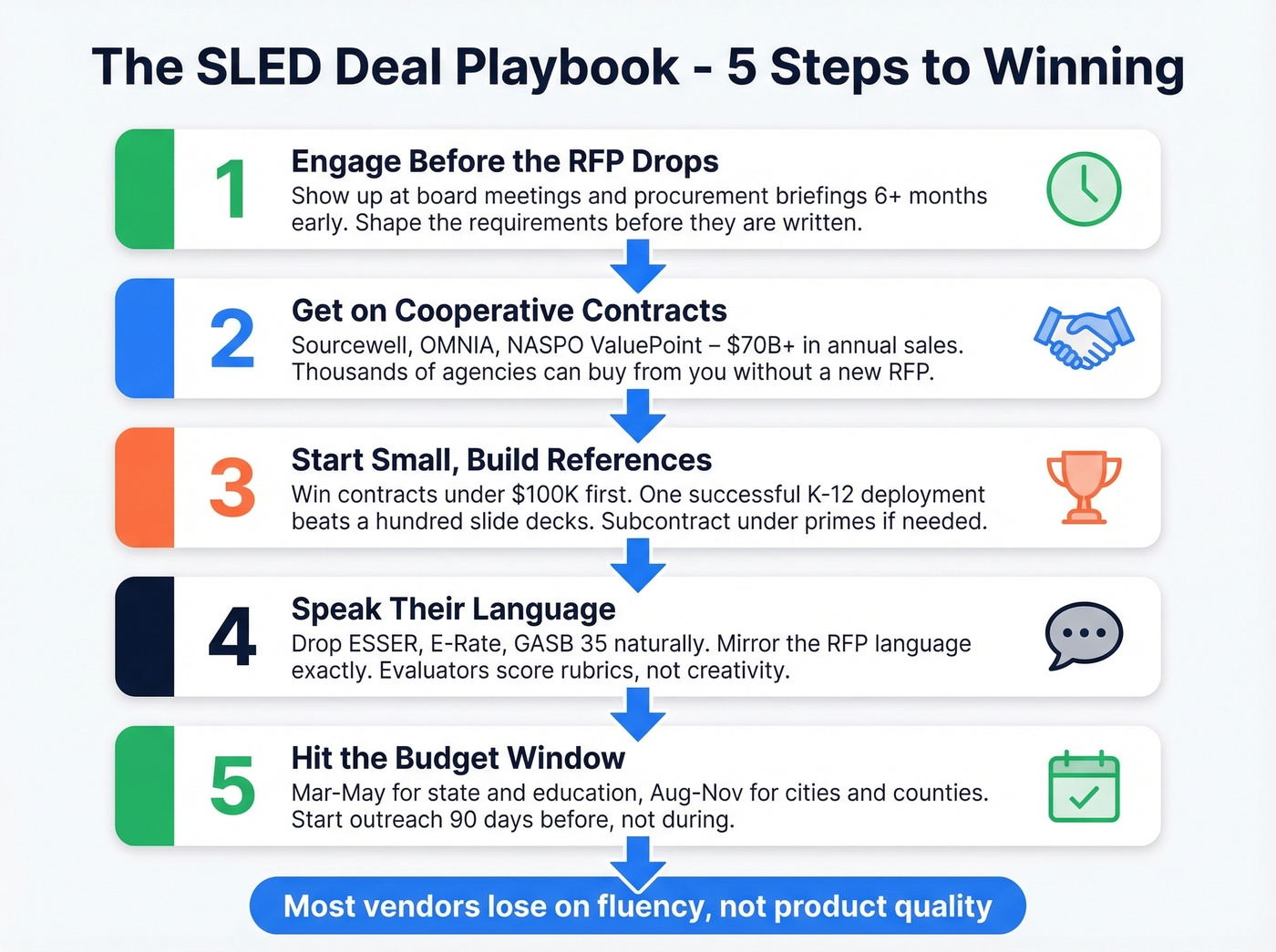
"If you're waiting for the RFP, you've already lost" isn't a cliché in government sales. It's operational reality. In our experience, the vendors who win statewide deals started relationship-building 6+ months before the solicitation went live. Before you show up at a board meeting, though, verify you have the right contact - government websites are notoriously outdated. Prospeo's Chrome extension lets you pull verified emails and phone numbers from any government website in one click, so you're reaching the actual decision-maker, not a generic info@ address.
Use Cooperative Purchasing
Cooperative purchasing is one of the fastest paths into the SLED market. The big three - Sourcewell, OMNIA Partners, and NASPO ValuePoint - sit at the center of how many agencies buy. Cooperative purchasing accounts for $70B+ in annual sales.
How it works: a lead public agency runs a competitive solicitation, evaluates responses, and publicly awards a master contract. Other agencies then buy directly off that award without running their own RFP.
For vendors, getting on a co-op contract means thousands of agencies can purchase from you immediately. For agencies, it satisfies competitive bidding requirements without the administrative burden of a standalone procurement. Look for piggybacking clauses that let neighboring agencies buy off an existing award - they're common and underutilized.
Start Small, Build References
Past performance matters enormously in government procurement. Agencies are risk-averse by nature - they're spending taxpayer money and nobody wants to be the procurement officer who picked the vendor that failed.
Start with contracts under $100K as entry points. Subcontracting under an established prime is a legitimate beachhead strategy, especially when incumbents have deep relationships. Shift your positioning from "we're eligible" to "we're capable." That means phased rollout plans, clear implementation timelines, security documentation, accessibility compliance, and - above all - referenceable customers in similar agencies. One successful K-12 deployment is worth more than a hundred slide decks.
Mirror the RFP's exact language, section order, and scoring criteria in your response. Evaluators score against rubrics, not creativity.
Learn the Language
Look, most vendors lose SLED deals not on product quality but on fluency. Dropping "ESSER funds" or "E-Rate" in a K-12 conversation signals you understand their world. Mentioning GASB 35 to a university CFO shows you've done the homework. Government buyers can smell a vendor who just copy-pasted their commercial pitch into an RFP template.
Learn the acronyms, reference the specific funding mechanisms, and speak like someone who's been in the room before - even if you haven't.
The Career Math
SLED AE OTE typically ranges from $160K-$300K depending on territory, segment, and contract vehicle access. Cycles are longer than SMB, but deal sizes and renewals compound. Statewide contracts can generate seven figures over their term, and this segment tends to deliver lower churn and more predictable revenue than commercial.
The consensus on r/sales about government sales being a "grinding race to the bottom" focused on lowest cost is real at the commodity level - but solution sellers who build relationships and stack references escape that trap entirely.
Building a SLED Prospect List
Every SLED guide explains procurement. Almost none explain how to actually find the people you need to talk to.
Government directories are notoriously outdated - staff turns over, titles change, and the website hasn't been refreshed since the last administration. Calling the main switchboard and asking for "whoever handles IT purchasing" is a recipe for wasted afternoons. We've burned entire days this way before switching to a data-first approach.
Prospeo's B2B database with 30+ search filters lets you target by job title, department, location, and technographics, so you can build a list of every K-12 CTO in Texas or every county IT director in the Midwest - with 98% email accuracy on a 7-day refresh cycle. The free tier gives you 75 verified emails per month plus 100 Chrome extension credits, enough to test your first SLED territory before committing a dollar.
SLED buying windows are narrow and unforgiving. You can't afford to waste March-May chasing dead emails on government websites. Prospeo's 7-day data refresh means the IT director who moved agencies last month already has an updated record - at $0.01 per verified email.
Hit the budget window with fresh data, not stale directories.
What SLED Agencies Are Buying in 2026
SLED IT spend is projected at $160.2B in 2026, growing to $202.3B by 2030 at a ~4-6% annual clip. That growth is being driven by a few converging forces.
Legacy modernization is the biggest line item. Decades of technical debt are hitting end-of-life simultaneously, and agencies can't keep patching systems built in the early 2000s. AI is moving from pilot to production - chatbots for citizen services, document analysis for internal workflows, retrieval-augmented generation for policy research. Over 90% of states have adopted responsible-use AI policies and established AI inventories.
Local government priorities put cybersecurity at #1, with co-managed security, identity and access management, and Cyber-as-a-Service models gaining traction among agencies that can't staff a 24/7 SOC. Workforce automation is right behind it - agencies are losing staff to private sector and need tools that let smaller teams do more.
Two details worth flagging for vendors: in 2025, 44% of IT solicitations included service components like integration, compliance, and implementation support - expect that share to grow this year. And the DOJ's April 2026 digital accessibility compliance deadline is creating urgent demand for accessibility solutions across every SLED segment.
Mistakes That Kill SLED Deals
Treating SLED like commercial B2B. Government buyers don't care about your Series C or your NPS score. They care about compliance, references, and whether you'll still be around in 5 years.
Waiting for the RFP. By the time it's published, the spec has been written - often with a competitor's help. Pre-RFP engagement isn't optional.
Ignoring budget cycle timing. Pitching a state agency in August for a July-June fiscal year means you're 10 months early. That's not pipeline - that's a prayer.
Submitting non-compliant proposals. We've watched teams submit technically superior proposals that got disqualified for missing a single mandatory form. Use checklists. Every time.
Speaking the wrong language. Referencing "ARR" and "churn" to a county procurement officer signals you don't understand their world. Use their terminology, reference their funding sources, and cite comparable deployments in their segment.
SLED in Sales FAQ
What does SLED stand for in sales?
SLED stands for State, Local, and Education - the 90,000+ U.S. government entities that aren't federal. Together they spend $3.96T annually and employ nearly 20 million people, making it one of the largest addressable markets in B2B sales.
How long is a typical SLED sales cycle?
Most SLED deals close in 6-24 months, depending on entity size and contract complexity. Cooperative purchasing contracts through vehicles like Sourcewell or NASPO ValuePoint can compress the cycle to weeks, since the competitive solicitation has already been completed.
How do you find SLED decision-makers?
Government directories are often outdated and switchboards are slow. A B2B data platform with verified contact data and filters for job title, department, and location is the fastest path. Skip the main line and go straight to the procurement officer or IT director with a verified email.
What does a SLED sales rep earn?
OTE for SLED account executives typically falls between $160K and $300K, depending on territory size, segment focus, and access to cooperative contract vehicles. Longer cycles are offset by larger contract values and strong renewal dynamics that compound over multi-year terms.