

What Is Stakeholder Mapping (And How to Actually Do It Right)
You're three weeks into a CRM migration. The project plan is solid, the team's aligned, and then a VP of Operations you never talked to kills your timeline with a single email. She wasn't on your radar. She should've been.
70% of change efforts fail because of exactly this kind of blind spot - and the fix isn't complicated. It's stakeholder mapping, and most teams just skip it.
What You Need (Quick Version)
If your project has fewer than 10 stakeholders and moves fast, skip the fancy frameworks. A simple stakeholder note - three fields per person, five minutes to write - will outperform any matrix you build and never update. For standard projects with clear hierarchies, the power/interest grid is your starting point. For complex, politically charged initiatives involving regulators or community groups, use the salience model. And if you're in B2B sales mapping a buying committee, we've got you covered too.
Stakeholder Mapping Defined
Stakeholder mapping is the process of identifying every person or group who can influence, is affected by, or has a stake in your initiative - then plotting them visually so you know who to engage, how, and how often. It's the visual equivalent of stakeholder analysis: you take the messy reality of competing interests and power dynamics and turn it into something your team can actually use.
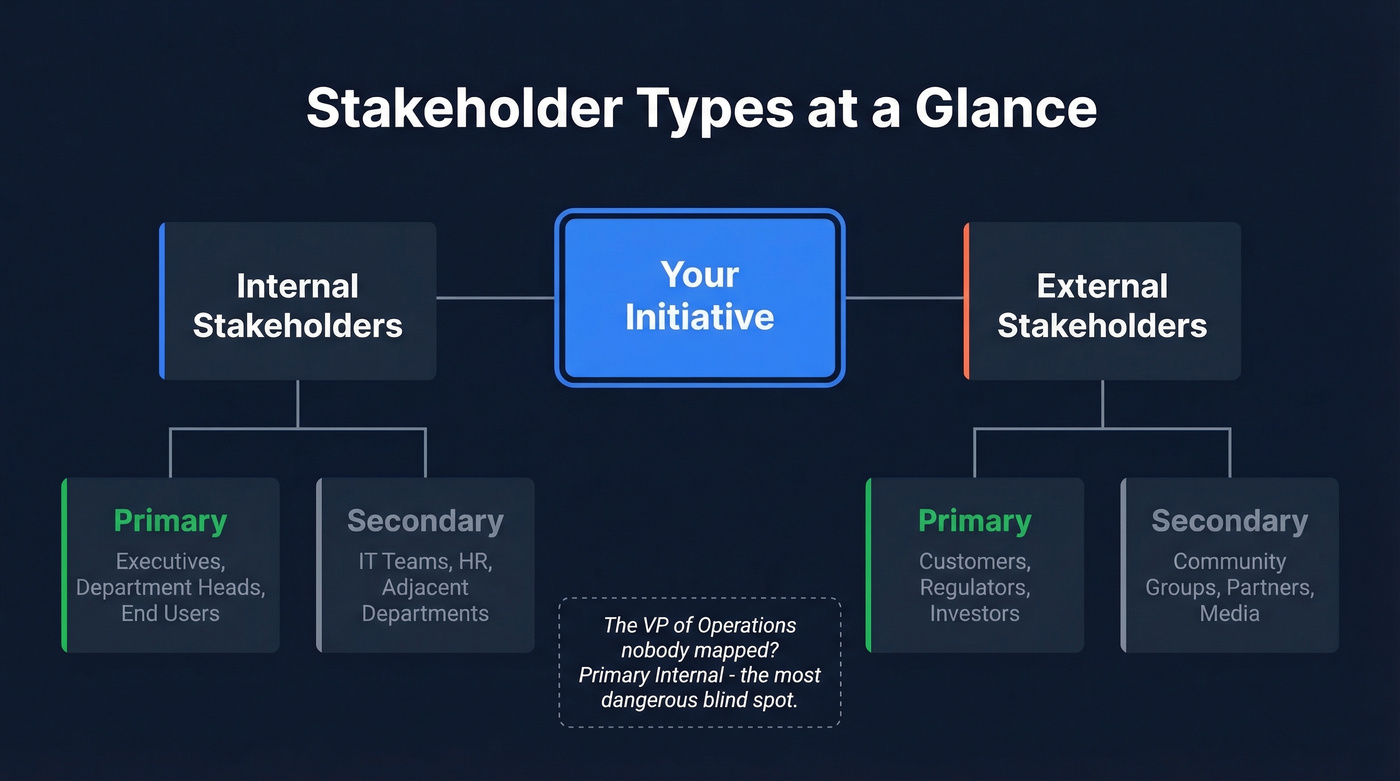
Stakeholders fall into two broad buckets. Internal stakeholders sit inside your organization - executives, department heads, end users, IT teams. External stakeholders sit outside - customers, regulators, investors, partners, community groups. Within each bucket, you've got primary stakeholders (directly affected by the project's outcome) and secondary stakeholders (indirectly affected but still capable of influencing it). That VP of Operations from the intro? Primary internal stakeholder nobody classified.
Most teams trigger this exercise at project kickoff, but it's equally valuable during reorgs, new product launches, or any initiative that crosses departmental lines. The earlier you map, the fewer surprises you absorb later. The output can be as simple as a shared spreadsheet or as polished as a Miro board with color-coded quadrants - the format matters far less than the discipline of doing it at all.
Mapping vs. Analysis vs. Management
These three terms get used interchangeably. They shouldn't.
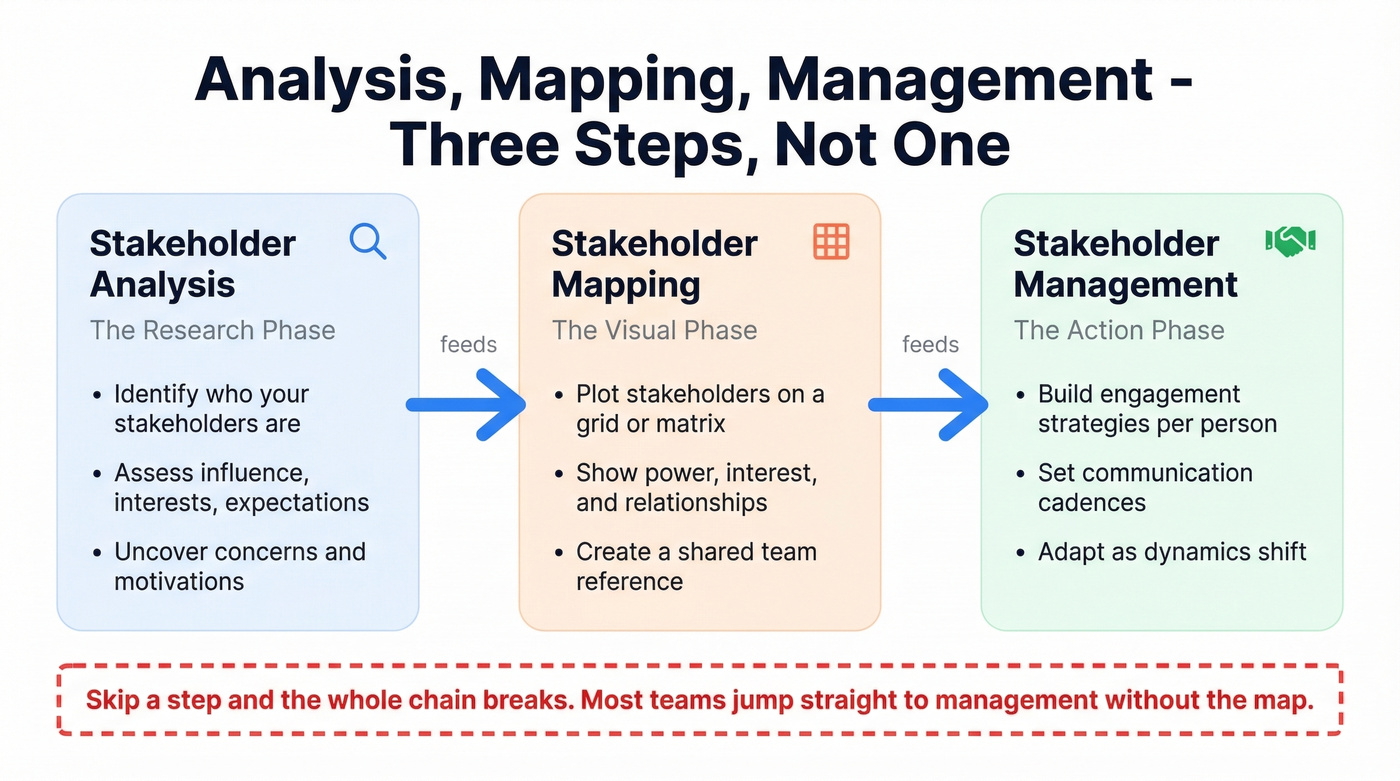
Stakeholder analysis is the research phase - identifying who your stakeholders are and assessing their influence, interests, expectations, and concerns. Stakeholder mapping takes that analysis and turns it into a visual representation: a grid, a Venn diagram, a matrix. Stakeholder management is the ongoing relationship strategy you build after the map exists - the cadences, the comms plans, the engagement tactics.
Analysis feeds mapping. Mapping feeds management. Skip a step and the whole chain breaks.
Why It Matters
That 70% failure stat isn't just a scare number. We've watched projects with perfect Gantt charts collapse because nobody mapped the stakeholders. The pattern is always the same: teams build plans, skip the stakeholder work, then get blindsided by resistance from people who should've been consulted early. A well-executed map prevents this by forcing you to think about influence and interest before you need something from someone.
The practical benefits stack up fast:
- Conflict anticipation - you see competing interests before they collide in a meeting
- Smarter resource allocation - you stop spending equal time on people with unequal influence
- Tailored communication - your CFO doesn't need the same update format as your end users
- Faster approvals - when decision-makers feel informed and consulted, they sign off quicker
One risk worth flagging: mapping stakeholders but then ignoring their input creates tokenism perceptions that are worse than not engaging at all. A PMC study on stakeholder engagement found that perceived power imbalances and performative consultation actively eroded trust. The map is only valuable if it changes how you communicate - not if it's theater you perform once at kickoff and never revisit.
How to Create a Stakeholder Map
Let's walk through this with a real scenario: you're leading a CRM migration from a legacy system to HubSpot. Five key stakeholders, each with different stakes.
Step 1: Identify your stakeholders. Start with the org chart, but don't stop there. Trace the product journey - who touches the CRM daily? Interview team members. Review past projects for people who showed up late and caused problems. Finding key stakeholders early is the single most important step, because everything downstream depends on the completeness of this list.
For our CRM migration, the list includes: Sarah (VP Sales, daily CRM user), Marcus (CFO, budget authority), Priya (IT Director, technical implementation), James (Sales Ops Manager, data migration lead), and Dana (Customer Success Lead, worried about downtime affecting clients).
Step 2: Analyze characteristics. For each stakeholder, assess their authority level, resource control, domain expertise, and position on the project. Marcus controls the budget but doesn't use the CRM. Dana has no budget authority but her team will feel the migration pain most directly.
Step 3: Prioritize. Score each stakeholder on power (1-5) and interest (1-5). Sarah scores 5/5 on both - she's your champion and your biggest risk if she turns. Marcus is 5 power, 2 interest - he'll approve or kill the budget but doesn't care about feature details. Dana is 2 power, 5 interest - deeply invested but can't block you directly.
Step 4: Create the map. Plot them on your chosen framework. Sarah goes in the "manage closely" quadrant. Marcus goes in "keep satisfied." Dana goes in "keep informed." James lands in "manage closely" alongside Sarah. Priya sits between "manage closely" and "keep satisfied" depending on the implementation phase.
Step 5: Develop engagement strategies. Sarah gets weekly 1:1s and a seat on the steering committee. Marcus gets monthly executive summaries - two paragraphs, no jargon. Dana gets biweekly email updates with a feedback channel. Document these strategies in your stakeholder register alongside each person's profile so the engagement plan lives next to the analysis, not in a separate doc nobody opens.
Now you've got a plan, not just a diagram.

Stakeholder mapping tells you who matters. Prospeo tells you how to reach them. Search 300M+ profiles with 30+ filters - by seniority, department, company size - and get 98% accurate emails for every decision-maker on your map.
Turn your stakeholder map into a contact list in minutes.
Frameworks Compared
Power/Interest Grid (Mendelow Matrix)
The power/interest grid - originally developed by Mendelow - is the framework most people picture when they hear "stakeholder map." It's a 2x2 matrix with power on one axis and interest on the other, creating four quadrants:
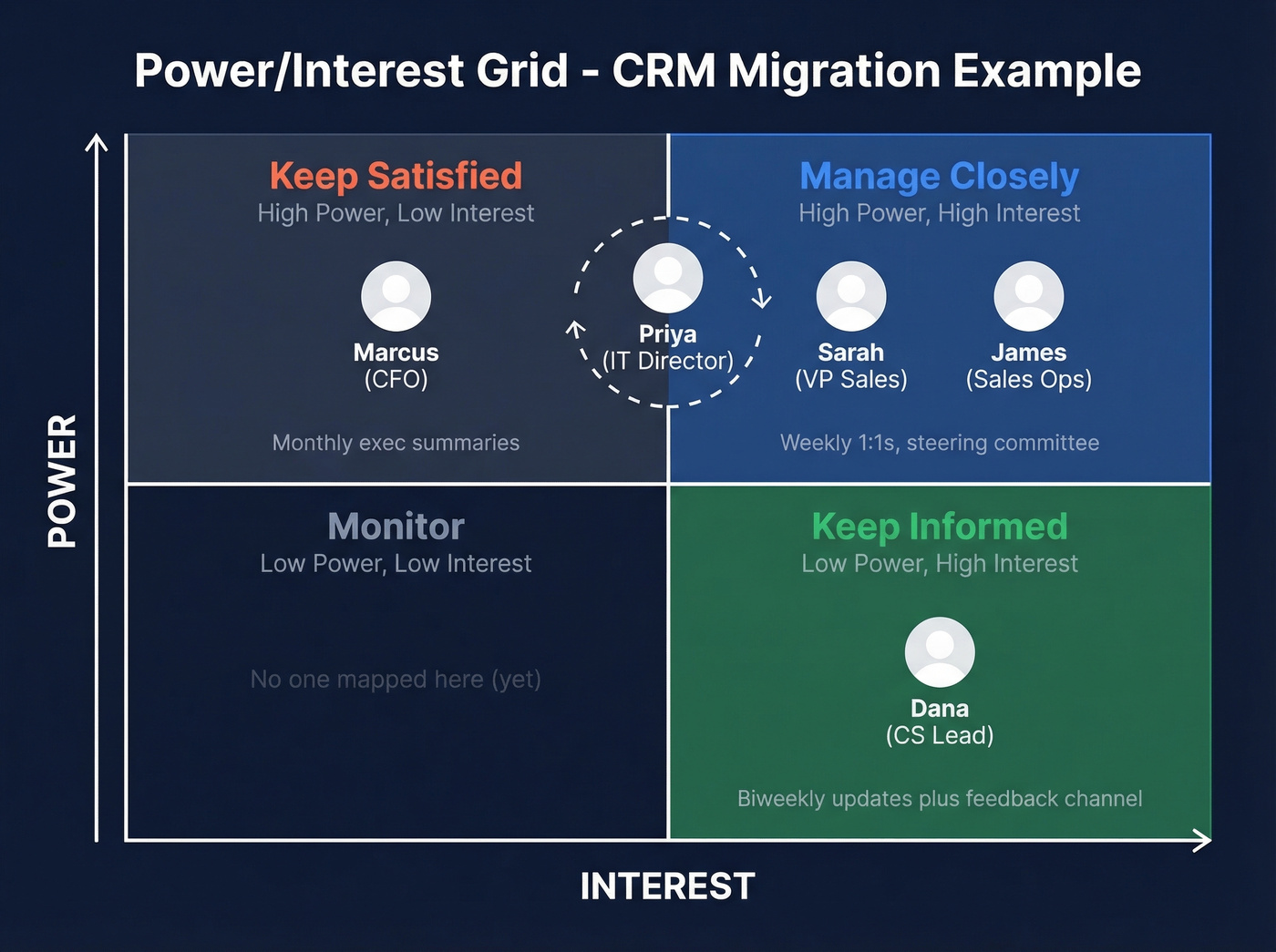
- Players (high power, high interest) - manage closely with regular updates and direct involvement
- Context Setters (high power, low interest) - keep satisfied with executive summaries; follow up even when they seem disengaged
- Subjects (low power, high interest) - keep informed with regular updates and feedback channels
- Crowd (low power, low interest) - monitor with minimal communication
This is the starting point, not the finish line. It works beautifully for straightforward projects with clear hierarchies. It falls apart when stakeholders have legitimate claims but no formal power, or when urgency shifts mid-project.
The Salience Model
Introduced by Mitchell, Agle, and Wood in their 1997 Academy of Management Review paper, the salience model assesses stakeholders across three attributes instead of two: power, legitimacy, and urgency. Salience is the priority managers give to competing stakeholder claims - and this model acknowledges that power alone doesn't tell the full story.
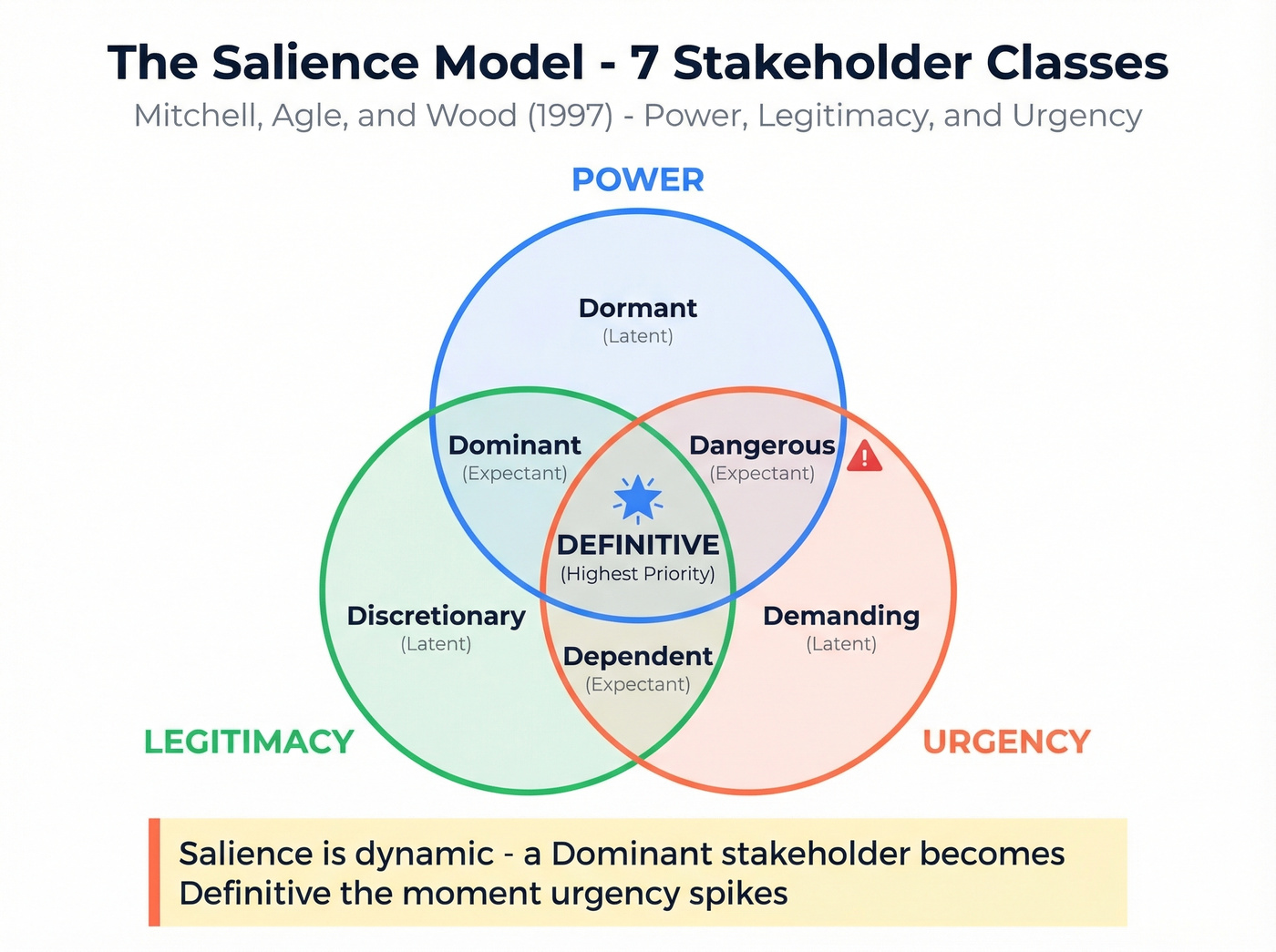
The three attributes create seven stakeholder classes through their overlaps:
| Class | Attributes | Group |
|---|---|---|
| Dormant | Power only | Latent |
| Discretionary | Legitimacy only | Latent |
| Demanding | Urgency only | Latent |
| Dominant | Power + Legitimacy | Expectant |
| Dangerous | Power + Urgency | Expectant |
| Dependent | Legitimacy + Urgency | Expectant |
| Definitive | All three | Definitive |
The critical insight is that salience is dynamic. A dominant stakeholder becomes definitive the moment urgency spikes - say, a regulator who's been passively monitoring suddenly gets a complaint. A PMC study applying this framework across 57 interviews in Uganda's health system found that politicians were the most salient stakeholders, but their salience shifted dramatically depending on the specific decision being made.
If your project involves regulators, community groups, or political stakeholders, use this instead of the grid. The extra dimension of legitimacy catches stakeholders that a pure power/interest analysis misses entirely.
Influence, Interest, Intensity
A practitioner on r/environmental_science proposed adding a third dimension to the standard grid: intensity - how strongly a stakeholder feels about the outcome, regardless of their formal power or stated interest. This three-dimension approach reveals hidden influencers and potential blockers that a 2x2 grid misses.
Here's the thing: a mid-level manager with moderate power but extreme intensity about data security will derail your CRM migration faster than a disengaged C-suite sponsor. We've seen this pattern more times than we can count.
Intensity is the hardest dimension to assess because people don't always broadcast it. You have to ask indirect questions: "What would make this project a failure in your eyes?" and "What's your biggest concern about the current approach?" The answers reveal intensity levels that org charts never will.
Which Framework Should You Use?
Hot take: most teams don't need a framework at all. If you have fewer than 10 stakeholders, a framework adds ceremony without adding clarity. The 5-minute stakeholder note below will serve you better.
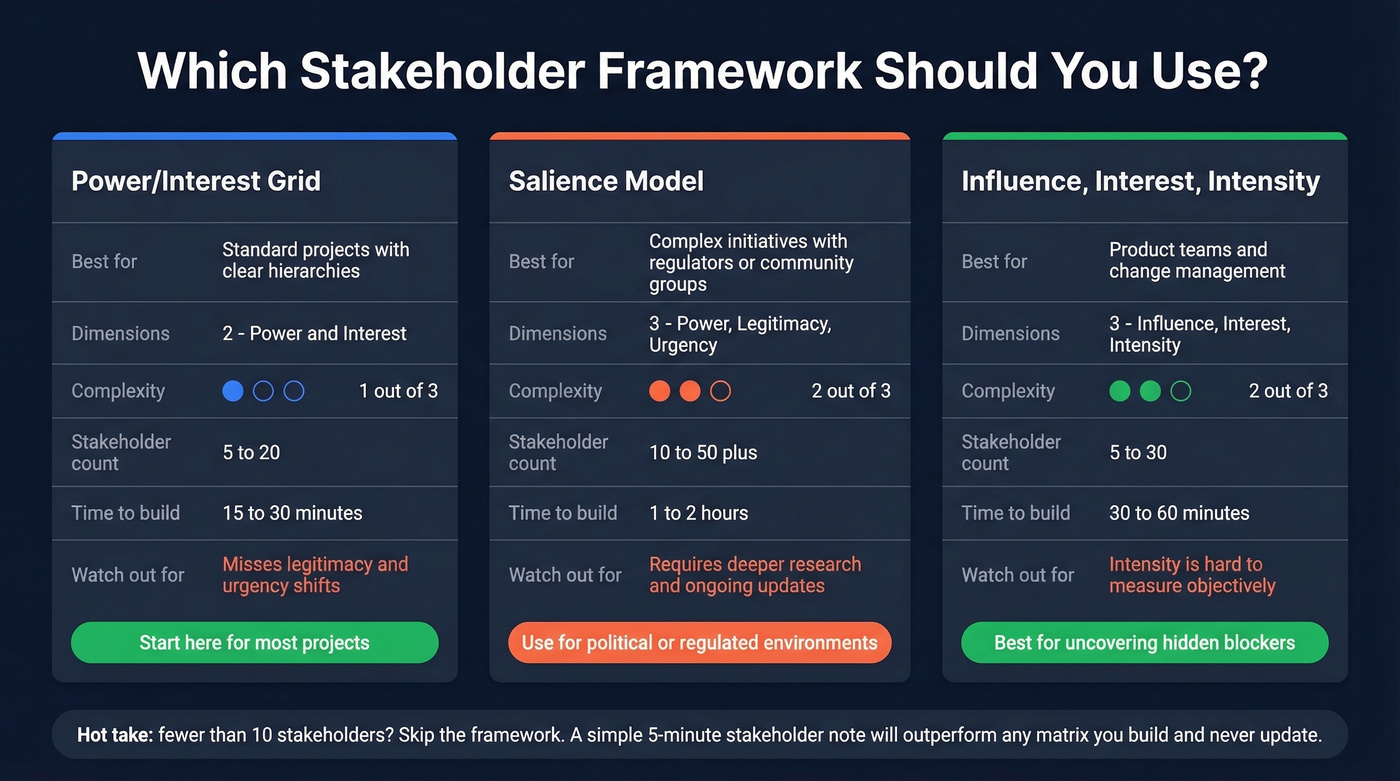
For simple, well-defined projects with clear reporting lines, go with the power/interest grid. It's fast and everyone understands it. For complex, politically charged initiatives with regulators, community stakeholders, or cross-organizational dynamics, the salience model is worth the extra effort. For product teams juggling multiple stakeholder types, combine RACI with stakeholder personas, as the Product Management Society recommends.
The 5-Minute Stakeholder Note
Stop over-engineering your stakeholder map. In our experience, the teams that reference a quick stakeholder note outperform the ones with elaborate Miro boards every single time - because they actually look at it.
For projects with fewer than 10 stakeholders, a lightweight note beats a polished matrix. For each key stakeholder, capture three things:
- What they care about most - not their job title, their actual concern. "Sarah cares about rep adoption speed, not feature completeness."
- How they measure success - the metric or outcome they'll judge you by. "Marcus measures this by total cost vs. budget, period."
- How they want updates and how often - some want a Slack message every Friday, others want a monthly email with bullet points. "Dana wants every change request written down before work starts."
That's it. Five minutes per stakeholder. One practitioner on r/LifeProTips framed it as "five minutes saves five hours" of downstream stress. A note you actually reference beats a beautiful Miro board you built once and forgot about.
Five Mistakes That Derail Your Map
1. Keeping stakeholders in your head. Everyone thinks they "know" their stakeholders. Then someone gets missed. Write a stakeholder register with concrete fields: Name, Department, Key Interests, Power/Influence Score, Preferred Channel, Update Frequency, Information Flow, and Notes. If it's not written down, it doesn't exist.
2. Treating all stakeholders the same. Your CFO and your end users don't need the same communication. Use your quadrant placement to drive differentiated engagement - weekly 1:1s for players, monthly summaries for context setters, async updates for subjects.
3. Only communicating when you need something. This is the fastest way to erode trust. Set a cadence by stakeholder type and stick to it, even when there's nothing urgent to report. A "no news, still on track" message takes 30 seconds and keeps people feeling included.
4. Adding data fields midstream. You're 100 stakeholders deep and realize you need everyone's preferred communication channel. Now you're re-researching half your list. Define your fields before you start mapping. Retrofitting is painful.
5. Letting the map go stale. Review your stakeholder map at least quarterly, and update immediately after trigger events: reorgs, funding rounds, leadership changes, or scope shifts. Stakeholder categories aren't static - the PM Society recommends reassessing whenever significant changes occur.
Stakeholder Mapping Tools
You don't need specialized software for most projects. A shared spreadsheet or Miro board beats a $995/month platform if all you need is a simple map and a communication plan.
That said, here's what's available:
| Tool | Free Tier | Paid Pricing | Best For |
|---|---|---|---|
| Miro | Yes (free plan) | ~$8/user/mo | Visual collaboration |
| Monday.com | 2 seats free | $9-19/user/mo | Project tracking |
| ClickUp | Free (personal) | $7-12/user/mo | Versatility |
| Canva | Free whiteboard | Paid plans available | Quick visuals |
| Meegle | 20 seats free | $8-12/user/mo | Stakeholder mgmt |
| Jambo | No | $995/mo | Enterprise engagement |
Jambo at $995/month is steep for most teams - that's enterprise engagement tracking for organizations managing hundreds of community or government stakeholders. Skip it unless you're in that category. For everyone else, Miro's free tier or a well-structured Google Sheet will get you most of the way there.
Where these tools fall short is the B2B sales use case. Mapping a buying committee is one thing. Finding verified contact data for each person on that committee is another problem entirely.
Applying This to B2B Sales
Stakeholder mapping isn't just a project management exercise. In B2B sales, it's how you avoid the $200K lost deal where your team spent three months talking to a champion who didn't have budget authority.
A common point of confusion worth clearing up: shareholder vs. stakeholder. Shareholders own equity in a company and care about financial returns. Stakeholders in a B2B deal are anyone who influences or is affected by the purchase decision - they may have zero ownership stake but total power to block or accelerate a deal. Your champion, the CFO, the IT security reviewer, and the end users are all stakeholders. Only investors and founders are shareholders. Conflating the two leads to misallocated outreach.
Every complex deal has a buying committee: the champion who loves your product, the economic buyer who controls the budget, the technical evaluator who'll test your API, procurement who'll negotiate terms, and the end users who'll actually live with the tool. The ability to identify these people early in the cycle is what separates reps who close from reps who forecast deals that never land. Map them the same way you'd map project stakeholders - plot their influence, understand what they care about, and tailor your approach to each one.
Once you've identified the five people who matter, you need to actually reach them. Filter down to the exact roles you need - VP Finance at Series B SaaS companies with 200-500 employees, for example. Prospeo's database of 300M+ profiles with 30+ search filters, including buyer intent signals across 15,000 topics, makes that search take seconds. You get verified emails at 98% accuracy and direct dials from 125M+ verified mobile numbers, all on a 7-day data refresh cycle. The free tier gives you 75 emails and 100 Chrome extension credits per month - enough to map and reach a buying committee without spending a dollar.

Mapping a buying committee for a complex deal? Prospeo's Chrome extension lets you pull verified emails and direct dials for every stakeholder - from the CFO who controls the budget to the ops lead who'll block your timeline. 125M+ verified mobiles, 30% pickup rate.
Stop mapping stakeholders you can't actually contact.
FAQ
What's the difference between a stakeholder map and a stakeholder matrix?
A stakeholder map is the broader visual exercise of plotting all stakeholders by their relationships and influence. A stakeholder matrix - like the power/interest grid - is one specific technique used within that exercise. Most people use the terms interchangeably, but technically the matrix is a subset of mapping.
How often should you update a stakeholder map?
Reassess quarterly at minimum, and update immediately after trigger events: leadership changes, reorgs, funding rounds, or scope shifts. Fast-moving environments - startups, M&A integrations - benefit from monthly check-ins to catch role changes before they cause surprises.
Who should own the stakeholder map?
The project manager or program lead owns it, but it should be a shared, live document - not a PowerPoint buried in someone's folder. Anyone on the core team should be able to view and suggest updates. Ownership means accountability for keeping it current, not gatekeeping access.
How do you find contact data for stakeholders in B2B sales?
Use a B2B data platform with role-based filters to locate verified emails and direct dials for each buying committee member. Prospeo covers 300M+ profiles with 98% email accuracy and 125M+ verified mobiles - the free tier (75 emails/month) lets you map and reach a full committee at zero cost.
That VP who killed your timeline? She's in every project. The only question is whether you find her on your map or in your inbox. Five minutes of stakeholder mapping at kickoff would've surfaced her - and the engagement strategy to keep her on your side. The tools and frameworks exist. The hard part is just doing it.