

WHOIS Lookup Email: Why It Doesn't Work Anymore (and What to Do Instead)
You ran a WHOIS lookup expecting a registrant email. You got "REDACTED FOR PRIVACY." Maybe you tried the command line and got "Requests of this client are not permitted." The consensus on r/DigitalMarketing matches your experience: "Tried WHOIS lookup, also doesn't work."
That's because it hasn't worked for most domains since 2018 - and the protocol was officially replaced WHOIS with RDAP for gTLD data in January 2025.
The Short Answer
If you're trying to find someone's professional email from a domain, skip WHOIS entirely. These actually work:
- Prospeo - 300M+ professional profiles, 98% email accuracy, 5-step verification with catch-all handling. Free tier gives you 75 emails/month.
- Hunter.io - 100M+ indexed emails, free tier (25 searches + 50 verifications/month), paid plans from $49/mo.
- WHOIS history lookup - Tools like WhoisFreaks or DomainTools can surface pre-privacy registration data. Only useful for older domains.
WHOIS registrant emails have been redacted since GDPR took effect in May 2018, and ICANN officially replaced WHOIS with RDAP on January 28, 2025. Registrars still collect the data - it just isn't public anymore.
What WHOIS Returns in 2026
Pre-GDPR, a WHOIS query returned everything:
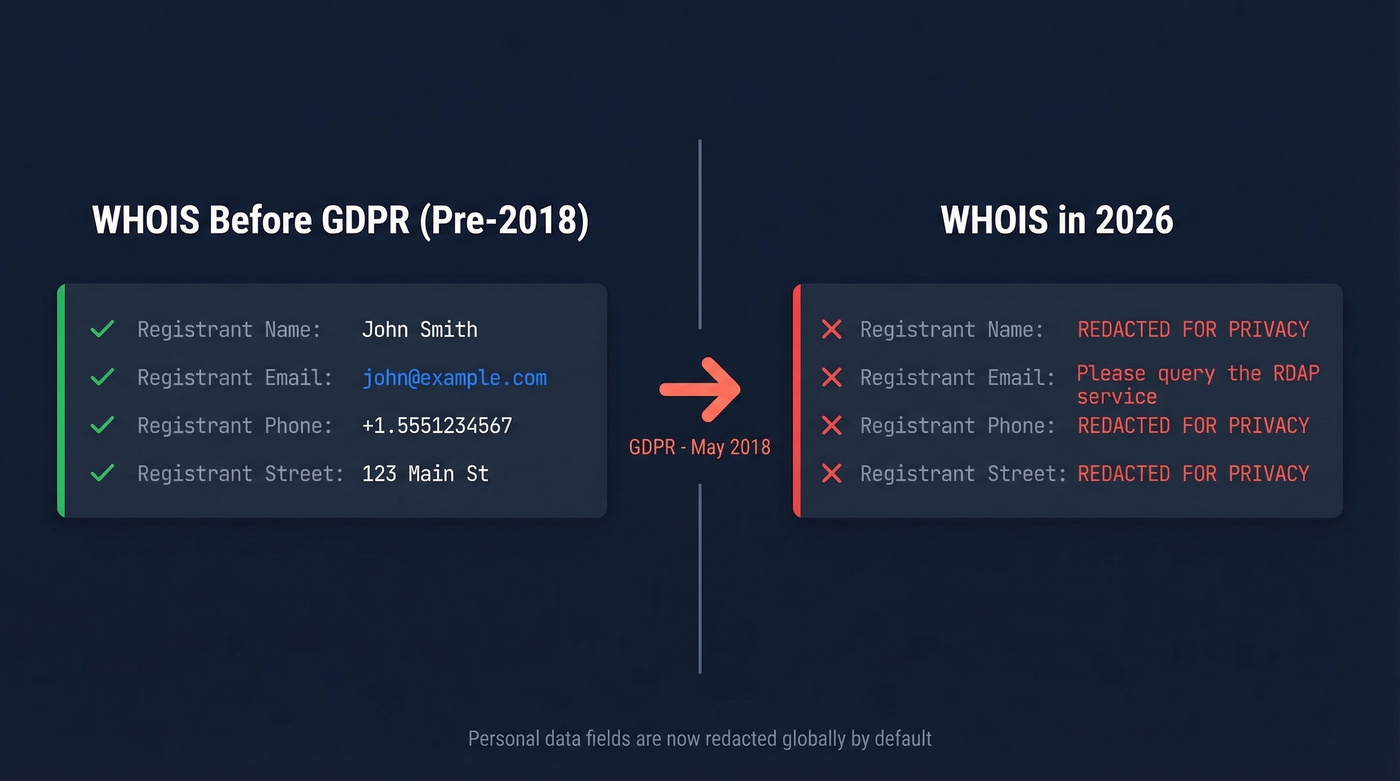
Registrant Name: John Smith

Registrant Email: john@example.com

Registrant Phone: +1.5551234567

Registrant Street: 123 Main St
Run that same query today:
Registrant Name: REDACTED FOR PRIVACY

Registrant Email: Please query the RDAP service of the registrar

Registrant Phone: REDACTED FOR PRIVACY

Registrant Street: REDACTED FOR PRIVACY
The fields that remain public are administrative: registrar name, creation and expiration dates, nameservers, and domain status codes. Everything personally identifiable is gone.
Why WHOIS Stopped Showing Emails
GDPR was the trigger. When the regulation took effect in May 2018, registrars faced a choice: expose EU registrant data and risk massive fines, or redact it by default. They chose redaction - and applied it globally, not just for EU domains.
Even before GDPR, WHOIS privacy services existed, but they cost $5-$10/year and required opt-in. Now registrars like Cloudflare, Porkbun, and Namecheap offer free privacy protection on every registration. Public registrant emails went from common to nearly nonexistent. Some TLDs go further - .ch and .li domains block port-43 queries entirely, returning "Requests of this client are not permitted" and directing you to their web portal instead.
ICANN's Registration Data Policy, effective August 21, 2025, codifies this shift. Registrars must collect registrant email - it's explicitly listed as a required data element. But they don't have to publish it. The data sits behind a disclosure request process, accessible only to parties with a legitimate reason.
WHOIS vs RDAP
On January 28, 2025, ICANN sunsetted WHOIS and made RDAP the definitive lookup protocol for gTLD registration data.
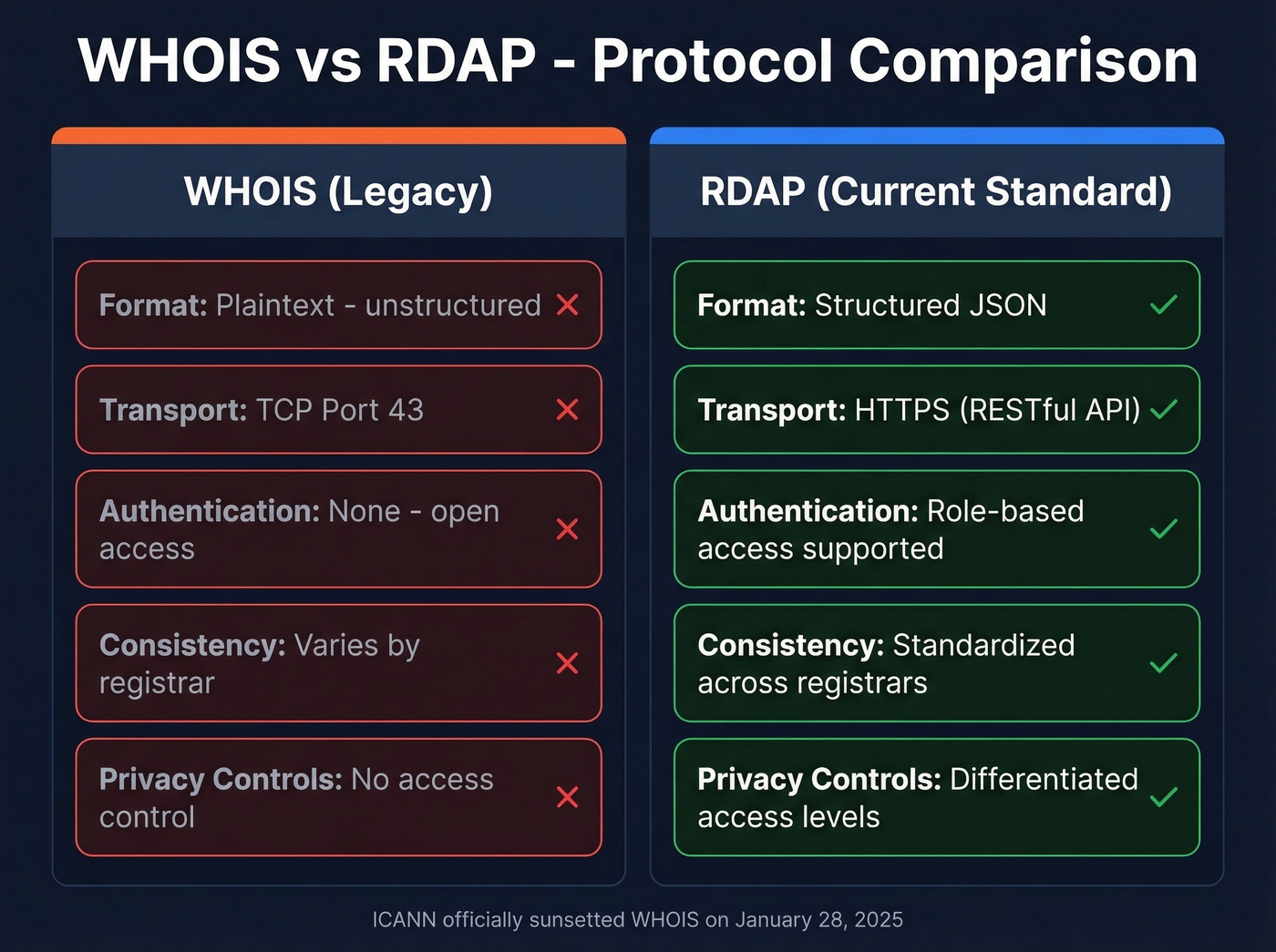
| WHOIS | RDAP | |
|---|---|---|
| Format | Plaintext | Structured JSON |
| Transport | TCP port 43 | HTTPS (RESTful) |
| Auth | None | Role-based access |
| Consistency | Varies by registrar | Standardized |
| Privacy | No access control | Differentiated access |
You can query RDAP through ICANN's lookup tool. The structured format and authentication support mean registrars can grant tiered access - showing more data to verified requesters - but in practice, the public view is just as redacted as late-era WHOIS.

WHOIS redacted the registrant emails you need. Prospeo indexes 300M+ professional profiles and verifies every email through a 5-step process - including catch-all handling that most tools skip. At $0.01 per email, it costs less than the WHOIS privacy protection that killed your old workflow.
Stop querying dead protocols. Start finding verified emails in seconds.
How to Actually Find a Domain Owner's Email
Here's the thing: public WHOIS/RDAP is dead for email discovery. We've tested a lot of the common workarounds over the years, and these five methods are what actually deliver results.
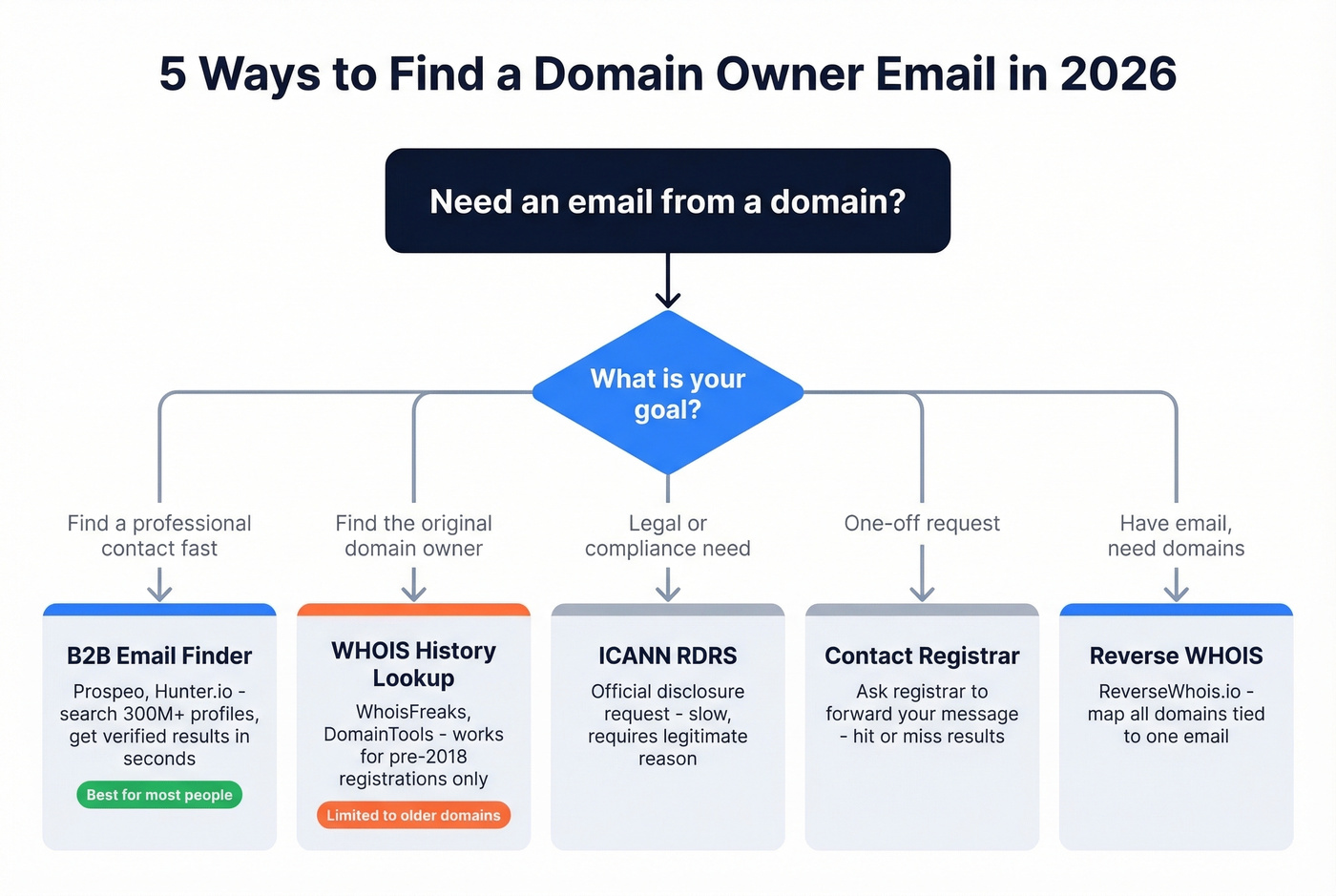
1. B2B Email Finder (Fastest)
This is the practical answer for most people reading this. Instead of querying domain registration records, B2B email finders search professional profiles, company databases, and web sources to surface verified work emails.
We've tested dozens of email finders, and Prospeo consistently delivers the most reliable results on catch-all domains - the ones that trip up most other tools. It covers 300M+ professional profiles at 98% accuracy using a 5-step verification process: not a simple MX check, but catch-all handling, spam-trap removal, and honeypot filtering on proprietary infrastructure. The free tier gives you 75 emails per month, and paid plans work out to roughly $0.01 per email.
2. WHOIS History Lookup
If you specifically need to find the owner of a domain - not just someone at the company - WHOIS history tools can help. WhoisFreaks and DomainTools maintain archives of historical registration records from before privacy became the default. You can sometimes find a registrant email from 2015 or 2016 that's still active.
This only works for domains registered before privacy became standard. Many newer registrations never had a public registrant email to begin with.
3. ICANN's RDRS
ICANN's Registration Data Request Service is the official channel for requesting nonpublic gTLD registration data. You submit a request, the registrar reviews it, and they decide whether to disclose. It's slow, only works with participating registrars, and requires a legitimate reason. Not practical for prospecting - but it exists if you have a legal or compliance need.
4. Contact the Registrar Directly
You can reach out to the sponsoring registrar and ask them to forward a message or disclose contact information. Results are hit-or-miss. Skip this if you're doing any kind of outbound at scale - it doesn't work for that.
5. Reverse WHOIS (Email to Domains)
This flips the direction. You already have an email and want to find all domains associated with it. ReverseWhois.io handles this use case well. It's useful for trademark enforcement, competitor research, and mapping a company's domain portfolio. Reverse IP lookup can also reveal other domains hosted on the same server, helping you map connected properties.
For security investigators, exact-match email searches and breach-exposure tools like Have I Been Pwned offer additional pivots - but that's a different workflow than finding a professional contact.
Email Finder Pricing Compared
| Tool | Free Tier | Starting Price | Notes |
|---|---|---|---|
| Hunter.io | 25 searches + 50 verifs/mo | $49/mo (500 searches) | 100M+ indexed emails |
| FindThatLead | None | $49/mo (5K credits) | Up to $399/mo |
| Anymail Finder | None | $49/mo (1K verified) | Pay per verified email |
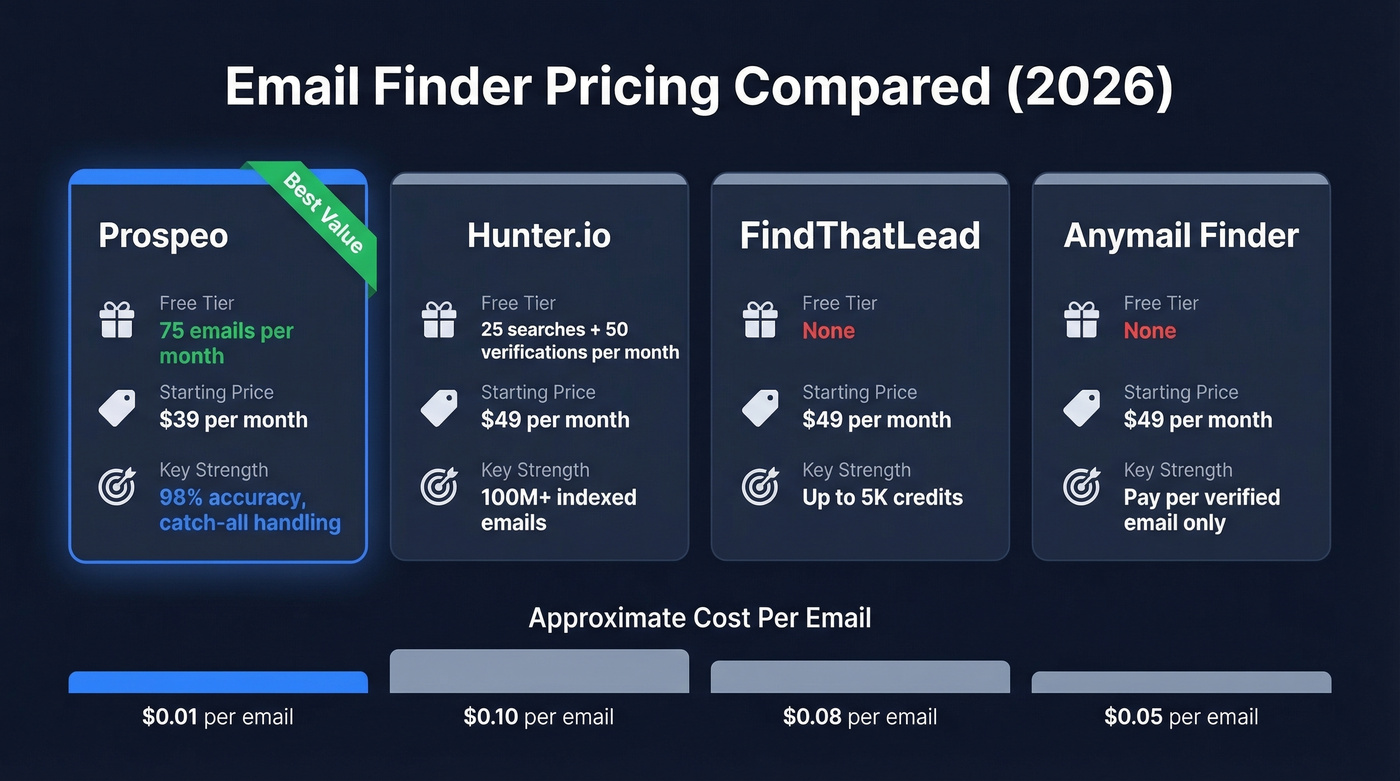
Prospeo's free tier is the most generous here, and the per-email cost on paid plans is the lowest.
Let's be honest about the real cost calculation, though: if you're doing outbound at any real scale - say 200+ emails a month - accuracy matters more than sticker price. One bad batch of unverified emails can torch a domain you spent months warming up. We've seen teams lose sender reputation over a single campaign built on unverified data, and rebuilding that takes weeks.
Verify Before You Send
Regardless of how you find an email - email finder, historical records, educated guess - verify it before you hit send. A BuzzStream study found roughly 28% of checked emails were invalid or risky, up from 22% two years earlier. Bad emails tank your sender reputation fast.
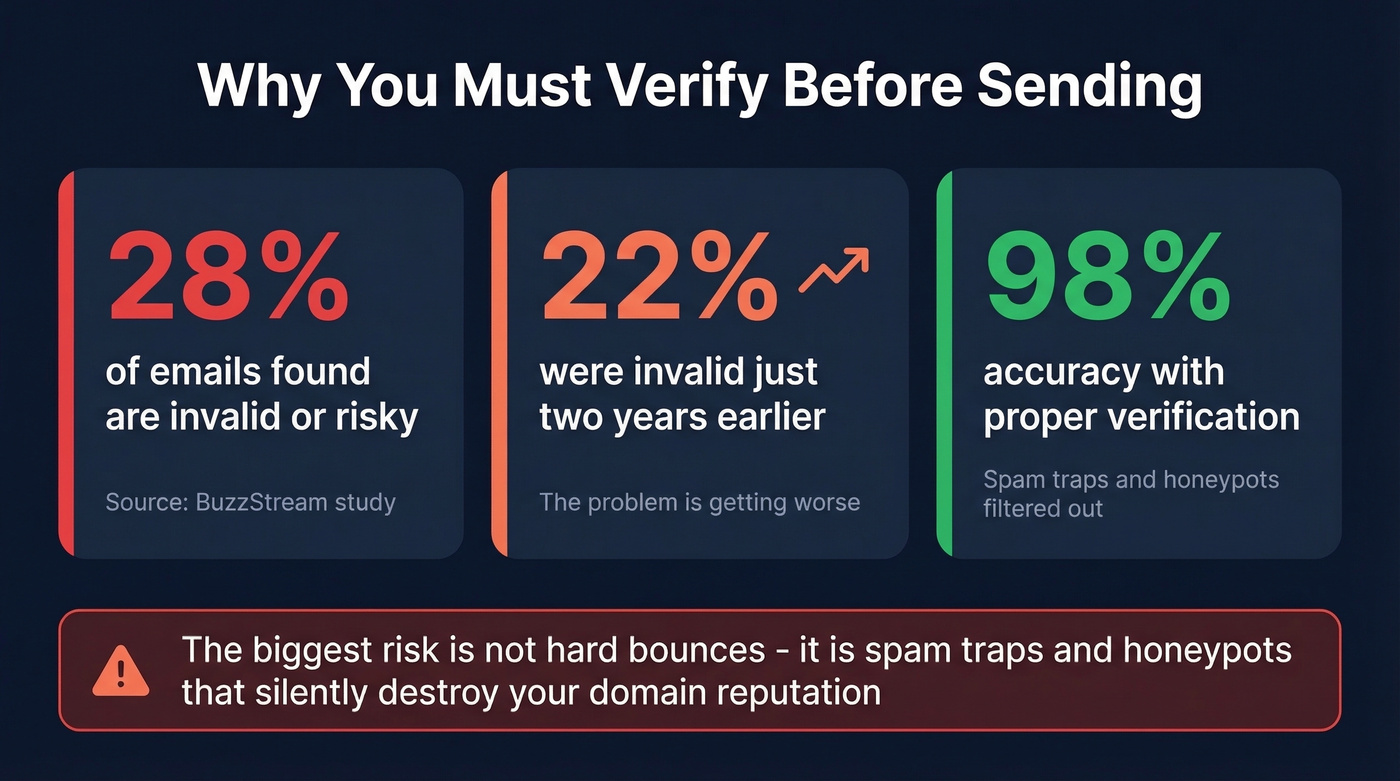
In our experience, the biggest risk isn't hard bounces. It's spam traps and honeypots that silently destroy your domain reputation. If you're pulling emails from any source that doesn't include built-in verification, run them through a dedicated email verification tool before loading them into your sequences.

Bad email data doesn't just waste credits - it burns sender domains you spent months warming up. Prospeo's proprietary verification catches spam traps and honeypots before they hit your outbox, delivering 98% accuracy across 300M+ profiles. The free tier gives you 75 verified emails per month to prove it.
Protect your domain reputation with emails that actually verify.
FAQ
Can I find someone's email through WHOIS?
Rarely. Since GDPR took effect in 2018, most registrars redact registrant emails from public WHOIS and RDAP records. You'll see "REDACTED FOR PRIVACY" instead of an actual address. A dedicated email finder is the reliable alternative for professional contacts.
Is WHOIS lookup free?
Yes. ICANN's RDAP-based lookup is free, as are most web-based tools from registrars. Personal contact details including email are typically redacted under current privacy policies, though.
What replaced WHOIS?
RDAP (Registration Data Access Protocol) officially replaced WHOIS for gTLD data as of January 28, 2025. It returns structured JSON over HTTPS and supports authentication for differentiated access levels - though the public view remains just as redacted.
What's the fastest way to find an email from a domain?
Use a B2B email finder. Prospeo searches 300M+ professional profiles and returns verified emails with 98% accuracy - including a free tier of 75 emails per month. Results come back in seconds, no WHOIS digging required.
Is WHOIS data accurate?
Public WHOIS/RDAP data for registrar names, dates, and nameservers is generally accurate. But registrant contact data is either redacted or, in some cases, intentionally fake - ICANN policy requires collection, but inaccurate submissions still happen.