

Why Cold Calling Is Still Important - And the Data That Proves It
Your VP just told the team to double call volume this quarter. Half the room groaned. The other half opened LinkedIn. But the VP isn't wrong - and the single variable that separates a 1% connect rate from a 30% pickup rate isn't technique. It's data freshness. If you're wondering why cold calling is important in 2026, the short answer is this: it's the only outbound channel where you control the pipeline, and the teams that dismiss it are leaving meetings on the table.
The 2026 Reality: Is Cold Calling Even Necessary?
Let's kill this narrative with numbers. A HubSpot survey of 379 sales professionals found that 49% still use cold calling as a primary or secondary sales channel. That's not a dying tactic. That's mainstream.
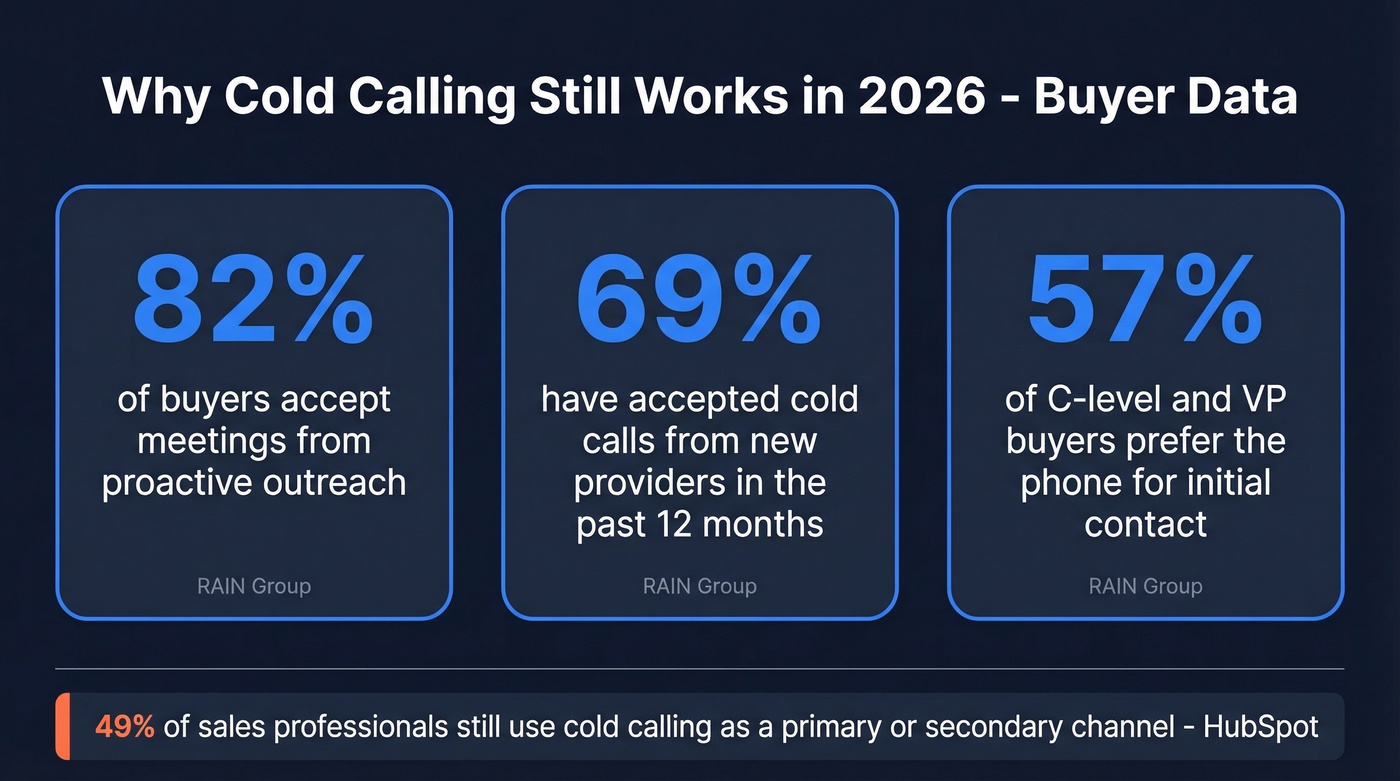
The buyer side tells the same story. RAIN Group data shows 82% of buyers accept meetings from proactive outreach, and 69% have accepted phone calls from new providers in the past 12 months. Meanwhile, 57% of C-level buyers and VPs prefer the phone as their method of initial contact - a stat that surprises people until they think about how many unread emails sit in a VP's inbox right now.
One SaaS seller on r/sales put it bluntly: the phone generates 95% of their business. That tracks with what we've seen across thousands of outbound teams. Cold calling isn't dead. Lazy cold calling is dead.
Success Rate Benchmarks Worth Knowing
The benchmarks have improved dramatically over the past decade. Cognism's cold calling report, based on WHAM (We Have A Meeting) data, puts the conversation-to-meeting rate at 4.82%. Compare that to the Keller Center's 2012 benchmark of roughly 1%. Different methodologies, sure, but the directional improvement is clear: roughly 5x better in a decade.
| Metric | Number | Source |
|---|---|---|
| Conversation-to-meeting rate | 4.82% | Cognism/WHAM |
| Avg call length | 93 seconds | Cognism/WHAM |
| Successful call length | 5 min 50 sec | Gong |
| Failed call length | 3 min 14 sec | Gong |
| Attempts to reach 93% of conversations | 3 calls | Cognism/WHAM |
Three attempts per prospect captures 93% of total conversations. Five gets you to 98.6%. Beyond that, you're chasing diminishing returns. Be persistent, but don't be a stalker.

You just read that 93% of conversations happen within 3 attempts - but only if you're dialing verified numbers. Prospeo's 125M+ mobile database refreshes every 7 days (not the 6-week industry average) and delivers a 30% pickup rate. Meritt tripled their connect rate to 20-25% and jumped from $100K to $300K/week in pipeline.
Stop burning call blocks on dead numbers. Start dialing people who pick up.
Seven Reasons the Phone Keeps Growing in B2B
1. Pipeline you control. Inbound is great until it dries up. Outbound calling is the one channel where you generate pipeline on your own schedule, without waiting for marketing to deliver leads.
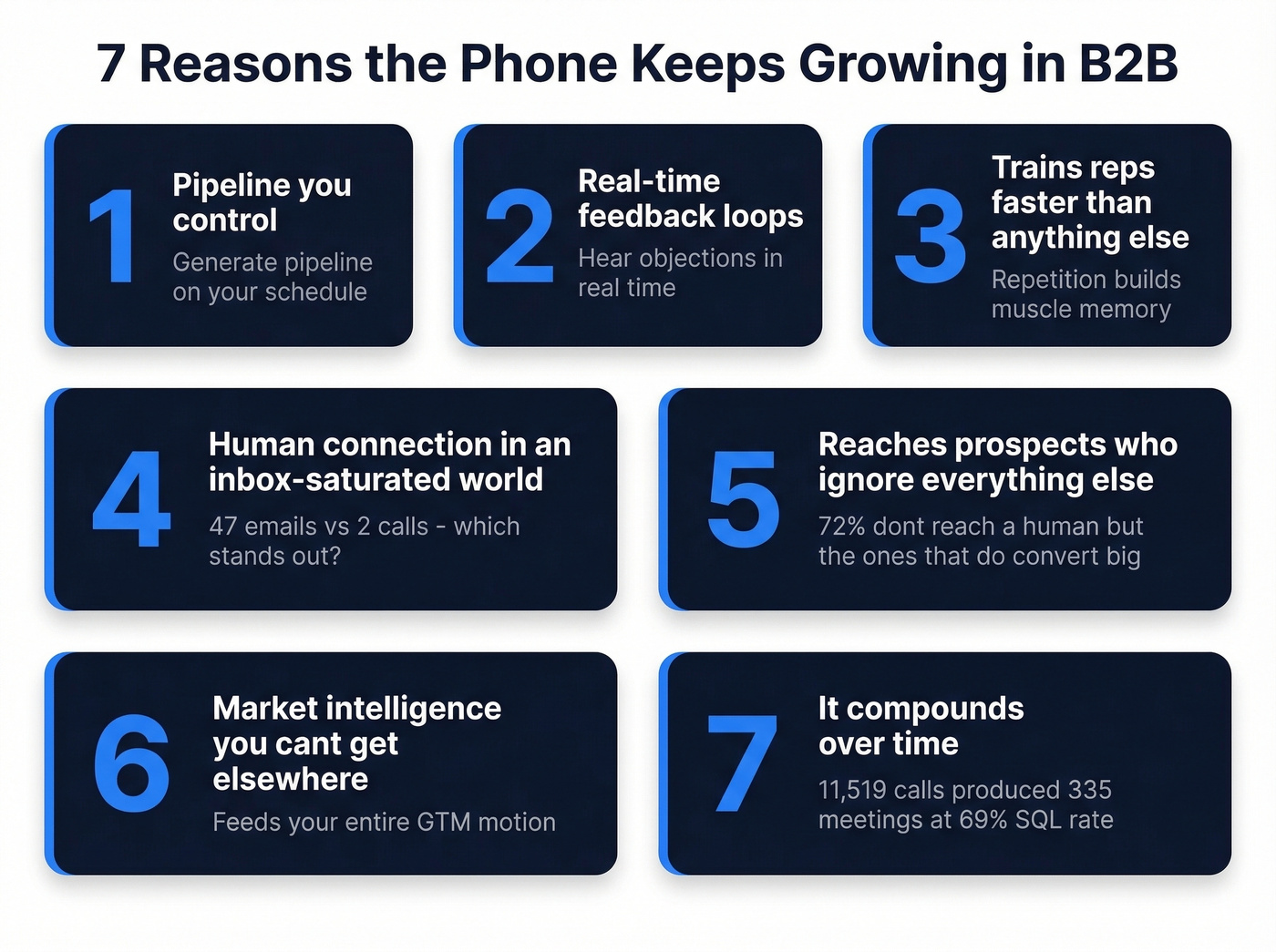
2. Real-time feedback loops. No other channel gives you instant signal on messaging, positioning, and objections. You hear the hesitation in someone's voice - that's data no dashboard can replicate.
3. It trains reps faster than anything else. As Forbes has noted, the repetition forces reps to master their pitch, handle rejection, and think on their feet. There's no shortcut to that muscle memory. In our experience, the reps who complain most about dialing are the ones working the worst lists.
4. Human connection in an inbox-saturated world. Your prospect got 47 emails today. They got two phone calls. Which one stands out?
A mutual connection boosts your meeting chance by 70%, according to Sales Insights Lab - but even without one, the phone cuts through noise that email simply can't.
5. Reaches prospects who ignore everything else. Yes, 72% of cold calls don't reach a human, and 80% go to voicemail. But the calls that do connect convert at rates email can only dream of. Sometimes the phone is the only way in.
6. Market intelligence you can't get elsewhere. Every call teaches you something. You learn they just switched from Salesforce to HubSpot, which changes your entire pitch. You hear a competitor's name you hadn't considered. That intel feeds your entire GTM motion - it shapes positioning, messaging, and competitive strategy far beyond the single meeting.
7. It compounds over time. One HubSpot practitioner documented 11,519 cold calls that produced 335 meetings. Those meetings converted at a 69.1% SQL rate with a sub-18% no-show rate. That's not luck. That's a system refined through thousands of reps.
Why Your Calls Aren't Converting
Here's the frustrating truth most advice ignores: your connect rate is a data problem, not a skill problem.
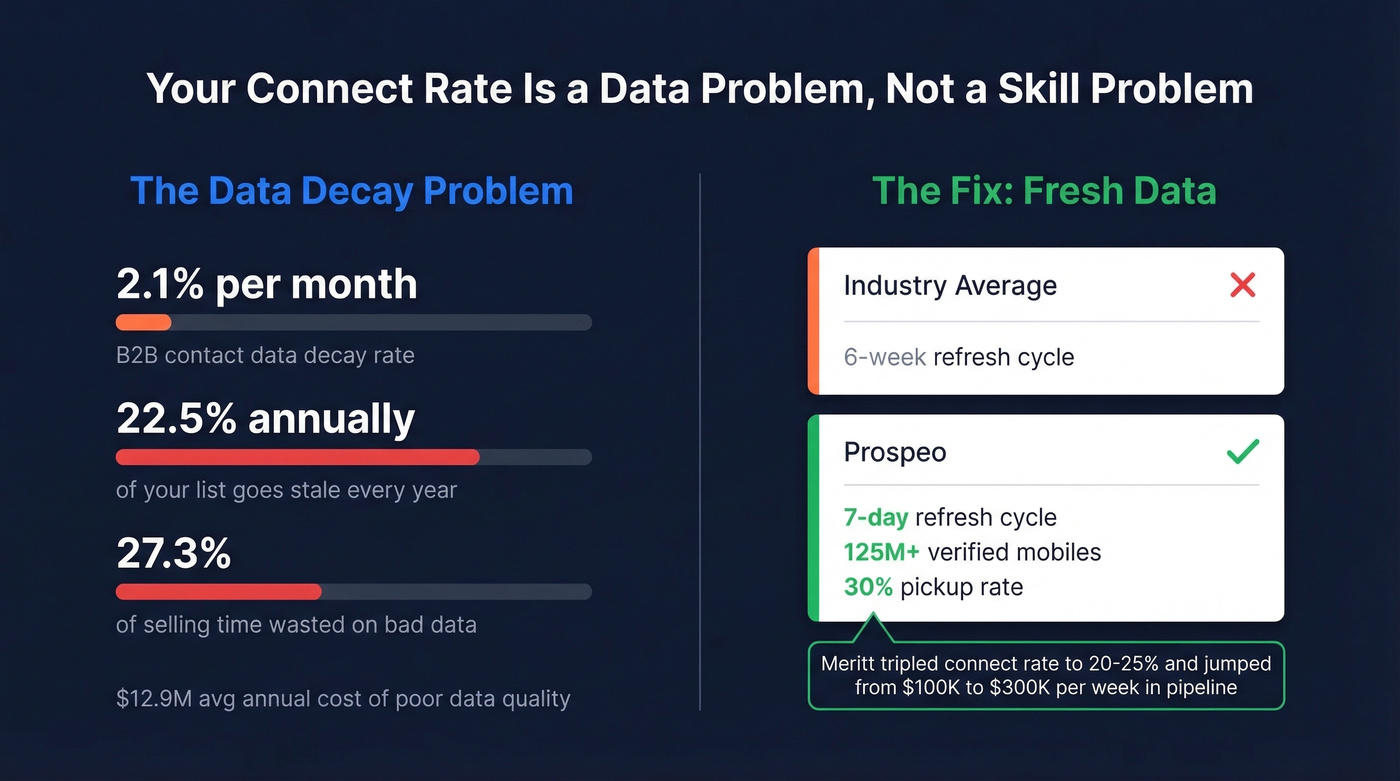
B2B contact data decays roughly 2.1% per month - that's 22.5% annually. Reps waste 27.3% of their selling time on bad data, and the average cost of poor data quality runs $12.9M per year across organizations. If you've ever spent an entire call block dialing wrong numbers and reaching voicemails for people who left six months ago, the problem isn't your opener. It's your list.
Look, most teams don't have a cold calling problem. They have a data hygiene problem dressed up as a cold calling problem. Fix the data, and the calls fix themselves. We've seen teams triple their connect rates just by switching to fresher numbers.
The industry average refresh cycle for contact data is 6 weeks. Prospeo runs a 7-day refresh cycle across 125M+ verified mobile numbers with a 30% pickup rate. That gap matters more than any script tweak. One customer, Meritt, saw their connect rate triple to 20-25% after switching - pipeline jumped from $100K to $300K per week.
Quick Wins for Your Next Call Block
State your reason for calling. Gong's research shows this single move makes you 2.1x more likely to book a meeting. "The reason I'm calling is..." works every time. Don't overthink it.
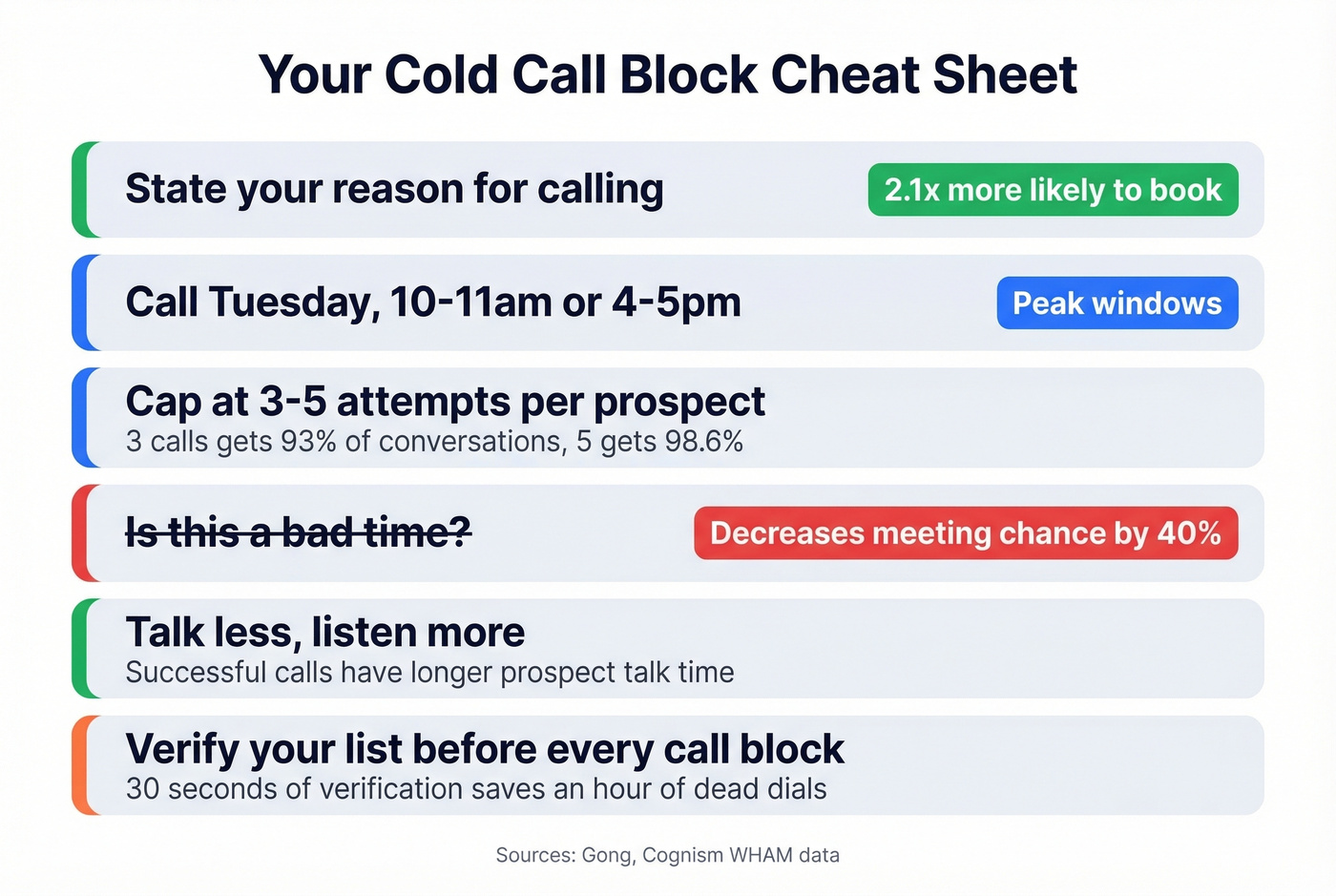
Call on Tuesday, between 10-11am or 4-5pm. These windows consistently outperform other time slots across multiple studies. Wednesday and Thursday are decent backups, but Tuesday is king.
Cap at 3-5 attempts per prospect. Three gets you 93% of conversations. Five gets 98.6%. After that, move on to someone who'll actually pick up.
Never ask "Is this a bad time?" Gong found this phrase decreases your meeting chance by 40%. State your reason and keep going.
Talk less, listen more. Successful cold calls have significantly longer prospect talk time. Ask a question, then shut up. The silence feels uncomfortable for you, not for them.
Verify your list before every call block. Thirty seconds of data verification saves an hour of dead dials. Stale numbers are the silent killer of call blocks - and the one thing most reps never think to check. If you're building a repeatable motion, a documented cold calling system helps keep quality consistent.
Bad data costs reps 27.3% of their selling time. Every wrong number is a dead dial that could've been a booked meeting. Prospeo's 5-step verification and 7-day refresh cycle mean your next call block starts with numbers that actually ring - 125M+ verified mobiles at 10 credits per number, pay only when found.
Fix your list in 30 seconds and triple your connect rate.
FAQ
Why is cold calling still important in B2B sales?
It's the only outbound channel where you fully control pipeline generation without relying on inbound or marketing. 49% of sales professionals use it as a primary channel, and 57% of C-level buyers prefer the phone for initial contact. No other method delivers real-time objection handling and market intelligence in a single conversation.
What's the average cold calling success rate in 2026?
The current benchmark is a 4.82% conversation-to-meeting rate, based on Cognism's WHAM data. That's roughly 5x the ~1% rate documented by the Keller Center in 2012. Better data quality and improved training have driven the improvement.
How many attempts should you make per prospect?
Three attempts capture 93% of total conversations, and five reach 98.6%. Beyond five calls, returns drop sharply. Most teams find 3-5 attempts the sweet spot before moving a contact to a nurture sequence or email cadence.
How do you improve cold calling connect rates?
Data quality is the single biggest lever. B2B data decays 2.1% per month, so even a list that's a few weeks old has dead numbers baked in. Use a provider with frequent refresh cycles, call during peak windows like Tuesday between 10-11am, and always lead with your reason for calling. The script matters, but the list matters more.