


Zymplify Pros and Cons: Honest Review (2026)
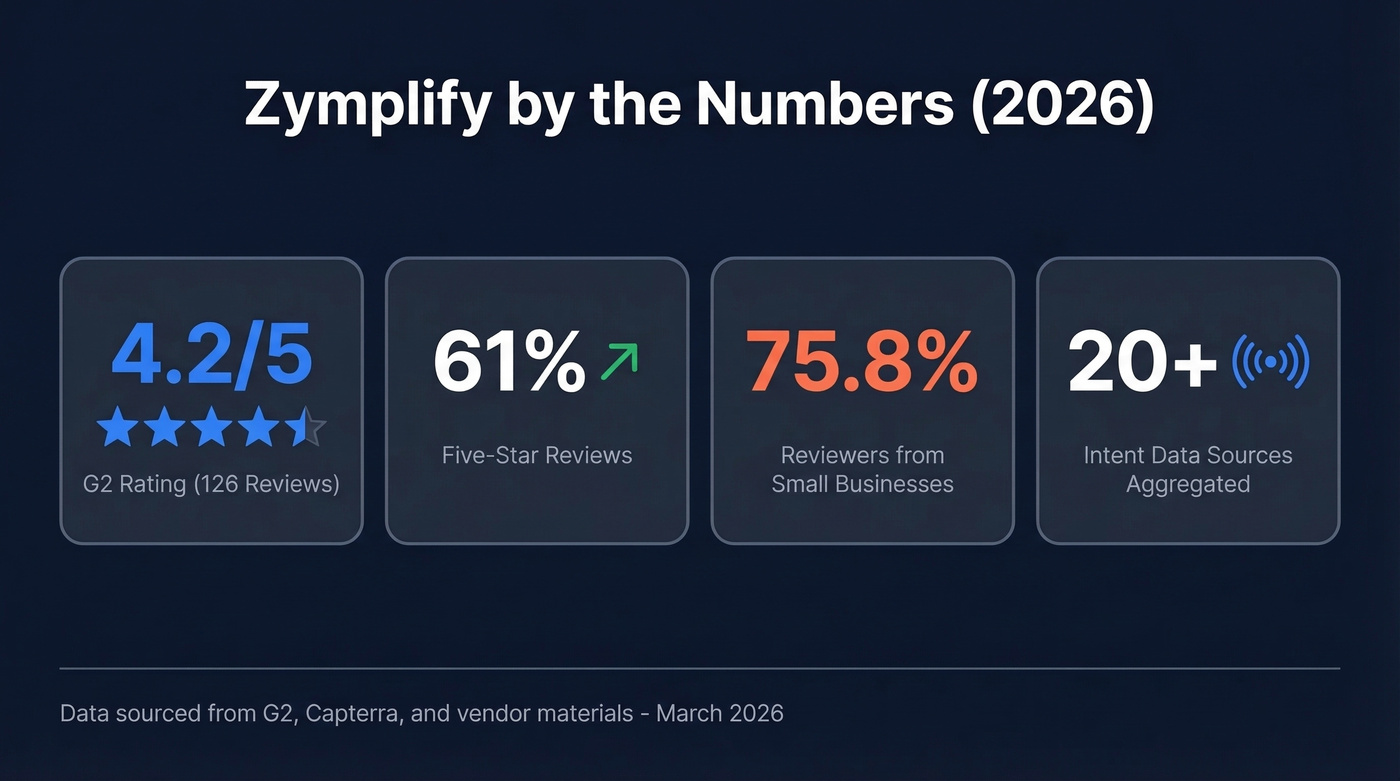
Zymplify sits at 4.2 stars on G2 - 61% five-star ratings across 126 reviews. Looks solid on paper. Then you notice the £600/month starting price, the four listed integrations, and reviewers calling the CRM "clunky." That gap between the star rating and the fine print is exactly why we dug into the real user feedback.
Here's where we landed: Zymplify is a legitimate buyer intent activation platform with genuine multi-source coverage - 20+ intent data sources, a Bombora partnership, and built-in activation tools like alerts, sequences, and CRM sync. It's cheaper than the six-figure enterprise ABM contracts you'll see from 6sense or Demandbase, which matters for small teams that want ABM-style prospecting without the enterprise price tag. But the interface is rough, integrations are thin, and pricing varies depending on which directory you check. If your actual bottleneck is verified contact data for outbound, you'll get better results from a dedicated data platform at a fraction of the cost.
What Zymplify Does Well
Multi-Source Intent Data with Bombora Backing
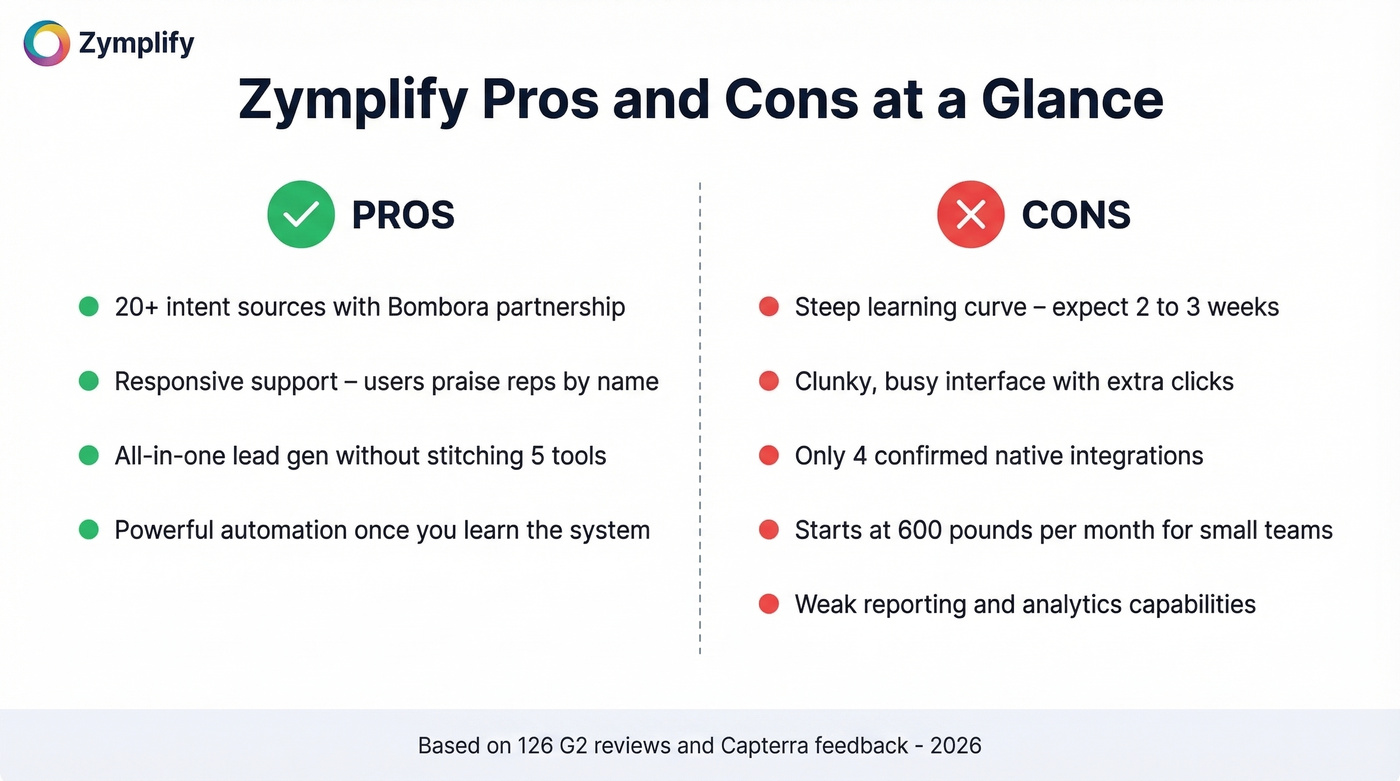
This is Zymplify's strongest card. It aggregates signals from 20+ intent sources into one platform, including a Bombora partnership covering 16,000+ intent topics across 5,000+ B2B sites. Most tools at this price point offer single-source intent. That distinction matters - 67% of B2B teams say data quality is the most important attribute when evaluating intent providers, and multi-source aggregation directly addresses that concern.

Five G2 reviewers call out ease of use and all-in-one lead generation tracking as top benefits. For small teams that don't want to stitch together five different tools, that's a real draw. And 75.8% of Zymplify's G2 reviewers are small businesses, which tells you who's actually buying this.
Responsive Customer Support
Support quality appears in four of G2's aggregated review themes, and a rep named "John" gets called out by name multiple times. Most B2B platform reviews are a graveyard of support complaints. Zymplify's team actually shows up.
One Capterra reviewer - a Director of Business Management - praised "the accuracy of the contact data" and noted they'd considered ZoomInfo Sales before choosing Zymplify on price.
Automation That Rewards Patience
The automation builder gets praise from users who've invested the time. Setting up workflows, cadences, and triggered campaigns doesn't require developer help. The catch? "Invested the time" means 2-3 weeks of real learning, not an afternoon.
Where Zymplify Falls Short
Steep Learning Curve
Four of 126 G2 reviews cite this directly. One directory claims setup takes "less than 1 hour" - that's plausible for basic configuration, but G2 reviewers tell a different story about advanced automations. A January 2026 reviewer specifically asked for better in-app guidance and templates. For £600/month, the onboarding experience should be further along.
Clunky, Busy Interface
A Capterra reviewer described the CRM as "clucky" (almost certainly a typo for clunky), and that tracks with G2 sentiment about the interface being "busy" with too many extra clicks. Three G2 reviews flag navigation friction. When your platform tries to do everything, the UI pays the price.
Limited Native Integrations
G2 lists just four native integrations: Google Workspace, Typeform, G2 Buyer Intent, and Al Manara. Vendor materials also reference Salesforce, HubSpot, and Dynamics 365, but the gap between those listings and what's actually native is wide enough that you should clarify integration depth - native vs. Zapier vs. API - before signing anything. Four integrations means high switching costs and real vendor lock-in.
Expensive for What Small Teams Actually Use
£600/month is the entry point for 10 seats and 1,000 data credits. A G2 reviewer pointed out you can get Apollo plus Bombora intent data at roughly a third of the cost. That's a pricing-audience mismatch when three-quarters of your reviewers are small businesses.
Reporting and Analytics Gaps
Four G2 reviews flag missing essential features, including analytics and reporting frustrations. For a platform built around intent signals, weak reporting undermines the core value.
Zymplify Pricing Breakdown
Here's the thing about Zymplify pricing: it varies across directories, and the company doesn't publish a simple pricing page on its site.
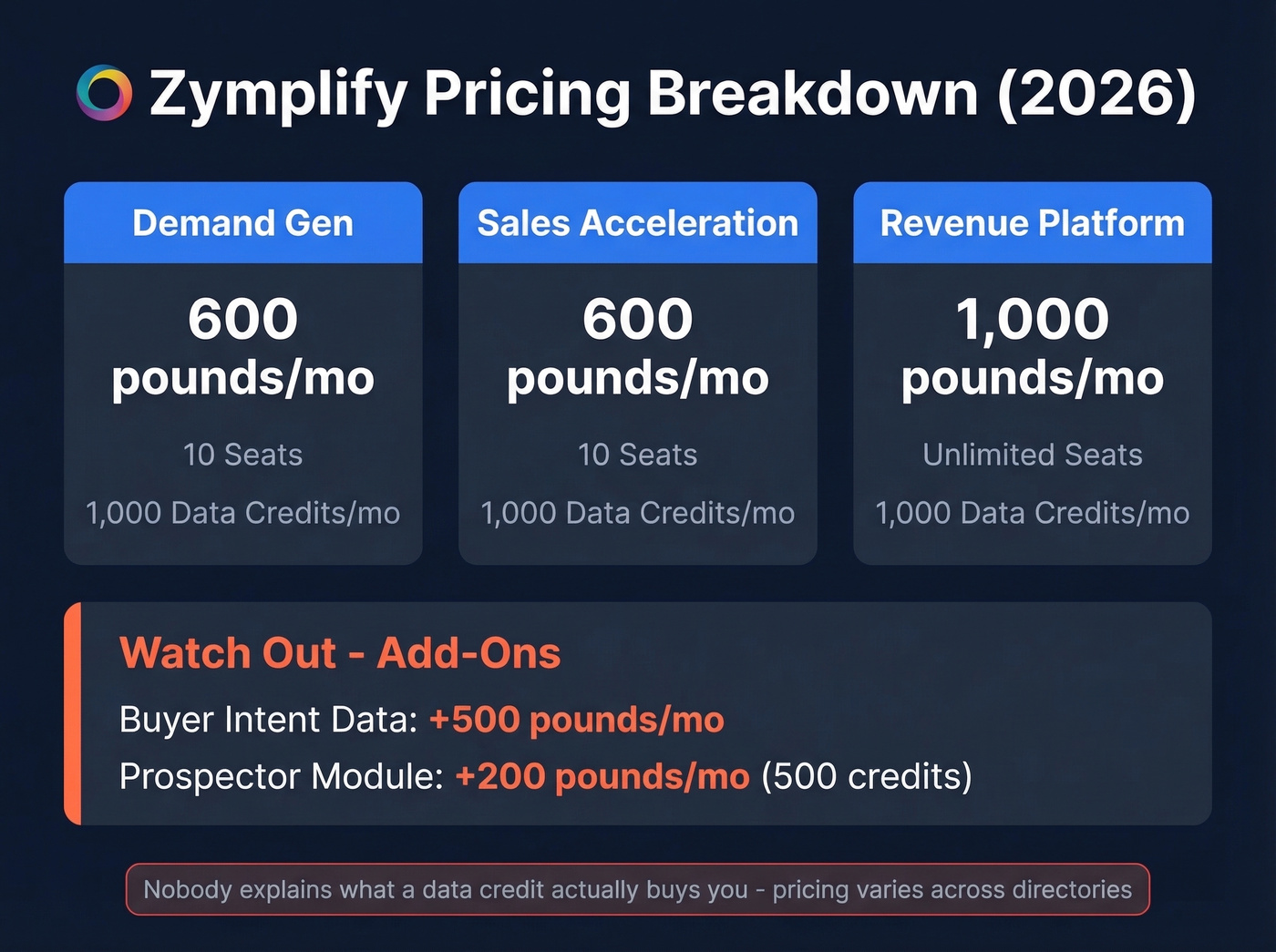
| Plan | Monthly Price | Seats | Data Credits |
|---|---|---|---|
| Demand Gen | £600 | 10 | 1,000/mo |
| Sales Acceleration | £600 | 10 | 1,000/mo |
| Revenue (Platform) | £1,000 | Unlimited | 1,000/mo |
Add-ons push costs higher. Buyer Intent Data runs £500/month, and the Prospector module is £200/month with 500 credits. Capterra lists a starting price of £180/user/month, while SoftwareSuggest shows older USD tiers from $129-$399/month. The pricing confusion is a red flag on its own - and nobody explains what a "data credit" actually buys you. Expect annual contracts at this price point.

Zymplify charges £600/month and still leaves reviewers frustrated with data credits they can't explain. Prospeo gives you 143M+ verified emails at 98% accuracy, 125M+ verified mobiles, and Bombora intent data across 15,000 topics - starting at $39/month with no contracts.
Get the contact data and intent signals without the £7,200/year gamble.
Who Should Use Zymplify
It's a fit if you want intent-driven prospecting but can't afford 6sense or Demandbase ($30-100K+/year), your team is under 10 people and willing to live inside one platform, and you're EMEA-focused B2B with buying cycles long enough to benefit from intent signals.
Skip it if your primary need is verified contact data for outbound sequences - you're overpaying for features you won't use. Same goes for teams that need deep CRM integrations with Salesforce or HubSpot, or lean teams that can't absorb a multi-week learning curve. We found one r/CRM thread asking about Zymplify with zero replies, which tells you something about market awareness.
Let's be honest: 59% of B2B teams are only somewhat satisfied with their current intent solution, and that stat applies to enterprise platforms too. Before committing £7,200+/year to any ABM tool, make sure you actually need intent data - not just better contact data.
Alternatives Worth Considering
Prospeo
If your bottleneck is bad emails and dead phone numbers rather than intent signals, Prospeo solves the problem most outbound teams actually have. It delivers 98% email accuracy across 143M+ verified emails and 125M+ verified mobiles on a 7-day data refresh cycle, while the industry average sits at six weeks. At around $39/month with no contracts, it's a fraction of Zymplify's cost for the contact data piece - and it includes Bombora-powered intent data covering 15,000 topics, so you aren't sacrificing buyer signals entirely. Pair it with any outbound stack and you've got a cleaner, more flexible outbound stack than most all-in-one platforms deliver.

Apollo.io
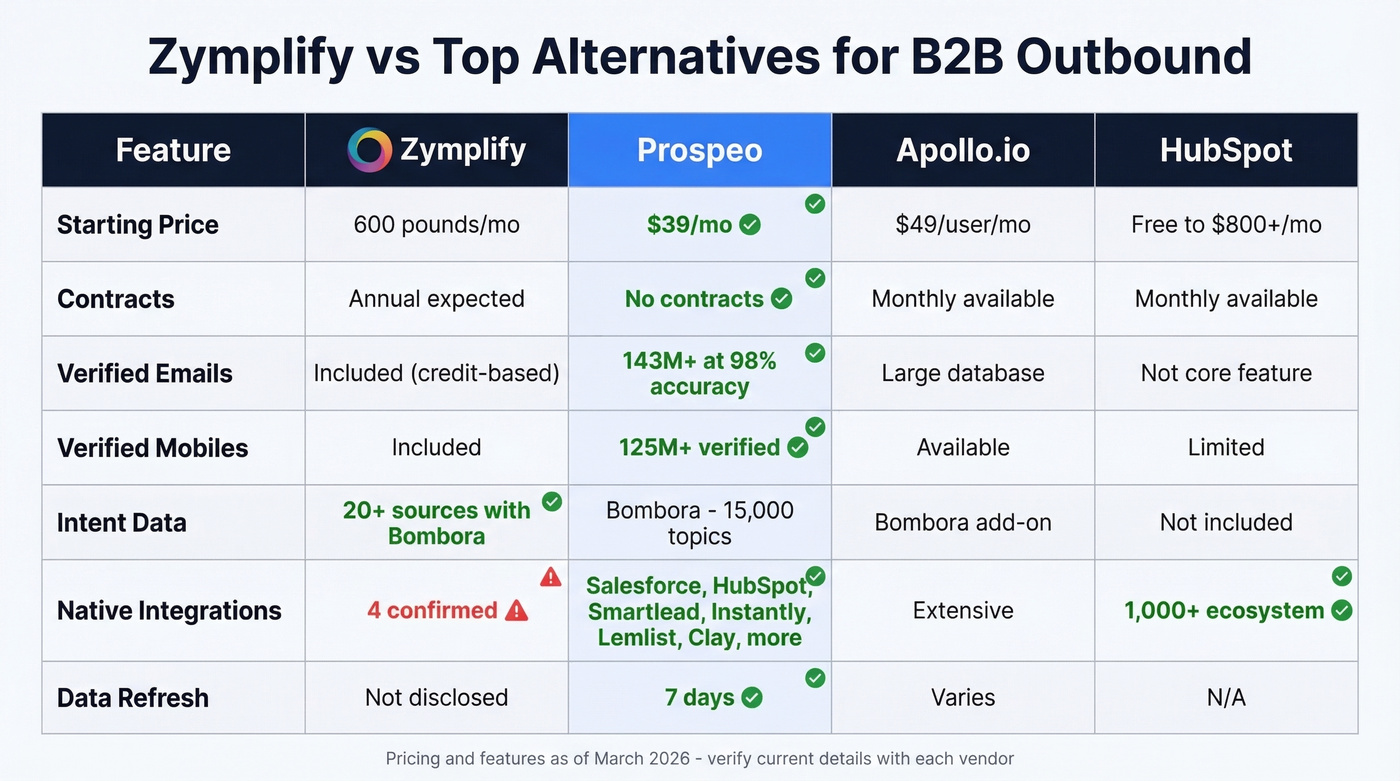
This is the tool that G2 reviewer referenced when comparing costs. The free tier is genuinely useful, paid plans start around $49/month per user, and pairing it with Bombora intent data gets you similar intent coverage without the all-in-one lock-in. Our team has seen plenty of small sales orgs run Apollo effectively for years.
HubSpot Marketing Hub
The safer bet if marketing automation and integrations matter more than intent data. The integration ecosystem is massive, pricing ranges from free to $15/month Starter to around $800+/month Professional, and it won't lock you into a four-integration ecosystem. If CRM flexibility is non-negotiable, start here.
Four native integrations and a multi-week learning curve shouldn't be the cost of doing outbound. Prospeo connects natively to Salesforce, HubSpot, Smartlead, Instantly, Lemlist, Clay, and more - with data refreshed every 7 days, not every 6 weeks.
Skip the lock-in. Build a cleaner outbound stack for $0.01 per email.
Final Verdict
Weighing all the Zymplify pros and cons, the underrated risk is vendor lock-in. With only four confirmed native integrations, migrating away from its all-in-one ecosystem gets expensive fast. The intent data is genuinely strong - that Bombora partnership and 20+ source aggregation aren't marketing fluff. But the clunky interface, pricing opacity, and thin integrations create real friction that compounds over time.
Evaluate the free trial carefully. Budget at least 3-4 active days, not a quick afternoon walkthrough. And before you sign, make sure you're buying intent intelligence - not just a bundle of features you'll never fully adopt.
FAQ
Does Zymplify offer a free trial?
Yes. Zymplify advertises "7 days, 50 free leads, zero risk." Given the documented learning curve, budget at least 3-4 days of active use to meaningfully test the automation and intent features before the trial expires.
What integrations does Zymplify support?
G2 lists four native integrations: Google Workspace, Typeform, G2 Buyer Intent, and Al Manara. Vendor materials also reference Salesforce, HubSpot, and Dynamics 365. Clarify whether each connection is native, Zapier-based, or API-only before committing.
Is Zymplify better than 6sense or Demandbase?
Different tier entirely. 6sense and Demandbase are enterprise ABM platforms starting in the six-figure annual range with deep integrations and mature analytics. Zymplify targets small businesses at £600-£1,000/month - the budget option, with UX and integration trade-offs to match.
What's the best alternative for verified B2B contact data?
If contact data is the core need, Prospeo delivers 98% email accuracy across 143M+ verified emails with a 7-day refresh cycle, plus 125M+ verified mobiles at a 30% pickup rate. Free tier available, paid plans from around $39/month with no contracts.