

7 Sales Cadence Examples With the Actual Emails You'd Send
A RevOps lead we work with ran a 3-tool bake-off last quarter. Her SDR team loaded 800 prospects into a 14-day cadence, executed it perfectly, and booked 6 meetings. The postmortem? 30% of emails bounced before a human ever saw them. The cadence wasn't broken - the data was.
That gap between "great sales cadence examples on a blog" and "pipeline that actually closes" comes down to execution details most guides skip. Below you'll find 7 cadence templates with real copy, a performance audit framework, and the one prerequisite every guide ignores: clean data. If your bounce rate is above 5%, jump to the email bounce rate section first.
Why Cadences Still Matter in 2026
Buyers don't sit still. 80% of B2B sales interactions now happen in digital channels, the average buyer uses 10 interaction channels (up from 5 in 2016), and buying committees run 7 people deep at mid-sized firms. Meanwhile, 89% of B2B buyers report a deal stalling in the past year.
Here's what makes this worse: 73% of B2B buyers say they have less time to research purchases, and 60% prefer not to interact with a sales rep as their primary information source. Your cadence emails need to deliver value, not just request meetings. And yet 84% of reps missed quota last year. A cadence gives you a repeatable system for reaching buyers across channels, on a timeline, with messaging that compounds - the difference between activity and pipeline.
Cadence Design Principles
Before the templates, here's the framework that holds them together.
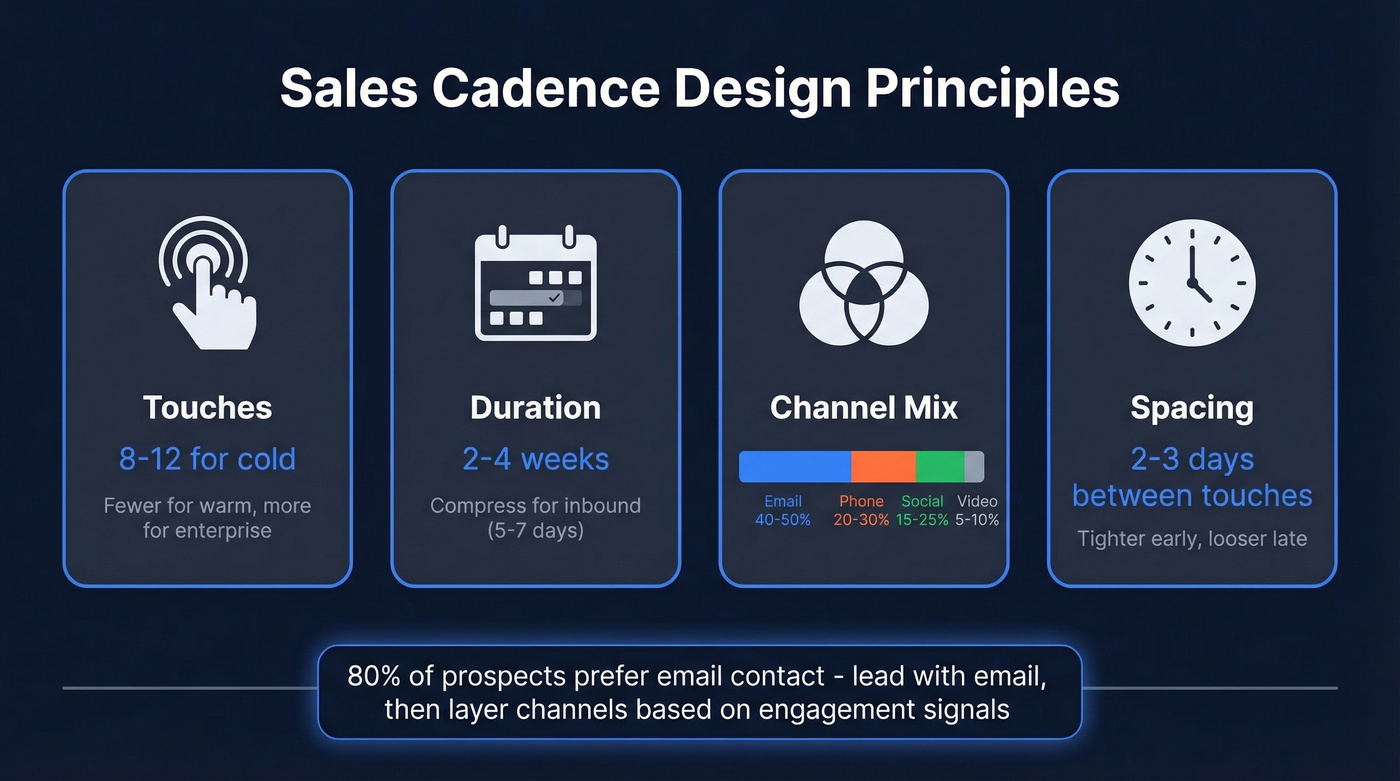
Touches should land between 8 and 12 for cold outbound. Fewer for warm leads, more for enterprise. Duration runs 2-4 weeks - compress for inbound (5-7 days), extend for enterprise (21+ days). For channel mix, aim for email at 40-50%, phone at 20-30%, social at 15-25%, and video at 5-10%. Spacing works best at 2-3 days between touches, tighter early, looser late.
Lead with email. 80% of prospects prefer email contact per RAIN Group research. Start there, then layer channels based on engagement signals. The best cadences adapt to what the prospect does (or doesn't do) rather than following a rigid script.
7 Proven Sales Cadence Examples
1. Cold Outbound (Multi-Channel, 14 Days)
This is the workhorse. Seven touchpoints across three channels, designed for cold prospects who've never heard of you.
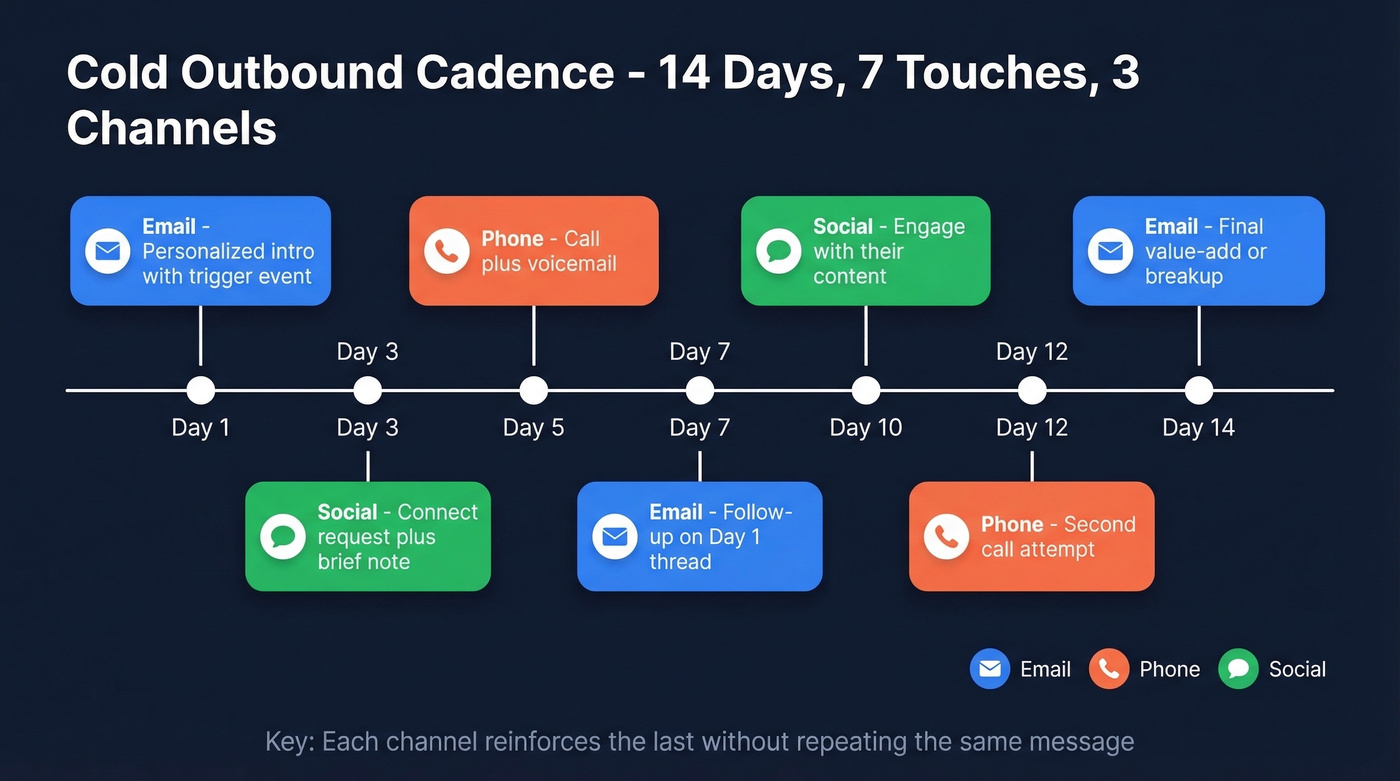
| Day | Channel | Action |
|---|---|---|
| 1 | Personalized intro (see copy below) | |
| 3 | Social | Connect request + brief note |
| 5 | Phone | Call + voicemail |
| 7 | Follow-up on Day 1 thread | |
| 10 | Social | Engage with their content |
| 12 | Phone | Second call attempt |
| 14 | Final value-add or breakup |
Day 1 email:
Subject: Quick question about [specific initiative]
Hi [First Name],
I noticed [Company] just [specific trigger - new hire, funding round, product launch]. When teams hit that stage, they usually run into [specific problem your product solves].
We helped [similar company] cut [metric] by [result] in [timeframe]. Worth a 15-minute call to see if that's relevant?
[Your name]
The key is the trigger. "I noticed you exist" isn't a trigger. "I noticed you just hired 3 SDRs" is. Each channel reinforces the last without repeating the same message.
2. Email-Only Outbound (11 Days)
Most teams should start here before going multi-channel. Jed Mahrle's framework is deliberately simple - four emails over 11 days, alternating between new threads and follow-ups.
| Day | Action | Thread |
|---|---|---|
| 1 | Email #1 | New thread |
| 4 | Email #2 | Reply to #1 |
| 8 | Email #3 | New thread |
| 11 | Email #4 | Reply to #3 |
Day 1 email:
Subject: [Company] + [Your Company] - quick thought
Hi [First Name],
[One sentence about their situation]. [One sentence about the problem you solve]. [One sentence with a specific result].
Open to hearing more?
The genius is in the gating logic: don't add phone or social as sequence steps. Instead, call only prospects who are engaging with your emails - opens, clicks, replies. This keeps your phone time focused on warm signals rather than spraying dials across a dead list. When you layer in those additional calls and social touches for engaged prospects, you effectively build a 9-touch sequence without wasting effort on unresponsive contacts.
Start email-only to test your messaging and targeting. Once you're hitting 5%+ reply rates, layer in phone and social for the engaged segment.
3. Inbound Speed-to-Lead (5 Days)
Forget the table for a second. The single most important number in inbound sales: you're 100x more likely to connect and convert a lead if you respond within 5 minutes. Yet the average B2B team takes 42 hours.
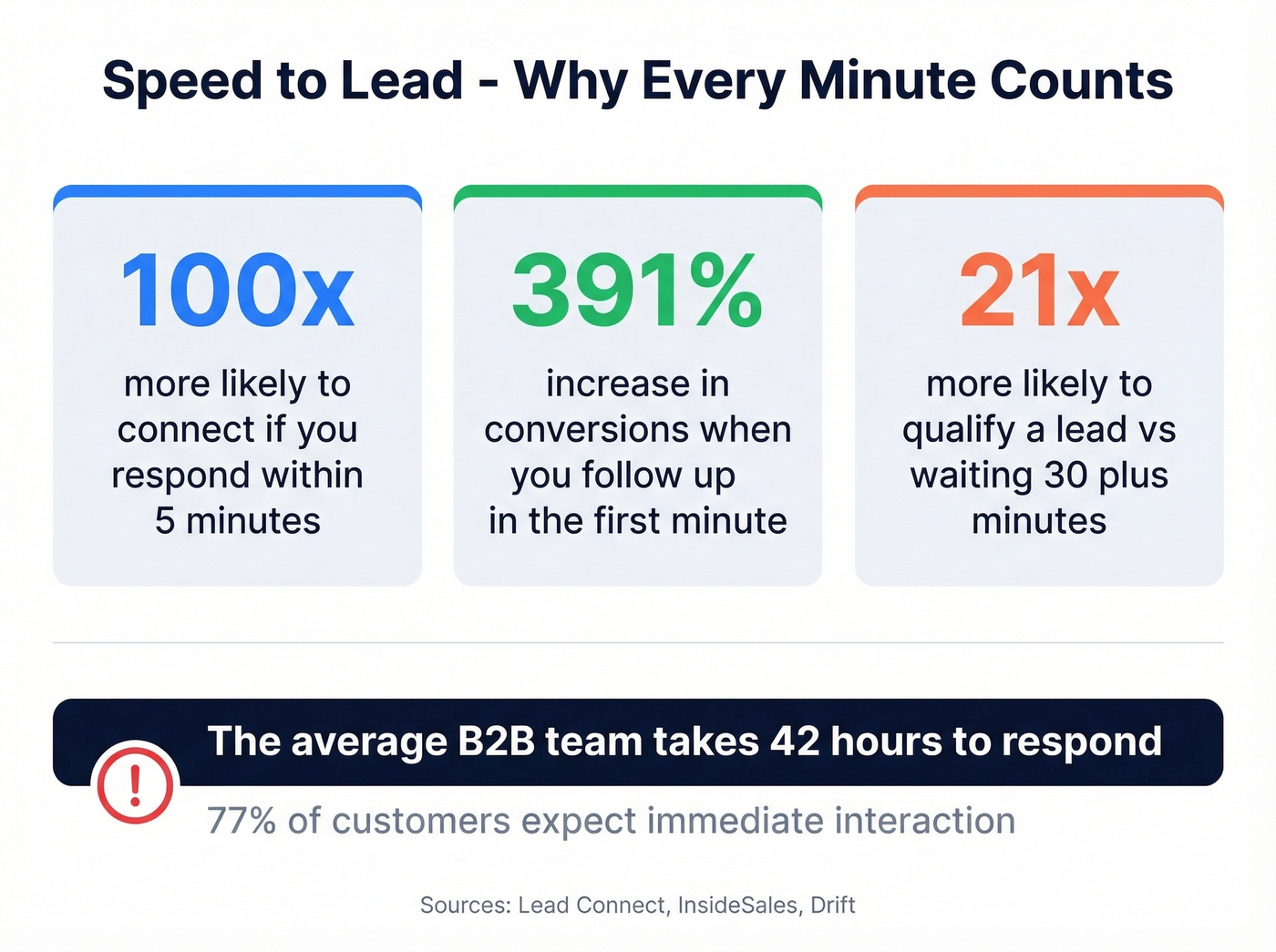
That's not a cadence problem. It's a process failure.
77% of customers expect immediate interaction when they reach out. Following up in the first minute drives a 391% increase in conversions. And you're 21x more likely to qualify a lead when you respond fast versus waiting 30+ minutes. Here's how response times break down by segment:
| Segment | Avg Response Time |
|---|---|
| Healthcare | 2h 5m |
| Telecom | 16m |
| Small (1-300 employees) | 48m |
| Medium (301-2,500) | 1h 38m |
| Large (2,501+) | 1h 28m |
If you're above these benchmarks, you're losing deals before your cadence starts. The actual sequence is straightforward: welcome email within 5 minutes, phone call within 15 minutes of form fill, case study on Day 2, personalized video on Day 4, final follow-up on Day 5. Compress everything. Speed wins.
4. SaaS Trial / Product-Led (10 Days)
The smartest move we've seen comes from Close: they wait 30 minutes before sending the welcome email so the user can actually do something in the product first. Then they branch into one of four email variants based on what the user did.
The personalization here isn't "Hi [First Name]." It's "I noticed you set up your first sequence but haven't imported contacts yet - here's a 2-minute walkthrough." That's the difference between a cadence and spam.
| Day | Action | Trigger |
|---|---|---|
| 0 | User signs up | - |
| 0 (+30 min) | Welcome email | Based on in-app action |
| 2 | Tip email | Feature they haven't tried |
| 5 | Case study | Matched to their use case |
| 7 | Check-in call | If engaged but not converted |
| 10 | Upgrade nudge | Trial expiring |
For financial services, insurance, or any industry with cyclical buying, align your trial cadence timing to renewal dates or tax deadlines. A perfectly timed nudge during budget season converts better than a generic "your trial is expiring" email any day of the week.
5. Enterprise / Multi-Stakeholder (21 Days)
Enterprise deals don't close through a single thread. You're selling to a committee - the economic buyer, the technical evaluator, the end user, and the blocker you haven't met yet.
Before you send a single email, identify 3-5 stakeholders and build messaging for each persona. The CEO doesn't care about your API documentation. The technical lead doesn't care about your ROI calculator. Account mapping is non-negotiable, and skipping it is the #1 reason enterprise cadences stall.
| Day | Channel | Target | Action |
|---|---|---|---|
| 1 | Champion | Personalized intro | |
| 3 | Social | VP/Director | Connect + engage |
| 5 | Phone | Champion | Discovery call |
| 7 | Technical DM | Use-case specific | |
| 10 | Social | C-level | Thought leadership share |
| 14 | Champion | Case study + ROI | |
| 17 | Phone | VP/Director | Executive briefing ask |
| 21 | All contacts | Summary + next steps |
Eight touches across three channels, with room to add two or three more based on committee engagement signals.
6. Re-Engagement / Breakup (7 Days)
Skip this cadence if your prospects never engaged in the first place - that's a targeting problem, not a re-engagement problem. This is for prospects who went cold after real interaction: they took a meeting, downloaded content, or replied once and vanished.
The breakup email does the heavy lifting, so here it is first:
Subject: Should I close your file?
Hi [First Name],
I've reached out a few times and haven't heard back - totally understand if the timing isn't right.
I'll close out your file for now, but if [problem you solve] comes back up, I'm here. Just reply to this thread.
[Your name]
The lead-up is simple: a "still relevant?" check-in on Day 1, a quick call attempt on Day 3, a new value angle on Day 5, and the breakup on Day 7. After the breakup, follow up once per quarter with something genuinely useful - a relevant report, a market insight, a trigger event. Never "just checking in."
7. Warm Referral (10 Days)
Referral-triggered cadences convert at 3-5x cold outbound rates because trust is pre-built. Don't over-engineer this - the referrer's name does 80% of the work.
Day 1 email:
Subject: [Referrer Name] suggested we connect
Hi [First Name],
[Referrer] mentioned you're working on [initiative] and thought we should talk. We helped [Referrer's company] with [specific result], and they thought it'd be relevant to what you're building.
Worth a quick call this week?
Follow up with a social connect on Day 3, a value-add email on Day 6, and a soft call on Day 10. Keep the touch frequency lighter than cold outbound - you're using relationship capital, not building it from scratch.

That RevOps lead's problem? 30% of emails bounced before anyone saw her cadence. Prospeo's 5-step verification delivers 98% email accuracy - so your 14-day multi-channel sequence actually reaches real inboxes. At $0.01 per email, bad data is a choice.
Stop perfecting cadences that bounce. Start with data that connects.
Auditing Cadence Performance
Before you tweak copy or add channels, measure what you've got. These thresholds are a solid baseline:
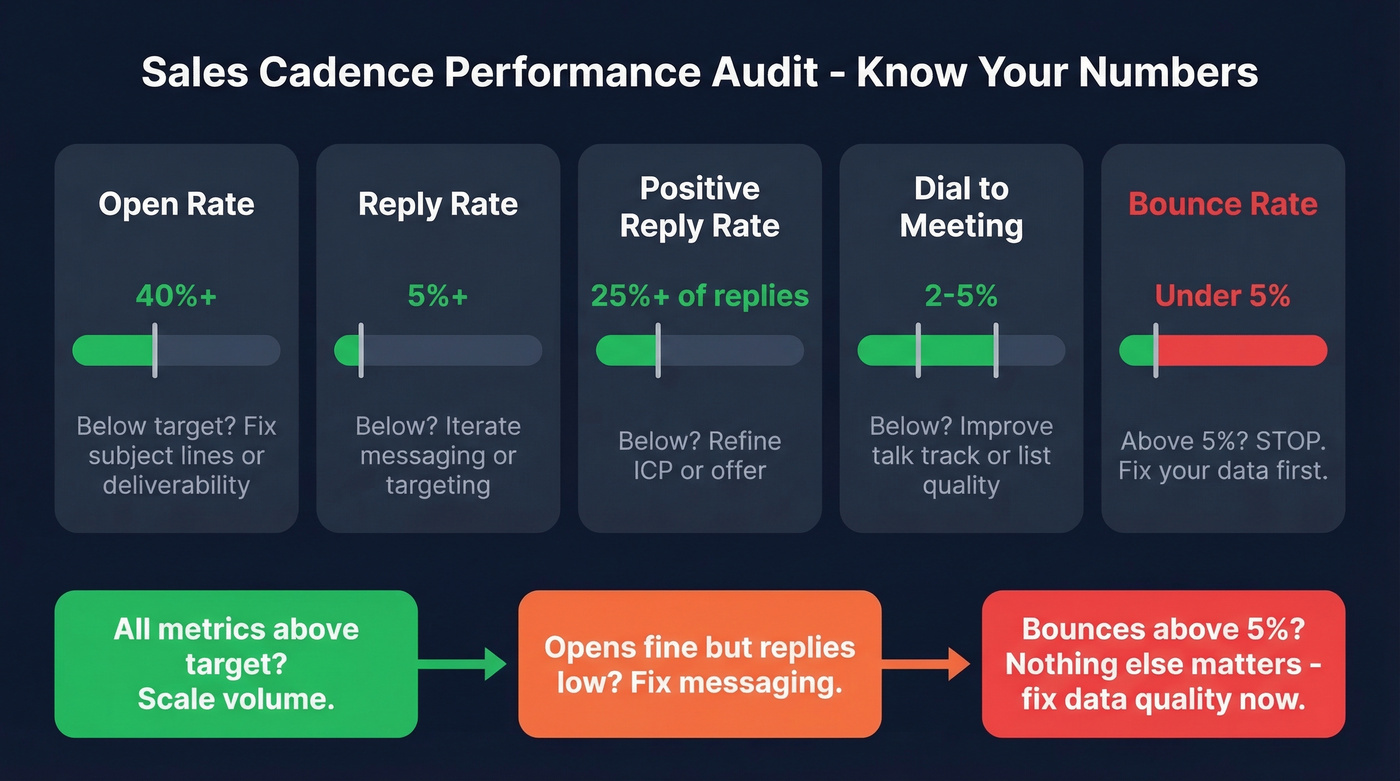
| Metric | Target | Below Target? |
|---|---|---|
| Open rate | 40%+ | Fix subject lines or deliverability |
| Reply rate | 5%+ | Iterate messaging or targeting |
| Positive reply rate | 25%+ of replies | Refine ICP or offer |
| Cold call dial-to-meeting | 2-5% | Improve talk track or list quality |
| Bounce rate | Under 5% | Stop. Fix your data first. |
The decision logic is straightforward. Above all thresholds? Scale volume. Below on replies but opens are fine? Your messaging needs work. Bounces above 5%? Nothing else matters until you fix data quality - you're actively damaging your sender reputation.
Clean Data: The Prerequisite Nobody Mentions
Here's a pattern we see constantly: a team copies one of the templates above, loads contacts into a sequencer, hits send, and bounce rates spike. Their domain reputation tanks. Their next campaign - even with perfect copy - lands in spam.
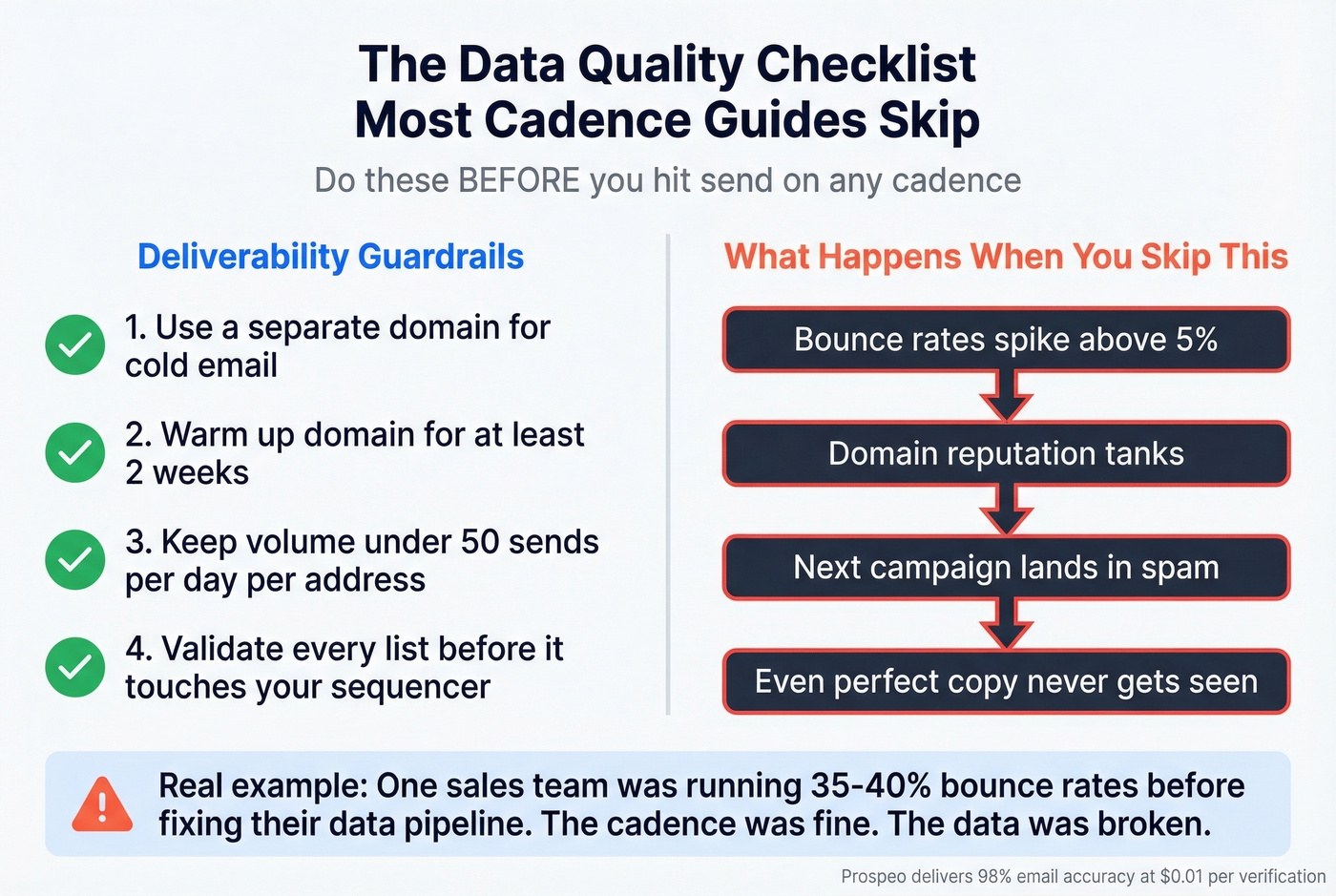
Let's be honest: most cadence failures aren't messaging failures. They're data failures.
Deliverability guardrails are non-negotiable. Use a separate domain for cold email. Warm it up for at least 2 weeks. Keep volume under 50 sends per day per address. And validate every list before it touches your sequencer.
Snyk's sales team was running 35-40% bounce rates before they fixed their data pipeline. They got it under 5% and saw AE-sourced pipeline jump 180% with 200+ new opportunities per month. Prospeo sits between your list-building step and your sequencing tool - upload a CSV, run it through 5-step verification with catch-all and spam-trap handling, and export only valid addresses. At 98% email accuracy and a 7-day data refresh cycle versus the 6-week industry average, you're protecting the domain reputation that makes every cadence above actually work.
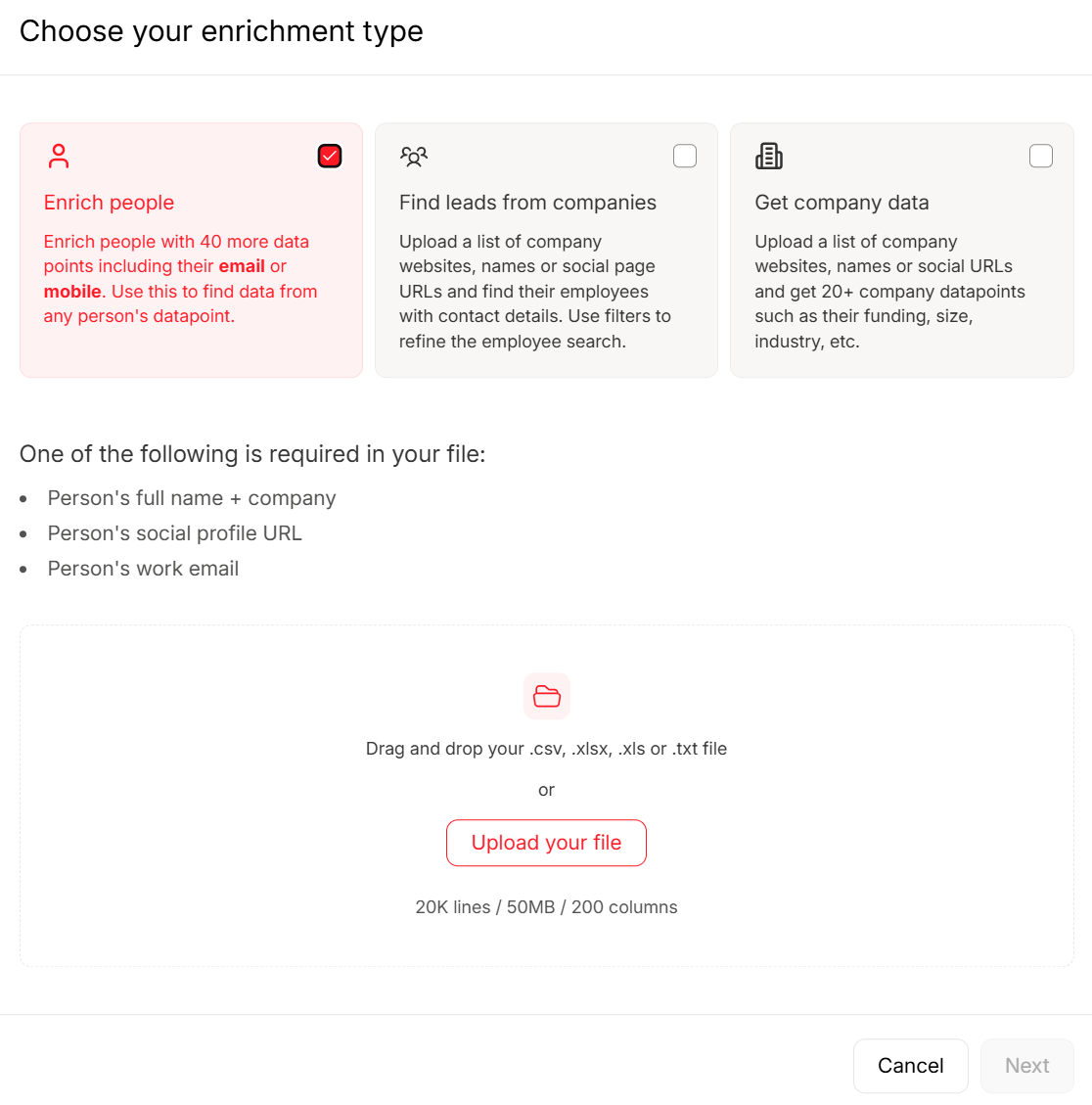
Enterprise cadences need 3-5 verified stakeholders per account. Prospeo's 300M+ profiles with 30+ filters - including department headcount, funding, and job changes - let you map entire buying committees in minutes, not days. Every contact comes back with 50+ data points.
Map the full buying committee before you send touchpoint one.
Mistakes That Kill Your Cadence
These come straight from practitioner threads on Reddit and our own observations running campaigns for clients.
- Targeting wrong accounts. Add trigger-based filters - hiring, funding, tech adoption.
- Not segmenting within ICP. A 20-person startup and a 200-person scale-up need different emails.
- Ignoring buyer personas. Build 2-3 persona-specific email variants per cadence.
- Generic messaging. Reference a specific trigger, tech stack, or KPI in every first touch.
- Relying on one channel. Start email-only to test, then layer phone and social for engaged prospects.
- Volume over fit. Tighter lists and better research beat blasting 5,000 contacts every time.
- Pitching too early. Lead with insight or a question, not a demo request.
- Dirty data. Every mistake above is amplified when 15% of your emails bounce. Verify before every campaign.
Sales Cadence Tools
Look - if your average deal size is under $10k, you don't need a $150/seat engagement platform. A $25/month email tool with verified contacts will outperform an enterprise suite fed with stale data. The sequencing tool matters far less than the data going into it, and the consensus on r/sales backs this up consistently.
| Tool | Starting Price | Best For |
|---|---|---|
| Prospeo | Free (75/mo); ~$0.01/email | Data verification before sequencing |
| Apollo.io | Free; ~$49/mo/user | All-in-one sequencing + data |
| Smartlead | ~$39/mo | Budget email sequencing |
| Outreach | ~$100-150/user/mo | Enterprise sales engagement |
| Salesloft | ~$100-150/user/mo | Enterprise sales engagement |
| Mailshake | $25/user/mo (annual) | Budget email sequencing |
| Reply.io | $89/user/mo (annual) | Multi-channel sequencing |
| Yesware | $19/user/mo | Email tracking + templates |
| Saleshandy | $25/mo | Cold email at scale |
| Nooks | ~$1,000-2,000/mo | Power dialing for phone-heavy teams |
If we had to pick a stack today: Smartlead or Apollo for sequencing, Prospeo for data verification, and Nooks if you're doing heavy phone. That covers 90% of teams under $200/month.
FAQ
How many touchpoints should a cadence include?
Eight to twelve for cold outbound. Start with 4-6 emails and add channels once messaging converts at 5%+ reply rate. Enterprise cadences can stretch to 15+ across multiple stakeholders.
How long should a sales cadence last?
Two to four weeks for outbound. Compress inbound to 5-7 days since speed-to-lead drives 100x better connect rates. Enterprise cadences run 21+ days to cover full buying committees.
What's a good reply rate for cold outbound?
Five percent or higher is the baseline. Positive reply rate should hit 25% of total replies - if most replies are "not interested," your ICP targeting or messaging needs rework, not more volume.
How do I prevent bounces from killing my cadence?
Verify every contact list before loading it into your sequencer. Keep bounce rates under 5% or pause outreach entirely. Tools like Prospeo catch invalid addresses, spam traps, and catch-all domains before they touch your sender reputation.
Where can I find proven cadence templates to copy?
The seven templates above cover cold outbound, email-only, inbound, SaaS trial, enterprise, re-engagement, and warm referral scenarios. Adapt them to your ICP, test with a small batch, and iterate based on the performance audit thresholds before scaling.