

17hats vs HoneyBook: The Only Comparison With Correct Pricing
Choosing between 17hats and HoneyBook in 2026 is harder than it used to be - mostly because HoneyBook raised prices across every tier in February 2025, with jumps of around 50-90% depending on the plan. The "loyalty discount" they gave existing members expires after twelve months. If you just got a renewal email with a number that made you flinch, you're not alone.
Most comparison articles still show HoneyBook at $19/mo and 17hats with three tiers that haven't existed for years. We verified every number below against official pricing pages as of early 2026. If a number looks different from what you've read elsewhere, it's because elsewhere is wrong.
30-Second Verdict
Choose 17hats if you're a solopreneur who values deep automation and predictable costs. The bi-yearly plan works out to $33/mo, and you get every core feature without tier-gating.
Choose HoneyBook if you need polished client-facing documents, team collaboration, and built-in scheduling. HoneyBook Essentials at $49/mo annual is the sweet spot - but only if the aesthetics and lead forms justify the premium.
Skip both if your real bottleneck is finding clients, not managing the ones who already found you. Neither platform helps you prospect.
Pricing Corrected for 2026
This is where every other comparison article falls apart.
HoneyBook's Price Hike
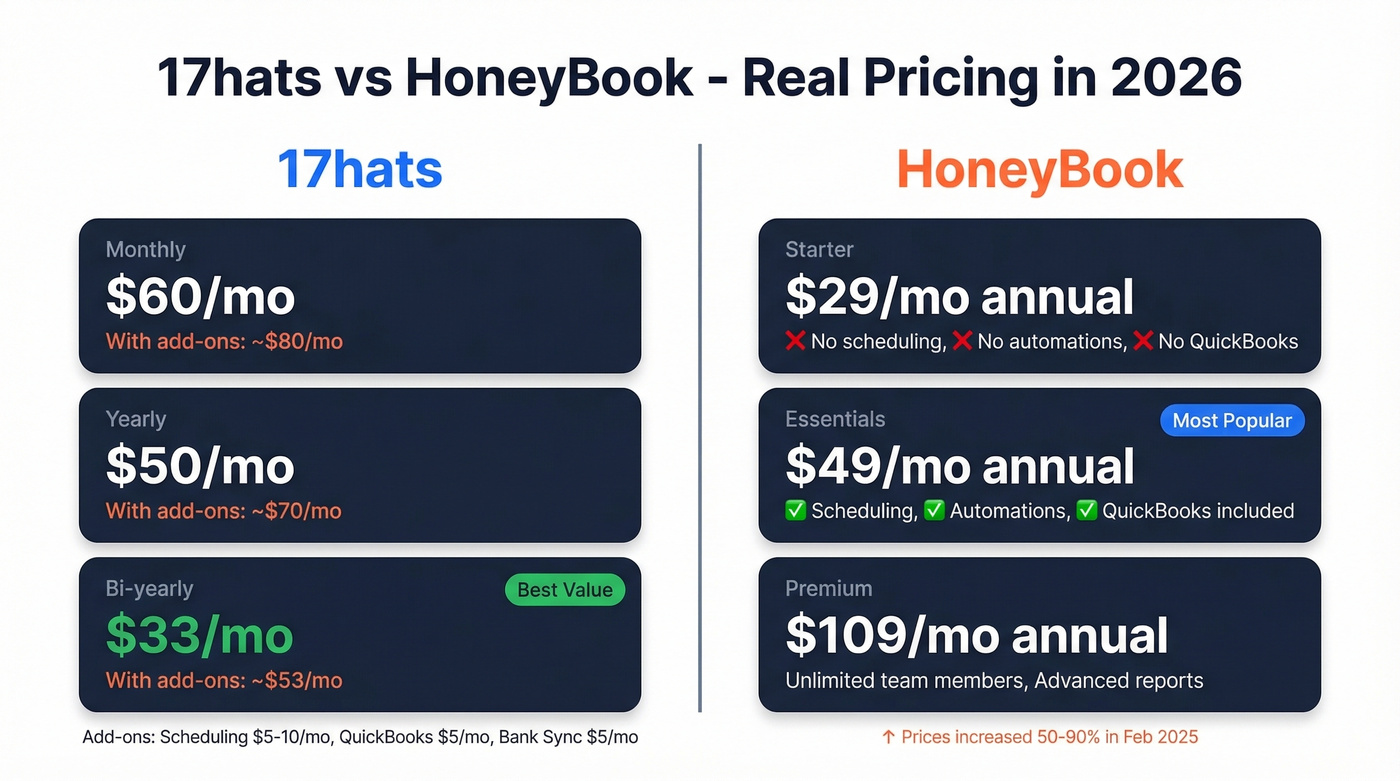
On February 4, 2025, HoneyBook updated prices and packages:
- Starter: $19/mo → $36/mo monthly | $16/mo → $29/mo annual
- Essentials: $39/mo → $59/mo monthly | $32/mo → $49/mo annual
- Premium: $79/mo → $129/mo monthly | $66/mo → $109/mo annual
Existing members got a 20% discount on the new rates, but it only lasts one year from the first billing date on or after Feb 4, 2025. Multiple Reddit threads from late 2024 and early 2025 show HoneyBook users shopping for alternatives after this increase. The sentiment on r/smallbusiness and r/weddingvideography is unmistakable: people feel blindsided.
17hats: "All-Inclusive" With Asterisks
17hats takes a different approach - one plan, three billing cycles:
- Monthly: $60/mo
- Yearly: $600/year ($50/mo)
- Bi-yearly: $800/two years ($33/mo)
That looks clean until you hit the add-ons. Bank connection runs $5/mo. Online Scheduling is $5/mo (Basic) or $10/mo (Advanced). QuickBooks Online integration is $5/mo. Users are $5/mo, and additional brands are $10/mo.
Here's the real math: a solopreneur who wants advanced scheduling, bank sync, and QuickBooks on the monthly plan pays $60 + $10 + $5 + $5 = $80/mo. Add a user and you're at $85/mo. On the bi-yearly plan those same add-ons bring you to roughly $53-58/mo - still competitive, but not the $33 headline number.
There's also a Free CRM option with unlimited contacts and projects plus four invoices per quarter. Genuinely useful for testing the platform before committing.
17hats Pricing Breakdown
| Monthly | Yearly | Bi-yearly | |
|---|---|---|---|
| Base cost | $60/mo | $50/mo | $33/mo |
| With scheduling + QB + bank | ~$80/mo | ~$70/mo | ~$53/mo |
| Team members | +$5/mo each | +$5/mo each | +$5/mo each |
| Automations | Included | Included | Included |
HoneyBook Pricing (Post-Increase, Annual)
| Starter | Essentials | Premium | |
|---|---|---|---|
| Monthly cost | $29 | $49 | $109 |
| Scheduling | Not included | Included | Included |
| Team members | 1 | Up to 2 | Unlimited |
| QuickBooks | Not included | Included | Included |
| Automations | Not included | Included | Included |
True Cost of Ownership
Subscription price is only half the equation. Both platforms process client payments, and those fees compound fast. If you're comparing tools as a CRM, this is the part most people miss.
HoneyBook charges 2.9% + $0.25 per card transaction, 3.4% + $0.09 for card-on-file payments, and 1.5% for ACH. 17hats connects to Stripe or Square, which typically run 2.9% + $0.30 for cards.
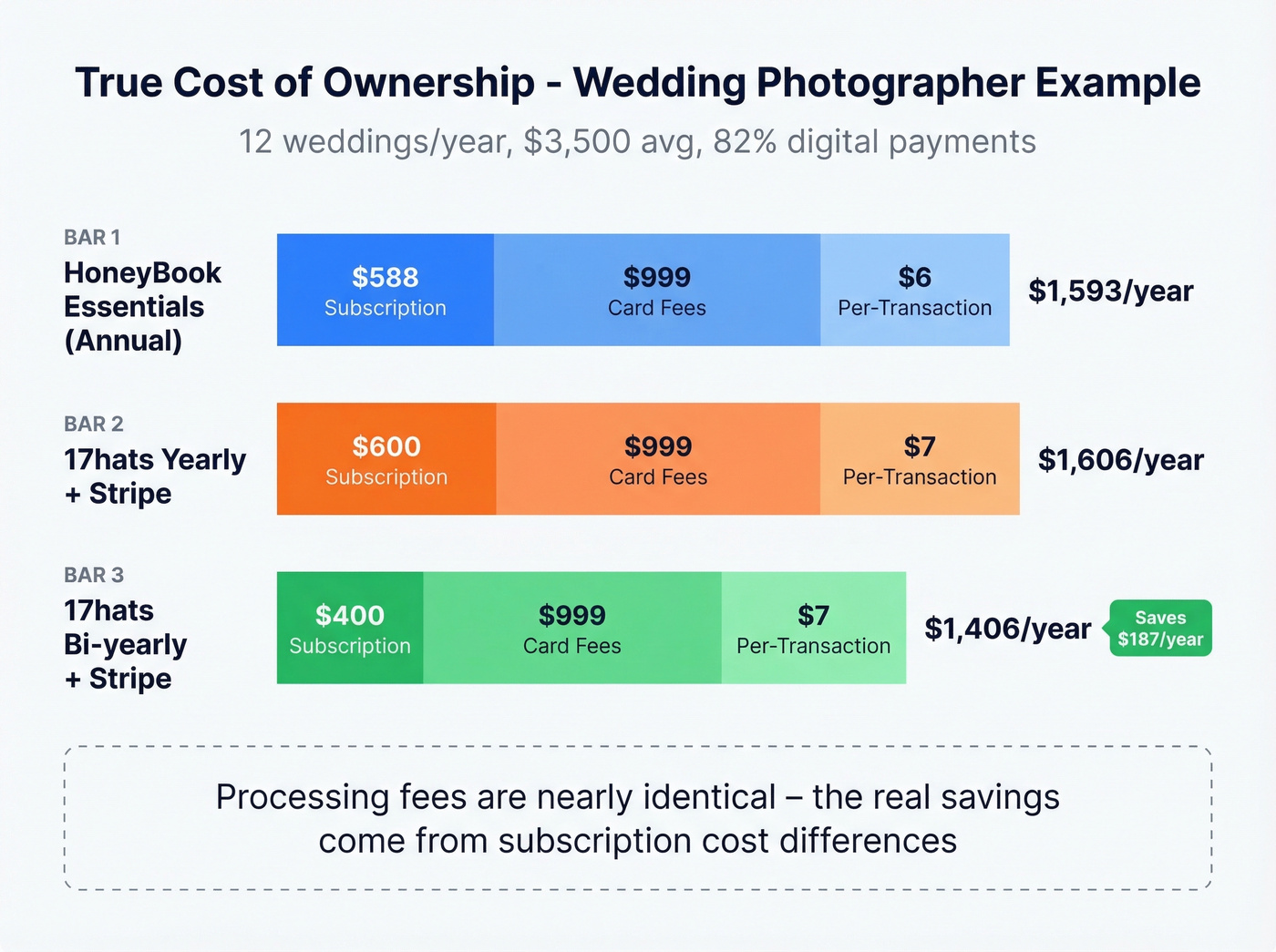
Let's run the math for a wedding photographer booking 12 weddings per year at $3,500 average, collecting 82% of payments digitally. That's ~$34,440 in digital revenue. Assuming each booking involves two transactions (deposit plus final payment), that's 24 card transactions per year.
HoneyBook Essentials (annual): $588 subscription + $998.76 in card fees (2.9% x $34,440) + $6.00 in per-transaction fees ($0.25 x 24) = ~$1,593/year.
17hats yearly with Stripe: $600 subscription + $998.76 in card fees (2.9% x $34,440) + $7.20 in per-transaction fees ($0.30 x 24) = ~$1,606/year.
17hats bi-yearly with Stripe: $400 subscription + $998.76 + $7.20 = ~$1,406/year.
The processing fee difference between the two platforms is pennies per transaction. The real savings come from 17hats' lower subscription on the bi-yearly plan - a $187 annual gap versus HoneyBook Essentials. On the yearly plan, the two platforms cost almost exactly the same. The bi-yearly commitment is where 17hats pulls ahead on pure cost.
Feature-by-Feature Comparison
Contracts, Invoicing & Payments
Both platforms handle the core document workflow well. HoneyBook's proposals, contracts, and invoices look more polished out of the box - clients notice the design quality. In our testing, HoneyBook's templates required minimal customization to look professional, while 17hats' templates needed more styling work to match.
If you're evaluating this as contact management software, the difference is mostly client-facing polish vs operational speed.
17hats counters with a 3-in-1 document that combines quote, contract, and invoice into a single flow, which speeds up booking. For payment processing, HoneyBook includes built-in payments with its own fee schedule, while 17hats connects to Stripe or Square. Functionally equivalent; aesthetically, HoneyBook wins.

Scheduling
This is where tier-gating stings. 17hats offers scheduling as a paid add-on ($5/mo basic, $10/mo advanced). HoneyBook locks scheduling behind Essentials at $49/mo annual. On HoneyBook Starter, you don't get a scheduler at all - you'll need Calendly or Acuity on the side. For solopreneurs who live and die by booking calls, that's a meaningful difference.
Automation & Workflows
This is 17hats' strongest card. The workflow engine lets you chain triggers across documents, emails, to-dos, and scheduling in ways that HoneyBook's automations can't match. In our testing, 17hats' workflow builder took about 45 minutes to replicate a full post-booking sequence - questionnaire, timeline request, final invoice - but once built, it ran without intervention for months.
HoneyBook's automations are simpler and faster to configure (about 15 minutes for a comparable sequence), but they're shallower. Want "set it and forget it" complexity? 17hats wins. Want to be up and running before lunch? HoneyBook wins.
Templates & Design
HoneyBook's templates look polished enough to send without customization. 17hats' templates are functional but visually plain - most users spend time customizing them to match their brand. For service businesses where first impressions drive bookings (wedding vendors, designers, event planners), HoneyBook's design quality is a genuine competitive advantage.
Lead Forms & Client Portal
HoneyBook's lead forms are genuinely good - up to 2 on Starter, 10 on Essentials, unlimited on Premium. The client portal looks professional and branded. 17hats has a client portal too, and it works, but it doesn't carry the same visual polish.
Mobile App
Both platforms offer mobile apps for iOS and Android. HoneyBook's app is more polished and lets you send proposals, track payments, and respond to inquiries on the go. 17hats' app covers the basics - viewing schedules, sending invoices, checking messages - but feels more limited. If you manage your business from your phone between shoots or client meetings, HoneyBook's mobile experience is noticeably better.
Integrations
HoneyBook includes QuickBooks Online integration on Essentials and Premium. 17hats offers QuickBooks Online as a $5/mo add-on and supports payments via Stripe and Square.
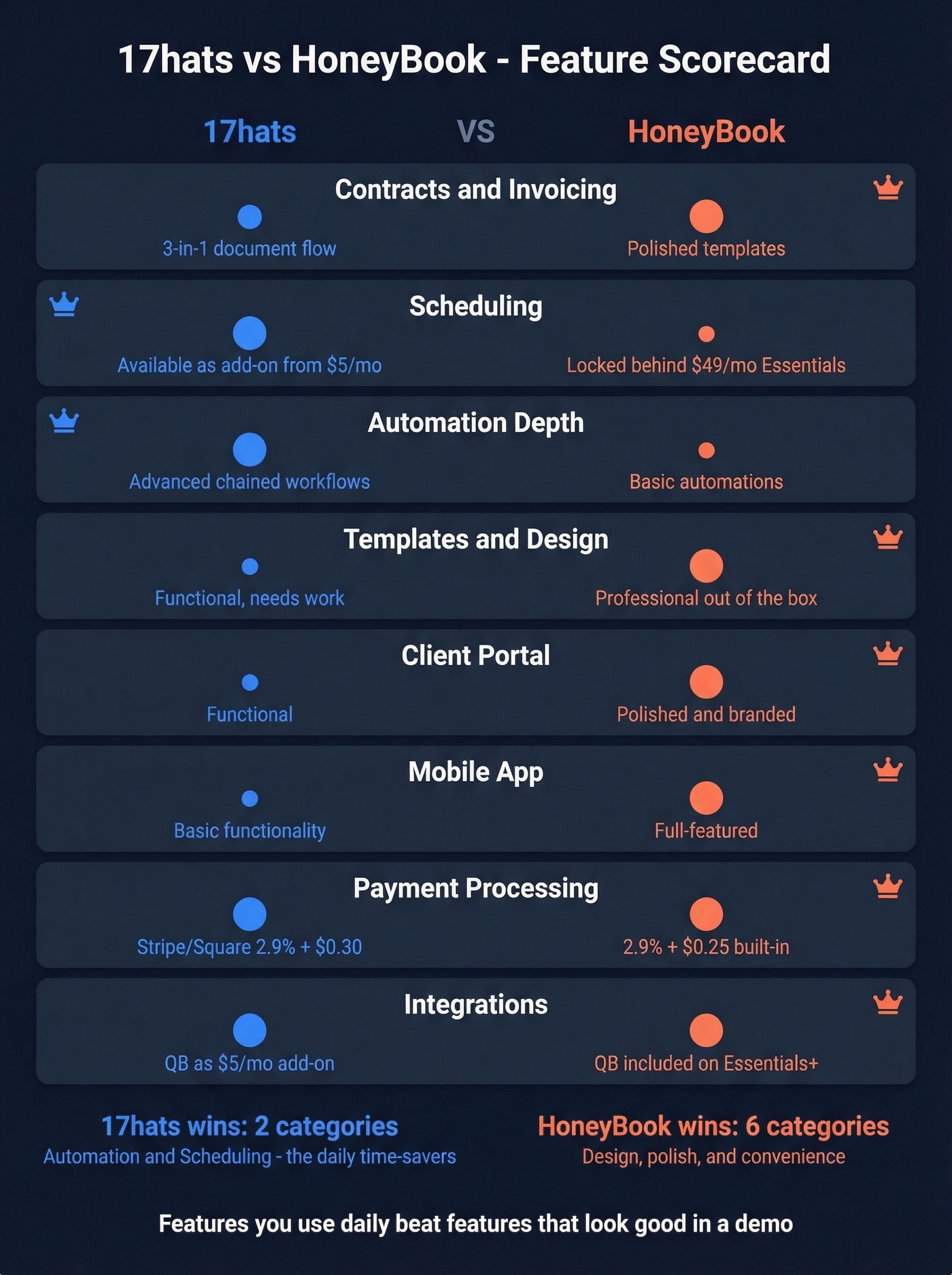
| Category | 17hats | HoneyBook | Winner |
|---|---|---|---|
| Contracts/invoicing | 3-in-1 document flow | Polished templates | HoneyBook |
| Scheduling | Available as add-on | Essentials+ only | 17hats |
| Automation depth | Advanced chained workflows | Basic automations | 17hats |
| Templates & design | Functional, needs customization | Professional out of the box | HoneyBook |
| Client portal | Functional | Polished and branded | HoneyBook |
| Mobile app | Basic functionality | Full-featured | HoneyBook |
| Payment processing | Stripe/Square (2.9% + $0.30) | 2.9% + $0.25 | HoneyBook (marginally) |
| Integrations | Stripe, Square, QB add-on | QuickBooks Online (Essentials+) | HoneyBook |
Here's the thing: HoneyBook wins more feature categories, but 17hats wins the two that save you the most time - automation and scheduling access. For a solopreneur running 50+ projects a year, those two categories matter more than a prettier client portal. The features you use daily beat the features that look good in a demo.

You're comparing CRMs to manage existing clients - but what's filling your pipeline? Neither 17hats nor HoneyBook helps you find new prospects. Prospeo gives you access to 300M+ profiles with 98% email accuracy and 30+ filters to target your ideal buyers.
Stop managing an empty pipeline. Start filling it.
What Real Users Say
G2 and Software Advice tell different stories, and the divergence is revealing.
| Platform | G2 | Software Advice |
|---|---|---|
| 17hats | 4.6/5 (114 reviews) | 4.4/5 (136 reviews) |
| HoneyBook | 4.4/5 (188 reviews) | 4.7/5 (677 reviews) |
G2 skews toward power users who value automation and workflow depth - that's 17hats' wheelhouse. Software Advice draws more ease-of-use seekers who prioritize design and onboarding speed - HoneyBook's territory.
On G2, 17hats reviewers consistently praise the automation engine. One recurring theme: users describe setting up their entire client workflow once and then barely touching it for months. The average time-to-implement is under one month, with ROI kicking in around four months. HoneyBook reviewers highlight ease of use and customer support, but a growing number flag the price increases as a dealbreaker. One common complaint: once you're deep in HoneyBook's ecosystem, migrating away is painful because of how tightly it bundles everything.
The consensus on Reddit since the price hike has been dominated by HoneyBook users looking for exits. The tools that appear most in these switching threads: Dubsado, 17hats, and Bonsai.
Who Should Choose Which
Just starting out (under 30 clients/year, budget-conscious): 17hats bi-yearly at $33/mo is the best value. You get every core feature, and the Free CRM option lets you test before committing. HoneyBook Starter at $29/mo annual is cheaper on paper but locks you out of scheduling, automations, and QuickBooks - the features that actually save you time.
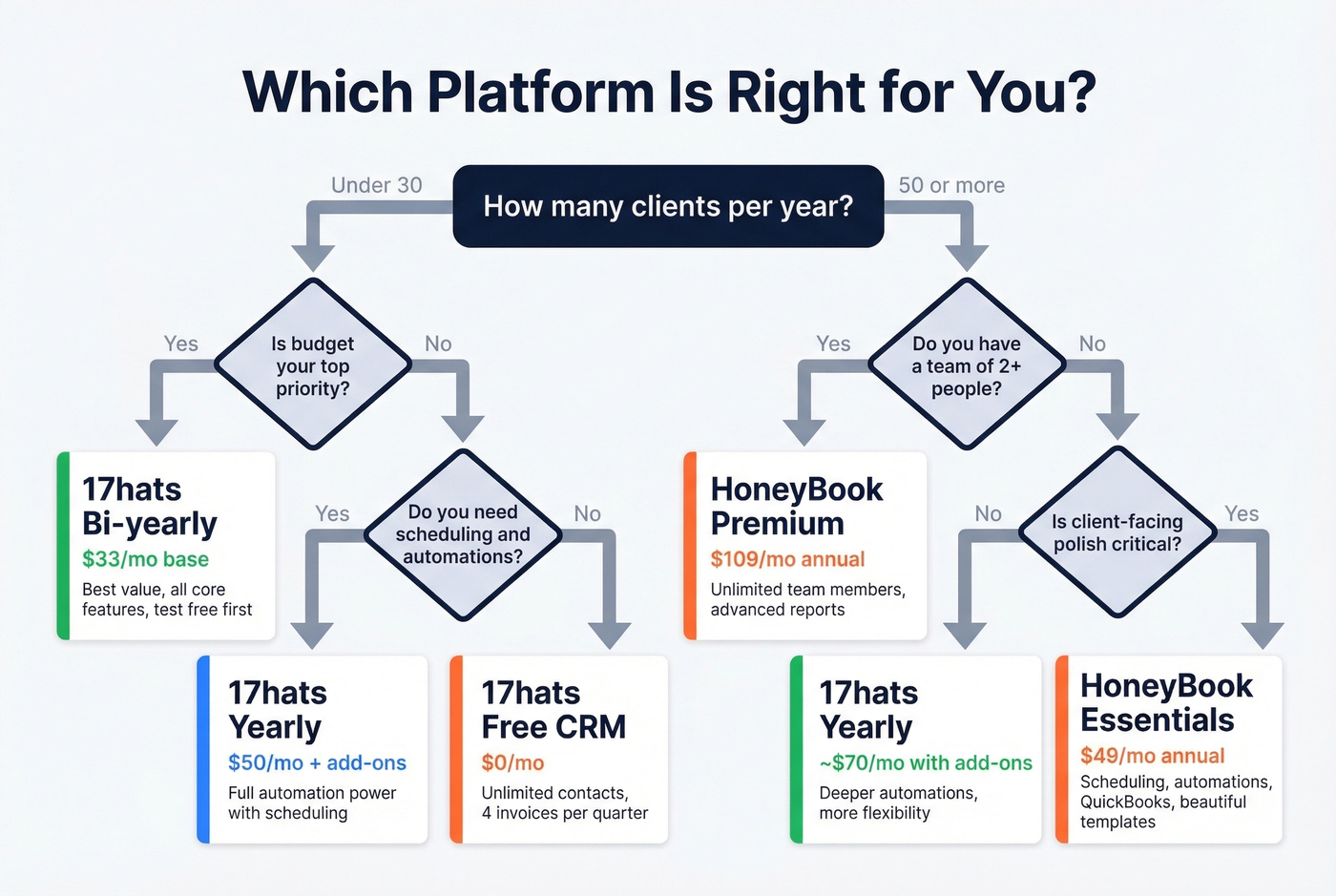
Established solopreneur (50-100+ clients/year, values polish): HoneyBook Essentials at $49/mo annual. The scheduler, automations, QuickBooks integration, and client-facing aesthetics justify the premium - especially if your brand depends on a polished client experience.
Growing team (2+ people, multiple brands): HoneyBook Premium at $109/mo if budget allows - unlimited team members and advanced reports. 17hats with user add-ons keeps costs lower but feels more duct-taped at scale.
The Gap Neither Tool Fills
Both 17hats and HoneyBook are inbound CRMs - they're brilliant at managing clients who've already found you. But if you're proactively reaching out to venues, corporate clients, or referral partners, you need verified contact data, and neither platform offers that.
For service businesses building outbound relationships, that upstream problem is worth solving separately. Tools like Prospeo let you find verified email addresses for venue coordinators, wedding planners, or corporate event managers directly from company websites. The Chrome extension has over 40,000 users and delivers 98% email accuracy - and there's a free tier of 75 emails per month with no contracts required. If you're building a repeatable outbound motion, start with sales prospecting techniques and then pick the right data source.
That wedding photographer booking 12 weddings a year? They need 120+ leads to get there. Prospeo finds verified contact data for decision-makers at $0.01 per email - less than a single HoneyBook transaction fee. No contracts, cancel anytime.
Spend less on finding clients than you do on processing their payments.
Alternatives Worth a Look
Dubsado
Dubsado is one of the most-mentioned alternatives in Reddit threads about leaving HoneyBook. It offers deep customization and strong automation comparable to 17hats in workflow power, but it has the steepest learning curve of the three. Plans run around $35/month or $350/year. Worth evaluating if you want granular control over every client-facing workflow and don't mind spending a weekend on setup. Skip it if you want to be operational by tomorrow.
If you're also comparing outbound stacks, these SDR tools can complement a lightweight CRM.
Bonsai
Bonsai is built for freelancers who primarily need invoicing, contracts, and basic project management without CRM complexity. Plans typically land around $20-30/mo depending on the tier. It's clean, fast, and does the basics well. Skip it if you handle more than 50 clients per year - you'll outgrow it quickly.
For a broader shortlist, see our guide to free lead generation tools if budget is tight.
FAQ
Is 17hats really cheaper than HoneyBook?
At base price on the bi-yearly plan, 17hats costs $33/mo versus HoneyBook Starter at $29/mo annual - but Starter lacks scheduling, automations, and QuickBooks. Comparing equivalent feature sets, 17hats yearly with add-ons runs $65-70/mo versus HoneyBook Essentials at $49/mo. The bi-yearly commitment is where 17hats wins on pure cost.
Did HoneyBook raise their prices in 2025?
Yes. On February 4, 2025, HoneyBook increased all plans by 50-90%. Starter jumped from $19/mo to $36/mo on monthly billing. Existing members received a 20% loyalty discount on the new rates, but it expires one year from the first post-change billing date.
Can I switch from HoneyBook to 17hats easily?
There's no one-click migration between the two. You'll need to manually export client data, contracts, and templates - plan for one to two weeks of setup and testing. 17hats offers a 7-day free trial, so you can build out your workflow before canceling HoneyBook.
Does either CRM help me find new clients?
No. Both 17hats and HoneyBook are designed to manage clients who contact you first. Neither includes outbound prospecting tools. For finding verified emails of venue coordinators, event managers, or referral partners, you'll need a separate tool like Prospeo, which offers a free tier of 75 emails per month.
Is Dubsado better than both?
Dubsado offers deeper customization than HoneyBook and comparable automation to 17hats, but it has the steepest learning curve of the three. It's worth evaluating if you want granular control over every client-facing workflow. For most solopreneurs who need to be operational quickly, 17hats or HoneyBook will get you there faster.