

Account-Based Marketing: What It Is, What It Costs, and How to Actually Do It
A RevOps lead we know spent $65,000 on a 6sense contract last year. Six months in, the sales team was still running their own target account list in a Google Sheet. The platform worked fine - the alignment didn't.
ABM is a strategy first and a software category second. Getting that order wrong is the most expensive mistake in B2B marketing.
What You Need (Quick Version)
What is ABM? A B2B strategy where sales and marketing coordinate personalized campaigns targeting specific high-value accounts instead of casting a wide net. If you've heard the term tossed around in planning meetings without a clear definition, that's the core of it. (Not to be confused with ABM Industries, the facility services company - this guide covers the go-to-market strategy.)
Does it work? A survey of 771 marketers found an average ROI of 137%. Forrester pegs these programs at 21-50% higher ROI versus non-ABM approaches.
What do I need to start? A target account list, verified contact data for the buying committee, and sales-marketing alignment. You do NOT need a $60K platform.
What Is Account-Based Marketing?
Traditional demand gen works like a funnel: cast a wide net, capture leads, qualify them down. Account-based marketing flips that funnel upside down. You start by identifying the specific companies you want to close, research the buying committee inside each one, and then run personalized campaigns designed to engage those exact people.
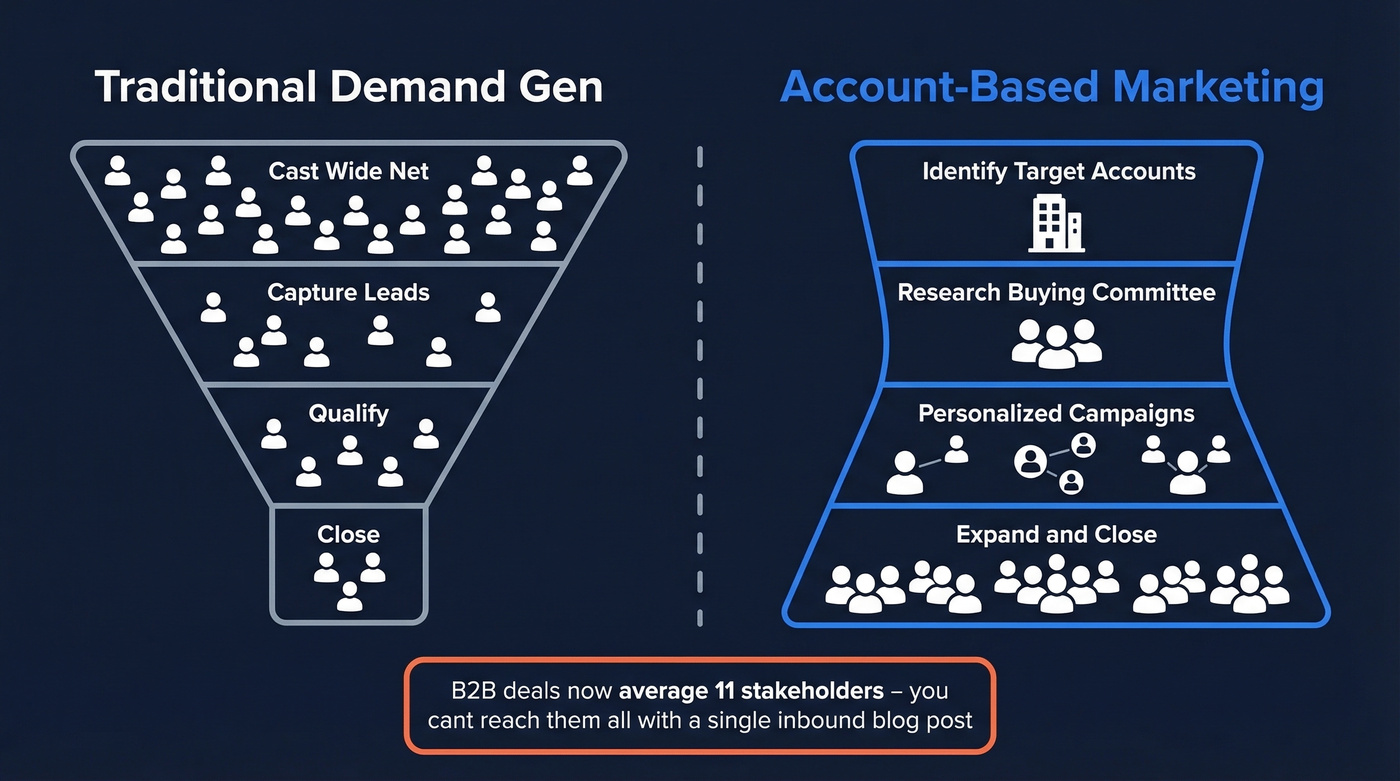
The logic is simple. Complex B2B purchases involve 6-10 decision-makers on average, and recent Salesforce data puts the number at 11 when you include everyone with influence. Sending a single whitepaper to one marketing manager and hoping it trickles up doesn't work when there's a CFO, a VP of Engineering, a procurement lead, and a security team all weighing in. ABM treats each account as a "market of one" and coordinates outreach across the entire buying group.
This isn't new. Enterprise sales teams have been running named-account plays for decades. What's changed is the tooling - intent data, programmatic advertising, and enrichment platforms now let mid-market teams run these workflows at scale without a 20-person department.
Why It Works
The data behind account-based marketing is unusually strong for a marketing strategy. That October 2025 survey of 771 marketers found 71.2% of organizations now run ABM programs, with 49.2% calling it their highest-ROI channel. The average reported ROI was 137%. Forrester's benchmark data shows these programs delivering 21-50% higher ROI than traditional approaches, with targeted accounts generating 11-50% larger average deal sizes. Those aren't marginal improvements - they're the difference between hitting quota and missing it.
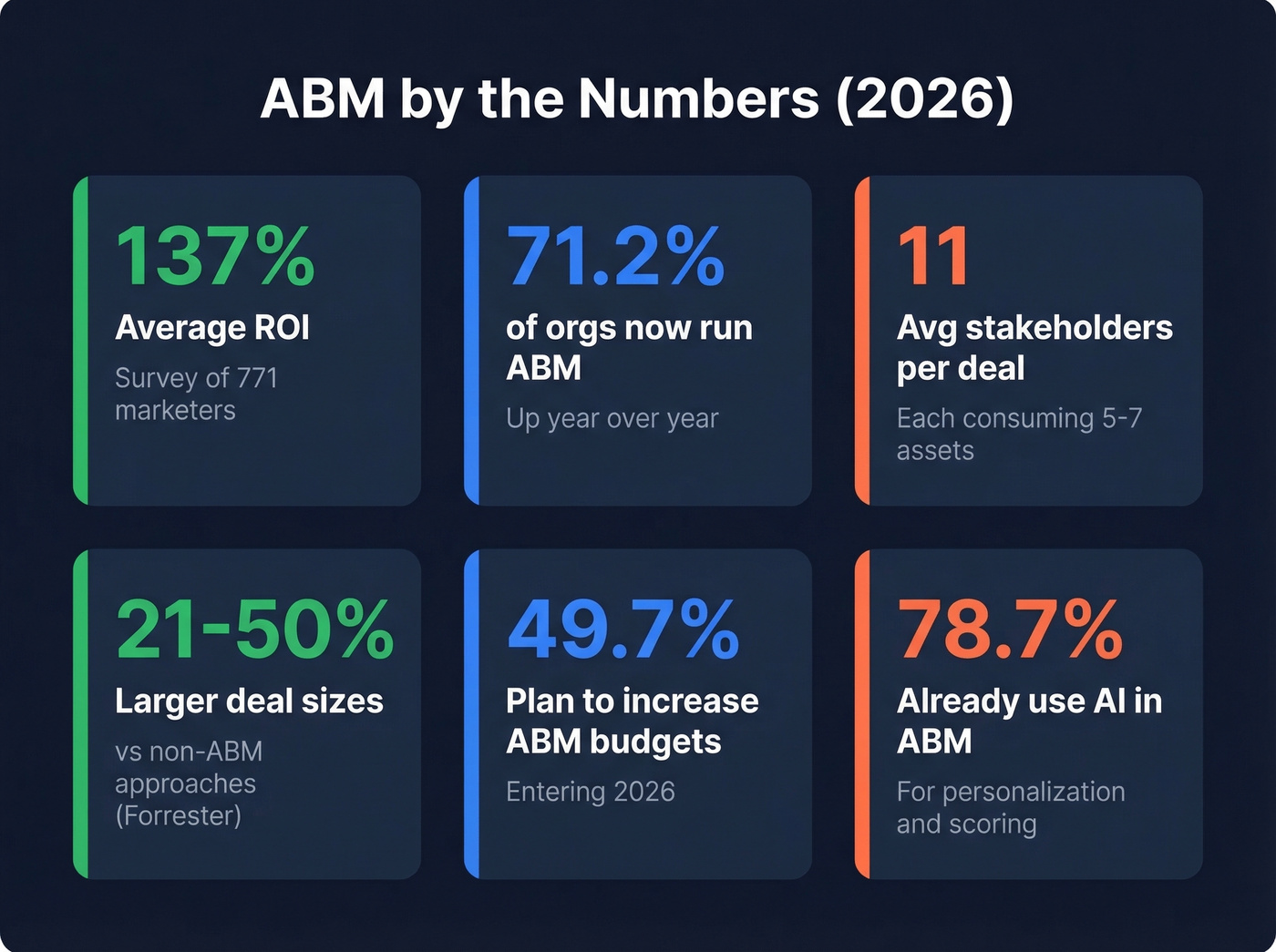
49.7% of marketers entered 2026 planning to increase their account-based budgets, and 78.7% already incorporate AI into their workflows for personalization, predictive scoring, and targeting. This isn't an experiment anymore.
Here's the stat that makes it click: B2B deals now average 11 stakeholders, each consuming 5-7 assets before engaging sales. You can't reach 11 people with a single inbound blog post. You need coordinated, multi-threaded outreach - and that's exactly what ABM delivers.
ABM vs Demand Gen vs Lead Gen
These three strategies aren't competing. They're complementary. But the distinctions matter because they determine how you measure success.
| Account-Based Marketing | Demand Gen | Lead Gen | |
|---|---|---|---|
| Target | Named accounts | Broad audience | Interested individuals |
| Approach | Personalized, multi-threaded | Awareness-building | Conversion-focused |
| Key metric | MQAs, pipeline per account | Reach, engagement | MQLs, cost per lead |
| Best for | High-value, complex deals | Market creation | Volume-driven sales |
Account-based programs narrow to named accounts and measure at the account level - think Marketing Qualified Accounts (MQAs), not MQLs. Demand gen widens the top of funnel to build awareness among people who don't know they have a problem yet. Lead gen converts that interest into contacts your sales team can work.
The smartest teams use all three together: demand gen builds the pool, ABM narrows to highest-value accounts, and lead gen captures the rest.
Three Types of ABM
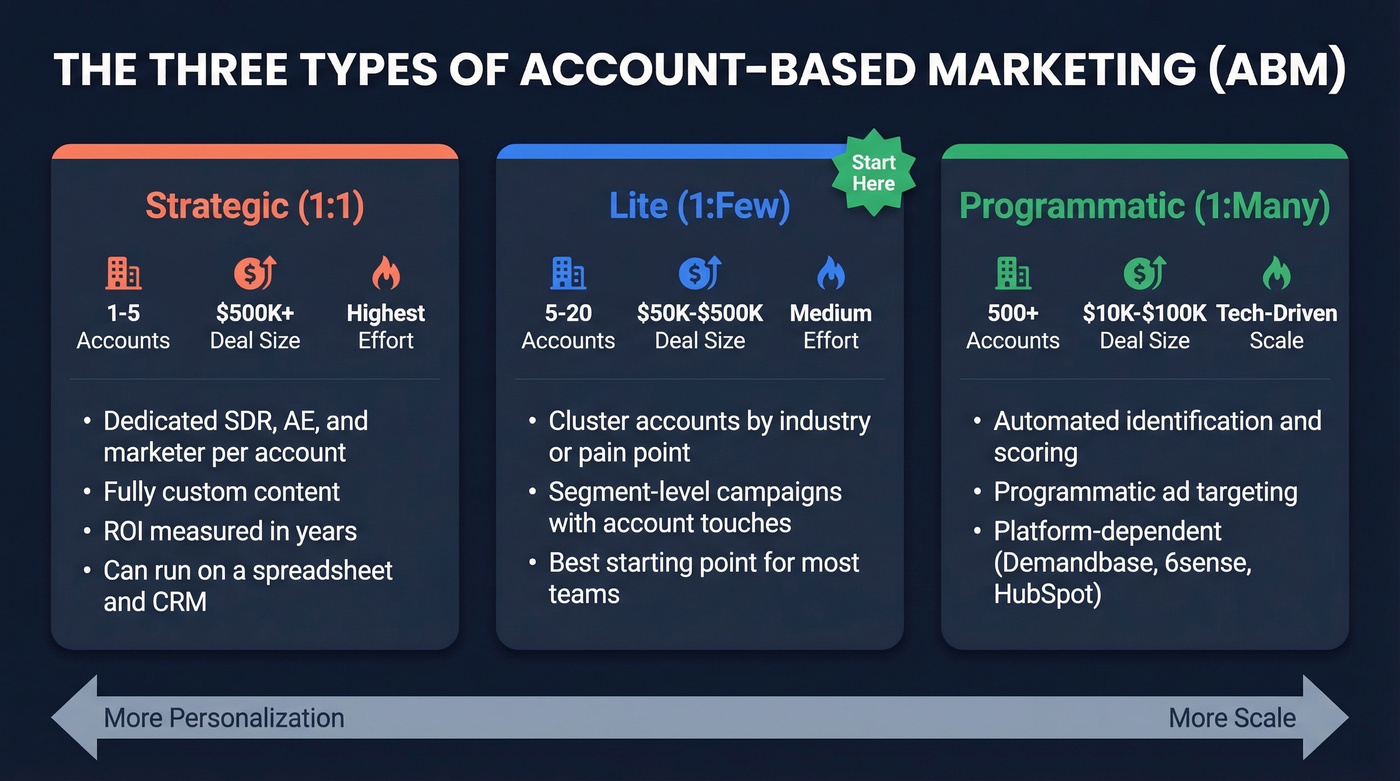
Not all account-based programs look the same. The right approach depends on your deal size, team capacity, and how many accounts you're targeting.
Strategic (1:1)
This is the white-glove version - highest effort, highest payoff. You're dedicating real resources, often a specific SDR, AE, and marketing counterpart, to 1-5 enterprise accounts worth $500K+ annually. Content is fully custom. Outreach is hyper-personalized. ROI is measured in years, not quarters.
Here's the thing: strategic programs don't require expensive software. They can run on a spreadsheet, a CRM, and verified contact data. The investment is in people and research, not platforms.
Lite (1:Few)
Mid-market sweet spot. You cluster 5-20 accounts with similar characteristics - same industry, same pain point, same tech stack - and build segment-level campaigns with account-specific touches. Deal sizes typically run $50K-$500K annually. This is where most teams should start.
Programmatic (1:Many)
For deal sizes in the $10K-$100K range across 500+ accounts, effort shifts from manual personalization to technology-driven scale. This is where platforms like Demandbase, 6sense, and HubSpot earn their keep - automating account identification, ad targeting, and engagement scoring across hundreds of accounts simultaneously.
If your average contract value is under $25K, you probably don't need a dedicated ABM platform at all. A CRM, a sequencing tool, and accurate contact data will get you 80% of the results at 10% of the cost.

You just read it: ABM doesn't require a $60K platform. It requires verified contact data for every stakeholder on the buying committee. Prospeo gives you 98% accurate emails and 125M+ verified mobile numbers across 300M+ profiles - with 30+ filters including intent data, technographics, and headcount growth to nail your ICP. At $0.01 per email, you can cover every decision-maker in your target accounts for less than one month of a legacy ABM platform.
Map the full buying committee with data that actually connects.
How to Run ABM Step by Step
Define Your ICP
Your Ideal Customer Profile isn't just firmographics anymore. Modern ICP modeling uses three layers: Fit (firmographic and technographic match), Intent (real-time signals showing research activity), and Timing (recency weighting - a surge in the last 14 days matters more than one from last quarter).
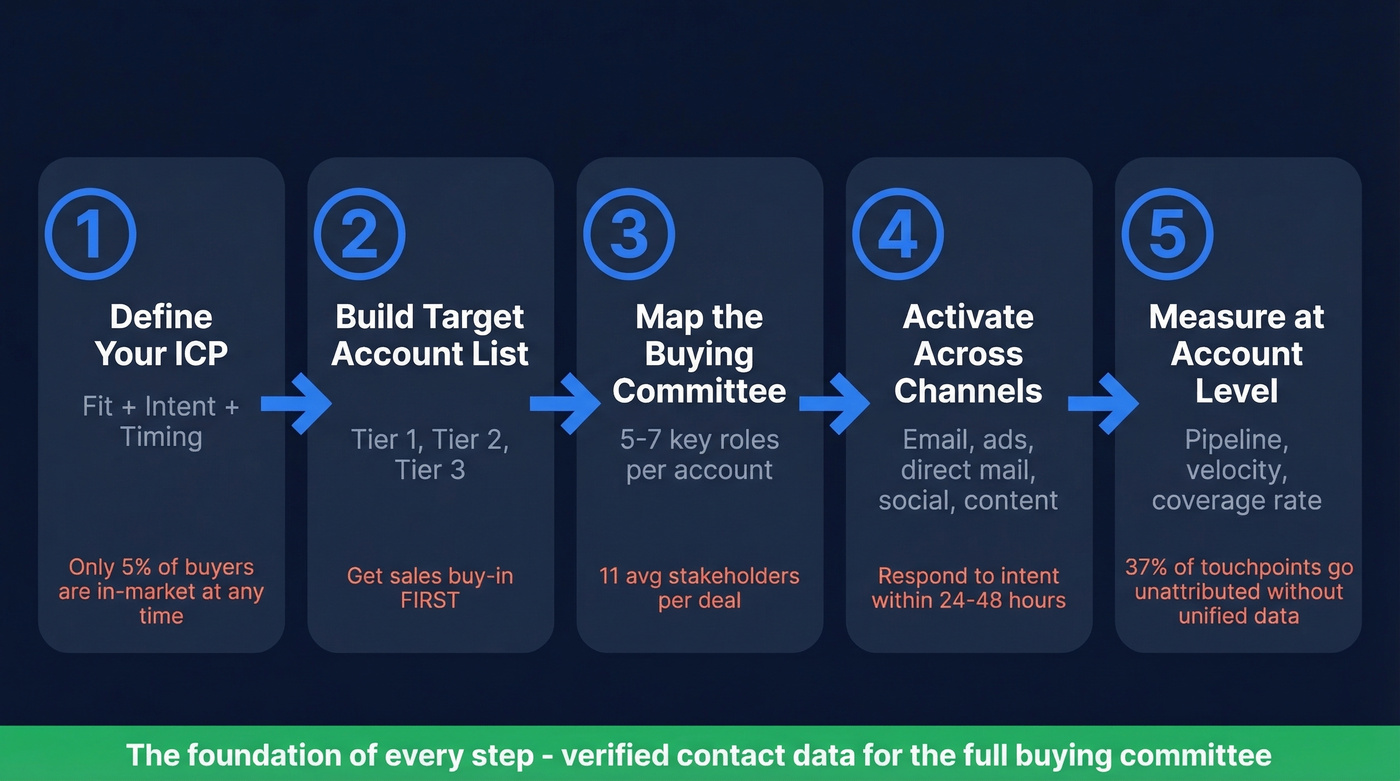
Only about 5% of B2B buyers are actively in-market at any time. Intent data is how you find that 5% instead of wasting outreach on the other 95%.
Build Your Target Account List
Tier your accounts by deal potential. Tier 1 gets the white-glove treatment. Tier 2 gets cluster campaigns. Tier 3 gets programmatic coverage. For a pilot, start with 10-25 accounts - enough to learn, small enough to execute well.
The most important step here isn't building the list. It's getting sales to agree to it before you do anything else. If your AEs don't believe in the list, they won't work the accounts, and your program dies on arrival.
Map the Buying Committee
With 11 stakeholders per average B2B deal, you need to identify 5-7 key roles per target account and get verified contact data for each one. That means real email addresses and direct dials, not generic info@ addresses or switchboard numbers.
Activate Across Channels
ABM isn't just email. The best programs coordinate personalized email sequences, display advertising, direct mail, content syndication, and social touches - all hitting the same account simultaneously. Don't limit yourself to a single channel. Expand to industry sites, professional media, and niche forums where your buyers actually spend time. Clearwave cut their sales cycle by 20% by combining intent data with website personalization - proof that multi-channel coordination pays off.
Speed matters. When an intent signal fires, outreach should happen within 24-48 hours while the buying committee is actively researching. Wait a week and someone else got there first.
Measure at the Account Level
Stop counting MQLs. Measurement lives at the account level: pipeline contribution, sales velocity, engagement depth by role, and coverage rate - how many of the 5-7 buying committee members you've actually reached. It's no surprise that 41% of marketers cite inability to track the right data as their biggest challenge.
One sobering stat: when data isn't unified at the account level, 37% of touchpoints go unattributed. More than a third of your effort, invisible to your reporting. Fixing identity resolution isn't glamorous, but it's the difference between proving ROI and guessing at it.
The Data Problem Nobody Talks About
We've watched teams spend six figures on platforms and then wonder why their campaigns underperform. The answer is almost always the same: bad contact data.
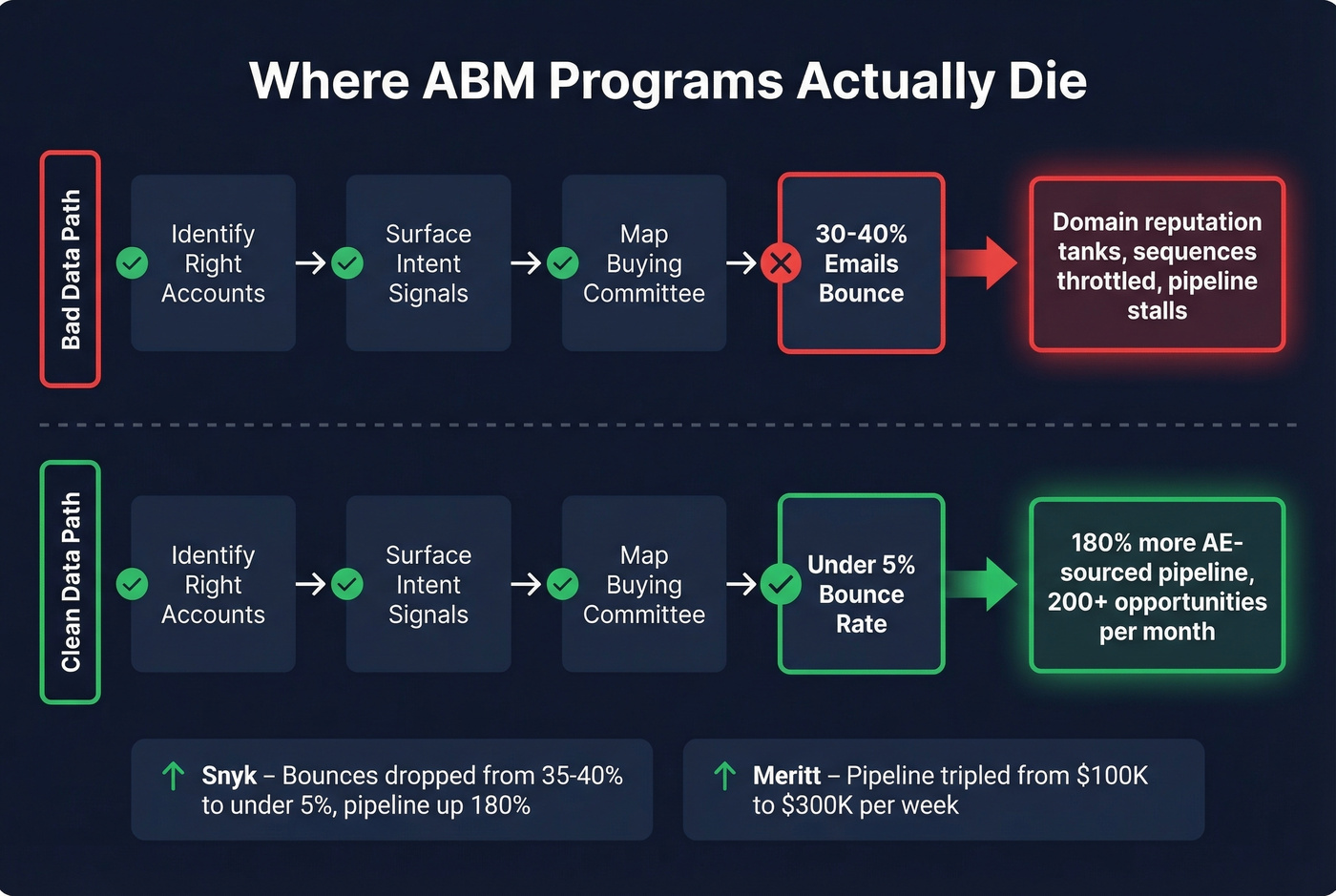
Intent signals are worthless if 30-40% of your emails bounce. You've identified the right accounts, surfaced the right intent, mapped the buying committee - and then your emails hit dead inboxes. Your domain reputation tanks. Your sequences get throttled. The strategy was sound; the data killed it.

Snyk's 50-person AE team was running account-based outreach with bounce rates of 35-40%. After switching to Prospeo, bounces dropped under 5%, AE-sourced pipeline jumped 180%, and the team generates 200+ new opportunities per month. Meritt saw pipeline triple from $100K to $300K per week with bounce rates falling from 35% to under 4%.
Let's be honest: the gap between "identifying accounts" and "reaching decision-makers" is where most ABM programs die. You can have the best intent data in the world, but if your contact records are stale, you're burning budget and domain reputation simultaneously.
Reaching 11 stakeholders per account means you need verified emails and direct dials - not bounces that torch your domain. Prospeo's 7-day data refresh cycle means your buying committee contacts stay current, not stale. Layer in Bombora intent data across 15,000 topics to find the 5% of accounts actively in-market, then export straight to HubSpot, Salesforce, or your sequencing tool.
Stop guessing which accounts are in-market. Start knowing.
What ABM Actually Costs
Let's break down what you're really signing up for. The platform is just one line item.
| Tool | Annual Cost | What's Included | Watch Out For |
|---|---|---|---|
| Prospeo | Free tier available; ~$0.01/lead | 300M+ profiles, 98% accuracy, intent data | Data enrichment layer - not a full ABM platform |
| Demandbase | $24K-$300K+ | Account ID, ads, attribution | ~$29K onboarding on top |
| 6sense | $35K-$200K+ | Predictive, intent, orchestration | Median contract ~$58K |
| Terminus | $18K-$87K | Display ads, analytics | Mid-market focused |
| RollWorks | $12K-$50K | Lighter platform, retargeting | Limited predictive/AI |
| HubSpot ABM | $43,200/yr | Bundled in Marketing Hub Enterprise | Need full Hub stack |
| Bombora | $15K-$40K | Intent data add-on | Layered on top of platform |
The fact that Demandbase and 6sense won't publish pricing tells you everything. A mid-market 6sense contract runs around $58K/year based on Vendr median contract data, and Demandbase's AWS Marketplace anchor sits at $215K for a 12-month contract. As one B2B marketer put it on r/sales, platforms like 6sense and Demandbase are "expensive reminders to sell to your ICP" - the tool doesn't replace the strategy.
But the platform cost is just the start. Here's what most budget guides leave out:
- Implementation: $10K-$30K for enterprise platforms, 3-6 months to fully deploy
- Ad spend: $3K-$20K+/month for display, social, and content syndication
- Dedicated headcount: $80K-$120K fully loaded for an ops person
Total realistic year-one cost for enterprise programs: $100K-$400K+. For a pilot program, you can start at $3K/month in ad spend plus your data provider.
Common Mistakes to Avoid
Buying a platform before aligning with sales. If your AEs don't agree on the target account list and aren't committed to working those accounts, no amount of software will save you. Align first, buy later.
Treating it like lead gen with a new label. Sending the same nurture emails to a "target account list" isn't ABM. If your content isn't personalized to the account's specific situation, you're just doing bad demand gen.
Measuring MQLs instead of account engagement. Success means pipeline per account, sales velocity, and buying committee coverage - not how many people downloaded your ebook. Kill the MQL dashboard for targeted accounts.
Sending "personalized" content that's actually generic. Swapping in a company name and logo isn't personalization. Real account-based content references the account's specific challenges, tech stack, competitive landscape, or recent news.
Skipping data quality. We can't stress this enough. If a third or more of your contact data is stale, your program fails before the strategy has a chance to work. Fix the data first.
Start Without a $60K Platform
Most guides recommend 10+ tools. You need three things: a way to identify accounts, a way to find verified contacts, and a way to run personalized outreach. Everything else is optimization.
Here's a six-month pilot framework. Start with 10-25 target accounts. Month one: build the list, map buying committees, launch initial outreach sequences. Month two: measure engagement signals - who's opening, clicking, replying, booking. Month three: early pipeline signals and iteration on messaging. Months four through six: measurable pipeline and revenue impact, depending on your sales cycle length.
Your minimum stack: a CRM (even HubSpot free works), a sequencing tool like Instantly or Smartlead, and verified contact data. Filter your target accounts' buying committees by job title, department, buyer intent, and technographics. Prospeo's free tier gives you 75 emails and 100 Chrome extension credits per month - enough to start without a credit card.
Budget roughly $3K/month for ad spend if you're running display alongside outbound. That's a fraction of what an enterprise platform costs, and it's enough to prove whether ABM works for your business before you commit to a six-figure contract.
FAQ
What Does ABM Stand For?
ABM stands for Account-Based Marketing - a B2B strategy where sales and marketing coordinate personalized campaigns targeting specific high-value accounts rather than casting a wide net. You treat your best-fit accounts as individual markets and tailor every touchpoint to them.
How Long Does It Take to See Results?
Expect engagement signals in months 1-2 and measurable pipeline impact in months 4-6. Strategic 1:1 programs targeting enterprise accounts with 9-12 month sales cycles take longer to show closed revenue, but pipeline velocity improvements appear earlier.
Can Small Teams Run ABM?
Yes. A two-person team targeting 10 accounts with personalized outreach is doing it effectively. Use a CRM, a sequencing tool, and a data provider with a free tier to map buying committees without enterprise budgets. Start with 1:Few clustering before scaling.
What's the Biggest Reason Programs Fail?
Bad data. If 30-40% of your emails bounce because contact information is stale, your program fails before the strategy gets a chance. Snyk cut bounces from 35-40% to under 5% and grew pipeline 180% after fixing their data layer.
What's the Difference Between ABM and Demand Generation?
Account-based marketing targets a defined list of named accounts with personalized, multi-threaded outreach. Demand gen builds broad awareness to attract new leads who don't know they have a problem yet. They work best together - demand gen fills the top of funnel, and ABM focuses resources on accounts most likely to close.