

The ABM Funnel: A Practitioner's Operating Manual
Your VP told the board you're launching ABM next quarter. You've got a slide deck, a vague mandate to "go after enterprise accounts," and a CRM nobody's touched in months. The gap between the ABM funnel on a whiteboard and the one in production is where most programs die - usually somewhere between the kickoff meeting and the first pipeline review.
A survey of 771 marketers found 71.2% of organizations now run ABM, with an estimated average ROI of 137%. But the practitioners on r/b2bmarketing tell a different story: programs collapse between awareness and conversion because of stale data, manual handoffs, and targeting that decays the moment a campaign launches. The most common question isn't "what is an ABM funnel" - it's "what does ABM look like on a Tuesday morning?" This guide answers that.
Quick Readiness Check
Before you read another word:
- Deal size above $30k. Below that, personalized multi-threaded campaigns don't pencil out. Run automated sequences instead.
- Start 1:few (5-15 accounts per cluster), not 1:1. You don't have the resources for bespoke campaigns per account yet.
- Measure account penetration, not MQLs. The moment someone puts "MQL target" on an ABM dashboard, you've lost the plot.
- Fix your data first. 43% of B2B marketers cite unreliable data as their biggest targeting challenge. Verify every contact before every campaign.
What Is an Account-Based Marketing Funnel?
An ABM funnel isn't really a funnel at all. A traditional demand gen funnel is wide-to-narrow - cast a huge net, qualify down, hope enough survive to hit quota. An account-based marketing funnel works in reverse. You start narrow with a curated list of target accounts, then expand engagement within each one until you've multi-threaded across the entire buying committee.
ABM isn't a marketing strategy. It's a sales operating model that marketing enables.
The ABM market hit $1.07B in 2023 and has continued growing since, because when this model works, it works dramatically better than spray-and-pray. But it requires a fundamentally different way of thinking about pipeline.
ABM Funnel vs. Traditional Funnel
The structural difference between an account-based funnel and a traditional one changes what you measure, how you staff, and what tools you need.
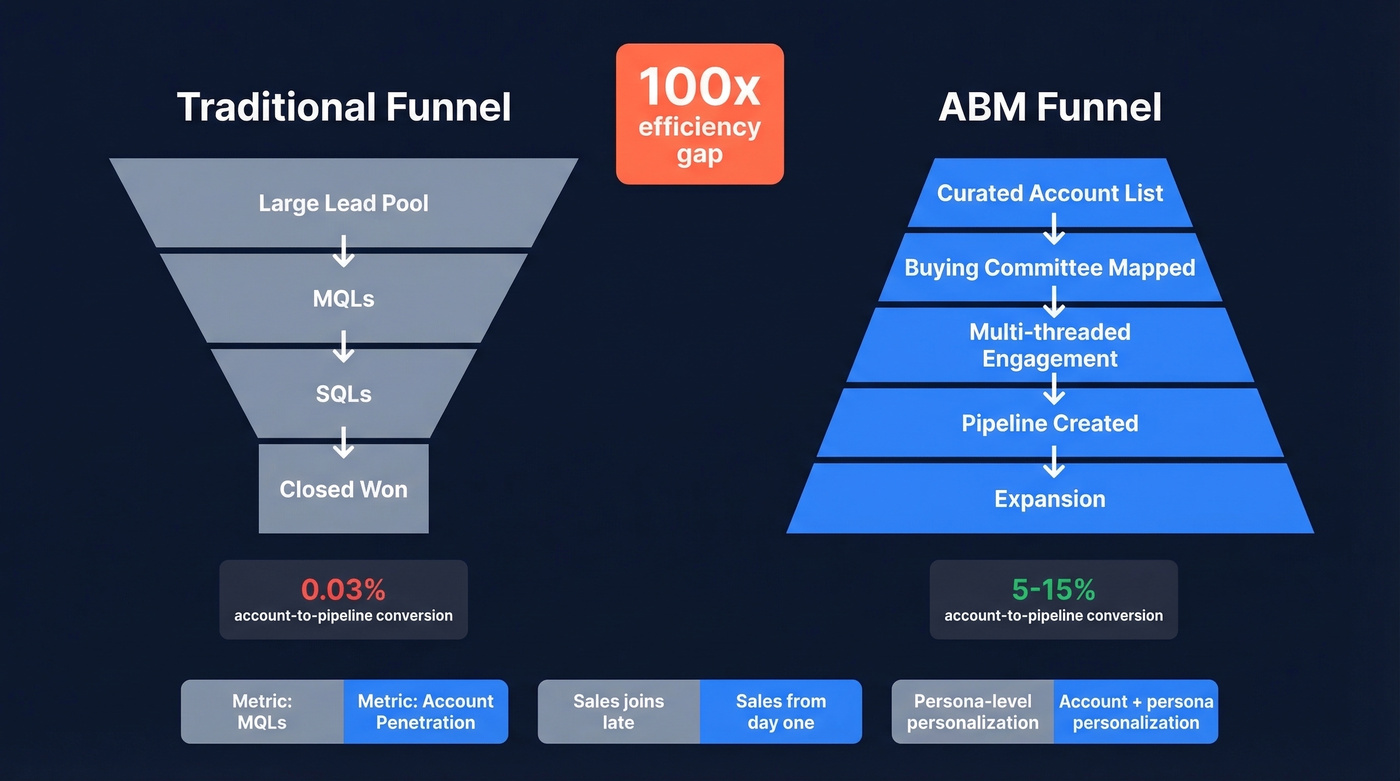
| Dimension | Traditional Funnel | ABM Funnel |
|---|---|---|
| Shape | Wide → narrow | Narrow → wide |
| Starting point | Large lead pool | Curated account list |
| Primary metric | MQLs, lead volume | Account penetration |
| Personalization | Persona-level | Account + persona |
| Sales involvement | Late (SQL handoff) | From day one |
| Post-sale | Separate CS motion | Expansion is a stage |
87% of marketers say ABM delivers higher ROI than traditional marketing. Companies running ABM report a 224% revenue increase over traditional methods. And 58% of B2B marketers blend ABM with demand gen - they aren't mutually exclusive.
Here's the number that should stop you cold: traditional high-volume outbound in complex B2B SaaS produces roughly 0.03% account-to-pipeline conversion - one opportunity per 3,000 accounts touched. A properly executed ABM sales funnel targets 5-15%. That's a 100x improvement in efficiency.
Should You Even Run ABM?
Not every company should.
If your average deal size is under $30k, your sales cycle is under 180 days, your TAM exceeds 1,000 companies, and deals involve fewer than three buyers - run demand gen. Running account-based plays against a $5k ACV with a 14-day sales cycle is just expensive lead gen with extra steps.
Here's the thing: most teams that say they're "doing ABM" are actually running demand gen with a target account list bolted on. Real ABM means sales and marketing share account plans, coordinate outreach daily, and measure account progression together. If your sales team finds out about your ABM campaigns from the ads in their own feed, you aren't doing ABM.
The most recent Pavilion benchmarks showed win rates down 18%, deal values down 21%, and 69% of reps missing quota. The old playbook of blasting 10,000 contacts is broken. The account-based approach is the structural response - but only if your business fits the profile.
ABM Funnel Stages: From Identify to Expand
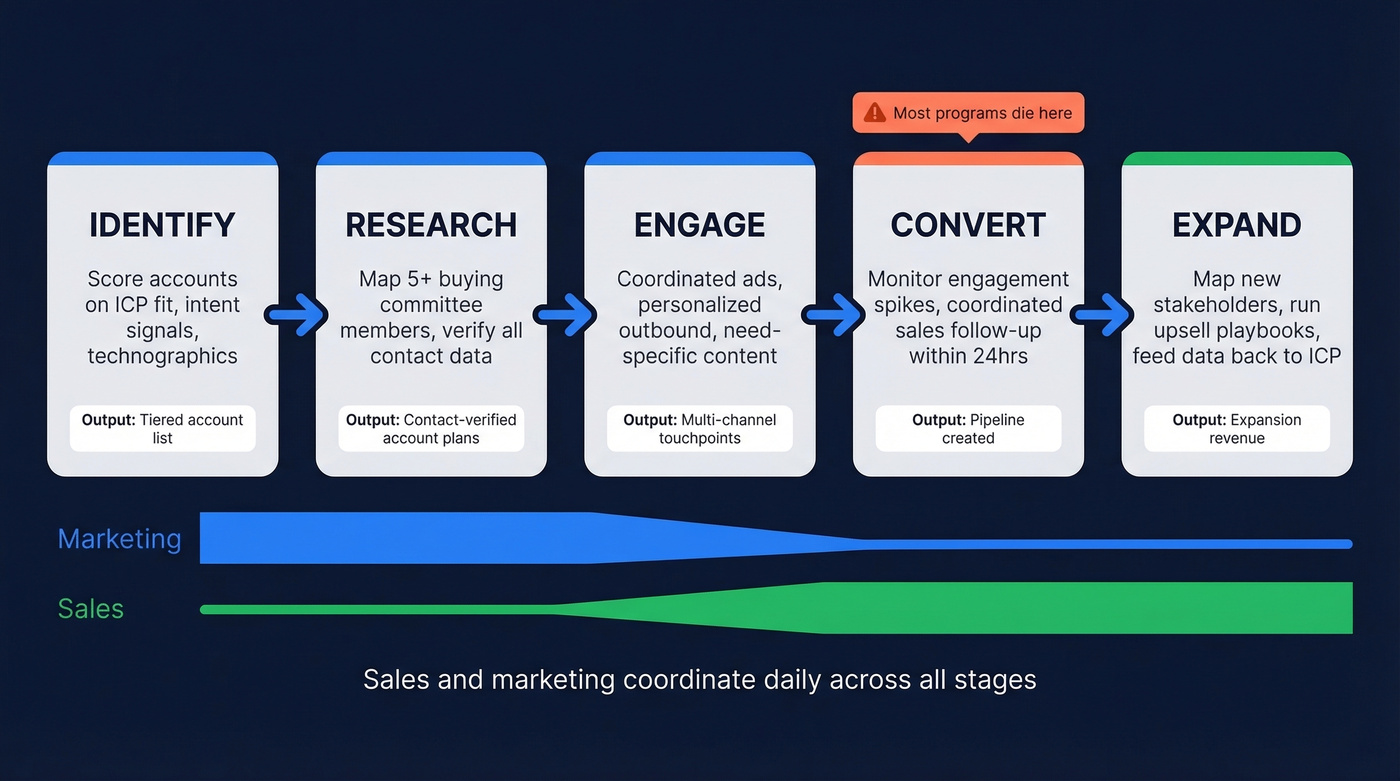
Five stages, each requiring coordinated action from sales and marketing.
Identify Target Accounts
Everything starts with a data-driven target account list - not a logo wish list from your CEO. Score accounts on ICP fit, firmographics, technographics, and intent signals. Tier them: Tier 1 gets bespoke, high-touch campaigns. Tier 2 gets cluster-based plays. Tier 3 gets programmatic automation.
Some teams layer in Cognism's F.I.R.E. framework (Fit, Intent, Relationships, Engagement) as a filtering model. The core principle is the same regardless of framework: score on multiple dimensions, not just firmographics.
Research the Buying Committee
Enterprise deals involve 3+ buyers minimum, and the best ABM programs multi-thread across 5+ contacts per account. You need verified emails and direct dials for every stakeholder - VP of Engineering, CFO, procurement lead, the technical evaluator who'll actually test your product. This is where 43% of teams struggle: they build a beautiful account list, then try to run campaigns on unreliable contact data that's already weeks old.

Engage With Personalized Plays
If your "personalization" is a merge tag, you're running mail merge, not ABM. Account-level personalization references their specific tech stack, their recent funding round, the competitive displacement they're evaluating. At the top of funnel, this means synced audiences and platform-level campaigns. Mid-funnel, it's need-specific content via coordinated ads, email, and outbound. Bottom-funnel, it's targeted ads plus direct calls to drive meetings.
Full funnel ABM marketing means orchestrating all three tiers simultaneously so no stage goes cold while another heats up. We've watched teams nail their top-of-funnel awareness only to let mid-funnel engagement flatline because nobody was running the nurture sequence. Don't be that team.
Convert to Pipeline
Most ABM programs fall apart right here. You've got engagement signals, some content downloads, a few ad clicks. Nobody's booked a meeting.
Enterprise ABM deals involve 9-12 month sales cycles and can require 100+ touchpoints before a contract is signed. The conversion stage is about sustained, coordinated pressure - not a single "book a demo" CTA. Sales and marketing need shared visibility into account engagement so reps know exactly when and how to reach out. When an account's engagement score spikes because three buying committee members hit your pricing page in the same week, that's the moment your rep picks up the phone. Miss it and you're back to cold outreach.
Expand Post-Sale
Expansion isn't an afterthought - it's a funnel stage. The best ABM programs loop back from closed-won to identify, treating existing customers as accounts to be further penetrated. New buying committee members get mapped. Upsell campaigns launch against the same playbook that won the deal. Every closed deal feeds intelligence back into your ICP model.
Skip this and you're leaving the highest-ROI stage on the table.

Your ABM funnel dies at the buying committee stage if your contact data is stale. Prospeo refreshes 300M+ profiles every 7 days - not every 6 weeks - so the emails and direct dials you pull for that VP of Engineering are verified the moment your rep picks up the phone. 98% email accuracy, 125M+ verified mobiles, 30+ filters including intent data and technographics.
Stop running ABM campaigns on data that decayed before your first touchpoint.
A Worked Example: One Account Through the Funnel
Your target is a $50M fintech running a legacy CRM. Week 1-2 (Identify): Intent data shows they're researching CRM migration. You score them Tier 1. Week 3-4 (Research): You map five buying committee members - VP Sales, CTO, CFO, Head of RevOps, IT Director - and verify contact data for each. Week 5-8 (Engage): Marketing runs ads referencing their specific CRM pain points while sales sends personalized outbound to the VP Sales and CTO with a migration case study from a similar fintech. Week 9-12 (Convert): The Head of RevOps downloads your ROI calculator. Sales follows up within 24 hours with a tailored demo offer. Meeting booked. Month 6+ (Expand): After close, you map three new stakeholders in their APAC office for expansion.
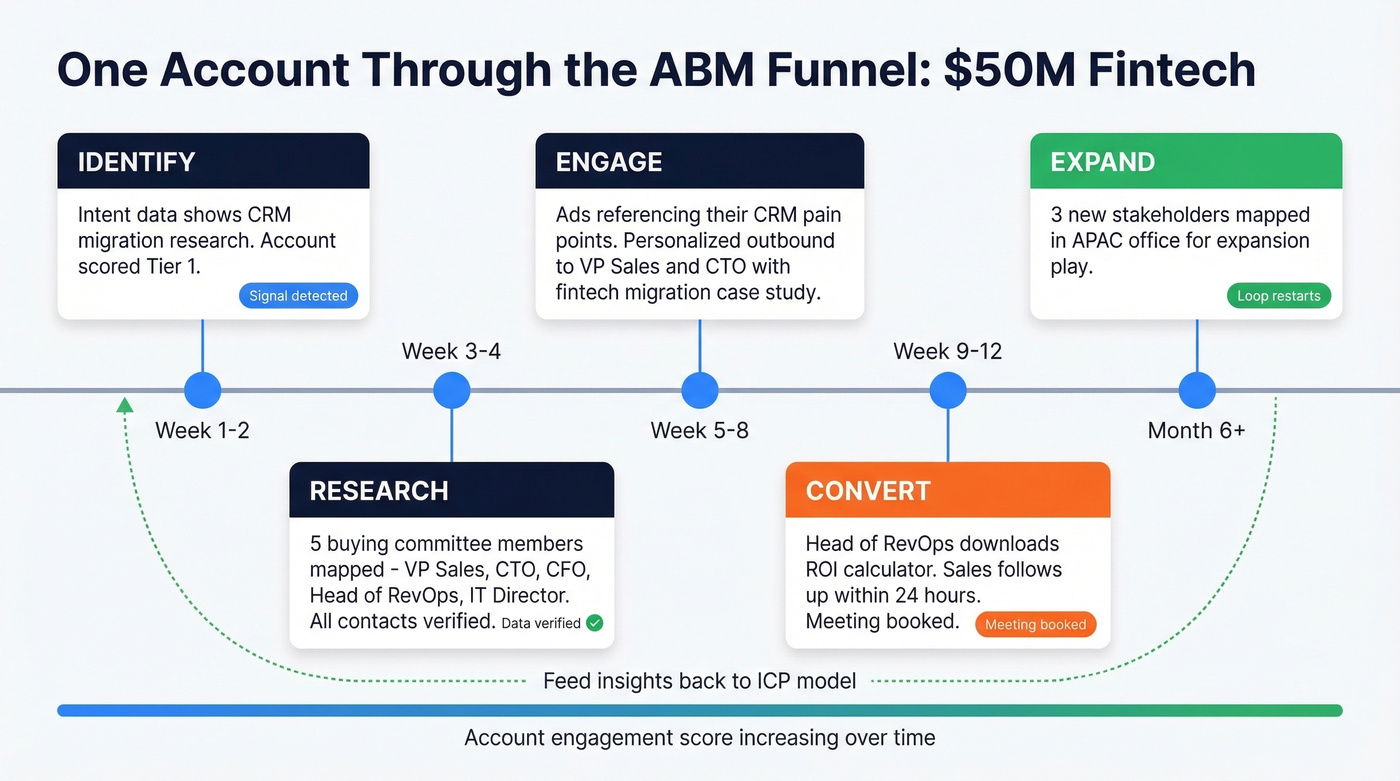
That's ABM on a Tuesday morning.
ABM Types: 1:1, 1:Few, 1:Many
| Type | Accounts | Resources | Best For |
|---|---|---|---|
| 1:1 | 1-10 | Very high (~$10k+ per account) | $500k+ deals |
| 1:few | 5-15 per cluster | Moderate (~$2-5k per account) | $50-500k deals |
| 1:many | 50-500 | Low per account (~$500-2k) | $30-100k deals |
| Programmatic | 500+ | Platform-driven | Broad ABM layer |
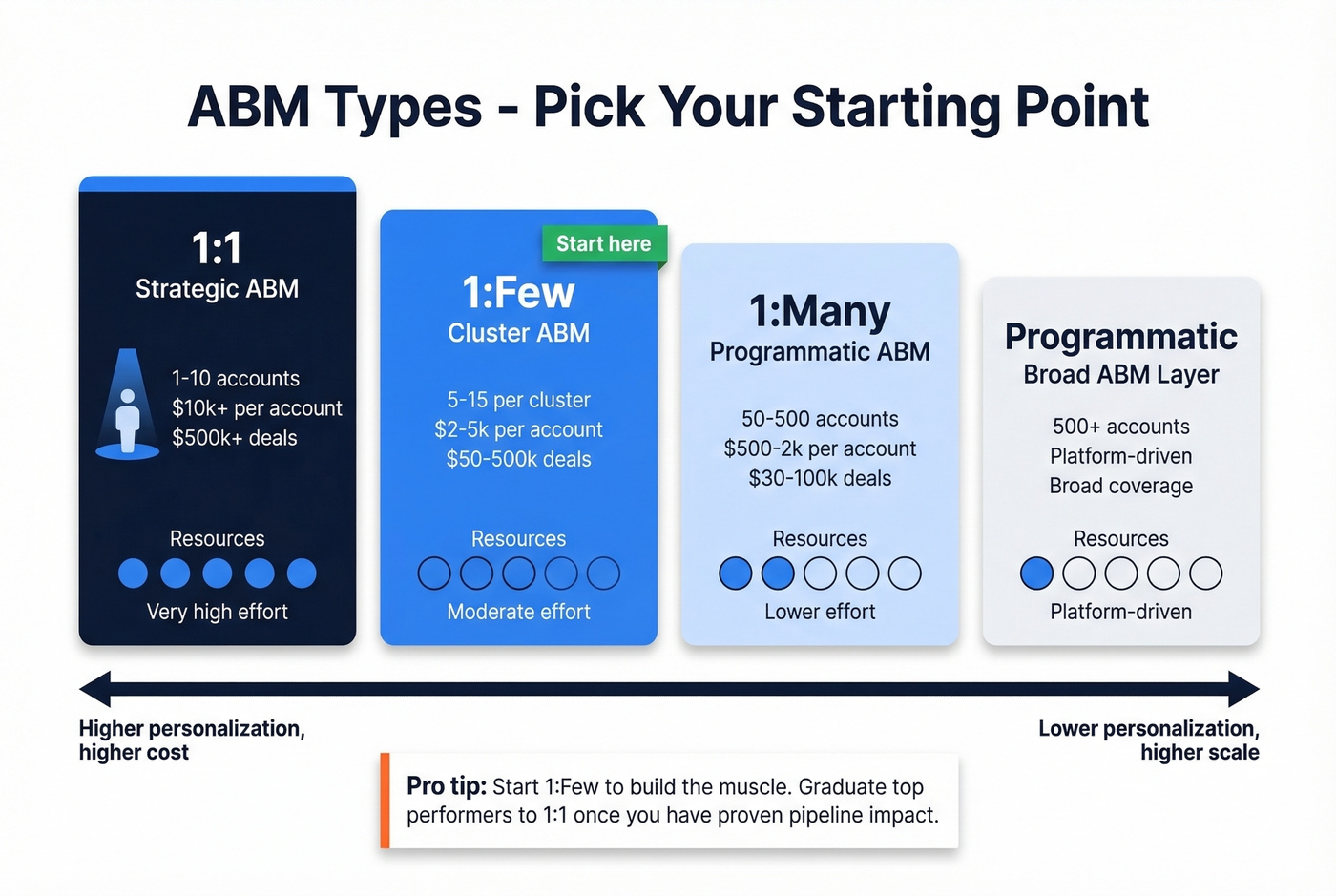
Start with 1:few. We've seen teams burn out trying to run 1:1 programs before they've built the muscle. Clustering 5-15 accounts by shared characteristics - industry, tech stack, pain point - lets you create semi-personalized plays that scale without requiring a dedicated marketer per account. Once you've proven pipeline impact, graduate your top performers to 1:1.
Metrics That Matter
If your primary KPI is MQLs, you're running demand gen with an ABM label. An account-based marketing funnel requires account-level measurement.
Leading Indicators
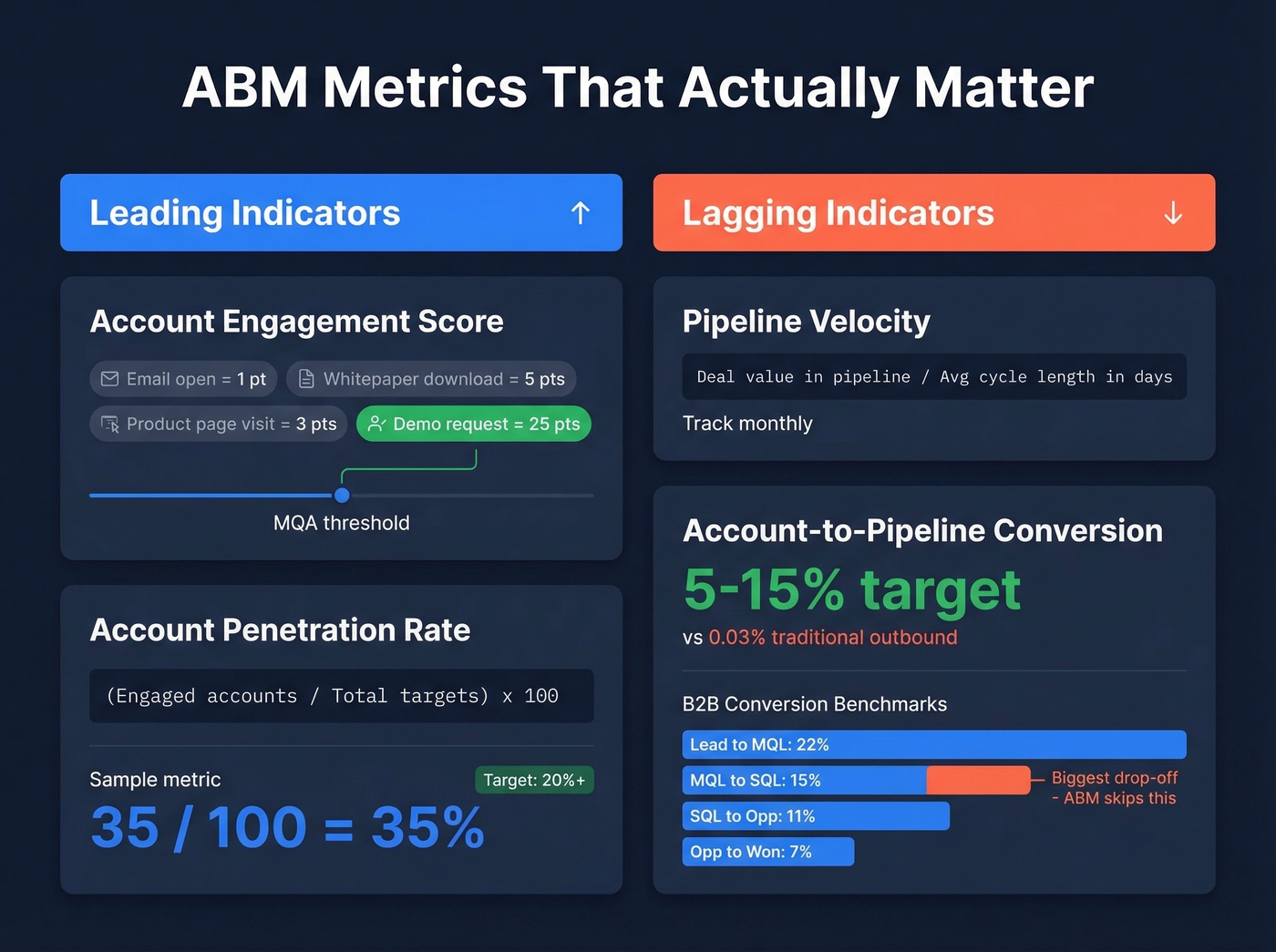
Account Engagement Score - Assign weighted points to every interaction. Email open = 1 point. Whitepaper download = 5. Product page visit = 3. Demo request = 25. When an account crosses your threshold, it becomes a Marketing Qualified Account and triggers sales outreach.
Account Penetration Rate:
(Engaged target accounts / total target accounts) x 100
If you're targeting 100 accounts and 35 have at least one engaged contact, your penetration rate is 35%. Well-run programs aim to reach 20%+ of target accounts.
Lagging Indicators
Pipeline Velocity:
Total value of deals in pipeline / average sales cycle length in days
Track this monthly - it's the single best indicator of whether your ABM motion is accelerating or stalling. Account progression rate, expansion revenue, win rate, and average deal size round out the picture.
Benchmark Table
Aggregated B2B pipeline benchmarks give you a baseline:
| Stage | Conversion Rate |
|---|---|
| Lead to MQL | 22% |
| MQL to SQL | 15% |
| SQL to Opportunity | 11% |
| Opportunity to Closed-Won | 7% |
The biggest drop-off happens at MQL to SQL - which is exactly why ABM skips the MQL stage entirely. For ABM-specific planning, target 5-15% account-to-pipeline conversion as your north star.
Mistakes That Kill ABM Programs
Seven mistakes we see repeatedly, ranked by how often they torpedo programs:
Measuring ABM like lead gen. Set an MQL target for your ABM program and you've incentivized volume over depth. Measure percentage of target accounts progressing through stages instead.
Running campaigns on stale data. This is the #1 complaint on r/b2bmarketing - teams launch ABM with a list that's already decaying. If your contact list is 90 days old, a quarter of it is wrong. Verify before every campaign, not once a quarter.
Persona-only personalization. "Dear VP of Marketing" isn't ABM. Account-level personalization references the company's specific situation - their tech stack, competitive landscape, recent earnings call.
Over-segmenting into tiny audiences. Splitting 50 target accounts into 15 micro-segments means none have enough data to optimize against. Keep clusters at 5-15 accounts minimum.
Sales and marketing running parallel. Marketing sends an email Tuesday, the rep sends a different one Wednesday - credibility destroyed. Shared account plans and coordinated cadences aren't optional.
Contact-level attribution. Trying to attribute ABM revenue to individual touchpoints produces false negatives in long buying journeys. Cookie loss, ad blockers, and deal association gaps break standard attribution. Measure at the account level.
Stopping at close. Skipping expansion means you're leaving the highest-ROI stage on the table.
How to Build an ABM Funnel: 90-Day Pilot
You don't need a $50k platform to start. Here's the minimal viable approach:
Days 1-14: Document your ICP with qualification and disqualification criteria. Build an account scoring model. Get sales to co-sign on 25-50 target accounts. Agree on leading indicators before anyone launches anything.
Days 15-30: Build your target account list, map buying committees, verify every contact. Budget reality: 10-15 hours/week of a sales rep's time (~25% capacity) costs roughly $37k annually at $150k OTE. That's your minimum resource commitment, and it's non-negotiable - ABM without dedicated sales time is just advertising.
Days 31-60: Launch coordinated outbound and paid campaigns against your first cluster. Track engagement scores weekly. Don't expect pipeline yet - you're building awareness and gathering signal.
Days 61-90: Review account penetration rates, engagement scores, and early pipeline signals. Build a dashboard showing account progression, not lead counts. Decide whether to expand, adjust, or kill the program. If penetration is below 10% after 60 days of active campaigns, your ICP or your messaging is off - go back to days 1-14 before spending another dollar.
ABM Funnel Tools by Category
Data and Enrichment
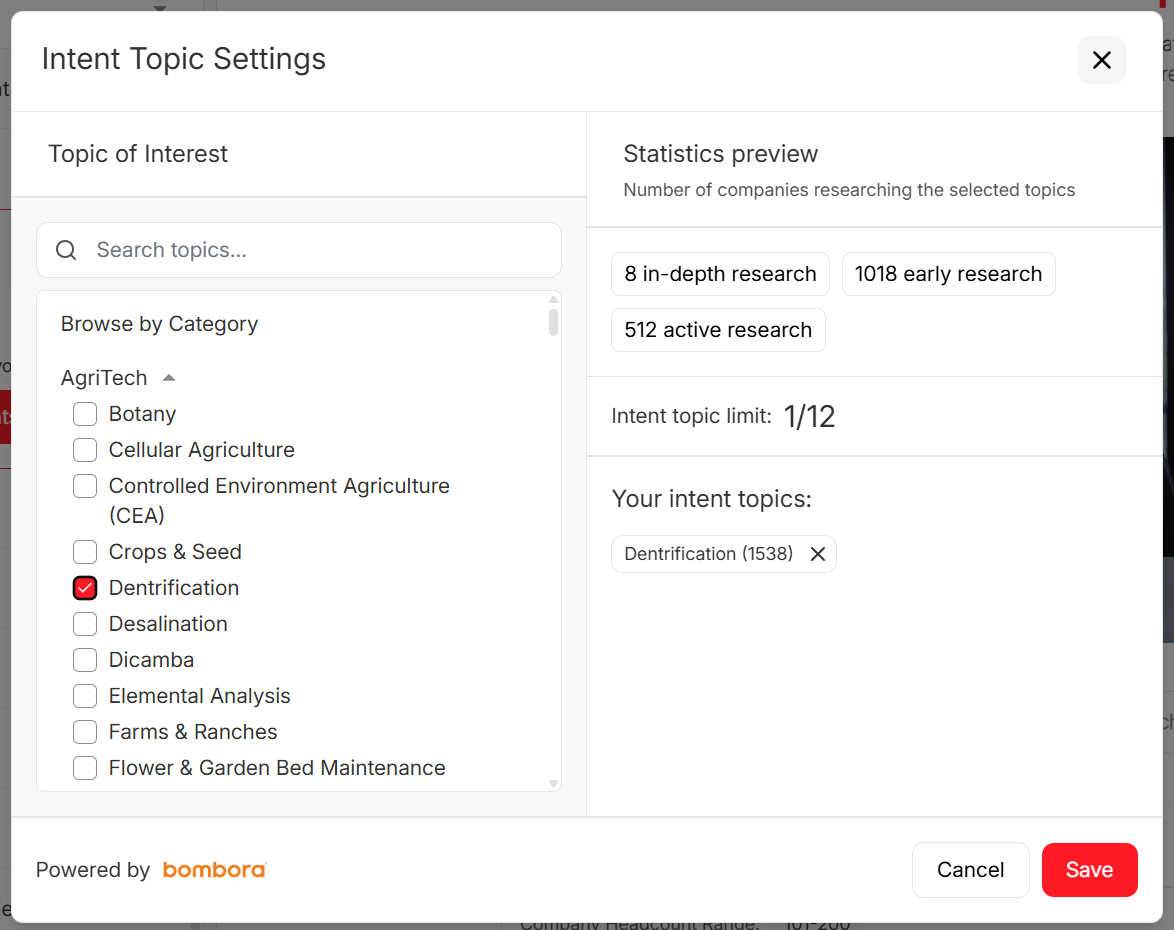
Your account-based funnel is only as good as the data feeding it. In our experience, the single biggest failure point isn't strategy or creative - it's launching campaigns against contacts who've changed jobs, emails that bounce, and phone numbers that ring out. Prospeo's 7-day refresh cycle addresses this directly, keeping 300M+ professional profiles and 143M+ verified emails current while most providers refresh every six weeks. Intent data tracking 15,000 topics via Bombora lets you identify which target accounts are actively researching solutions in your category before you spend a dollar on outreach. Pricing is transparent and credit-based at roughly $0.01 per email, with a free tier of 75 emails per month.
ABM Orchestration
6sense and Demandbase are the enterprise heavyweights, combining intent data, advertising, and orchestration into a single platform. Expect $20-100k+ per year depending on modules and scale. They're powerful, but they're where you graduate to once your ABM motion is proven - not where you start.
Marketing Automation and CRM
HubSpot's Marketing Hub includes ABM features starting around $800/mo. Apollo.io offers solid prospecting from $49/mo. Marketo typically runs $1,000-$3,000+/mo for enterprise automation depending on database size. Salesforce Sales Cloud ranges from $25-$330/user/month depending on edition and remains the CRM backbone for most ABM programs.
Let's be honest about what ABM actually costs:
| Stack Level | Monthly Cost | What's Included |
|---|---|---|
| Lean | $100-500/mo | Prospeo + HubSpot free + Apollo |
| Full | $2,000-10,000/mo | HubSpot Pro + Cognism + enrichment |
| Enterprise | $50,000+/year | 6sense or Demandbase + Salesforce + Marketo |
If you're just getting started, skip the enterprise platforms. A lean stack with verified data, a free CRM, and coordinated outbound will tell you whether ABM works for your business before you commit to a six-figure annual contract.
Multi-threading 5+ contacts per target account means you need verified emails and direct dials for every stakeholder - not just the ones your CRM remembers. Prospeo's database lets you filter by job title, department headcount, tech stack, and buyer intent across 15,000 topics. At $0.01 per email, building a full buying committee costs less than a single wasted ad click.
Build complete buying committees in minutes, not weeks.
FAQ
What's the difference between an ABM funnel and a demand gen funnel?
A demand gen funnel casts wide and qualifies down; an account-based funnel starts with curated target accounts and expands engagement within each one. 58% of B2B marketers blend both - demand gen for broad awareness, ABM for high-value accounts above $30k ACV.
How long does it take to see pipeline results?
Plan for a 90-day pilot to generate leading indicators like engagement scores and penetration rates. Pipeline and revenue outcomes typically take 6-12 months given enterprise sales cycles. Agree on leading indicators with leadership before launch so nobody kills the program at month three.
Can you run ABM without expensive tools?
Yes. A lean stack - Prospeo for verified contact data, a free CRM tier, and coordinated outbound via Apollo - costs under $500/month. Enterprise platforms like 6sense help at scale but aren't required to start. The biggest investment is the 10-15 hours per week of sales rep time needed to work accounts properly.
How does an ABM sales funnel differ from a standard sales funnel?
A standard sales funnel processes individual leads sequentially - qualify, demo, close. An ABM sales funnel orchestrates multi-threaded engagement across an entire buying committee simultaneously, with marketing and sales coordinating every touchpoint against shared account plans rather than handing off leads at a single stage gate.