

ABM Objectives: What to Measure, What to Skip, and the Math Behind It
Most ABM programs don't fail at execution. They fail at objective-setting.
Teams import their demand gen playbook - MQL targets, lead volume, engagement scores - then wonder why their "ABM program" feels like expensive demand gen with a shorter list. As one marketer put it on r/sales, ABM is just "a refined list of prospect companies with tailored content." They're half-right. The difference between account-based marketing that works and ABM that's a rebrand isn't the tactics. It's the objectives you set from day one.
The Only Metric That Matters
The only account-based marketing objective worth anchoring to is pipeline generated from target accounts. Everything else is a leading indicator.
Start with three numbers:
- Account penetration rate - percentage of target accounts you've actually engaged
- Pipeline from target accounts - dollars sourced or influenced by ABM
- Sales cycle length, ABM vs. non-ABM - proof that account-level focus accelerates deals
TOPO research shows ABM opportunities closed at 53% versus 19% for demand gen. That gap is the entire argument for setting account-specific goals.
The 6 Core ABM Objectives
Forrester benchmarks put account-based marketing at 21-50% higher ROI than traditional marketing. But those numbers only show up when you're measuring the right things.
1. Pipeline from target accounts. The north star. Mature programs should influence at least 50% of total revenue across acquisition and expansion. If you're not tracking this as your primary number, you're running demand gen with extra steps.
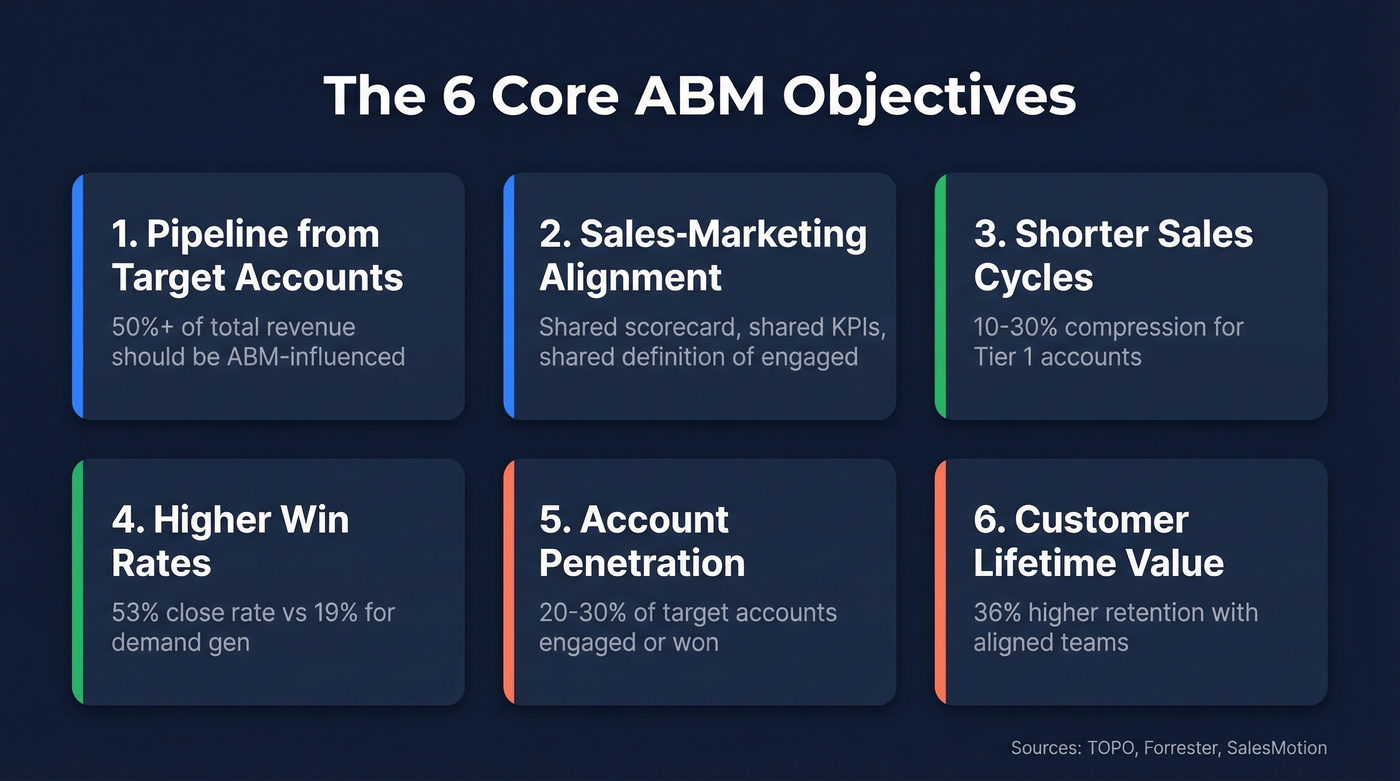
2. Sales-marketing alignment. Not a vibe - a shared scorecard. Both teams track the same KPIs, review the same dashboards, and agree on what "engaged" means before the program launches.
3. Shorter sales cycles. Strong programs compress deal timelines by 10-30% for Tier 1 accounts, mostly because early multi-threading gets the full buying committee involved before procurement slows everything down.
4. Higher win rates. That 53% vs. 19% close-rate gap exists because ABM engages the full buying committee early, not just the loudest lead who downloaded a whitepaper.
5. Account penetration. For enterprise ABM, a penetration rate of 20-30% of target accounts actively engaged or won is strong performance. Below 15%? Your targeting or messaging needs work.
6. Customer lifetime value. Expansion revenue from existing accounts should be a core objective, not an afterthought. Teams that align sales and marketing see 36% higher customer retention.
Objectives by Program Type
A 1:1 program targeting 15 enterprise accounts looks nothing like a programmatic play across 200 mid-market companies. Match your goals to your motion.
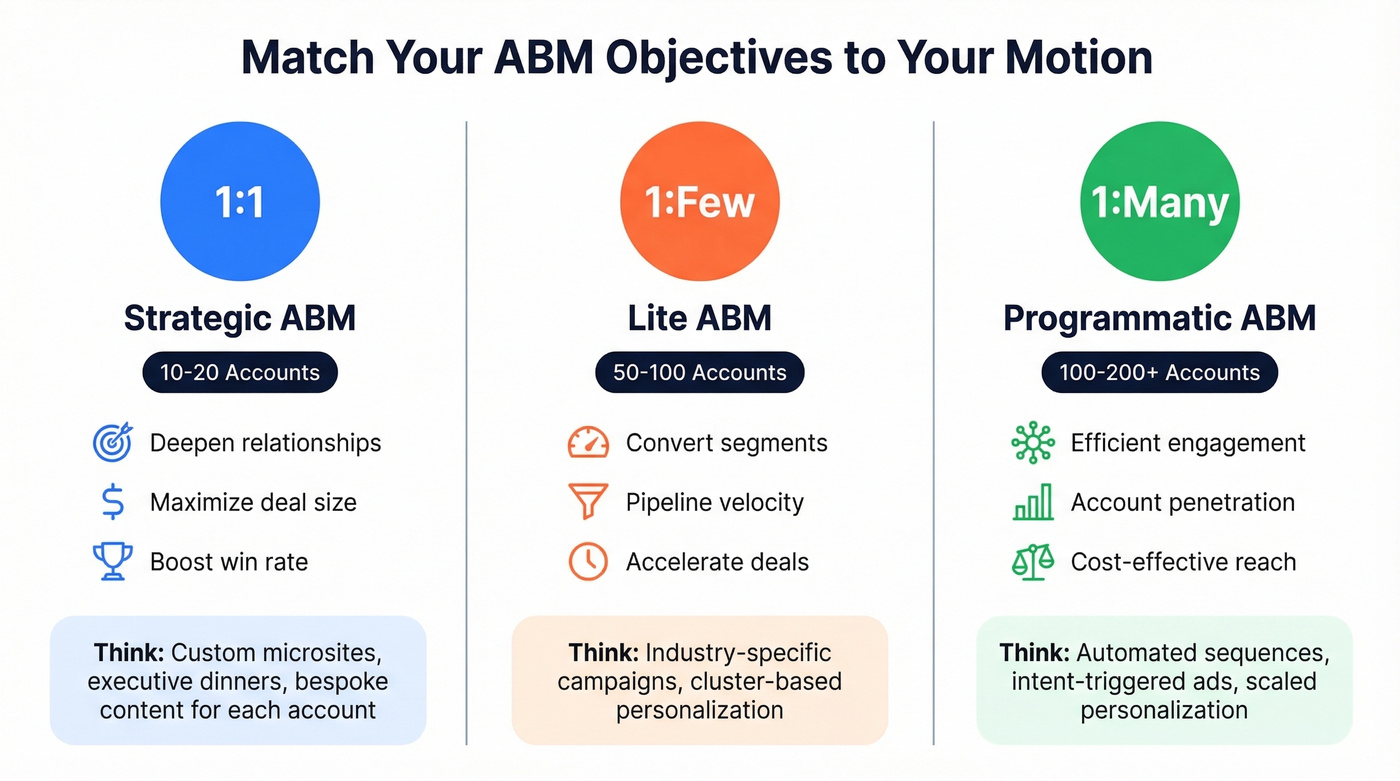
| ABM Type | Accounts | Primary Objective | KPI Focus |
|---|---|---|---|
| 1:1 (Strategic) | 10-20 | Deepen relationships | Deal size, win rate |
| 1:Few (Lite) | 50-100 | Convert segments | Pipeline velocity |
| 1:Many (Programmatic) | 100-200+ | Efficient engagement | Account penetration |
We've watched teams run a 1:many program but set 1:1 objectives, then declare failure when they were actually succeeding. If you're targeting 200 accounts, don't expect deep relationship metrics from every single one.

Multi-threading into a 10-person buying committee means nothing if half your emails bounce. Prospeo delivers 98% email accuracy with a 7-day refresh cycle, so your account penetration numbers reflect real engagement - not failed sends.
Build verified contact lists for every target account at ~$0.01/email.
Pipeline Math for Setting Goals
Work backward. If your ABM closed-won target is $1M and your close rate is 50%, you need $2M in qualified pipeline. Simple.
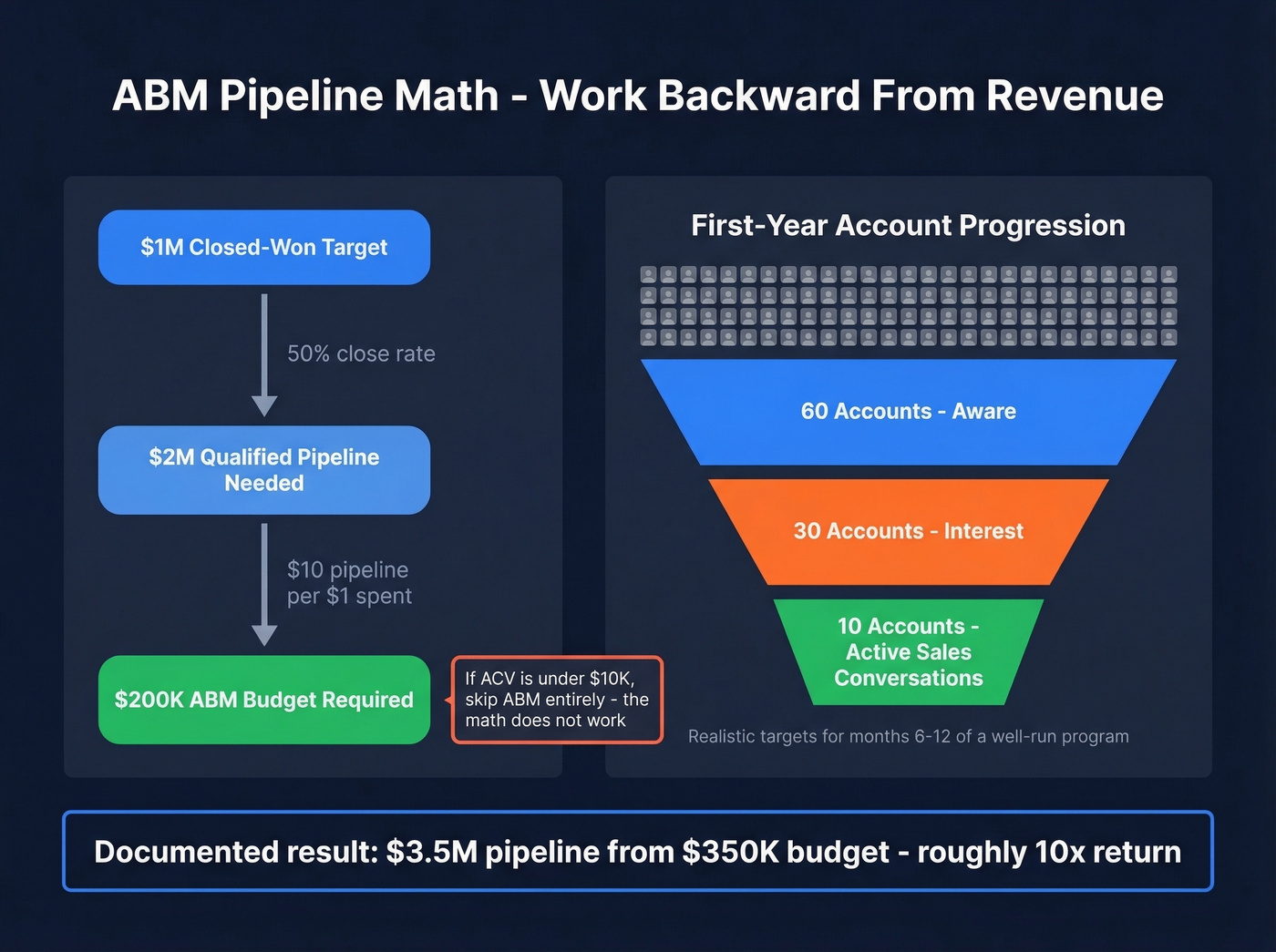
For engagement progression across 100 target accounts, here's what realistic first-year planning looks like: aim for 60 reaching "aware," 30 hitting "interest," and 10 entering active sales conversations. Those aren't aspirational - they're practical targets for months 6-12 of a well-run program.
One documented example: $3.5M in pipeline from a $350K annual ABM budget, roughly $10 in pipeline for every $1 spent. If you're dedicating 30-50% of marketing resources to account-based programs, that ratio should be your floor.
Here's the thing: if your average contract value is under $10K, you probably don't need ABM at all. The math only works when deal sizes justify the per-account investment. Skip this approach entirely if you're selling $5K deals to SMBs - your time is better spent on efficient inbound.
How to Measure ABM Objectives
Nearly 80% of organizations report having an ABM program, but only 29% measure with ABM-aligned metrics. Almost half still track MQLs as their primary signal. That's measuring a marathon by counting steps.
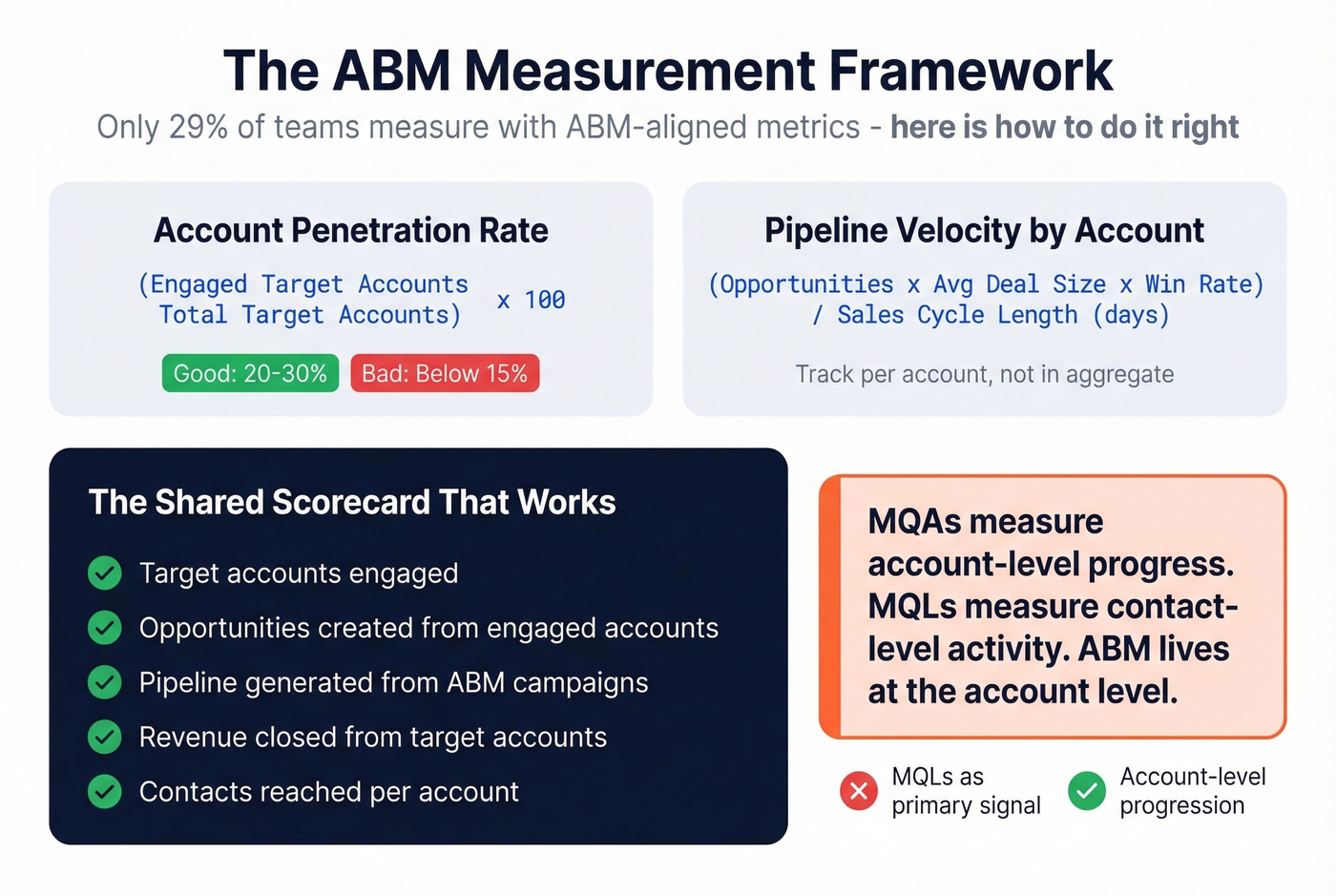
Account Penetration Rate: (Engaged Target Accounts / Total Target Accounts) x 100
Pipeline Velocity by Account: (Opportunities x Avg Deal Size x Win Rate) / Sales Cycle Length (days)
The shared scorecard that actually works:
- Target accounts engaged
- Opportunities created from engaged accounts
- Pipeline generated from ABM campaigns
- Revenue closed from target accounts
- Contacts reached per account
The critical distinction: MQAs measure account-level progress. MQLs measure contact-level activity. Account-based marketing lives at the account level - if your reporting doesn't, your objectives are misaligned.

Account penetration rate is only as good as your contact data. If half your emails bounce when you try to multi-thread into a buying committee, your penetration numbers are fiction. We've seen teams report 40% penetration that drops to 18% once you filter out bounced outreach. Prospeo's 98% email accuracy and 7-day data refresh cycle mean your outreach actually reaches the 6-10 stakeholders who typically shape the deal.
Three Objective-Setting Mistakes
1. Setting MQL targets for ABM. Goals should be "percentage of target accounts moving through funnel stages." The moment you set an MQL number, you've incentivized lead volume over account depth. Every time.
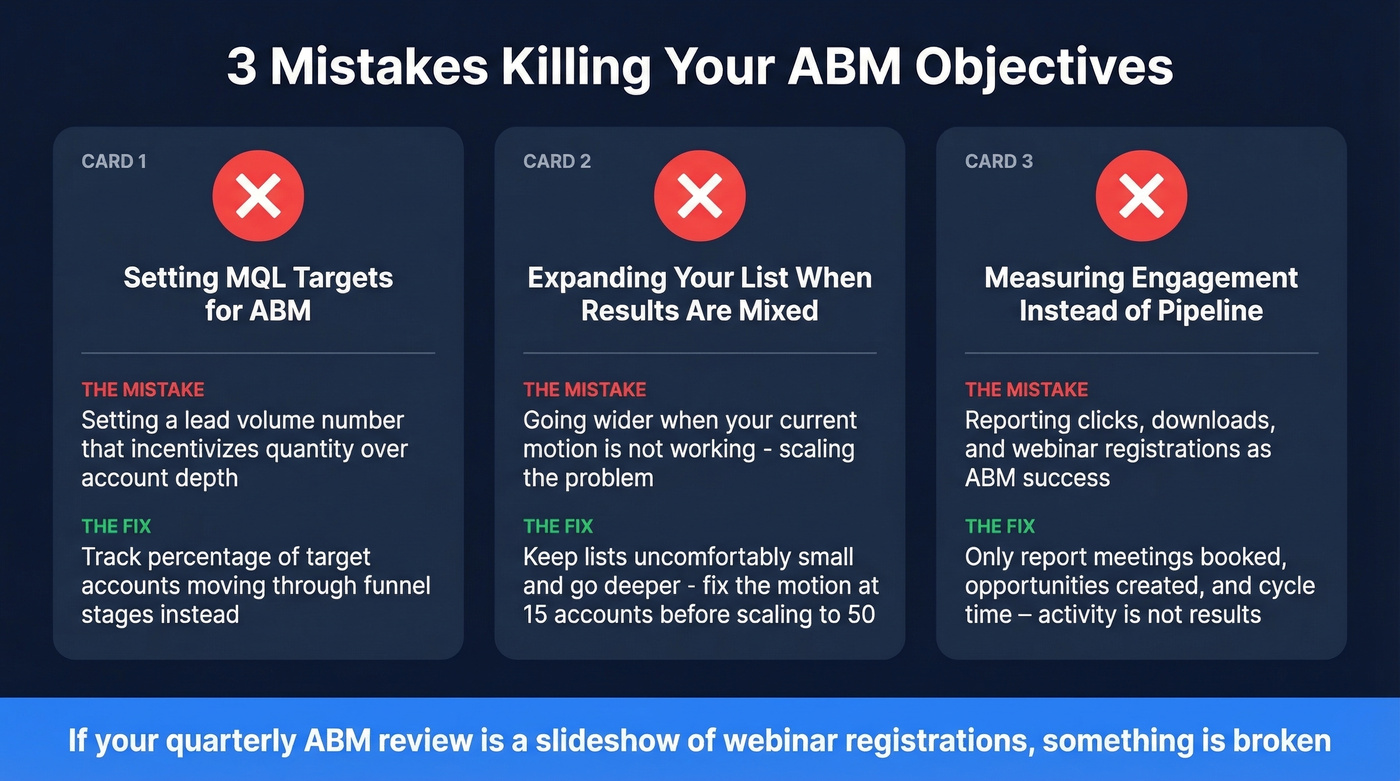
2. Expanding your list when results are mixed. The instinct is to go wider. High-performing teams do the opposite - they keep lists uncomfortably small and go deeper. If your Tier 1 motion isn't working at 15 accounts, scaling it to 50 usually just scales the problem.
3. Measuring engagement instead of pipeline. Clicks and downloads feel like progress. They're activity masquerading as results. Meetings booked, opportunities created, and cycle time are the only signals that matter. Let's be honest - if your quarterly ABM review is a slideshow of webinar registrations, something's broken.
ABM pipeline math breaks down when your contact data decays. Prospeo refreshes 300M+ profiles every 7 days - 6x faster than the industry average - so your Tier 1 outreach reaches the right stakeholders, not dead inboxes.
Stop inflating engagement metrics with bounced outreach.
FAQ
What's the primary objective of ABM?
Pipeline generated from target accounts - full stop. Every other metric like engagement, awareness, and content consumption is a leading indicator. Mature programs aim for ABM-sourced or ABM-influenced revenue to represent at least 50% of total pipeline.
How do you measure ABM success?
Track account penetration rate, pipeline velocity by account, and win rate for ABM vs. non-ABM deals. Use a shared sales-marketing scorecard built around account-level progression, not individual MQLs.
What's the difference between ABM objectives and demand gen goals?
Demand gen optimizes for lead volume across a broad audience. ABM optimizes for depth within a defined set of accounts - measured by account progression, deal size, and named-account pipeline rather than form fills or downloads.
What tools help execute on ABM objectives?
You need intent data to prioritize accounts and verified contact data to multi-thread into buying committees. Intent platforms like Bombora or 6sense handle the signal side, while a data provider with high accuracy handles the contact side - bounced emails kill ABM penetration metrics faster than anything else.