

Account-Based Content Marketing: Frameworks, Formats, and Metrics That Work
Buyers are 60% through their journey before they talk to sales. And 97% of that research happens anonymously - your target accounts are evaluating you right now, and you have no idea. Account-based content marketing exists to close that gap: role-specific, stage-aware content that gives every member of a buying committee a reason to say yes.
A late-2025 survey of 771 marketers found that organizations running ABM report an average ROI of 137%, with 71.2% now implementing ABM strategies. Yet the content layer - the part that actually earns attention - remains the weakest link for most teams.
You don't need a six-figure ABM platform to start. You need a buying committee content map, a tiered personalization model, and verified contact data for every stakeholder. A CRM, an email finder, and your existing marketing automation can run a meaningful pilot. The expensive tooling comes later, after you've proven the model works.
What Is ABCM (and How It Differs from ABM)?
Account-based content marketing is the content discipline within ABM, not a synonym for it. ABM is the strategy - targeting named accounts with coordinated sales and marketing efforts. ABCM is how you build and deploy the assets that fuel that strategy: role-specific content, triggered by intent signals, measured at the account level rather than the contact level.
"Isn't this just good marketing with a fancy name?" You'll find this exact debate on r/b2bmarketing, where practitioners regularly push back on ABM as a rebranding of what good B2B teams already do. The difference is specificity and measurement. Traditional content marketing creates assets for personas and measures leads. ABCM creates assets for named accounts and buying committee roles, then measures whether those specific accounts move through pipeline stages. If you're not doing both - named-account targeting and account-level measurement - you're running targeted demand gen, not ABCM. The skeptics aren't wrong that the principles overlap; they're wrong that the execution is the same.
94% of B2B marketers now employ some form of ABM. The content piece is where most teams still struggle - and where the biggest competitive advantage lives.
Three Tiers of ABM Content Strategy
Not every account deserves a custom microsite. The standard framework breaks ABCM into three tiers based on personalization depth and content effort.
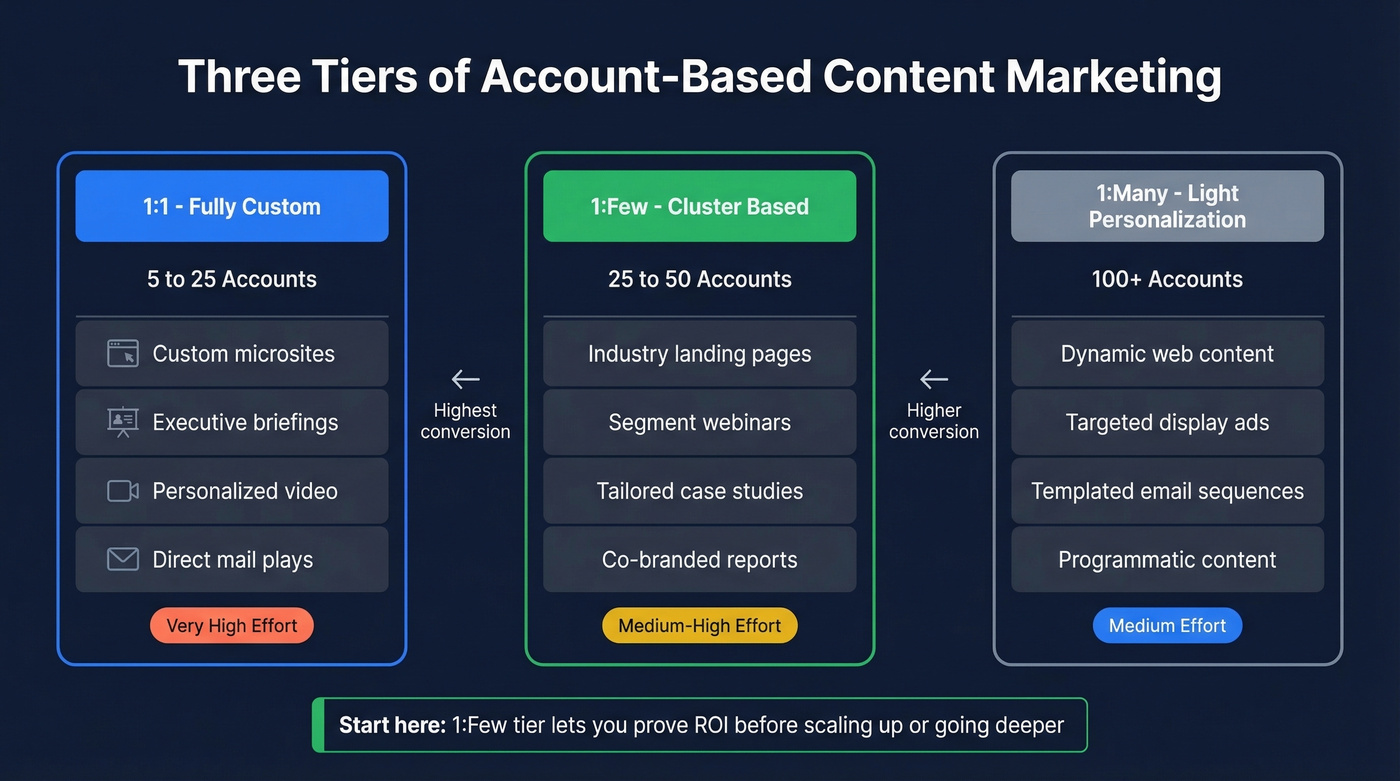
| Tier | Account Volume | Personalization | Example Formats | Effort |
|---|---|---|---|---|
| 1:1 | 5-25 accounts | Fully custom | Custom microsites, exec briefings, personalized video | Very high |
| 1:Few | 10-30 accounts | Cluster-based | Industry-specific landing pages, segment webinars | Medium-high |
| 1:Many | 100+ accounts | Light personalization | Dynamic web content, targeted ads, templated emails | Medium |
The LiveRamp case study illustrates what 1:1 looks like in practice. They ran a high-touch program targeting just 15 accounts with customized display ads, personalized emails, and direct mail. 33% of cold leads converted to meetings within four weeks. Customer lifetime value increased 25x over two years. That's the power of deep personalization - but it only works at small scale.
Most teams should start in the 1:few tier. Pick 25-50 accounts that share an industry or pain point, build content for that cluster, and measure engagement before scaling up or going deeper. 62% of marketers can measure positive impact since adopting ABM, but only if they're realistic about which tier matches their resources.
Map Content to Your Buying Committee
Here's where most ABCM programs fall apart. Teams create great content for one persona - usually the champion - and ignore everyone else in the room. Gartner research puts the average B2B buying committee at 11 stakeholders. You don't need content for all 11, but you need it for at least five archetypes.
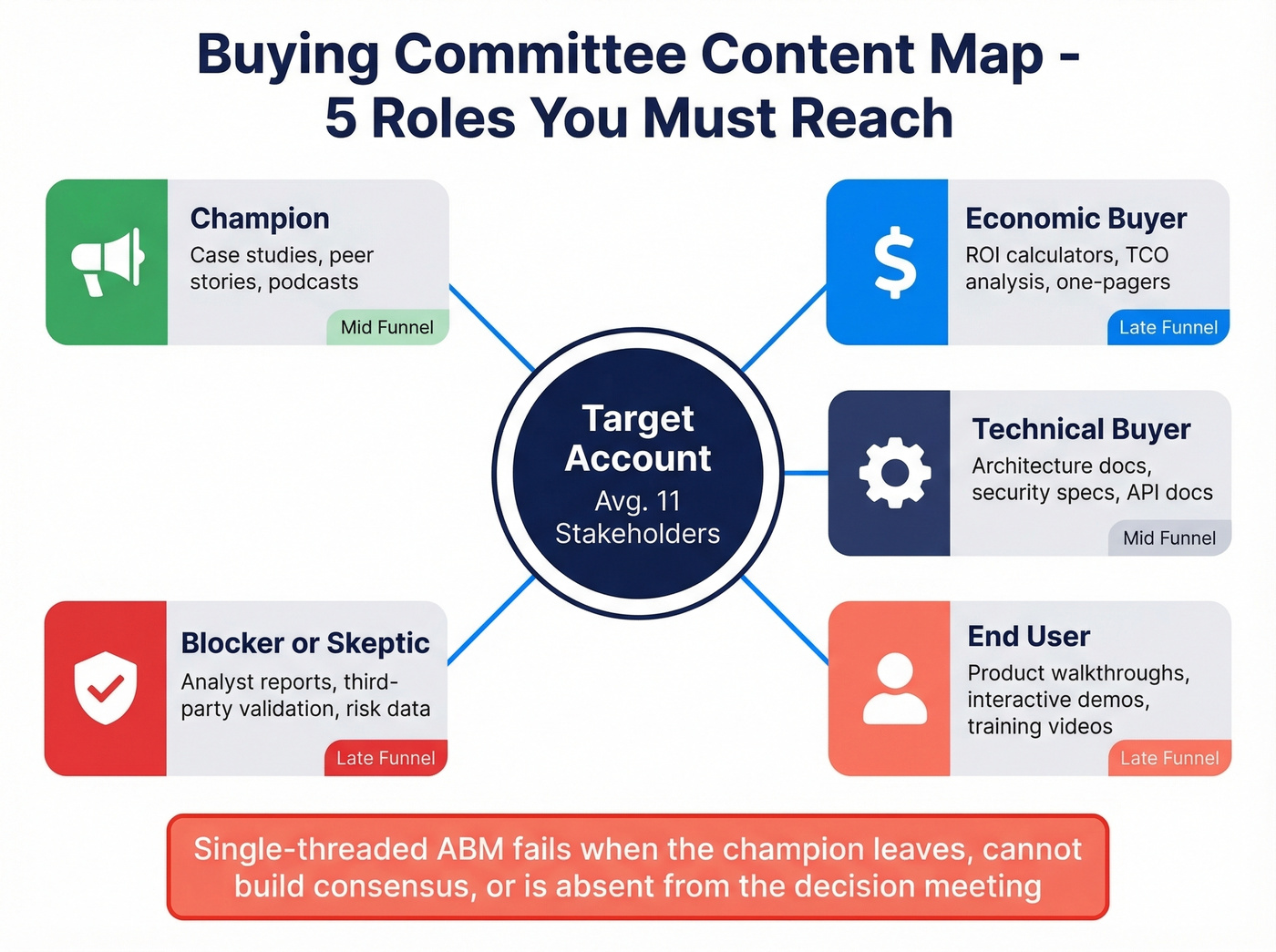
| Role | Content Types | Formats | Stage Focus |
|---|---|---|---|
| Champion | Use cases, peer stories | Case studies, podcasts | Mid funnel |
| Economic Buyer | ROI calculators, TCO analysis | Spreadsheets, one-pagers | Late funnel |
| Technical Buyer | Architecture docs, security specs | Whitepapers, API docs | Mid funnel |
| End User | Product walkthroughs, training | Videos, interactive demos | Late funnel |
| Blocker/Skeptic | Third-party validation, risk & compliance data | Analyst reports, comparisons | Late funnel |
Single-threaded ABM fails for three predictable reasons. The champion leaves the company. The champion can't build internal consensus alone. Or decisions happen in meetings where the champion isn't present. Multi-threading - reaching multiple stakeholders with role-appropriate content - is the fix.
The practical bottleneck isn't strategy; it's data. Finding verified contacts for 6-11 stakeholders across dozens of target accounts is tedious work. We've found that tools with granular search filters (by title, department, seniority) make multi-threading possible instead of theoretical - without that data layer, buying committee mapping stays a whiteboard exercise.
The execution model is straightforward: map the committee before the campaign launches, build role-specific content tracks, stagger outreach over 2-3 weeks, measure engagement at the account level, and alert sales with stakeholder context when engagement spikes.
Formats That Drive Pipeline
Webinars and original research remain the highest-converting ABCM formats. Orbit Media's playbook recommends building a webinar as your primary conversion asset - live video builds trust, and deadlines create urgency. Pair it with original research as the topic, and you've got a reason for every stakeholder to show up.
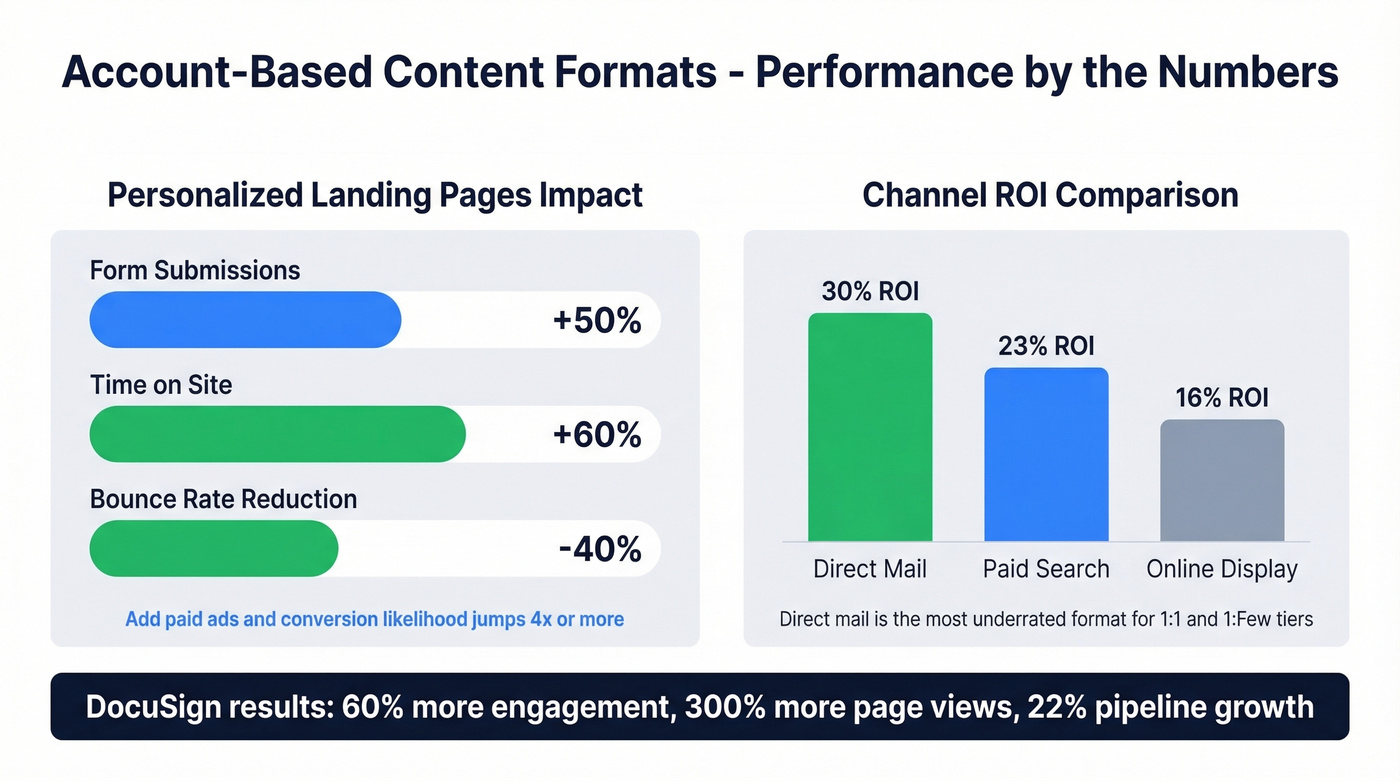
Personalized landing pages often do the heaviest lifting with the least attention. DemandScience data shows personalized web experiences drive 50% higher form submissions, 60% longer time on site, and 40% lower bounce rates. Combine personalized on-site experiences with paid ads and conversion likelihood jumps 4x or more. DocuSign proved this at scale - tailored industry content with personalized on-site experiences produced a 60% increase in engagement, 300% rise in page views, and 22% growth in sales pipeline.
Direct mail is underrated for 1:1 and 1:few tiers. Industry benchmarks put direct mail ROI at around 30%, compared to paid search at 23% and online display at 16%. One creative example: an agency mailed a guide inside a locked safe to CIOs, then mailed the combination code to security managers - forcing internal collaboration to access the content. That's the kind of play that earns meetings with accounts that ignore every digital touchpoint.
Video is the format most teams underinvest in. In our experience, a short promo video reused across outreach, sponsored content, and landing pages compounds engagement in ways static content can't match.

Buying committee mapping dies on the whiteboard without verified contact data. Prospeo gives you 30+ search filters - title, department, seniority - across 300M+ profiles so you can find every stakeholder in your target accounts, not just the champion.
Turn your buying committee map into a live contact list in minutes.
Trigger Content with Intent Signals
Calendar-based content activation is one of the biggest ABCM mistakes. Sending a case study because it's "Week 3 of the nurture" ignores what the account is actually doing. The Factors.ai framework gets this right: group accounts by shared decision blockers - budget approval, security review, internal consensus - not just industry or size, and trigger content based on behavior.
Map these intent signals to specific content actions:
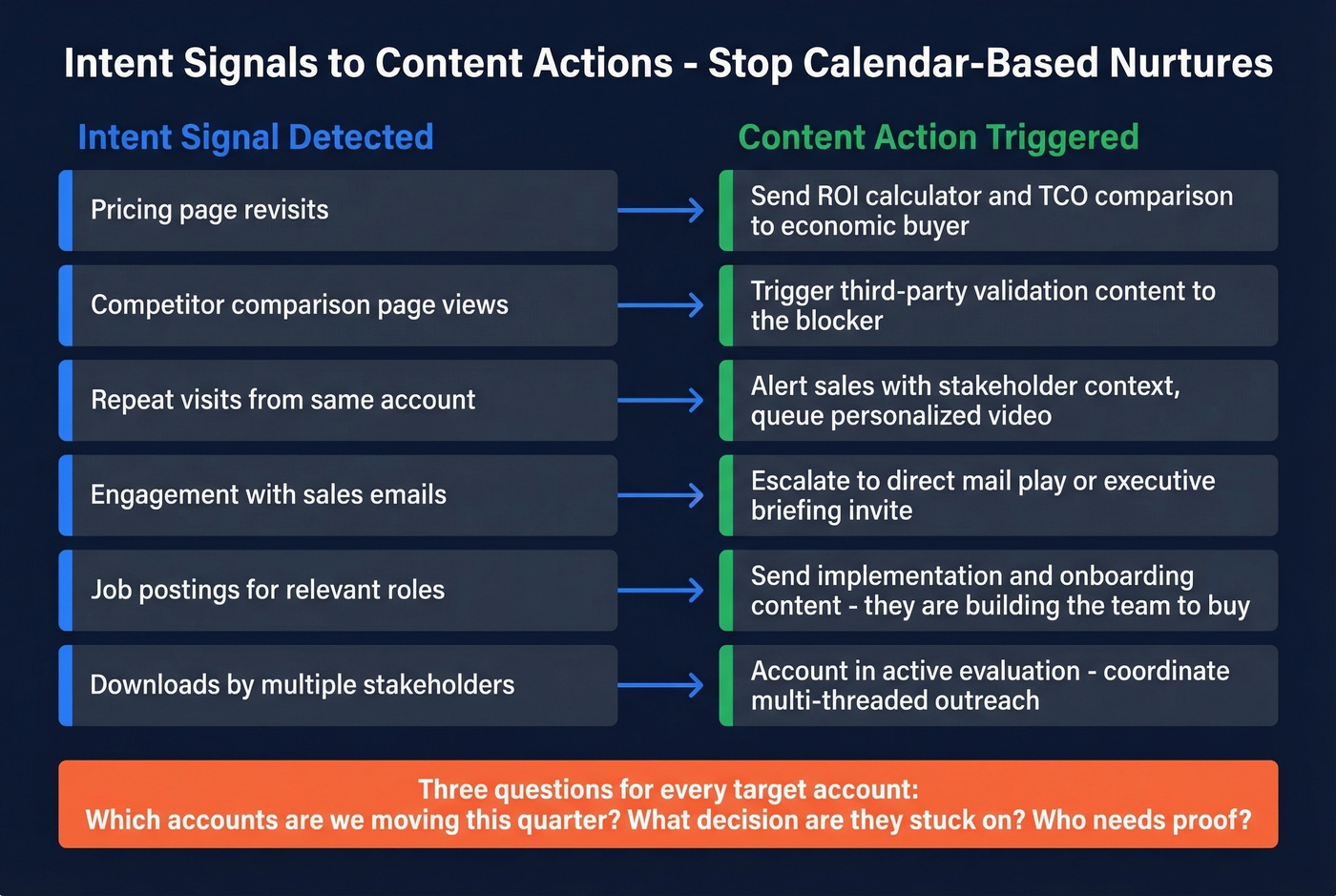
- Pricing page revisits - Send ROI calculator and TCO comparison to the economic buyer
- Competitor comparison views - Trigger third-party validation content to the blocker
- Repeat visits from the same account - Alert sales with stakeholder context and queue a personalized video
- Engagement with sales emails - Escalate to a direct mail play or executive briefing invite
- Job postings for relevant roles - Send implementation and onboarding content (they're building the team to buy)
- Downloads by multiple stakeholders - The account is in active evaluation; coordinate multi-threaded outreach
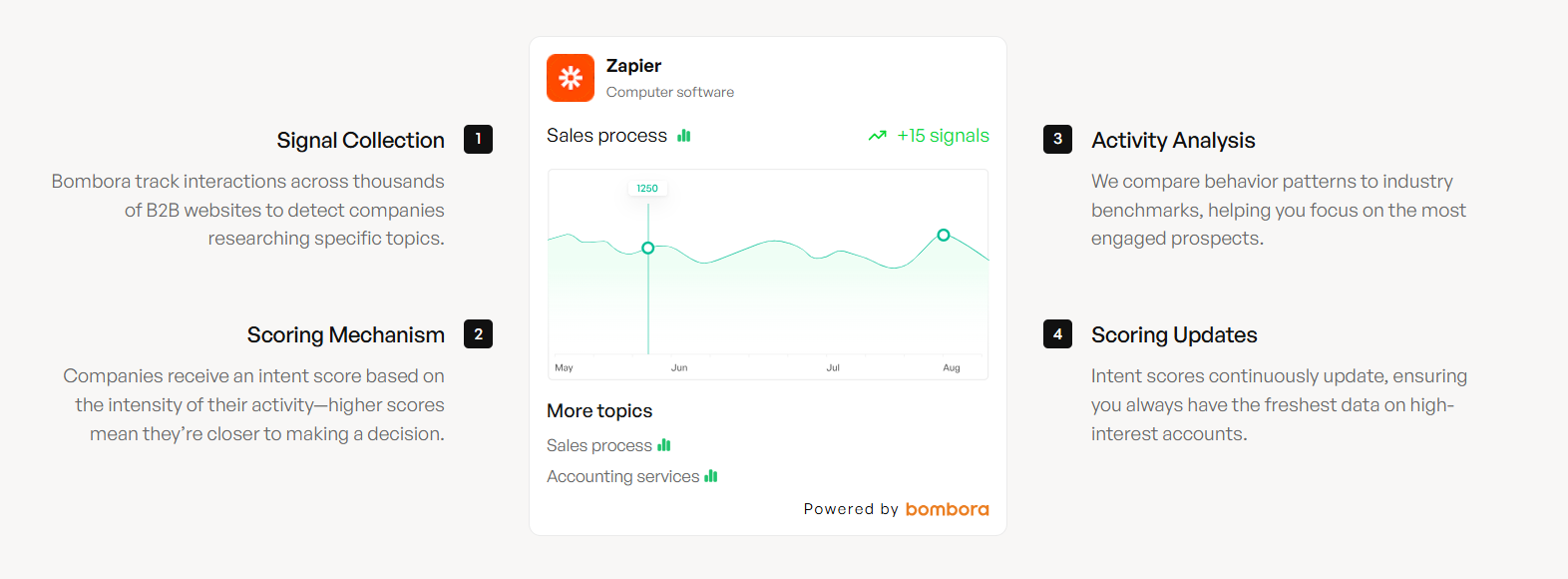
Intent data platforms tracking thousands of topics help identify which accounts are actively researching before you waste content on accounts that aren't in-market. Prospeo layers Bombora-powered intent data across 15,000 topics directly into its search filters, so you can combine buyer intent signals with job role, company growth, and technographic criteria - building lists of in-market stakeholders rather than cold accounts.
Three planning questions that matter for every target account: Which accounts are we trying to move this quarter? What decision are they stuck on? Who needs proof? If you can't answer all three, your content is flying blind.
Content for Every Pipeline Stage
ABCM isn't just about generating net-new pipeline. The four goals are net-new pipeline creation, pipeline acceleration, expansion/upsell, and renewal. Most teams over-index on the first and ignore the other three.
Pipeline acceleration content is where the biggest wins hide. One program improved win rates from 12.5% to 50% by deploying stage-specific content to accounts already in the funnel. CrossKnowledge saw marketing's contribution to qualified pipeline jump from 35% to 60%, with 26% of target accounts engaging in multiple meetings over six months. Charlesgate generated $3M+ in revenue and a record sales quarter using account-targeted content - proof that ABCM scales beyond tech.
Engagement-based outreach - content triggered by account behavior rather than a cadence - consistently achieves 30%+ response rates. The key is buyer enablement content: business cases and ROI frameworks for champions to circulate internally. Pair that with objection-handling materials for committee members who weren't in the demo and personalized content hubs that give every stakeholder a self-serve path to the information they need.
Measuring Account-Based Content Marketing
If your ABM goal is generating leads, you're measuring the wrong thing.
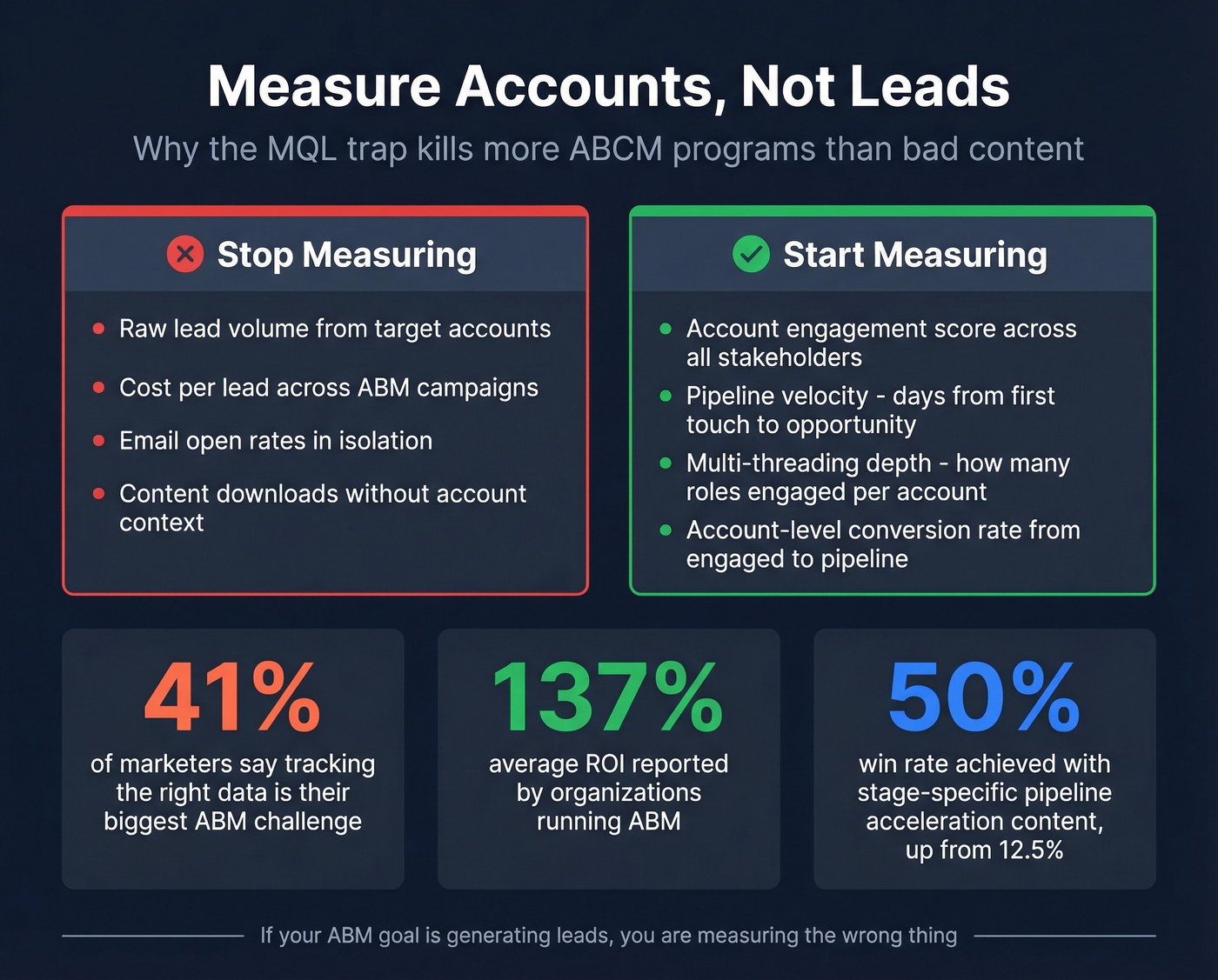
The MQL trap kills more ABCM programs than bad content does. 41% of marketers cite inability to track the right data as their biggest ABM challenge - and most of that comes from applying contact-level metrics to an account-level strategy. Contact-level attribution breaks in ABM because the buying journey spans multiple people, channels, and touchpoints that no single contact record captures.
The right KPIs are account-level:
- Account progression rate - percentage of target accounts moving through stages (aware, interested, considering, selecting, won)
- Engagement depth - how many stakeholders are engaging, not just how many clicks
- Pipeline velocity - target accounts versus non-target accounts
- Won revenue - attributed to target account programs
These metrics tell you whether your content is moving deals, not just generating activity.
Common ABCM Mistakes
Format monotony. If your content library is 90% datasheets, you're losing every stakeholder who doesn't read datasheets. Mix formats - analyst reports, short video, interactive tools, podcasts. The Demandbase framework calls this breaking "big rock" assets into smaller "pebbles" across formats.
Discarding content too early. A Q3 2024 asset was still the top-performing piece in Q2 2025 for one team we spoke with. Refresh with new stats and a fresh headline before you retire anything.
Calendar-based activation. Sending content on a schedule instead of triggering it by intent signals wastes your best assets on accounts that aren't ready. Skip this approach entirely if you have any intent data at all.
No stage assignment. Every asset should have a clear stage job. If you can't say "this piece is for accounts in consideration who need technical validation," the content is directionless.
Building Your ABCM Tech Stack
You don't need a six-figure platform to start. Here's how to think about tooling by maturity stage.
| Stack Tier | Tools | Approx. Cost | Best For |
|---|---|---|---|
| Starter | CRM (free) + Prospeo (from $0) + existing email | Under $500/mo | Pilots, SMBs, first program |
| Growth | + HubSpot (~$800/mo) + Mutiny (~$1K-3K/mo) | $2K-5K/mo | Mid-market, scaling |
| Enterprise | + Demandbase/6sense ($30K-100K+/yr) + Bombora ($25K-50K+/yr) + Marketo (~$1.5K-3K+/mo) | $60K-200K+/yr | Large orgs, 500+ accounts |
Before you invest in an ABM platform, get your contact data right. Verified emails and direct dials for every member of the buying committee - that's the foundation everything else sits on. A 7-day data refresh cycle (versus the 6-week industry average) means your committee lists stay current as stakeholders change roles, which happens more often than most teams account for.

For the growth tier, HubSpot Marketing Hub handles most SMB and mid-market ABM workflows - ABM lists, dashboards, and automated workflows. Marketo is the enterprise play if you need advanced reporting and deep integrations, though the learning curve and setup costs are steep. ActiveCampaign works as a budget option (from ~$29/mo) for basic segmentation and drip campaigns, but it lacks advanced ABM features.
Let's be honest about the real pattern we see: 49.7% of ABM practitioners plan to increase their budgets in 2026, and 78.7% now incorporate AI into their programs. A SEMrush study found 68% of businesses report increased content marketing ROI when using AI for personalization and targeting. The tooling matters, but most teams buy the platform before they've built the content engine. That's backwards. Prove the model with a CRM, a contact data tool, and good content. Then scale the stack. Your content strategy should dictate your tooling choices, not the other way around.
If you're evaluating enterprise ABM suites, compare options before committing to a long contract with best Kapta alternatives and best Metadata.io alternatives.
Multi-threading 6-11 stakeholders per account means nothing if half your emails bounce. Prospeo's 98% email accuracy and 7-day data refresh keep your ABCM campaigns out of spam folders - so role-specific content actually reaches the right people.
Stop sending personalized content to dead email addresses.
FAQ
Is account-based content marketing just good marketing with a fancy name?
No. ABCM creates content for named accounts and specific buying committee roles, then measures whether those accounts advance through pipeline stages. If you're not doing named-account targeting with account-level measurement, you're running targeted demand gen, not ABCM.
How many accounts should I target for a pilot?
Start with 10-25 accounts in your 1:few tier. That's enough to identify engagement patterns but small enough to personalize without burning out your content team. Expand only after you see account progression signals.
What's the minimum budget to get started?
A CRM and a contact data tool with a free tier. You can run a meaningful pilot for under $500/month. The real investment is content creation time, not software licensing.
How long before ABCM shows pipeline results?
Expect 3-6 months for measurable pipeline impact. Account engagement signals - multi-stakeholder visits, content downloads, pricing page views - should appear within 4-8 weeks if targeting and content are aligned.
How do ABM and content marketing work together?
ABM identifies target accounts and orchestrates cross-functional outreach; content marketing supplies the assets that earn attention at each stage. Aligned together, every piece has a named audience, a clear stage job, and measurable account-level impact - which separates ABCM from generic demand gen.