

Account-Based Everything: What It Is, Why It Fails, and How to Actually Do It
67% of ABM programs fail to deliver expected results in their first year. Not because the strategy is wrong - because the execution is sloppy, the data decays, and sales never touches half the accounts marketing hand-picks. Account-based everything is a simple concept: get your entire revenue team working the same accounts. The reality is messier.
What You Need (Quick Version)
- ABE = your entire revenue team operating around target accounts. Not just marketing. The acronym doesn't matter; alignment and data quality do.
- If your average contract value is below $15k/year, skip ABE. Invest in demand gen instead. The coordination overhead doesn't pay off on smaller deals.
- You don't need a six-figure ABM platform. A CRM, a verified data platform, and a sales engagement tool get you started for under ~$5k/year.
What Is Account-Based Everything?
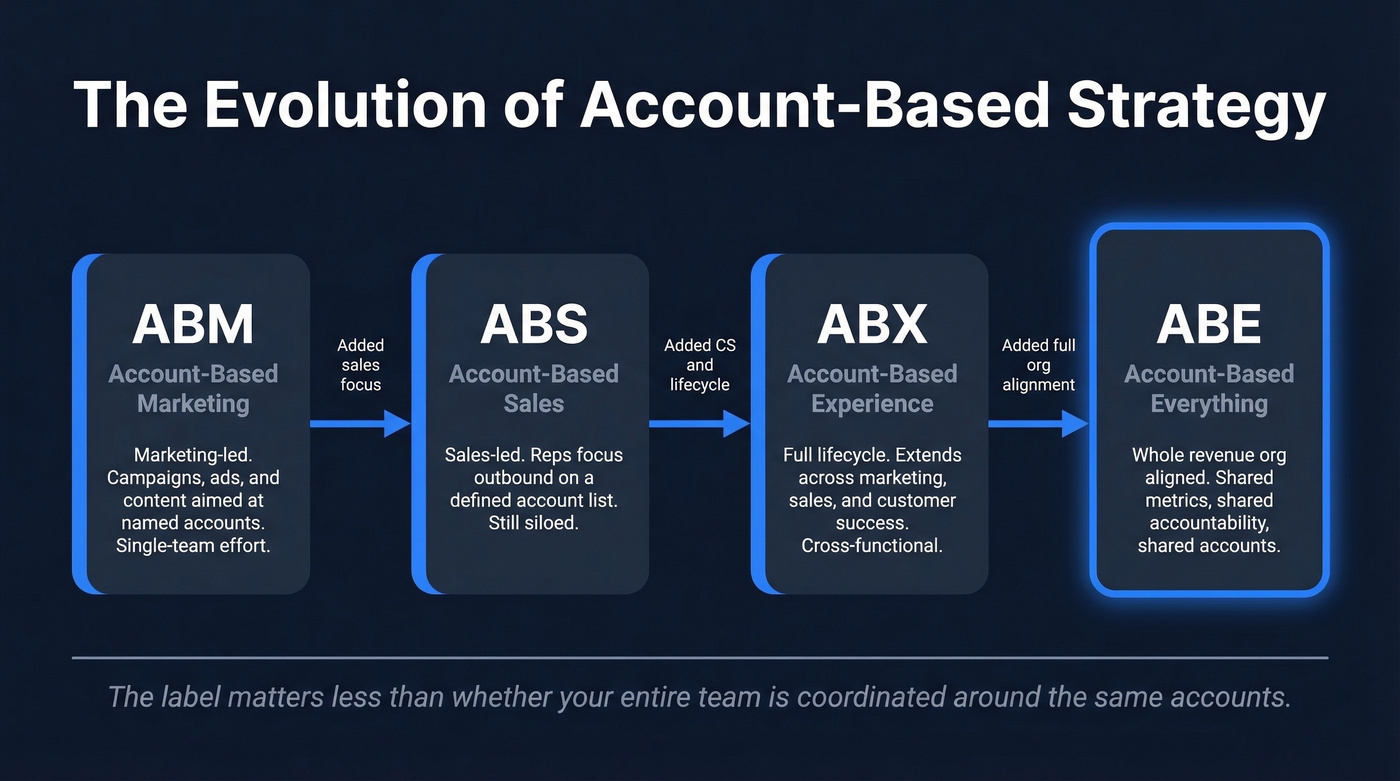
ITSMA coined "account-based marketing" over 20 years ago - marketing and sales collaborating on customized plans for high-value accounts. Then ABM got squishy. Teams slapped the ABM label on lightly personalized email blasts and called it strategy. The "M" signaled marketing-only, which missed the point entirely. So new acronyms appeared:
| Term | What It Means |
|---|---|
| ABM | Marketing-led account targeting - campaigns, ads, content aimed at named accounts |
| ABS | Sales-led account targeting - reps focus outbound on a defined account list |
| ABX | Account-based experience - extends ABM across the full lifecycle including CS |
| ABE | Account-based everything - the whole revenue org aligned around accounts |
In practice, ABX is just ABM done right. The distinction between ABE and ABX is mostly semantic since both demand cross-functional alignment. The label you use matters far less than whether your entire team is actually coordinated around the same accounts with shared metrics and shared accountability. With 71.2% of B2B teams now running some form of ABM, the question isn't whether to do it - it's whether to do it well.
Why ABE Works for B2B
80% of marketers using an account-based strategy say it delivers better ROI than any other marketing program. A survey of 771 marketers pegged estimated average ABM ROI at 137%.
Here's the thing: buying group complexity makes traditional lead gen almost useless at the enterprise level. The average B2B buying committee runs 5.4 people - for enterprise tech, that climbs past 12. Buyers spend just 17% of their process meeting with vendors, split across every vendor in the running. Each vendor gets roughly 5-6% of the buyer's attention. You can't win that game chasing individual leads. You need to multi-thread across the entire buying committee, hitting the CFO, the end user, the IT gatekeeper, and the champion with different messages at different times.
A Forrester Summit keynote reinforced this: teams that shift from MQLs to buying groups see 200% higher win rates.

Multi-threading a buying committee of 12 stakeholders means you need verified contact data for every one of them. Prospeo gives you 300M+ profiles with 30+ filters - buyer intent, technographics, department headcount - so you can map the entire buying group in minutes, not weeks. 98% email accuracy. 125M+ verified mobiles. Data refreshed every 7 days.
Build your target account lists with data that actually connects.
Is ABE Right for You?
Not every team should run an account-based program. Here's a quick readiness check:
- ✅ Average contract value above $15k/year - ABE's coordination overhead pays off at this threshold
- ✅ Sales cycle involves multiple stakeholders, not single-buyer transactional deals
- ✅ You have or can build a shared definition of target accounts between sales and marketing
- ✅ Leadership will give you 18-24 months of runway - ABE isn't a quarterly experiment
- ✅ Start with 5-10 target accounts, not 500 - prove the model before scaling
- ❌ Budget under $3k/month for tools and content - 37% of marketers cite lack of resources as the top constraint
- ❌ Average deals in the four-figure range - stick to demand gen and inbound
Enterprise ABM platforms run $35,000 to $1M+ annually. You don't need one to start.
The ABE Framework
Score Your Accounts
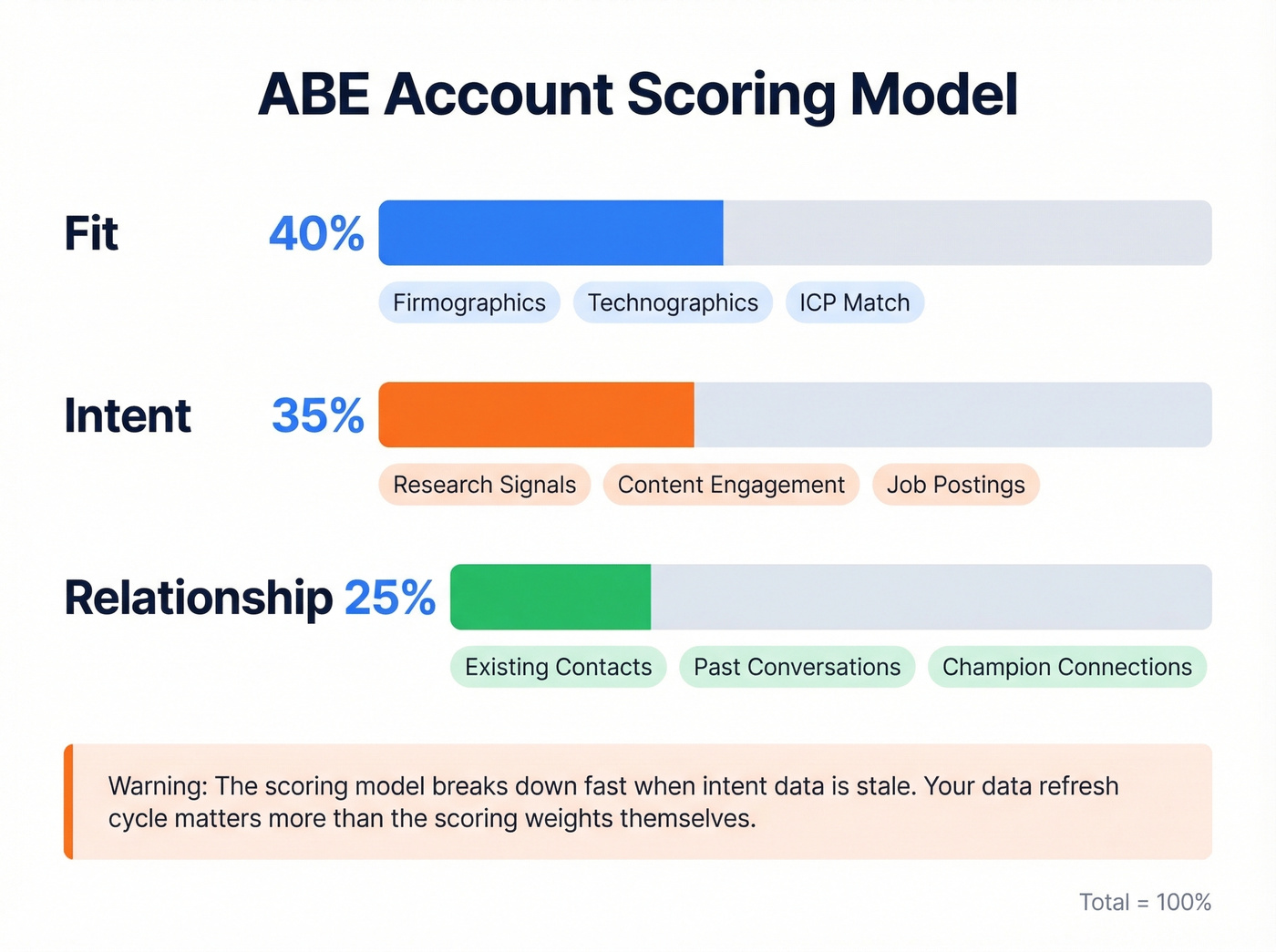
Don't pick accounts that "feel right." Build a scoring model with three dimensions: Fit (40%) covers firmographics, technographics, and ICP match. Intent (35%) tracks active research signals, content engagement, and job postings. Relationship (25%) measures existing contacts, past conversations, and champion connections. We've found the scoring model breaks down fast when intent data is stale - which is why the data refresh cycle matters more than the scoring weights themselves.
Allocate Resources: 70/20/10
Put 70% of resources into proven demand gen that's already working, 20% into ABE implementation, and 10% into experiments. This prevents the classic failure mode where a team abandons everything for ABM and has nothing to show after two quarters. UserGems ran 200-300 accounts per month with this approach and 5x'd revenue in a year - no agency, no massive budget.
Align Sales and Marketing
Even with the best ABM tools, marketing wastes 50% of ABM spend when sales only works half the target accounts. The fix is a shared SLA: joint account reviews, shared metrics, and a meeting cadence that forces accountability.
The #1 sign an ABE program is about to stall? Sales stops attending the bi-weekly account review. If that happens, escalate immediately.
Shift Measurement to MQAs
Stop counting leads. Start counting account engagement. Marketing gets measured on revenue influence across target accounts, not form fills. This is the hardest cultural shift in any account-based program, and it's where most programs stall out - not because people disagree with the idea, but because their comp plans and dashboards still reward the old behavior.
Pick Your Channels
The 2026 ABM Benchmark Survey confirms what practitioners already know: email (92%) and in-person events (72%) dominate. Not programmatic display. Not chatbots. Personalized email to the right contacts at the right accounts, backed by face-to-face at events.
Let's be honest about AI in ABE: 78.7% of teams now use it for targeting and personalization, but nearly 70% say its effectiveness is still limited. Don't buy an AI-powered ABM platform expecting it to replace your strategy. The fundamentals - accurate data, sales-marketing alignment, account scoring - still do the heavy lifting.
Why 67% of ABE Programs Fail
That 67% failure rate comes down to three execution failures that compound on each other.
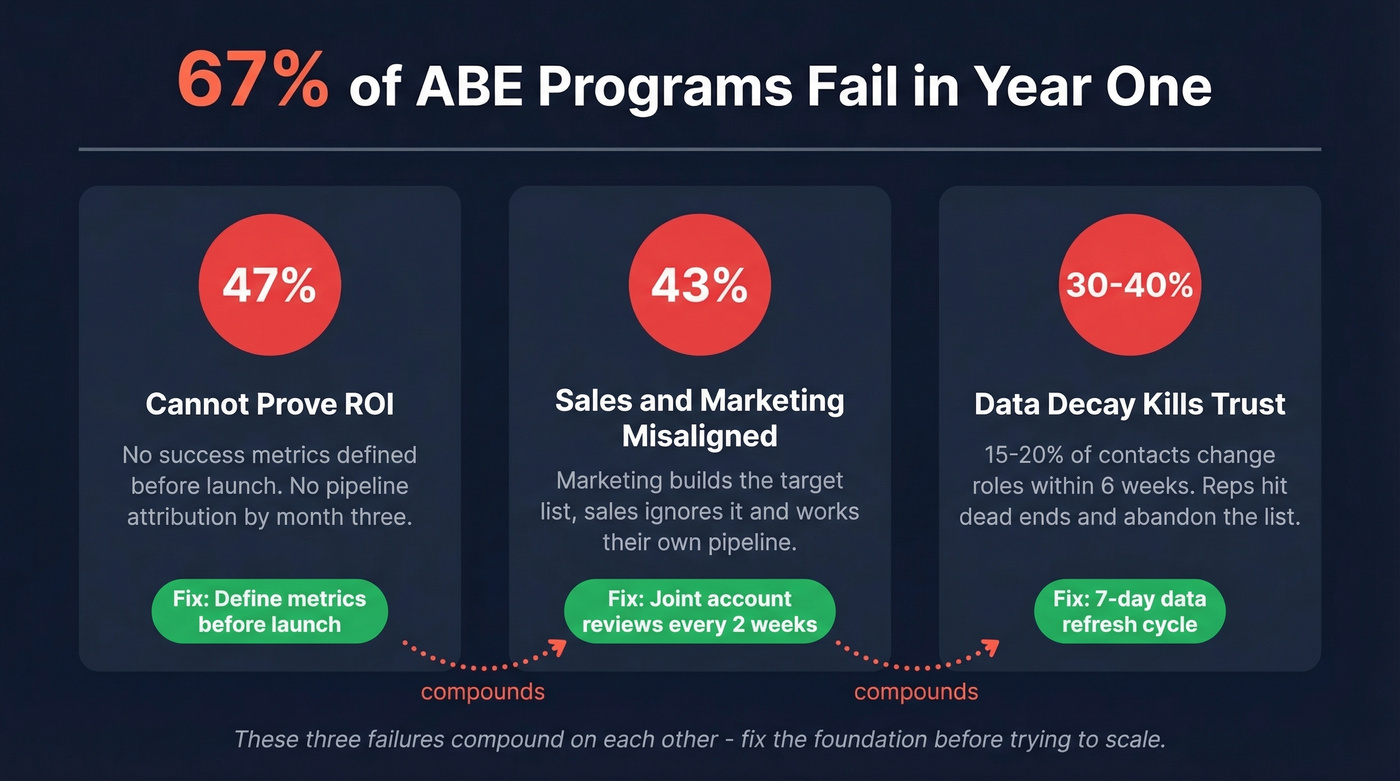
Nobody can prove ROI. 47% of teams cite this as their top challenge. The fix: define success metrics before launch - pipeline influenced by target accounts, meeting conversion rate, deal velocity. If you can't measure it by month three, you didn't set it up right.
Sales and marketing aren't aligned. 43% flag this. We've seen it firsthand - marketing builds a beautiful target account list, sales ignores it and works their own pipeline. Joint account reviews every two weeks and a single account owner per account solve this. When a Pedowitz Group client unified their signals into cross-team plays, meeting rates jumped 34%, opportunity creation rose 22%, and expansion pipeline grew 18%.
Data decay kills trust. Poor data integration causes 30-40% lower account match rates. Picture this: marketing identifies 200 target accounts, enriches them with contacts, and hands them to sales. By the time reps start outreach six weeks later, 15-20% of those contacts have changed roles, bounced emails, or left the company entirely. Reps hit dead ends, lose confidence in the list, and go back to sourcing their own leads. A fourth challenge - scaling programs - affects 40% of teams, but it's downstream of these three. Fix the foundation first.
The Lean ABE Tech Stack
Cognism built a $700k+ pipeline using their existing stack and no six-figure ABM platform. You can do the same.
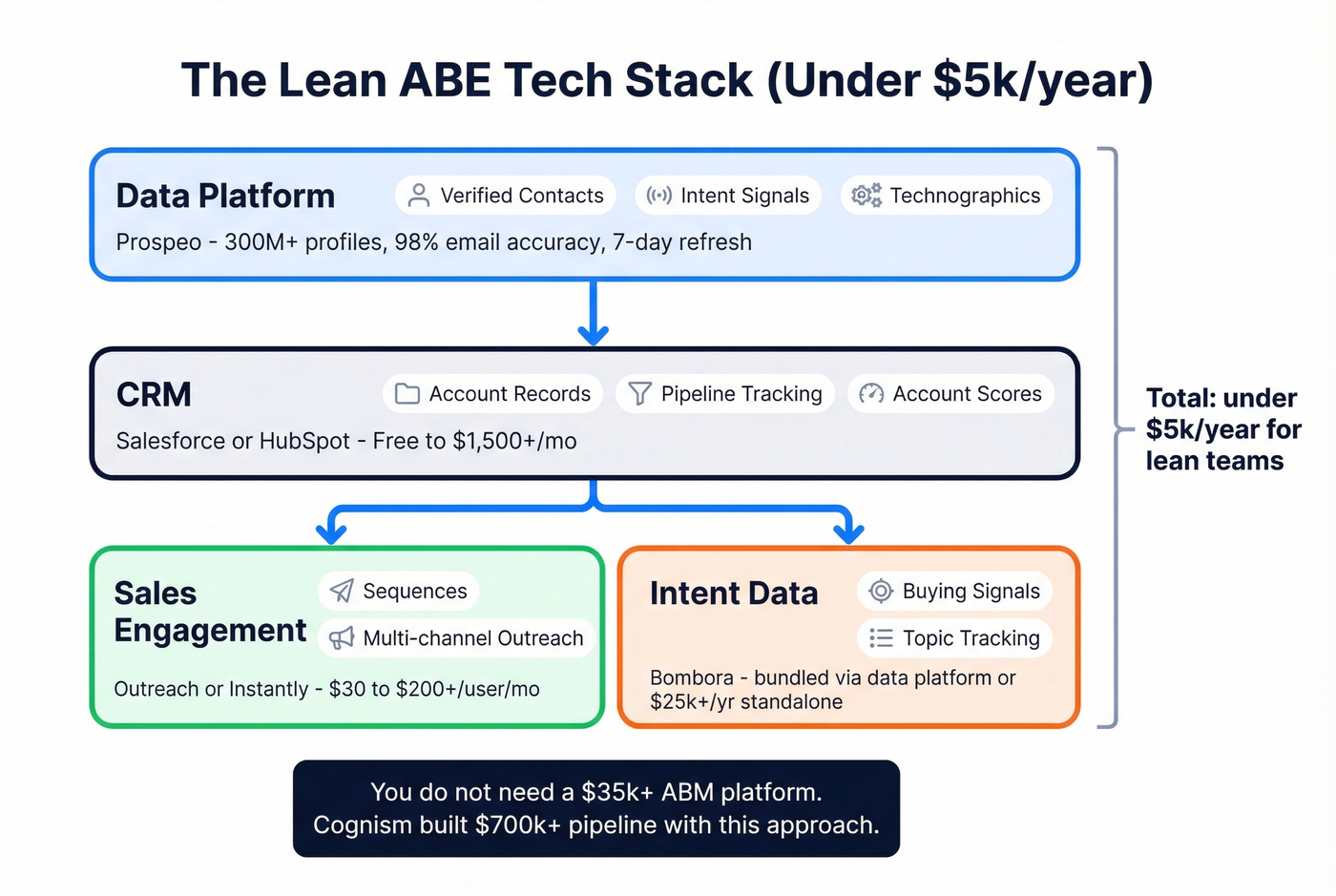
| Category | What It Does | Example | Price Range |
|---|---|---|---|
| CRM | Account records, pipeline | Salesforce, HubSpot | Free-$1,500+/mo depending on seats |
| Data platform | Verified contacts, intent | Prospeo | Free tier available; ~$0.01/email |
| Sales engagement | Sequences, outreach | Outreach, Instantly | ~$30-$200+/user/mo |
| Intent data | Buying signals | Bombora standalone or bundled via data platform | ~$25k-$60k+/yr standalone |
The data layer is where most lean stacks fall apart, because cheap contact data means bounced emails, burned domains, and reps who stop trusting the list. Prospeo covers this with 300M+ professional profiles searchable by 30+ filters - including buyer intent across 15,000 Bombora topics, technographics, and job-change signals. Emails verify at 98% accuracy on a 7-day refresh cycle, so your target account list doesn't decay between quarterly reviews. For teams that need to multi-thread across buying committees, the combination of intent signals and verified direct dials means reps actually reach the stakeholders marketing identified.

For teams running 200-300 target accounts per month, this lean stack delivers accurate contacts, intent signals, and sequenced outreach without the $35k+ annual commitment of a full ABM platform.
You don't need a six-figure ABM platform to run account-based everything. Prospeo starts at $0.01/email with no contracts - giving lean teams enterprise-grade data at 90% less than ZoomInfo. Intent data across 15,000 topics, CRM enrichment returning 50+ data points, and a 7-day refresh cycle so your account scores never run on stale signals.
Stop letting decayed data kill your ABE program before it proves ROI.
FAQ
What's the difference between ABE and ABM?
ABM is marketing-led account targeting. Account-based everything extends that approach to sales, CS, and the full revenue team - you'll sometimes see it called ABE or ABX interchangeably. In practice, ABE is ABM done right: every customer-facing function aligned around the same accounts with shared metrics.
How long before an ABE program shows results?
Expect early signals like meeting rates and account engagement within 3-6 months. Full maturity - measurable pipeline and revenue lift - takes 18-24 months. Set that expectation with leadership before you launch, or risk getting the plug pulled too early.
Can I run ABE without an expensive ABM platform?
Yes. A CRM, a data platform for verified contacts and intent signals, and a sales engagement tool form a viable stack for under ~$5k/year. Start lean, prove the model on 10-20 accounts, then invest in heavier tooling once pipeline results justify it.
Is ABE only for enterprise companies?
No. Any B2B team with average contract values above $15k/year and multi-stakeholder sales cycles can benefit. Mid-market companies running 50-200 target accounts often see the fastest time to ROI because coordination overhead stays manageable.