

Account Based Marketing for Manufacturers: The No-Fluff Playbook
You spent $40K on a trade show booth last quarter. You came back with business cards from companies that'll never buy - while three dream accounts were actively researching your product category online and nobody on your team knew.
That's the gap account based marketing for manufacturers closes.
ITSMA data shows ABM programs drive 78% pipeline growth and 74% revenue growth. In 2026, competitors who started earlier are already shortening sales cycles and locking up the accounts you want. The math isn't subtle.
Why ABM Works for Manufacturers
Use ABM if:
- Your sales cycles run 6-18 months with decision-makers across engineering, procurement, operations, and finance
- Your total addressable market is hundreds or low thousands of companies - not millions
- Your average deal size justifies personalized outreach (think $50K+ contracts)
- You want the 81% higher ROI that ABM delivers over broad demand gen
Skip ABM if you sell commodity parts through a catalog, your average order is under $5K, or your buying "committee" is one procurement clerk.
Here's the thing about manufacturing: buying committees average 10.2 people. When you're selling capital equipment or complex assemblies, you're dealing with engineers, plant managers, finance directors, and C-suite sponsors - all with different concerns, different timelines, and different definitions of "good enough." Spray-and-pray demand gen doesn't work when you need to influence ten people simultaneously. Best-in-class programs see win rates 25-40% higher and deal sizes increase by 75%.
Map the Buying Committee
Before you write a single email, know who's in the room. This is where account based selling in manufacturing gets granular.
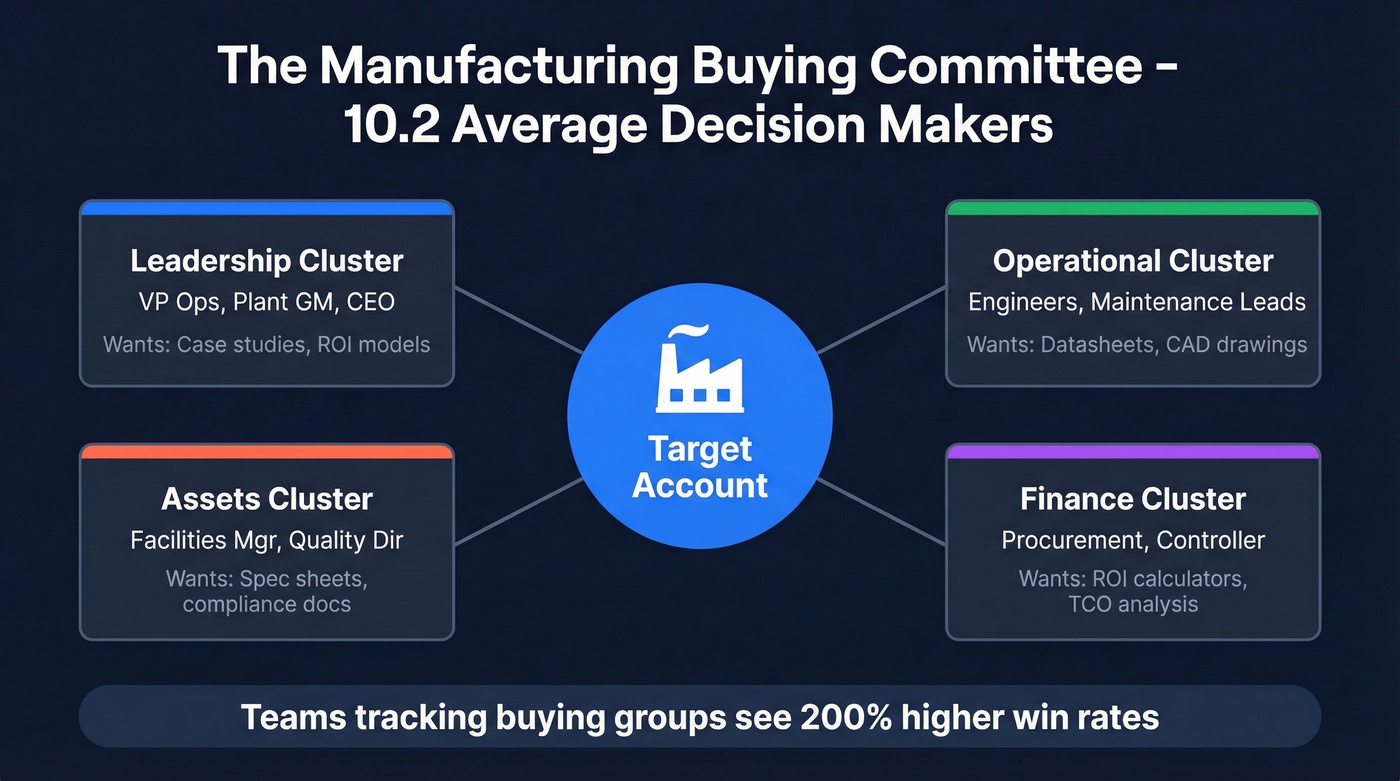
| Cluster | Typical Roles | Content They Want |
|---|---|---|
| Leadership | VP Ops, Plant GM, CEO | Case studies, ROI models |
| Operational | Engineers, Maintenance | Datasheets, CAD drawings |
| Assets | Facilities, Quality | Spec sheets, compliance docs |
| Finance | Procurement, Controller | ROI calculators, TCO analysis |
Engineers researching significant purchases rank datasheets and CAD drawings as the two most useful content types. Your plant manager wants a case study showing 15% throughput improvement. Your CFO wants a payback-period calculator. Sending all three the same whitepaper isn't ABM - it's lazy email marketing with a fancier name.
Teams tracking buying groups instead of individual leads see a 200% increase in win rates. And a common bottleneck is simple: you know which companies to target, but you can't get verified contact data for the right people inside those accounts. Sending to info@ addresses doesn't count.
Six Steps to Launch Your ABM Strategy
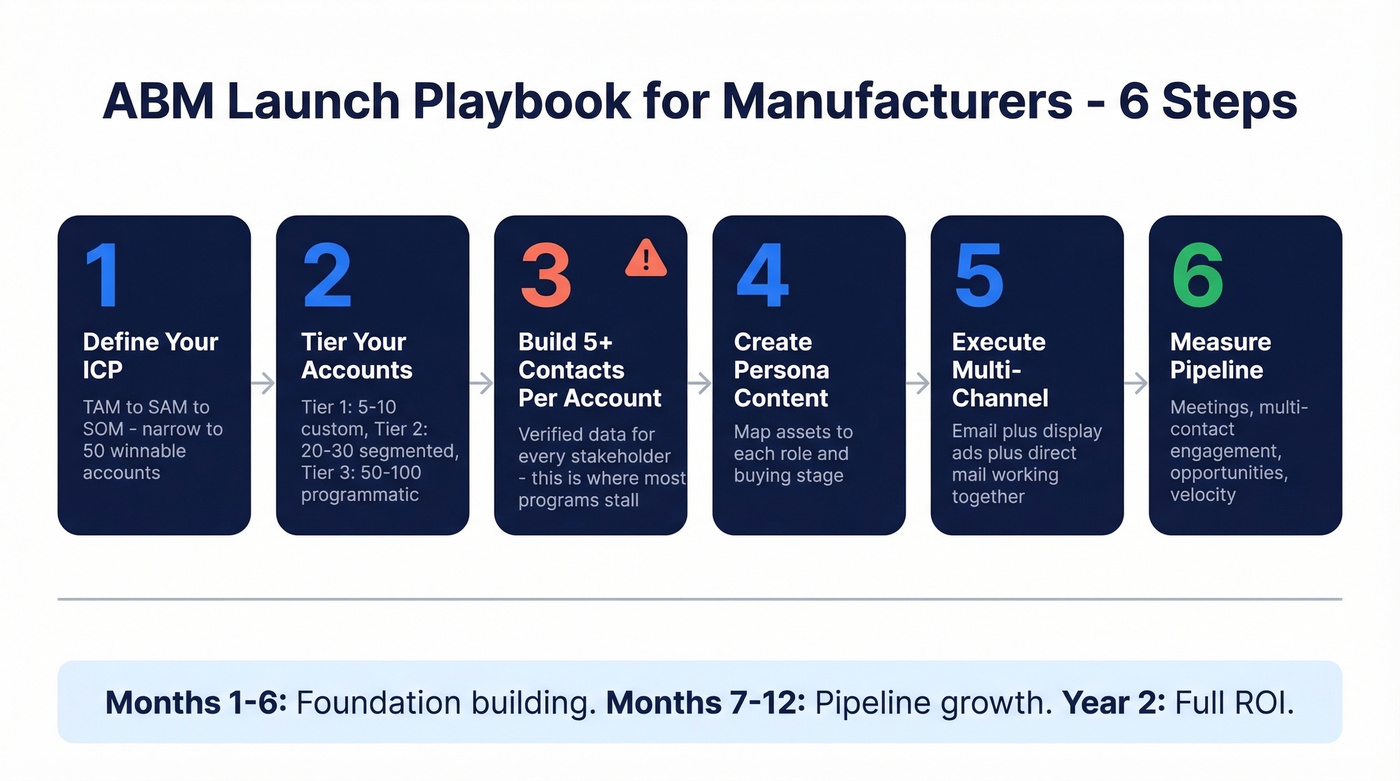
1. Define Your ICP
Start with TAM, then SAM, then SOM. For a manufacturer selling industrial automation, your TAM might be 5,000 plants globally. Your SAM narrows to 800 in North America running legacy equipment. Your SOM - the ones you can realistically win this year - is 50.
2. Tier Your Accounts
Tier 1 (top 5-10) gets fully custom one-to-one campaigns. Tier 2 (next 20-30) gets one-to-few campaigns grouped by segment. Tier 3 (50-100) gets programmatic ABM with targeted ads and automated sequences. This tiered approach is the backbone of any ABM strategy manufacturing teams can actually execute without burning out.
3. Build 5+ Contacts Per Account
The actual starting point isn't "10 target accounts." It's whether you have verified contact data for 5+ people at each one. If not, you're not ready for ABM - you're ready for a data project. In our experience, this is where most manufacturing ABM programs stall before they start.
4. Create Persona-Specific Content
Your R&D engineer needs technical depth. Your procurement director needs pricing frameworks. Your plant manager needs operational proof. Map content to each persona and buying stage - and resist the urge to create one "universal" asset that tries to speak to everyone.
5. Execute Multi-Channel Campaigns
Email sequences, display ads via IP targeting, and direct mail working together. One manufacturer we worked with sent 3D-printed sample parts to target engineers alongside technical schematics - the engagement rate crushed every digital-only campaign they'd run. Don't ignore physical channels because "digital-first" is trendy. Sometimes a box on someone's desk beats a banner ad by a mile.
6. Measure Pipeline, Not Vanity
Track meetings booked, multi-contact engagement within accounts, opportunities created, and pipeline velocity. If your dashboard shows impressions and clicks, you're measuring the wrong things.

Step 3 is where most manufacturing ABM programs die - you can't run multi-stakeholder campaigns without verified contacts for engineers, procurement, and plant managers at every target account. Prospeo covers 300M+ profiles with 98% email accuracy and 125M+ verified mobiles, refreshed every 7 days. Layer in Bombora intent data across 15,000 topics to see which accounts are actively researching your product category right now.
Build 5+ verified contacts per target account in minutes, not weeks.
ABM Tech Stack for Manufacturers
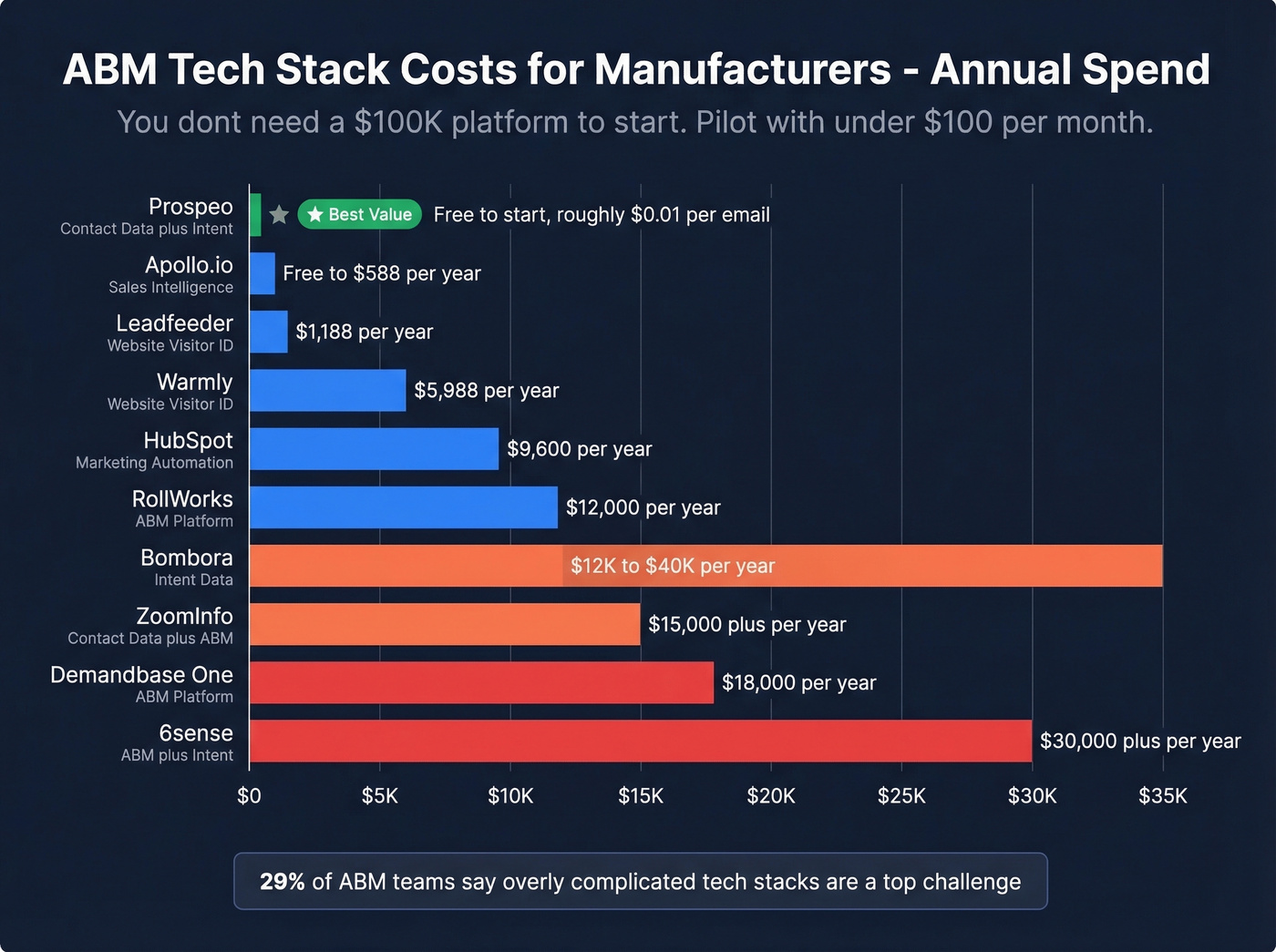
Let's be honest: every ABM vendor says "purpose-built for manufacturing" then gates pricing behind a six-week sales process. Meanwhile, 29% of ABM teams cite overly complicated tech stacks as a top challenge. Here's what the stack actually costs.
| Tool | Category | Starting Price |
|---|---|---|
| Prospeo | Contact Data + Intent | Free; ~$0.01/email |
| Apollo.io | Sales Intelligence | Free / $49/mo |
| Leadfeeder | Website Visitor ID | $99/mo |
| Warmly | Website Visitor ID | $499/mo |
| HubSpot | Marketing Automation | ~$800/mo |
| RollWorks | ABM Platform | ~$1K/mo |
| Bombora | Intent Data | $12K-$40K/yr |
| ZoomInfo | Contact Data + ABM | ~$15K/yr+ |
| Demandbase One | ABM Platform | ~$18K/yr |
| 6sense | ABM + Intent | $30K+/yr |
Every other tool in this stack depends on accurate contact data. If your emails bounce, your intent signals are useless and your ad spend is wasted. Prospeo covers 300M+ professional profiles with 143M+ verified emails at 98% accuracy on a 7-day refresh cycle - and it includes Bombora-powered intent data across 15,000 topics, so you can see which target accounts are researching "predictive maintenance" or "industrial automation" before your competitors do. The free tier gives you 75 emails plus 100 Chrome extension credits per month, enough to pilot ABM on your first 10-15 accounts without spending a dollar on data.
Case Study: Fortune 500 Manufacturer
A Fortune 500 industrial equipment manufacturer shifted from trade-show-heavy marketing to digital-first ABM and hit 300% ROI within 12 months. Their sales cycle dropped from 14 months to 10. Technical titles - engineers and plant managers - engaged at a 42% rate.
The tactics that worked: 6sense IP targeting to catch accounts researching "predictive maintenance," engineer-to-engineer content written by their own R&D staff (not marketing), and direct mail packages with 3D-printed sample parts. The mix of digital targeting and physical mail is what made it click. That program succeeded because it avoided the five mistakes that kill most ABM initiatives.
Five Mistakes That Kill ABM Programs
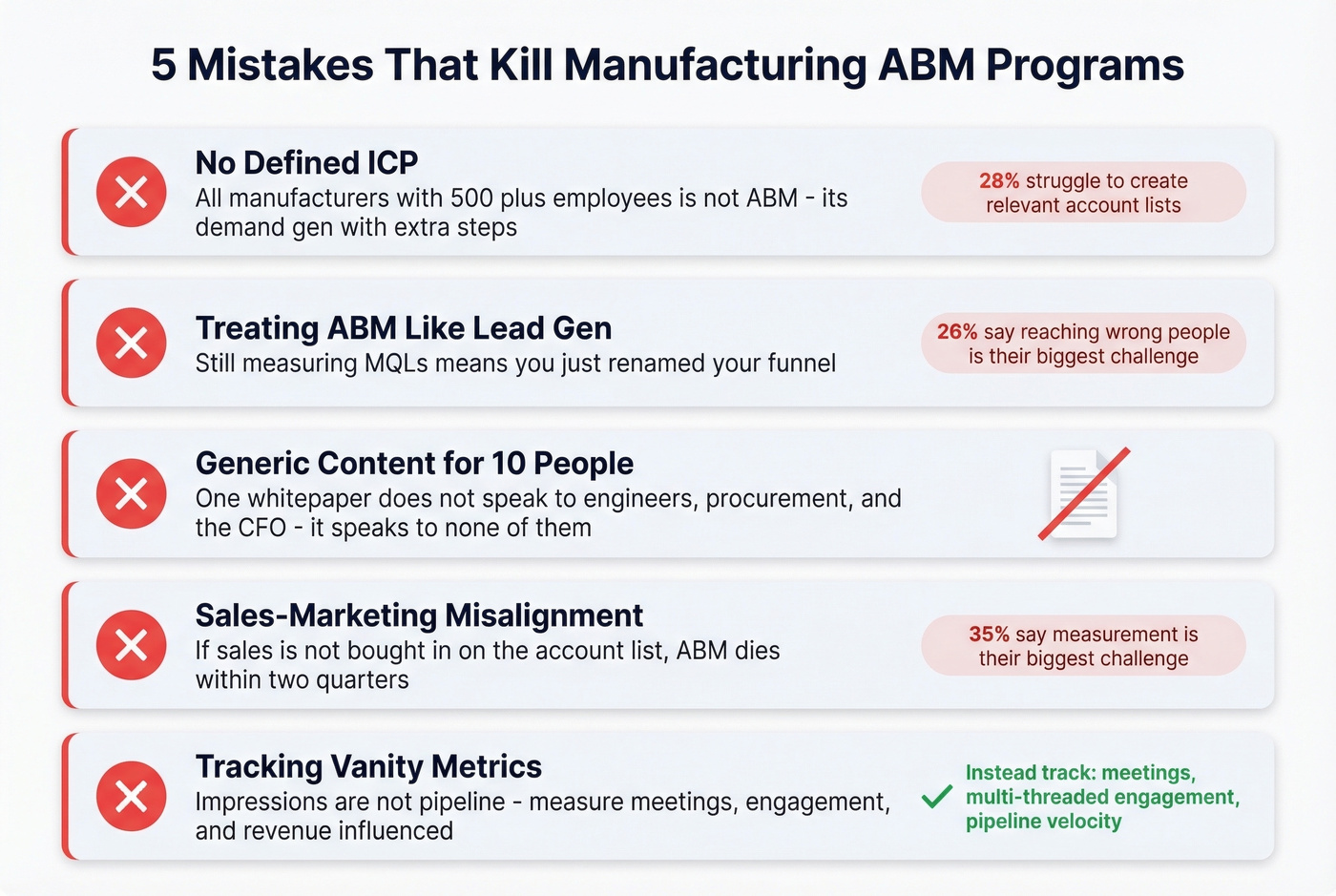
- No defined ICP. "All manufacturers with 500+ employees" isn't ABM - it's demand gen with extra steps. 28% of teams struggle to create relevant target account lists, and 26% say reaching the wrong people is their biggest challenge.
- Treating ABM like lead gen. If you're still measuring MQLs, you've just renamed your funnel. A real ABM strategy measures account engagement, not individual lead scores.
- Generic content for a 10-person committee. One whitepaper doesn't speak to engineers, procurement, and the CFO simultaneously. It speaks to none of them.
- Sales-marketing misalignment. If sales isn't bought in on the account list, ABM dies within two quarters. 35% of teams say measurement is their biggest challenge - usually because sales and marketing are tracking different numbers.
- Tracking vanity metrics. Impressions aren't pipeline. Measure meetings, multi-threaded engagement, and revenue influenced.
Realistic ABM Costs
Most manufacturers don't need a $100K ABM platform. They need 15 accounts, verified contacts for every stakeholder, and the discipline to create role-specific content. The platform comes later.
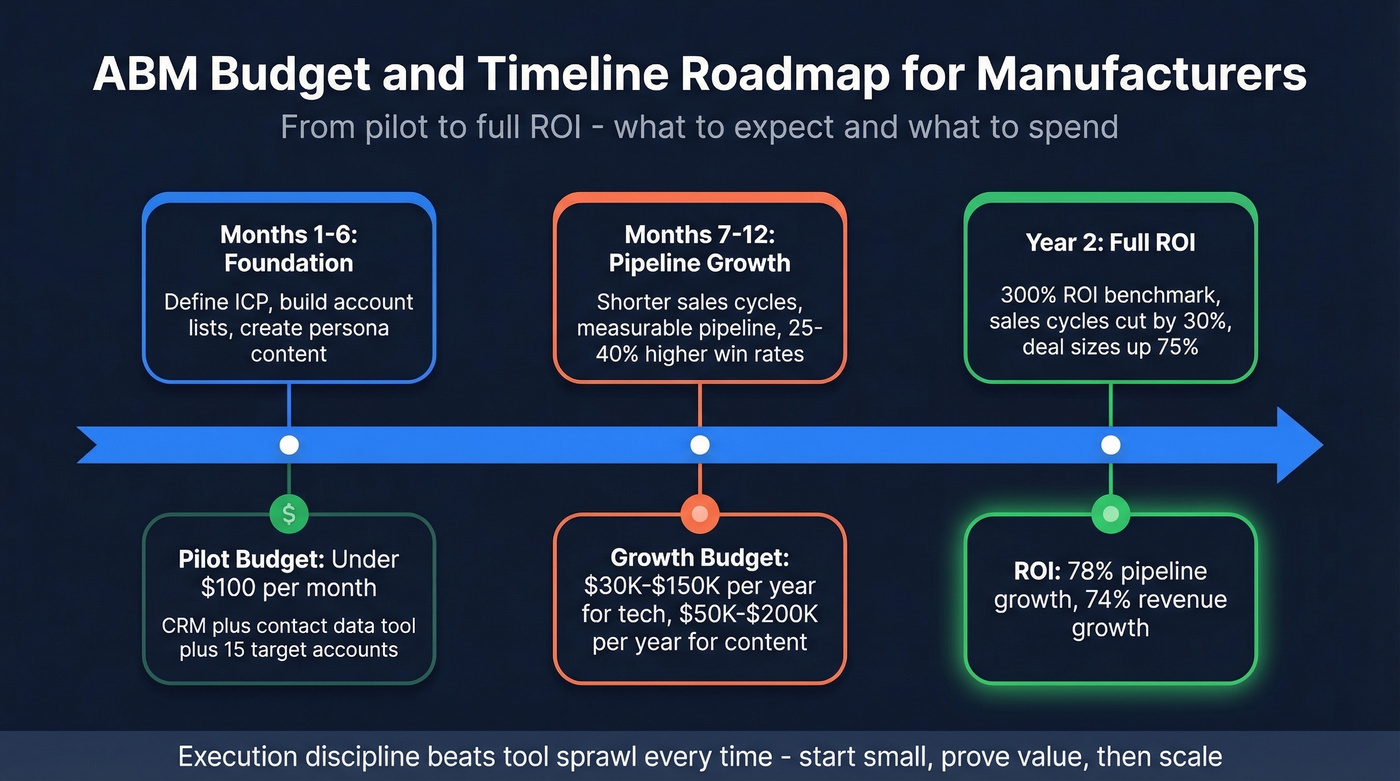
Budget realistically: ABM tech runs $30K-$150K annually for a mature program. Content production adds $50K-$200K per year. Months 1-6 are foundation-building - defining your ICP, building account lists, creating persona-specific assets. Months 7-12 bring pipeline growth and shorter cycles. Full ROI materializes in year two.
We've seen manufacturers launch with nothing more than a CRM, a contact data tool, and 15 target accounts - under $100/month total - and outperform teams running six-figure stacks with no strategy behind them. The consensus on r/sales echoes this: execution discipline beats tool sprawl every time.
You don't need a $30K ABM platform to launch. You need accurate data for the 10 buying committee members at each target account. Prospeo gives you verified emails at $0.01 each - 90% cheaper than ZoomInfo - with intent signals that tell you which manufacturers are researching your category before they hit a competitor's trade show booth.
Stop paying enterprise prices to reach your first 50 target accounts.
FAQ
Is ABM worth it for mid-market manufacturers?
Yes. A 15-20 account pilot with a CRM, contact data tool, and persona-specific content outperforms broad demand gen at a fraction of the cost. The key is disciplined account selection and multi-stakeholder coverage, not expensive platforms. Mid-market teams routinely see 25-40% higher win rates within 12 months.
How long until ABM shows ROI in manufacturing?
Expect six months of foundation-building, then months 7-12 bring measurable pipeline growth and shorter sales cycles. Full ROI materializes in year two. Manufacturing's long buying cycles mean patience is structural, not optional - teams that commit from day one see compounding returns as account relationships deepen.
Can I run ABM without intent data?
You can, but you'll be slower to identify in-market accounts. Start with first-party signals like website visits and email engagement. When budget allows, layer in intent data to spot accounts researching your product categories before they ever fill out a form.
How does ABM differ from traditional manufacturing marketing?
Traditional manufacturing marketing casts a wide net - trade shows, print ads, broad email blasts - and hopes the right buyers self-select. ABM flips that model: you choose specific target companies first, then build personalized campaigns for each stakeholder in the buying committee. The result is higher engagement, shorter sales cycles, and significantly better ROI per marketing dollar.