

Account Enrichment: The Practitioner's Guide to Keeping Company Data Fresh
You just pulled a target account list of 2,000 companies for your next ABM campaign. Half the records are missing employee count. Industry is wrong on a third of them. The "decision-maker" contacts? People who left eight months ago. That's not a data problem - it's a revenue problem, and it's exactly what account enrichment solves.
What Is Account Enrichment?
Contact enrichment tells you who to call. Account enrichment tells you whether the company is worth calling in the first place - and gives your reps the context to have a relevant conversation when they do.
It fills in and updates company-level records: employee count, annual revenue, industry classification, tech stack, parent-child corporate hierarchy, funding stage, and headcount growth trends. A rep who knows a prospect company just raised a Series C and runs Salesforce and Marketo walks into a call armed. A rep with just a name and email is guessing. That gap between armed and guessing is why enriching accounts has become non-negotiable for sales teams running any kind of targeted outbound.
The Cost of Stale Company Data
B2B contact data decays roughly 2.1% per month - that's 22-25% annually. One Reddit user running enrichment on 5,000+ target accounts reported that by the time campaigns launched, 30-40% of data points were already outdated. Another enterprise team managing 40+ subsidiaries in HubSpot found contacts untouched for 5+ years still cluttering their database.
Gartner pegs the average cost of poor data quality at $12.9M per year. 80% of companies report inaccurate CRM data, and duplicate records account for 15-30% of most contact databases.
Here's the thing that frustrates us most: many enrichment vendors won't tell you their refresh cycle. Some refresh quarterly and call it "continuous." That opacity is exactly why your CRM data is rotting.
Types of Account Intelligence Data
| Type | Example Fields | Why It Matters |
|---|---|---|
| Firmographic | Revenue, headcount, industry, funding, parent-child | Qualifies accounts against ICP |
| Technographic | Tech stack (via Wappalyzer, job postings) | Enables competitive displacement plays |
| Intent / Behavioral | Bombora topics, site visits, content signals | Prioritizes in-market accounts |
| Geographic | HQ location, regional offices | Aligns territory routing and compliance |
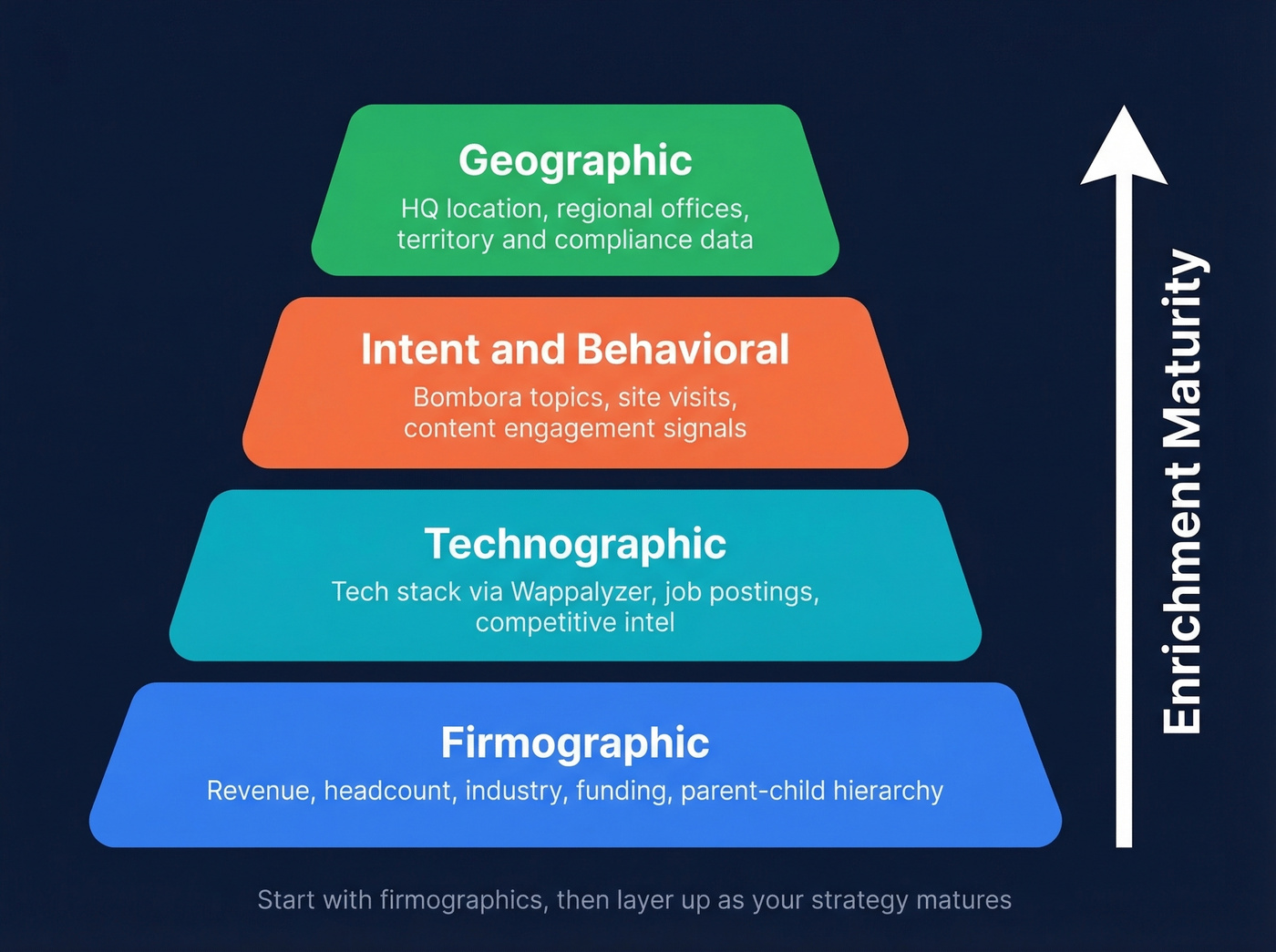
Start with firmographics and layer in technographic and intent data as your enrichment strategy matures. The mistake is trying to collect everything at once.
How to Implement the Process
Tiered Enrichment by Funnel Stage
Don't enrich every record to the same depth. A tiered approach saves credits and keeps data focused on what actually impacts pipeline:
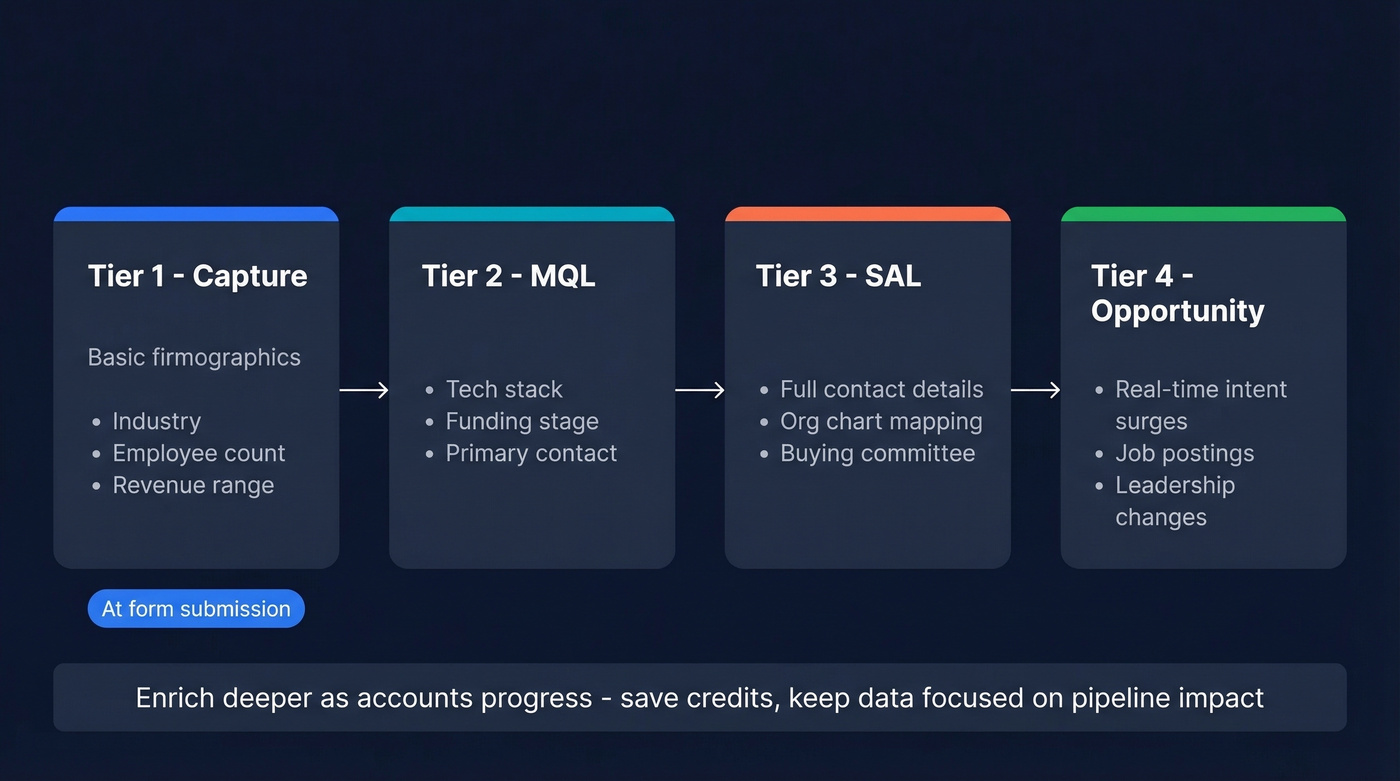
- Tier 1 (Capture): Basic firmographics - industry, employee count, revenue range. Enrich at form submission, not days later.
- Tier 2 (MQL): Add tech stack, funding stage, and a primary contact.
- Tier 3 (SAL): Full contact details plus org chart mapping - the buying committee, not just one name.
- Tier 4 (Opportunity): Real-time buying signals - intent surges, job postings, leadership changes.
Single-Source vs. Waterfall
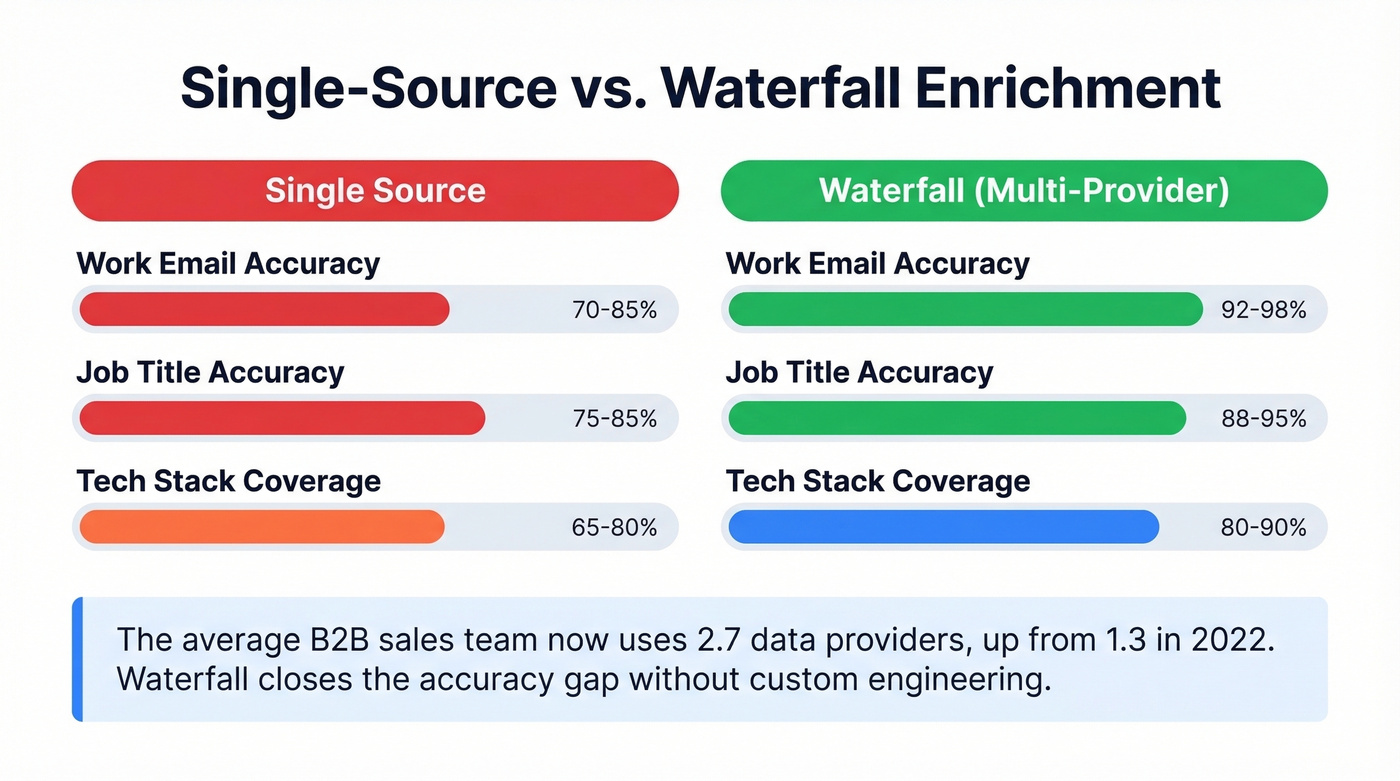
The average B2B sales team now uses 2.7 data providers, up from 1.3 in 2022. We've seen teams running ZoomInfo for contacts, Clearbit for firmographics, BuiltWith for technographics, and 6sense for intent - five subscriptions plus manual data sync. That's too many. But single-source enrichment leaves real gaps:
| Field | Single-Source Accuracy | Waterfall Accuracy |
|---|---|---|
| Work email | 70-85% | 92-98% |
| Job title | 75-85% | 88-95% |
| Tech stack | 65-80% | 80-90% |
Waterfall enrichment - running records through multiple providers sequentially - closes those gaps. Tools like Clay and API-first providers make it manageable without custom engineering.
Refresh Cadence
Enrichment isn't a one-time project. It's an ongoing operation.
| Segment | Refresh Frequency |
|---|---|
| Critical contacts | Monthly |
| Active opportunities | Bi-monthly |
| General database | Quarterly |
| Cold leads | Annual |


You just read that B2B data decays 2.1% per month. Prospeo refreshes every 7 days - not every 6 weeks like most vendors. 92% API match rate, 50+ data points per record, and 98% email accuracy so your enriched accounts actually convert.
Stop enriching accounts with data that's already stale.
Best Tools for Account Enrichment in 2026
For most teams, the right stack is two tools: one for company-level data and one for verified contacts. That's it.
Let's be honest: you don't need an "account enrichment platform." You need a refresh cycle that actually works. A $49/month tool refreshing weekly beats a $40K/year tool refreshing every six weeks. If your average deal size is under five figures, skip the enterprise-tier data spend entirely.
| Tool | Best For | Email Accuracy | Refresh Cycle | Starting Price |
|---|---|---|---|---|
| Prospeo | Verified contacts + enrichment | 98% | 7 days | Free (75 emails/mo) |
| ZoomInfo | Enterprise full-stack | ~85% | ~4-6 weeks | ~$15K/year |
| Apollo.io | Mid-market all-in-one | ~80% | Varies | $49/user/mo |
| Clearbit (Breeze) | Firmographic/tech API | ~85% | Real-time API | $30-$700/mo |
| Cognism | EMEA compliance | 98% | ~4-6 weeks | ~$1K-$3K/mo |
| Demandbase | Enterprise ABM + intent | N/A (account-level) | Ongoing | ~$30K-$100K+/yr |
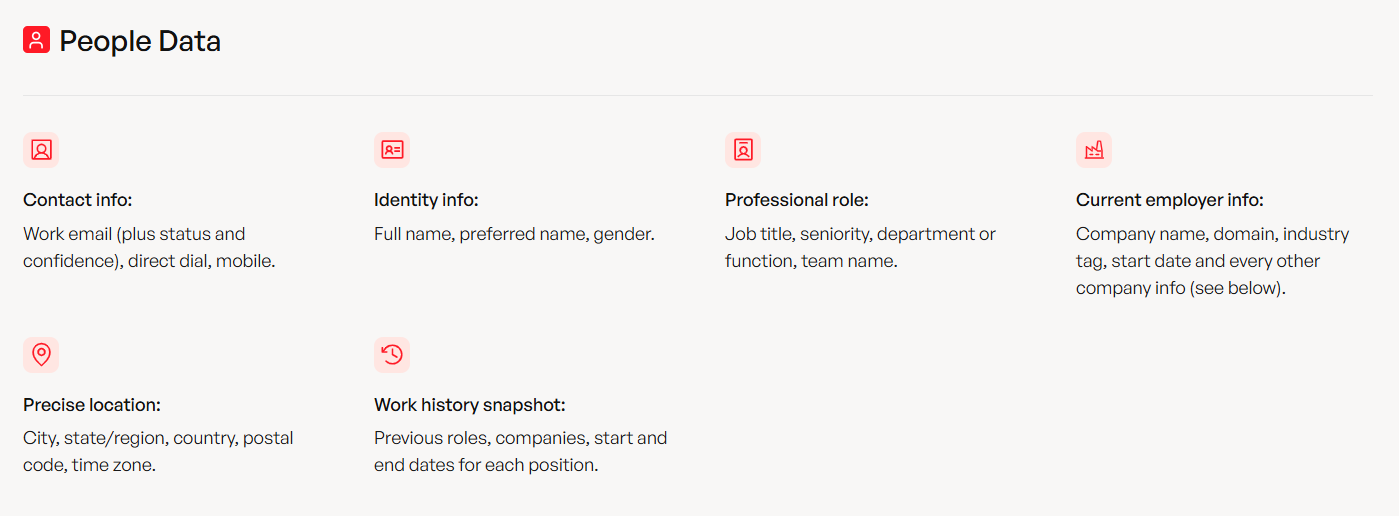
Prospeo is our top pick for verified contact data layered onto enriched accounts. 300M+ professional profiles, 143M+ verified emails, 92% API match rate, and 50+ data points returned per enrichment call. The 7-day refresh cycle - versus the industry average of six weeks - means your data doesn't go stale between campaign builds. One customer, Snyk, cut their bounce rate from 35-40% to under 5% and saw AE-sourced pipeline jump 180% after switching. Free tier gives you 75 emails/month to test, paid plans run credit-based at roughly $0.01/email with no annual contract. For teams that need accurate contacts without a $15K+ commitment, it's the obvious starting point.
At $15K-$40K+/year, ZoomInfo is the enterprise default - 300M+ contacts, broad firmographic and intent coverage, and extensive workflow integrations. But email accuracy sits around 85%, and the refresh cycle lags behind smaller, more agile providers. The right choice for large sales orgs that need everything in one platform. For everyone else, it's overkill.
Apollo.io has a tempting free tier, but expect tradeoffs. The database covers 275M+ contacts with paid plans from $49-$149/user/month, though email accuracy runs around 80% and data freshness varies by segment. Good for teams that want prospecting and sequencing in one tool and can tolerate some bounce rate.
Clearbit (Breeze Intelligence) is strong on firmographic and technographic API enrichment, increasingly HubSpot-native since the acquisition. Credit packs run $30-$700/month. Best as an account-level data source, not a contact finder.
Cognism is the pick for EMEA-focused teams needing GDPR-compliant data and verified mobile numbers. Custom pricing, typically $1K-$3K/month for small teams.
Demandbase is an enterprise ABM platform - account-level intent and firmographics at $30K-$100K+/year. Not a contact data tool. Use it for account identification and scoring, then pair it with a contact provider for the actual outreach layer.
If you're evaluating vendors, start with a shortlist from our best data enrichment tools roundup, then narrow down based on refresh cadence and match rate.
Snyk cut bounce rates from 35-40% to under 5% and grew AE-sourced pipeline 180% after switching their enrichment to Prospeo. 143M+ verified emails at ~$0.01 each, no annual contract, no sales call required.
Enrich 75 accounts free and see the difference fresh data makes.
Common Mistakes
Over-enriching. Hoarding 80 fields per record when only 10 impact your scoring and routing. Focus on fields that change deal outcomes: title/seniority, company size, tech stack, funding, and verified contact info. Everything else is noise. (If you need a framework for what to keep, start with the benefits of data enrichment and work backward to the fields that drive them.)
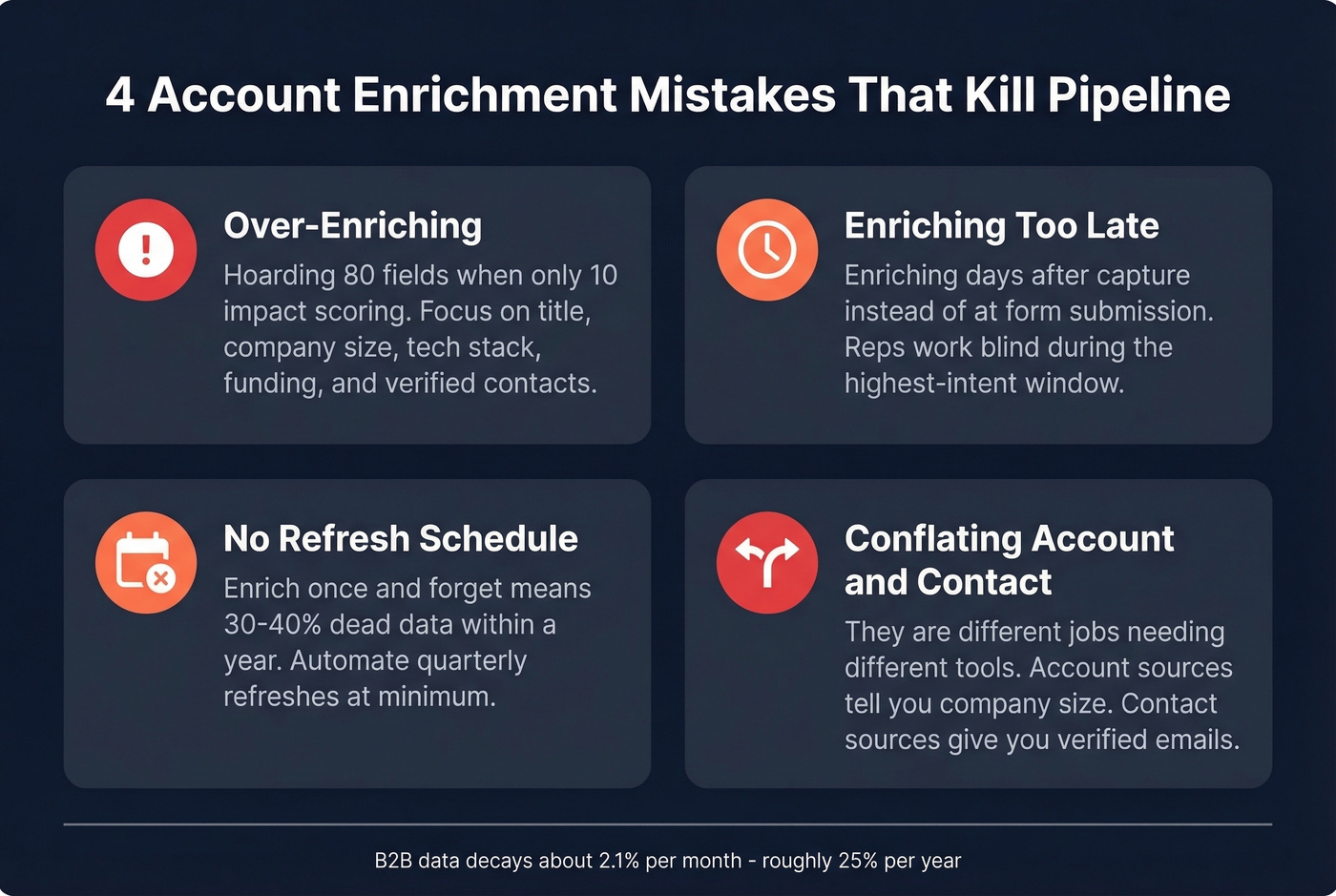
Enriching too late. If you're enriching records days after capture instead of at form submission, your reps are working blind during the highest-intent window. Real-time enrichment at the point of capture beats batch jobs every time. We've watched teams lose deals simply because a competitor responded faster with better context.
No refresh schedule. "Enrich once and forget" is how you end up with 30-40% dead data. Automate re-enrichment on the cadence table above. The consensus on r/sales is pretty clear: if you aren't refreshing at least quarterly, you're wasting whatever you spent on the initial enrichment.
Conflating account and contact enrichment. They're different jobs requiring different tools. An account-level source tells you the company has 500 employees and runs Salesforce. A contact-level source gives you the VP of Sales's verified email. Don't expect one tool to do both well.
Compliance Checklist
- Data minimization. Only collect and store fields you'll actually use. GDPR requires it, and it keeps your database lean.
- Lawful basis. Document your legitimate interest for enriching business contacts. Have a clear data processing rationale before you start appending.
- Accuracy obligation. GDPR requires keeping personal data current - regular enrichment actually supports compliance rather than undermining it.
- Automated decision-making safeguards. If enrichment feeds lead scoring or routing that affects individuals, build in human review. GDPR penalties reach EUR 20M for violations. (For a deeper audit, use our B2B compliance checklist.)
Account Enrichment FAQ
What's the difference between account and contact enrichment?
Account enrichment adds company-level data - firmographics, technographics, intent signals - to a company record. Contact enrichment adds person-level data like verified email and job title. Most teams need both, typically from separate tools optimized for each layer.
How often should I re-enrich account data?
Critical accounts monthly, active opportunities bi-monthly, general database quarterly. B2B data decays around 2.1% per month, so annual-only enrichment leaves roughly a quarter of your records stale. Automated refresh schedules are the only way to stay ahead of decay.
What's the most accurate way to enrich contacts on target accounts?
Waterfall enrichment - running records through multiple sources sequentially - delivers 92-98% email accuracy versus 70-85% for single-source. Pair an account-level data provider like Clearbit with a high-accuracy contact source for both layers. In our testing, teams that waterfall consistently see bounce rates drop below 5%.
Is there a free tool for B2B data enrichment?
Prospeo offers 75 free emails per month with 50+ data points per record and 98% accuracy - enough to test enrichment on a small account list. Apollo.io also has a free tier, though email accuracy runs closer to 80%. For serious testing, start with the free plan and compare bounce rates against your current provider.