

ACV Meaning: Every Definition Explained (2026)
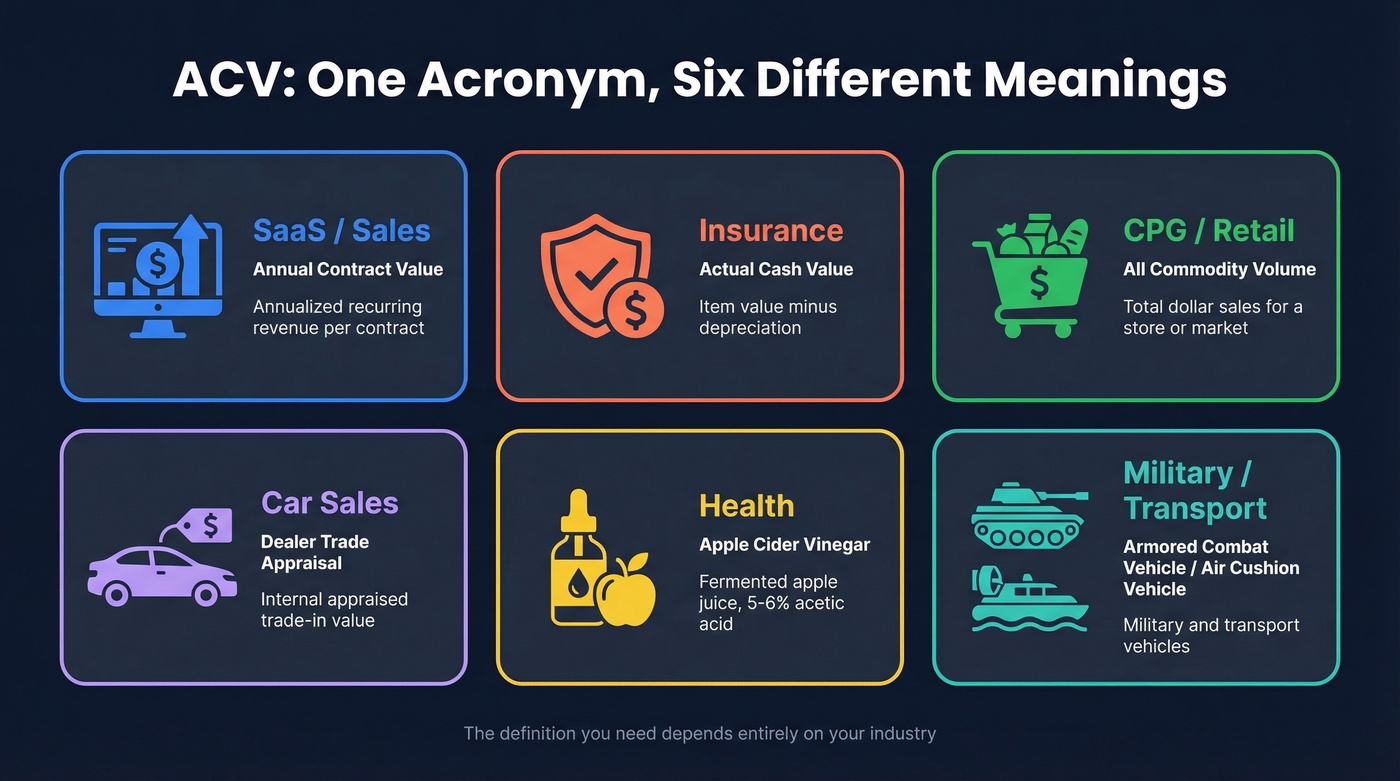
Three letters, at least six meanings, and constant miscommunication. The ACV meaning you need depends entirely on your industry - and getting the wrong definition wastes everyone's time. ACV could be the metric your VP of Sales won't stop talking about, the number your insurance adjuster just used to lowball your roof claim, or the bottle of vinegar your coworker swears cures everything.
| Meaning | Full Term | One-Line Definition |
|---|---|---|
| SaaS / Sales | Annual Contract Value | Annualized revenue per contract |
| Insurance | Actual Cash Value | Item value minus depreciation |
| [CPG / Retail](#acv-in-cpg - retail) | All Commodity Volume | Total dollar sales for a store/retailer in a given market |
| Car Sales | Dealer Trade Appraisal | Internal appraised trade-in value |
| Health | Apple Cider Vinegar | Fermented apple juice, ~5-6% acetic acid |
| Military | Armored Combat Vehicle | Armored troop transport or combat vehicle |
| Transport | Air Cushion Vehicle | Hovercraft on a pressurized air cushion |
ACV in SaaS (Annual Contract Value)
If you work in B2B software, this is the definition that matters most. Annual Contract Value is the annualized recurring revenue from a single customer contract. It's the normalization layer that lets you compare a 3-year enterprise deal to a month-to-month startup subscription on equal footing.
Formula and Worked Example
The formula is straightforward:
ACV = Total Contract Value (recurring only) / Contract Duration (years)
A customer signs a 3-year deal worth $120,000 in recurring fees, plus a $5,000 one-time implementation charge. The ACV is $40,000 - not $41,667, which is what you'd get if you mistakenly included that $5,000 one-time fee. One-time fees like setup, onboarding, and professional services are excluded because ACV is supposed to represent the repeatable, predictable revenue a deal generates each year.
Why exclude them? Because they distort comparisons. A $60K/year deal with a $30K implementation looks like a $90K deal in year one if you lump everything together. That inflates your metrics and misleads your board.
One caveat: not every company calculates this the same way. Some include one-time fees, others don't. Standard practice is to exclude them, but always confirm the methodology when comparing average contract value across companies.
ACV vs ARR vs TCV
These three metrics get confused constantly.
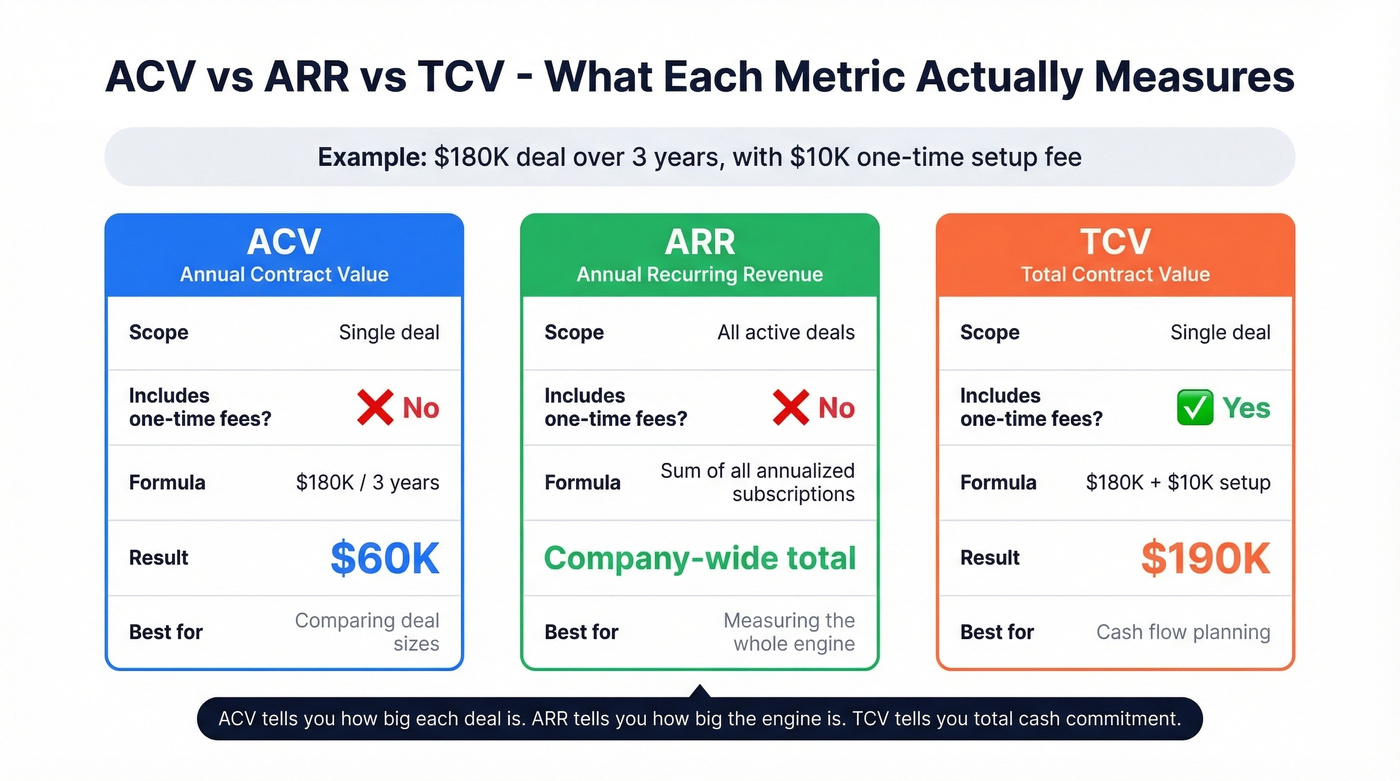
| Metric | What It Measures | Scope | Includes One-Time Fees? |
|---|---|---|---|
| ACV | Annual value of one contract | Single deal | No |
| TCV | Total value over full term | Single deal | Yes |
| ARR | Annual recurring revenue | All active deals | No |
ACV is a deal-level metric. ARR is a company-level metric. A $180K deal over 3 years has an ACV of $60K. A $60K deal over 1 year also has an ACV of $60K - same annual contribution, totally different commitments. ARR sums every active subscription's annualized value into one company-wide number. It tells you how big the engine is, while ACV tells you how big each deal is.
TCV includes everything: recurring revenue, one-time fees, the whole contract. It's useful for cash flow planning but terrible for benchmarking because it conflates repeatable revenue with one-time windfalls. ACV is also commonly used alongside ASC 606 revenue-recognition workflows, where consistent annualization methodology matters.
If you want a deeper breakdown of ACV vs ARR vs TCV, Stripe’s explainer is a solid reference.
Benchmarks by Segment
B2B SaaS annual contract value typically ranges from $8K to $300K, depending on stage, segment, and vertical. Here's what "normal" looks like right now.
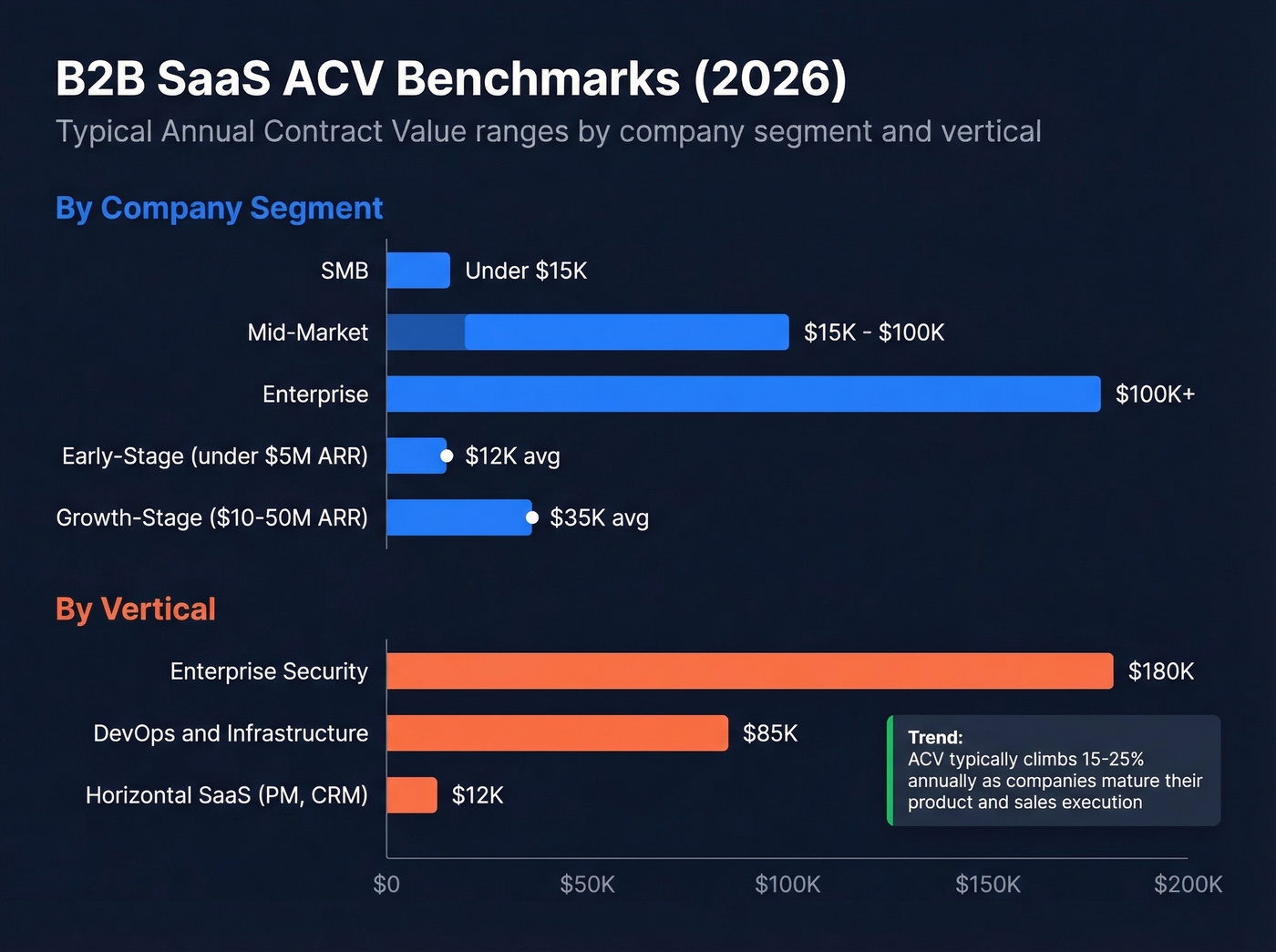
| Segment | Typical ACV Range |
|---|---|
| SMB | Under $15K |
| Mid-Market | $15K-$100K |
| Enterprise | $100K+ |
| Early-Stage (under $5M ARR) | ~$12K average |
| Growth-Stage ($10-50M ARR) | ~$35K average |
Verticals tell an even sharper story. Enterprise security companies average around $180K. DevOps and infrastructure tools sit closer to $85K. Horizontal SaaS - think project management or basic CRM - hovers around $12K.
One trend we've been tracking: ACV creep. As companies mature their product and sharpen their sales execution, annual contract value tends to climb 15-25% annually. If yours is flat year over year, that's a signal your packaging, pricing, or sales motion needs work. And if your enterprise numbers are climbing but SMB is stagnant, revisit your SMB packaging - not just your sales motion.
Edge Cases: Ramp Deals and Usage-Based Pricing
Not every deal fits neatly into the formula. Ramp deals - where a customer starts at a lower price and scales up over the contract term - create a calculation headache. A 3-year deal that's $20K in year one, $40K in year two, and $60K in year three has a total recurring value of $120K, so the ACV is $40K. But the revenue profile is wildly uneven.
For usage-based pricing, the practical approach most ops teams follow is to base ACV on the committed minimum (the contractual floor) and track actual usage separately. SaaStr's guidance on this is solid: either model expected value upfront with a clawback if actuals fall short, or pay smaller commissions at close with ongoing payouts as usage grows. Neither approach is perfect, but both beat pretending usage-based revenue is predictable.
Why ACV Alone Isn't Enough
Here's the thing: annual contract value tells you how big your deals are, but it says nothing about whether those deals are profitable. A $50K deal that costs $60K to acquire is a money pit. That's why this metric only makes sense when paired with CAC and LTV (see our guide to cost to acquire customer).
Most teams over-index on ACV growth and under-index on CAC efficiency. A 15% increase paired with a 40% CAC increase is a loss, not a win - and we've seen it happen more often than anyone admits.
The relationship is simple. If your deal sizes are low - say you're selling to SMBs at $10K-$15K per year - every dollar of acquisition cost matters. A 23% email bounce rate on your outbound sequences doesn't just hurt reply rates; it inflates your CAC because you're paying for outreach that never reaches anyone. Tools like Prospeo keep that outreach budget hitting real inboxes at 98% email accuracy and roughly $0.01 per lead, which is the kind of efficiency that actually moves your unit economics when deal sizes are tight.
I've watched teams celebrate a 30% ACV increase while their CAC doubled - net result, worse economics. Always pair contract value with the cost to acquire and the expected lifetime of the customer.
ACV in Insurance (Actual Cash Value)
In insurance, ACV stands for Actual Cash Value - and it's the number that makes policyholders angry. The NAIC defines ACV coverage as paying to repair or replace based on the item's value considering age, wear, and depreciation. Translation: you don't get what it costs to buy new. You get what your old thing was worth.
ACV is a valuation method used within homeowners, renters, and auto policies - not a standalone product. Don't confuse it with accounting book value either; they use different depreciation methods and serve entirely different purposes.
Insurance Formula and Examples
The formula is deceptively simple:
Replacement Cost - Depreciation = ACV
A storm destroys your roof. A new roof costs $12,000 to install. But your roof was 15 years old, so the insurer applies $6,000 in depreciation. Your actual cash value payout is $6,000 - minus your deductible. You're covering the gap out of pocket.
Now consider a car total loss. Your 2019 sedan has a retail value around $18,000 based on comparable listings. The insurer runs their own comps, adjusts for mileage, condition, and prior damage, and offers you $12,000. That gap between what you think the car is worth and what the insurer offers is where most disputes happen.
ACV vs Replacement Cost
Replacement cost coverage pays to repair or replace with like kind and quality - no depreciation deducted. Actual cash value coverage deducts depreciation first. The difference can be enormous on older assets.
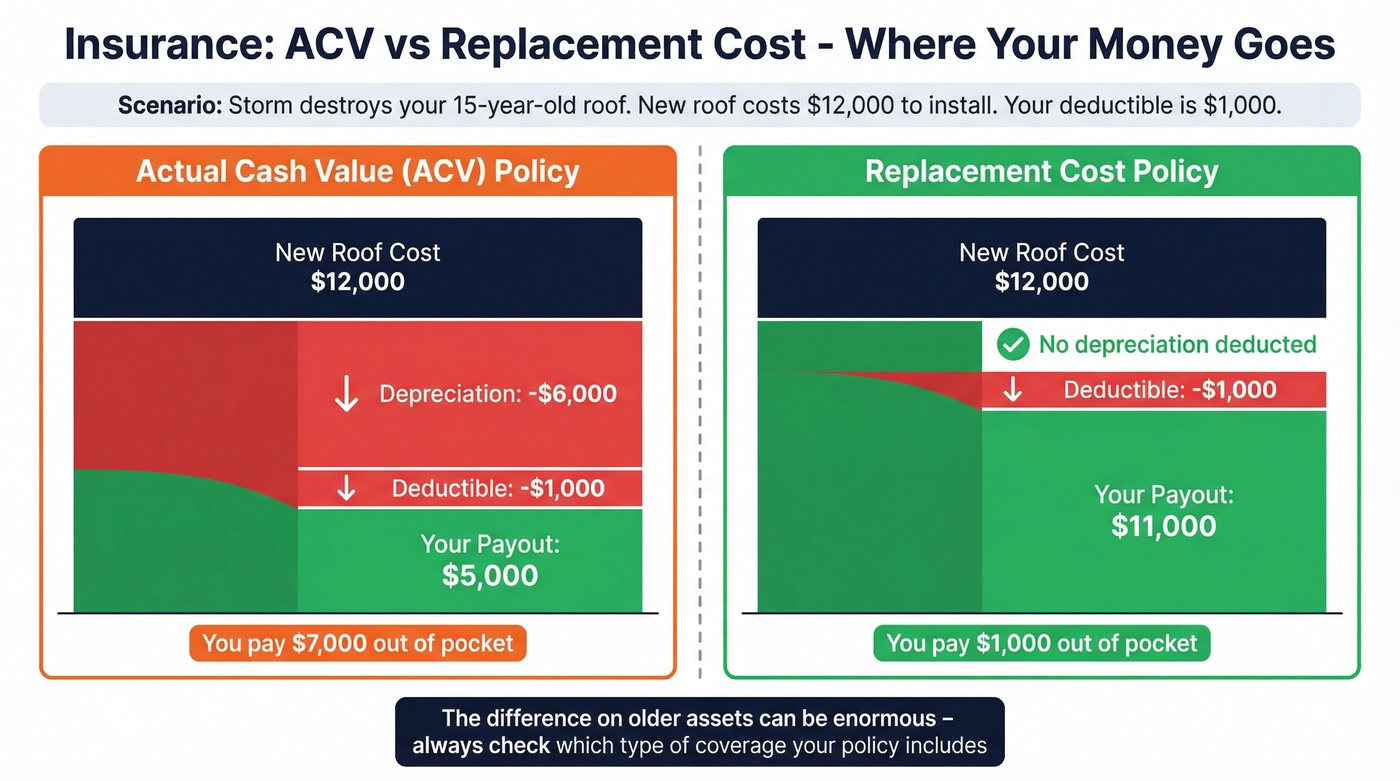
In auto insurance specifically, "replacement cost" almost always means replacing with a brand-new vehicle, which requires a specific endorsement. Standard auto policies pay actual cash value: the market value of your car on the day of the accident, not what a new one costs. Some states require insurers to include taxes and registration fees in the payout, but this varies by jurisdiction.
Why Your Payout Feels Too Low
The #1 misconception on r/Insurance is that actual cash value equals the average of retail and trade-in value. It doesn't. Insurers use their own comparable sales data, adjust for condition, mileage, prior damage, and title type, and arrive at a number that's often below what you'd expect.
The first offer from your insurer is rarely the best one. Before you sign anything, gather comparable listings from dealer sites and private-party sales in your area. Document the mileage, condition, and features of your vehicle versus the comps. If the insurer's number is significantly below market, you have leverage to negotiate - and in many states, you can invoke the appraisal clause in your policy for an independent review.
The insurer isn't necessarily trying to cheat you. Their methodology just optimizes for a different set of comps than the ones you're looking at. Understanding that gap is how you close it.
ACV in CPG & Retail (All Commodity Volume)
In consumer packaged goods, ACV stands for All Commodity Volume - the total dollar sales for a retailer or store across every product category within a given market. NielsenIQ defines it as the broadest measure of a store's sales volume, and it's used as a proxy for store "size" when weighting distribution metrics.
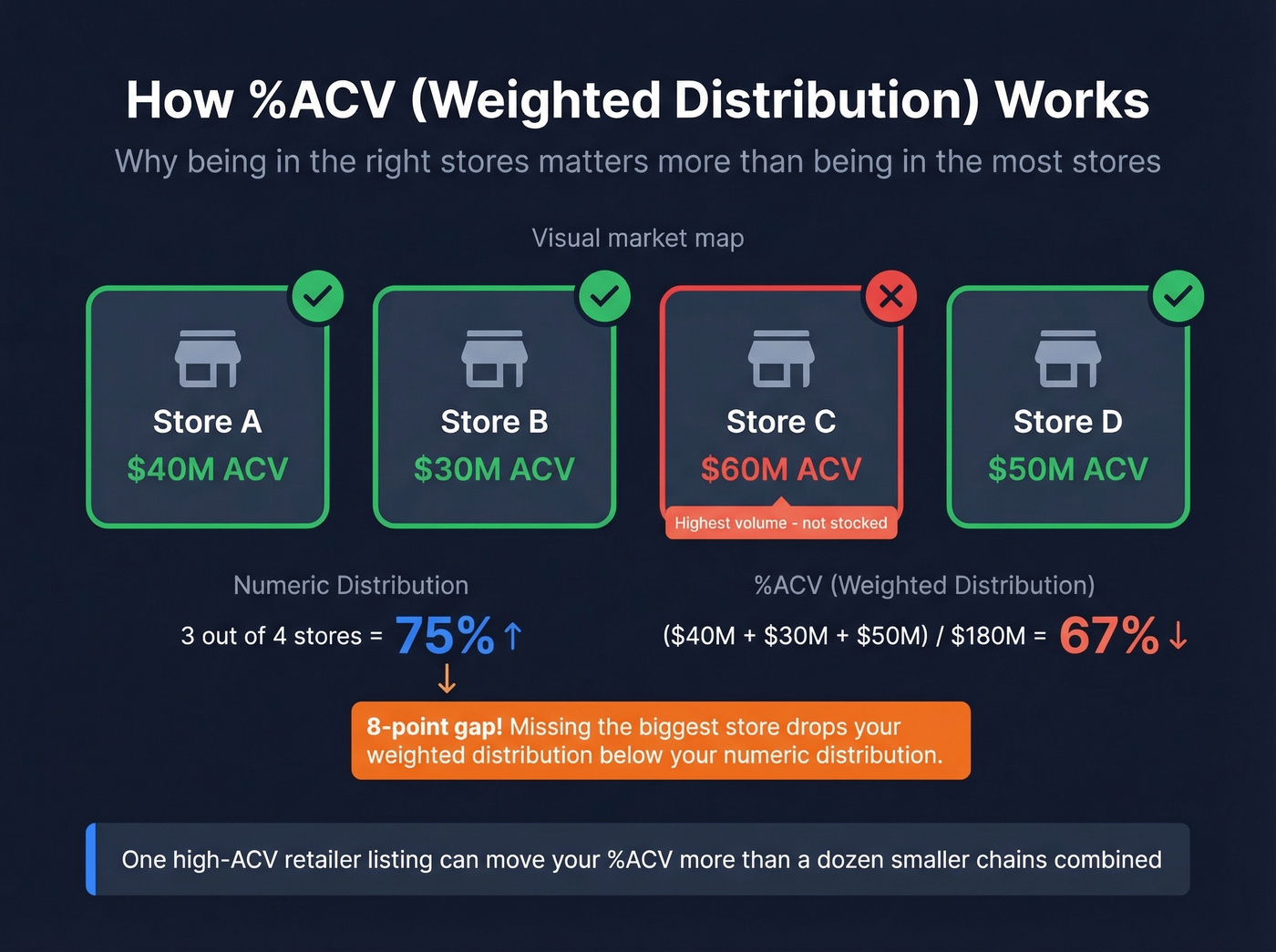
The metric that actually matters to brand managers is %ACV, which measures weighted distribution:
%ACV = (Total ACV of stores carrying your product) / (Total ACV of all stores in the market)
Let's break this down with an example. Four stores in a market have ACVs of $40M, $30M, $60M, and $50M. Your product is stocked in stores 1, 2, and 4 - but not store 3, the highest-volume location. Your numeric distribution is 75% (3 out of 4 stores). But your %ACV is only 67%: ($40M + $30M + $50M) / $180M.
That 8-point gap matters. Missing the highest-volume store means your weighted distribution understates your shelf presence relative to where shoppers actually spend. This is why CPG teams obsess over getting into top-volume retailers - one high-ACV listing can move your %ACV more than a dozen smaller chains combined.
When syndicated data providers calculate all commodity volume, they often exclude departments like lottery, pharmacy, and gasoline, so the number in your report won't match the retailer's total annual revenue. People also frequently say "ACV" when they mean "%ACV" - the weighted distribution metric. If someone tells you their product has "80 ACV," they almost certainly mean 80% ACV-weighted distribution, not $80 in total store sales.

A 23% bounce rate doesn't just kill reply rates - it inflates your CAC and destroys the unit economics behind every ACV dollar. Prospeo's 98% email accuracy and $0.01/lead pricing keep your outbound hitting real inboxes, so your cost-to-acquire stays proportional to your deal sizes.
Fix your CAC before you try to grow your ACV.
ACV in Car Sales (Dealer Trade Appraisal)
Walk into a dealership and "ACV" means something entirely different. It's the internal appraised value the dealer assigns to your trade-in - what they want to "own the car for" on their books. This number drives deal profitability and sales commissions, and it's distinct from any published book value like KBB or NADA.
The dealer's figure is often lower than the trade-in value they show you on the deal sheet. That's because the dealer factors in reconditioning costs, auction risk, and how quickly they think the car will sell. Skip worrying about the dealer's internal appraisal and focus on the net difference between the new car price and your trade allowance - that's the number that actually affects your wallet. If you're running a dealership team, an auto sales CRM can help keep trade-in and follow-up workflows tight.
ACV in Health (Apple Cider Vinegar)
Yes, people search "ACV meaning" looking for apple cider vinegar. It's fermented apple juice containing roughly 5-6% acetic acid, and it's become a wellness trend with claims ranging from modest to absurd.
Here's what the evidence actually says. Small studies suggest ACV can modestly lower post-meal blood sugar by slowing gastric emptying - promising but not conclusive. A few analyses show possible improvements in cholesterol and triglycerides, again from small sample sizes. An 8-week BBC/Aston University trial found no impact on weight loss, and short-term fullness effects don't translate to reliable long-term results. As for cancer and serious diseases? No credible evidence. Full stop.
The risks are more concrete than the benefits. Drinking undiluted ACV erodes tooth enamel and can trigger heartburn or acid reflux. If you're going to use it, dilute it heavily and don't expect miracles.
Other ACV Meanings
A couple of niche uses round out the acronym:
- Air Cushion Vehicle: The technical term for a hovercraft - a vehicle that travels over surfaces on a cushion of pressurized air. Used in military and civilian transport, particularly for amphibious operations.
- Armored Combat Vehicle / Armored Command Vehicle: Military designations for armored vehicles used in troop transport, combat operations, or mobile command posts. The specific meaning depends on the branch and country.
FAQ
What does ACV stand for?
ACV most commonly stands for Annual Contract Value in SaaS, Actual Cash Value in insurance, or All Commodity Volume in CPG retail. In health contexts it's shorthand for apple cider vinegar. Military and transport fields use it for armored combat vehicle and air cushion vehicle respectively.
How do you calculate ACV in SaaS?
Divide the total recurring contract value by the number of contract years. A $150K three-year deal has an ACV of $50K. Exclude one-time fees like setup, implementation, or onboarding - they aren't recurring revenue and distort comparisons between deals of different structures.
What's the difference between ACV and ARR?
ACV measures the annualized value of a single contract; ARR measures total annual recurring revenue across all active subscriptions company-wide. Use ACV to evaluate individual deal size and sales efficiency. Use ARR to measure overall business scale.
Why is my insurance ACV payout so low?
Insurers subtract depreciation from replacement cost before paying out. A 10-year-old roof that costs $12,000 to replace might only yield a $6,000 payout after depreciation - minus your deductible. Pull your own comparable estimates from dealer sites and private-party listings, then negotiate before accepting the first offer.
Does prospect data quality affect ACV-related sales metrics?
High email bounce rates inflate customer acquisition cost relative to deal size, destroying unit economics - especially for teams selling into the SMB segment where annual contract values are already tight. Keeping your outbound data clean with verified emails and direct dials is one of the fastest ways to improve CAC payback.
Higher ACV starts with reaching the right decision-makers. Prospeo gives you 300M+ profiles with 30+ filters - buyer intent, funding, headcount growth - so your reps spend time closing enterprise deals, not chasing dead leads.
Teams using Prospeo book 26% more meetings than ZoomInfo users.