


AdvizorPro vs Lusha: Different Tools for Different Jobs
Someone on your team asks: "Can't we just use Lusha for RIA prospecting?" No. And the reason matters.
When you compare AdvizorPro vs Lusha, you're not looking at competitors. They're different categories of tool that happen to show up on the same G2 alternatives page. We've watched teams try to force a general contact database into a wealth management workflow, and the result is always the same - manual workarounds within a month, spreadsheets multiplying like rabbits, and a sales leader wondering where the budget went.
30-Second Verdict
- Selling into RIAs and broker-dealers? AdvizorPro. Nothing else gives you AUM, custodian mix, ETF holdings, and breakaway signals in one place.
- Running broad B2B outbound across industries? Lusha. It's a general-purpose contact database with 280M+ profiles and a credit-based model.
What Each Tool Actually Is
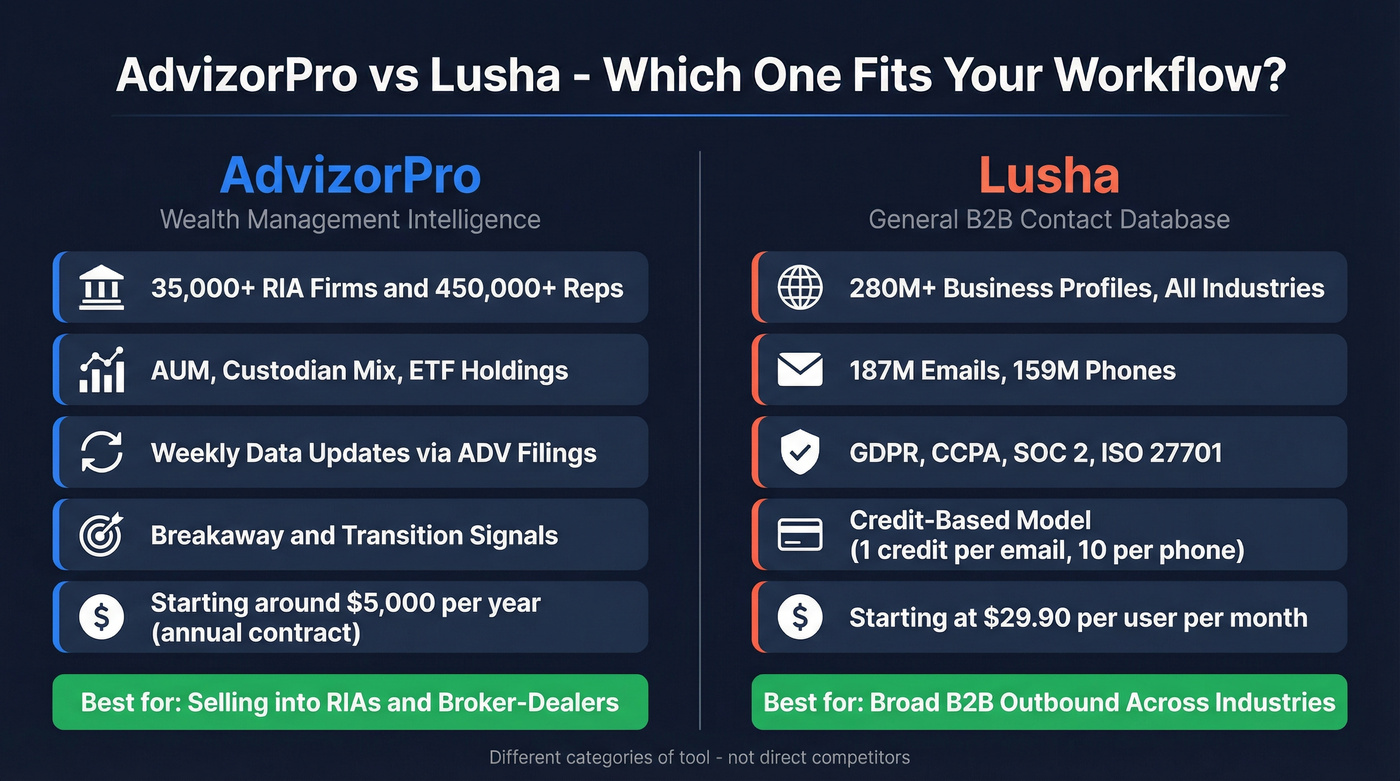
AdvizorPro is a niche intelligence platform built for the wealth management ecosystem. It covers 35,000+ RIA firms, 450,000+ registered reps, 25,000+ mapped wealth teams, and 5,000+ broker-dealers - with data you won't find in any general B2B database. We're talking AUM and asset allocation, custodian mix, technology stack details (Orion, Envestnet, eMoney), ETF holdings, behavioral and growth signals, and breakaway/transition activity. There's also an AI Search Assistant for natural-language queries, which is a nice touch for teams that don't want to learn complex filter logic. Profiles are validated through ADV filings, Form U4 updates, custodian checks, and continual AI-assisted verification on a weekly cadence.
Lusha is a horizontal B2B contact platform spanning 280M+ business profiles, 187M verified emails, and 159M verified phones across every industry. It's built for teams that need contact details at scale - not teams that need to know which custodian a $500M RIA uses. Lusha carries GDPR, CCPA, ISO 27701, and SOC 2 compliance certifications.
Feature Comparison
| Dimension | AdvizorPro | Lusha | Best for |
|---|---|---|---|
| Coverage | RIAs, BDs, reps | All industries | AdvizorPro (if selling into wealth) |
| Key data | AUM, custodian, holdings | Email, phone, company | AdvizorPro (depth wins) |
| Update cadence | Weekly | Not stated | AdvizorPro |
| Compliance | ADV/U4 filings | GDPR, CCPA, SOC 2, ISO 27701 | Lusha (broader certs) |
| CRM integrations | Salesforce, HubSpot, Dynamics, Snowflake | Salesforce, HubSpot | Tie |
| Pricing model | Annual dataset | Per-seat credits | Lusha (lower entry) |
| G2 rating | 4.8/5 (12 reviews) | - | AdvizorPro |

Lusha's credit math breaks down fast for phone-heavy teams. Prospeo's mobile finder covers 125M+ verified numbers with a 30% pickup rate - and you only pay when a number is found. No credit burn on stale dials.
Stop burning credits on numbers that don't pick up.
Pricing Reality
| Plan | AdvizorPro | Lusha |
|---|---|---|
| Free | Demo only (not public) | $0 - 70 credits/mo |
| Entry paid | ~$5,000/yr | $29.90/user/mo (annual) |
| Mid-tier | ~$10,000-$15,000/yr | $52.45/user/mo (annual) |
| Enterprise | ~$20,000+/yr | ~$37,482/yr for 25 seats |
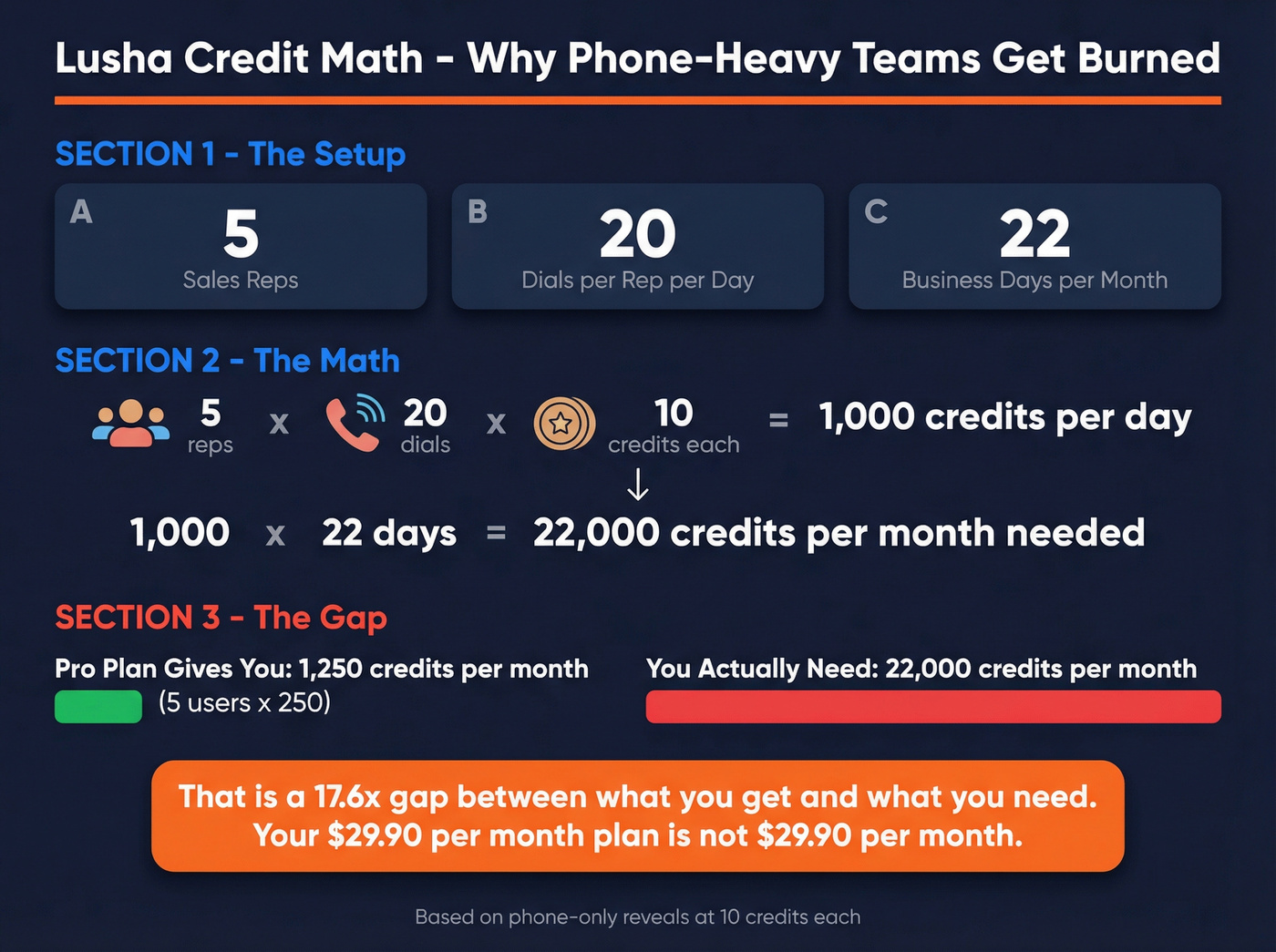
Here's the thing about Lusha's credit math: revealing an email costs 1 credit, but a phone number costs 10. A 5-rep team doing 20 dials a day needs 100 phone reveals daily - that's 1,000 credits per day, or roughly 22,000 credits per month across 22 business days. The Pro plan's 250 monthly credits per user cover exactly 25 phone numbers per user. Do the math on that gap.
So your "$29.90/month" plan actually costs multiples of that once you're dialing, not just emailing. AdvizorPro's pricing isn't public, which is frustrating - expect a demo-led sales process and annual contracts in the $5,000-$20,000/year range depending on seats and modules.
What Real Users Say
AdvizorPro earns a 4.8/5 on G2 across 12 reviews. Users praise exceptional customer support and the depth of RIA-specific data. The main gripe: it's expensive, though reviewers also frame it as worth it for the niche. A few note that filtering could be more granular for narrowing to exact agent types, and some flag room for improvement on data accuracy for smaller firms.
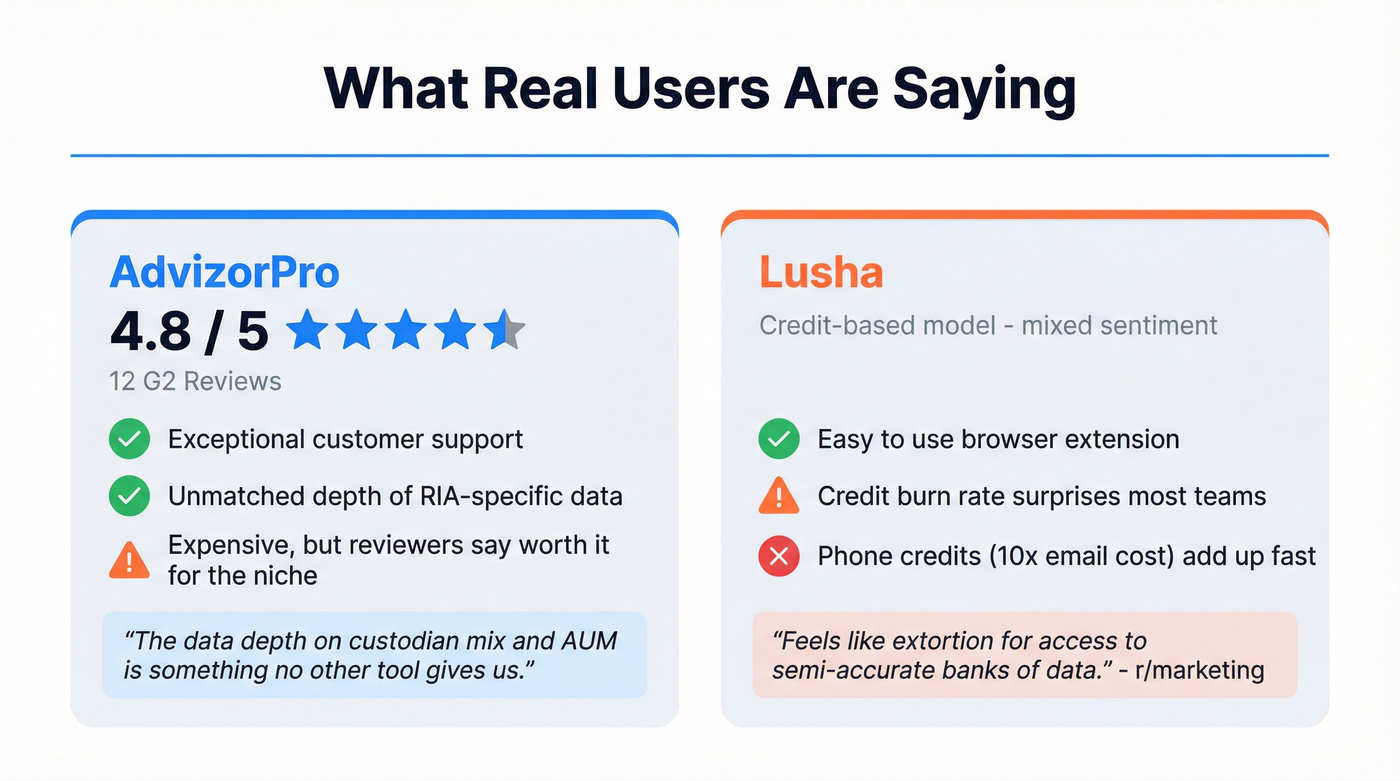
Lusha is a credit-based platform, so the most common pain point is predictable: burn rate. One r/marketing thread summed up the vibe around credit-based contact platforms as "extortion for access to semi-accurate banks of data." Harsh, but the sticker price really does look reasonable only until you model actual phone-heavy usage.
Why You Still Need a Verification Layer
Even good databases produce bounces. Neither AdvizorPro nor Lusha guarantees every email will land, and a single bad batch can torch your sender reputation for weeks.
For teams running phone-heavy outreach, Prospeo's mobile finder covers 125M+ verified numbers with a 30% pickup rate, and you only pay when a number is found. That's a real alternative to burning Lusha credits on stale dials.

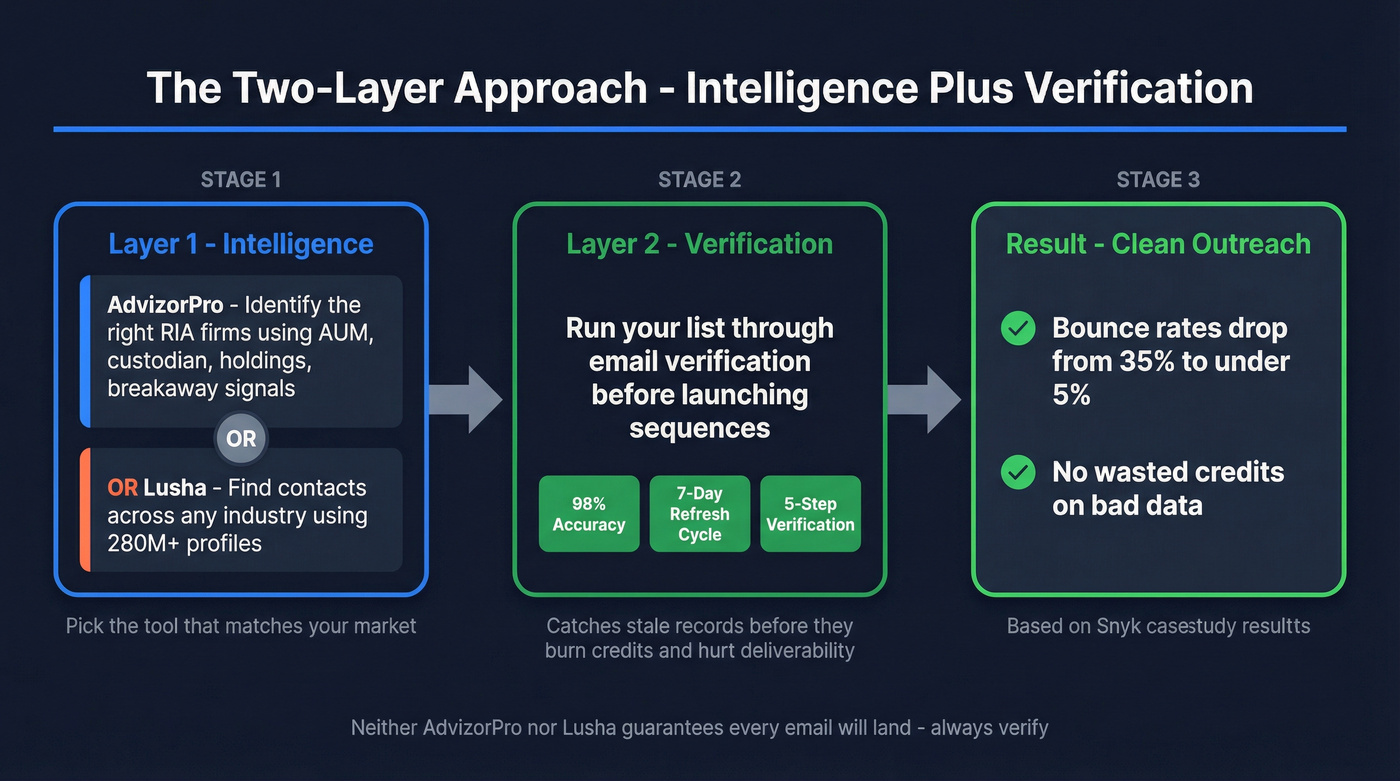
Whether you pick AdvizorPro, Lusha, or both - bad emails still kill deliverability. Prospeo's 5-step verification catches stale records at 98% accuracy on a 7-day refresh cycle. Snyk cut bounce rates from 35% to under 5% by adding this layer.
Verify your list before it wrecks your sender reputation.
FAQ
Can I use AdvizorPro and Lusha together?
Yes, and many wealth management sales teams do exactly this. AdvizorPro identifies the right RIA firms using AUM, custodian, and holdings data. A contact tool then fills in verified details for outreach. The two-layer approach - intelligence platform plus verification layer - is how the best teams avoid wasting sequences on bad data.
Which tool is better for financial advisor leads?
AdvizorPro, by a wide margin. It carries AUM, custodian mix, ETF holdings, and breakaway/transition activity that Lusha simply doesn't have. A generic B2B database can tell you someone works at an RIA. It can't tell you that firm just switched custodians or grew assets 40% last quarter. That's the difference between a cold email and a relevant one.
How do I avoid wasting credits on bad data?
Run your list through a verification step before launching sequences. Prospeo's 5-step verification catches stale records at 98% accuracy with a 7-day refresh - before they burn credits and hurt deliverability. Teams like Snyk cut bounce rates from 35-40% to under 5% after adding this layer.
Skip this if...
You're selling a horizontal SaaS product to SMBs across dozens of industries. AdvizorPro won't help you, and you don't need it. Grab Lusha or a similar general-purpose database, pair it with a verification tool, and move on. Don't overcomplicate it.