

=== CURRENT ARTICLE (slug: company-growth-signals) ===
Company Growth Signals: The Ones That Actually Predict Buying Behavior
Every article about company growth signals says the same thing: "look for revenue growth, watch for new hires, monitor funding rounds." That's about as useful as a weather forecast that says "it might rain."
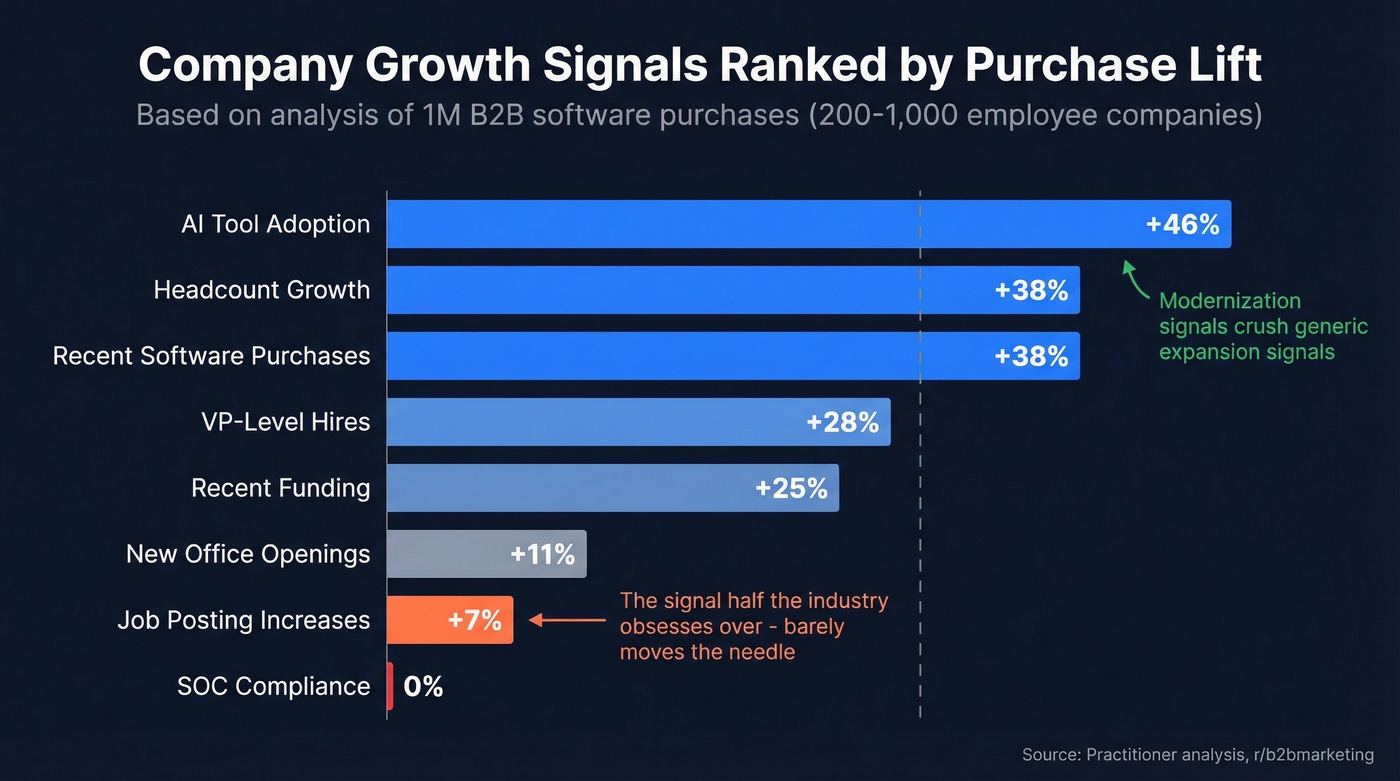
The real question isn't what signals exist - it's which ones actually correlate with purchases, and how you act on them before competitors do. Here's the short answer: AI tool adoption (+46% lift), headcount growth (+38%), and recent software purchases (+38%) are the three strongest predictors. Job postings, the signal half the industry obsesses over, barely register.
What Are Company Growth Signals?
These are observable indicators that a business is expanding, modernizing, or entering a new phase. They split into two categories that most guides conflate:
Internal readiness signals tell you whether your company can handle scale - retention rates, revenue trajectory, operational capacity. External buying signals tell you whether a target company is in buying mode - headcount surges, funding rounds, technology adoption.
A company with 40% revenue growth but 25% employee turnover isn't healthy. It's overheating. The signal matters less than the context around it.
Which Signals Predict Purchases?
A practitioner analysis of 1 million B2B software purchases across 200-1,000 employee companies ranked buying signals by lift over a control group. The hierarchy is more lopsided than most people expect:
| Signal | Purchase Lift |
|---|---|
| AI tool adoption | +46% |
| Headcount growth | +38% |
| Recent software purchases | +38% |
| VP-level hires | +28% |
| Recent funding | +25% |
| New office openings | +11% |
| Job posting increases | +7% |
| SOC compliance | 0% |
Look at that gap. Job posting increases - the signal half the industry obsesses over - barely move the needle at +7%. Companies adopting AI tools are nearly 50% more likely to make additional software purchases. Modernization signals crush generic expansion signals, and it's not even close.
Companies that recently raised funding are 2.5x more likely to buy new solutions. But funding alone is moderate. Pair it with headcount growth or new tech adoption and the picture sharpens dramatically - that's where we've seen the strongest outbound results in our own campaigns.

AI adoption, headcount growth, and funding rounds drive the strongest purchase lift - but only if you reach decision-makers before competitors do. Prospeo layers 15,000 Bombora intent topics with headcount growth, funding, and technographic filters across 300M+ profiles, all refreshed every 7 days.
Spot the signal and act on it in the same platform.
Benchmarks for High Growth Companies
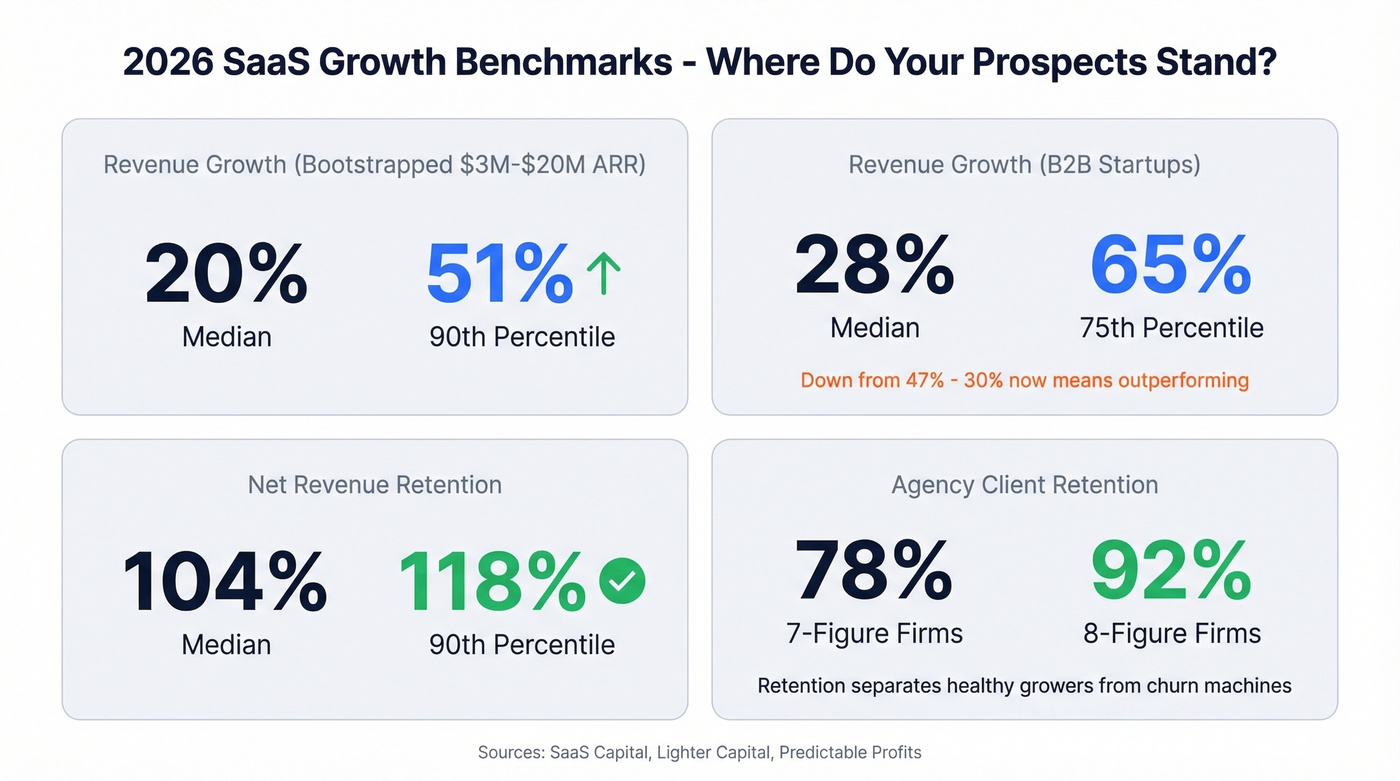
If you're evaluating your own trajectory or sizing up a prospect, you need benchmarks. Sales teams that focus on high growth companies see shorter deal cycles because these businesses already have budget momentum and internal urgency to buy.
| Metric | Median | Top Quartile / Top Tier |
|---|---|---|
| SaaS revenue growth (bootstrapped, $3M-$20M ARR) | 20% | 51% (90th percentile) |
| SaaS revenue growth (B2B startups dataset) | 28.29% | 65.40% (75th percentile) |
| Net revenue retention (bootstrapped, $3M-$20M ARR) | 104% | 118% (90th percentile) |
| Gross revenue retention (bootstrapped, $3M-$20M ARR) | 92% | 98% (90th percentile) |
| Revenue churn (B2B startups dataset) | 12.50% | - |
| Agency client retention | 78-92% | - |
Sources: SaaS Capital, Lighter Capital, Predictable Profits
Median SaaS growth has dropped from 47.25% to 28.29% in Lighter Capital's 155-startup dataset, so a company hitting 30% in 2026 is genuinely outperforming. For agencies, 8-figure firms retain 92% of clients annually versus 78% for 7-figure firms. Retention separates the healthy growers from the churn machines.
When Expansion Signals Turn Red
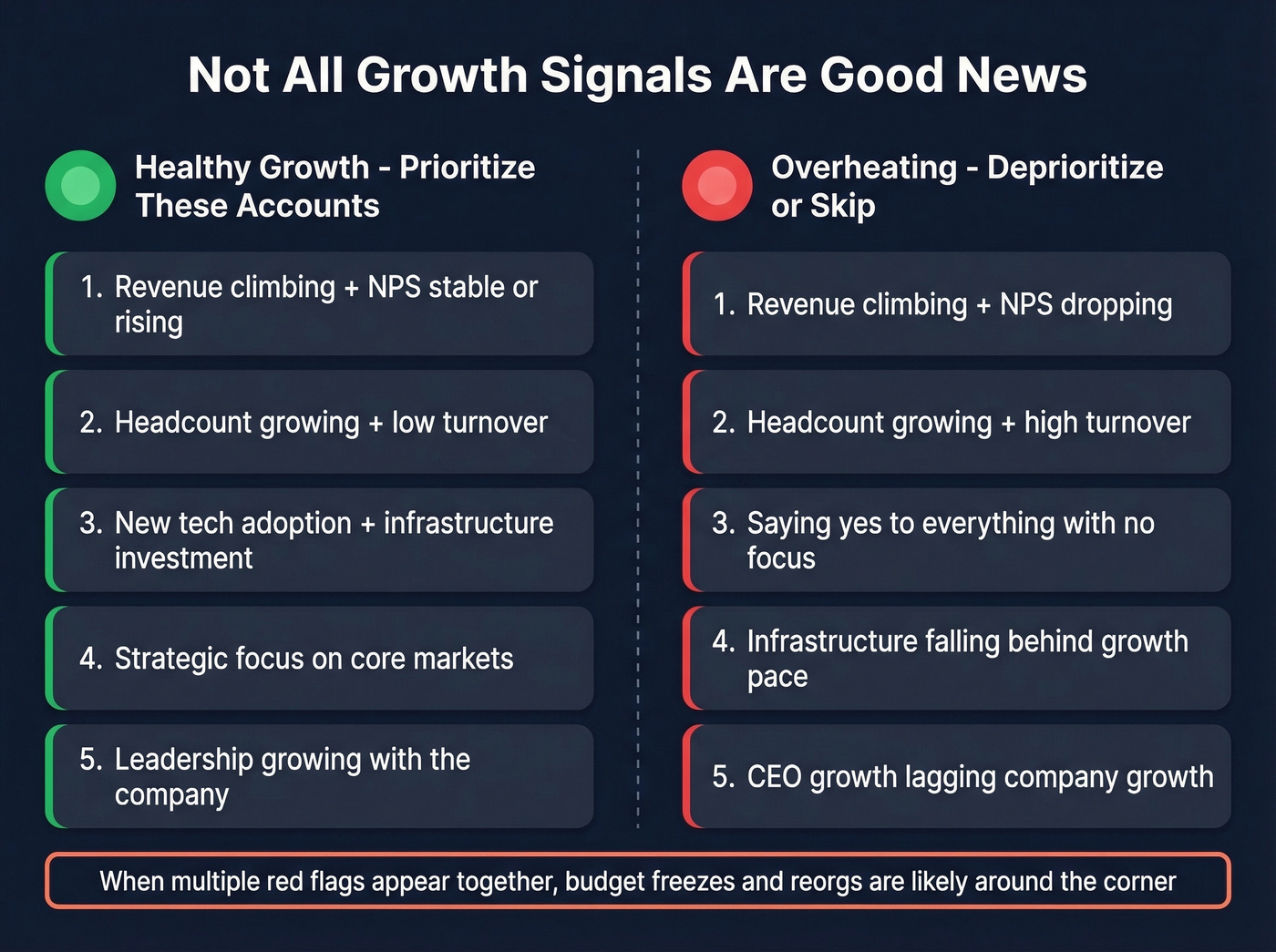
Not all growth signals are positive. These indicate a company scaling faster than its foundation supports:
- Decreasing NPS - customers get less happy even as revenue climbs
- High employee turnover - burning through people to hit targets
- Infrastructure falling behind - systems and tooling can't keep pace
- Saying yes to everything with no strategic focus
- CEO growth lagging company growth
When several of these warning signs show up at once, the growth story is fragile. For sales teams, it also means budget freezes and reorgs are likely around the corner - skip these accounts or at least deprioritize them in your pipeline.
How to Track and Act on Growth Signals
Here's the thing: identifying a signal is the easy part. Every tool on the market can tell you a company raised a Series B. The hard part - and where 90% of teams lose - is reaching the VP of Engineering with a verified email within 48 hours of that signal firing.
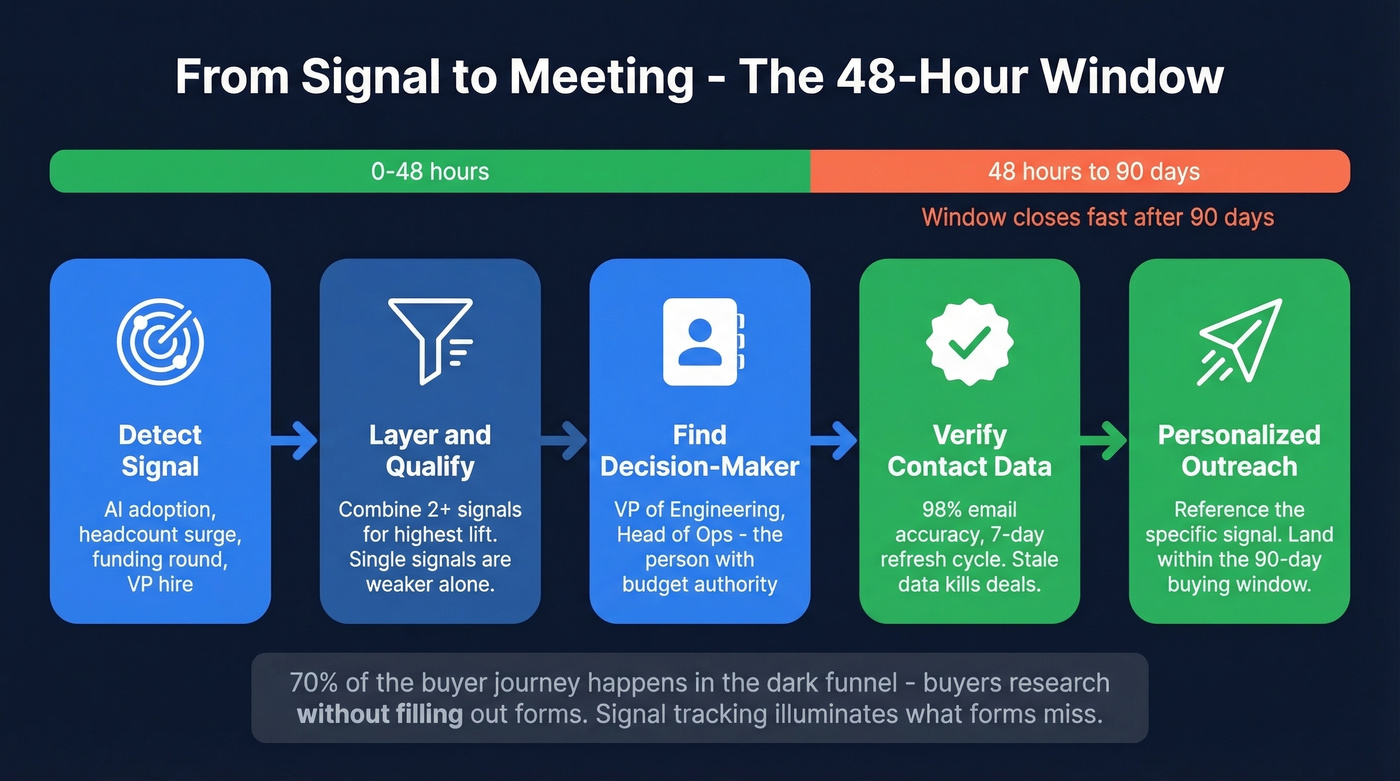
Up to 70% of the buyer journey happens in the "dark funnel", with buyers researching without filling out forms. The B2B intent data market hit roughly $4.5B in 2026 because companies are desperate to illuminate that invisible research phase. Major third-party intent platforms often run $25K-$100K+/year, and standalone Bombora access typically costs $12K-$40K/year.
When evaluating signal tracking tools, the biggest differentiators are data freshness, signal granularity, and whether the product is built for activation - meaning workflows that help you actually reach the right contacts - versus just exporting data. Teams that layer employee data for deal sourcing, tracking new hires, departures, and role changes, can time outreach to land during the window when a new decision-maker is actively evaluating vendors. In our experience, that window is about 90 days after a VP-level hire, and it closes fast.
Enrichment-first providers like Coresignal and People Data Labs are great for raw company and person profiles, but you'll still need an intent layer and a verification workflow to turn signals into meetings. And while using job listing data for sales prospecting sounds promising, that +7% purchase lift means it should supplement stronger signals like technographics and headcount growth rather than drive your entire strategy.

Let's be honest about what most teams actually need: a way to spot the signal and act on it in the same platform. Prospeo tracks 15,000 Bombora intent topics layered with headcount growth, funding, technographics, and 30+ search filters across 300M+ profiles. Email accuracy runs 98% on a 7-day refresh cycle, compared to the 6-week industry average. Paid plans start at ~$39/month with a free tier - a fraction of what enterprise intent platforms charge.
That 90-day window after a VP-level hire closes fast. Prospeo delivers 98% accurate emails and 125M+ verified mobiles so you can reach new decision-makers while they're still evaluating vendors - at $0.01/email instead of $25K+/year for enterprise intent tools.
Stop paying enterprise prices to watch signals you can't act on.
FAQ
What's the difference between growth signals and intent signals?
Growth signals indicate expansion - headcount, revenue, funding. Intent signals indicate active buying behavior like content consumption and review site visits. Intent is a subset: the company is expanding and actively shopping. Layering both gives you the highest purchase correlation.
Which company growth signal has the highest purchase correlation?
AI tool adoption shows a +46% lift in B2B software purchases, based on analysis of 1 million transactions. Headcount growth and recent software purchases tie at +38%. Job postings (+7%) are dramatically weaker than most teams assume.
How do you track company growth signals without enterprise tools?
Self-serve platforms let you filter by headcount growth, funding, and buyer intent across large profile databases, then deliver verified contact data at a fraction of enterprise pricing. Pair that with a traffic monitoring tool like SimilarWeb for web-based expansion indicators, and you've got a signal stack that rivals what $100K/year buys elsewhere.