

Company Database: The Complete Guide to Finding, Choosing, and Using B2B Data
Poor data quality costs organizations an average of $12.9M per year. That's not a typo - and it's not just a Fortune 500 problem. Whether you're a sales team building outbound lists or a compliance officer running due diligence on acquisition targets, the company database you choose determines whether you're working with signal or noise.
What Is a Company Database?
A company database is any structured collection of information about businesses - their attributes, the people who work there, and the signals that indicate when they might be ready to buy, partner, or get acquired. The term covers a wide range because different roles need different data.
For a sales team, it means a searchable index of companies and contacts. For a compliance officer, it means verified registration records, ownership structures, and financial filings. For a data engineer, it might mean an API returning firmographic fields they can pipe into a warehouse. At its core, every company information database serves the same purpose: turning raw records into actionable intelligence.
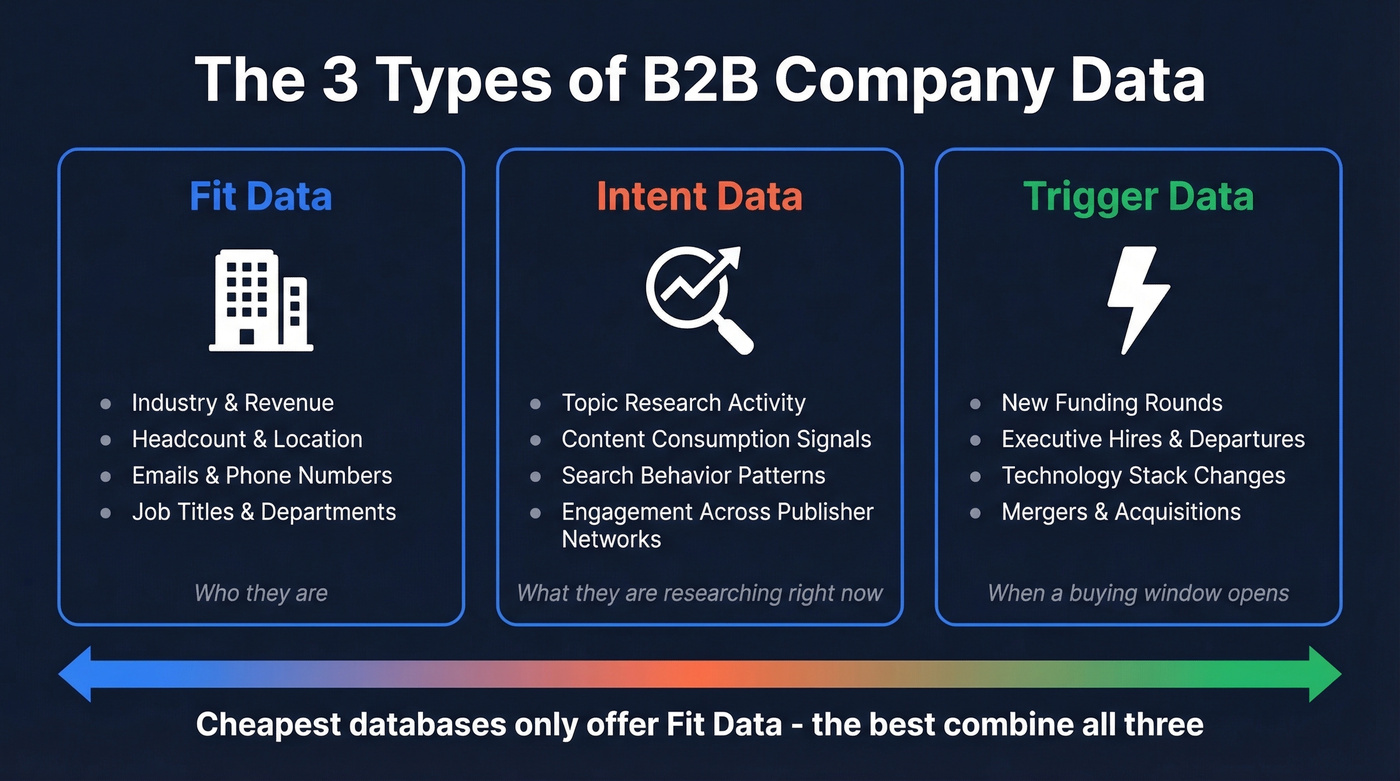
The data inside these databases generally falls into three buckets:
- Fit data - firmographics like industry, revenue, headcount, and location, plus contact data like emails, phone numbers, and job titles
- Intent data - behavioral signals showing which companies are actively researching topics related to your product (intent data)
- Trigger data - events like funding rounds, executive hires, or technology changes that create buying windows (sales triggers)
The best modern databases combine all three. The cheapest ones give you fit data only - and often stale fit data at that.
Types of B2B Company Data Sources
Understanding the architecture behind a database tells you more about its strengths and weaknesses than any feature chart ever will.
Single-Source Databases
Waterfall Enrichment Platforms
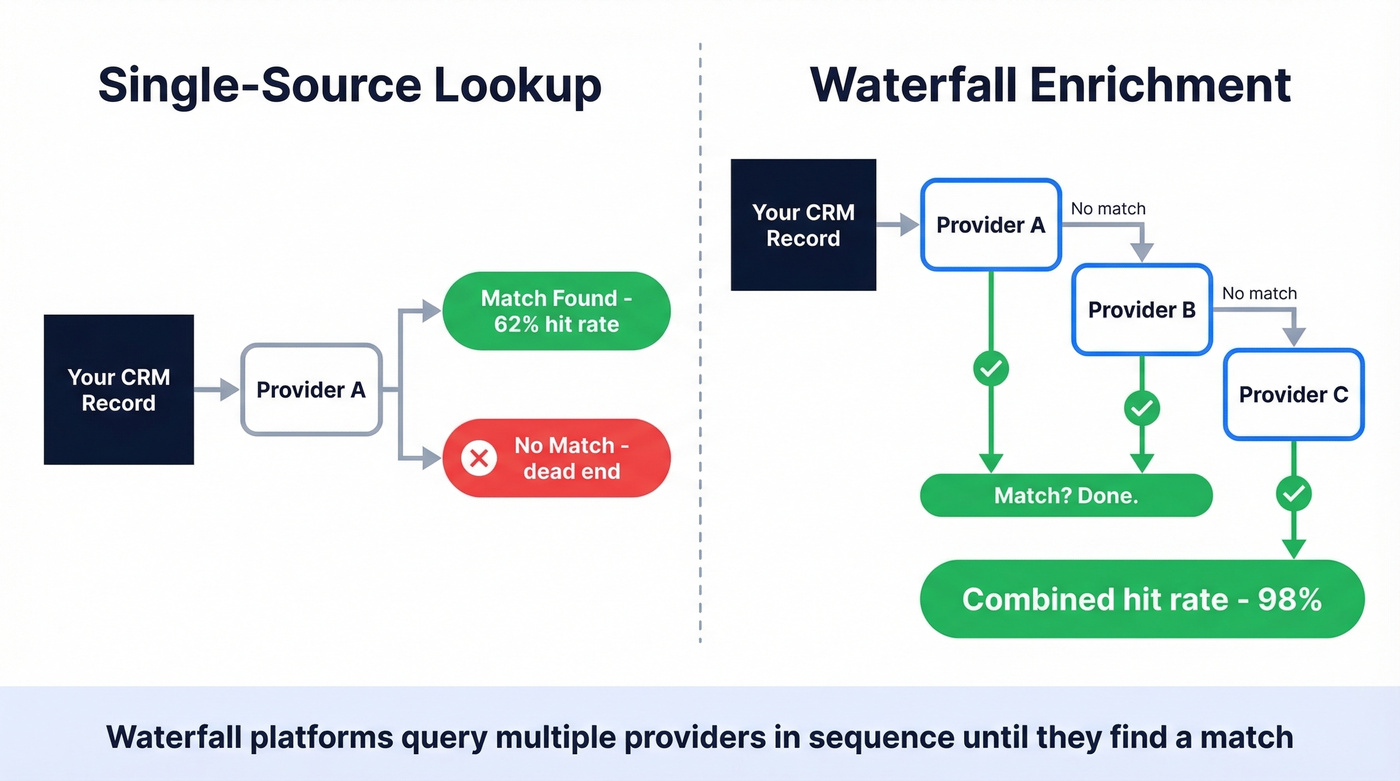
Instead of relying on a single source, waterfall platforms query multiple providers in sequence until they find a match. The math is compelling - 98% vs. 62% - but waterfall platforms cost more and are harder to debug when bad data slips through. In our experience, the accuracy gains are worth the complexity for any team sending more than a few hundred emails per week (waterfall enrichment).
API-First Data Providers
Companies like People Data Labs sell raw data via API rather than through a polished UI. They're built for engineering teams integrating company data into internal tools, scoring models, or enrichment workflows (data enrichment API). Great flexibility, steeper learning curve.
Intent & Signal Platforms
Bombora, 6sense, and Demandbase focus less on "who exists" and more on "who's in-market right now." They track content consumption, search behavior, and engagement signals across publisher networks. These aren't replacements for a contact database - they're a layer on top that tells you which accounts to prioritize (best intent data providers).
Government Registries & Open Datasets
Every country maintains some form of corporate registry. In the US, that means state-level incorporation records and SEC EDGAR for public company filings. OpenCorporates indexes 200M+ corporate registrations across jurisdictions. The U.S. Department of Commerce library guide warns that "databases can provide incomplete and conflicting information" - which is why triangulating across multiple sources matters, especially for due diligence.
Best Commercial Options in 2026
Here's the thing: most sales teams don't need an enterprise-grade platform. If your average deal size is under $15K, a self-serve tool with accurate emails will outperform a $40K/year platform you only use for contact lookups. Pick the tool that matches your actual workflow, not the one with the longest feature list.
Prospeo
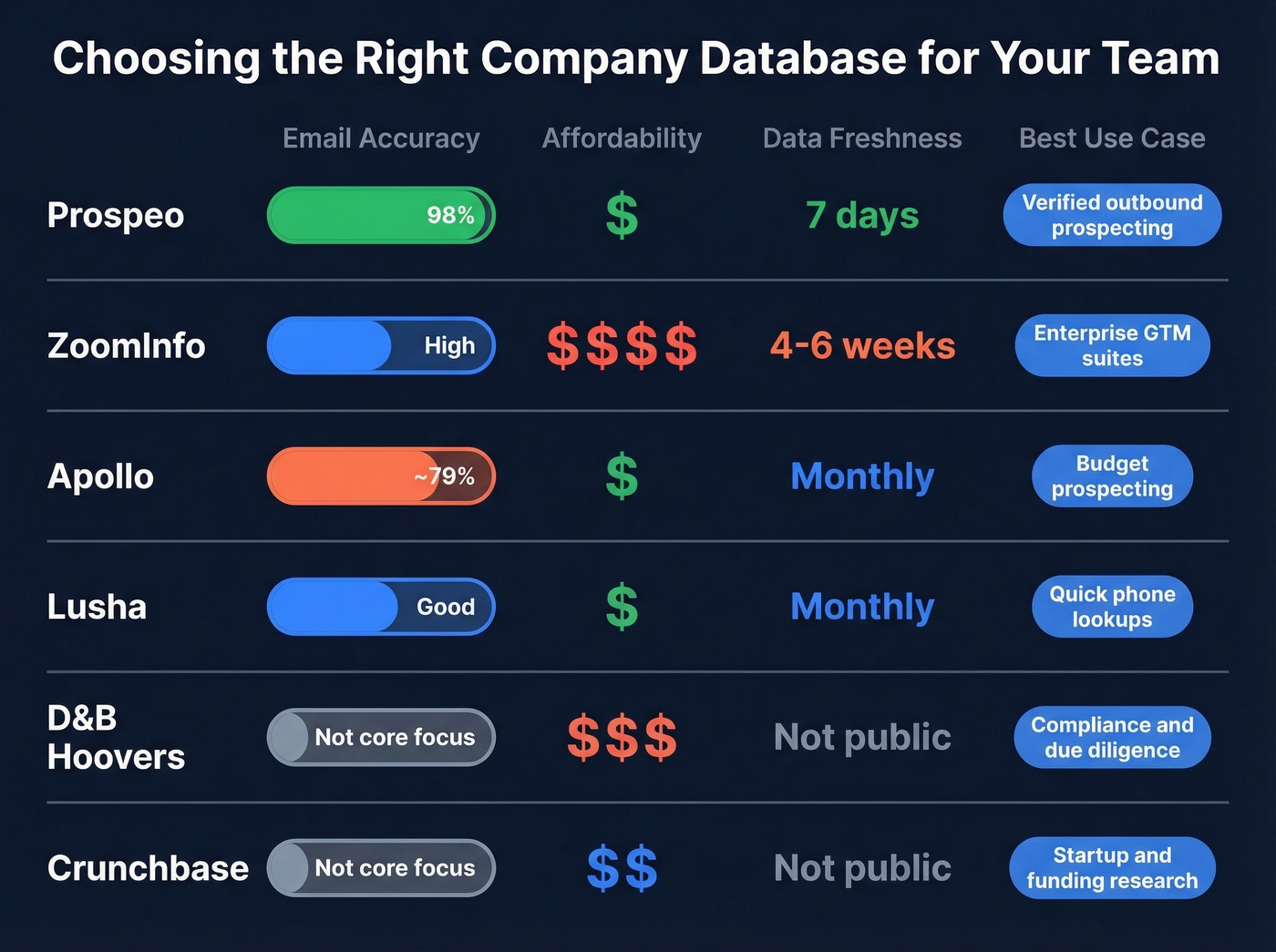
Prospeo covers 300M+ professional profiles with 143M+ verified emails and 125M+ verified mobile numbers. Email accuracy hits 98%, backed by a proprietary 5-step verification process that handles catch-all domains, spam traps, and honeypots. Data refreshes every 7 days - roughly six times faster than the industry average.

The search interface offers 30+ filters including buyer intent across 15,000 topics, technographics, job changes, headcount growth, and funding events. Pricing starts at ~$39/mo with no annual contracts. Native integrations with Salesforce, HubSpot, Smartlead, Lemlist, Instantly, and Clay mean data flows straight into your existing stack.
Use this if you need verified contact data with enterprise-grade accuracy at self-serve pricing. Skip this if you only need corporate registry data rather than contacts.
ZoomInfo
The #1 complaint about ZoomInfo on Reddit? Price. A mid-market contract typically runs $15K-$45K+/year depending on seats, modules, and add-ons. Long-term annual contracts are standard, and the renewal conversation is where most teams get burned - paying for intent modules and conversation intelligence features they barely touch.
That said, ZoomInfo is one of the largest enterprise B2B databases in the US. For large sales organizations with budget to match, the platform combines contact data, intent signals, website visitor tracking, and conversation intelligence into a single GTM suite. We've seen it work well for teams with 20+ reps who actually use the full platform. For everyone else, it's expensive shelfware.
Use this if budget is genuinely no object and you need maximum US coverage plus a full GTM platform. Skip this if you're an SMB, hate annual contracts, or primarily need EMEA data.
Apollo
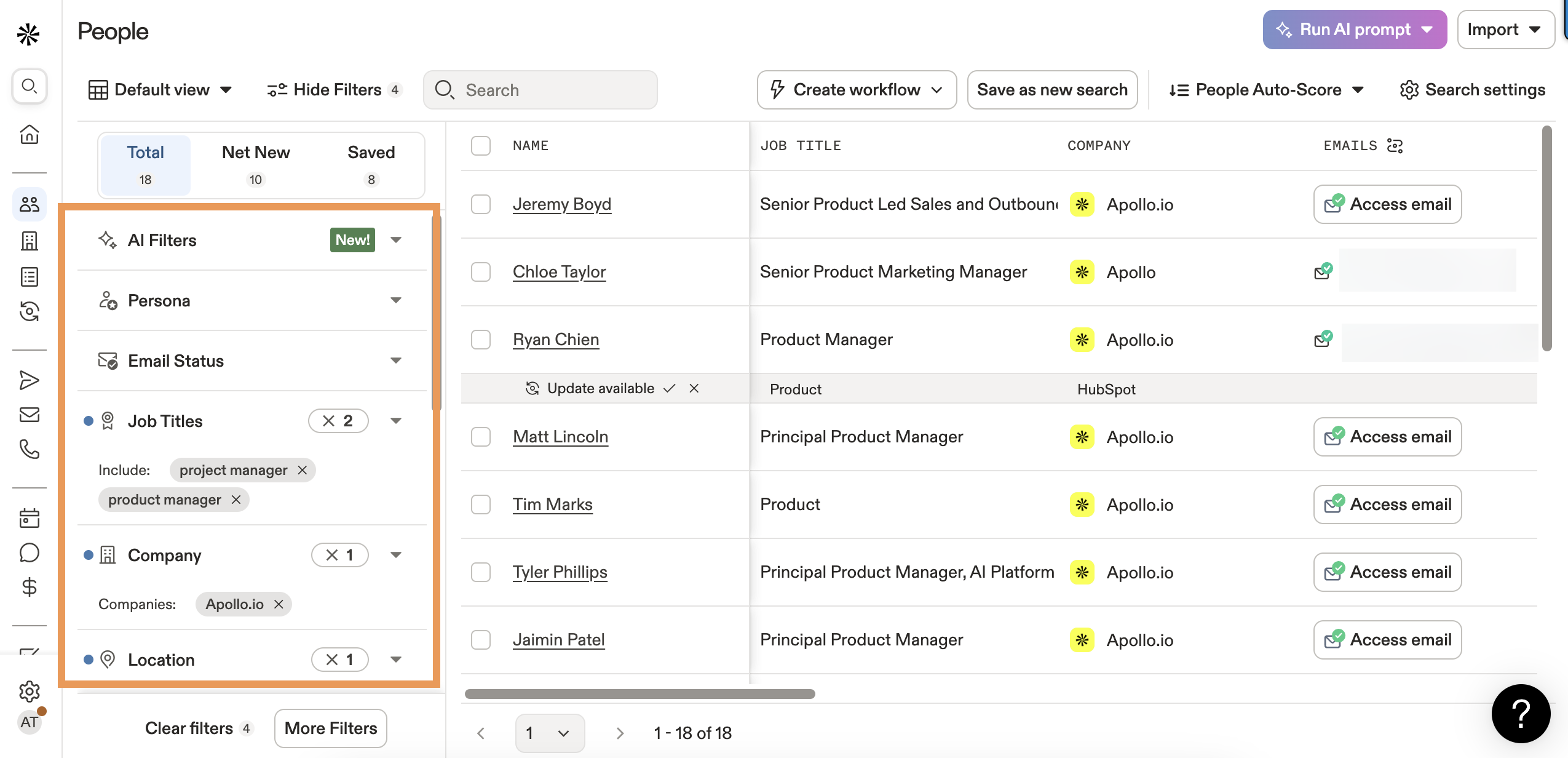
Apollo is the obvious starting point for budget-conscious teams. The free tier gives you 1,200 credits/month - enough to test workflows before committing. Paid plans run ~$49-99/mo per user.
The tradeoff is accuracy. Benchmarks put Apollo around 79% email accuracy, which is workable for high-volume outbound but a real problem if deliverability matters to your domain reputation. Credit mechanics also get tricky: email and phone lookups consume separate credits, and exports burn through allocations faster than expected. We've watched teams exhaust their monthly credits by week two.
Lusha
Lusha's Chrome extension is fast and simple - 40 free credits/month, quick lookups while browsing company websites. Paid plans start around $36/mo. It's a lightweight tool for reps who need a phone number right now, not a full company profiles database for building segmented lists.
D&B Hoovers
D&B Hoovers sits at the intersection of sales intelligence and corporate research. The database covers 170M+ business records with deep firmographic detail - ownership structures, corporate family trees, financial data, and industry classifications. It's one of the tools the Department of Commerce library recommends for company profiles and corporate family research.
Pricing spans a wide range: Hoovers Essentials starts at $49/mo for 150 credits, while enterprise bundles run $25K-$50K+/year. Onboarding takes weeks, not minutes. Skip this for outbound sales prospecting - the contact data isn't the strength. Use this for compliance, financial research, or mapping corporate hierarchies.
Crunchbase
Crunchbase starts at $49/mo (billed annually) and is the go-to for startup and funding data. If you're targeting venture-backed companies or tracking investment rounds, it's unmatched. For general B2B prospecting, it's too narrow.
Quick Comparison
| Tool | Database Size | Starting Price | Best For | Data Refresh |
|---|---|---|---|---|
| ZoomInfo | Large US-focused B2B database | ~$15K/yr | Enterprise GTM | 4-6 weeks |
| Apollo | Large contact database | Free / ~$49/mo | Budget prospecting | ~Monthly |
| Lusha | Contact database | Free / ~$36/mo | Quick lookups | ~Monthly |
| D&B Hoovers | 170M+ records | $49/mo | Due diligence | Not public |
| Crunchbase | Company & funding database | $49/mo | Startup/funding | Not public |

The article above says poor data costs $12.9M/year. Prospeo's company database eliminates that tax: 300M+ profiles, 98% email accuracy, and a 7-day refresh cycle that's 6x faster than the industry average. 30+ filters - intent, technographics, funding, headcount growth - so you build lists on signal, not noise.
Search 300M+ company profiles with 98% verified emails for $0.01 each.
Free Company Databases Worth Using
You don't always need to pay. Several open datasets provide surprisingly useful B2B company data - especially for firmographics, technographics, and public filings.
SEC EDGAR
For publicly traded US companies, the SEC EDGAR database provides free access to financial filings and ownership disclosures, with full-text electronic filings since 2001. EDGAR isn't a prospecting tool, but for due diligence on public companies, nothing else comes close.
People Data Labs (Free Dataset)
People Data Labs offers a free company dataset covering 22M+ global companies with fields like name, domain, size, founded year, industry, and location. It's updated quarterly, available in CSV, pipe-delimited, and JSON formats, and licensed under CC BY 4.0 for commercial use. Fair warning: the CSV runs millions of lines and won't open in Excel without choking.
Open Technographics Datasets
For teams targeting companies by tech stack, there's a free technographics dataset indexing 51.3M+ companies across 403 technologies. You get 500 sample records per technology for free, with daily updates and MIT licensing. Detection accuracy runs ~96% based on manual spot-checks.
OpenCorporates & Government Registries
OpenCorporates indexes 200M+ corporate registrations across jurisdictions worldwide, with API access for programmatic lookups. Data includes company name, registration number, status, officers, and corporate relationships. The caveat: data consistency varies wildly by jurisdiction - a UK company record will be far more complete than one from a smaller registry. For US companies, you can also go directly to state registries like Delaware's Division of Corporations.
Why Your Data Is Already Decaying
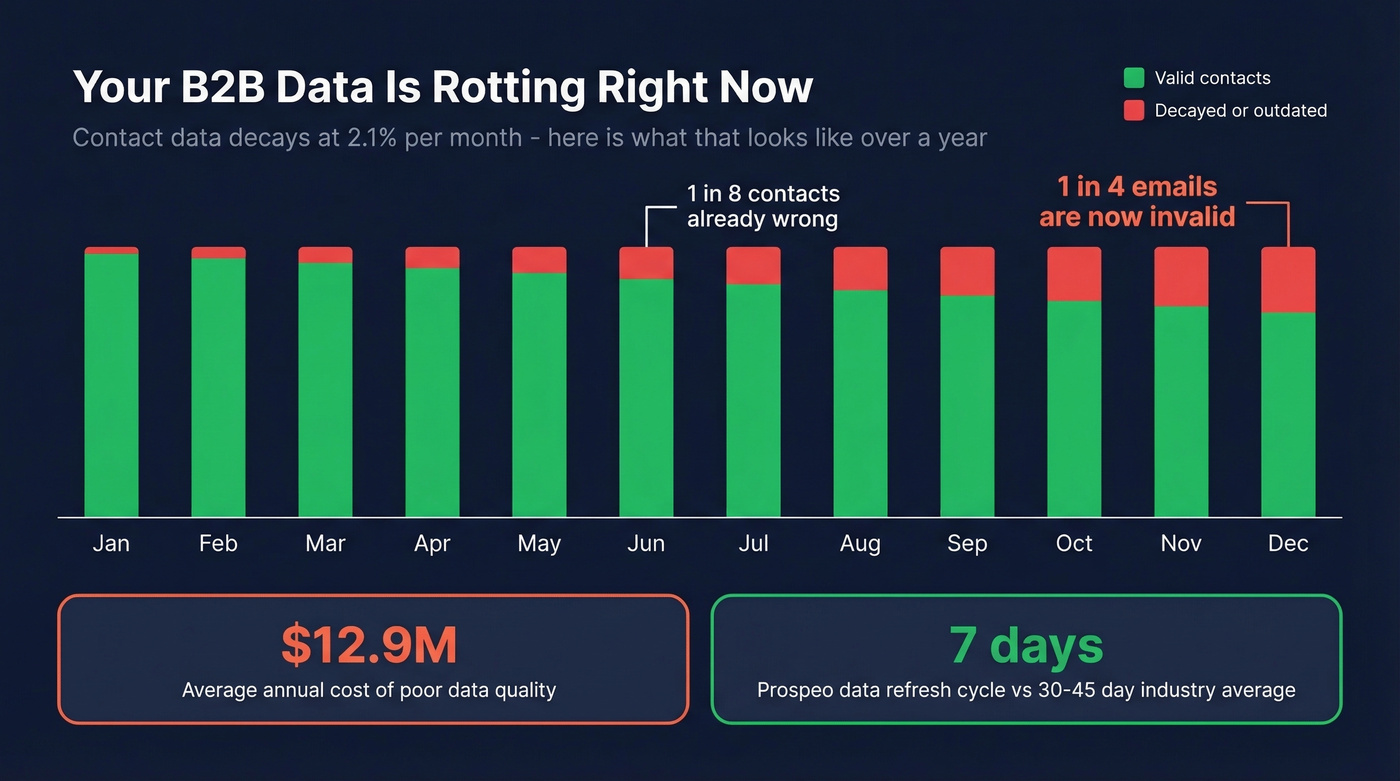
B2B contact data decays at 2.1% per month - roughly 22.5% annually. Some estimates put it even higher: 28% of B2B emails become outdated each year. People change jobs, companies get acquired, phone numbers get reassigned. After 12 months, about 1 in 4 email addresses in your records will be wrong.
Then there's the overuse problem. When everyone pulls from the same provider, everyone emails the same prospects. Reply rates drop not because your messaging is bad, but because your prospect got the same "quick question" email from six other vendors this week.
The fix isn't switching databases every quarter. It's choosing one with a fast refresh cycle and building hygiene into your workflow (CRM data enrichment). The industry average sits around six weeks between updates. Weekly refresh cycles mean the contact you pulled on Monday is verified against current data, not last month's snapshot.
How to Choose the Right Provider
Let's break this down to five questions. Answer them honestly and the right option becomes obvious.
What's your use case? Sales prospecting, corporate research, and compliance due diligence require fundamentally different data. D&B Hoovers excels at corporate family trees. SEC EDGAR covers public company filings. Don't buy a Swiss Army knife when you need a scalpel. If you're researching privately held firms, look for a private company database with verified financials and ownership data - public-company tools won't cut it.
What data types do you actually need? Firmographics alone? Contact data with emails and phones? Intent signals? Technographics? Most teams overestimate what they need on day one and underestimate what they'll need in six months. Start lean, then expand (see B2B data enrichment).
What's your real budget? Free tiers are genuinely useful for small teams - Apollo gives you 1,200 credits/month. But if you're running outbound at scale, plan for $39-99/mo per user at the self-serve tier, or $15K+ annually for enterprise platforms.
How do credits work? This is the question I wish more teams asked before signing. Credit-based pricing creates a scarcity mindset - reps start optimizing for credit conservation instead of pipeline generation. Some tools charge separate credits for emails vs. phones. Others burn credits on exports even if the contact is already in your CRM. Read the fine print.
How often does the data refresh? A provider that refreshes weekly is fundamentally different from one that refreshes every six weeks. Over a year, that gap compounds into thousands of stale records. If you're building an internal company database, prioritize continuous cleaning and validation - data left untouched for even a quarter starts dragging down your outbound performance (CRM data cleaning).
You don't need a $40K/year platform to get enterprise-grade company data. Prospeo gives you 143M+ verified emails, 125M+ mobile numbers, and intent data across 15,000 topics - self-serve, no contracts, starting at $39/mo. Teams using Prospeo book 26% more meetings than ZoomInfo users.
Get ZoomInfo-level data without the ZoomInfo contract.
FAQ
What is the largest company database?
OpenCorporates indexes 200M+ corporate registrations globally, making it the largest open registry. For verified contact data, Prospeo covers 300M+ professional profiles with 143M+ verified emails - the largest verified contact database available on a self-serve basis. ZoomInfo and D&B both claim 100M+ company records.
Are free company databases reliable?
For basic firmographics like company name, size, and industry, yes - People Data Labs, OpenCorporates, and SEC EDGAR provide solid foundational data. For verified emails and phone numbers, free datasets fall short. You need a provider with active verification infrastructure to avoid bounces and wrong numbers.
How fast does B2B data go stale?
Contact data decays at roughly 2.1% per month - about 22.5% annually. Phone numbers decay even faster due to job changes and number reassignment. Providers with weekly refresh cycles dramatically reduce this problem compared to the 6-week industry average.
What's the difference between a company database and a lead database?
A company database provides firmographic information - name, size, revenue, industry, location. A lead database adds verified contact data for individual people: emails, phone numbers, job titles, and seniority levels. Most modern sales tools combine both into a single platform so reps can go from account research to outreach without switching tools.
How much do company databases cost?
Free tiers are available from Apollo (1,200 credits/mo) and Prospeo (75 emails + 100 Chrome extension credits/mo). Paid self-serve plans range from $36-$99/mo per user. Enterprise platforms like ZoomInfo run $15K-$45K+/year with annual contracts. The right budget depends on team size and whether you need contact data, intent signals, or both.