

Sales Triggers: How to Spot, Score, and Act on Buying Signals Before Your Competitors Do
84% of sales reps missed quota last year. Not because they couldn't sell - because they couldn't time. In our trigger playbook benchmarks, generic cold emails pull a 3.4% reply rate, while signal-personalized outreach hits 18%. The difference isn't talent or messaging. It's knowing when to reach out, and every trigger you miss is a deal your competitor books first.
Here's the thing: you've probably read five articles about trigger events already. They all list the same signals and pitch a product. None tell you how to build the system. This one does.
The Short Version
You don't need 23 triggers. You need five - the ones that actually preceded your last 20 closed-won deals. Track them with a scoring and decay system, act within hours, and make sure your contact data is accurate before you spend a dime on trigger tools.
Most sales teams would get more pipeline from fixing their contact data than from buying another intent tool. The rest of this article shows you exactly how to build the system that makes buying signals pay off.
What Is a Sales Trigger?
A sales trigger is any observable event that signals a company's likelihood to buy just changed. A funding round. A new VP of Sales. A competitor going down. These aren't vague "intent signals" - they're concrete, timestamped events you can build outreach around.
Don't confuse triggers with intent data (we'll unpack that distinction shortly). Intent data tells you an account might be researching solutions. A trigger event tells you something specific happened that creates urgency. Both matter, but triggers give you a reason to open a conversation that doesn't sound like a cold pitch.
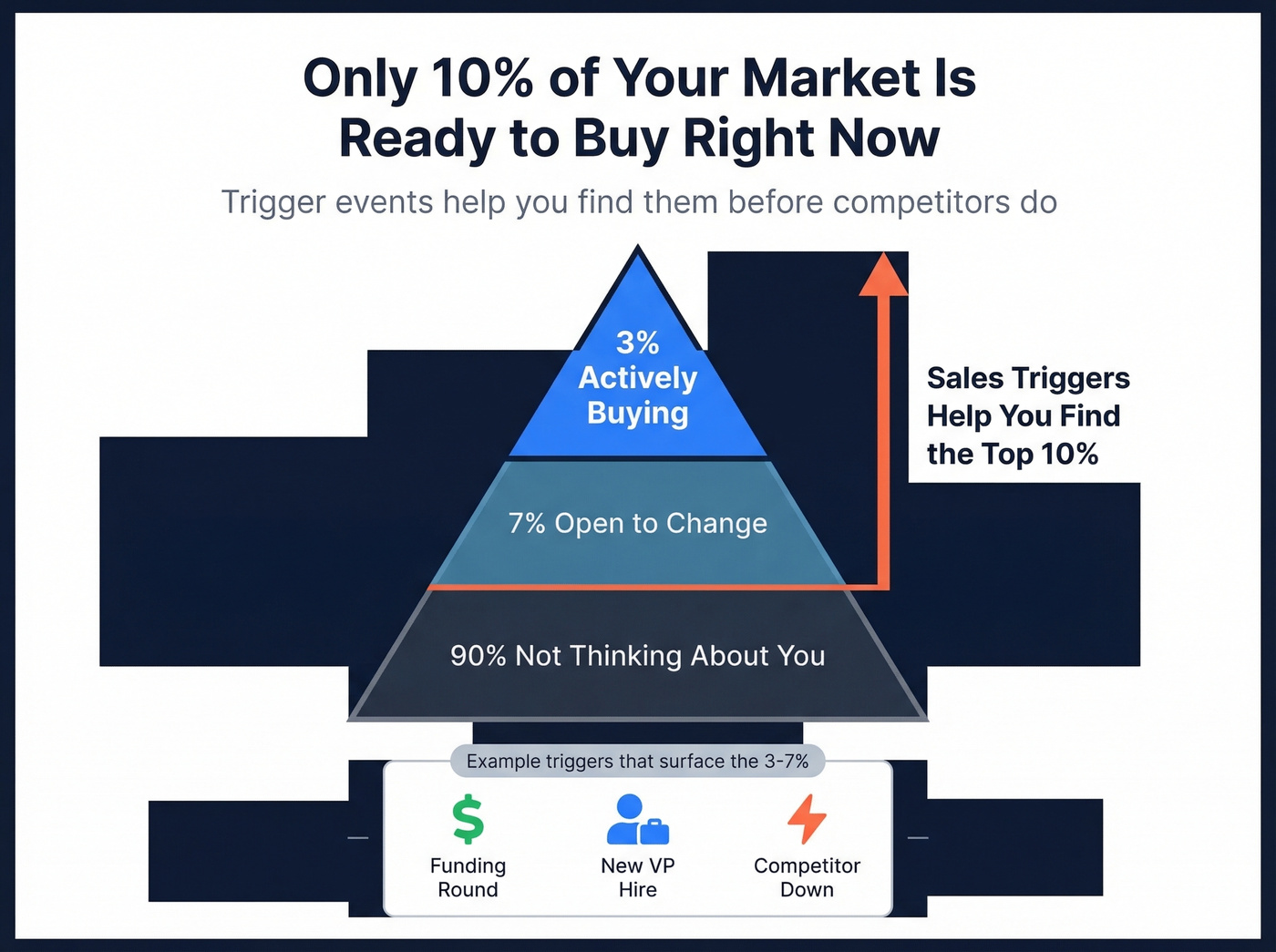
Chet Holmes's buyer readiness model frames it well: only 3% of your market is actively buying at any moment, another 7% is open to change, and the remaining 90% isn't thinking about you at all. With an average of 7 people involved in B2B buying decisions, entering the conversation early - before committees calcify around a competitor - is the whole game. Trigger events help you find the 3-7% and reach them first.
Trigger Events That Actually Move Pipeline
Not all signals are created equal. A pricing page visit from your target account is a fundamentally different buying signal than a generic "new to role" alert. Here's the breakdown of the most common types, organized by category and prioritized by how reliably they indicate real buying motion.
Company Events
Funding rounds, M&A activity, IPO/SPAC filings, product launches, office expansions, and bad earnings quarters all reshape a company's priorities overnight. A Series B means new budget and new mandates. A bad quarter means cost-cutting - which is still a trigger if you sell efficiency.
Personnel Changes
New C-suite or VP hires, layoffs and restructuring, champion job changes, and new department heads. Personnel triggers are the strongest category because new leaders almost always bring new vendors. When your champion leaves for a new company, that's a warm intro waiting to happen.
Market & Industry Shifts
New legislation, competitor disruption, and industry consolidation create urgency across entire segments. GDPR didn't just create compliance headaches - it created a massive market for privacy and compliance tools. Watch for regulatory shifts in your buyers' industries.
Behavioral Signals (Micro-Triggers)
Website visits, content downloads, pricing page views, and G2 comparison activity. These are the fastest-decaying signals. A pricing page visit from two hours ago is gold. From two weeks ago, it's noise.
| Trigger | What It Signals | Recommended Action | Priority |
|---|---|---|---|
| Funding round | New budget, new mandates | Reference growth plans | High |
| New C-suite hire | Strategy shift, vendor review | Sell outcomes, not features | High |
| Pricing page visit | Active evaluation (decays fast) | Respond within 1-4 hours | High |
| Champion job change | Warm intro at new company | Re-engage within days | High |
| M&A activity | Consolidation, integration needs | Position around efficiency | High |
| Bad earnings quarter | Cost-cutting pressure | Lead with ROI/savings | Med |
| Product launch | Scaling needs, new tech stack | Align to launch priorities | Med |
| Office expansion | Headcount growth, new tools | Target new location leads | Med |
| Layoffs/restructuring | Budget reallocation | Lead with efficiency | Med |
| New legislation | Compliance urgency | Position enablement | Med |
| Competitor disruption | Vendor re-evaluation | Offer migration path | Med |
| G2 comparison activity | Active vendor research | Respond same day | Med |
| Content download | Early-stage research (decays fast) | Nurture, don't pitch | Low |
| Social engagement | Awareness, not urgency | Add to nurture sequence | Low |
| Industry consolidation | Long-term strategic shift | Build relationship early | Low |

You found the trigger. Now what? If the email bounces, the signal is wasted. Prospeo delivers 98% email accuracy and 125M+ verified mobile numbers - refreshed every 7 days, not 6 weeks. Layer Bombora intent data across 15,000 topics with verified contact data so every trigger you detect turns into a conversation, not a bounce.
Stop losing deals to stale data. Act on triggers with contacts that connect.
Sales Triggers vs. Intent Data
These terms get used interchangeably, and that's a problem. They're different things that work best together.
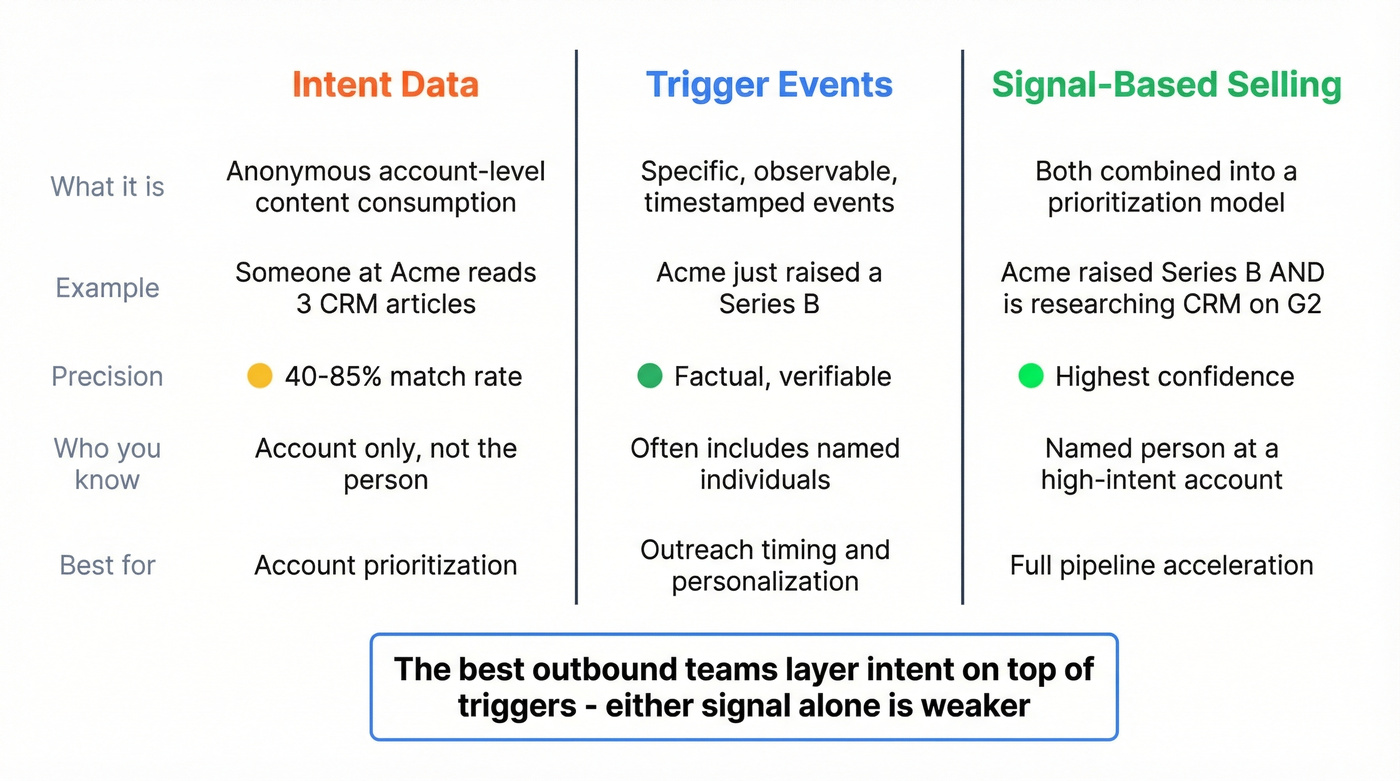
Intent data is anonymous, account-level content consumption. Someone at Acme Corp reads three articles about CRM migration on a Bombora-tracked publisher. You don't know who, and you don't know why. Intent match rates range from 40% to 85% depending on the provider - which means up to 60% of your "intent signals" are noise. Intent data spans four signal types (content consumption, search behavior, product comparison, and website activity), each with different reliability and decay rates.
Trigger events are specific, observable occurrences. Acme Corp just raised a Series B. Their new VP of Engineering started Monday. These are facts, not inferences.
Signal-based selling is the umbrella combining both into a prioritization model. The best outbound teams layer intent data on top of trigger events: "Acme raised a Series B and they're researching our category on G2." That's a high-priority account. Either signal alone is weaker. The global intent data software market is projected to exceed $4B by 2028, but the teams getting ROI from it are the ones combining it with trigger events, not using it in isolation.
How to Detect Buying Signals Without Drowning in Noise
The #1 complaint about trigger tools on r/sales is that they surface generic events that don't reliably indicate buying motion. Reps end up manually parsing signals, questioning whether it's better than random prospecting. That's a system problem, not a data problem.
Start With Closed-Won Data
Pull your last 20 closed-won deals. For each one, identify what happened at the account in the 30-90 days before the opportunity was created. Funding round? New hire? Pricing page visit? You'll find patterns - and those patterns become your trigger shortlist.
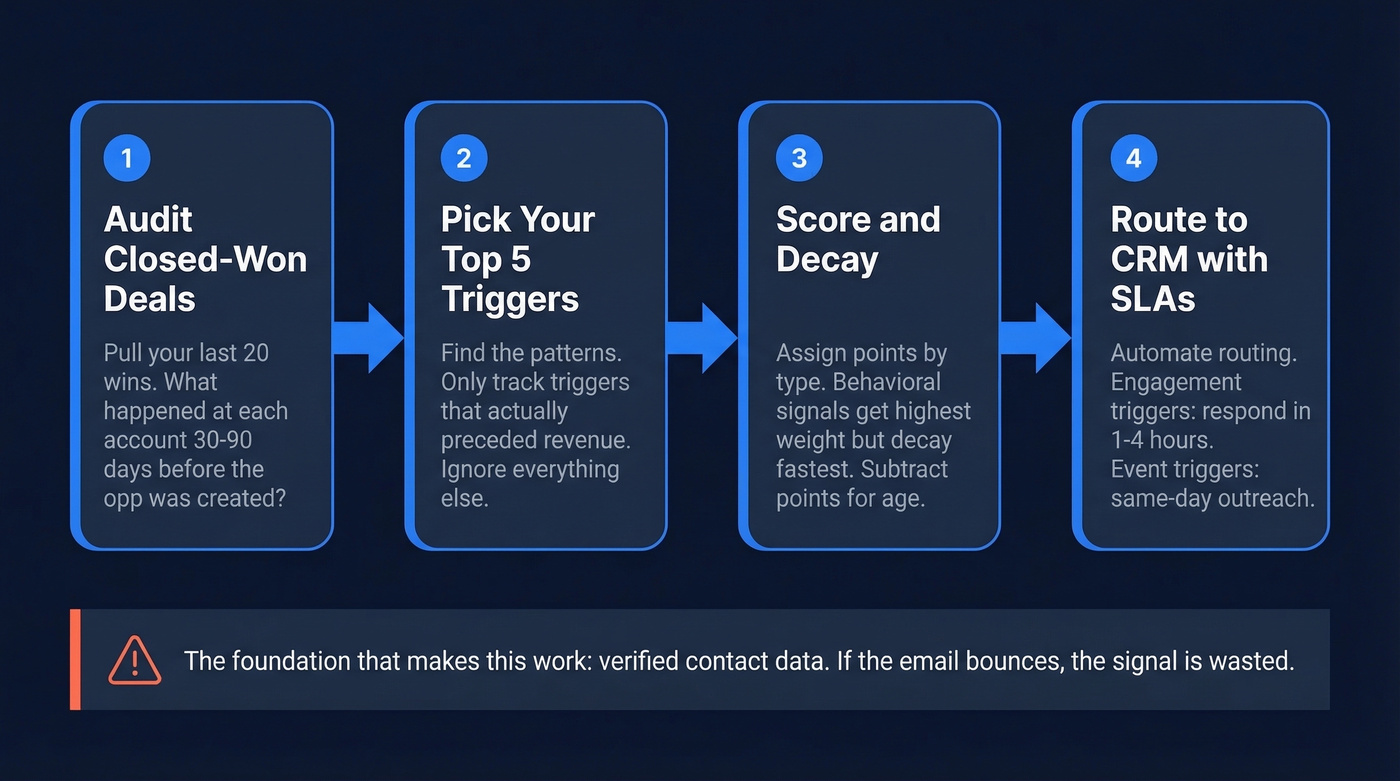
Track only those five triggers. Not 25. Five.
These are your highest-value signals because they're validated by your own revenue data, not borrowed from a generic playbook. We ran this exercise with our own pipeline and found that champion job changes and funding rounds preceded over 60% of our closed-won deals - everything else was background noise.
Score and Decay Your Triggers
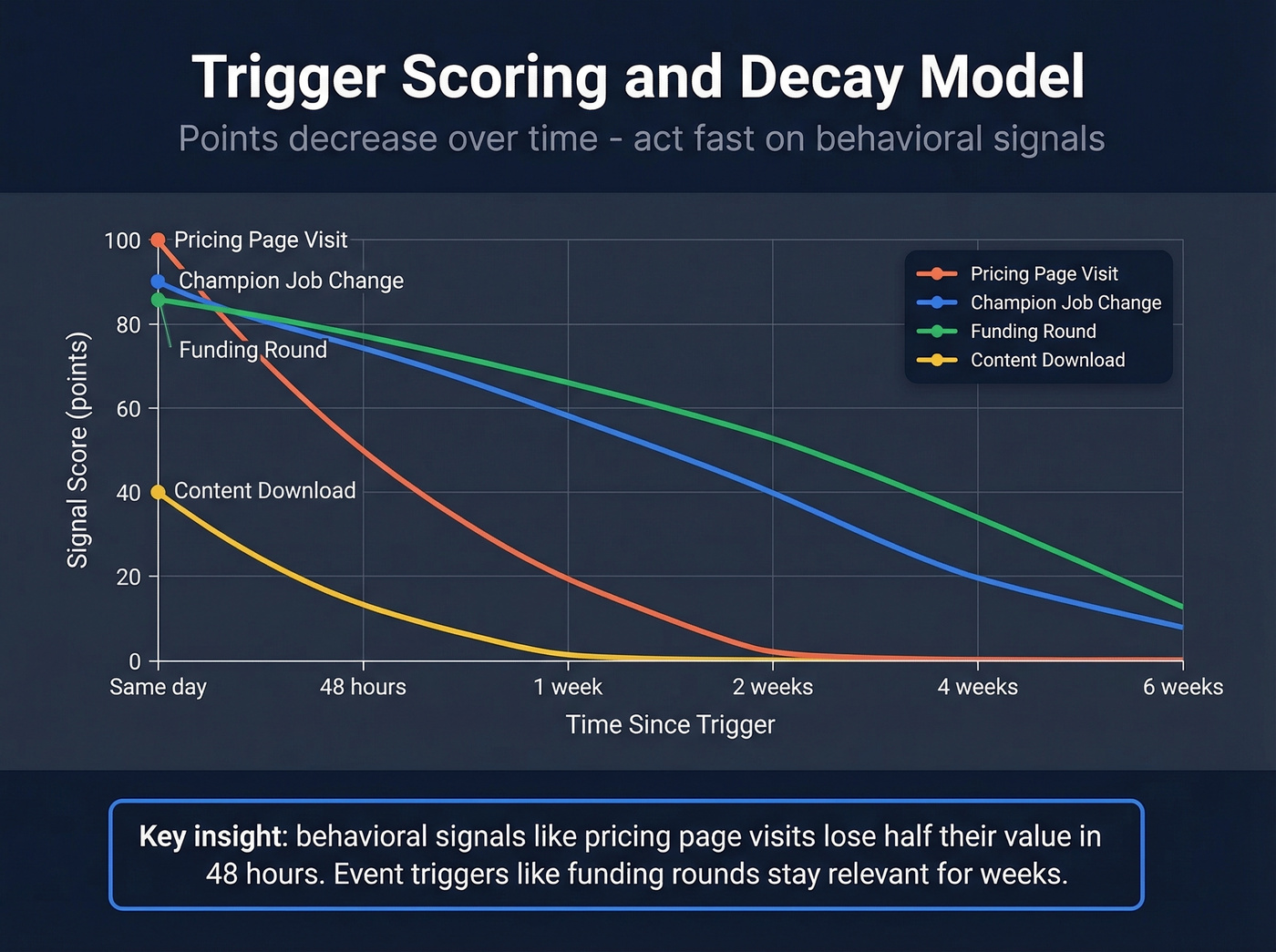
Fresh triggers outrank old ones. A funding round from yesterday beats a job change from six weeks ago. Build a simple lead scoring model: assign points by trigger type (behavioral signals get the highest weight because they decay fastest), then subtract points for age. A pricing page visit loses half its value after 48 hours. A funding round stays relevant for 2-3 weeks.
Route Triggers Into Your CRM
Manual spreadsheets die within two weeks. We've seen it happen over and over - someone builds a beautiful trigger-tracking sheet, and by week three nobody's updating it.
Automate routing into your CRM and set response SLAs. Engagement triggers (website visit, content download) need a response within 1-4 hours. Event triggers (funding, new exec) need same-day outreach. But here's what kills trigger-timed outreach faster than bad timing: stale contact data. You spot the perfect signal, craft the perfect message, and it bounces. A data provider with a 7-day refresh cycle versus the 6-week industry average is the unsexy foundation that makes the entire trigger chain work. If you want the full ops setup, see our guide on how to track sales triggers.
Filter the Noise
The "5 triggers, not 25" rule is your antidote to alert fatigue. If a trigger type didn't show up in your closed-won analysis, turn off the alert. You can always expand later once the system works with a tight set.
Trigger-Based Outreach Templates
Trigger-timed outreach performs 2-5x better than generic cold outreach - but only if the message connects the event to a relevant problem. 57% of the buying journey is complete before a prospect talks to sales. Your job isn't to pitch. It's to be useful at the exact moment they're thinking about the problem you solve.
If you need more plug-and-play messaging, borrow from these sales follow-up templates and adapt them to each trigger.
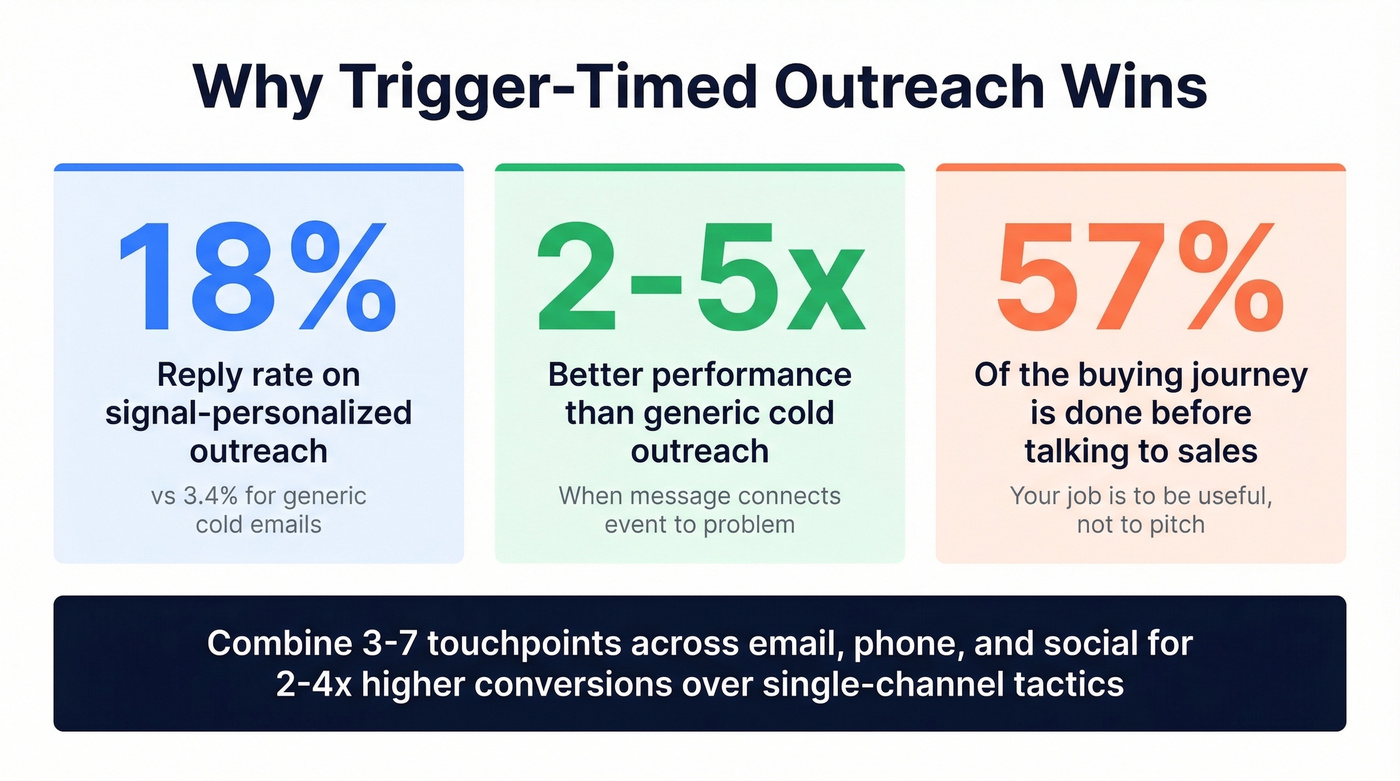
Since combining touchpoints boosts conversions 2-4x over single-channel tactics, plan for 3-7 messages across email, phone, and social - not a single Hail Mary. (If you're rebuilding your outbound motion, start with these sales prospecting techniques.)
Here are four openers tied to specific trigger types. Adapt the brackets to your product.
Funding round:
Subject: [Company]'s Series B + [specific challenge] "Congrats on the round. Most teams at your stage start hitting [specific pain point] around month 3 of scaling. We helped [similar company] solve that before it became a fire. Worth a 15-min look?"
New exec hire:
Subject: Quick note for [Name]'s first 90 days "New [title] roles usually mean a vendor review is coming. If [specific problem area] is on your list, here's a one-pager on how [similar company] approached it. No pitch - just context."
Don't do this (the generic version that gets ignored):
"Congrats on the new role! I'd love to set up a call to show you how we can help. When works for you?"
No trigger connection, no relevance, no value. That's a pitch slap, not outreach.
Competitor switch signal:
Subject: Saw you're evaluating [category] "Noticed [Company] is comparing [category] tools on G2. We just helped [similar company] migrate from [competitor] - cut their [metric] by [number]. Happy to share the playbook."
Pricing page visit:
Subject: Quick question "You were on our pricing page earlier. Rather than guessing what you need, want me to build a custom quote based on your team size? Takes 5 minutes."
Top-closing reps speak 43% of the time versus 65% for average performers. Your trigger-based email should open a conversation, not deliver a monologue. If you're tightening your talk track, use these email subject line examples to increase opens without sounding clickbaity.
Best Tools for Tracking Triggers in 2026
Most dedicated trigger platforms start around $450/mo before you pay for contact data on top. That's the hidden cost - you detect the signal, then you still need a verified email to act on it. Here's what the market looks like.
Prospeo
The data quality layer that makes every other trigger tool work. 300M+ professional profiles, 143M+ verified emails at 98% accuracy, 125M+ verified mobile numbers, and a 7-day data refresh cycle. It also includes intent data tracking 15,000 topics via Bombora, so you can layer buying signals directly into your prospecting filters. Free tier gives you 75 verified emails per month. Paid plans start at ~$39/mo - roughly $0.01 per verified email. Teams using Prospeo book 26% more meetings than those on ZoomInfo and 35% more than Apollo users, largely because the data actually lands in inboxes instead of bouncing. (If you're comparing vendors, start with our roundup of the best B2B company data providers.)

Trigify
Skip this if you haven't validated which triggers convert yet - it's overkill for teams still figuring out their playbook. But once you know your five triggers, Trigify is purpose-built to scale monitoring with 30+ pre-built trigger events and an AI research assistant called TrigIQ. Plans start at $450/mo. The gap: you still need a separate provider for verified contact info.
UserGems
The best tool for job-change triggers, period. If your playbook relies on tracking champion movements and new exec hires, UserGems is purpose-built for that use case. Typically $1,000-2,500/mo. It's narrow but deep - don't buy it expecting broad trigger coverage.
| Tool | Best For | Pricing | Data Refresh |
|---|---|---|---|
| Prospeo | Verified contacts + intent | Free tier; ~$39/mo+ | 7 days |
| Trigify | Dedicated trigger detection | $450/mo+ | Real-time alerts |
| UserGems | Job-change tracking | ~$1,000-2,500/mo | Near real-time |
| Google Alerts | Free news monitoring | Free | As indexed |
| Cognism | Intent + EMEA compliance | ~$1,000-3,000/mo | Varies |
| Apollo | All-in-one prospecting | Free; $49/mo+/user | Monthly |
Let's be honest - Google Alerts is free and surprisingly effective for funding, M&A, and news triggers. It's the right starting point for your first trigger system. Cognism adds strong sales intelligence with European compliance coverage at $1,000-3,000/mo. Apollo covers all-in-one outbound prospecting with a generous free tier and paid plans from $49/mo per user, though its trigger detection is basic. If you're building a budget stack, start with these free lead generation tools before you commit to paid platforms.
Your closed-won analysis revealed the triggers. Now you need the right contacts at those accounts - fast. Prospeo's 30+ search filters let you combine buyer intent, job changes, and headcount growth to find decision-makers the moment a trigger fires. At $0.01 per email, your trigger system pays for itself on the first booked meeting.
Turn every buying signal into a booked meeting for a penny per lead.
FAQ
What is a sales trigger example?
A funding round, new VP hire, or competitor contract expiration - any observable event signaling a company is more likely to buy. The best triggers are ones that preceded your own closed-won deals, not generic lists from blog posts.
How many triggers should I track?
Start with five. Analyze your last 20 closed-won deals, identify which events preceded them, and monitor only those. Tracking 25 signals creates alert fatigue, not pipeline. Expand once the core system proves ROI.
What's the difference between triggers and intent data?
Triggers are specific events - a funding round, a new hire, a pricing page visit. Intent data is anonymous behavioral signals like content consumption and search activity. Signal-based selling combines both: layer intent data from sources like Bombora on top of trigger events for stronger account prioritization.
How quickly should I respond to a buying signal?
Engagement triggers like website visits need a response within 1-4 hours. Event-based triggers like funding rounds and new exec hires need same-day outreach. Speed matters more than perfection - a good-enough email sent in 2 hours beats a perfect one sent next week.
Do I need a dedicated trigger tool?
Not at first. Start with Google Alerts for news-based signals and a verified data provider for contact accuracy. Add a dedicated platform like Trigify or UserGems once you've validated which triggers actually convert for your ICP.