

Data Enrichment API: The Practitioner's Guide to Choosing, Stacking, and Not Wasting Money
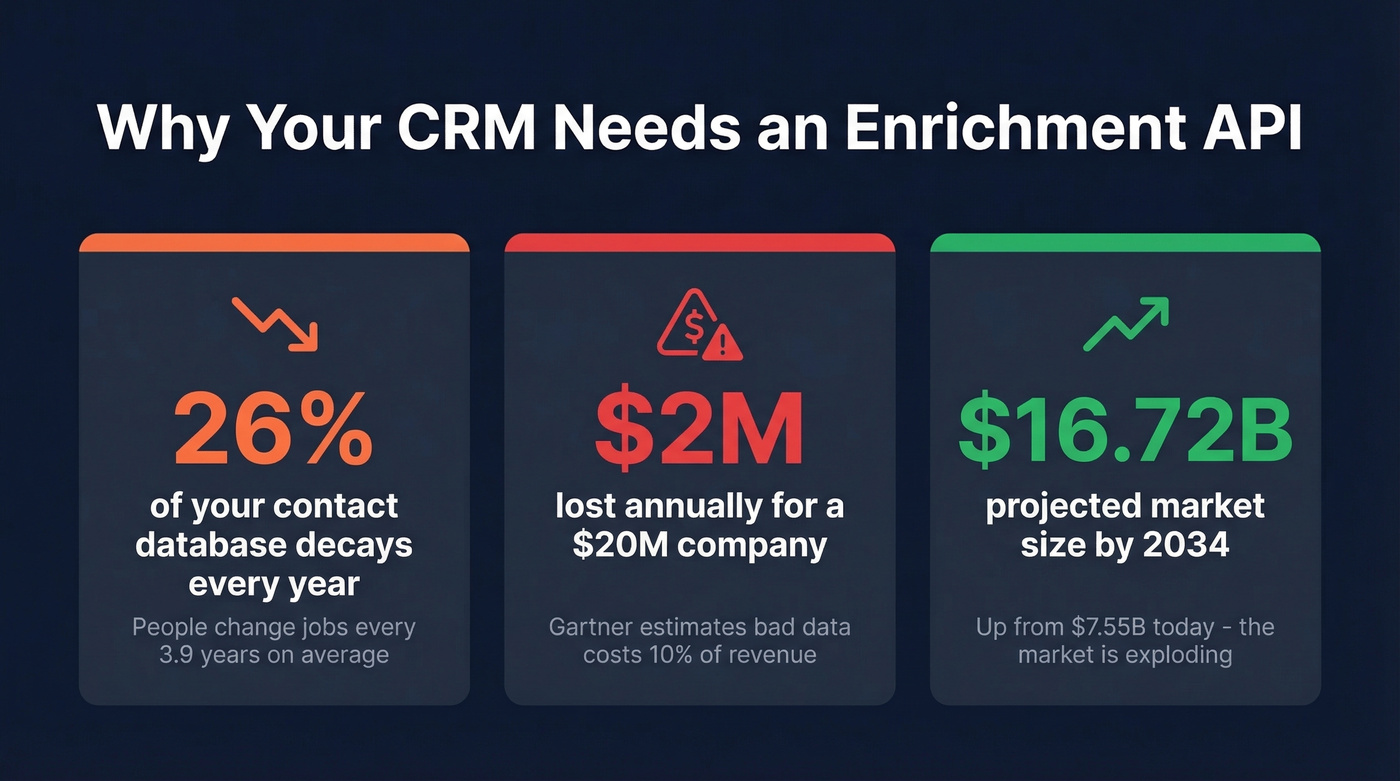
Your CRM is rotting. That's not hyperbole - people change jobs every 3.9 years on average in the US, which means roughly 26% of your contact database decays annually. Gartner pegs the cost of bad data at around 10% of annual revenue. For a $20M company, that's $2M leaking through stale phone numbers, dead email addresses, and contacts who left the company eight months ago.
The fix is a data enrichment API - an automated layer that fills in missing fields, refreshes stale records, and keeps your CRM from turning into a graveyard. But the market's gotten noisy. Dozens of options, most claiming 95%+ accuracy, and pricing models that range from transparent to deliberately opaque. We've tested a lot of them. Here's what actually matters.
Quick Picks
If you don't want the full breakdown:
- Best for raw scale + developer flexibility: People Data Labs - 3.1B+ people profiles, $0.05/record, free tier
- Best if you also need sequencing: Apollo - enrichment + outbound in one platform, $49/user/mo billed annually
Here's the thing: most teams need 2-3 APIs stacked in a waterfall, not one "best" tool. No single provider covers every geography, every seniority level, and every data field reliably. Plan for that from the start.
How API Enrichment Actually Works
At a technical level, a contact enrichment API takes a thin input - an email address, a company domain, a name + company pair - and returns a structured JSON payload with dozens of additional fields: job title, direct dial, company revenue, tech stack, funding stage, department headcount. It's a contact append and firmographic data layer that runs programmatically.
If you're comparing vendors at a higher level, see our breakdown of the best data enrichment tools and how they differ by workflow.
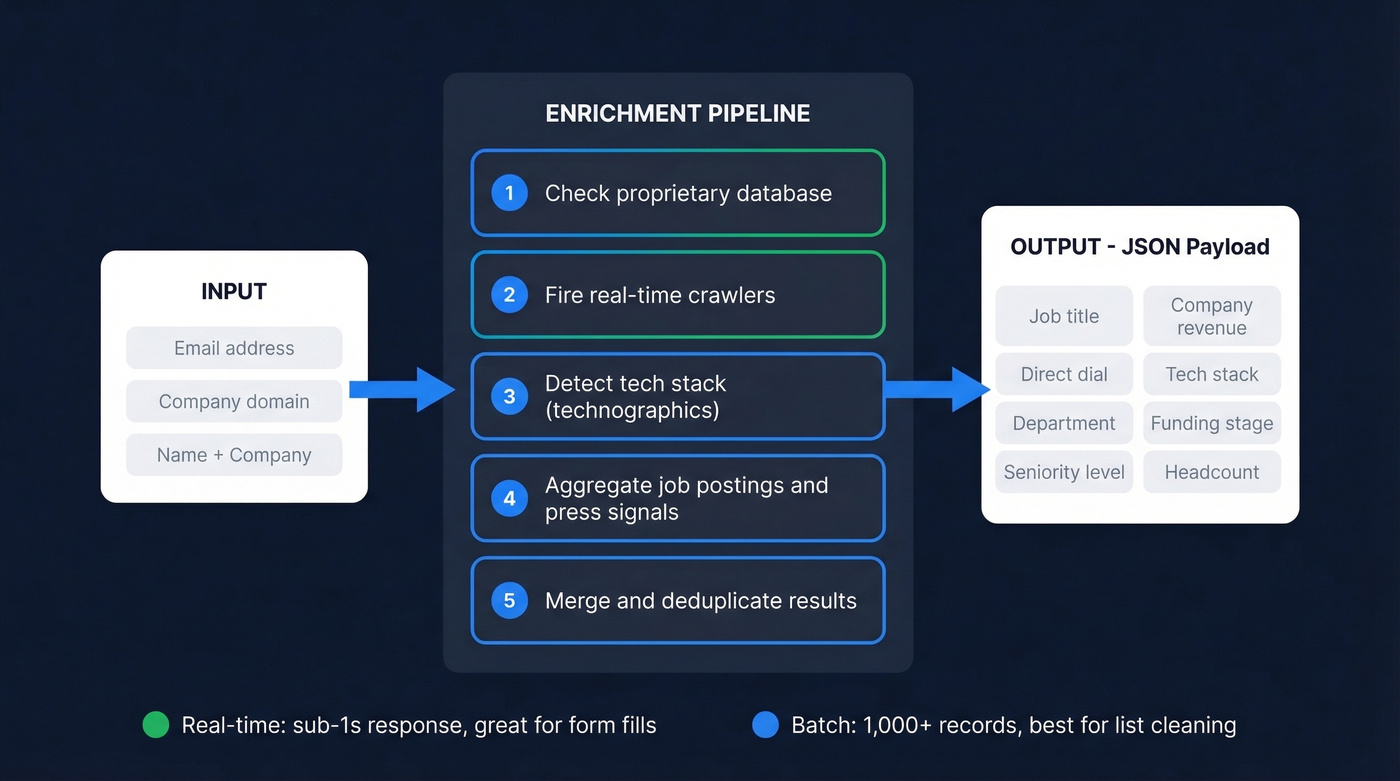
Most providers run a multi-step pipeline behind the scenes. They check a proprietary database first, then fire real-time crawlers for fresh signals, layer in technographic detection to identify what software the company runs, aggregate signals from job postings and press releases, and return the merged result. Cached enrichments come back in under a second. Batch jobs for 1,000+ records take longer.
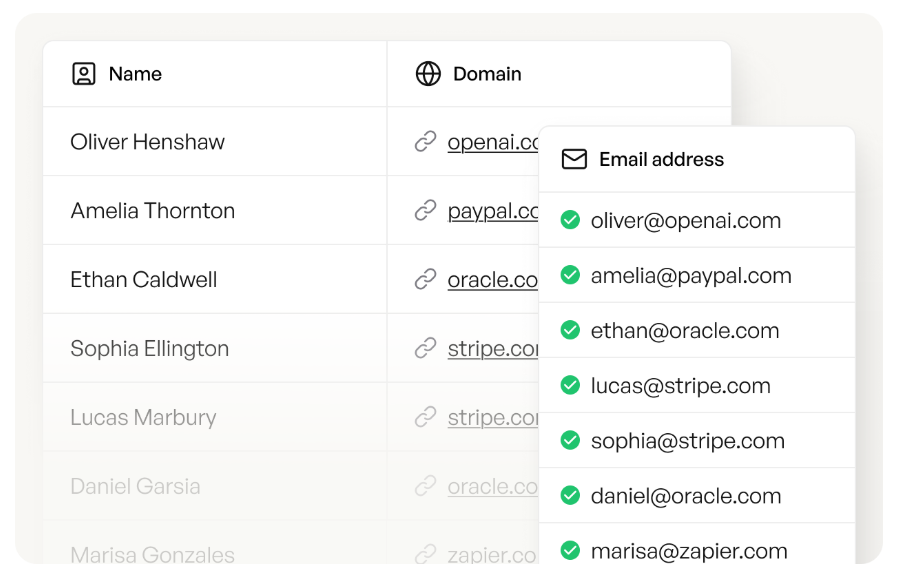
Two distinctions most buyers miss. Person enrichment and company enrichment are separate endpoints with different use cases - don't assume one API call gives you both. And real-time enrichment (sub-1s, great for form fills and progressive profiling) serves a completely different workflow than batch enrichment (better for list cleaning). The form-fill use case is underrated: shorten your signup form to just email, then enrich the rest in the background. Your conversion rate will thank you.
One emerging pattern worth watching: AI agents consuming enrichment APIs autonomously. As more teams deploy AI SDRs and research agents, the API's schema consistency and latency matter more than any dashboard. If you're building toward that future, prioritize APIs with clean JSON schemas and sub-second response times.
The market's growing fast - the global data enrichment solutions market sits at $7.55B and is projected to hit $16.72B by 2034. More vendors, more noise, more reason to be deliberate about which APIs you wire into your stack.
Best Data Enrichment APIs in 2026
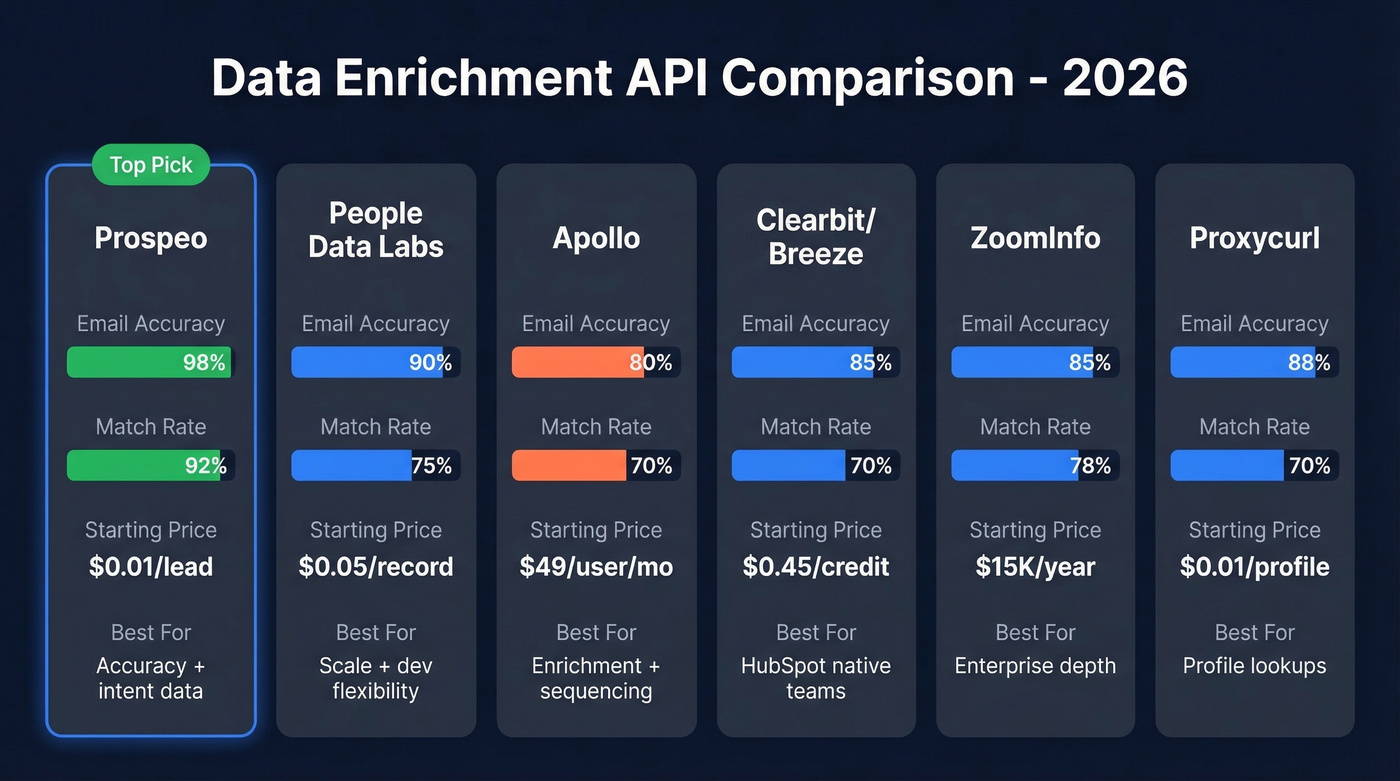
| Tool | Best For | Email Accuracy | Match Rate | Starting Price |
|---|---|---|---|---|
| Prospeo | Accuracy + price | 98% | 92% | ~$0.01/lead |
| People Data Labs | Scale + dev flex | ~90% | ~70-80% | $0.05/record |
| Apollo | Enrichment + sequencing | ~80% | ~65-75% | $49/user/mo |
| Clearbit/Breeze | HubSpot users | ~85% | ~70% | $0.45/credit |
| ZoomInfo | Enterprise depth | ~85% | ~75-80% | ~$15K/year |
| Proxycurl | Profile enrichment | ~88% | ~70% | $0.01/profile |
| Enrich.so | Budget enrichment | ~94% | Not published | ~$70/mo |
| Captain Data | No-code workflows | Varies | ~60-70% | Not public |
Prospeo
What separates Prospeo from every other provider on this list is the combination of Bombora intent data across 15,000 topics layered directly into the enrichment response. No other self-serve platform offers buyer-intent signals alongside contact append in the same API call. The database covers 300M+ professional profiles, 143M+ verified emails, and 125M+ verified mobile numbers, returning 50+ data points per contact at a 92% match rate.
The 98% email accuracy holds up because of a 5-step verification process that includes catch-all handling, spam-trap removal, and honeypot filtering - all inline, not bolted on after the fact. Data refreshes every 7 days, which matters more than most teams realize. Native integrations with Salesforce, HubSpot, Clay, Lemlist, and Instantly mean you're not building custom middleware to get data where it needs to go.
Real-world proof: Meritt went from a 35% bounce rate to under 4% after switching their enrichment pipeline. Snyk's 50-person AE team saw bounce rates drop from 35-40% to under 5% and AE-sourced pipeline increase 180%. In head-to-head comparisons, teams book 26% more meetings than ZoomInfo users and 35% more than Apollo users. At ~$0.01 per lead, the per-record economics are 90% cheaper than ZoomInfo. The free tier gives you 75 emails per month - enough to validate data quality before committing a dollar.
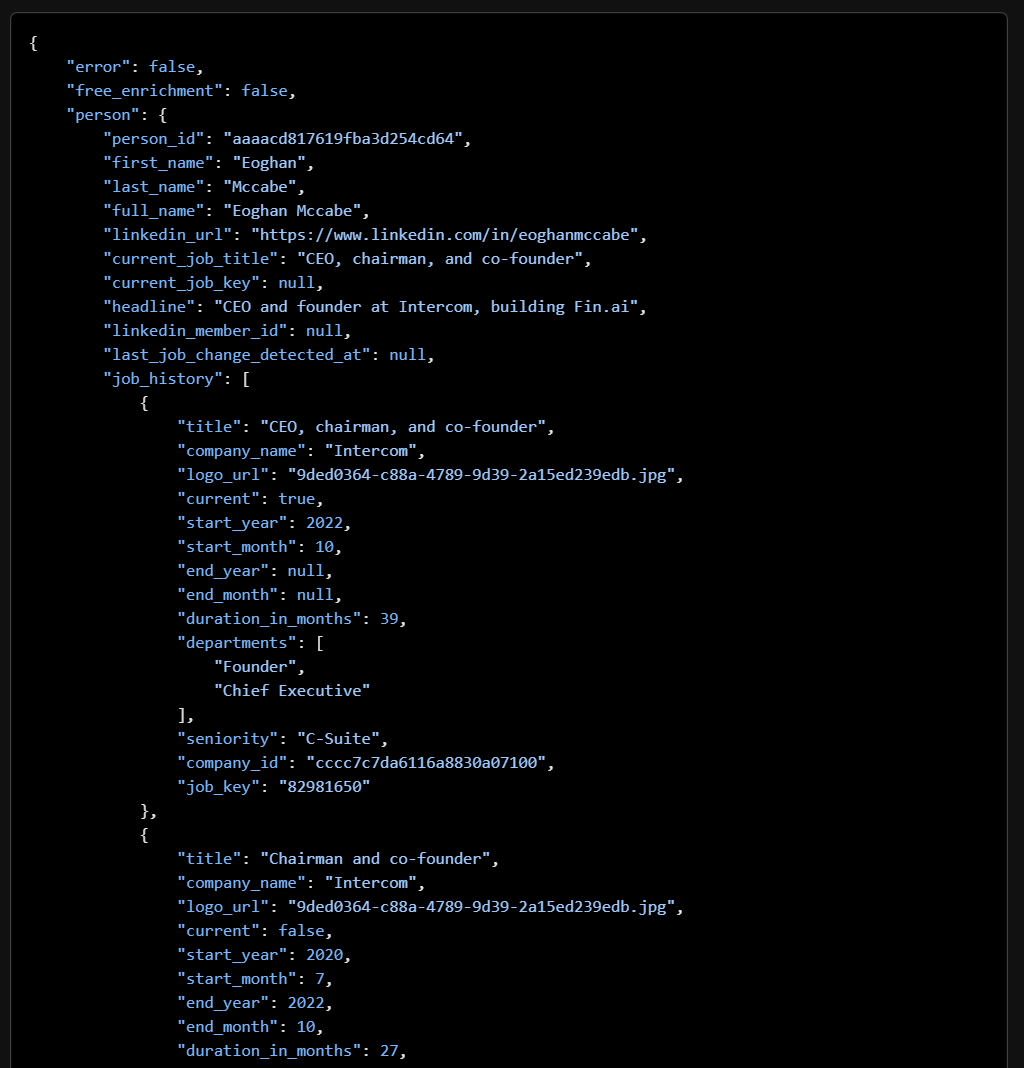

Most enrichment APIs decay faster than your CRM. Prospeo returns 50+ data points per contact at a 92% match rate, with 98% email accuracy backed by 5-step verification. Data refreshes every 7 days - not every 6 weeks. At ~$0.01/lead, it's 90% cheaper than ZoomInfo.
Start with 75 free enrichments. No credit card, no contract, no sales call.
People Data Labs
People Data Labs is the developer's enrichment API. If you're building a custom data pipeline and need raw coverage over polished UX, PDL is the obvious choice. The database runs 3.1B+ people profiles, with person and company endpoints that return clean JSON you can pipe directly into your data warehouse.
Pricing sits at $0.05/record, with a free tier of 100 records/month for testing. The API documentation is excellent, rate limits are generous, and the schema is consistent enough that you won't spend weeks normalizing outputs. PDL also delivers data via Snowflake and Databricks for teams that want enrichment inside their data warehouse, plus an IP enrichment endpoint for de-anonymizing website visitors - a feature most competitors don't offer.
Where PDL falls short: email verification isn't as rigorous, and there's no built-in intent data layer. You'll want to pair it with a verification step downstream. For pure coverage in a waterfall setup, though, it's hard to beat.
Apollo
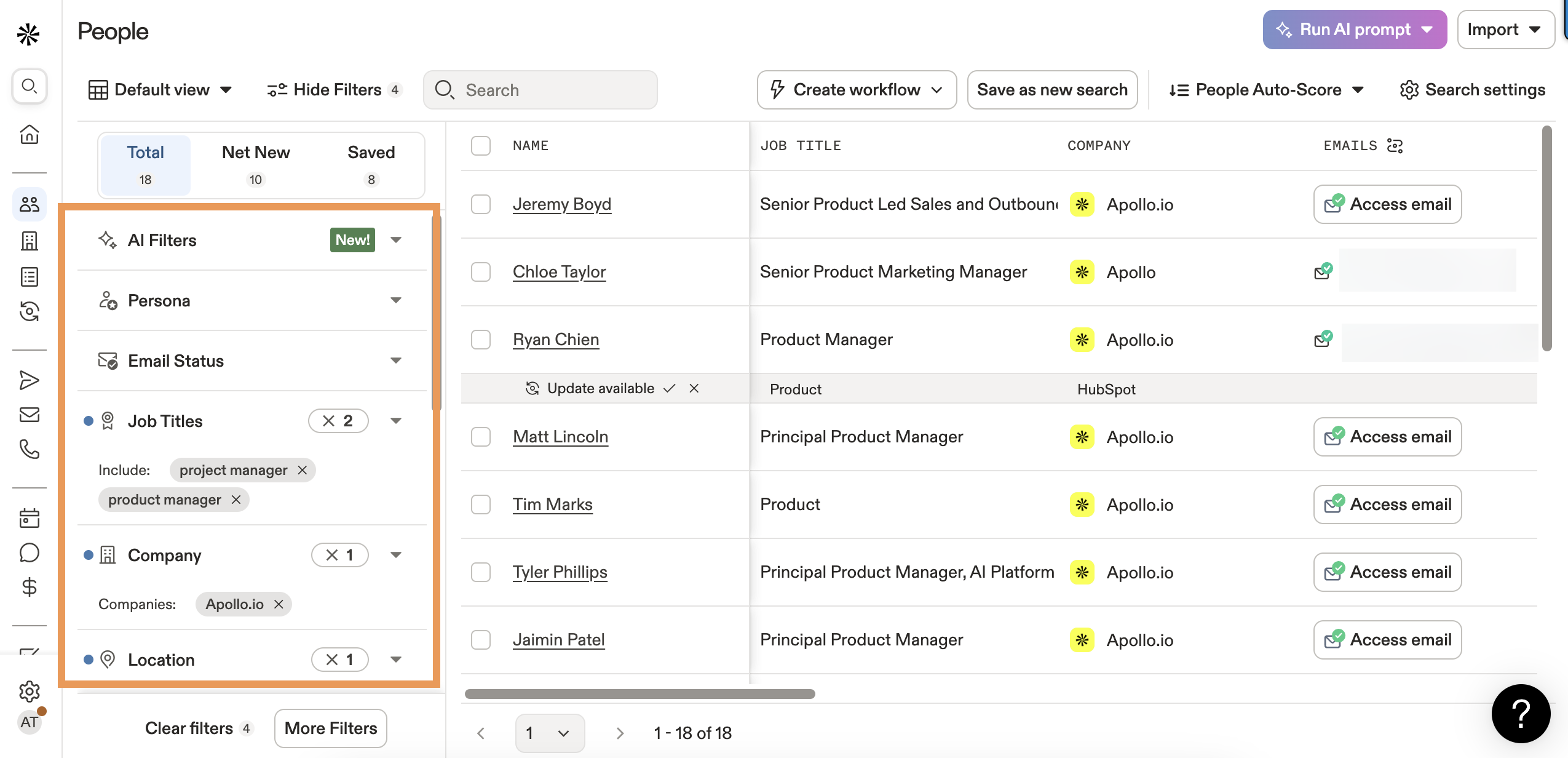
Apollo's pitch is compelling: enrichment and sequencing in one platform, starting at $49/user/month billed annually. The database covers 275M+ contacts with person and company enrichment endpoints. Bulk endpoints handle up to 10 records per call. Credits split into two pools - mobile and export - so your effective capacity depends on what data you're pulling.
The tradeoff is real, though. The consensus on r/coldemail is that Apollo bounce rates land in the 32-38% range, which means roughly a third of the emails you pull won't land. That's not a dealbreaker if you run a verification layer on top, but it means Apollo's enrichment data shouldn't be your only source. Use it for coverage and sequencing; verify elsewhere.
If you're evaluating sequencing tools alongside enrichment, compare options in our guide to the best outbound sales platforms.
Clearbit / Breeze Intelligence
Use this if: You're already deep in HubSpot and want enrichment that auto-populates CRM records without leaving the ecosystem.
Skip this if: You're not on HubSpot, or you enrich more than a few hundred records monthly.
Clearbit was the developer favorite for years. Then HubSpot acquired it, rebranded it Breeze Intelligence, and made it a HubSpot add-on. Pricing starts at $45/month for 100 credits, roughly $0.45/credit, dropping to ~$0.15/credit at 1,000 credits. At 10,000 credits, pricing is typically custom and lands around ~$0.06-$0.10/credit. Credits reset monthly with no rollover, so you're paying for capacity whether you use it or not. Factor in HubSpot platform costs and the total picture changes fast: $60-$75/month for HubSpot Starter with 100 credits, up to $4,000-$5,500/month at HubSpot Enterprise with 10,000 credits. The data quality is solid, but the economics only work for HubSpot-native teams who were already paying for the platform.
ZoomInfo
ZoomInfo is still the deepest all-in-one data platform. But most teams don't need all-in-one - and they definitely don't need the price tag.
The database is massive: 500M+ contacts, 100M+ companies, 200M+ verified emails. The company enrichment API is enterprise-grade with strong US coverage. It's also priced like enterprise software: $15K-$40K+/year before add-ons. Need NeverBounce verification? That's ~$3K extra. Global Data? $9,995. Some teams end up near $50K/year after the upsells stack. There's a free Lite tier with 10 monthly credits, but that's a taste test, not a solution.
If you're a 500-person sales org with budget and you'll actually use the full platform, ZoomInfo delivers. For everyone else, the per-record economics don't compete.
If you're still shopping for a primary data source, start with our ranked list of the best B2B database options.
Proxycurl
Strong for profile-level enrichment at $0.01/profile, with plans starting at $49/month. Real-time lookups make it a good fit for teams building custom tools that need on-demand profile data rather than bulk enrichment. Limited on company-level data compared to broader platforms, so you'll likely need a second source for firmographics.
Enrich.so and Captain Data
Enrich.so is a budget-friendly option with 100 free API credits to start and paid plans from ~$70/month. Their developer experience stands out - a TypeScript SDK with type safety and copy-paste docs makes integration fast for engineering teams. Worth testing as a secondary source in a waterfall, particularly if you're building AI agents that consume enrichment data programmatically.
Captain Data is more of a no-code orchestration platform that includes enrichment - 100 free credits, 1-2 credits per API call. Useful if you're building multi-step automations without engineering resources, but don't expect the data depth of a dedicated enrichment API.
We also evaluated FullContact, Demandbase, and Pipl but excluded them. FullContact is identity-resolution focused, Demandbase is ABM-first with enrichment as a secondary feature, and Pipl has pivoted to fraud and identity verification.
Real Per-Record Pricing
Published pricing tells half the story. Here's what you're actually paying:
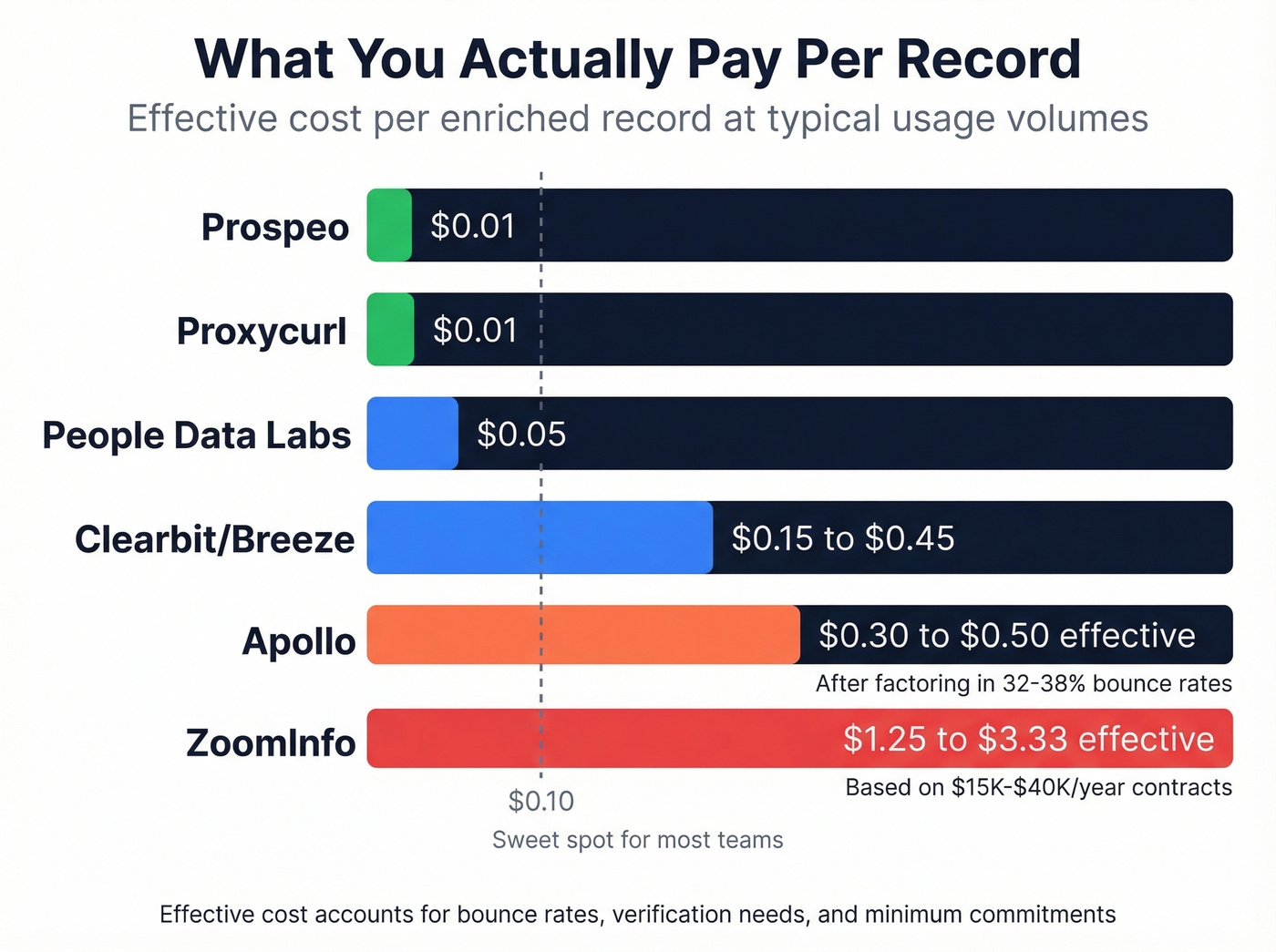
| Tool | Per-Record Cost | Hidden Costs | Annual Min |
|---|---|---|---|
| Prospeo | ~$0.01 | None | No minimum |
| People Data Labs | $0.05 | None | No minimum |
| Apollo | ~$0.04-0.08 (est.) | Mobile vs export credit splits | ~$588/yr |
| Clearbit/Breeze | $0.15-0.45 | HubSpot lock-in | ~$540/yr+ |
| ZoomInfo | $0.60-3.00 | Add-ons stack to $10K+ | ~$15K/yr |
Three pricing traps to watch for. Credit expiration - Breeze Intelligence credits reset monthly with no rollover, so you pay for capacity whether you use it or not. Platform lock-in - Clearbit's pricing looks reasonable until you add the mandatory HubSpot subscription. And add-on creep - ZoomInfo's base price is just the starting point; NeverBounce, Global Data, and extra credit packs can double the bill.
Self-serve pricing is a signal of confidence. When a vendor publishes transparent per-record costs, they're betting their data quality speaks for itself. When they hide behind "talk to sales," they're betting on their sales team's ability to justify the markup.
If you're trying to keep costs predictable, pay-as-you-go B2B data is often a better fit than annual minimums.
Building a waterfall? Start with the API that returns the highest match rate at the lowest cost. Prospeo's enrichment endpoint covers 300M+ profiles, 143M+ verified emails, and 125M+ mobile numbers - with Bombora intent data across 15,000 topics baked into every response.
One API call gives you contact data and buyer intent. No one else does that self-serve.
Waterfall Enrichment: Stack, Don't Pick
The single biggest mistake teams make is picking one provider and calling it done. No single database covers every contact, every geography, and every data field. The solution is waterfall enrichment: route each record through multiple providers in sequence until all required fields are filled.
The numbers make the case. With a single enrichment source, you'll enrich maybe 400 out of 1,000 leads. Add a second and third source in a waterfall, and that number jumps to 850 out of 1,000. One Reddit practitioner reported Apollo single-source bounce rates of 32-38%, dropping to 10-14% with a Clay + waterfall approach. A Cargo customer reported 5-6x coverage uplift compared to a single-vendor setup.
Ordering matters. Start with your highest-accuracy source, then fall back to a broader database for coverage gaps. The logic is simple: false positives - bad data that looks good - cost more than missing data. Accuracy first, coverage second.
Let's break down implementation in five steps:
- Benchmark your vendors. Take 100 verified CRM records as ground truth. Run them through each API. Measure coverage (percentage of fields returned) and accuracy against your known-good data.
- Order by accuracy, then coverage. Your most accurate source goes first. Broader but less precise sources fill gaps.
- Use field-level fallback logic. Don't just waterfall email - apply the same logic to phone, revenue, employee count, and technographics. Tag each field with provenance metadata so you know which vendor supplied it.
- Orchestrate with Clay or Cargo. Both let you build waterfall sequences visually. Clay is the most popular orchestration layer for this right now.
- Verify the output. Enrichment isn't verification. Run the final merged record through an email verification step before it hits your sequences.
For regional coverage, consider stacking Cognism or Lusha for Europe and ZoomInfo or LeadIQ for the US.
If you want a deeper walkthrough of the orchestration layer, see our guide to Clay list building.
Accuracy: What the Numbers Actually Mean
Every enrichment vendor claims high accuracy. Most of those claims are inflated. One test of 22 APIs found that 68% claim 95%+ accuracy, but only 12 actually hit that mark. The gap between marketing and reality is wide enough to tank your outbound campaigns.
The deeper problem is that point-in-time accuracy decays fast. An API that verified an email six weeks ago is giving you stale data today. This is why refresh cadence matters as much as the accuracy number itself - and why we keep hammering on the difference between a 7-day refresh cycle and the 6-week industry average.
Look, if your average deal size sits below $10K, you probably don't need ZoomInfo-level data depth. What you need is high email accuracy and fast refresh cycles. Overpaying for 500M+ records when you're targeting 5,000 accounts is like renting a warehouse to store a bookshelf.
How to benchmark for yourself: take 100 contacts you know are accurate - people who've recently replied to emails, attended meetings, or been manually verified. Run them through each API you're evaluating. Compare the returned data against your ground truth. This 100-record test takes an afternoon and tells you more than any vendor's marketing page ever will.
Enrichment and verification are separate layers. Enrichment fills in missing fields. Verification confirms those fields are deliverable. You need both. Most enrichment APIs skip inline verification entirely, leaving you to bolt on a separate tool downstream. The APIs that run verification as part of the enrichment pipeline - with catch-all handling, spam-trap removal, and honeypot filtering built in - save you both a tool and a workflow step.
If deliverability is a priority, pair enrichment with a dedicated email verifier and keep an eye on inbox placement as you scale.
GDPR and CCPA Compliance
Enrichment APIs process personal data. Compliance isn't optional.
- Execute a DPA with every enrichment vendor. No Data Processing Agreement, no data flowing.
- Log data provenance per field. When you waterfall across three vendors, you need to know which vendor supplied each data point for audit trails and deletion requests.
- Implement deletion workflows for opt-out requests. If someone requests erasure, you need to purge enriched data - not just the original record.
- Apply data minimization. Only enrich the fields you'll actually use. Pulling 50 data points when you need 5 creates unnecessary liability.
- Set retention limits and auto-purge. Enriched data shouldn't live forever. Define a retention window and automate cleanup.
- Verify your vendor's legitimate interest basis. How did they collect the data? What's their legal basis for processing? If they dodge the question, walk away.
For a practical checklist, see our guide to a GDPR compliant database.
Mistakes That Waste Your Budget
Not setting confidence thresholds. Many APIs return a confidence score with each match. Accepting low-confidence matches floods your CRM with garbage. Set a minimum threshold and discard anything below it.
Paying for failed lookups. Some vendors charge credits even when they can't find a match. We've been burned by this. Check the policy before you commit - not every provider refunds empty results.
Enriching without verifying. We've said it twice already, but it bears repeating: enrichment fills fields, verification confirms deliverability. Running sequences on unverified enriched emails is how you tank your domain reputation in a week.
Using one vendor for all geographies. Coverage varies dramatically by country. A provider that's excellent in the US can have massive blind spots in DACH or APAC. Stack vendors by geography or accept the gaps.
FAQ
What is API enrichment?
API enrichment is the process of sending a lightweight input - like an email or domain - to a programmatic endpoint that returns structured data such as job titles, phone numbers, company revenue, and tech stack. It replaces manual research with automated lookups, forming the foundation of any scalable data hygiene strategy.
How does enrichment differ from email verification?
Enrichment adds missing fields to a record - job title, phone, revenue, technographics. Verification confirms that an email address is deliverable and won't bounce. They're complementary: enrich first to fill gaps, then verify before launching outbound sequences.
How many enrichment APIs should I stack?
Most teams get the best results with 2-3 providers in a waterfall. A single source typically leaves 20-40% of records unenriched. Stacking a high-accuracy primary with a high-coverage fallback like People Data Labs closes those gaps without overpaying.
What's a good free option for testing?
Prospeo offers 75 free emails per month with full enrichment - enough to benchmark accuracy against your real contacts. People Data Labs provides 100 free records monthly for developer testing. Apollo's free tier includes limited enrichment credits alongside its sequencing tools.
Are enrichment APIs GDPR compliant?
The API itself is a tool - compliance depends on how you use it. Always execute a DPA with your vendor, log which provider supplied each data point, and honor opt-out requests promptly. Choose vendors that enforce opt-outs globally and provide DPAs to simplify your compliance posture.