

B2B Intent Data: What Works, What Doesn't, and What It Costs in 2026
A practitioner with 15+ years in marketing and sales engineering tested 6sense, ZoomInfo, and Bombora over two years and called B2B intent data results "mostly disappointing." Mysterious intent scores with no context, no explainability, and no clear path from signal to pipeline. That's not an outlier opinion - only 24% of teams report exceptional ROI from intent data, and 70% say data quality is their number-one challenge. Yet 91% of B2B marketers use intent data to prioritize accounts. The technology works. The implementation usually doesn't.
This guide bridges that gap - what intent data actually is, why most teams waste money on it, and the specific playbook that turns account-level signals into booked meetings.
The Short Version
- Intent data works - with conditions. Act within 48 hours of a high-priority signal, tier your signals by strength (demo request > repeat topic engagement > one-off blog visit), and pair account-level data with verified contact information. Without all three, you're watching dashboards.
- Pricing spans a massive range. Enterprise platforms like 6sense and Demandbase run $40K-$300K+/year. Self-serve options start under $200/month. The gap between "intent data" and "intent data that's useful" isn't always the price tag - it's the activation workflow.
- Hot take: most teams with deal sizes under $30K don't need an enterprise intent platform. A self-serve tool with intent signals plus verified contacts will outperform a half-configured 6sense instance every time.
What Is B2B Intent Data?
B2B intent data tracks behavioral signals - content consumption, search patterns, product research - that suggest a company is actively evaluating solutions in your category. Picture a VP of Engineering at a Series B company reading three articles about API security tools in a week, visiting two vendor comparison pages, and downloading a buyer's guide. That cluster of behavior is an intent signal.
The market for these tools hit $4.49B in 2026, projected to reach $20.89B by 2035 at a 16.6% CAGR. The reason: 92% of B2B buyers already have a shortlist before they ever fill out a form on your site. Intent data is how you get on that shortlist before the buyer raises their hand - it's your window into the dark funnel where most purchase decisions actually happen.
Terminology That Trips Teams Up
Most teams use "intent data," "buyer signals," and "triggers" interchangeably. They're not the same, and conflating them is how you end up with dashboards that look great while sales misses pipeline - what DemandScience calls the "Marketing Data Mirage."
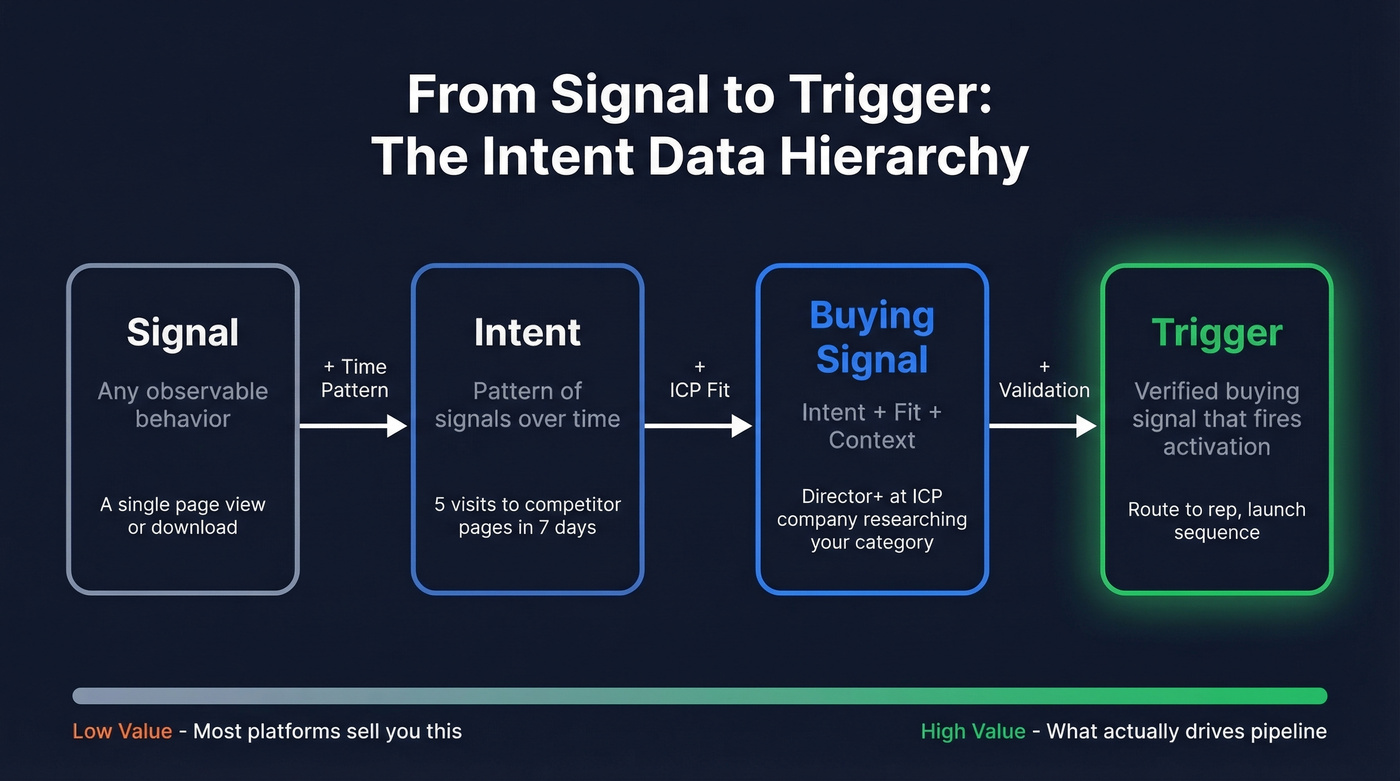
| Term | What It Actually Means | Example |
|---|---|---|
| Signal | Any observable behavior | A page view, a download |
| Intent | Pattern of signals over time | 5 visits to competitor pages in 7 days |
| Buying Signal | Intent + fit + context | Director+ at ICP company researching your category |
| Trigger | Verified buying signal that fires activation | Route to rep, launch sequence |
The distinction matters because most platforms sell you signals and call them intent. A single blog visit isn't intent. A pattern of research behavior from a company that matches your ICP, concentrated in a short window - that's a real buying signal. Even intent isn't a trigger until you've validated fit and timing.
One more distinction that separates experienced buyers from first-timers: intent to learn vs. intent to buy. Someone reading "What is zero-trust security?" is learning. Someone comparing "Okta vs. CrowdStrike pricing" is buying. Most third-party providers blend both into a single score, which is why your sales team gets frustrated chasing accounts that are "surging" but nowhere near a purchase decision. Filter for bottom-funnel topics - competitor comparisons, pricing pages, implementation guides - and you'll cut noise by half.
Types of Intent Signals
First-Party Intent
Engagement on your owned properties - website visits, content downloads, webinar attendance, product usage patterns. It's the highest-accuracy signal you'll get because there's no inference involved. Someone visited your pricing page three times this week. That's real.
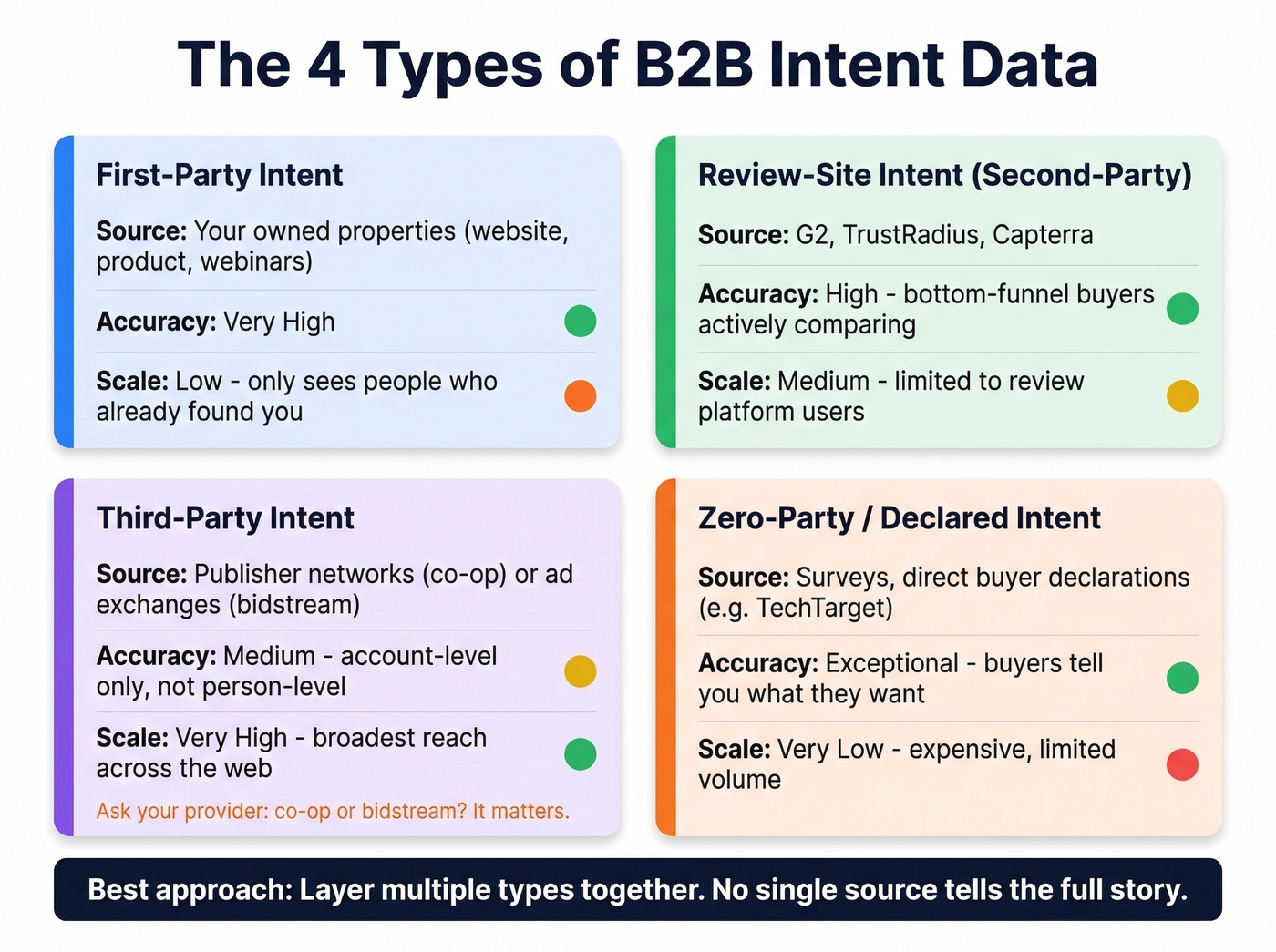
The limitation is scale. Only about 10-15% of your website traffic typically converts, and you're only seeing behavior from people who already found you. First-party intent tells you who's interested among people who know you exist. It says nothing about the 92% of buyers building shortlists elsewhere.
Review-Site Intent (Second-Party)
This is the category most guides skip. Review-site intent comes from platforms like G2 and TrustRadius - places where buyers actively compare vendors. When someone reads your profile, compares you against competitors, and checks pricing, that's bottom-funnel intent with high purchase correlation.
Dreamdata's analysis found that G2 Buyer Intent exposure correlates with higher conversion rates through the pipeline. G2 intent packages often start around ~$15K/year, and signal volume is lower than broad third-party sources, but the quality-to-noise ratio is dramatically better.
Third-Party Intent
This is what most people mean when they say "intent data." Third-party providers aggregate behavioral signals across publisher networks, and the two dominant collection methods are fundamentally different in quality.
Co-op data (Bombora's model) aggregates content consumption across a network of B2B publisher sites that voluntarily share anonymized behavioral data. When accounts at a company consume an unusual volume of content around a topic, that registers as a surge. Co-op data is the gold standard for third-party intent because the signals come from genuine content engagement.
Bidstream data captures signals from programmatic ad exchanges - essentially tracking which ad impressions get served to which IP addresses. It's cheaper and broader, but the signal quality is significantly lower. A page loading an ad isn't the same as someone reading an article. If your provider can't tell you whether their data is co-op or bidstream sourced, assume bidstream and discount the signals accordingly.
Third-party intent is the broadest in reach and the noisiest in signal quality. The tradeoff: you're getting account-level signals, not person-level. You know a company is researching cloud security. You don't know who at that company is doing the research.
Zero-Party / Declared Intent
An emerging category worth watching. Zero-party intent comes from incentivized surveys and direct buyer declarations - platforms like TechTarget's Priority Engine where buyers explicitly state what they're evaluating and when they plan to purchase. Signal quality is exceptional because there's no inference, but volume is limited and cost is high.
Why Most Teams Waste Money on Intent Data
Here's the thing: 64% of teams collect intent data but struggle to actually use it. The technology isn't the problem. The activation is. We see the same seven mistakes over and over.
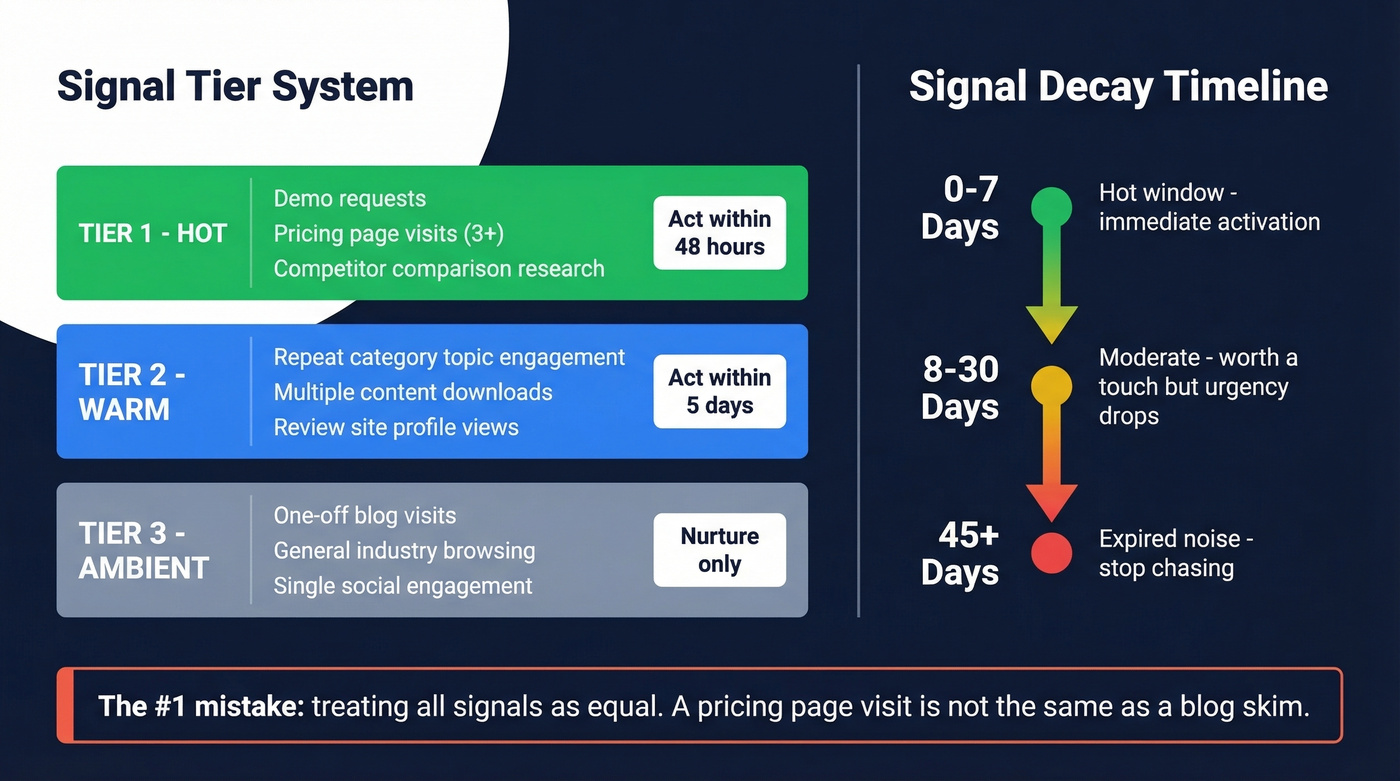
1. Treating all signals as equal. A prospect visiting your pricing page is not the same as someone reading a loosely related blog post. Build a signal hierarchy - Tier 1 (hot) includes demo requests, pricing page visits, and competitor comparison research. Tier 2 (warm) covers repeat engagement with category topics and multiple content downloads. Tier 3 (ambient) is one-off blog visits and general industry browsing.
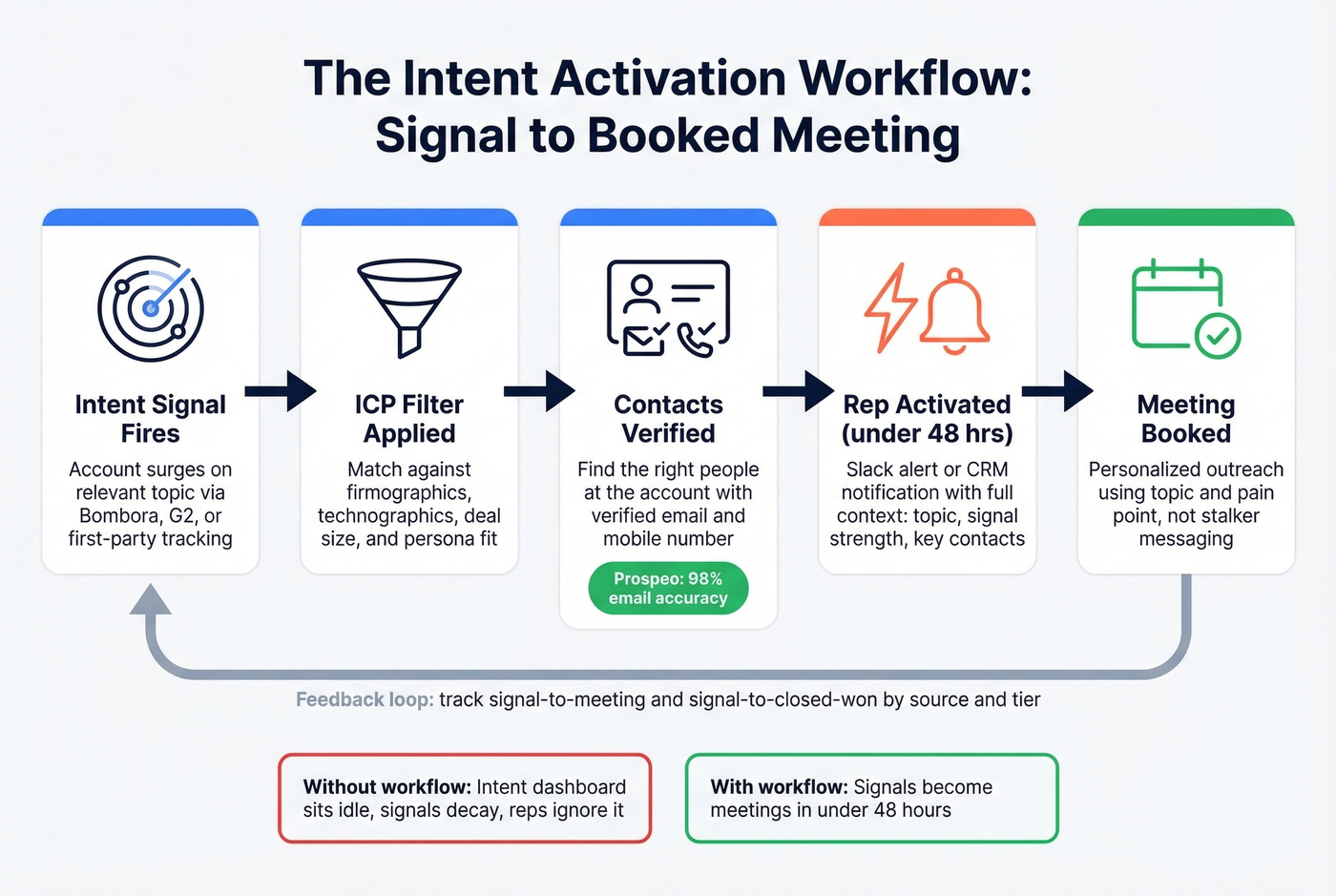
2. Collecting but not acting. Intent signals decay fast. The 0-7 day window is hot and worth immediate activation. Days 8-30 are moderate - still worth a touch, but urgency drops. After 45 days, treat the signal as expired noise. Act within 48 hours of a Tier 1 signal. If your workflow takes a week to route an account to a rep, you've already lost.
3. Paying for the same data twice. Intent data is frequently bundled, resold, or embedded through partner platforms across your stack. We've audited teams running Bombora signals through three different tools without realizing it. Check your contracts before adding another source.
4. Ignoring context. An intent surge from a 10-person agency and a surge from a 5,000-person enterprise aren't the same opportunity. Layer intent signals on firmographic and technographic filters - including account scoring and buying group analysis - before routing to sales. Modern B2B deals involve 11+ stakeholders on average; account-level intent without persona-level targeting wastes rep time.
5. Sending "stalker" messages. Never write "We noticed you've been researching cloud security solutions." Use intent to shape relevance - lead with the topic, the pain point, the trend.
Bad: "Hi Sarah, we noticed your team has been researching data enrichment tools this month."
Good: "Hi Sarah, a lot of RevOps teams are rethinking their enrichment stack right now - especially around mobile verification rates. Here's what we're seeing work."
6. Mistaking intent for qualification. Intent tells you someone is researching. It doesn't tell you they have budget, authority, or timeline. Use intent to prioritize who gets attention first, then qualify normally.
7. No feedback loop. The #1 complaint on r/LeadGeneration about intent data? "Mysterious intent scores" with no context. If you can't trace which signals, topics, and sources actually convert to pipeline, you can't improve. Track signal-to-meeting and signal-to-closed-won by source, topic, and tier.

Intent data without verified contacts is just a dashboard. Prospeo tracks 15,000 intent topics via Bombora and pairs every surging account with 98% accurate emails and 125M+ verified mobile numbers - so you go from signal to sequence in minutes, not days.
Stop watching intent dashboards. Start booking meetings from them.
How to Use B2B Intent Data for Sales and Marketing
Sales Prioritization
Route high-intent accounts to reps within 48 hours. Intent signal fires, account matches ICP filters, CRM alert or Slack notification goes out, rep gets the account with context - topic, signal strength, key contacts. The hard part isn't the technology. It's getting sales to trust the signals enough to act on them, which is why the feedback loop matters so much.
If you want to operationalize this end-to-end, start with automating sales signals so routing and follow-up happen without manual handoffs.
ABM Targeting
Layer intent on ICP filters to build dynamic account lists. Instead of static target account lists that go stale in 60 days, use intent surges to rotate accounts in and out of active campaigns. This is what makes account-based marketing dynamic rather than a glorified spreadsheet - it tells you which accounts deserve budget right now versus next quarter.
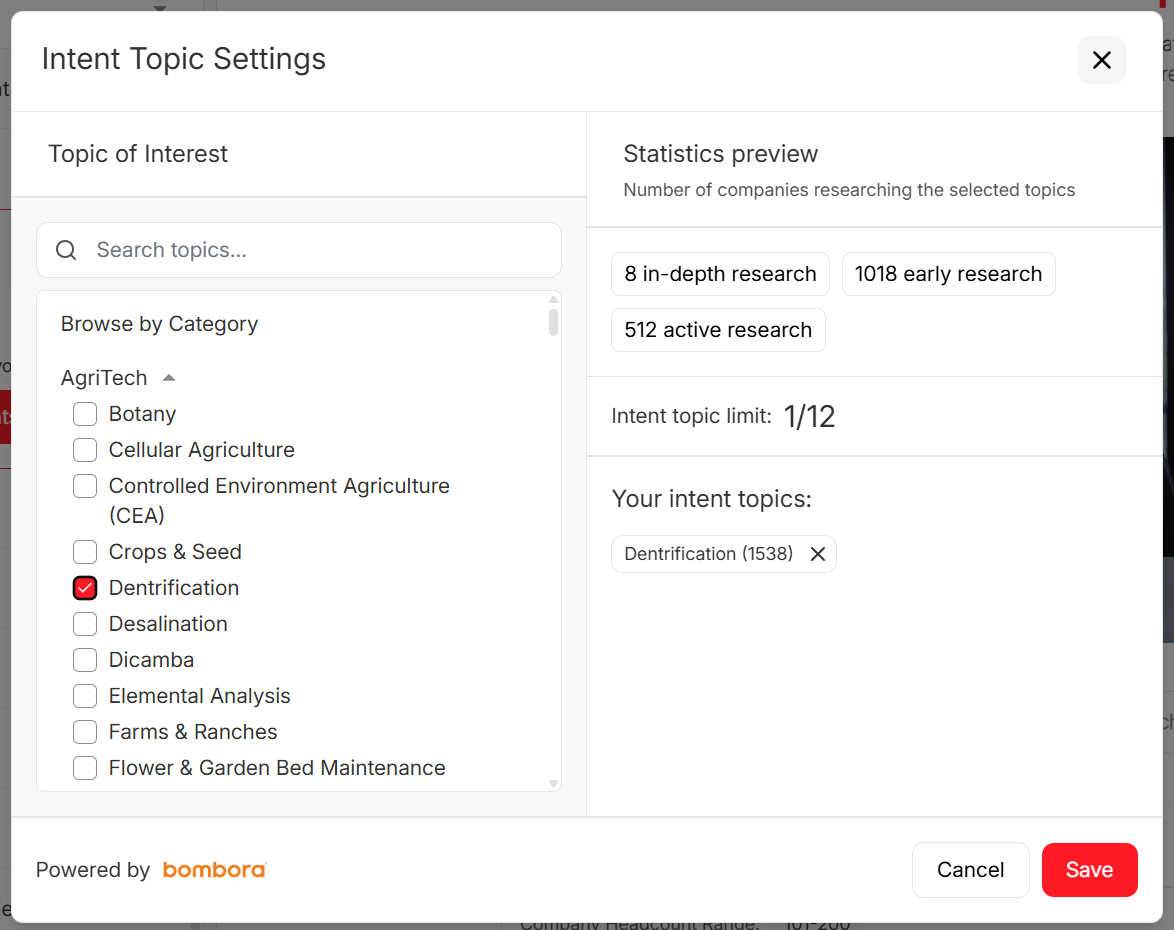
And this is where the "account flagged but no contact data" gap kills most teams. You know the account is in-market, but you can't reach anyone there. Prospeo solves this directly - search by intent topic, layer on firmographic filters, and export verified emails and direct dials for decision-makers at surging accounts.
Ad Optimization
Suppress low-intent accounts from paid campaigns and boost spend on surging ones. If you're running paid ABM to a static list, you're spending budget on accounts that aren't in-market. Intent signals let you shift spend dynamically toward accounts showing active research behavior.
If you're building the broader motion around this, align it with your account-based marketing project plan so targeting, ads, and sales plays stay in sync.
Churn Prevention
Monitor existing customers researching competitor categories. If three people at a current customer start consuming content about alternatives to your product, that's a churn signal worth acting on before the renewal conversation. Customer success teams rarely have access to intent data, and that's a missed opportunity.
This pairs well with a formal how to prevent churn workflow so intent signals trigger the right CS actions.
How Providers Collect Intent Signals
Understanding collection methods helps you evaluate provider quality. Co-op networks like Bombora aggregate anonymized content consumption from thousands of publisher sites - when a company's employees read an unusual volume of content on a topic, the provider flags a surge. Bidstream providers tap into programmatic ad exchanges, capturing IP-level data from ad impressions. Publisher-sourced providers like TechTarget generate intent from their own content properties, giving them direct control over signal quality.
The collection method directly impacts accuracy. Co-op data reflects genuine reading behavior. Bidstream data reflects ad-serving events, which may or may not correlate with actual interest. Publisher-sourced data is the most trustworthy but the narrowest in scope.
Always ask a provider which collection methods they use. If they blend multiple sources, ask how they deduplicate and weight them. The consensus on r/sales is that most reps can't tell you where their "intent scores" actually come from - and that's a red flag.
What Intent Data Costs in 2026
The pricing opacity in this market is genuinely frustrating. One Reddit user put it perfectly: they don't want to "sit through every demo just to hear we have to spend $20K." Here's what you'll actually pay.
| Provider | Type | Pricing (2026) | Signal Level | Contacts Included? |
|---|---|---|---|---|
| Prospeo | Intent + contacts | Free tier; ~$0.01/lead | Account + contact | Yes - emails + mobiles |
| Bombora | Third-party co-op | $12K-$40K/yr | Account only | No |
| 6sense | ABM platform | ~$50K-$300K+/yr | Account | No (separate purchase) |
| Demandbase | ABM platform | ~$40K-$120K/yr | Account | No (separate purchase) |
| ZoomInfo | Sales intel + intent | ~$25K/yr add-on (plus base sub) | Account + contact | Yes (with base sub) |
| TechTarget | First-party publisher | ~$20K-$60K+/yr | Account + contact | Yes (opted-in leads) |
| Intentsify | Intent orchestration | $24K-$60K/yr | Account | No (activation add-on) |
| G2 Intent | Review-site | ~$15K+/yr | Account | No |
| Apollo.io | Sales intel | $49/user/mo | Limited | Yes (lower accuracy) |
| Warmly | Visitor ID | ~$700/mo | Account | Basic enrichment |
| Leadfeeder | Visitor ID | $139/mo | Account | No |
Budget 15-25% above the license cost for implementation - CRM integrations, workflow automation, and the RevOps time to build signal routing. For enterprise platforms like 6sense, expect 4-12 weeks of setup before you see any pipeline impact.
If you're comparing sources, it helps to benchmark against the broader best B2B database landscape so you don't overpay for contacts you already have elsewhere.
Top B2B Intent Data Providers
Forrester evaluated 15 intent data providers across 21 criteria in their Q1 2025 Wave. The Leaders group included Intentsify, 6sense, Bombora, Informa TechTarget, and Demandbase. But "Leader" in a Forrester Wave doesn't mean "right for your team."
Prospeo
Most intent data platforms give you account-level signals and leave you to figure out who to actually contact. Prospeo eliminates that gap. It tracks 15,000 intent topics powered by Bombora's co-op network, then layers those signals on top of 300M+ professional profiles with 143M+ verified emails and 125M+ verified mobile numbers.
Search by intent topic, filter by job title, company size, technographics, or headcount growth, and export verified contacts at in-market accounts. Every record runs through a 5-step verification process - 98% email accuracy, 30% mobile pickup rate. Data refreshes every 7 days, not the 6-week industry average.
Pricing is transparent and self-serve. Free tier gets you started, paid plans run ~$0.01 per lead with no annual contracts. For teams that need intent signals and the contact data to act on them in a single workflow, this is the obvious starting point.
Bombora
Bombora is the industry-standard third-party intent co-op. Their publisher network aggregates behavioral signals across thousands of B2B content sites, and their Company Surge scores power intent signals inside many go-to-market stacks. At $12K-$40K/year, it's the most common standalone intent data purchase for mid-market teams. The limitation: account-level signals only, and signals are often 48-72 hours behind real time - which matters when your activation window is 48 hours.
6sense and Demandbase
The enterprise heavyweights. 6sense starts around $50K/year and scales past $300K for large deployments. Demandbase starts around $40K and commonly lands in the $40K-$120K/year range. Both offer deep orchestration - predictive scoring, dynamic segmentation, multi-channel activation, and revenue analytics.
The tradeoff is complexity and cost. We've seen teams buy 6sense, spend three months on implementation, and still not have clean signal routing to sales by month four. If you have the budget and a dedicated RevOps team, these platforms are powerful. If you don't, you'll pay enterprise prices for a tool that sits half-configured. Let's be honest: that's the most common outcome we hear about in conversations with mid-market teams.
TechTarget and Intentsify
TechTarget is unique because it generates first-party intent from its own publisher network - buyers actively researching on TechTarget properties. The signals are high-quality and come with opted-in contact details, but coverage skews heavily toward IT and security categories. Expect custom pricing, typically in the ~$20K-$60K+/year range depending on topic coverage.
Intentsify takes a different approach, synthesizing intent signals from multiple sources - co-op, bidstream, publisher, and technographic - into a unified scoring model. Their orchestration layer can activate signals directly into ad campaigns and sales sequences. Pricing runs $24K-$60K/year. Strong for teams that want a single pane of glass across multiple intent sources without building the integration themselves.
Budget Options
Apollo ($49/user/month) includes basic intent signals alongside its sales intelligence database - limited depth, but accessible for teams testing the waters. Warmly (~$700/month) identifies website visitors and enriches them with intent context, solid for inbound-heavy teams. Leadfeeder ($139/month) does website visitor identification at the most accessible price point, though it's account-level only with no native contact data.
Skip these if you need serious intent depth. Use them if you want to validate that intent-driven workflows fit your sales motion before committing real budget.
If you're testing lighter-weight stacks, pair this with a simple sales outreach strategy so signals translate into consistent touches.

Compliance in 2026
Three new comprehensive state privacy laws took effect January 1, 2026 - Indiana, Kentucky, and Rhode Island - joining an already complex patchwork of U.S. privacy regulations. The enforcement climate is the most aggressive it's ever been, and intent data sits squarely in the crosshairs because it involves tracking behavioral signals tied to identifiable companies and individuals.
Under GDPR, professional emails and direct dials are personal data if they identify an individual. Cold outreach can rely on legitimate interest as a lawful basis, but you need documentation - a legitimate interest assessment you can produce if challenged. One cold outreach program triggered an EUR 85,000 fine after the sender couldn't document lawful basis for 12,000 contacts sourced from a third-party provider.
CAN-SPAM is more permissive - no prior consent required - but you still need a physical address, a working unsubscribe link, truthful subject lines, and must honor opt-outs within 10 business days. Most teams get CAN-SPAM right and GDPR wrong. If you're selling into EMEA, make sure your intent data provider enforces opt-outs and can provide DPAs. Cookie deprecation is also reshaping IP-based identification methods, so verify your provider's tracking methodology isn't dependent on third-party cookies that browsers are actively killing.
For a deeper breakdown of frameworks and audit steps, see our B2B compliance guide.
The article is clear: account-level intent is useless without person-level contact data. Prospeo bridges that gap - layer buyer intent with 30+ filters like job title, department headcount, and technographics, then export verified contacts at $0.01/email. No $40K contracts required.
Enterprise intent data at self-serve pricing. No sales call needed.
FAQ
What is B2B intent data and why does it matter?
B2B intent data captures behavioral signals - content consumption, search activity, product research - that indicate a company is actively exploring solutions in your market. It matters because 92% of buyers build a shortlist before ever contacting a vendor, giving you a window to engage accounts while they're still in research mode rather than after they've already picked a winner.
How fast do intent signals decay?
The hot window is 0-7 days from the initial surge. After 45 days, treat signals as expired. Act within 48 hours of a high-priority signal - speed-to-lead is the single biggest predictor of whether intent data produces pipeline or just populates dashboards.
Is intent data worth it for small teams?
Yes, if you avoid six-figure platforms. Self-serve tools combine intent signals with verified contacts at a fraction of enterprise pricing - no annual contracts required. Build a simple workflow (signal, filter, outreach) and iterate before committing serious budget.
What's a realistic ROI timeline?
Expect 60-90 days to see pipeline impact. The first 30 days are setup and integration, the next 30 are calibration - learning which signals, topics, and tiers actually convert for your ICP. Most failures happen because teams skip the activation workflows entirely and just stare at dashboards.
How do I avoid sounding like a stalker?
Never reference the data directly in outreach. Use intent to shape relevance - lead with the topic, the pain point, or an industry trend. Your prospect should think "this is relevant," not "this company is tracking me." Topic-first messaging converts 2-3x better than surveillance-style openers in our experience.