

The Sales Outreach Strategy Playbook for 2026
You just pulled your Q1 outreach report. Two percent reply rate. Thousands of emails sent, dozens of connection requests ignored, and your pipeline looks like it did in November. The sales outreach strategy that worked in 2023 - blast a big list, follow up three times, hope for the best - doesn't just underperform now. It actively damages your sender reputation.
B2B contact data decays at roughly 22.5% per year. Nearly 20% of cold emails get flagged as spam before a human ever sees them. And the average cold email reply rate sits at 3.43%, meaning for every hundred emails you send, ninety-seven people don't respond. The top 10% of outbound teams, though, hit 10.7%+ reply rates. The gap between them and everyone else isn't effort. It's infrastructure, targeting, and data quality.
Why Outreach Feels Broken
Three things separate top-performing outreach teams from the 2% reply rate crowd:
Verified data as the foundation. If a quarter of your list is stale, you're burning domain reputation before you write a single subject line. You need 98% verified emails before anything else matters. (If you’re auditing list health, start with bounce rate benchmarks and fixes.)
Signal-based targeting over database blasting. Campaigns sent to fewer than 50 recipients get 5.8% reply rates. Campaigns blasted to thousands get 2.1%. Smaller, smarter lists win.
Deliverability infrastructure before volume. SPF, DKIM, DMARC, inbox warmup, sending limits - this is the boring stuff that makes everything else work. Skip it and your beautifully personalized emails land in spam. (For the full checklist, use this email deliverability guide.)
2026 Outreach Benchmarks
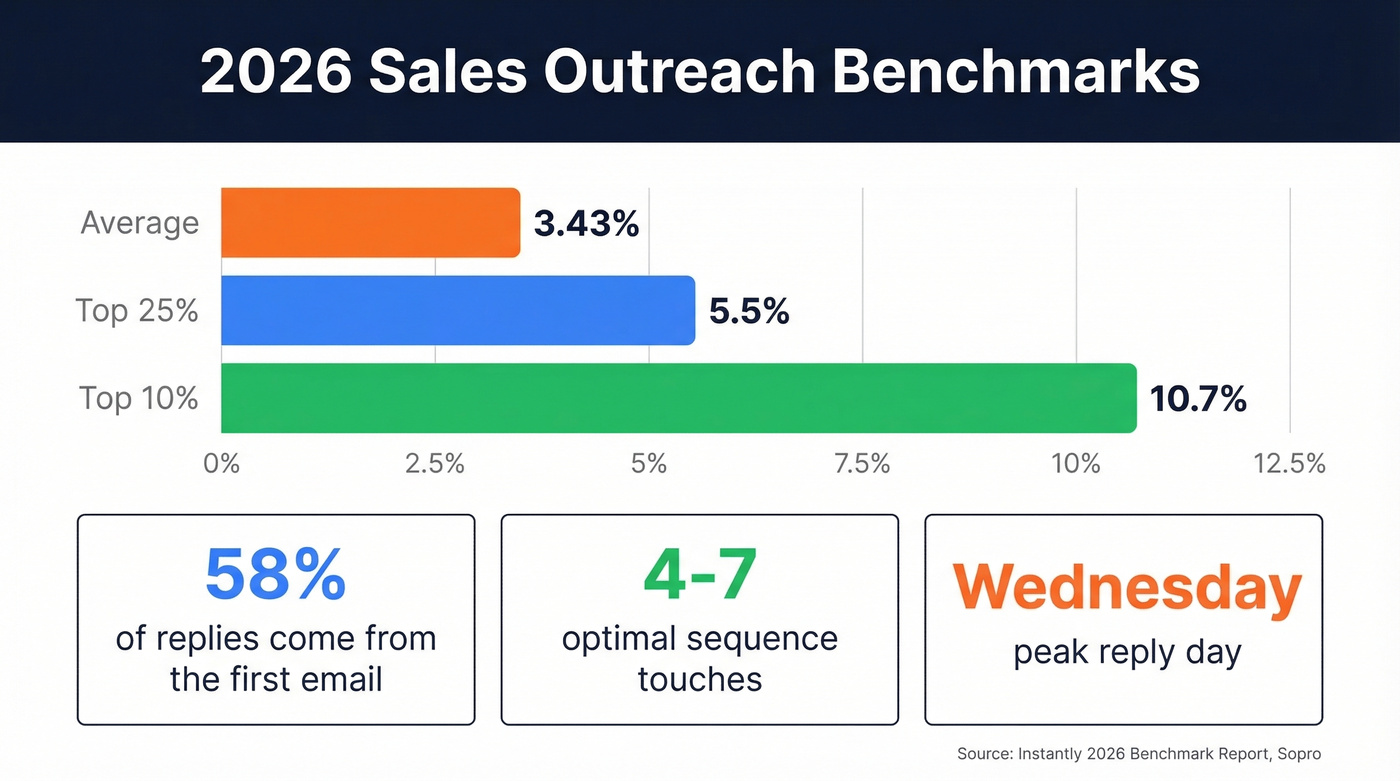
Before you optimize anything, you need to know what "good" looks like. These numbers come from Instantly's analysis of billions of cold email interactions and Sopro's dataset of 151 million outreach points.
| Metric | Average | Top Quartile | Top 10% |
|---|---|---|---|
| Reply rate | 3.43% | 5.5%+ | 10.7%+ |
| Open rate | 20-30% | - | - |
| Calls-to-meeting | 1:8-1:15 | - | - |
A few things jump out. 58% of all replies come from the first email - your opener does most of the heavy lifting. The sweet spot for sequence length is 4-7 touches; beyond that, diminishing returns kick in hard. Wednesday is the peak reply day, with Tuesday close behind.
Sopro's data adds another layer: 81% of decision-makers engage with cold outreach when it's tailored to their company and context. The average cold email response rate across their dataset is 5.1%, with most campaigns landing between 1% and 5%. The takeaway isn't that outreach is dead. Generic outreach is dead.
Build Signal-Based Prospect Lists
The "export 20K leads from a database, load them into a sequence, and pray" approach is how most teams operate. It's also why most teams get 2% reply rates. A strong B2B outreach strategy starts with who you target, not what you send.
Define Your ICP First
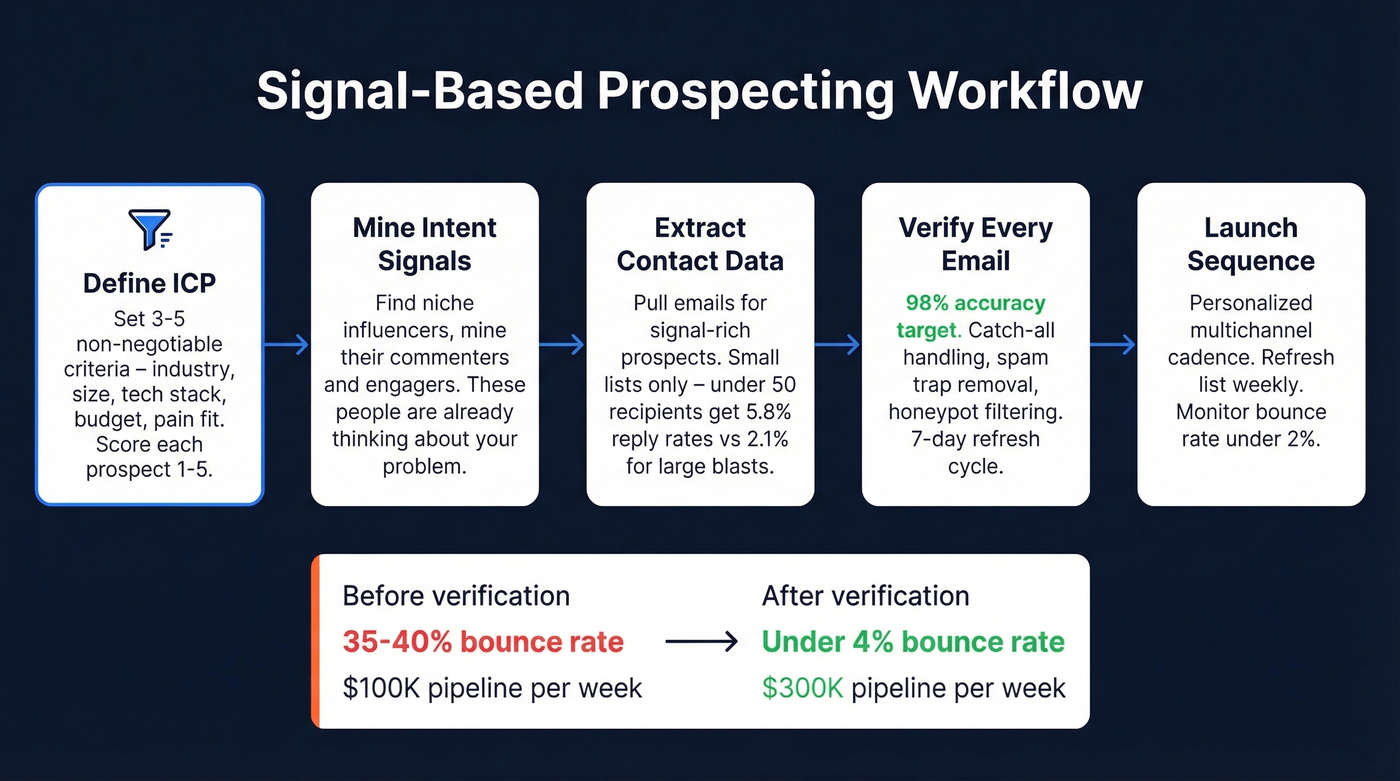
Before you mine engagement signals, nail down 3-5 non-negotiable ICP criteria: industry, company size, tech stack, budget authority, and pain alignment. Without these filters, signal-based targeting just gives you a warmer list of the wrong people. Score each prospect 1-5 across these criteria. Anyone below a 3 doesn't enter your sequence. (If you need a scoring rubric, use an ideal customer profile template.)
Mine Intent Signals
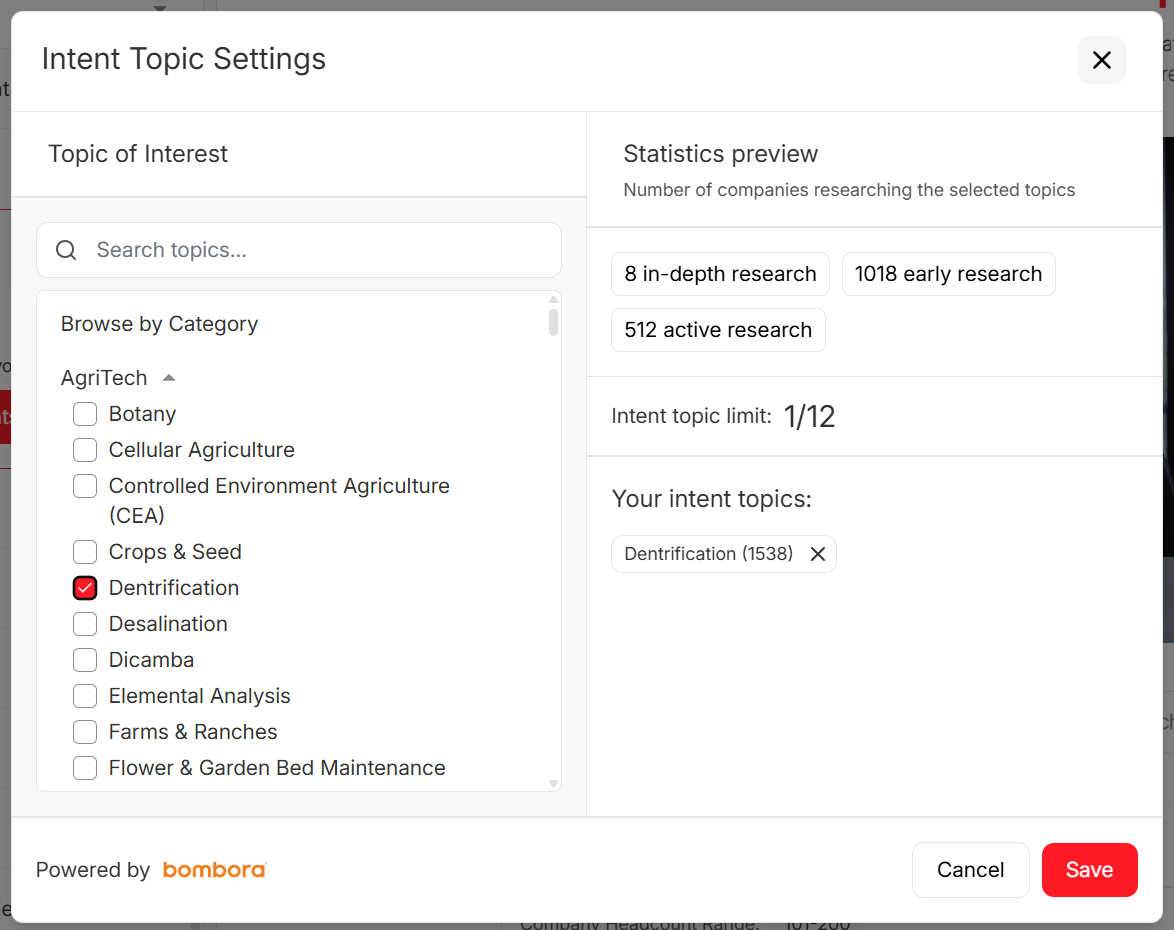
A practitioner on r/coldemail shared a workflow that flips traditional prospecting entirely. Instead of starting with a database, they started with intent signals: find 5-10 niche influencers in your space, then mine the likers, commenters, and repeat engagers on their posts. These people are actively thinking about the problem you solve. The practitioner reported 30-35% connection acceptance rates and 34 sales conversations in 45 days - numbers that make traditional cold outreach look broken by comparison.
Instantly's 2026 benchmarks confirm the pattern: campaigns targeting fewer than 50 recipients achieve a 5.8% reply rate, while large-list campaigns drop to 2.1%. Nearly 3x the performance from simply being more selective.
Here's the thing, though: signal-based targeting only works if the contact data behind it is accurate. You identify the right people, then pull their emails from a database that hasn't been refreshed in six weeks. Agencies we've worked with reported 35-40% bounce rates from stale databases, tanking domain reputation and erasing the signal advantage entirely.
The workflow that actually works: define your ICP, identify signal-rich prospects, verify every email before it enters your sequence, keep lists small, and refresh weekly. Prospeo's 5-step verification - catch-all handling, spam-trap removal, honeypot filtering - delivers 98% email accuracy across 143M+ verified addresses on a 7-day refresh cycle. Meritt, an outbound agency, saw bounce rates drop from 35% to under 4% after switching, and their pipeline tripled from $100K to $300K per week. (If you’re building lists in tools like Clay, see this Clay list building workflow.)
Personalization That Scales
Everyone agrees personalization matters - advanced personalization doubles cold email response rates - but most teams either skip it entirely or spend forever per prospect doing manual research that doesn't scale. (For more frameworks, see personalized outreach.)
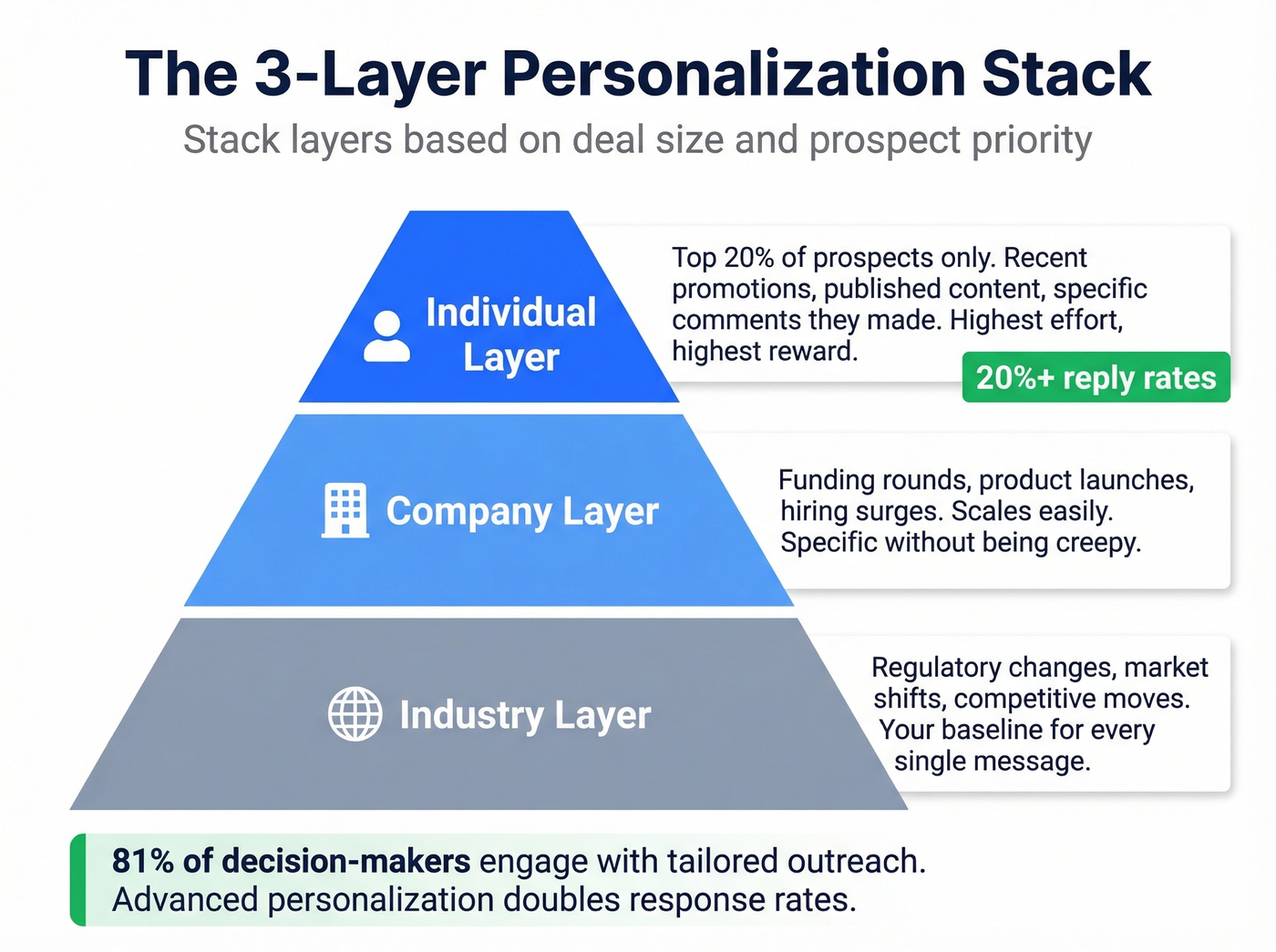
Sam McKenna's "Show Me You Know Me" (SMYKM) principle is the best mental model here. Prove you've done your homework before you ask for anything. SMYKM-style outreach can drive 43% open rates and 20% reply rates. The scaling lever is layered personalization - stack three layers and pick the right combination for each segment:
Individual layer works best for your top 20% of prospects. A recent promotion, published content, or a specific comment they made on a post. Highest effort, highest reward.
Company layer scales more easily. Funding rounds, product launches, hiring surges - these signal that you're paying attention without requiring deep individual research. Most prospects respond well to "I noticed your team just raised a Series B" because it's specific without being creepy.
Industry layer is your baseline for every message. Regulatory changes, market shifts, competitive moves. It still beats "I help companies like yours," and you can layer individual or company signals on top where the deal size justifies the time. The 81% of decision-makers who engage with tailored outreach aren't responding to mail-merge tokens. They're responding to relevance.

You just read that 35-40% bounce rates from stale data erase every signal advantage you build. Prospeo's 7-day refresh cycle and 5-step verification deliver 98% email accuracy across 143M+ verified addresses - so your carefully targeted, signal-based lists actually reach inboxes. Meritt tripled their pipeline from $100K to $300K/week after switching.
Stop burning domain reputation on dead emails. Fix your data foundation first.
Your Multichannel Sequence
The 14-Day Cadence
We've tested variations of this cadence across dozens of campaigns, and this structure consistently outperforms both shorter and longer sequences. It synthesizes cadence spacing from Instantly's benchmarks with multichannel alternation best practices.
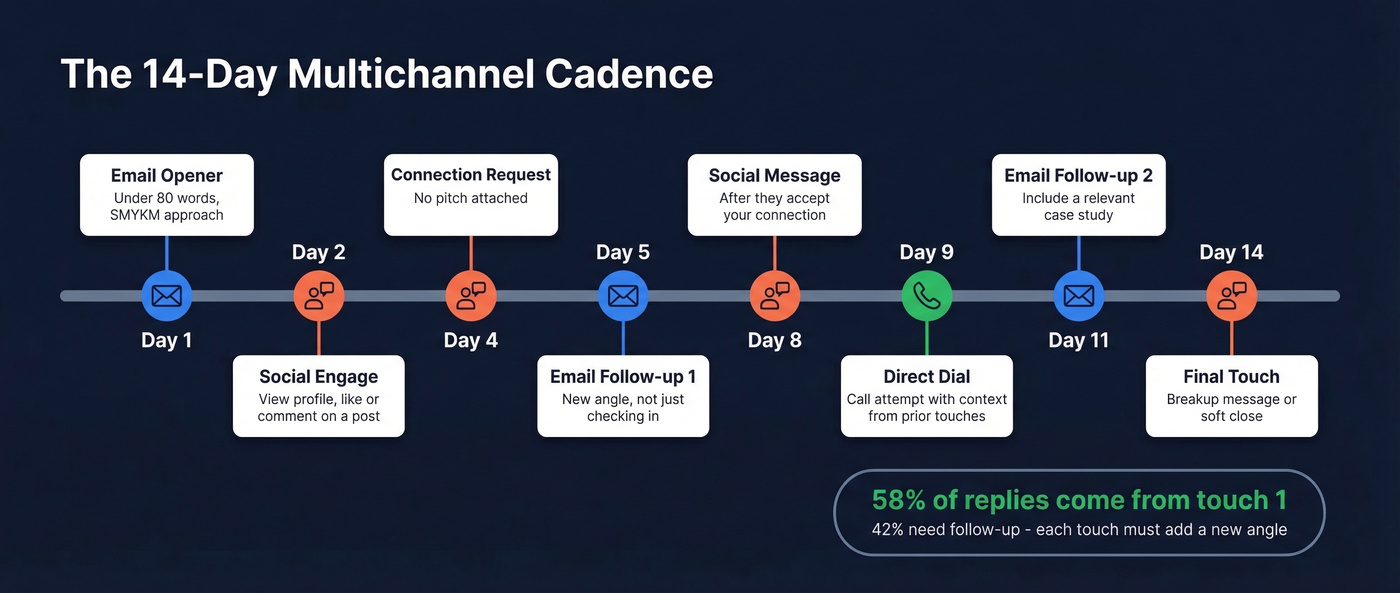
| Day | Channel | Action |
|---|---|---|
| 1 | Opener (<80 words, SMYKM) | |
| 2 | Social | View profile, engage with post |
| 4 | Social | Send connection request (no pitch) |
| 5 | Follow-up #1 (new angle) | |
| 8 | Social | Message after acceptance |
| 9 | Phone | Direct dial attempt |
| 11 | Follow-up #2 (case study) | |
| 14 | Social | Final touchpoint or breakup |
58% of replies come from the first touch, but the other 42% require follow-up. Each touch should introduce a new angle, proof point, or question - never "just checking in." (If you need copy, pull from these sales follow-up templates.)
Copy That Gets Replies
The best-performing cold emails in Instantly's dataset are under 80 words. Four sentences. Use PAS (Problem-Agitate-Solve) or AIDA as your skeleton, but keep it conversational. (If you want a tighter AIDA structure, see the AIDA sales funnel.)
The Reddit practitioner who generated 34 conversations in 45 days used a connection note of just nine words: "Hey [Name], Would love to add you to my network." After acceptance, the conversation starter was equally simple: "Curious, how are you currently handling outbound? What's your cold email stack?" A question, not a pitch. The selling happens later.
Non-Traditional Tactics
If everyone's running the same email-social-email sequence, standing out requires doing something different. A few tactics from Forbes contributors that work in practice:
Podcast invitations. Invite your prospect to be a guest on your podcast. It creates a relationship and gives you 30 minutes of their time without a sales pitch. Even if your show has 50 listeners, the invitation itself is flattering.
New-in-role targeting. People in their first few months at a new job are far more likely to buy. They're evaluating vendors, building their stack, and open to conversations that their predecessor would've ignored.
Personalized video. A 45-second Loom walking through a specific insight about their business takes two minutes to record and proves you're not a bot. Embedding a video thumbnail in an email can double or triple click-through rates compared to text-only messages. (Here’s a full Loom video cold email strategy.)
The Technical Foundation
This is the section that separates teams who get 10%+ reply rates from teams who wonder why their emails disappear. No outreach framework survives contact with a broken deliverability setup.
Authentication Setup
Before you send a single cold email, configure these three protocols on every sending domain:
SPF tells receiving servers which IP addresses are authorized to send on your behalf. DKIM with 2048-bit keys cryptographically signs your emails so recipients can verify they haven't been tampered with. DMARC ties SPF and DKIM together with a policy - start at p=none to monitor, then tighten to p=quarantine or p=reject once you're confident. (If you’re troubleshooting, use this guide on how to verify DKIM is working.)
Two more requirements: one-click unsubscribe headers are now required for bulk senders under RFC 8058, and GDPR compliance isn't optional - fines can reach EUR 20M or 4% of global annual revenue.
Warmup and Sending Limits
New inboxes need a warmup ramp. Push too hard too early and you'll land in spam before your first real campaign launches.
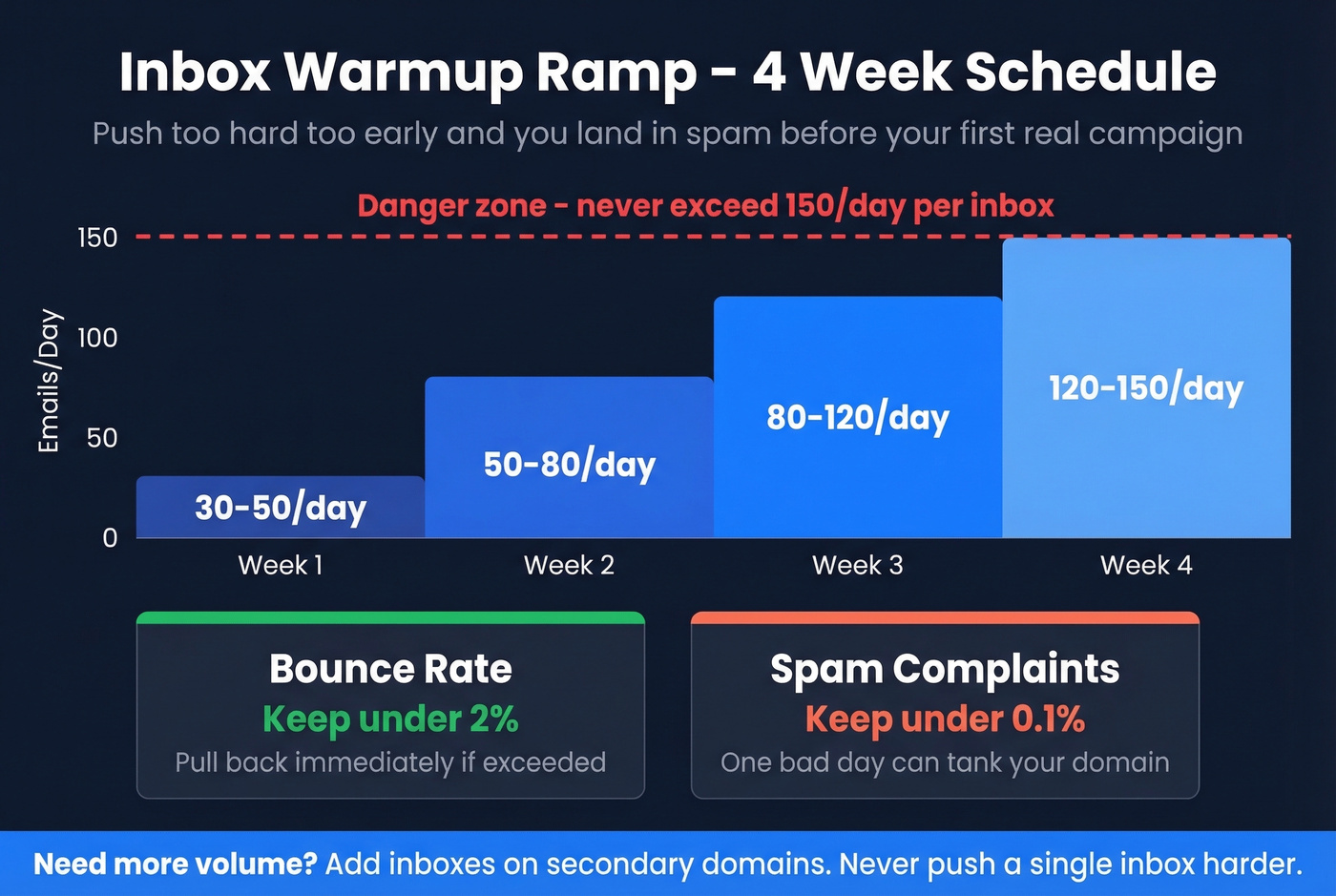
Week 1: 30-50 emails/day. Week 2: 50-80. Week 3: 80-120. Week 4: 120-150, but only if metrics stay green. (For safe caps by inbox age, see email velocity.)
Even after warmup, keep each inbox at 30-50 cold emails per day. Stagger sends across 10-15 minute intervals rather than blasting 150 at 9:00 AM. Monitor two thresholds religiously: bounce rate under 2% and spam complaints under 0.1%.
Scale Horizontally
When you need more volume, don't push a single inbox harder. Add inboxes. Set up secondary domains and warm each one independently. If open rates drop below 30% from your baseline on any inbox, pull back before the damage compounds. Keep warmup running continuously, even during active campaigns - the moment you stop, engagement signals decay.
How AI Changes Outreach in 2026
Let's be honest about AI in sales: it's genuinely useful, but it's not magic. Among teams using AI SDR tools, 100% report saving time, with 40% saving 4-7 hours per week. LivePerson cut prospect research time from 20 minutes to 2 minutes and saw a 35% lift in engagement rates. (If you’re evaluating platforms, start with these SDR tools.)
The bigger shift is the hybrid model. 45% of high-performing sales teams now run human-AI SDR setups where AI handles research, initial personalization drafts, and lead scoring, while humans handle the actual conversations. This makes sense - sellers currently spend only 28% of their time actually selling. BCG's analysis shows AI-leading companies achieve 1.7x revenue growth.
Where AI falls short: it can't replace signal-based judgment. An AI can tell you that a prospect's company just raised funding. It can't tell you that the specific VP you're targeting just complained about their current vendor in a comment thread. The teams winning right now use AI to eliminate busywork and human judgment to identify the signals that actually matter.
Measuring What Matters
Stop obsessing over open rates. With Apple Mail Privacy Protection and various proxy services inflating opens, that metric is increasingly unreliable. It doesn't correlate with revenue, either.
I'll say something that might be unpopular: most outbound teams measure the wrong things because their comp plans reward the wrong behaviors. Activity-based compensation plans drive 43% more spam complaints - you're literally incentivizing your team to damage your domain.
McKinsey's research tells a counterintuitive story. Teams that target 40% fewer accounts but spend 2.5x more time per target achieve 18% higher win rates and 35% faster deal cycles. Deals closed within 50 days show a 47% win rate versus just 20% beyond that window. Less volume, more depth, better outcomes. (To operationalize this, track pipeline health metrics, not vanity metrics.)
The metrics that actually predict pipeline: reply rate over open rate, meetings booked per sequence, pipeline generated per channel, stakeholder coverage across accounts, and bounce rate as a proxy for data quality. 72% of buyers ignore generic outreach entirely. If your measurement framework rewards volume over relevance, you're optimizing for the wrong thing.
The Tool Stack
You don't need fifteen tools. You need the right tool in each category, and you need them to talk to each other.
| Category | Tool | Starting Price | Why It's Here |
|---|---|---|---|
| Data & Verification | Prospeo | Free tier; ~$0.01/email | 98% accuracy, 7-day refresh |
| Data & Verification | Apollo | ~$49/mo | Large DB, 79% accuracy |
| Data & Verification | ZoomInfo | ~$15-40K/yr | Enterprise, 87% accuracy |
| Data & Verification | Lusha | Free (70 credits); ~$30/mo | Quick lookups, small teams |
| Sales Engagement | Instantly | ~$30/mo | Cold email sequences, warmup |
| Sales Engagement | Smartlead | ~$39/mo | Multi-inbox management |
| Sales Engagement | Salesloft/Outreach | ~$100-150/seat/mo | Enterprise engagement |
| Intent Data | 6sense | ~$30-100K+/yr | Enterprise ABM signals |
| CRM | HubSpot | Free tier; ~$20/mo paid | Most teams already have one |
Instantly is the go-to for teams running cold email at scale. Built-in inbox warmup, A/B testing, and campaign analytics at $30/month make it the best value in the sending category. Smartlead edges ahead if you're managing 10+ inboxes across multiple clients - its multi-inbox rotation and unified dashboard are purpose-built for agencies.
Apollo is popular and the free tier is generous, but 79% email accuracy means roughly one in five emails is invalid or risky. Skip it if you're sending cold email at volume - that bounce rate will catch up with you. ZoomInfo's database depth is unmatched for large US enterprises, but it's serious money for teams with deals under $15K. Prospeo matches or beats ZoomInfo's accuracy at a fraction of the cost, without contracts or sales calls - which is why outbound agencies like Stack Optimize built to $1M ARR on it without a single domain flag across their entire client base.
FAQ
What's a good reply rate for cold outreach in 2026?
The average cold email reply rate is 3.43% based on Instantly's 2026 benchmark data. Top quartile performers hit 5.5%+, and the top 10% exceed 10.7%. If you're consistently below 3%, focus on data quality and list targeting before tweaking copy.
How many touchpoints should an outreach sequence include?
Four to seven touches across multiple channels is the sweet spot. 58% of replies come from the first email, but follow-ups capture the remaining 42%. Space touches 3-4 days apart and introduce a new angle each time rather than "just checking in."
Does cold email still work in 2026?
Yes, but only with verified data, proper authentication, and targeted lists. Campaigns sent to fewer than 50 recipients get 5.8% reply rates - nearly triple the 2.1% that large untargeted blasts achieve. Generic mass emails get 67% fewer replies than segmented campaigns.
What's a good free tool for verified outreach data?
Prospeo's free tier includes 75 verified emails and 100 Chrome extension credits per month - enough to run a small targeted campaign with 98% accuracy. Apollo also offers a free plan, though its 79% accuracy means more bounces and higher domain risk for cold senders.
How do I stop cold emails from landing in spam?
Set up SPF, DKIM with 2048-bit keys, and DMARC on every sending domain. Warm up new inboxes over four weeks starting at 30-50 emails per day. Keep bounce rate under 2% and spam complaints under 0.1%. Verify every address before sending - one high-bounce campaign can damage your domain for months.
Smaller lists win - 5.8% reply rates vs 2.1% for mass blasts. But precision targeting demands precision data. Prospeo gives you 30+ filters including buyer intent, technographics, and headcount growth to build signal-rich lists of under 50 prospects, each with verified contact data at $0.01 per email.
Build the small, smart lists that top 10% outbound teams actually use.