

B2B Data Enrichment: What It Costs and Which Tools Are Worth It in 2026
Your last outbound campaign bounced 16% of emails. Your SDRs wasted a chunk of the morning updating job titles that changed three months ago - and research shows SDRs lose 27% of potential selling time to exactly this kind of bad-data busywork. Somewhere in a quarterly review, someone's going to ask why the team burned $40k on a data platform that still can't produce a working phone number for a VP of Engineering at a Series C company.
Dirty data costs the average organization $15M per year, per Gartner's estimate. B2B contact data decays at roughly 2.1% per month - nearly a quarter of your CRM going stale every year, compounded by the fact that 10.9% of professionals change companies annually. B2B data enrichment is how you fight that decay. But the market has gotten noisy, pricing models are deliberately confusing, and half the tools out there are reselling the same underlying data with different logos on top.
We've tested these tools, run bake-offs, and watched teams waste real money on the wrong ones. Here's what actually works.
Top Picks (Quick Version)
If you don't want to read 3,000+ words:
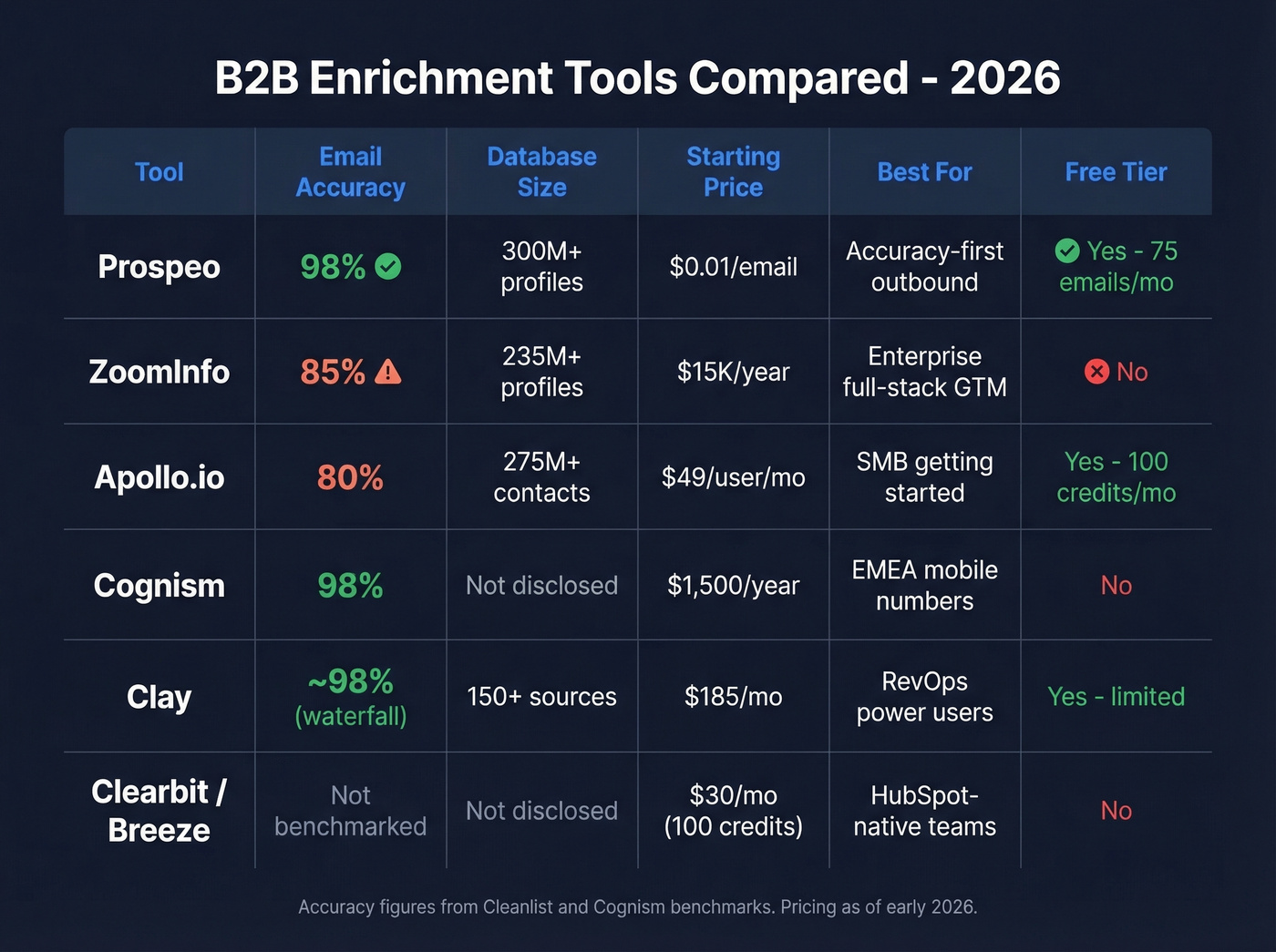
- Best overall enrichment accuracy: Prospeo - 98% email accuracy, 125M+ verified mobile numbers with a 30% pickup rate, 7-day data refresh, starts free.
- Best free tier to test enrichment: Apollo.io - 100 credits/month, built-in sequencing, good enough for SMBs getting started.
- Best for EMEA mobile numbers: Cognism - phone-verified European data, worth the premium if your ICP lives in DACH, UK, or Nordics.
If you've got $15K+ and need the full platform - intent signals, technographics, enrichment, and workflow automation bundled together - ZoomInfo. Everyone else: keep reading.
What Is B2B Data Enrichment?
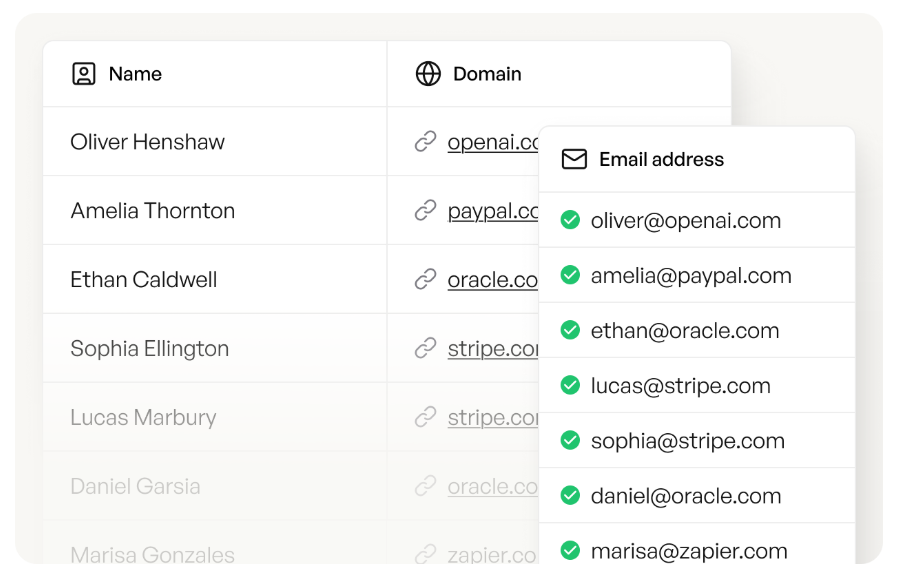
It's the process of taking incomplete or outdated records and filling them with accurate, current information - emails, phone numbers, firmographics, technographic signals, intent data. You start with a company name and a job title. You end with a verified email, a direct dial, the tech stack they're running, and whether they're actively researching your category.
Don't confuse enrichment with cleansing. Cleansing fixes what you already have: deduplication, formatting corrections, removing invalid records. Enrichment adds what's missing. Most teams need both, but they're different workflows with different tools.
The enrichment market is projected to hit $4.58B by 2030 at a 10.1% CAGR. That growth is driven by a simple reality: contact databases decay 30% or more annually. People change jobs, companies get acquired, phone numbers rotate. Experian found that 44% of companies lose more than 10% of revenue due to poor CRM data. If you're not enriching continuously, your CRM is rotting.
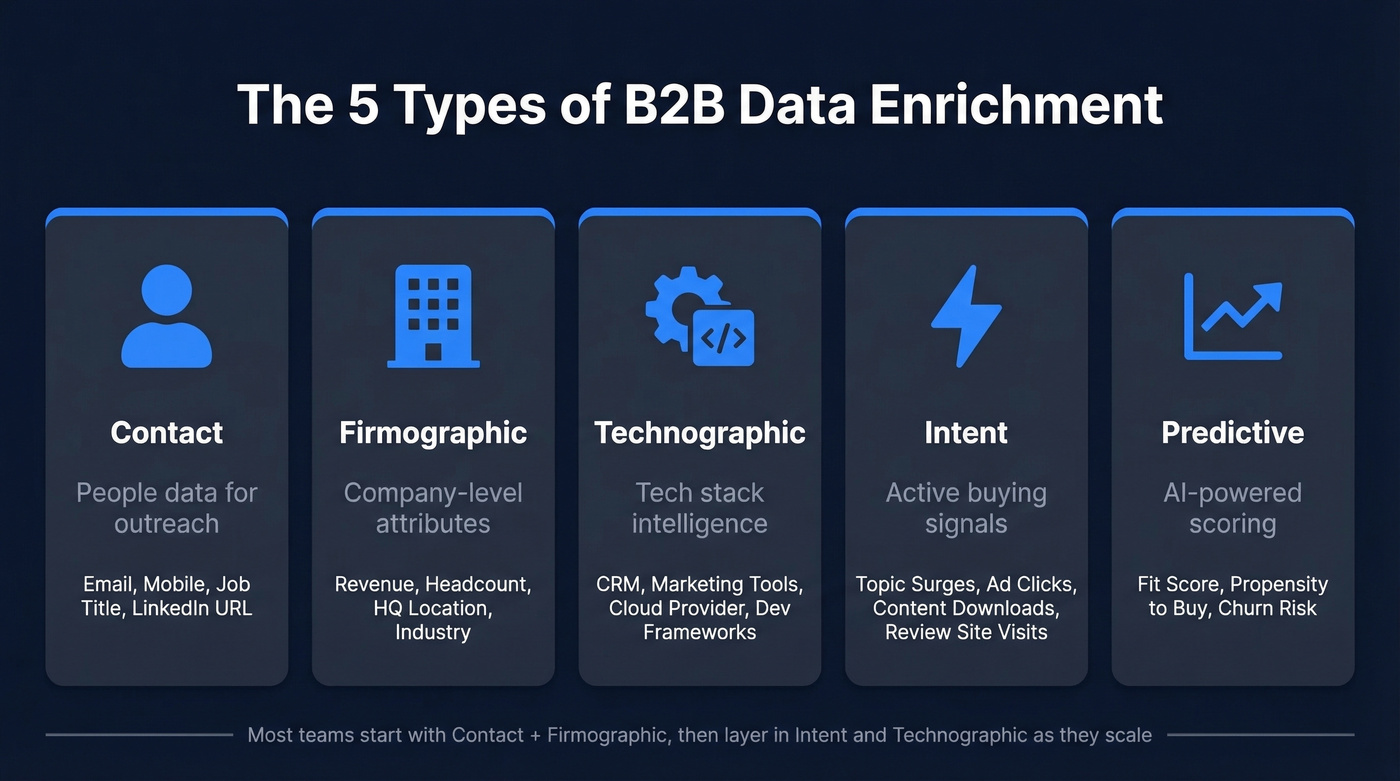
The five core enrichment types in practice:
| Type | What It Adds | Example Fields |
|---|---|---|
| Contact | People data | Email, mobile, title |
| Firmographic | Company data | Revenue, headcount, HQ |
| Technographic | Tech stack | CRM, MAP, cloud provider |
| Intent | Buying signals | Topic surges, ad clicks |
| Predictive | Scoring | Fit score, propensity |
How the Enrichment Process Works
Real-Time vs. Batch
The old model was batch enrichment: export a CSV, upload it to a tool, wait, download the results, re-import. It worked, but your data was already aging by the time it hit your CRM.
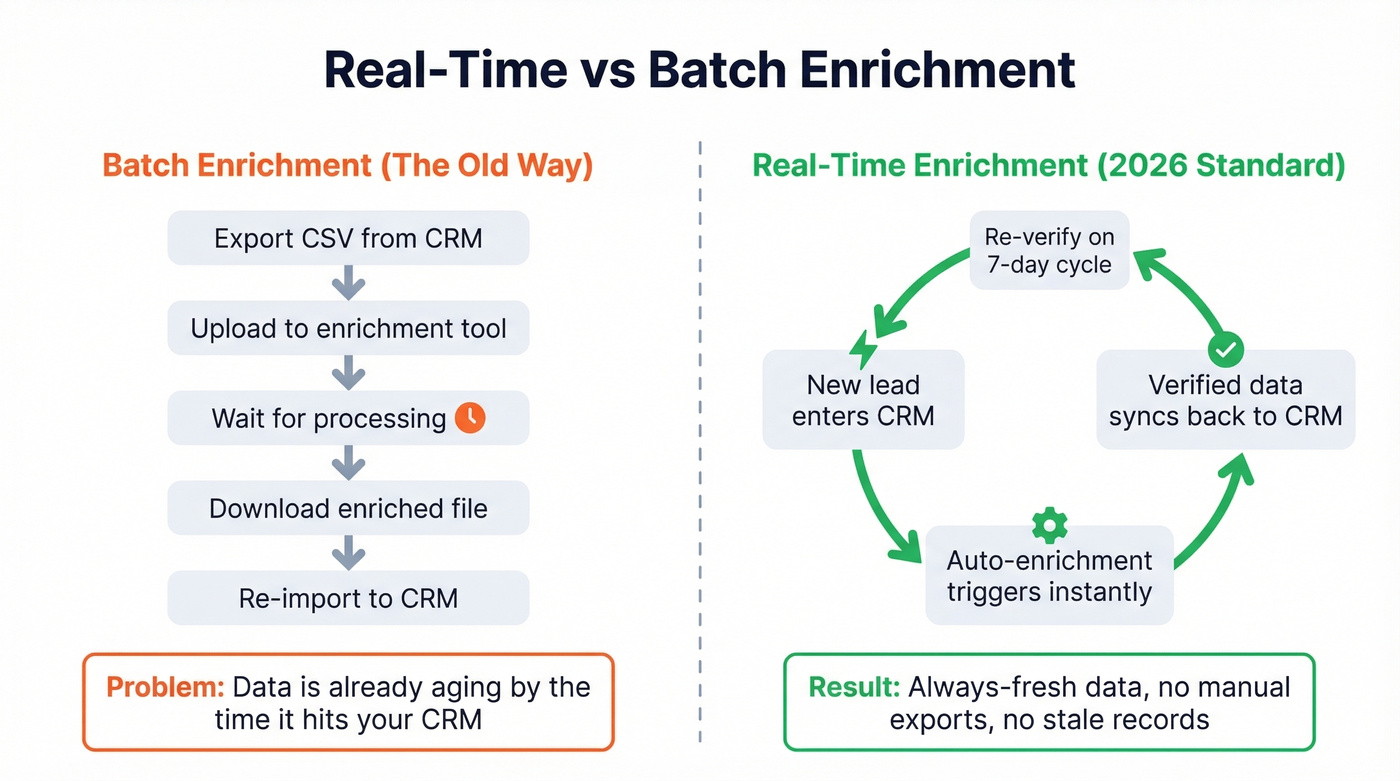
The 2026 standard is continuous enrichment. The best tools integrate directly with Salesforce or HubSpot, trigger enrichment when a new lead enters, and re-verify on a scheduled cycle. If your enrichment tool doesn't offer native CRM integration with bi-directional sync and overwrite controls, it's already behind.
Real-time enrichment matters most at the point of capture - when a prospect fills out a form, when an SDR adds a contact, when a marketing lead hits your routing rules. Batch still has its place for quarterly database hygiene, but it shouldn't be your primary workflow.
What Is Waterfall Enrichment?
Waterfall enrichment queries multiple data providers sequentially until it finds a valid match. Instead of relying on one database, a waterfall tool chains together dozens of sources - Clay, for example, connects to 150+ databases and runs providers in order until it gets a hit.
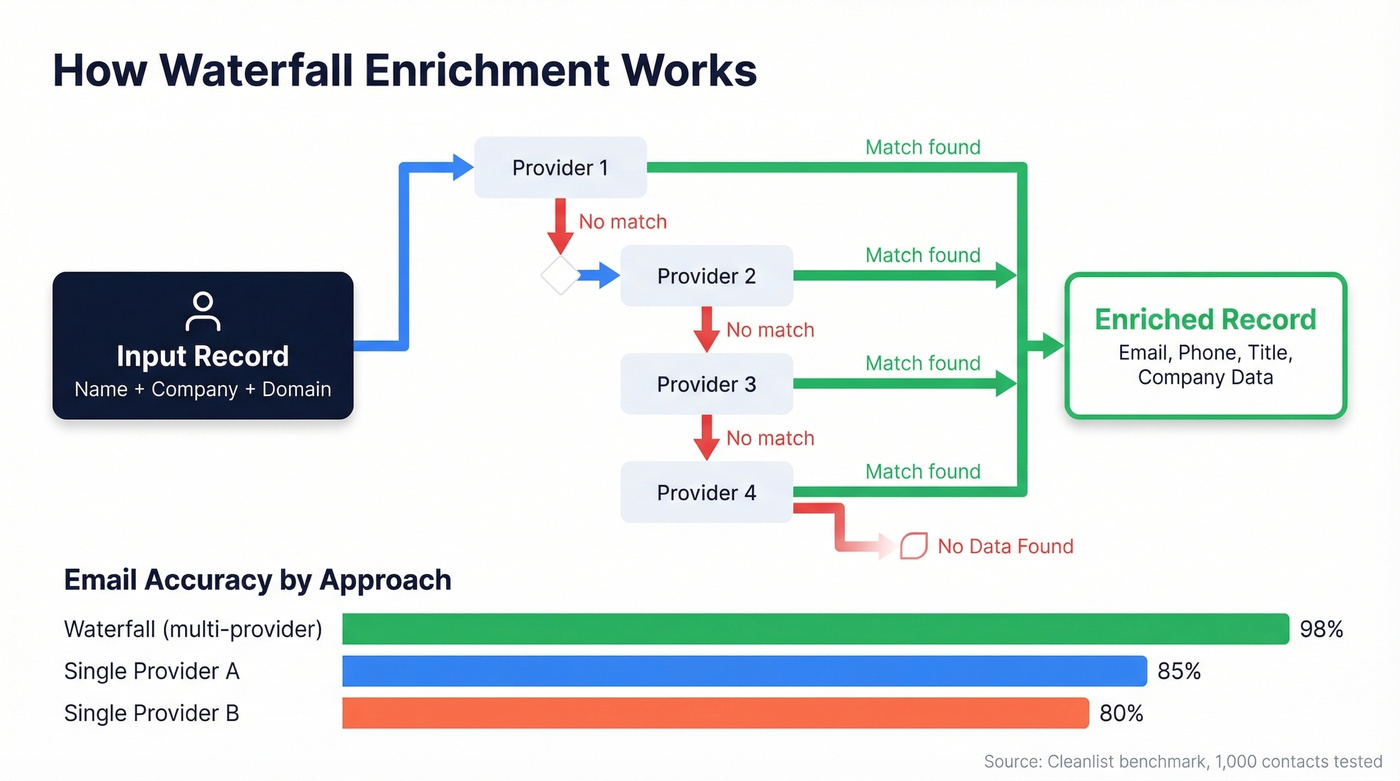
The accuracy numbers support the approach. A Cleanlist benchmark testing 1,000 contacts reported waterfall tools hitting ~98% email accuracy versus ZoomInfo at 85% and Apollo at 80%.
The catch: every vendor in that chain needs a signed DPA. Every provider needs to have obtained their data lawfully. If one link in the waterfall is scraping data without proper consent, your compliance exposure multiplies. And the cost adds up - Clay charges credits at every step of the chain, which is why teams often underestimate the true cost of "just one more provider."
Here's the thing: most teams don't need waterfall enrichment. You'll see vendors pitch scoring frameworks with hundreds of sub-features and enterprise metadata governance layers. That's noise. If your single enrichment provider delivers 98% email accuracy and refreshes weekly, chaining six more providers together adds complexity and compliance risk for diminishing returns. Save waterfall for the edge cases where your primary provider genuinely can't cover your ICP.
Best Tools for B2B Data Enrichment in 2026
Prospeo
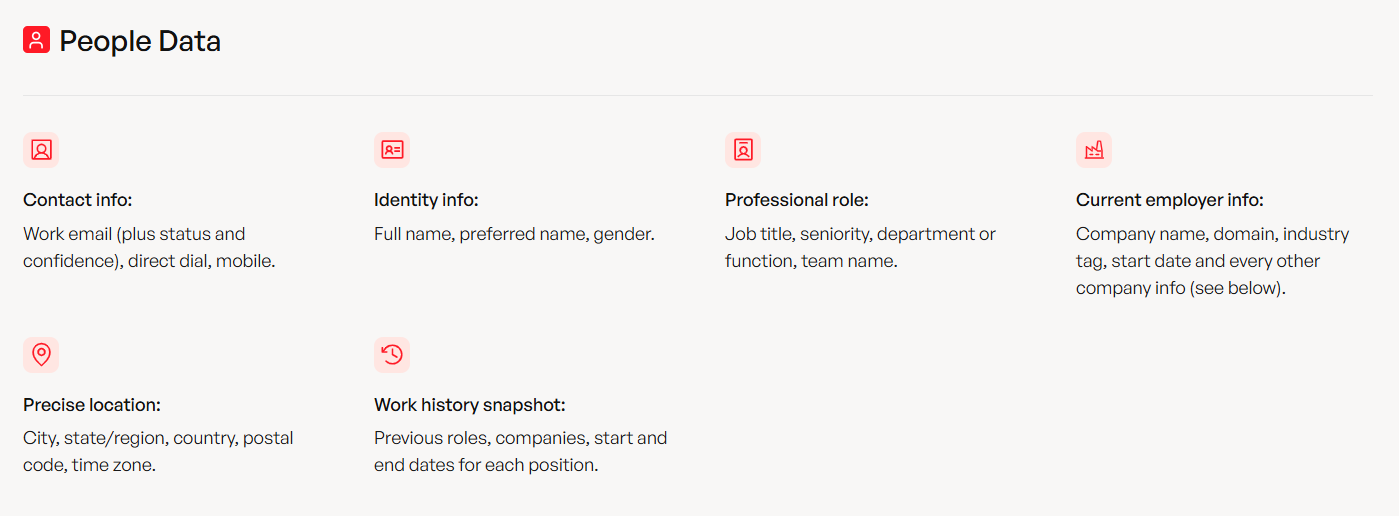
Prospeo's database covers 300M+ professional profiles with 98% email accuracy, an 83% enrichment match rate, and a 7-day refresh cycle - the industry average is six weeks. The platform returns 50+ data points per contact, runs a 92% API match rate, and includes 125M+ verified mobile numbers with a 30% pickup rate.
Thirty-plus search filters let you slice by buyer intent, technographics, job changes, headcount growth, funding, and revenue - so you're enriching the right contacts, not just more contacts. Intent data tracks 15,000 Bombora topics to surface who's actually in-market. Native integrations with Salesforce, HubSpot, Smartlead, Instantly, Lemlist, Clay, Zapier, and Make mean enriched data flows directly into your workflows without manual exports.
Pricing is the most transparent in the category: roughly $0.01 per email, with a free tier that gives you 75 verified emails and 100 Chrome extension credits per month. No annual contracts, no "talk to sales" gates.
The proof points are concrete. Snyk's 50-person AE team went from a 35-40% bounce rate to under 5% after switching, generating 200+ new opportunities per month. Meritt tripled their pipeline from $100K to $300K per week while cutting bounce rates from 35% to under 4%.
Best for: Accuracy-obsessed teams, outbound agencies, anyone whose domain reputation has been damaged by bad data (see how to check domain reputation).
ZoomInfo
ZoomInfo is the incumbent for a reason. The database covers 235M+ professionals and 14M+ companies, and the platform bundles enrichment with intent data, technographics, website visitor identification, and workflow automation.
But let's lead with what matters: the price tag. Professional starts around $15K/year for 3 seats and 5,000 credits. Advanced runs ~$25K/year. Elite typically lands around $35K-$45K+ per year, and can climb higher with add-ons and seat count. Additional seats cost $1,500-$2,500 each, contracts are annual, and expect 10-20% renewal increases. You're locked in before you've validated whether the data actually works for your ICP.
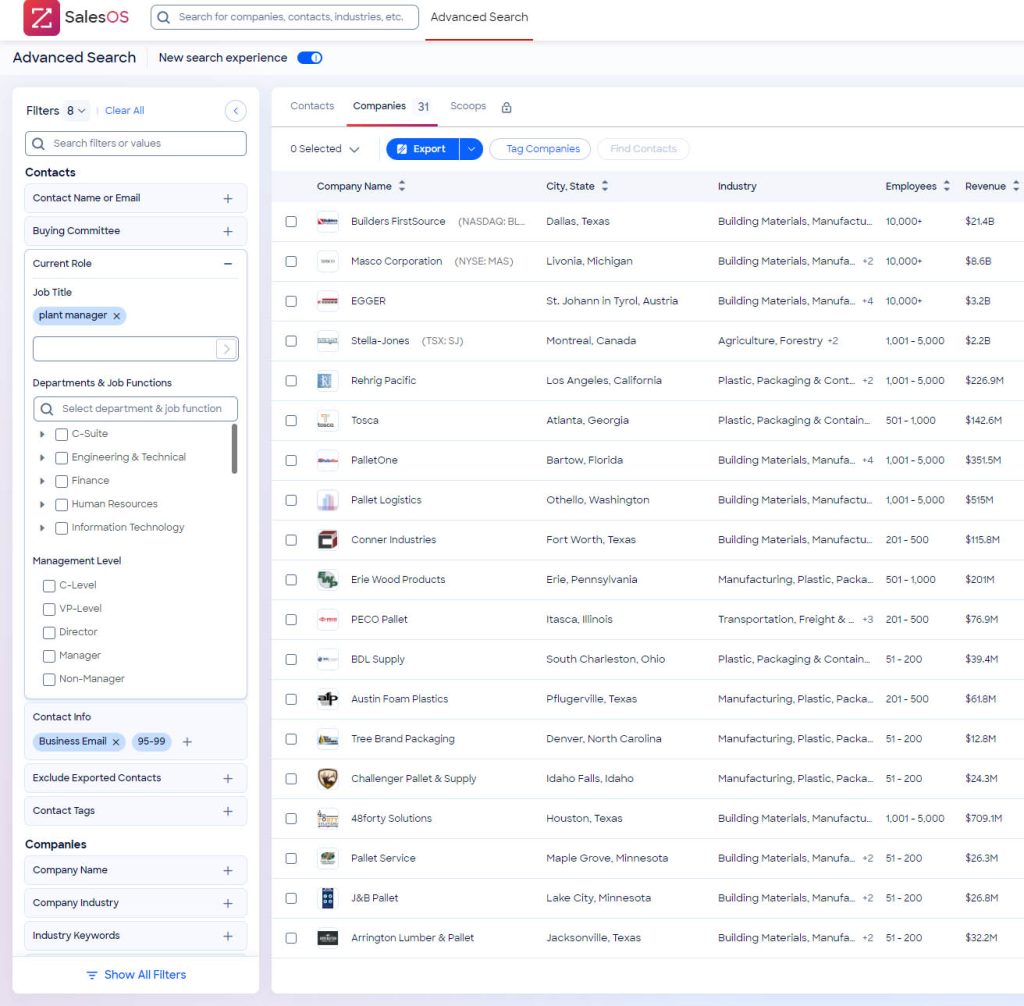
The accuracy question is real. In the Cleanlist benchmark, ZoomInfo hit 85% email accuracy. A Cognism case study showed a 72% match rate versus Cognism's 98%. Those gaps matter when you're running high-volume outbound - every percentage point of bounce rate compounds into deliverability damage.
Best for: Enterprise teams with $25K+ budgets who need the full GTM platform. Skip if: You only need enrichment. You're paying for intent, chat, and workflow features you might never turn on.
Apollo.io
Apollo is the obvious starting point for SMB teams testing enrichment for the first time. The database covers 275M+ contacts, the free tier gives you 100 credits per month, and the built-in sequencing means you can enrich and email from the same platform. Paid plans run $49/user/month (Basic), $79 (Professional), and $119 (Organization) on annual billing. Monthly billing adds ~20%.
The number you need to know: 80% email accuracy in the Cleanlist benchmark. For a 500-contact campaign, that's manageable - 100 bounces you can absorb. For a 50,000-contact quarterly push, you're looking at 10,000 bounces. That's domain reputation damage you can't undo quickly. Additional credits cost $0.20 each, and credits expire each cycle - a detail that catches people off guard.
Best for: SMBs testing enrichment, teams that want enrichment + outreach in one tool. Skip if: You need high accuracy at scale. Bounce rates climb with volume.
Cognism
Imagine you're an SDR in London trying to reach a CFO in Munich. Your US-centric data provider gives you a generic company switchboard. Cognism gives you a phone-verified mobile number with a 22% connect rate. That's the difference.
Cognism's GDPR-first approach means your compliance team won't lose sleep, and a published case study showed a 98% match rate versus ZoomInfo's 72% and a 22% connect rate versus 14%. Pricing typically lands around $1,500-$10,000/year for Platinum packages and can scale up to $25K/year for Diamond with Bombora intent add-ons. No hidden platform fees - you pay for licenses and add-ons.
Best for: EMEA-focused teams needing verified mobile numbers (and better phone sales skills to convert connects). Skip if: Your ICP is entirely US-based - you're paying a premium for European coverage you won't use.
Clay
Clay is the power tool for RevOps teams who think in API calls. The waterfall enrichment across 150+ databases is genuinely powerful, and the workflow builder lets you create custom enrichment sequences that no other tool matches.
Pricing starts with a free plan. Paid plans include Launch at $185/month and Growth at $495/month, with some packages starting around $134/user/month depending on configuration. Top-up credits carry a 50% premium over base rates. Credits burn at every step of the waterfall - a single enrichment that queries five providers costs five credits. We've seen teams blow through their monthly allocation in the first week because they didn't model the credit math.
Best for: RevOps teams with a dedicated operator who can manage workflows (especially if you're doing Clay list building). Skip if: You don't have someone to babysit the credit burn. The marginal accuracy gain over a single high-quality provider rarely justifies 3-5x the cost.
Clearbit / Breeze Intelligence
Now fully absorbed into HubSpot as Breeze Intelligence. Credit packs range from $30/month (100 credits) to $700/month (10,000 credits). Requires a HubSpot subscription, which makes it a non-starter if you're on Salesforce.
Best for: HubSpot-native teams who want enrichment without leaving their CRM (pair it with solid CRM automation software). Skip if: You're not on HubSpot. There's no standalone option anymore.
Lusha
Quick lookups for individual reps. Free plan available, paid plans start around $36/user/month. Phone lookups consume multiple credits per number, so the effective cost per phone is higher than it looks.
Best for: Reps who need fast, one-off lookups without a platform commitment. Skip if: You need bulk enrichment - the credit math doesn't scale.
Demandbase
Account intelligence platform aimed at enterprise ABM. Pricing runs $30K-$100K+/year, quote-based. Overkill for enrichment alone - you're buying an ABM platform that happens to include enrichment.
Best for: Enterprise ABM teams already invested in account-based strategies (see account based marketing benchmarks). Skip if: You just need contact enrichment. This is a $50K+ hammer for a $5K nail.
People Data Labs
API-first, no GUI. Pay-per-record at ~$0.01-$0.10 per enrichment, with most teams spending $500-$10K/year depending on volume. A common shortlist pick for developers building custom enrichment pipelines.
Best for: Engineering teams building custom enrichment into their product or internal tools. Skip if: You want a UI. There isn't one.
Amplemarket
All-in-one platform bundling enrichment, sequencing, and AI. Runs $2,880-$3,960/user/year with a 14-day free trial. No per-record credits, which simplifies budgeting.
Best for: Teams that want enrichment, sequencing, and AI coaching in a single contract. Skip if: You already have a sequencing tool - you'd be paying for overlap.
Tools we considered but didn't include: Seamless.AI, Lead411, Snov.io, and 6sense all have enrichment capabilities. Seamless.AI and Lead411 offer competitive phone data for US markets. 6sense is strong on intent but priced for enterprise. None offered enough differentiation from the tools above to warrant a full section.

You just read that dirty data costs $15M/year and contact databases decay 30% annually. Prospeo returns 50+ data points per contact at a 92% API match rate, refreshes every 7 days, and starts at $0.01 per email. Snyk cut their bounce rate from 40% to under 5% - with 50 AEs prospecting.
Stop enriching with stale data. See the difference a 7-day refresh makes.
Most teams don't need waterfall enrichment chaining six providers together. Prospeo delivers 98% email accuracy, 125M+ verified mobiles with a 30% pickup rate, and an 83% enrichment match rate from a single platform - no compliance headaches, no compounding credit costs.
One provider. 98% accuracy. Zero excuses for bad data.
How Enrichment Pricing Works
Every enrichment tool uses a different pricing model - probably intentional. Here are the five models you'll encounter:
| Model | How It Works | Watch Out For |
|---|---|---|
| Monthly credits | Fixed credits/mo | Credits expire unused |
| Per-seat | Price x users | Costs scale with team |
| Flat fee | Unlimited usage | Usually has soft caps |
| Pay-as-you-go | Per record | Costs spike with volume |
| Enterprise quote | Custom pricing | Renewal increases |
The hidden costs are where teams get burned. Credit expiration means you lose what you don't use. Multi-action lookups for email + phone + firmographic data can consume 3-5 credits per contact. Some tools charge for failed lookups - you pay even when they don't find anything. And integration costs like custom API work, Zapier plans, and middleware add 10-20% to your effective spend.
Real numbers across the market:
| Tool | Annual Cost Range | Model |
|---|---|---|
| Prospeo | Free - ~$500/yr+ | Per-email, no contract |
| Apollo | Free - ~$600-$1,500+/user/yr | Credits + per-seat |
| Lusha | Free - ~$400-$1,000+/user/yr | Credits + per-seat |
| Cognism | ~$1,500-$25K/yr | License + add-ons |
| Clay | ~$1,600-$6K/yr | Credits (burn fast) |
| Clearbit/Breeze | ~$360-$8.4K/yr | Credit packs |
| ZoomInfo | ~$15K-$75K/yr | Platform + seats |
| Demandbase | ~$30K-$100K+/yr | Enterprise quote |
| People Data Labs | ~$500-$10K/yr | Per-record API |
| Amplemarket | ~$2.9K-$4K/user/yr | Per-seat, no credits |
How to Evaluate Accuracy
Vendor-claimed accuracy is marketing. Bounce rate is the real metric.
If your enrichment tool says "95% accuracy" but your sequences bounce 12%, the tool is lying - or their definition of "accurate" doesn't match yours. The most useful benchmark data comes from a Cleanlist study that tested 1,000 contacts across multiple providers and measured actual deliverability. Waterfall tools hit ~98% email accuracy. ZoomInfo landed at 85%. Apollo came in at 80%. Those gaps compound fast at scale.
Three things to evaluate beyond the headline accuracy number:
Catch-all handling. Catch-all domains accept all emails regardless of whether the mailbox exists. Cheap tools mark these as "valid" to inflate their accuracy numbers. The best tools flag catch-all domains separately and include spam-trap removal in their verification pipeline, so you can make an informed decision about whether to include those contacts.
Refresh frequency. A contact verified six weeks ago might already be wrong. The bar you should hold any enrichment tool to is a weekly refresh cycle. If a vendor can't tell you their refresh cadence, assume it's quarterly or worse.
Verification methodology. Does the tool verify in real-time or rely on cached results? Does it check MX records, SMTP responses, and mailbox existence? Or does it just pattern-match against a database that was last updated months ago? In our experience, the difference between real-time SMTP verification and cached lookups accounts for most of the accuracy gap between providers (see best email verifier tools).
Using Enriched Data for GTM Execution
Enrichment isn't a standalone activity - it's the foundation of every go-to-market motion.
When you treat it as infrastructure rather than an afterthought, the downstream impact compounds across sales, marketing, and customer success. Outbound sequences convert higher because SDRs reach real people at verified addresses. ABM campaigns target the right accounts because firmographic and intent data are current. Routing rules work because enriched records carry the fields your lead-scoring model depends on.
The consensus on r/sales is pretty clear: teams that enrich at the point of capture and re-verify on a schedule consistently outperform teams that treat enrichment as a one-time project. Every GTM play - from cold outbound to expansion revenue - degrades when the underlying data is stale (more B2B sales best practices here).
GDPR and CCPA Compliance
Enrichment is legal - but only if you do it right.
Establish your lawful basis. For B2B enrichment, that's legitimate interest under GDPR Article 6(1)(f). Recital 47 explicitly states that direct marketing "may be regarded as carried out for a legitimate interest."
Document a Legitimate Interest Assessment. This isn't optional. You need a written record showing you've balanced your business interest against the data subject's rights. If you can't produce this document, you're exposed.
Sign DPAs with every data vendor. Every enrichment provider you use needs a Data Processing Agreement. If you're running waterfall enrichment through Clay with six providers in the chain, that's six DPAs. Miss one, and your compliance falls apart.
Maintain suppression lists. When someone opts out, they stay opted out - across every tool, every list, every campaign. This sounds obvious, but we've seen teams re-enrich suppressed contacts because the suppression list wasn't synced to the enrichment tool. That's a frustrating mistake that can cost you more than money.
Honor opt-outs quickly. GDPR doesn't specify an exact processing timeframe, but best practice is to honor requests within days, not weeks. CCPA requires honoring requests within 45 days.
Know the penalties. GDPR fines run up to 4% of global annual turnover. CCPA penalties are $2,500-$7,500 per violation. For a 10,000-contact enrichment batch with compliance gaps, the math gets ugly fast.
Audit your providers' sources. Your compliance is only as strong as your weakest vendor. If a provider in your enrichment chain scraped data without consent, that liability flows to you.
Enrichment Mistakes That Kill Pipeline
Treating all data sources as equal. Not all providers verify the same way. Run a pilot with 500 contacts across two providers and compare bounce rates. The difference will surprise you.
Over-enriching and hoarding data. Enriching every field on every contact wastes credits and creates noise. Prioritize the fields that actually drive conversion - verified email, direct dial, company size, and tech stack. Skip the rest until a contact moves deeper into the funnel.
Set-and-forget enrichment. With 30% annual decay, a database you enriched in January is already meaningfully stale by mid-year. Set refresh schedules: monthly for high-priority segments, quarterly for general database hygiene. Bad data can cost up to 25% of potential revenue - that's not a rounding error, it's a growth ceiling.
Ignoring privacy regulations. "We didn't know" isn't a defense. Document your lawful basis, sign your DPAs, maintain your suppression lists. The compliance section above isn't optional reading (use this B2B compliance guide as a checklist).
Enriching at the wrong funnel stage. Top-of-funnel leads need an email and basic firmographics. They don't need mobile numbers and buying committee maps - that's expensive data you'll waste on contacts who never convert. Save deep enrichment for mid-funnel and below.
Integration failures. Look, enrichment data that doesn't flow cleanly into your CRM is enrichment data that doesn't exist. Prefer tools with native CRM integrations and built-in validation rules. A CSV export workflow that requires manual import is a workflow that breaks within two weeks - we've watched it happen more times than we can count.
FAQ
What is B2B data enrichment and how does it differ from cleansing?
Cleansing removes duplicates and fixes formatting in existing records; enrichment adds new data points - emails, phones, firmographics, intent signals - to incomplete records. Most teams need both, but they're different processes. Run cleansing first, then enrich the clean records for best results.
How often should I re-enrich my CRM?
B2B contact data decays at ~2.1% per month, so re-enrich high-priority segments monthly and general segments quarterly. Tools with automatic refresh cycles - like a 7-day refresh - reduce this burden significantly compared to the six-week industry average.
Is contact enrichment GDPR compliant?
Yes, under legitimate interest (Article 6(1)(f)), provided you document a Legitimate Interest Assessment, sign DPAs with every data vendor, and maintain working opt-out and suppression processes. The enrichment itself isn't the risk - doing it without the paperwork is.
What's a good email bounce rate after enrichment?
Under 5%. If your provider delivers bounce rates above that threshold, the data quality is actively damaging your sender reputation. The best tools keep rates well below that line - Snyk and Meritt both reported sub-5% bounce rates after switching providers, and some teams consistently hit under 3%.
Do I need waterfall enrichment or is one provider enough?
For most teams, one high-accuracy provider is enough. Waterfall adds complexity, compliance risk since every provider needs a DPA, and cost since credits burn at every step. It's worth it only if your single provider leaves significant coverage gaps - and if you have someone to manage the workflows.