

How to Use AI for Competitive Intelligence (Without Wasting $30K)
A RevOps lead we know fed three competitors into ChatGPT last quarter and asked for a SWOT analysis. What came back could've described literally any mid-market SaaS company - generic strengths, generic threats, zero actionable insight. That's the state of AI competitive intelligence for most teams: impressive in demos, useless in practice.
With 68% of B2B sales deals involving at least one direct competitor, you can't afford to get this wrong. The gap between what AI can do and what most teams actually get is enormous, and it's almost always a workflow problem, not a technology problem.
What You Need (Quick Version)
Three layers, under $100/month total:
- A free LLM for analysis - ChatGPT or Perplexity. Use it for summarization and first-draft battlecards, but feed it curated sources, not generic prompts.
- A monitoring layer - Feedly at $6/mo or Visualping's free tier. Real-time competitor alerts beat checking websites manually every single time.
Upgrade to Crayon or Klue ($20K-$40K/yr) only after CI proves revenue impact. Not before.
What AI-Driven Competitive Analysis Actually Looks Like
60% of CI teams now use AI daily, and adoption jumped 76% year-over-year. McKinsey reports 88% of organizations are using AI regularly, with 62% already experimenting with AI agents. This isn't early-adopter territory anymore.
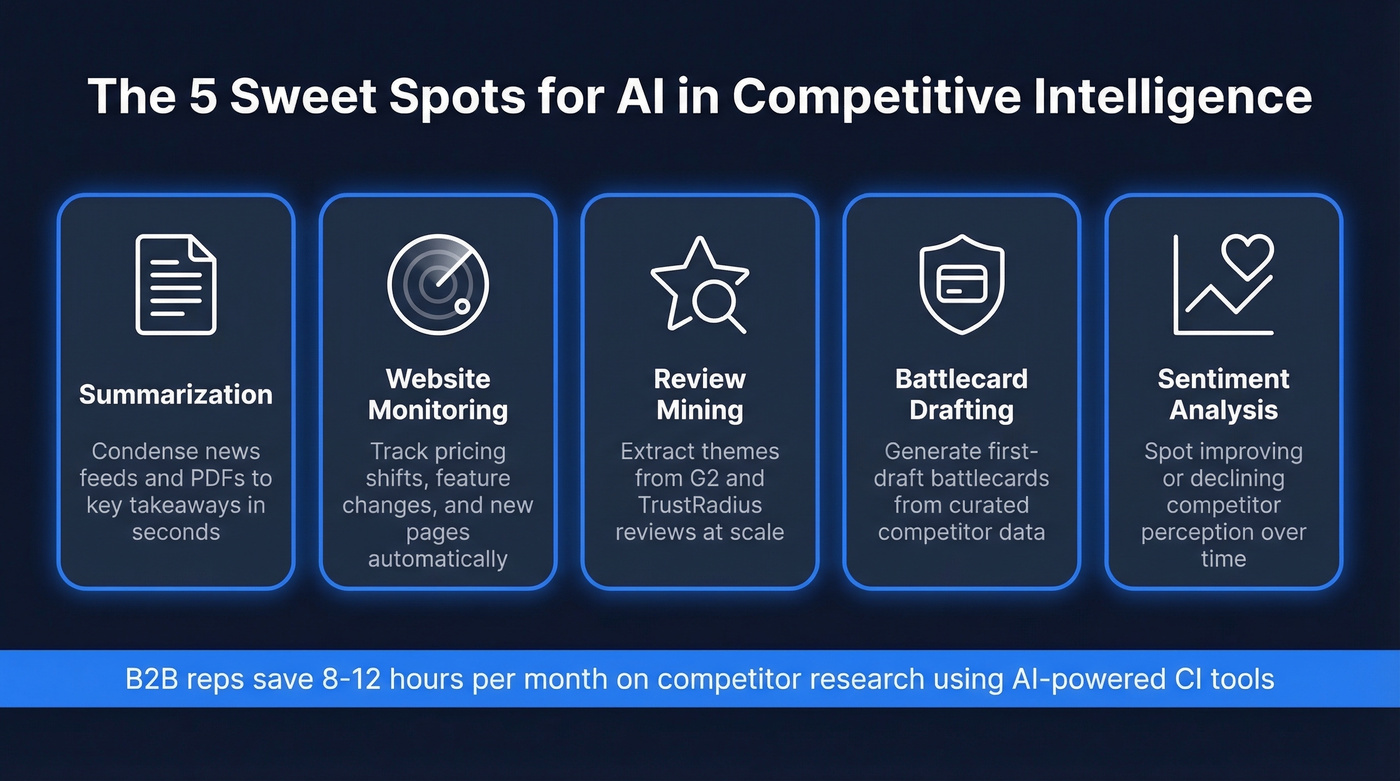
The sweet spot falls into five categories: summarization, monitoring website changes and pricing shifts, sentiment analysis across G2) and TrustRadius reviews, battlecard drafting, and review mining at scale. B2B SaaS reps using AI-powered CI tools save 8-12 hours per month on competitor research - that's real time back in the pipeline.
Ben Hoffman, a CI practitioner at Adobe, describes using AI to condense daily news feeds to key takeaways and extract information from long PDFs in seconds - tasks that used to eat entire mornings. Here's a prompt pattern that works:
"Summarize the last 30 days of news for [Competitor X]. Focus on: product launches, pricing changes, leadership hires, and partnership announcements. Flag anything that changes their positioning against us. Sources: [paste 5-10 curated links]."
And a second one for mining competitor reviews:
"Analyze the last 50 G2 reviews for [Competitor X]. Extract: top 3 praised features, top 3 complaints, any mentions of switching from/to other tools, and sentiment trend (improving or declining). Output as a table."
The key phrase in both is "curated sources." Feed the AI specific inputs and you get specific output. Feed it nothing and you get a SWOT that belongs on a college assignment.
One more thing: before uploading any proprietary competitive data into an LLM, disable chat history and training in your settings - or run a local model. Your competitor analysis shouldn't become someone else's training data.

Competitive intelligence is only as good as the data behind it. Prospeo tracks 15,000 intent topics via Bombora and refreshes 300M+ profiles every 7 days - so your battlecards reflect this week's reality, not last quarter's.
Layer real-time buyer intent into your CI stack for $0.01 per lead.
Where AI Falls Short
AI doesn't know what it doesn't know, and it won't tell you when it's guessing.
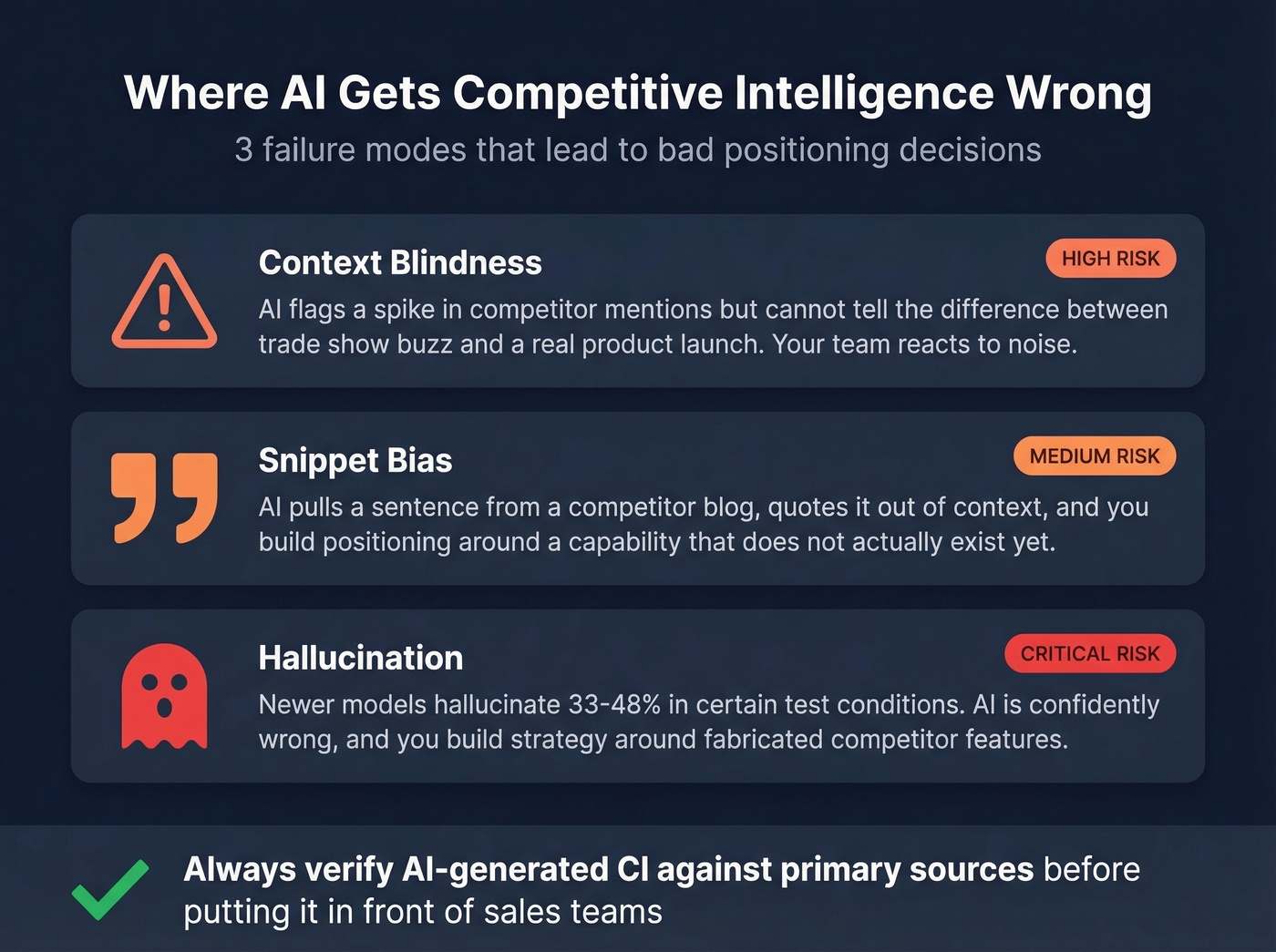
Context blindness is the most common failure mode. AI flags a spike in competitor mentions but can't distinguish trade show buzz from a product launch. Your team reacts to noise. Snippet bias is subtler - AI pulls a sentence from a competitor's blog, quotes it out of context, and you build positioning around a capability that doesn't actually exist yet.
Then there's hallucination. Newer models hallucinate 33-48% in certain test conditions. Air Canada's chatbot fabricated a refund policy the airline was forced to honor. Lawyers have been sanctioned for citing AI-generated case law that didn't exist.
Here's the thing: the biggest risk isn't that AI is wrong. It's that AI is confidently wrong, and you build positioning around a hallucinated competitor feature. As teams experiment with autonomous AI agents for CI, the risk compounds - agents can misprioritize signals and amplify bias without human checkpoints. Always verify AI-generated CI against primary sources before putting it in front of a sales team.
CI Tool Stack by Budget
Most enterprise CI platforms hide pricing behind a "request a demo" wall. Here's what things actually cost.
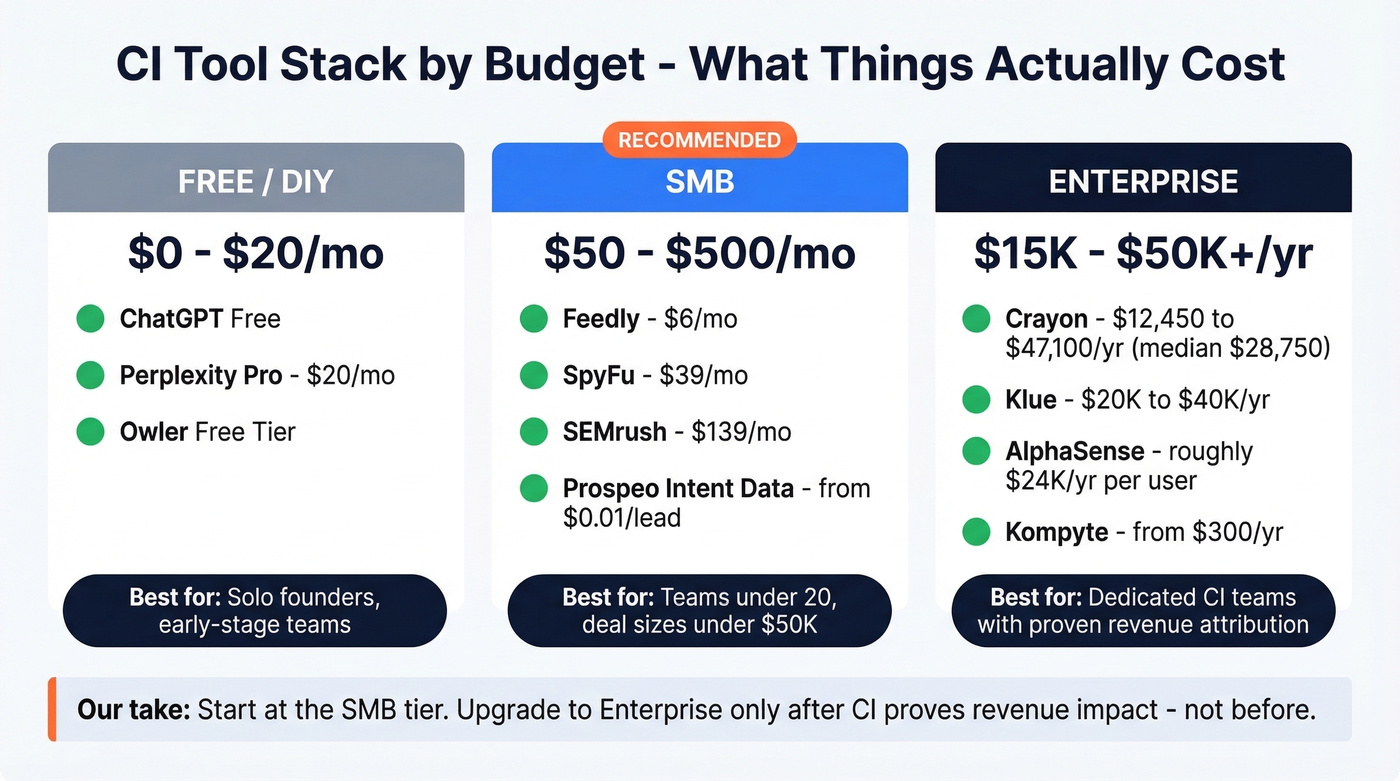
| Tier | Tools | Cost |
|---|---|---|
| Free/DIY | ChatGPT, Perplexity, Owler | $0-$20/mo |
| SMB | Feedly, SpyFu, SEMrush | $50-$500/mo |
| Enterprise | Crayon, Klue, AlphaSense | $15K-$50K+/yr |
Free/DIY gets you surprisingly far. ChatGPT Free handles analysis and summarization; Perplexity Pro at $20/mo adds better reasoning and web access. Owler's free tier gives you basic company alerts.
SMB ($50-$500/mo) is where most teams should live. Feedly at $6/mo aggregates competitor content feeds. SpyFu ($39/mo) and SEMrush ($139/mo) cover SEO and ad intelligence. Layer in Prospeo's intent data tracking 15,000 topics via Bombora, and you're combining buyer signals with competitive monitoring - with 300M+ profiles refreshed every 7 days, you're working with this week's data, not last quarter's.
Enterprise ($15K-$50K+/yr) is where things get expensive fast. Crayon's median contract runs $28,750/year based on 90 Vendr-tracked purchases, with a range of $12,450-$47,100. Klue typically costs $20K-$40K/year across four Access tiers: Essentials, Starter, Pro, and Plus. AlphaSense charges roughly $24K/yr per user. Kompyte starts from $300/year and can show data in about 24 hours, with setup typically taking 1-2 weeks - versus 7-8 weeks for Klue or Crayon.
We've seen Crayon deployments where teams spend more time filtering duplicate alerts than actually using the intelligence. One PMM on r/ProductMarketing reported that ChatGPT outputs were "ok but not novel" until they switched to feeding curated sources into NotebookLM - the tool matters less than the input quality.
Let's be honest: at $20K-$40K/year, Crayon and Klue are overkill for teams under 20 people. If your average deal size is below $15K, you almost certainly don't need enterprise-grade CI software. Skip them. Start with a $200/month setup and upgrade when competitive intelligence proves revenue impact.
Human + AI: The Winning Framework
AI is a force multiplier, not a replacement. 71% of businesses using battlecards report higher win rates, with monthly updates driving up to 59% win-rate lift. But the average sales team still rates itself 3.8 out of 10 for competitive preparedness. That gap is frustrating - and it's almost entirely a process failure, not a tooling one.
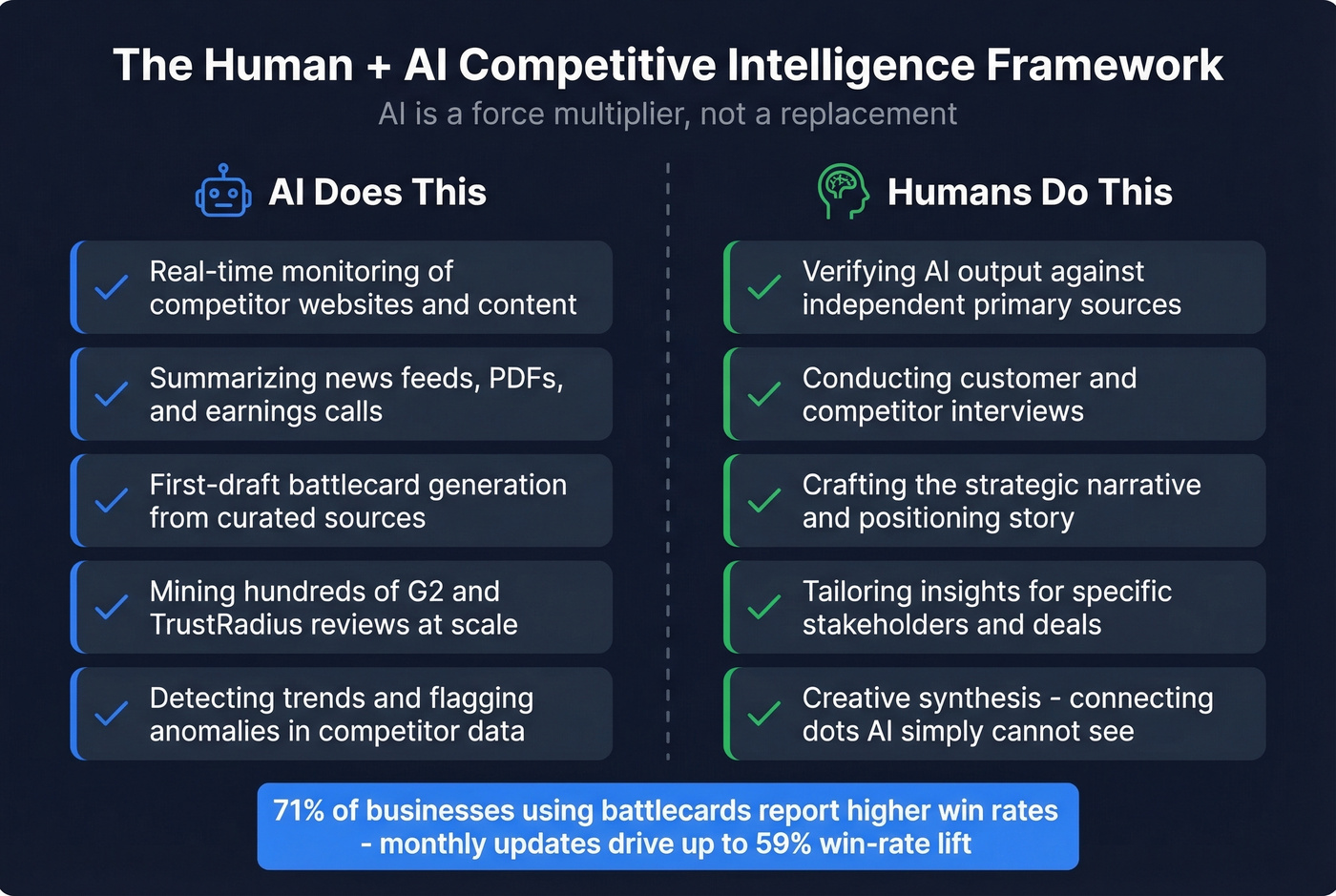
Use AI for: monitoring, summarization, first-draft battlecards, review mining, trend detection.
Use humans for: verification across independent sources, primary research through customer and competitor interviews, strategic narrative, stakeholder tailoring, and creative synthesis that connects dots AI simply can't see.
In our experience, the teams that win at AI competitive intelligence aren't the ones with the fanciest platform. They're the ones where a human analyst feeds AI the right inputs, verifies the outputs, and translates insights into something reps actually use in deals. I've watched teams with a $100/month stack outperform competitors spending 200x more - because they built the habit of curating inputs first and trusting outputs second.
If you're building this into your GTM motion, it helps to align CI outputs to your RevOps Tech Stack and keep your targeting tight with a clear Ideal Customer Profile.
You're building a CI stack under $200/month - smart. Prospeo fits right in: 98% email accuracy, intent signals across 15,000 topics, and 30+ filters to turn competitive insights into targeted outreach lists instantly.
Stop analyzing competitors and start reaching their unhappy customers.
FAQ
How much does competitive intelligence software cost?
Free to $50K+/year depending on team size. ChatGPT plus Owler's free tier costs nothing. A solid SMB toolkit with Feedly, SpyFu, and a data enrichment platform runs $50-$200/month. Enterprise platforms like Crayon ($12,450-$47,100/yr) and Klue ($20K-$40K/yr) are for teams with dedicated CI headcount and proven revenue attribution.
Can ChatGPT replace a CI platform?
For basic summarization and first-draft analysis, yes - but ChatGPT can't monitor competitors in real time, auto-update battlecards, or alert you to pricing changes. Feed it curated sources and it's genuinely useful; ask open-ended questions and you'll get generic output. It's one layer in a stack, not the whole thing.
What's the biggest risk of using AI for competitor research?
Hallucinations - AI confidently generating false competitor information. Newer models hallucinate 33-48% in certain test conditions. Always verify AI-generated insights against primary sources before acting on them, especially before putting competitive positioning in front of customers or sales teams.