

AI Sales Lead Generation: 9 Best Tools for 2026
A fully loaded SDR costs $139,000/year - and that rep spends roughly 28-30% of their time actually selling. AI sales lead generation tools exist to compress the waste, and 86% of sales teams now report positive ROI within the first year of adopting them. But pick wrong and you're paying for bounced emails, stale data, and a pipeline full of ghosts.
Here are nine tools worth evaluating, ranked by what actually drives revenue: data accuracy, usable pricing, and whether the thing works without a three-month implementation.
What Signal-Based Selling Means in 2026
The AI sales tools market hit $3B in 2025, growing at 13% annually. "AI lead generation" gets thrown around loosely, so let's be specific about what it means today: signal-based selling. The best tools don't just hand you a list of names - they watch for buying signals and surface prospects at the moment they're most likely to respond.
What kinds of signals? A closed-lost account circling back to your website. A decision-maker evaluating a competitor. A VP of Sales changing jobs and inheriting a new tech stack. A company posting headcount growth in your target department. These triggers separate 18% response rates from 3.4% generic outreach - a 5.2x improvement. Sellers who partner with AI are 3.7x more likely to hit quota, and teams using signal-based approaches report up to 60% lower customer acquisition costs.
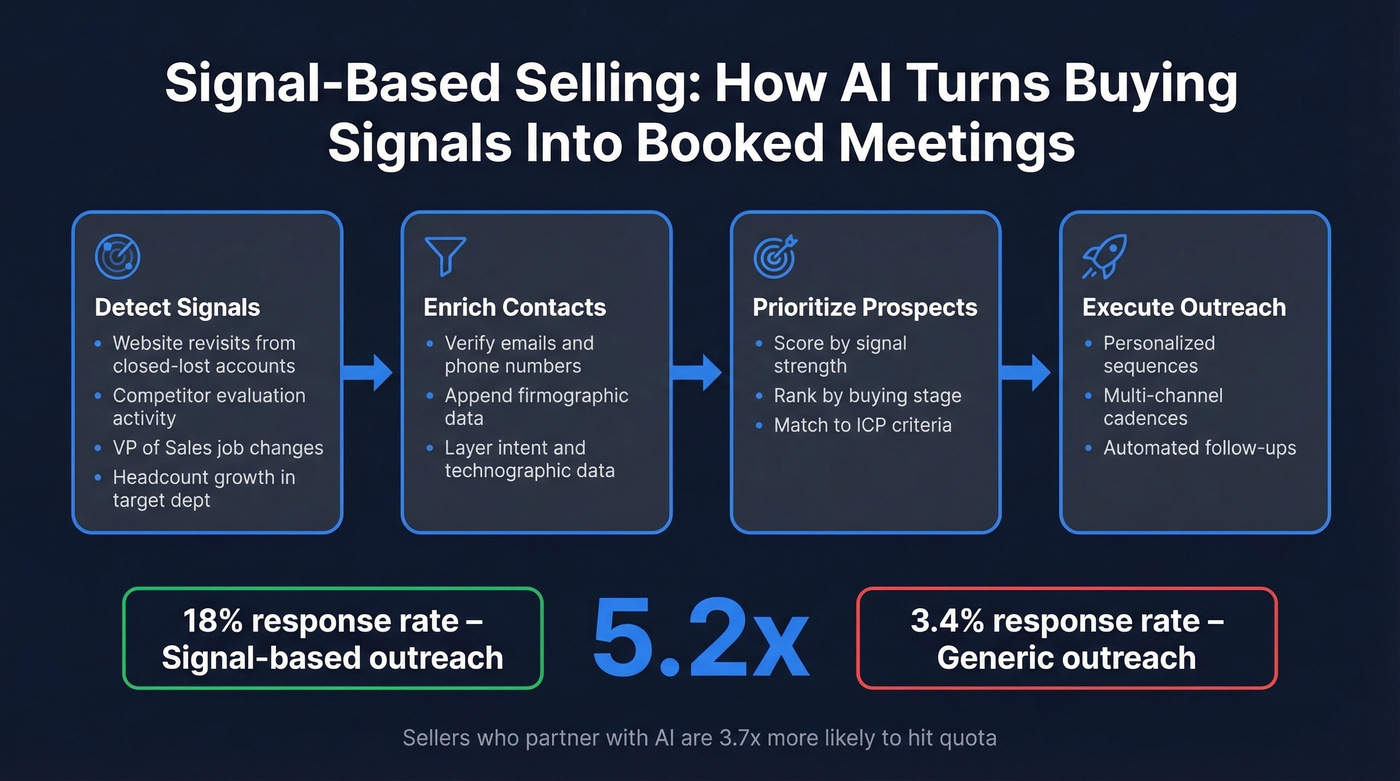
The tools below handle different slices of this workflow. Some find the signals. Some enrich the contacts. Some execute the outreach. A few try to do all three.
Our Top Picks
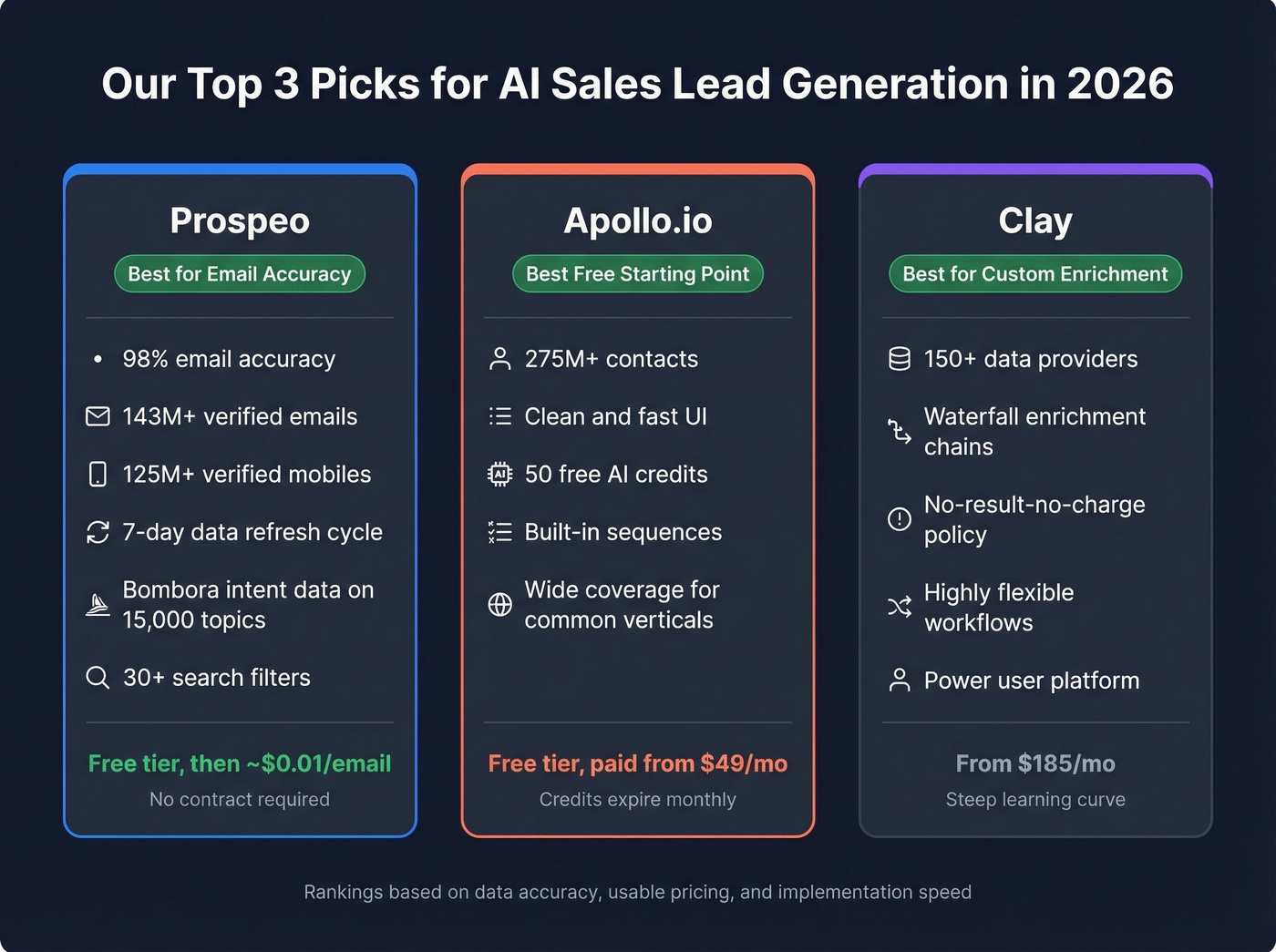
- Prospeo - Best for email accuracy and verified data. 98% email accuracy, 143M+ verified emails, starts free.
- Apollo.io - Best free starting point for fast list-building. Generous free tier, straightforward UI, wide coverage.
- Clay - Best for custom enrichment workflows. 150+ data providers, incredibly flexible if you've got the ops capacity.
9 Best AI Lead Generation Tools
Prospeo
Use this if you care about data quality more than feature count.
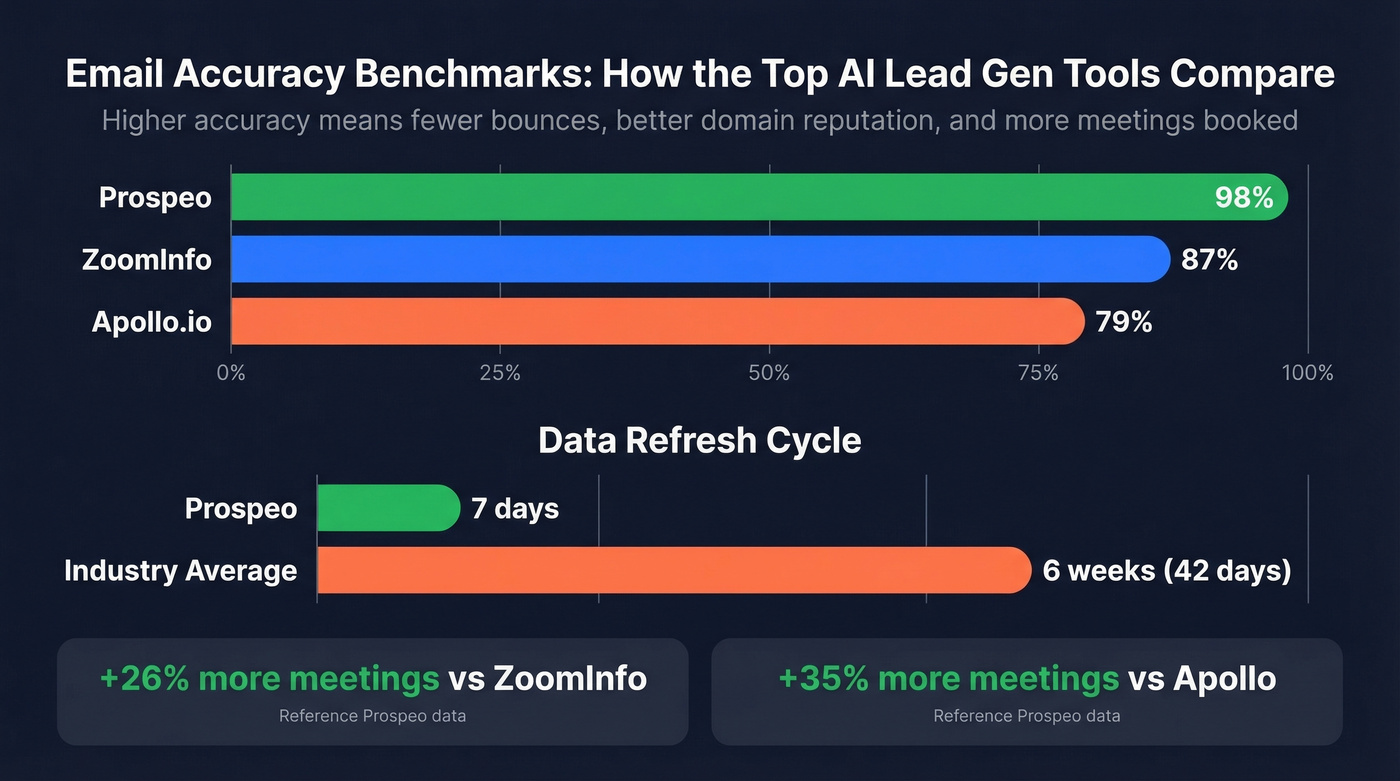
Prospeo's 300M+ professional profiles (from 800M+ collected records) and 143M+ verified emails run through a 5-step verification process with catch-all handling, spam-trap removal, and honeypot filtering. Email accuracy sits at 98%, compared to 87% for ZoomInfo and 79% for Apollo. The 125M+ verified mobile numbers deliver a 30% pickup rate - about 2.4x ZoomInfo's mobile pickup benchmark.

The 7-day data refresh cycle is the stat that matters most for outbound teams. Industry average is six weeks. That's the difference between reaching someone at their current company and bouncing off an inbox that doesn't exist anymore. The 30+ search filters include Bombora intent data across 15,000 topics, technographics, job changes, headcount growth, and funding signals - so you're building lists of people who are actually in-market, not just people who match a job title.
The bottom line: teams book 26% more meetings compared to ZoomInfo and 35% more compared to Apollo. Snyk's 50-person AE team cut bounce rates from 35-40% to under 5% after switching, and AE-sourced pipeline jumped 180%. Meritt tripled pipeline from $100K to $300K/week. The Chrome extension with 40K+ users lets you pull verified contact data from any website, web sources, or CRM without switching tabs.
Pricing: Free tier (75 emails/month + 100 Chrome extension credits/month), ~$0.01/email after that. No contracts, no sales calls, cancel anytime.
Apollo.io
Use this if you need a list built and sequences running by Friday.
Apollo's the default choice for teams that want speed over precision. The free tier includes 50 AI credits and up to 2 sequences, which is enough to test the waters. The UI is clean, the database covers 275M+ contacts, and you can go from zero to sending in under an hour.
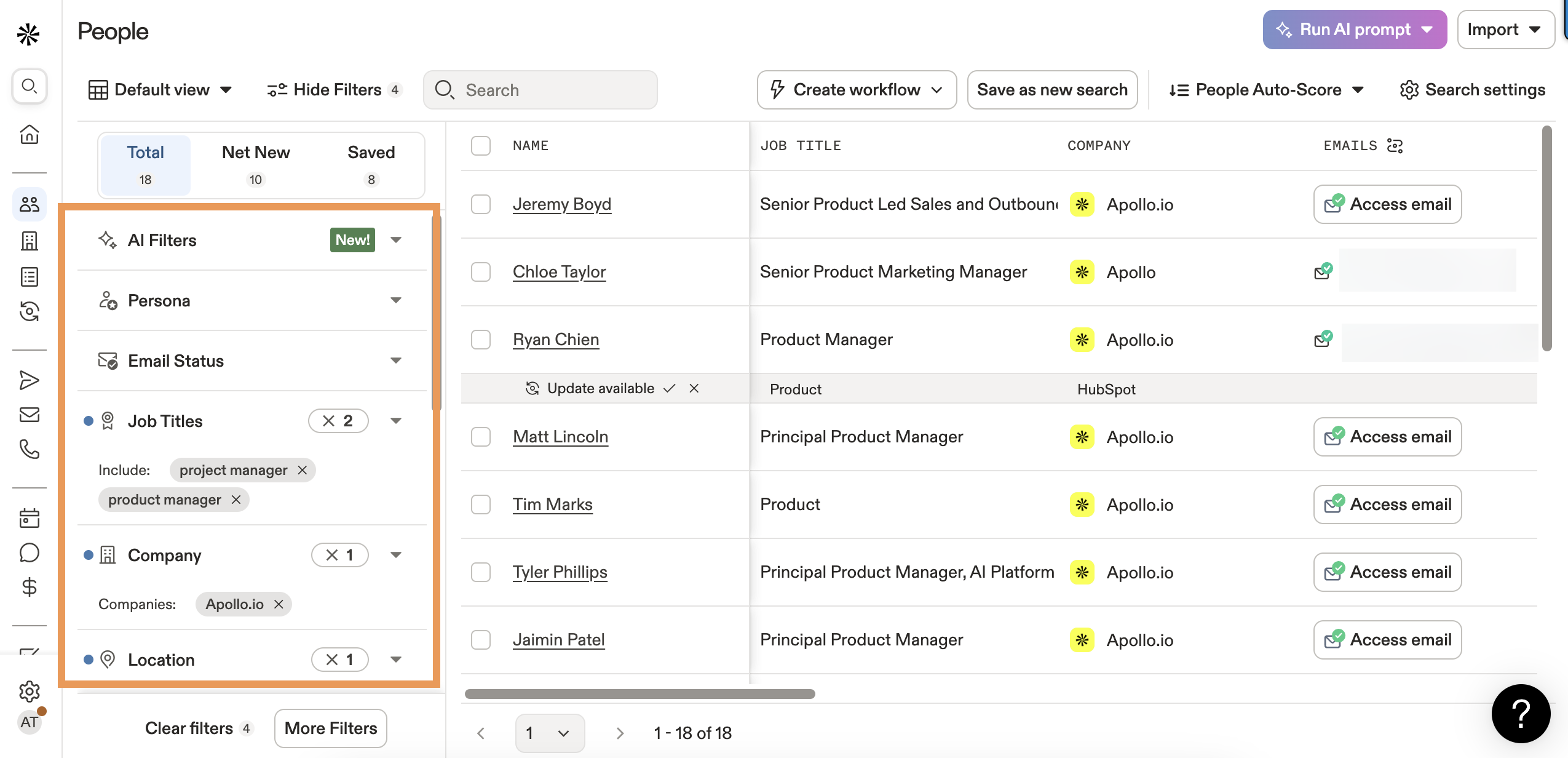
The practitioner consensus on Reddit is consistent: Apollo is the "default choice" for fast list-building, but "data wasn't great" in niche industries or smaller markets. That tracks with the 79% email accuracy benchmark - fine for volume plays, painful if you're running tight, targeted campaigns where every bounce hurts your domain reputation.
Skip this if you're selling into niche verticals where data quality matters more than coverage breadth.
Pricing: Free tier available. Basic from $49/mo, Professional from $79/mo, Organization from $119/mo with a minimum of 3 seats. Credits don't roll over.
Clay
Clay isn't a tool you hand to a junior SDR on day one. It's a power user's dream: 150+ enrichment providers chained together in sequences that practitioners describe as "LEGO pieces for data." Need to find Series B companies using Snowflake, with a new VP of Marketing who posted on a specific topic last month? Clay can build that list.
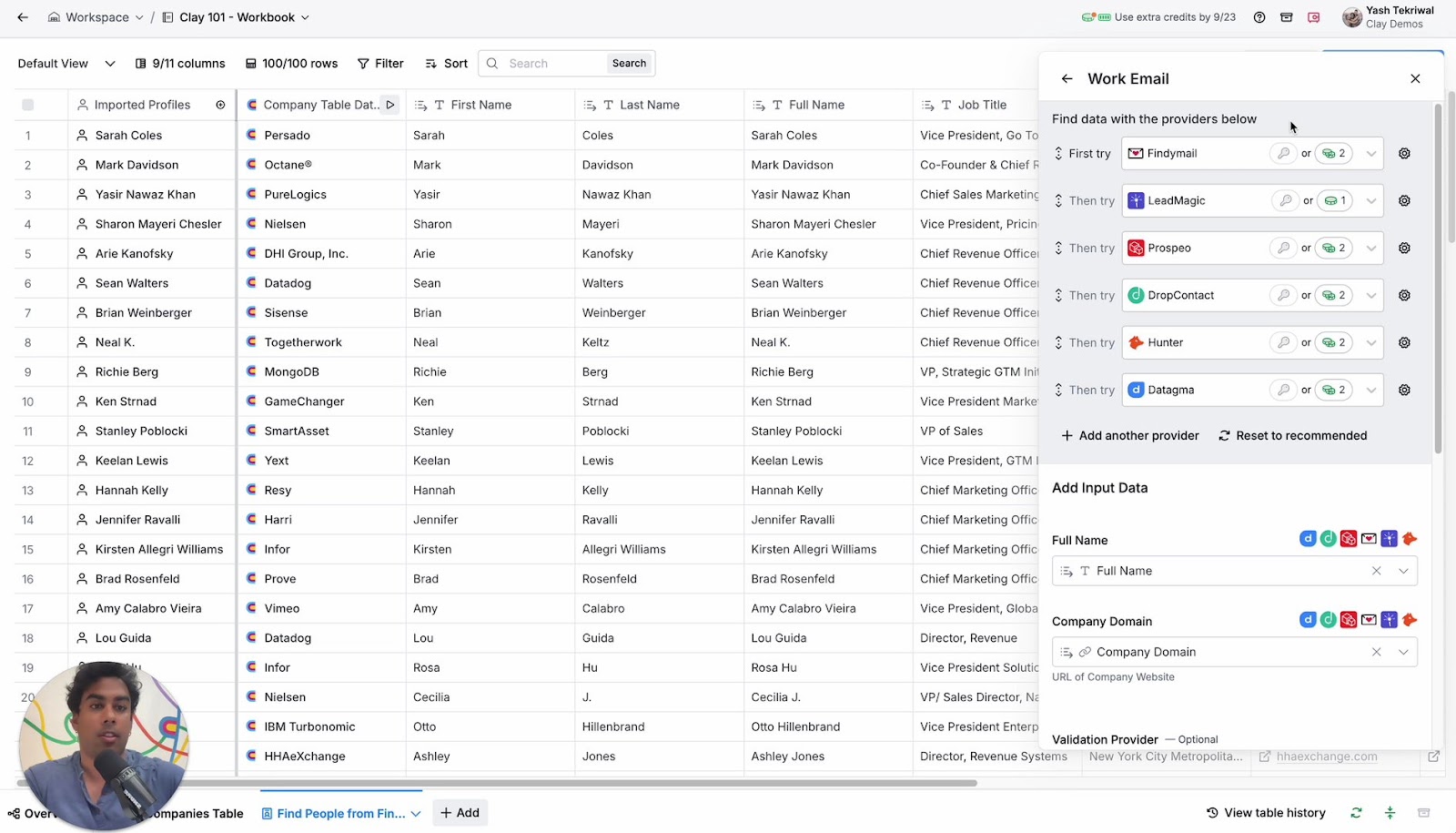
The pricing overhaul in early 2026 introduced a split between Data Credits for pulling data from providers and Actions for platform operations. The no-result-no-charge policy is genuinely useful - if an enrichment step returns nothing, you don't pay. Reddit users in r/sales consistently praise Clay's flexibility but warn about the learning curve: "incredible once you get it, frustrating until then."
Skip this if you want something that works out of the box. Clay rewards tinkering; it punishes impatience.
Pricing: Launch at $185/mo with 2,500 Data Credits and 15,000 Actions, Growth at $495/mo. Enterprise goes higher.
ZoomInfo
Look, ZoomInfo is one of the deepest US-focused databases on the market. 100M+ business profiles, 14M+ company records, intent data, technographics, and org charts - all in one platform. For mid-market and enterprise teams selling domestically, the breadth is hard to beat.
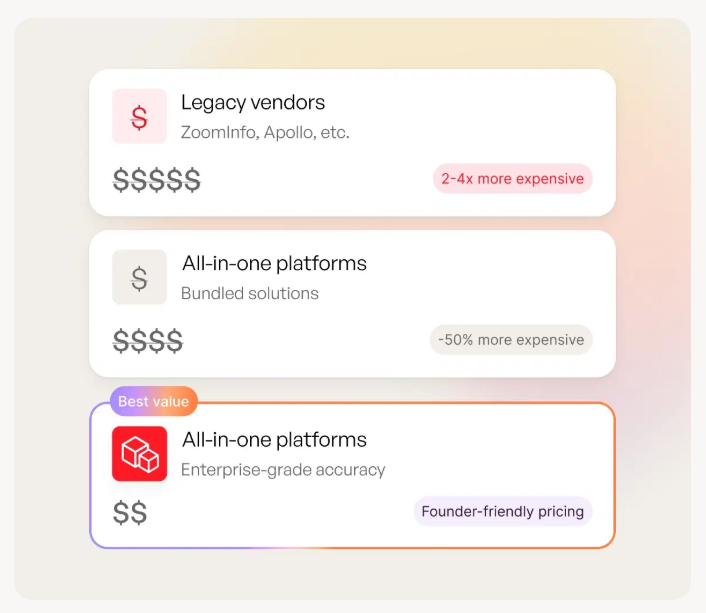
But that depth comes at a cost that makes most startups choke. The typical contract runs $15K-$45K+/year with annual commitments only, and expect 10-20% renewal uplifts. EMEA and APAC data is noticeably weaker. Email accuracy benchmarks at 87% - solid but not best-in-class.
If your average deal size is under $15K, you almost certainly don't need ZoomInfo-level infrastructure. We've seen teams running a $500/month stack outperform it for most outbound use cases.
Pricing: Starts ~$15K/year. Typical mid-market deals land $22K-$35K. Elite packages push past $45K.
6sense
Use this if you're running an ABM program and need account-level intent data at scale. 6sense analyzes 500B+ intent signals and its predictive models are strong for identifying accounts in active buying cycles. The free plan gives you 50 credits/month to test things out.
Skip this if your budget is under $50K/year or you need to execute outreach from the same platform. Median annual cost is $55,211 per Vendr data, with typical packages running $35K-$130K+ and enterprise packages $100K-$200K+. Implementation alone can cost $5K-$50K. And you'll still need separate tools for email, phone, and sequences.
Pricing: Free tier with 50 credits/mo. Paid plans typically $35K-$130K+/year. Enterprise $100K-$200K+.
Amplemarket
Use this if you want signals, enrichment, outreach, and deliverability management in a single platform. Amplemarket ties the full workflow together - from detecting buying signals to generating personalized sequences to managing inbox health. For teams looking to consolidate their prospecting stack, it's one of the more complete options available.
Skip this if you want something lightweight. Reddit practitioners in r/salestechniques note it's a "heavier" platform with a meaningful learning curve. It takes time to configure and prompt well. The payoff is there for teams that commit, but this isn't a quick-start tool.
Pricing: Custom pricing, typically mid-market range. Budget ~$1,500-$3,000/mo for a small team.
Seamless.AI
Seamless.AI finds contact data on the fly rather than pulling from a static database, which means coverage is strong for certain segments - particularly US-based tech companies. It's a quantity play, not a precision play.
User reviews are polarized. Some love the volume, others report variable accuracy. For teams that need high-volume prospecting and can tolerate some noise in the data, it works. For tight, targeted campaigns, you'll want something with better verification.
Pricing: Free tier available. Paid plans require a demo - expect ~$100-$200/mo per user based on community discussions.
Instantly
Primarily a cold email sending platform, not a data provider. The lead finder add-on is separate from the core sending product. Best paired with a dedicated data tool for the actual contact data. Starts around ~$30/mo for sending infrastructure.
Lusha
Quick phone number lookups and basic contact enrichment. Free tier gives 5 credits/month, Pro runs ~$49/mo. Practitioners call it "hit or miss depending on region." Think of Lusha as a utility for spot-checking numbers, not a full prospecting platform.

Signal-based selling only works when the data behind it is fresh. Prospeo refreshes 300M+ profiles every 7 days - not every 6 weeks like the industry average. Layer Bombora intent data across 15,000 topics with technographics, job changes, and headcount growth to build lists of buyers who are actually in-market.
Stop generating leads that bounce. Start generating pipeline.
Teams using Prospeo book 26% more meetings than ZoomInfo and 35% more than Apollo - at $0.01/email instead of $1. Snyk's 50 AEs cut bounce rates from 35% to under 5% and grew AE-sourced pipeline 180%. That's what 98% email accuracy and 125M+ verified mobiles do to your outbound math.
Get enterprise-grade AI lead generation data without the enterprise contract.
Pricing Comparison
| Tool | Starting Price | Free Tier? | Terms | Best For |
|---|---|---|---|---|
| Prospeo | ~$0.01/email | Yes (75 emails/mo) | No contract, cancel anytime | Email accuracy |
| Apollo.io | $49/mo | Yes (50 credits) | No contract, credits expire monthly | Fast list-building |
| Clay | $185/mo | No | No contract, credits expire monthly | Custom enrichment |
| ZoomInfo | ~$15K/yr | No | Annual only, 10-20% renewal uplift | US enterprise data |
| 6sense | ~$35K-$55K/yr | Yes (50/mo) | 12-24 month commitment | ABM intent data |
| Amplemarket | ~$1.5K/mo | No | Varies by deal | All-in-one outbound |
| Seamless.AI | ~$100/mo | Yes | Varies by plan | High-volume search |
| Instantly | ~$30/mo | No | No contract | Cold email sending |
| Lusha | ~$49/mo | Yes (5/mo) | No contract | Phone lookups |
Which Stack to Build by Budget
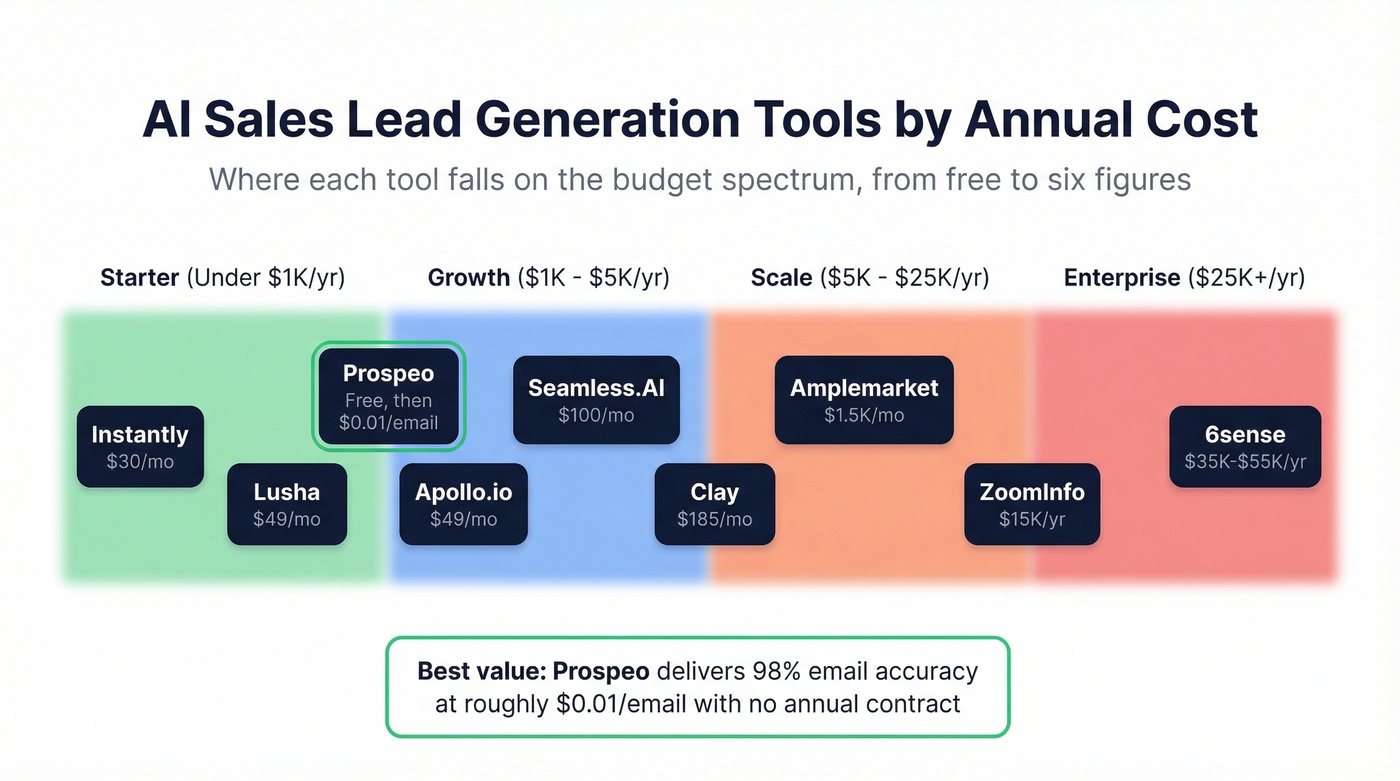
Not every team needs a $50K/year platform. Here's what we'd recommend at each level, anchored against that $139K/year SDR cost - even a $500/mo stack that saves 10 hours of SDR time per week pays for itself in weeks.
$0-$100/month: Start with free tiers from Prospeo and Apollo. You get verified emails and broad list-building - enough to validate outbound before spending a dollar. This is the lowest-risk way to test AI-driven prospecting before committing budget.
~$500/month: Pair a paid data plan with Instantly for sending. Clean data feeding a dedicated cold email engine. This is the sweet spot for founders and two-person sales teams, and it's where most early-stage companies should start.
~$2,000/month: Add Clay to the mix. Clay handles complex enrichment workflows, your verified data layer catches what Clay misses, and Instantly executes sequences. Serious outbound infrastructure without enterprise pricing.
$5,000+/month: You're competing with teams spending $40K+ on ZoomInfo - at a fraction of the cost. Layer in Amplemarket for full-cycle signal detection and execution, or run a full Clay stack with multiple enrichment chains. At this level, the ROI math is obvious.
Mistakes That Kill Your ROI
1. Using unverified data. If your bounce rate is above 5%, you don't have an outreach problem - you have a data provider problem. Snyk's bounce rate dropped from 35-40% to under 5% after switching providers. Your data foundation matters more than your copy, your sequences, or your subject lines.
2. Ignoring GDPR and CCPA. Compliance isn't optional, and the fines aren't theoretical anymore. Make sure your data provider has opt-out enforcement and DPAs available before you import a single contact.
3. Over-automating outreach. AI can write and send 10,000 emails a day. That doesn't mean it should. Spam filters are smarter than ever, and businesses using AI for lead generation report 50% more sales-ready leads only when they pair automation with human oversight on messaging quality. It now takes an average of 18 touches to book a meeting - blasting generic volume won't get you there.
4. Not integrating with your CRM. If enriched contacts don't flow into Salesforce or HubSpot automatically, your reps will ignore the tool within a month. Check native integrations before you buy.
5. Chasing quantity over quality. A list of 50,000 unqualified contacts is worth less than 500 signal-qualified ones. The tools that surface intent signals and job changes will outperform the ones that just give you more names.
FAQ
What is AI sales lead generation?
AI sales lead generation uses machine learning to identify, enrich, and prioritize potential buyers based on signals like intent data, job changes, and technographic fit. Instead of manually building lists, these tools surface prospects who are actively in-market and personalize outreach at scale.
How much do AI lead gen tools cost?
Costs range from free to $100K+/year for enterprise platforms. Most mid-market teams spend $200-$2,000/month on their prospecting stack. The key variable is whether you're paying per seat, per credit, or per verified contact.
Which tool has the most accurate email data?
Prospeo leads with 98% verified email accuracy, compared to 87% for ZoomInfo and 79% for Apollo. Accuracy matters because every bounced email damages your sender reputation - once your domain is flagged, even good emails stop landing.
Can AI fully replace SDRs?
Not yet. AI handles research, list building, enrichment, and initial sequencing extremely well - roughly 70% of the grunt work. But complex deal navigation and relationship building still require humans. The winning model is AI freeing SDRs to spend time on conversations, not data entry.
How do I keep bounce rates under 3%?
Start with a data provider that verifies emails before you send - not after. Look for catch-all domain verification, spam-trap removal, and refresh cycles under 30 days. A 7-day refresh cycle catches job changes and email deactivations before they become bounces.