

How to Build an ABM Audience That Actually Converts
71.2% of B2B organizations run some form of ABM. Benchmarks show outsized lifts in engagement and deal size when it's executed well. Yet most ABM audience lists are static exports someone pulled from the CRM six months ago and never touched again.
That gap between adoption and execution is where pipeline goes to die.
What You Need (Quick Version)
Three things: an evidence-based ICP with firmographic, technographic, and intent criteria; a tiered target account list sized backwards from your revenue goal; and verified contact data for 3-5 buying committee members per account. Most programs fail because they stop at step one and never refresh the list.
What an ABM Audience Actually Is
"Isn't ABM just detailed targeting?" Fair question, wrong conclusion.
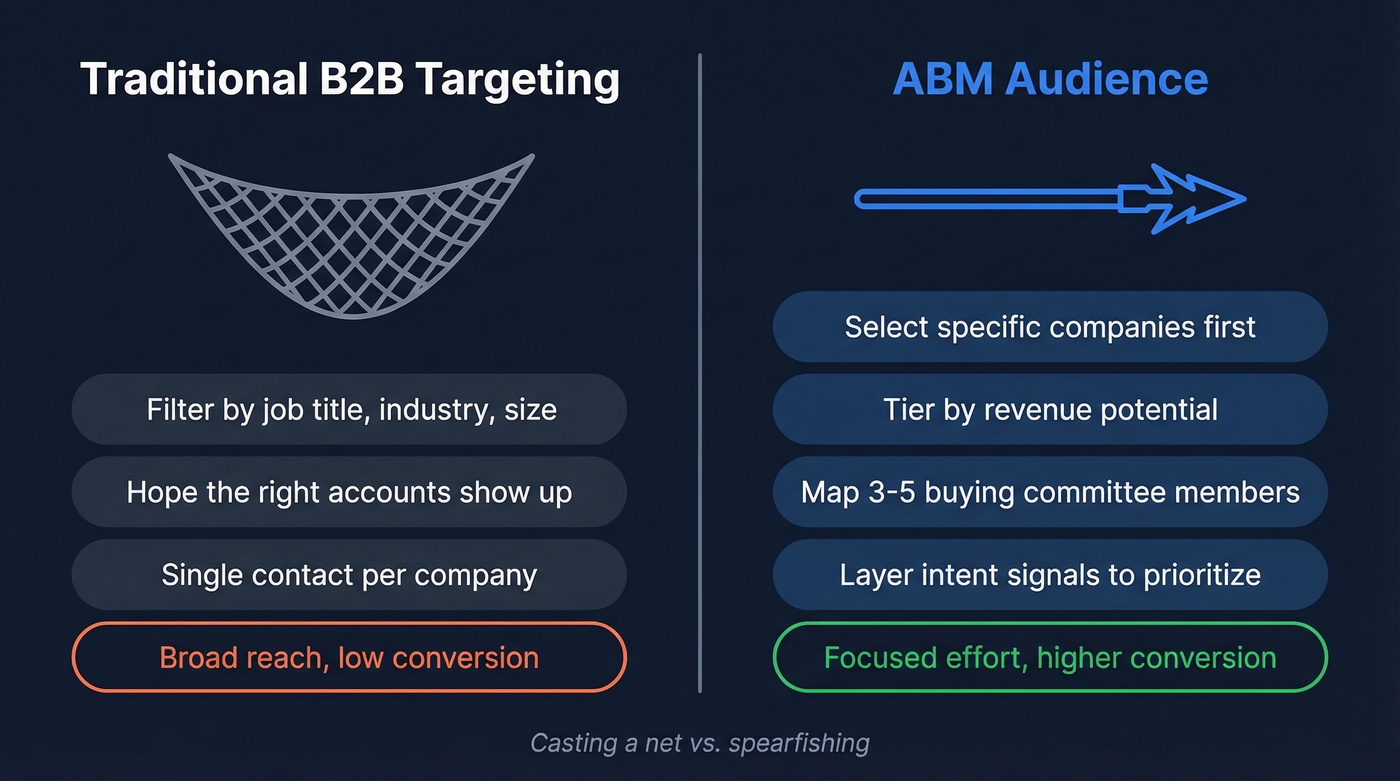
Regular B2B targeting filters by persona traits - job title, industry, company size - and hopes the right accounts show up. Account-based audiences flip that entirely. You select specific companies first, tier them by revenue potential, then map the buying committee inside each one. You layer intent signals to prioritize who's actually in-market and orchestrate outreach to multiple stakeholders at once.
It's the difference between casting a net and spearfishing.
How to Build Your ABM Audience
Define Your ICP With Data
Data beats intuition. Analyze your best closed-won deals and look for patterns across four dimensions:
- Firmographics - industry, employee count, revenue range, geography
- Technographics - tech stack signals (what they use, what they've recently added or dropped)
- Behavioral signals - site visits, content engagement, email engagement
- Intent signals - active research on topics your product solves
Score accounts on model fit, behavior, intent, and needs. The ICP isn't a persona doc living in a slide deck - it's a scoring model living in your CRM.
Go beyond your own data, too. Mine competitors' customer lists using tools like Enlyft or HG Insights. Set up job alerts for roles your product supports - a company hiring three "Revenue Operations Managers" is signaling a problem you might solve. We've found these creative sourcing tactics surface accounts competitors miss entirely, and they cost nothing but time.
If you need a starting point, use an ICP template and turn it into a scoring rubric.
Size Your Target Account List
Work backwards from your revenue goal:
Opportunities Needed = Revenue Goal / (Average Deal Size x Close Rate)
Targeting $2M in new revenue with a $50K average deal size and a 25% close rate? That's 160 opportunities. If 20% of engaged accounts convert to opportunities, you need 800 engaged accounts. If 10% of your target list becomes engaged, you need roughly 1,600 target accounts across all tiers.
Budget check: at a cost per engaged account of ~$70, 1,600 engaged accounts runs about $112K in campaign spend - before platform costs.
If you're trying to operationalize this, it helps to automate target account lists so the math stays tied to real conversion rates.
Tier Your Accounts
Not every account deserves the same investment.
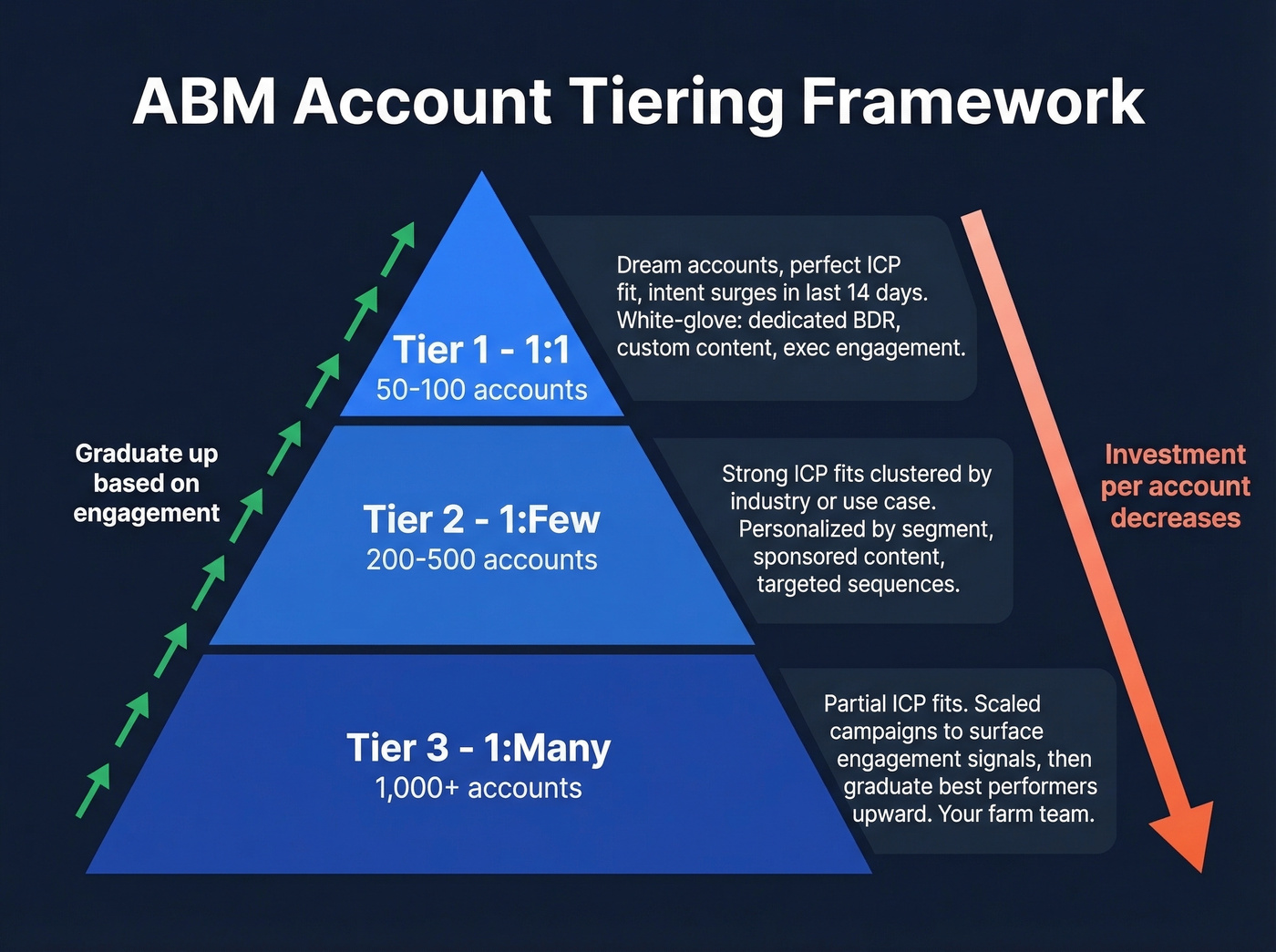
Tier 1 (1:1) - Dream accounts. Perfect ICP fit, highest deal potential, showing intent surges in the last 14 days. White-glove treatment: dedicated BDR outreach, custom content, executive engagement. Keep this list tight - 50 to 100 accounts max.
Tier 2 (1:Few) - Strong ICP fits clustered by industry or use case. Personalized by segment, not by individual account. Sponsored content and targeted sequences grouped by vertical.
Tier 3 (1:Many) - Partial ICP fits. Run scaled campaigns to surface engagement signals, then graduate the best performers upward. This is your farm team.
Layer Intent Signals
Intent data turns a static list into a living prioritization engine.
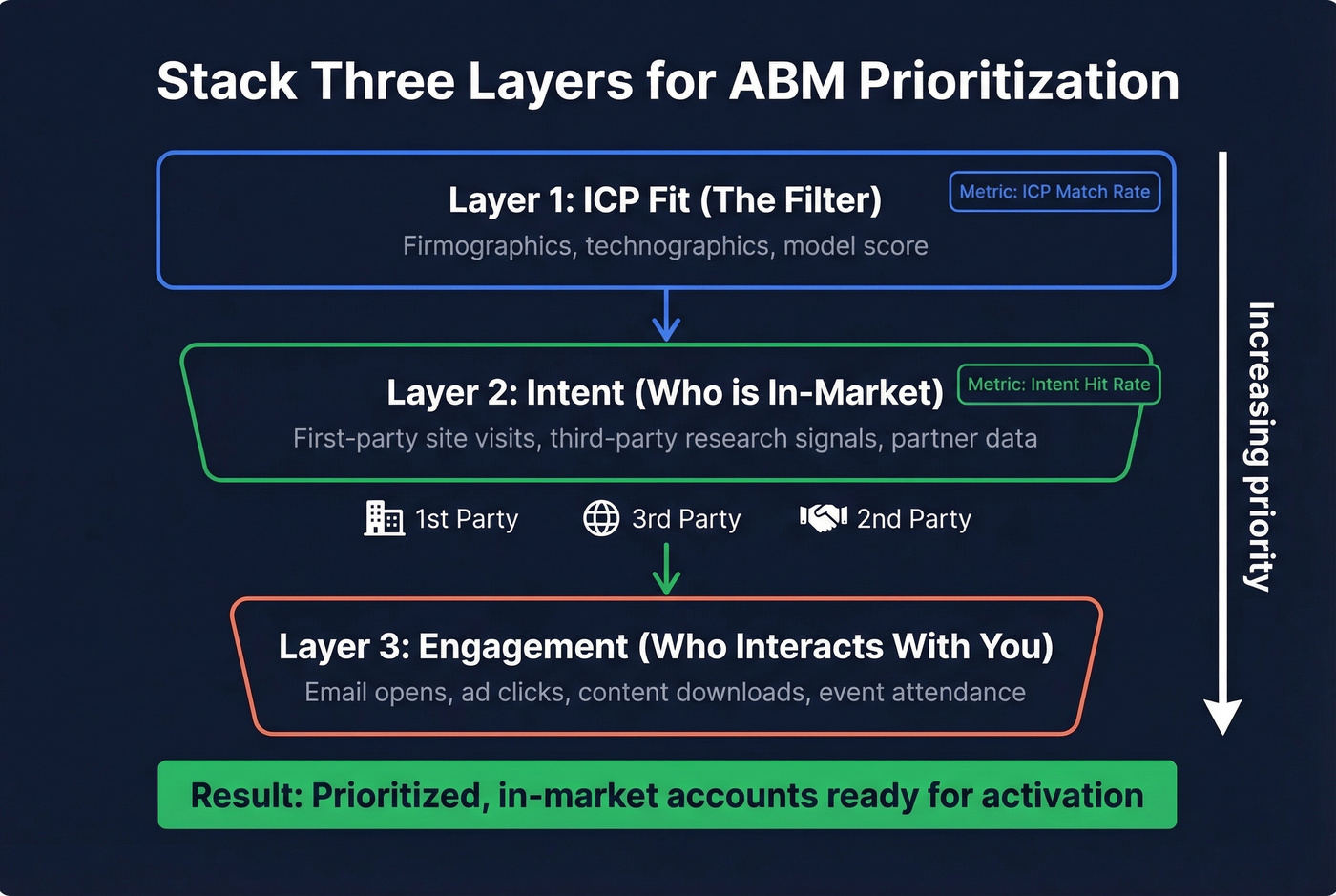
First-party intent comes from your own properties - site visits, email engagement, product usage. Third-party intent tracks research activity across publisher networks; Bombora, 6sense, and G2 are the big providers. Second-party intent is partner-shared first-party data, increasingly exchanged via clean rooms.
One distinction worth understanding: account-level intent tells you "someone at Company X is researching topic Y," while contact-level intent pins that activity to a specific person. Account-level is better for prioritization. Contact-level is better for sales personalization.
Stack three layers for prioritization: ICP fit first (the filter), intent second (who's in-market), engagement third (who's interacting with your brand). Track two operational metrics religiously - ICP Match Rate (percentage of your TAL meeting ICP criteria) and Intent Hit Rate (percentage above your intent threshold in the last 30 days).
If you want a cleaner way to operationalize this, build an intent based segmentation model that updates weekly.

Your ABM audience is only as good as the contact data behind it. Prospeo gives you 300M+ profiles with 98% email accuracy and 125M+ verified mobiles - all refreshed every 7 days, not every 6 weeks. Layer 30+ filters including buyer intent, technographics, and headcount growth to build tiered account lists that match your ICP scoring model.
Stop running ABM campaigns to stale data that bounces.
Map the Buying Committee
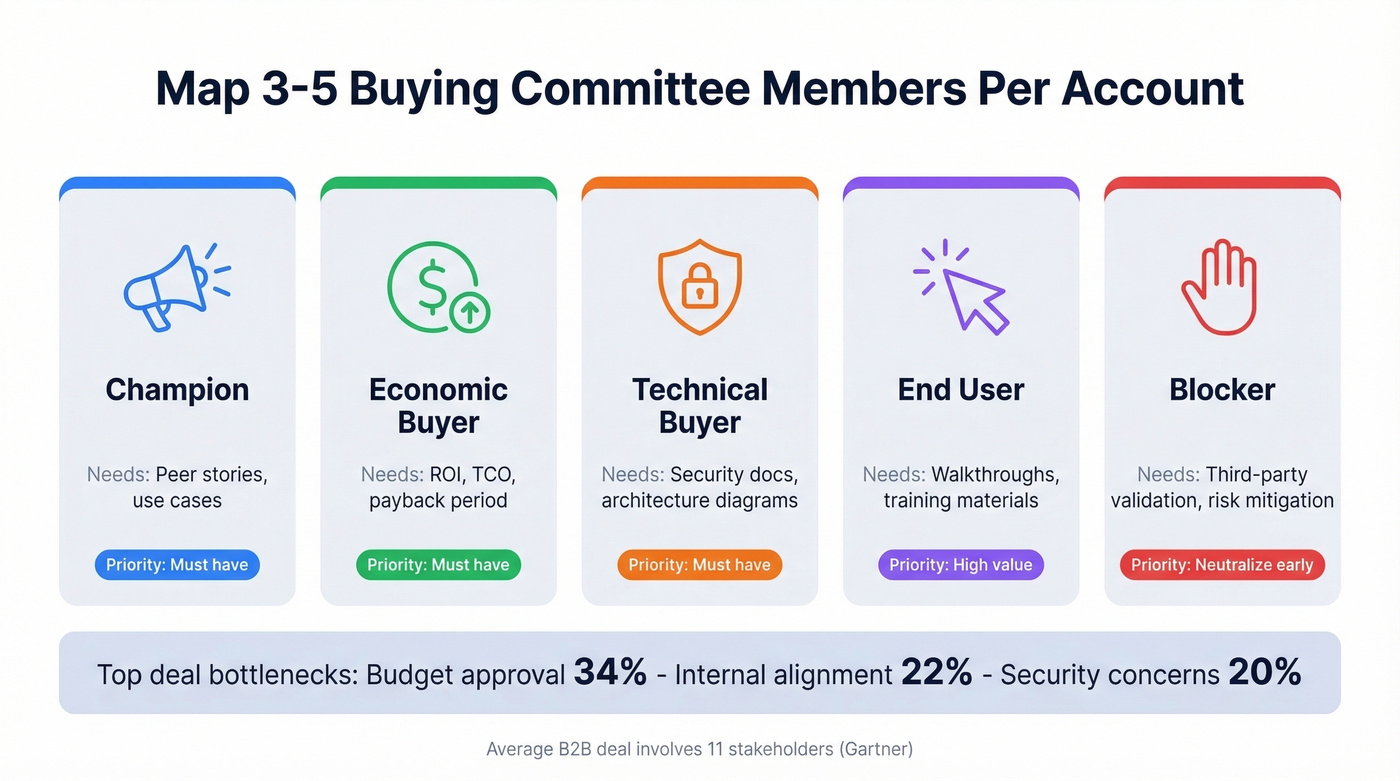
Gartner research shows average B2B deals involve 11 stakeholders. Salesforce data puts it at 5-7 content assets consumed per stakeholder before they'll talk to sales. You can't run account-based marketing to a single contact per account and expect results.
An Influ2 survey of enterprise and mid-market buyers found that 50% of buying groups are 2-4 people, 42% are 5-9, and groups of 10+ only appear at companies with 1,000+ employees. Influence splits roughly evenly: 32% say a senior leader's opinion carries the most weight, 32% say it's a group decision, and 16% point to end users.
Here are the five roles you need to map:
| Role | What They Need |
|---|---|
| Champion | Peer stories, use cases |
| Economic Buyer | ROI, TCO, payback |
| Technical Buyer | Security docs, architecture |
| End User | Walkthroughs, training |
| Blocker | Third-party validation |
Top deal bottlenecks? Budget approval (34%), internal alignment (22%), and security concerns (20%). If you're not reaching the economic buyer and the technical buyer early, you're setting up a stall at the finish line.
Identify 3-5 contacts per account before you launch any outreach. Minimum: champion, economic buyer, and technical buyer. I've watched teams burn entire quarters running campaigns to a single champion who couldn't get budget sign-off - multithreading isn't optional. Prospeo's database covers 300M+ professional profiles with 98% email accuracy and 125M+ verified mobile numbers on a 7-day refresh cycle, which means the VP of Engineering you found last Tuesday still has a valid email this Tuesday.
If you want a tighter framework for stakeholder coverage, map roles like technical buyer vs economic buyer before you write sequences.

Activate Across Channels
Your tier determines your channel mix.
Tier 1 accounts get personalized outreach and direct dials - this is where verified mobile numbers earn their keep. Tier 2 runs on matched audiences, sponsored content, and message ads. Tier 3 gets programmatic display and connected TV, designed to surface engagement signals that justify promotion to a higher tier.
On the technical side, retargeting lets you re-engage accounts that visited your site but didn't convert. Dynamic ads can personalize creative using recipient profile attributes. The 2026 trend worth watching: 78.7% of ABM programs now incorporate AI-driven predictive targeting, using behavioral and contextual signals that work in cookieless environments. These digital engagement tactics work best when coordinated across tiers rather than run in isolation.
Here's the thing, though: the activation bottleneck is almost always contact data quality. The best channel strategy in the world fails if your emails bounce or your mobile numbers connect to the wrong person.
If email is a core channel, make sure your email deliverability fundamentals are solid before you scale.
ABM Tools and What They Cost
A full ABM stack can run $50K-$150K/year before ad spend. Here's what the major platforms charge:
| Platform | Annual Cost | Best For |
|---|---|---|
| Prospeo | Free tier; ~$0.01/email | Contact data + intent signals |
| RollWorks | $12K-$50K | Mid-market entry |
| Terminus | $18K-$87K | Multi-channel ABM ads |
| Demandbase | $24K-$300K+ | Account ID + advertising |
| HubSpot ABM | ~$43,200 | HubSpot-native teams |
| 6sense | $60K-$300K+ | Predictive + intent |
| Intent add-ons | $15K-$40K | Layer on any platform |
6sense is the strongest on predictive analytics but can take 3+ months to implement. Demandbase leads on advertising and account identification. RollWorks is the most accessible mid-market option, using Bombora and G2 for intent signals. Hidden costs - implementation, ad spend, enrichment tools - can double your total investment.
Let's be honest: most teams under $5M ARR don't need a six-figure ABM platform. A CRM, an intent signal source, and a contact data tool with weekly refresh get you 80% of the way there. Layer the enterprise platform later when pipeline justifies the spend. Skip the big platforms entirely if your TAL is under 500 accounts and your team doesn't have a dedicated ABM operator to run the system.
If you're evaluating vendors, start with a shortlist of ABM tools and compare based on your channel mix.
Mistakes That Kill Your ABM Audience
The fastest way to kill an ABM program is to treat the target account list as a one-time deliverable. Accounts change, people change jobs, intent windows close. We've seen teams run campaigns for months against contacts who left the company in week two. If you're not refreshing your list monthly and reviewing tier assignments quarterly, you're not doing ABM - you're doing expensive display advertising.
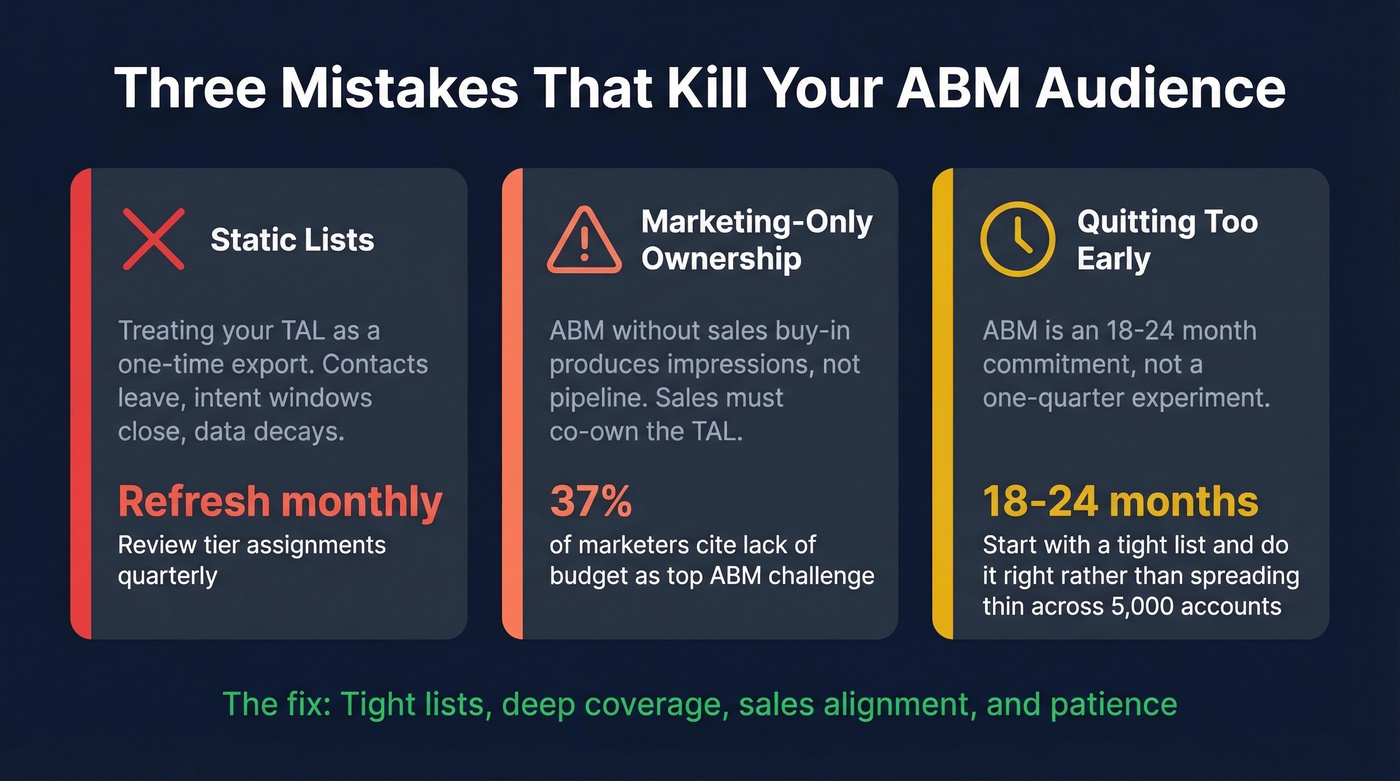
The second killer is marketing-only ownership. ABM without sales buy-in produces impressions, not pipeline. Sales needs to co-own the TAL, agree on tier definitions, and commit to working Tier 1 accounts with personalized outreach. Without that alignment, 37% of marketers cite lack of budget and resources as their top challenge - and it's usually because leadership never saw pipeline results worth funding.
ABM is an 18-24 month commitment, not a one-quarter experiment. If your team can't commit to that timeline, start with a smaller TAL and do it right rather than spreading thin across 5,000 accounts you'll never properly work. The consensus on r/sales backs this up - the threads that celebrate ABM wins almost always describe tight lists with deep coverage, not massive lists with shallow outreach.
If you're seeing misalignment, treat it like a sales pipeline challenge to fix operationally, not a messaging problem.
Multithreading 3-5 buying committee members per account requires verified contact data at scale. Prospeo's database lets you filter by job title, department, and seniority to map champions, economic buyers, and technical buyers - with direct dials that hit a 30% pickup rate. At $0.01 per email, covering 1,600 target accounts costs less than your morning coffee budget.
Find every stakeholder in the deal before your competitor does.
FAQ
How many accounts should be in an ABM audience?
Work backwards from your revenue goal. Divide target revenue by average deal size and close rate to get opportunities needed, then map upstream conversion rates. A $2M target with $50K deals and a 25% close rate typically requires around 1,600 target accounts across all tiers - 50-100 in Tier 1, several hundred in Tier 2, and the rest in Tier 3.
What's the difference between ABM and regular B2B targeting?
Regular targeting filters by persona traits and hopes the right accounts appear. An ABM audience starts with specific companies, tiers them by value, maps buying committees, layers intent signals, and orchestrates multi-channel outreach to multiple stakeholders. The unit of analysis is the account, not the individual - and that shift drives measurably higher engagement and deal sizes.
Do I need an expensive platform to start?
No. A CRM, an intent signal source, and a verified contact data tool get you 80% of the way. Prospeo's free tier includes 75 verified emails per month plus intent data across 15,000 topics - enough to pilot a Tier 1 program of 50 accounts before committing to enterprise spend.
How do I measure ABM audience performance?
Track engagement at each tier: Tier 1 should show multi-threaded conversations with buying committee members, Tier 2 should generate qualified meetings by segment, and Tier 3 should surface accounts ready for promotion. Key metrics include ICP Match Rate, Intent Hit Rate, accounts progressing through pipeline stages, and influenced revenue per account.