

Free Email List Validation: 10 Tools Compared (2026)
You exported 10,000 contacts last quarter. By now, roughly 2,300 of those emails are dead. Email lists decay about 23% per year, and the global inbox placement rate sits at just ~83.5%. Over on r/Emailmarketing, the consensus is that verification pricing is "a scam" - $25-75 just to clean a 10k list. Free email list validation tools exist for exactly this reason. The real question is whether they can actually handle the job.
Quick Recommendations
- MillionVerifier - 500 free credits. Best pure-value play for bulk lists, with paid pricing around $2-4 per 1,000.
- ZeroBounce - 98.8% observed accuracy in independent testing, 100 free credits/month. Best when accuracy is non-negotiable.
- Emailable - 250 free credits and 98.7% observed accuracy. Underrated.
- Skip validation entirely - if your data source is the problem, Prospeo gives you 75 pre-verified emails/month free at 98% accuracy with a 7-day refresh. Prevention beats cure.
How Free Email Validation Works
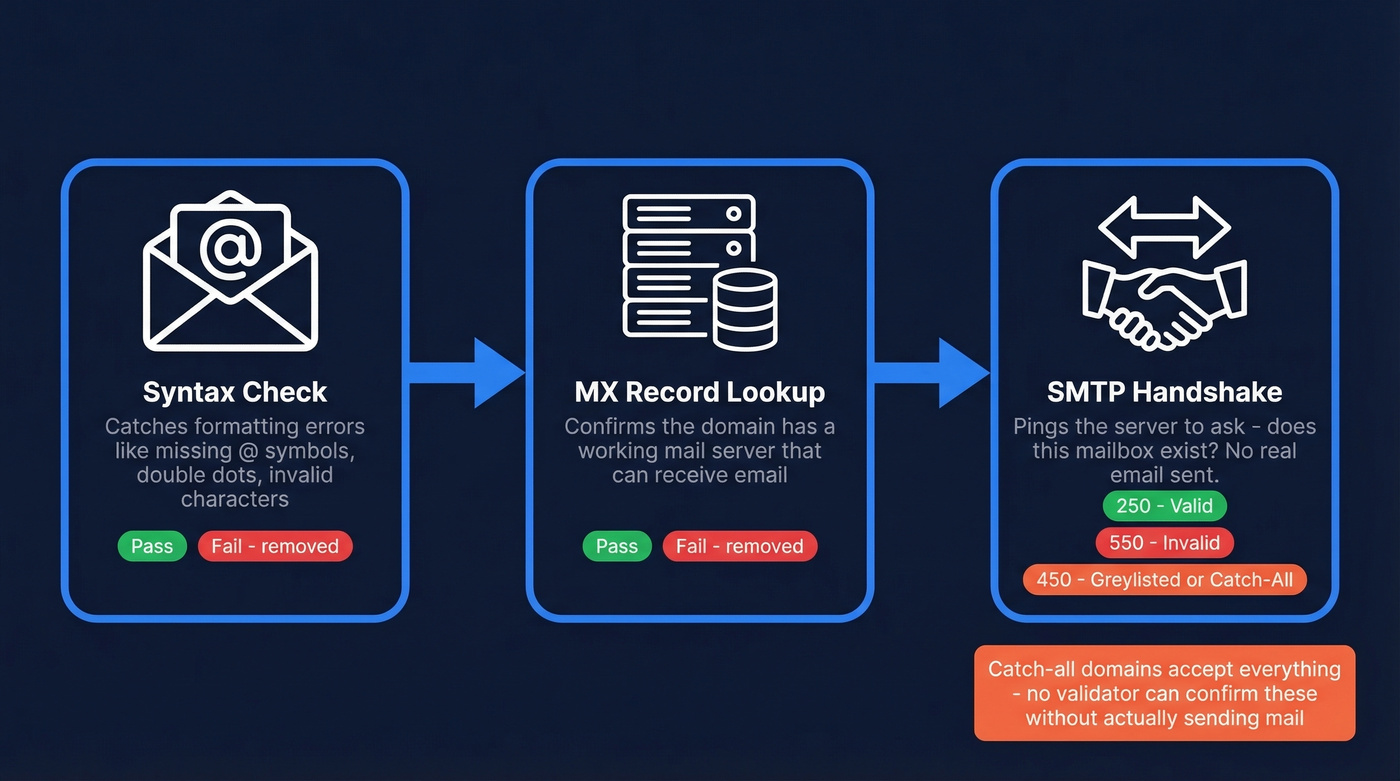
Every verification tool runs the same basic pipeline. First, a syntax check catches obvious formatting errors like missing @ symbols or double dots. Then an MX record lookup confirms the domain actually has a mail server. Finally, an SMTP handshake pings the server to ask "does this mailbox exist?" without sending a real email - the server responds with a status code where SMTP 250 means accepted, 550 means invalid, and 450 means temporary failure from greylisting.
Technically, "validation" checks formatting while "verification" confirms the mailbox exists. In practice, every tool in this list does both.
Some vendors advertise "30+ verification steps," but those are sub-checks within each phase - useful, not revolutionary. The tricky part is catch-all domains. These accept every recipient, so the SMTP handshake returns a success code whether the mailbox is real or not. Over 9% of all emails verified in 2025 were catch-all. No validator can definitively confirm those addresses without actually sending mail and watching for bounces.
10 Free Validation Tools Compared
Here's how they stack up. We pulled data from Warmup Inbox's 10,000-contact test, EmailTooltester's side-by-side checks, and published pricing pages.
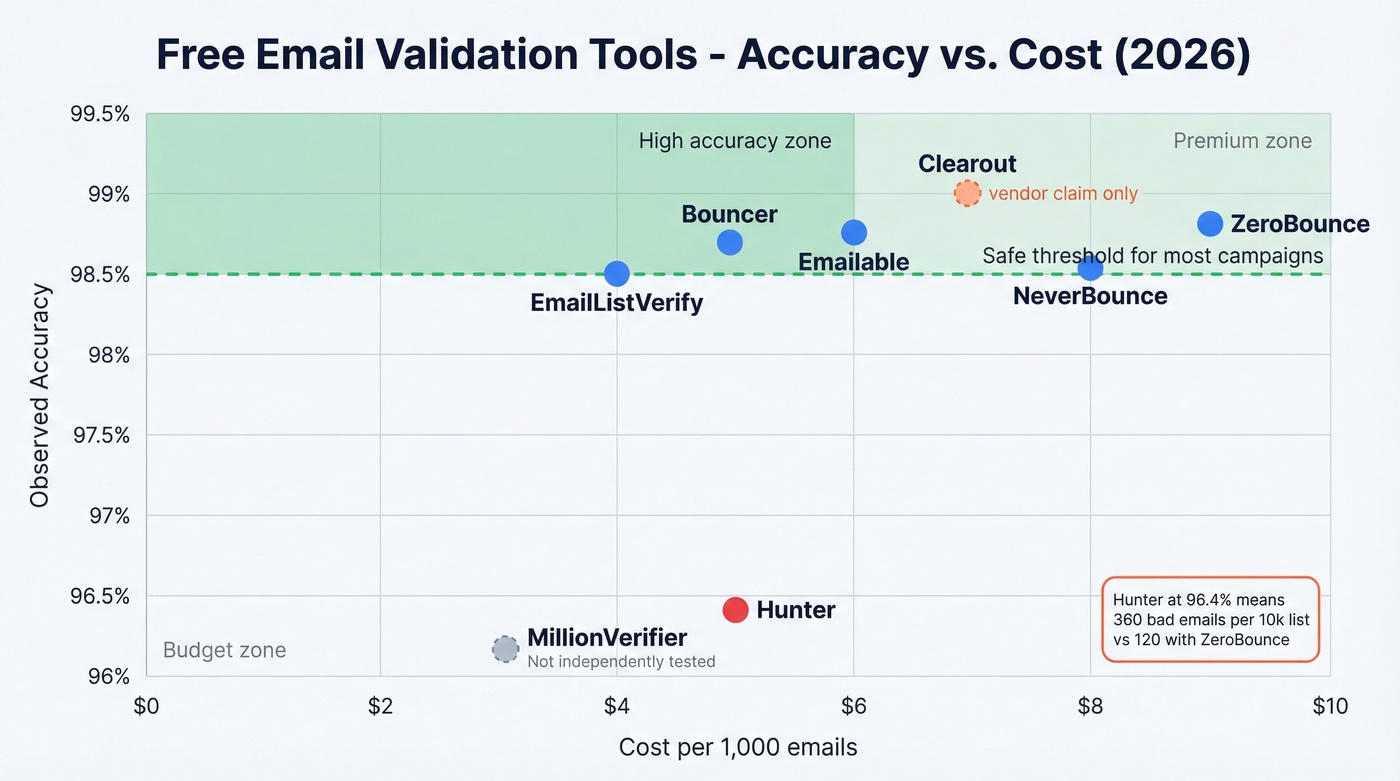
Accuracy & Pricing
| Tool | Free Credits | PAYG/1,000 | Observed Accuracy | Best For |
|---|---|---|---|---|
| MillionVerifier | 500 | ~$2-4 | Not independently tested | Free volume |
| ZeroBounce | 100/mo | $9-10 | 98.8% | Accuracy + compliance |
| Emailable | 250 | $6 | 98.7% | Solid all-rounder |
| NeverBounce | 10 | $8 | 98.6% | Bounce guarantee |
| EmailListVerify | 100 | $4 | 98.5% | Budget PAYG |
| Bouncer | 100 | $4-7 | 98.9% | Highest accuracy |
| Clearout | 100 | $7 | 99% (vendor claim) | ISO 27001 compliance |
| Verifalia | ~25/day | $7.90 | Not independently tested | Daily drip checks |
| Hunter | ~100/mo plan | ~$49/mo plan | 96.4% | Prospecting bundle |
| Email Hippo | 100/day | Not public | Not independently tested | Single checks |
Speed (10k list)
| Tool | Processing Time | Catch-All Handling |
|---|---|---|
| NeverBounce | ~3 min | Flags as "accept-all" |
| Emailable | ~3 min | Flags unknown/catch-all |
| Bouncer | ~7 min | Flags with confidence score |
| ZeroBounce | ~10 min | Flags + scoring |
| Others | Varies | Basic flagging |
A few things jump out. MillionVerifier's free tier is more generous than anything else on this list. EmailListVerify is one of the cheapest PAYG options at $4/1,000. And Hunter's 96.4% accuracy is a meaningful gap - on a 10k list, that's 360 bad emails slipping through versus ~120 with ZeroBounce. If you're running validation before a time-sensitive campaign, the difference between 3 minutes and 10 minutes adds up across multiple lists too.
If you're also building lists (not just cleaning them), start with these free lead generation tools and a tighter lead generation workflow so you’re not constantly fixing upstream issues.
The Best Free Options (Detailed)
MillionVerifier - Most Free Credits
Use this if you need the most free credits possible and plan to scale into low-cost bulk pricing. 500 free credits is enough to test a real segment, not just kick the tires.
Skip this if you need monthly recurring free credits or enterprise compliance certifications. MillionVerifier wasn't included in the major independent accuracy bake-offs we've seen, so we can't vouch for accuracy the way we can for ZeroBounce or Bouncer. That said, for pure volume at the lowest cost, it's hard to beat. We've used it for initial list hygiene passes before running high-value segments through a more accurate tool - a two-pass approach that keeps costs down without sacrificing deliverability where it matters.
ZeroBounce - Best Accuracy
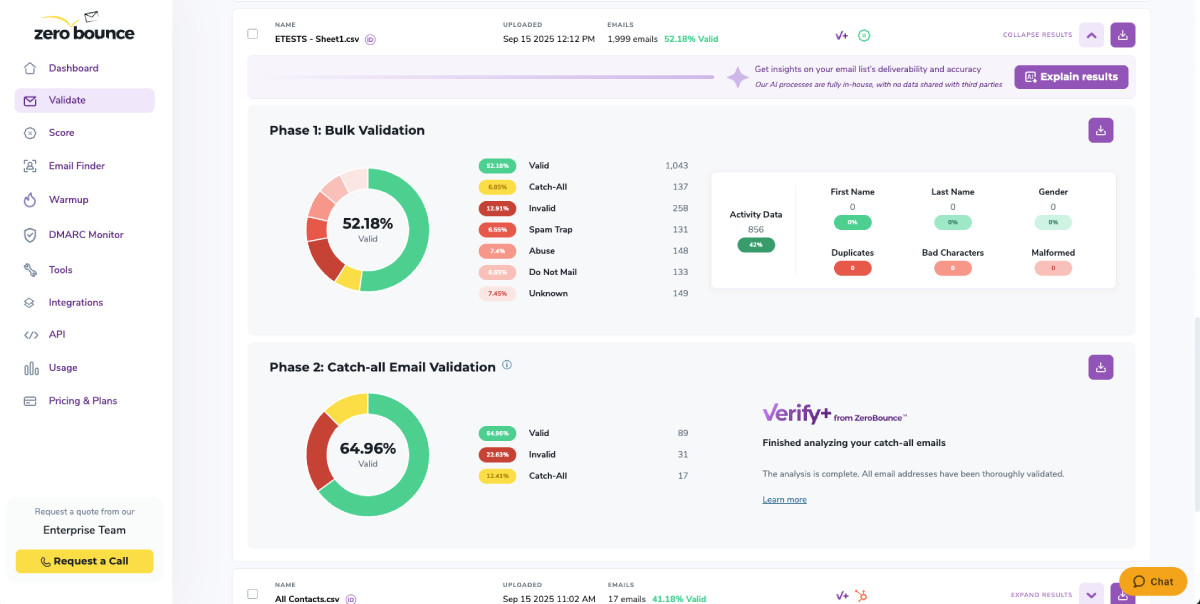
ZeroBounce is a compliance leader: SOC 2 Type 2, ISO 27001, HIPAA, with automatic data deletion after 30 days. In the Warmup Inbox test, it hit 98.8% observed accuracy on a 10,000-contact list - independently measured, not a vendor claim.
The trade-off is cost. The 100 free credits/month work for ongoing maintenance, but paid pricing runs about $9-10 per 1,000 - several times more than budget options. If you're in healthcare, finance, or any regulated industry, the premium is worth it. Everyone else should look at the budget tier first.
If you’re troubleshooting deliverability beyond list quality, use an email deliverability guide and track your email bounce rate by code and provider.
NeverBounce - Fastest Processing
NeverBounce processed 10k emails in roughly 3 minutes and offers a money-back guarantee if your bounce rate exceeds 3% on paid plans. That guarantee is genuinely useful for agencies managing client domains where a single bad send can torch a relationship.
Here's the thing: ten free credits is barely a test. You'll hit the paywall immediately. At ~$8/1,000, paid pricing is mid-range. Use NeverBounce when deliverability stakes are high enough to justify the bounce guarantee, and a cheaper tool for everything else.
EmailListVerify - Budget Pick
At $4 per 1,000, EmailListVerify is one of the cheapest PAYG options available. The 100 free credits let you verify the tool works before committing. It's no-frills - if you need compliance certifications or advanced catch-all scoring, look elsewhere. If you need to validate 50k emails without spending $500, this is your tier.
Emailable - Best All-Rounder
Emailable gives you 250 free credits, 98.7% observed accuracy, and it's one of the fastest tools in the group at ~3 minutes for 10k. At ~$6/1,000, it sits in the middle: cheaper than premium tools, more expensive than the lowest-cost bulk options. In our experience, it's the one we recommend most often to teams that don't have a specific compliance requirement pushing them toward ZeroBounce.
Bouncer, Verifalia, Clearout, Hunter
Bouncer posted the highest observed accuracy in the Warmup Inbox test at 98.9% and holds SOC 2 Type 1 compliance. At $4-7/1,000 PAYG with 100 free credits, it's a strong pick if accuracy is your top priority and you don't need ZeroBounce's deeper compliance stack.
Verifalia offers ~25 free verifications per day, but credits don't roll over. At ~$7.90/1,000, it's not cheap enough to justify the restrictive free tier for bulk cleaning. Fine for daily drip checks on small inbound lists.
Clearout gives 100 free credits and carries ISO 27001 certification. Solid for compliance-heavy environments at ~$7/1,000.
Hunter is the outlier. The free plan includes 50 monthly credits, and one verification costs half a credit, so you get about 100 verifications/month - but those credits are shared across all Hunter features. At 96.4% observed accuracy, it's the lowest performer in the group. Hunter's a fine prospecting tool, but don't rely on it as your primary validator.
If Hunter is already in your stack, compare options in our Hunter alternatives roundup.

You're spending time and money cleaning lists that were bad from the start. Prospeo's 7-day data refresh and 5-step verification deliver 98% email accuracy before you ever hit send - no validation pass needed.
Stop paying to fix bad data. Start with data that works.
How Accurate Is Free Validation, Really?
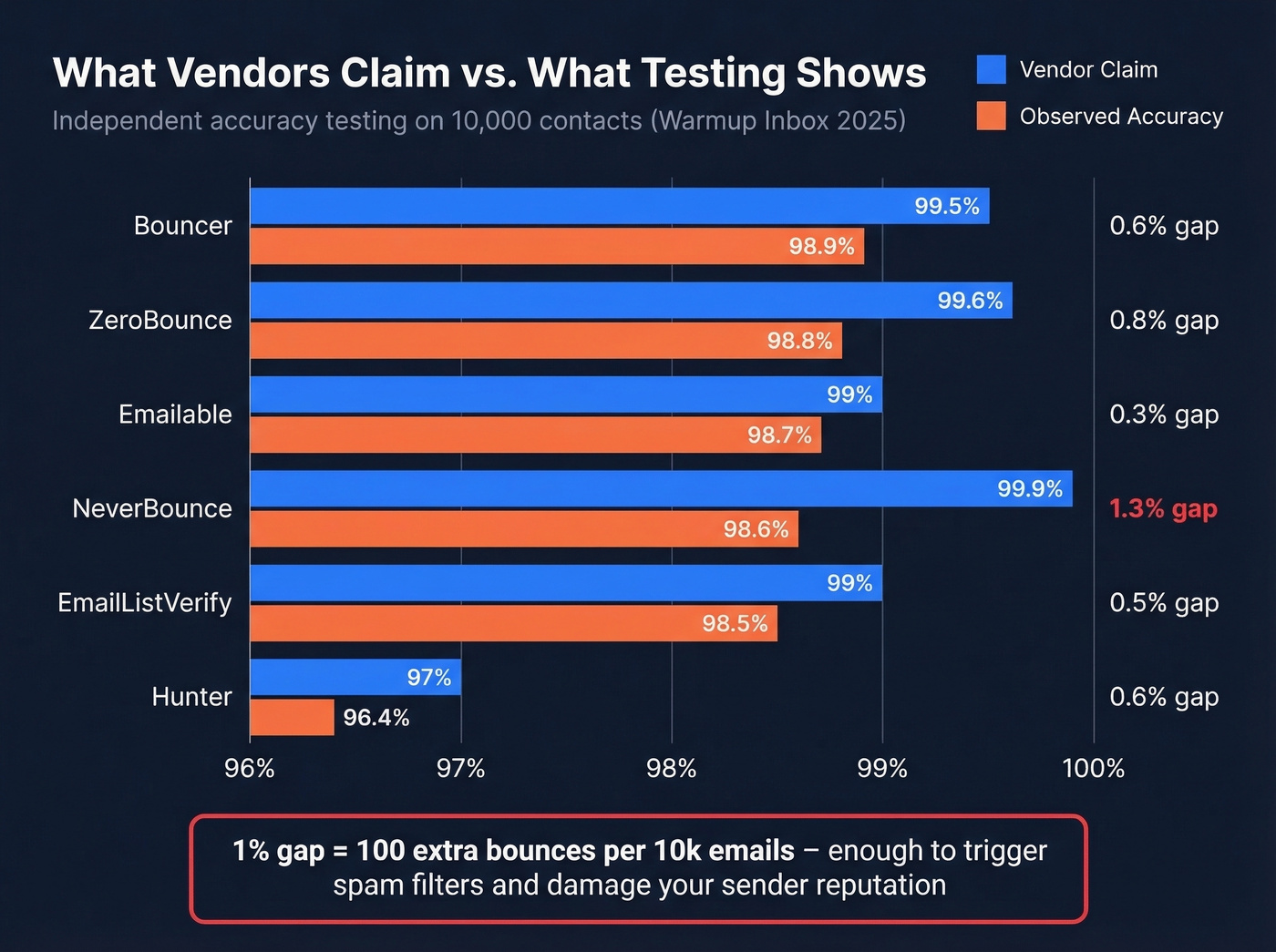
Vendors claim 99%+. Independent testing tells a different story.
| Tool | Vendor Claim | Observed Accuracy | Gap |
|---|---|---|---|
| Bouncer | 99.5% | 98.9% | 0.6% |
| ZeroBounce | 99.6% | 98.8% | 0.8% |
| Emailable | 99%+ | 98.7% | ~0.3% |
| NeverBounce | 99.9% | 98.6% | 1.3% |
| EmailListVerify | 99%+ | 98.5% | ~0.5% |
| Hunter | 97%+ | 96.4% | 0.6% |
That 1-2% gap isn't trivial. On a 10,000-email campaign, 1% means 100 extra bounces - enough to trigger spam filters, land you on a blacklist, and damage your sender reputation permanently. We've seen this gap stay consistent across tools, and it gets worse with older lists.
Let's be honest though: if your average deal size is under $15k, you probably don't need 98.9% accuracy. The difference between Bouncer at 98.9% and EmailListVerify at 98.5% is 40 extra bounces per 10k emails. At $4/1,000 versus $4-7/1,000, the cheaper tool wins for most teams. Save the premium validators for high-stakes campaigns where a single spam complaint could torch your domain.
If you’re sending at scale, also watch email velocity and use email reputation tools to catch issues early.
Handling Catch-All Results
Catch-all emails are the validation gray zone. The domain accepts everything, so the SMTP handshake returns a success code whether the mailbox exists or not. Up to 30% of a typical B2B contact list can land in the catch-all/unknown bucket - and disposable email addresses often hide in there too.
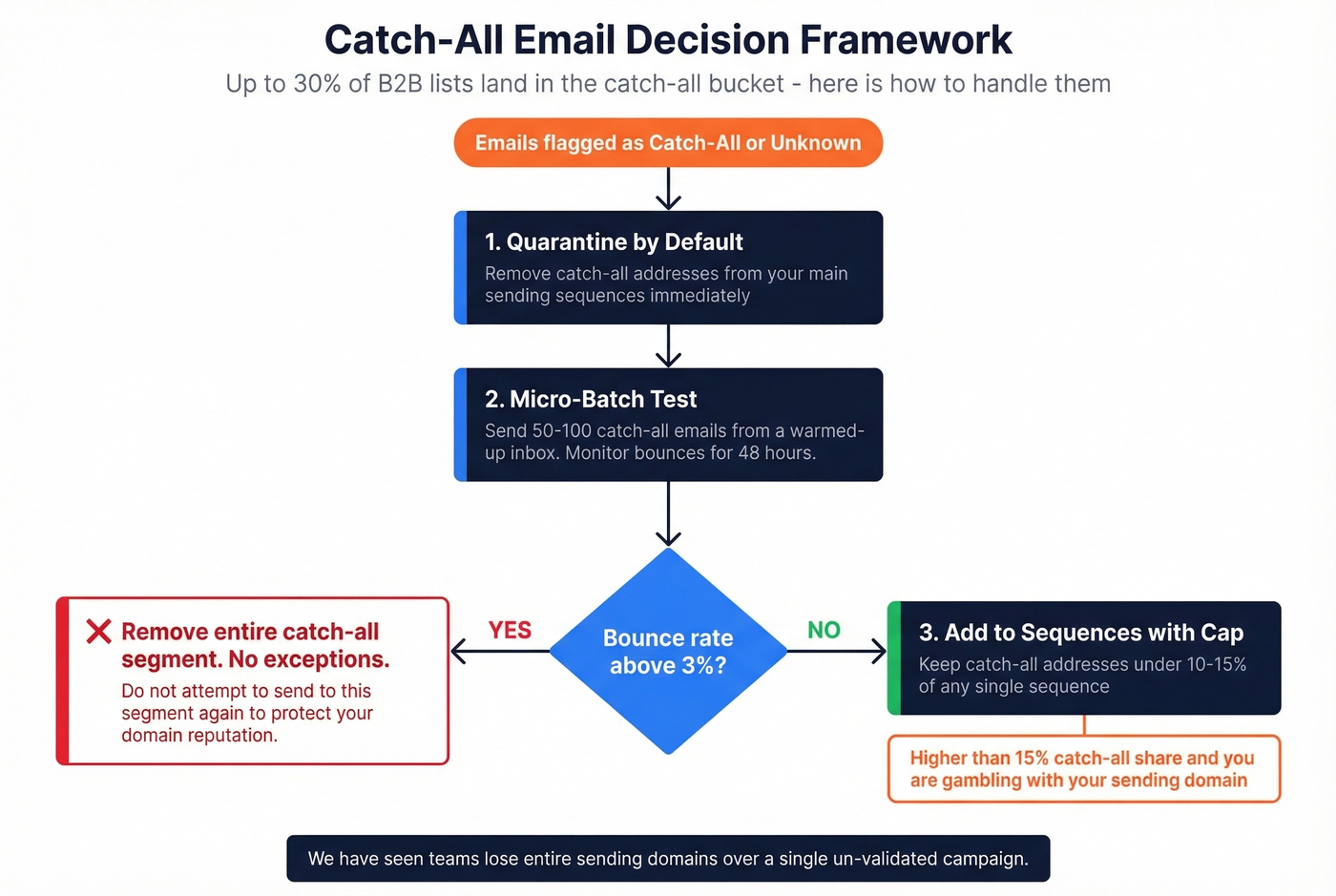
Here's the framework we use:
Quarantine by default. Don't send to catch-all addresses in your main sequences. Micro-batch test. Send 50-100 catch-all emails from a warmed-up inbox and monitor bounces for 48 hours. Cap catch-all share. Keep catch-all addresses under 10-15% of any single sequence - higher than that and you're gambling with your domain. Fail closed. If bounces spike above 3% in your test batch, remove the entire catch-all segment. No exceptions.
Most teams skip this entirely and blast their full list. We've seen teams lose entire sending domains over a single un-validated campaign. Don't be that team.
Stop Validating Bad Data - Fix the Source
If 23% of your list rots annually and you're paying $25-75 every quarter to re-validate 10k emails, that's $100-300/year on band-aids. Even the best free email list validation tool can't fix fundamentally stale data. The smarter move is fixing the data source.
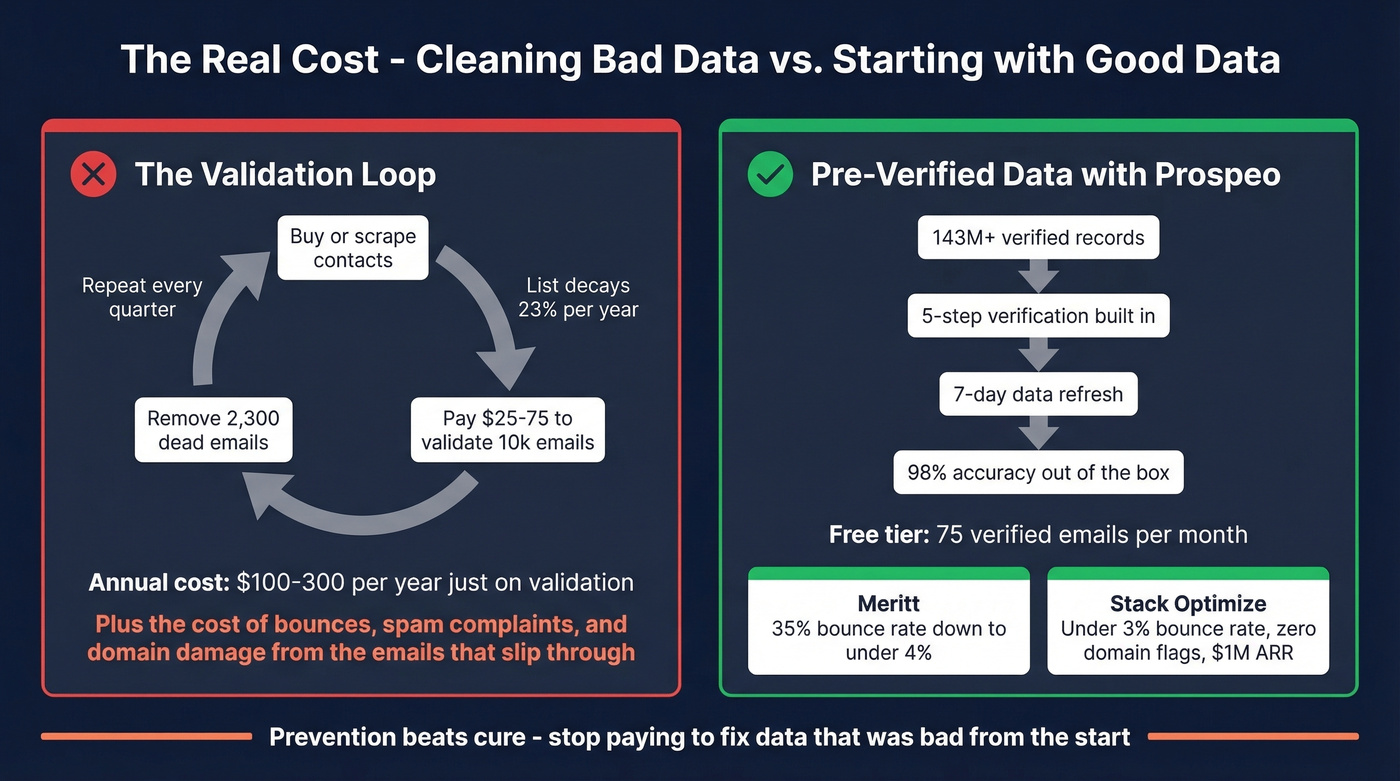
Prospeo delivers pre-verified emails from 143M+ verified records with a 5-step verification process - catch-all handling, spam-trap removal, honeypot filtering, the works. Data refreshes every 7 days, not every 6 weeks like most providers. The emails you pull today are still accurate next week.
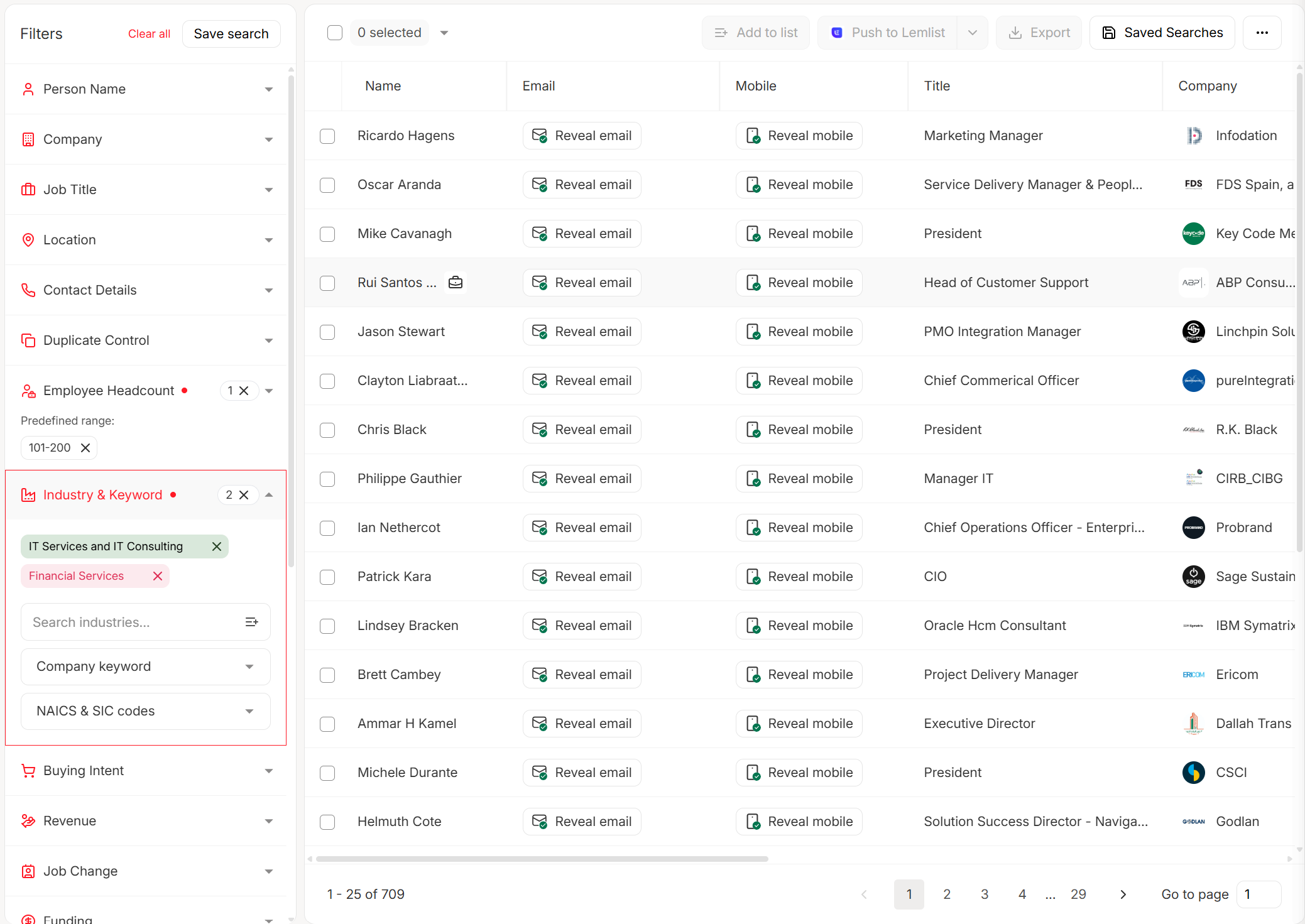
Meritt went from a 35% bounce rate to under 4% after switching. Stack Optimize built to $1M ARR with client deliverability above 94%, bounce rates under 3%, and zero domain flags. The free tier gives you 75 verified emails/month - enough to test whether upstream data quality eliminates your validation problem entirely.
If you need to enrich and standardize records before outreach, look at data enrichment services and a dedicated lead enrichment workflow.
At $0.01 per email, Prospeo costs less than most validation tools - and the emails arrive pre-verified at 98% accuracy. That's fewer bounces than running a 10k list through any tool on this page.
Skip the cleanup. Build lists that don't need it.
Common Validation Mistakes
Validating once and never again. Quarterly is the minimum. A list validated in January has about 5-6% dead addresses by April. Set a calendar reminder - this is the single most common mistake we see.
Relying on syntax checks only. A properly formatted email that doesn't exist will still bounce. You need the full SMTP handshake.
Ignoring role-based emails. Addresses like info@, sales@, and support@ have higher bounce and complaint rates. Most validators flag these - don't ignore the flags.
Skipping re-validation before major campaigns. Even a recently cleaned list needs a fresh pass before a high-stakes send. Spam traps get recycled into abandoned addresses constantly, and data decays faster than you'd expect.
Not using double opt-in for new signups. This is the cheapest validation you'll ever do. A confirmation email costs nothing and eliminates typos, bots, and fake submissions at the source.
If you’re writing outbound sequences, pair clean data with better copy: see email copywriting and these sales prospecting techniques.
FAQ
How many emails can I validate for free?
MillionVerifier offers 500 free credits - the most generous free tier available. ZeroBounce gives 100/month on a recurring basis, and Emailable provides 250. Most free tiers are enough to test accuracy and UX, but not enough to clean a full production list.
How often should I validate my email list?
At minimum, quarterly. Email lists decay ~23% per year, so a list validated in January could have 5-6% bad addresses by April. Always re-validate before any major campaign, even if you cleaned the list recently.
Is free email list validation accurate?
The best free tiers are. In a 10,000-contact test, ZeroBounce hit 98.8% and Bouncer 98.9% observed accuracy. Hunter lagged at 96.4%. Free tiers use the same verification engine as paid plans - accuracy doesn’t change, only volume limits do.
Can I validate bulk lists for free?
You can, but credit limits cap you quickly. MillionVerifier's 500 credits handle a decent test segment, and Verifalia's ~25/day drip lets you clean a list slowly over time. For anything over a few thousand contacts, you'll need a paid tier or a generous trial.
What if I want emails that don't need validation?
Use a data provider with built-in verification. Prospeo delivers 143M+ verified emails at 98% accuracy with a 7-day refresh cycle, so you skip the validate-then-send workflow entirely. The free tier includes 75 verified emails/month - enough to test whether better source data eliminates your bounce problem.