

AI Sales Prospecting: The Practitioner's Guide for 2026
A RevOps lead we know ran a 3-tool bake-off last quarter. The "best" database created 4,000 duplicate contacts in Salesforce in five days. The cheapest tool had better phone connect rates. AI sales prospecting isn't about picking the flashiest platform - it's about assembling the right layers and not letting bad data poison the whole stack.
Why AI Prospecting Looks Different in 2026
81% of sales teams have now implemented or are actively experimenting with AI in their prospecting workflows. The AI SDR market is projected to hit $15B by 2030 at a 29.5% CAGR, and the infrastructure is being built whether individual teams adopt or not.
McKinsey's B2B Pulse survey - roughly 4,000 decision makers across 34 sectors in 13 countries - found that teams blending personalized outreach with generative AI are 1.7x more likely to increase market share. The same research shows buyers now use 10 interaction channels on average, up from 5 in 2016. Your prospecting needs to meet them across multiple touchpoints, not just email.
Here's the problem with gold rushes: everyone shows up at once. If every team 10x's their outbound volume with AI, the channel drowns itself. A popular take on r/sales put it bluntly - AI outbound at scale will "drown itself out" as digital channels saturate, pushing the advantage back to teams with better signals, not more sends. The competitive edge in 2026 isn't automation volume. It's data quality and signal precision.
Teams using AI are 1.3x more likely to see revenue growth. But that stat hides a brutal distribution: the winners run tight, verified, signal-driven workflows, while the losers blast 10,000 generic emails a week and wonder why their domain got flagged.
What You Need (Quick Version)
You need three layers, not ten tools:
- Data + verification: Prospeo - 300M+ profiles, 98% email accuracy, 125M+ verified mobiles, free tier to start
- Enrichment + orchestration: Clay - waterfall enrichment across dozens of sources, workflow builder
- Sequencing: Apollo (budget), Outreach or lemlist (mid-market+)
That's it. Two to three tools, wired together. Everything else is optimization.
Three Types of AI Prospecting Tools
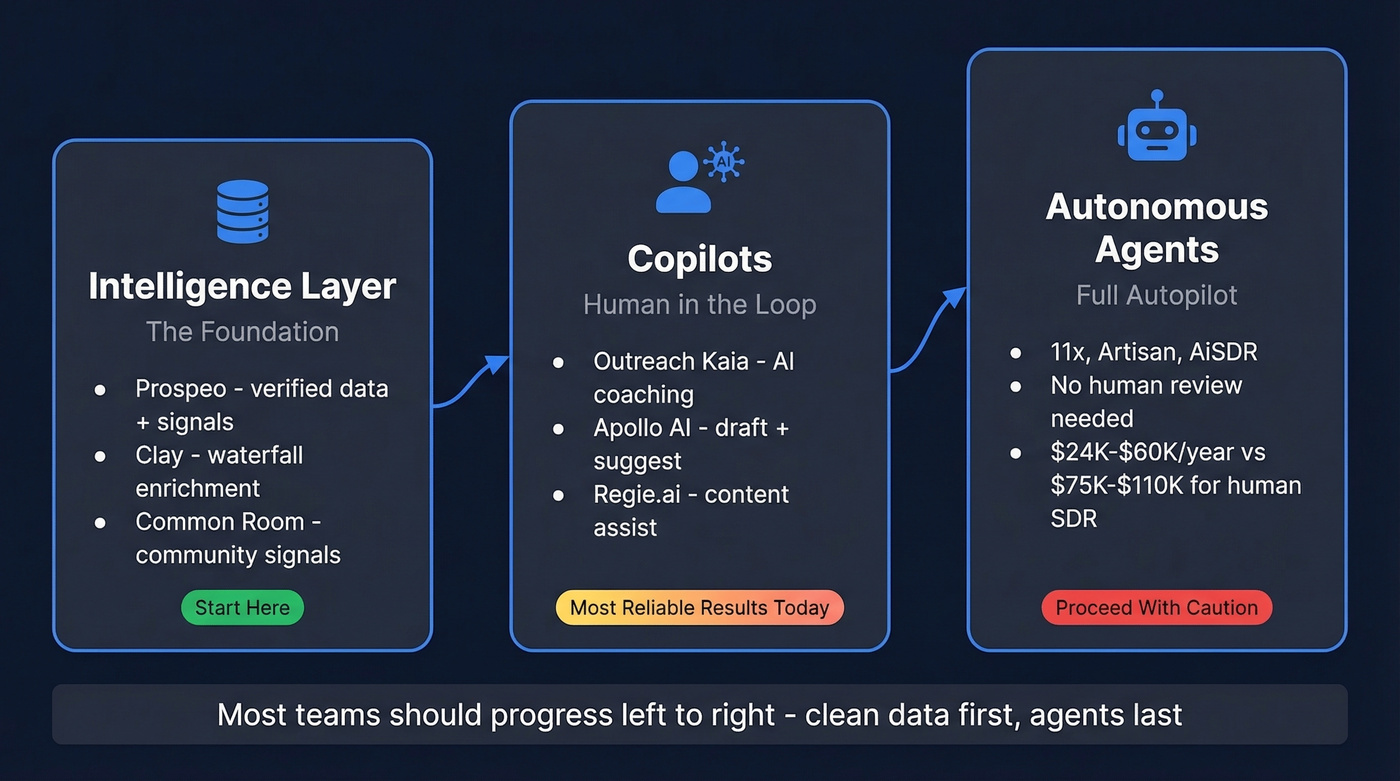
Not all "AI prospecting tools" do the same thing. The category breaks into three functional layers, and confusing them is how teams end up paying for six overlapping subscriptions. Most teams should start at the intelligence layer, graduate to copilots once their data is clean, and only consider autonomous agents after six-plus months of proven sequences. Skipping straight to agents is like hiring a junior SDR and handing them a corrupted CRM on day one.
Autonomous Agents
Tools like 11x, Artisan, and AiSDR promise to replace your SDR entirely - they research, write, send, and follow up without human intervention. The pitch is compelling: a fully loaded human SDR costs $75k-$110k/year, while these tools run $24k-$60k/year. But the category has credibility issues. Many autonomous SDR tools see high churn within the first year because the promise outpaces the execution. Proceed with caution.
Copilots
Outreach Kaia, Salesloft's AI features, Regie.ai (~$35k/year), and Apollo's AI layer sit in this bucket. They keep a human in the loop - drafting emails for approval, suggesting next steps, scoring leads. This is where most reliable results come from today. The human reviews and sends; the AI handles research and first drafts.
Intelligence Layers
Clay, Common Room, and Prospeo operate underneath the other two categories. They don't send emails - they provide the data, signals, and enrichment that make sending worthwhile. Without clean data, your autonomous agent is just a spam cannon.
Best AI Prospecting Tools (With Real Pricing)
| Tool | Type | Starting Price | Best For |
|---|---|---|---|
| Prospeo | Intelligence | Free; ~$0.01/lead | Verified data + freshness |
| Clay | Intelligence | $134/mo (2K credits) | Enrichment orchestration |
| Apollo.io | Copilot/all-in-one | Free; $49/user/mo | Budget all-in-one |
| ZoomInfo | Intelligence | $14K-$35K+/yr | Enterprise US coverage |
| Outreach | Copilot | $100/user/mo | Sequencing + AI coaching |
| 6sense | Intelligence | $30K-$100K+/yr | Enterprise intent + ABM |
| Cognism | Intelligence | ~$1K-$3K/mo | EMEA + phone-verified |
| Amplemarket | Copilot/all-in-one | ~$1.5K-$3K/mo | Mid-market all-in-one |
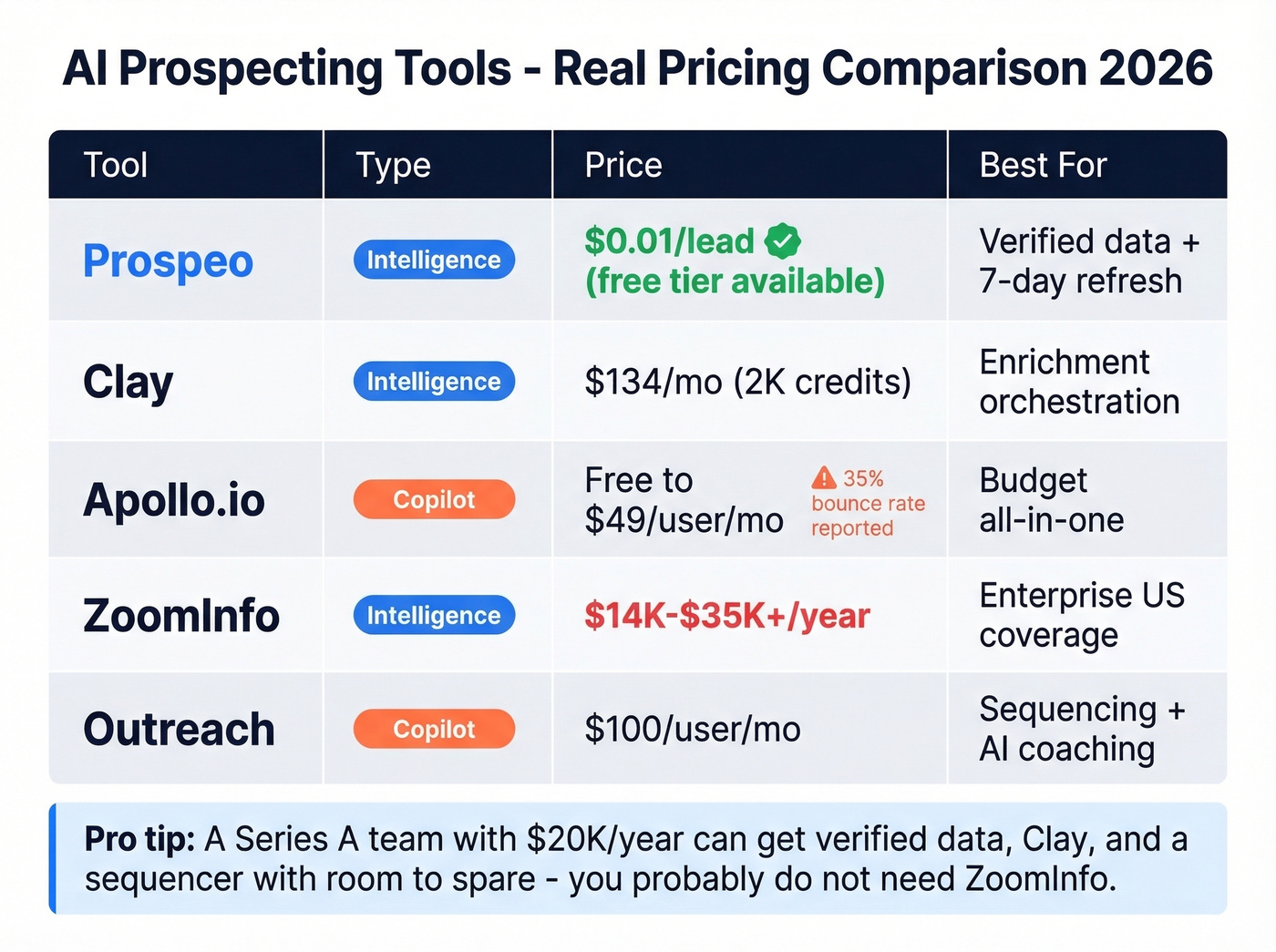
If a vendor won't publish pricing, that tells you something about who their target buyer is - and it's probably not you.
Prospeo
Prospeo covers 300M+ professional profiles with 98% email accuracy, 143M+ verified emails, and 125M+ verified mobile numbers that hit a 30% pickup rate. The 7-day data refresh cycle is what matters most - the industry average is six weeks, which means most databases are serving you stale contacts by the time you press send.

At roughly $0.01 per lead, it runs 90% cheaper than ZoomInfo on a per-contact basis. Meritt tripled their pipeline from $100K to $300K/week after switching, and Snyk cut bounce rates from 35-40% down to under 5% across 50 AEs. The 5-step verification process includes catch-all handling, spam-trap removal, and honeypot filtering - all on proprietary infrastructure that doesn't rely on third-party email providers.
The Chrome extension (40K+ users) lets you pull verified contact data from any website or CRM without leaving the page. Native integrations with Salesforce, HubSpot, Smartlead, Instantly, Lemlist, Clay, Zapier, and Make mean it slots into existing stacks without custom API work. Intent data powered by Bombora tracks 15,000 topics, so you're getting buying signals alongside contact info. Free tier gives you 75 verified emails plus 100 Chrome extension credits per month to test it.
Clay
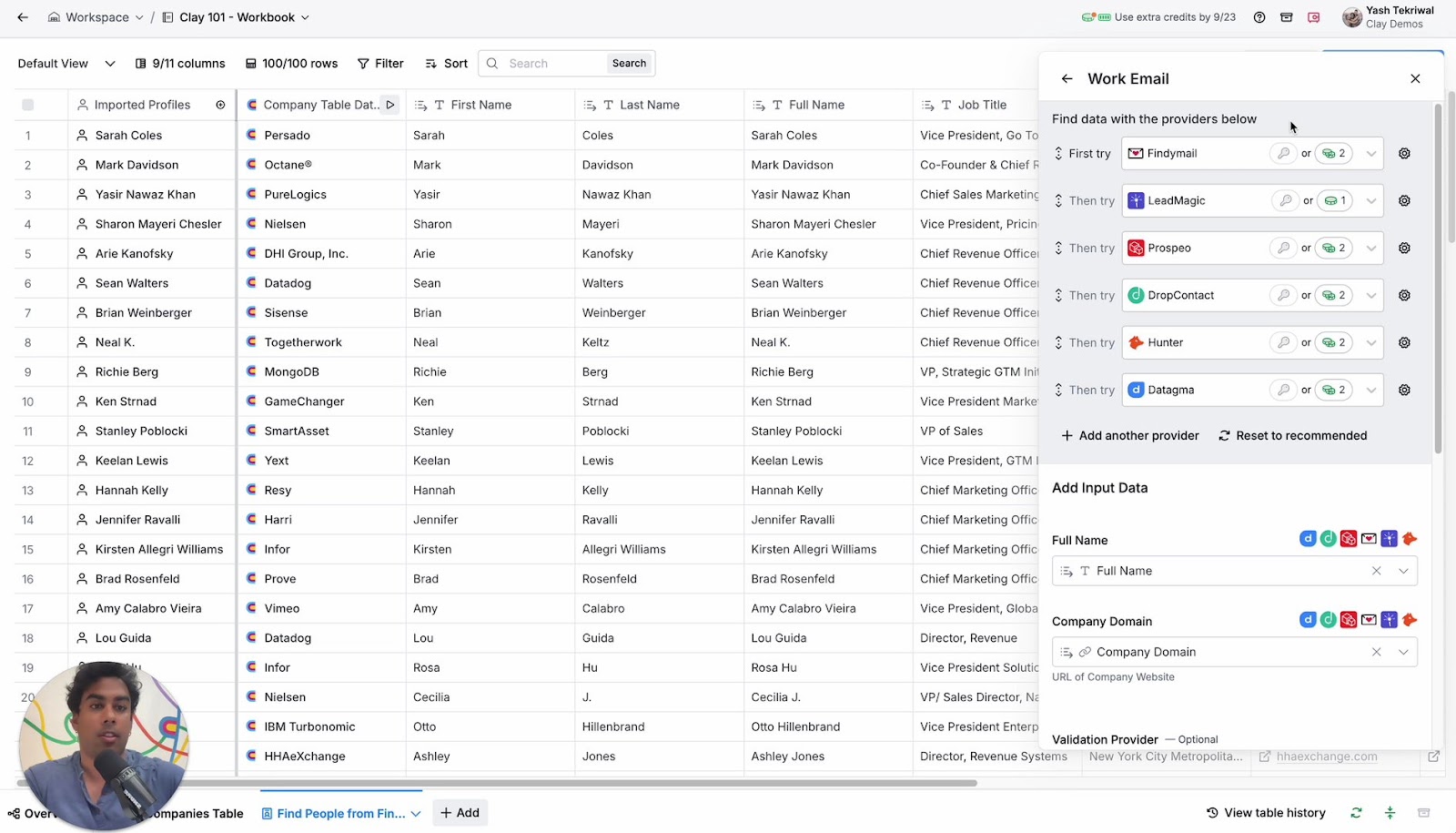
Clay keeps showing up as the practitioner favorite on Reddit, and for good reason. It's the workflow builder that sits between your data sources and your sequencer, running waterfall enrichment across dozens of providers to fill in gaps no single database covers. Starting at $134/month for 2,000 credits, it isn't cheap for small teams, but the orchestration capability is unmatched. Use this if you're building complex, multi-signal prospecting workflows. Skip it if you just need a list of emails.
Apollo.io
Apollo is the obvious starting point for budget-conscious teams. Free tier available, paid plans from $49/user/month, 275M contacts in the database, and a built-in sequencer so you don't need a separate tool. The catch: user-reported bounce rates run as high as 35%. We've seen this pattern repeatedly - teams love Apollo for list building but need a verification layer on top before loading contacts into sequences. Apollo's breadth paired with real verification gives you volume and deliverability.
Outreach
Outreach's AI Prospecting Agent moved into public beta in 2025, automating lead parsing and personalized outreach with human approval gates. At $100/user/month, it's the sequencing layer of choice for mid-market and enterprise teams. Strong once your data foundation is solid - not a data source itself.
ZoomInfo
The largest US database at 420M+ contacts, and still the default for enterprise teams. But a 10-seat contract with intent data and mobile numbers can run $14k-$35k+/year with mandatory annual commitments. The #1 complaint on Reddit? Price - and specifically, paying for modules you don't use.
Let's be honest: ZoomInfo is still the most comprehensive all-in-one platform. But most teams don't need all-in-one. If you're a Series A company with a $20k annual data budget, that money buys you a verified data layer, Clay, and a sequencer with room to spare.
Quick Mentions
6sense is enterprise ABM and intent at $30k-$100k+/year - powerful if you're running account-based plays at scale, overkill for everyone else. Cognism wins on EMEA compliance with DNC checking across 5+ regions and phone-verified mobiles; expect ~$1k-$3k/month. Amplemarket bundles prospecting, sequencing, and AI agents into one mid-market platform at roughly $1.5k-$3k/month - worth evaluating if you want fewer tools.

The article says it clearly: without clean data, your AI agent is just a spam cannon. Prospeo's 7-day refresh cycle, 98% email accuracy, and 5-step verification give your AI stack the foundation it needs - at $0.01/lead instead of $1.
Stop feeding stale data to expensive AI tools.
A Real AI Prospecting Workflow
Here's the five-step workflow that actually produces meetings, not just activity metrics.
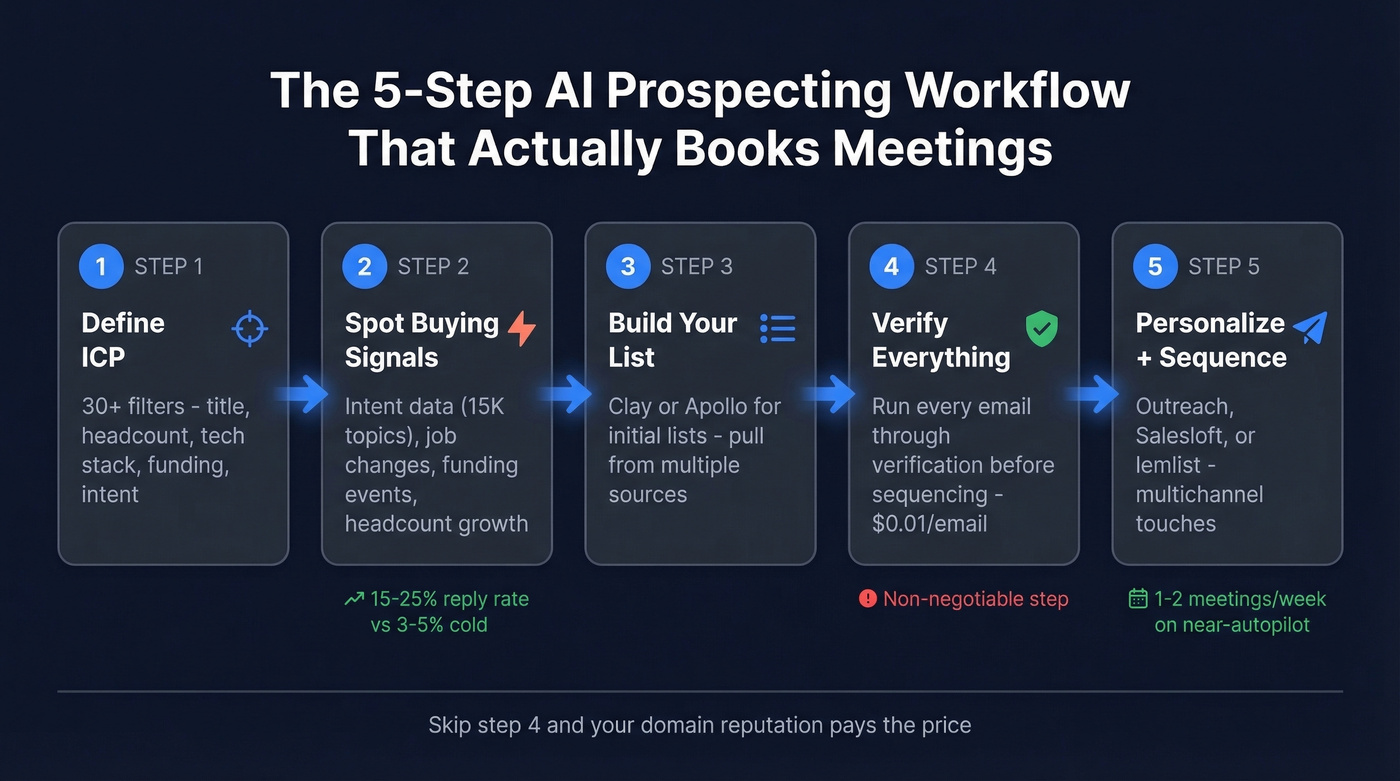
Step 1: Define your ICP with precision. Use 30+ filters - job title, department headcount, tech stack, funding stage, intent signals. Vague targeting is the #1 reason AI prospecting fails. (If you need a tighter definition, start with an ICP scorecard.)
Step 2: Identify buying signals. Layer intent data (15,000 topics via Bombora), job changes, headcount growth, and funding events. Signal-personalized outreach hits 15-25% reply rates vs. 3-5% for cold email.
Step 3: Build your list. Clay or Apollo for initial list generation and enrichment. Pull from multiple sources - no single database has everything. (If you're comparing sources, see the B2B database breakdown.)
Step 4: Verify before you send. Run every email through verification before loading into your sequencer. At $0.01/email, this step is cheaper than the domain reputation damage from a 35% bounce rate. Non-negotiable. (If you need the mechanics, use a domain reputation checklist.)
Step 5: Personalize and sequence. Outreach, Salesloft, or lemlist for multichannel sequences. One practitioner on r/Entrepreneur shared their stack - Apollo for lists, Prospect AI for personalized outreach, Avoma for call summaries - and reported booking 1-2 meetings per week on near-autopilot.
Common Mistakes That Kill Results
Volume over quality. Ten-x your outreach and you 10x your spam complaints. Only 13% of buyers say seller messages address a relevant challenge. More sends won't fix irrelevant messaging. (If you're scaling, follow an outbound email automation playbook.)
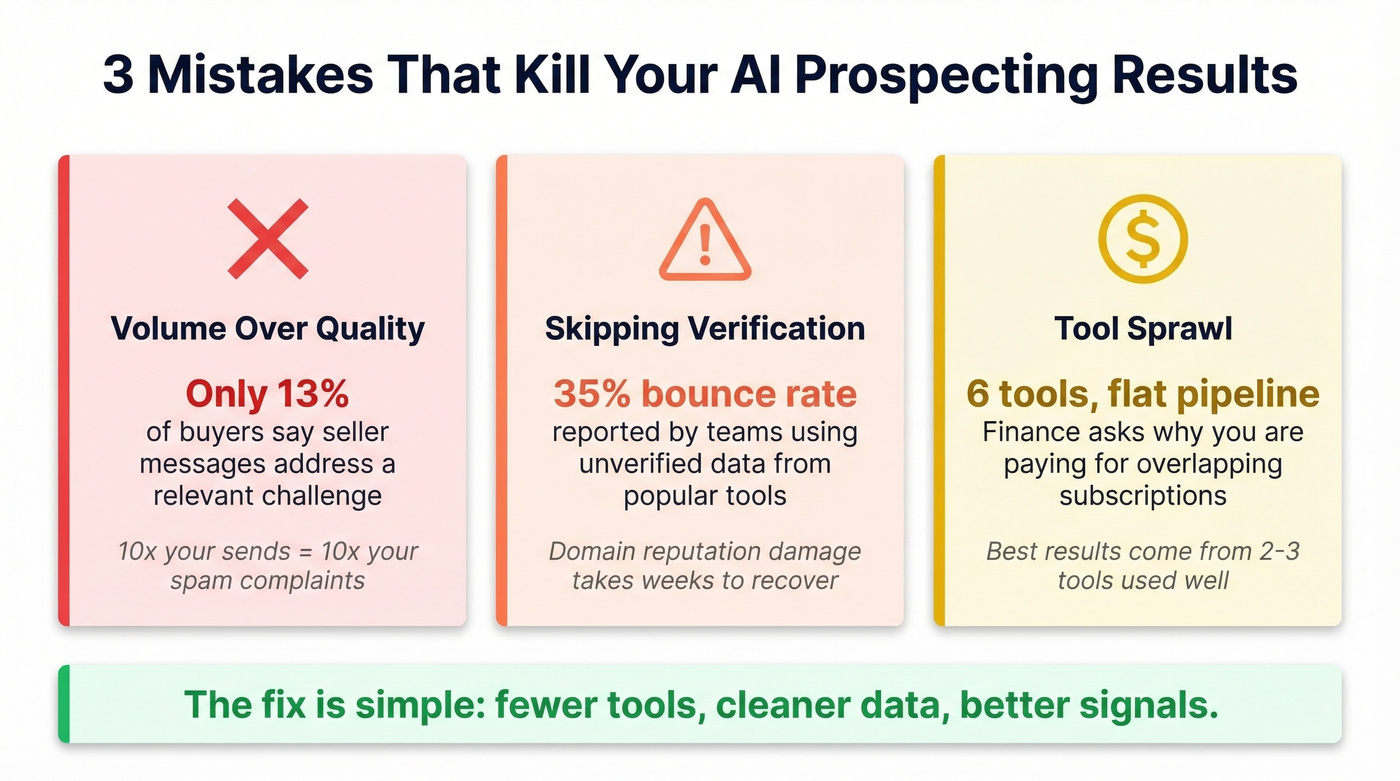
Skipping verification. Your SDR sent 500 emails and 180 bounced. Your domain reputation just took a hit that'll take weeks to recover. This is the most preventable mistake in the entire stack, and it drives us crazy how often we see it. (If you're already in trouble, start with spam trap removal.)
Tool sprawl. Finance asked why you're paying for six tools and pipeline is flat. Best results come from two to three tools used well, not collecting subscriptions. (If you're rebuilding, use a RevOps tech stack blueprint.)
Ignoring compliance. GDPR penalties reach EUR 20M. CCPA fines hit $7,988 per intentional violation. Over 20 US states now have comprehensive privacy laws, and GDPR requires personal data be accurate and up to date - stale enrichment isn't just wasteful, it's a compliance risk.
Set-and-forget mentality. AI needs training and iteration. The teams treating AI tools like a "set it and walk away" solution are the ones churning off autonomous agent platforms within six months.
The Data Quality Problem
Look - every tool in this article is only as good as the data feeding it. Apollo's user-reported bounce rates hit 35%. The industry average refresh cycle is six weeks, meaning the contact you pulled last month may have changed jobs, changed emails, or left the company entirely.
The advantage in 2026 doesn't go to teams with the most AI tools. It goes to teams with the cleanest data and the freshest signals. Stack Optimize built from $0 to $1M ARR running client deliverability at 94%+, bounce rates under 3%, and zero domain flags - all by prioritizing data quality over send volume. GreyScout cut bounce rates from 38% to under 4% and grew pipeline 140% with the same approach.
In our experience, a 98% accuracy rate and 7-day refresh cycle solve the root cause of most outbound failures. The 5-step verification process catches invalid addresses, handles catch-all domains, and strips spam traps and honeypots before they can damage your sender reputation. At $0.01/email, there's no rational reason to skip verification.
Snyk cut bounce rates from 35-40% to under 5% across 50 AEs. Meritt tripled pipeline to $300K/week. The difference wasn't a better AI sequencer - it was 300M+ verified profiles refreshed every 7 days, not every 6 weeks.
Your AI prospecting stack is only as sharp as your data layer.
How to Build Your Stack by Budget
SMB ($100-$300/month): A verified data source for contacts, Apollo's free tier for list building, and lemlist for multichannel sequencing. Total cost under $300/month. Compare that to a fully loaded SDR at $75k-$110k/year. One of the clearest benefits of AI-powered prospecting at this tier is the cost savings - you get 80% of the output at 5% of the headcount expense.
Mid-market ($500-$2,000/month): A verified data layer plus Clay for enrichment orchestration plus Outreach for sequencing and AI coaching. This is the sweet spot where signal-based prospecting starts compounding.
Enterprise ($15k+/year): ZoomInfo or Cognism for primary database, 6sense for intent and ABM, Outreach or Salesloft for sequencing, and a verification layer ensuring nothing goes out on bad data. Even at enterprise scale, verification pays for itself in the first week.
For teams running LinkedIn-first prospecting, practitioners recommend Heyreach for multi-account scale, lemlist for SMB multichannel, and Waalaxy for agencies managing multiple client profiles.
What Comes Next
The trajectory is clear: autonomous agents will improve, intent signals will get more granular, and the teams that built clean data foundations now will be the ones who can actually trust those agents when they mature. But the fundamentals - verified data, precise targeting, human judgment on final sends - aren't going anywhere. AI sales prospecting in 2026 rewards disciplined operators, not early adopters chasing hype.
FAQ
Is AI sales prospecting worth the investment?
Yes. Teams using AI are 1.3x more likely to see revenue growth, and McKinsey's data shows AI-personalization teams gain 1.7x more market share. ROI depends on data quality and workflow design, not tool quantity. A cheap stack with clean data outperforms an expensive stack with 35% bounce rates every time.
How much do AI prospecting tools cost?
A solid SMB stack runs $100-$300/month total. Mid-market teams typically spend $500-$2,000/month. Enterprise contracts with ZoomInfo or 6sense start at $14k/year and climb past $100k for full intent and ABM suites.
Will AI replace SDRs?
Not yet. Twenty-two percent of teams say they've done it, but autonomous AI SDR tools have high churn rates within the first year. Copilot and intelligence-layer tools that keep humans in the loop deliver more reliable results. The best model today: AI handles research and drafting, humans handle judgment and relationships.
What's the biggest mistake in AI prospecting?
Scaling volume without verifying data. A perfectly personalized email that bounces is worth zero - and it damages your domain reputation for every email that follows. At $0.01/email, verification is the cheapest, highest-ROI step in the entire workflow.