


Altify Pricing, Reviews, Pros and Cons (2026)
You just got off a demo call with Altify. The pitch was polished - AI-powered account planning, relationship maps, Salesforce-native everything. Then you asked about cost and got "let's schedule a follow-up." That's the Altify experience: impressive enterprise tooling behind a wall of opacity.
We've spent time digging through public pricing data, community threads, and review platforms so you don't have to piece it together yourself.
30-Second Verdict
Altify is a serious enterprise account-planning platform for Salesforce teams running complex, multi-threaded deals. If you have 50+ reps navigating big buying committees, it's top-tier. Pricing starts at $20/user/month for the entry module, but most teams land on $40/user/month modules - plus implementation services that can run $5,000-$25,000 depending on Salesforce complexity. No free trial. No self-serve signup. If you're under 50 reps or your real problem is finding verified contact data rather than mapping org charts, skip it.
What Is Altify?
Altify is a Salesforce-native account planning and deal execution platform built around four core modules: Insights, Sales Process, Account Manager, and Opportunity Manager. The headline features are Relationship Maps for visualizing buying committees, Insight Maps for uncovering buyer motivations, and TeamView for pipeline coaching.
In late 2024, Altify launched MaxAI - an AI layer that automates identifying key players, generating deal summaries, and surfacing account growth opportunities. It builds on nearly a decade of their "Max Insights" engine, so it's not a bolted-on ChatGPT wrapper. Then in March 2025, Gallant Capital acquired Altify from Upland Software, bringing back original leadership including Patrick Morrissey as CEO. That leadership shakeup matters because it signals renewed investment in the product after a period of relative stagnation under Upland.
Altify Pricing Breakdown
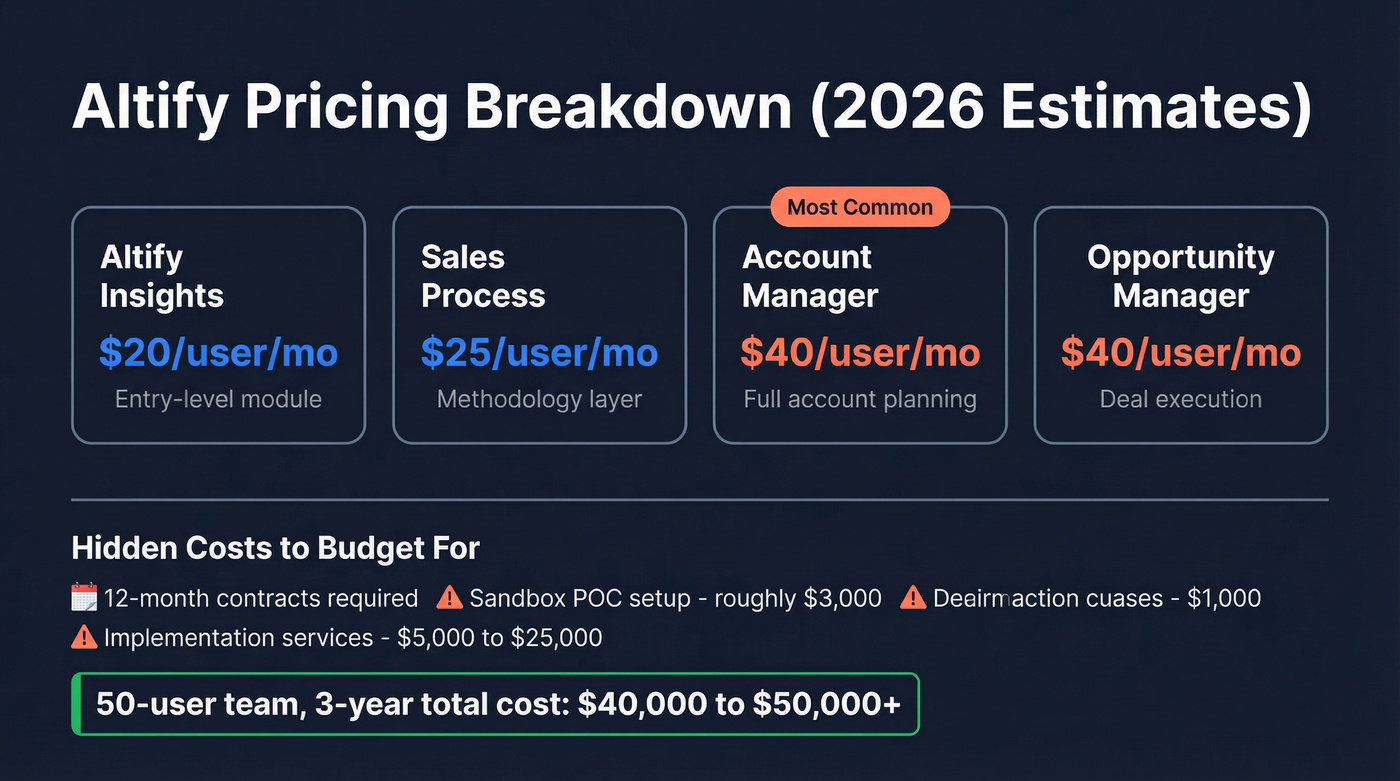
Altify doesn't publish pricing. Here's what we've pieced together from public sources and community discussions:
| Module | Est. Price |
|---|---|
| Altify Insights | $20/user/mo |
| Sales Process | $25/user/mo |
| Account Manager | $40/user/mo |
| Opportunity Manager | $40/user/mo |
Contracts are typically 12 months. The $20/user/month figure on Capterra gets you the entry-level Insights module only. Most teams running real account planning end up needing Account Manager or Opportunity Manager, which puts you at $40/user/month.
Subscription costs are only part of the picture. One thread on r/salesforce mentions $3,000 to stand up a sandbox POC before production deployment. Implementation services often land in the $5,000-$25,000 range depending on your Salesforce org's complexity and customization.
For a 50-user team, budget $40,000-$50,000 over three years once you factor in implementation, training, and renewal increases. The base subscription alone is $36,000 at $20/user/month - and that's the cheapest module.

Spending $40K+ on Altify to map org charts your reps still can't penetrate? The real bottleneck isn't strategy - it's contact data. Prospeo delivers 143M+ verified emails at 98% accuracy and 125M+ mobile numbers, starting free. No contracts, no demo gates, no $3,000 sandbox fees.
Reach the buying committee, not just map it.
Pros and Cons
What Users Like
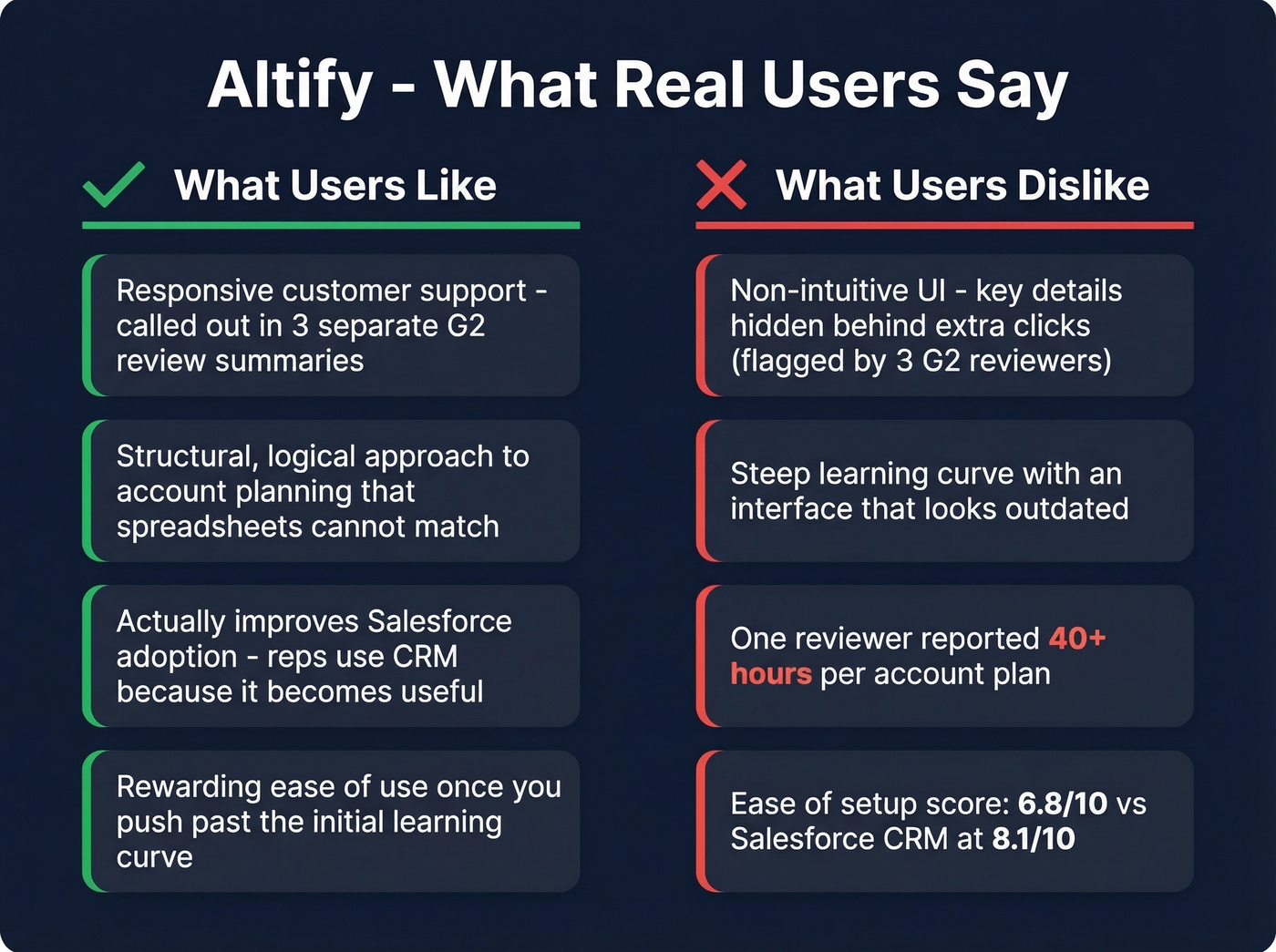
Responsive customer support comes up repeatedly on G2, with three separate review summaries calling it out. Gartner Peer Insights reviewers highlight the structural, logical approach to account planning - the kind of visibility into deal strategy that spreadsheets simply can't provide.
Multiple reviewers also note that Altify improves Salesforce adoption. Reps actually use CRM because the account planning layer makes it useful, which is a rare compliment for any Salesforce add-on. Two G2 reviewers praise ease of use once past the initial learning curve, suggesting the tool rewards persistence even if the first few weeks feel rough.
What Users Dislike
Here's the thing: the interface is the most-mentioned con across every review platform we checked. Three G2 reviewers flag a non-intuitive UI where key details hide behind extra clicks. Gartner Peer Insights reviewers pile on with complaints about a steep learning curve and an interface that "looks outdated."
One TrustRadius reviewer reported spending 40+ hours per account plan. That's not a typo. A tool that demands that kind of time investment before delivering value is a hard sell to reps already drowning in admin work.
The ease-of-setup score often cited for Altify is 6.8/10, compared to Salesforce CRM's 8.1/10. For a tool that's supposed to make Salesforce better, that gap stings.
Review Scores Across Platforms
| Platform | Rating | Reviews |
|---|---|---|
| Gartner Peer Insights | 4.4/5 | 19 |
| Capterra | 4.5/5 | 2 |
| G2 | 4.2/5 | 76 |
| TrustRadius | - | 2 |
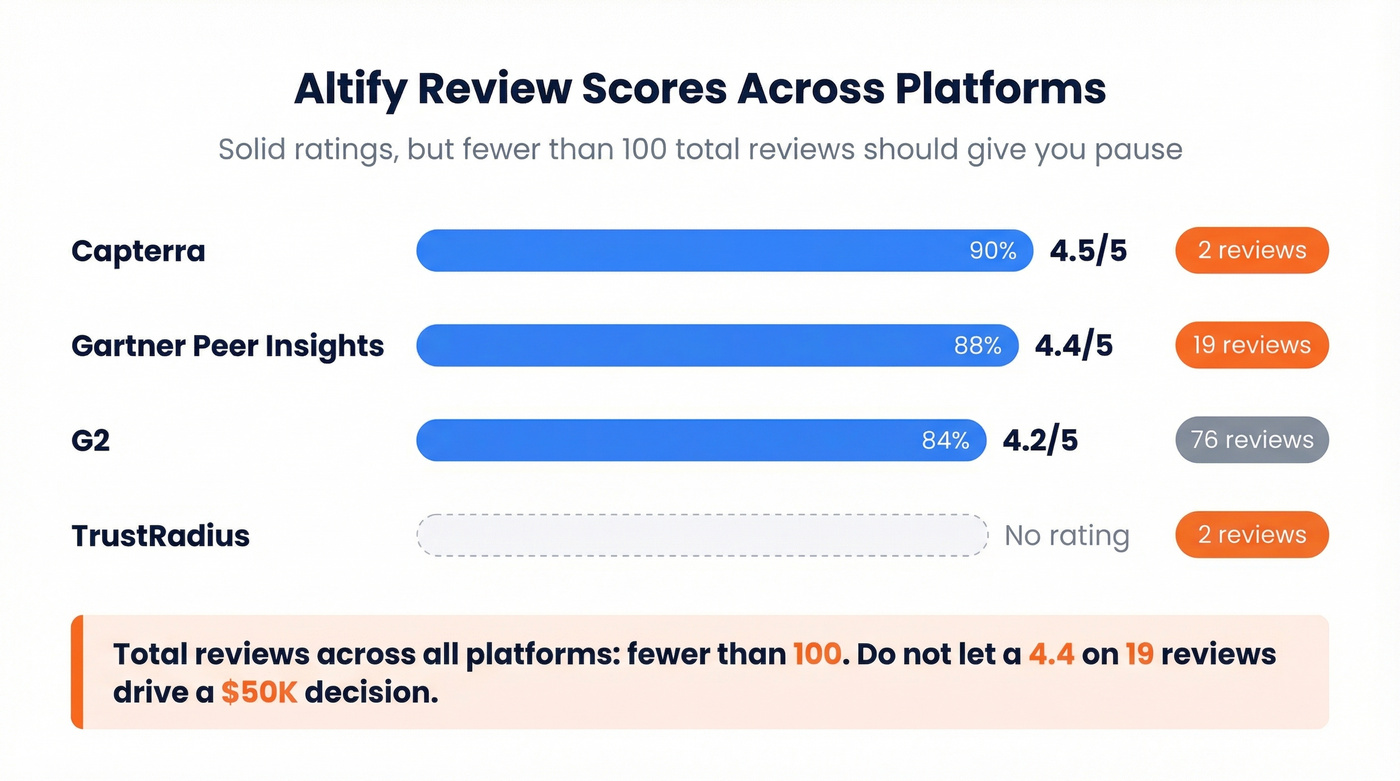
The ratings look solid at a glance. But we've analyzed enough enterprise tools to know that fewer than 100 total reviews across all platforms should give you pause. Don't let a 4.4 on 19 reviews drive a $50K decision - weight your own POC experience heavily.
Who Should (and Shouldn't) Buy Altify
Buy if you have 50+ reps running complex, multi-threaded deals with $500K+ ACV and buying committees of 12-14 people. You need a mature Salesforce org with dedicated admin support, and your bottleneck is deal strategy and relationship visibility - not prospecting.
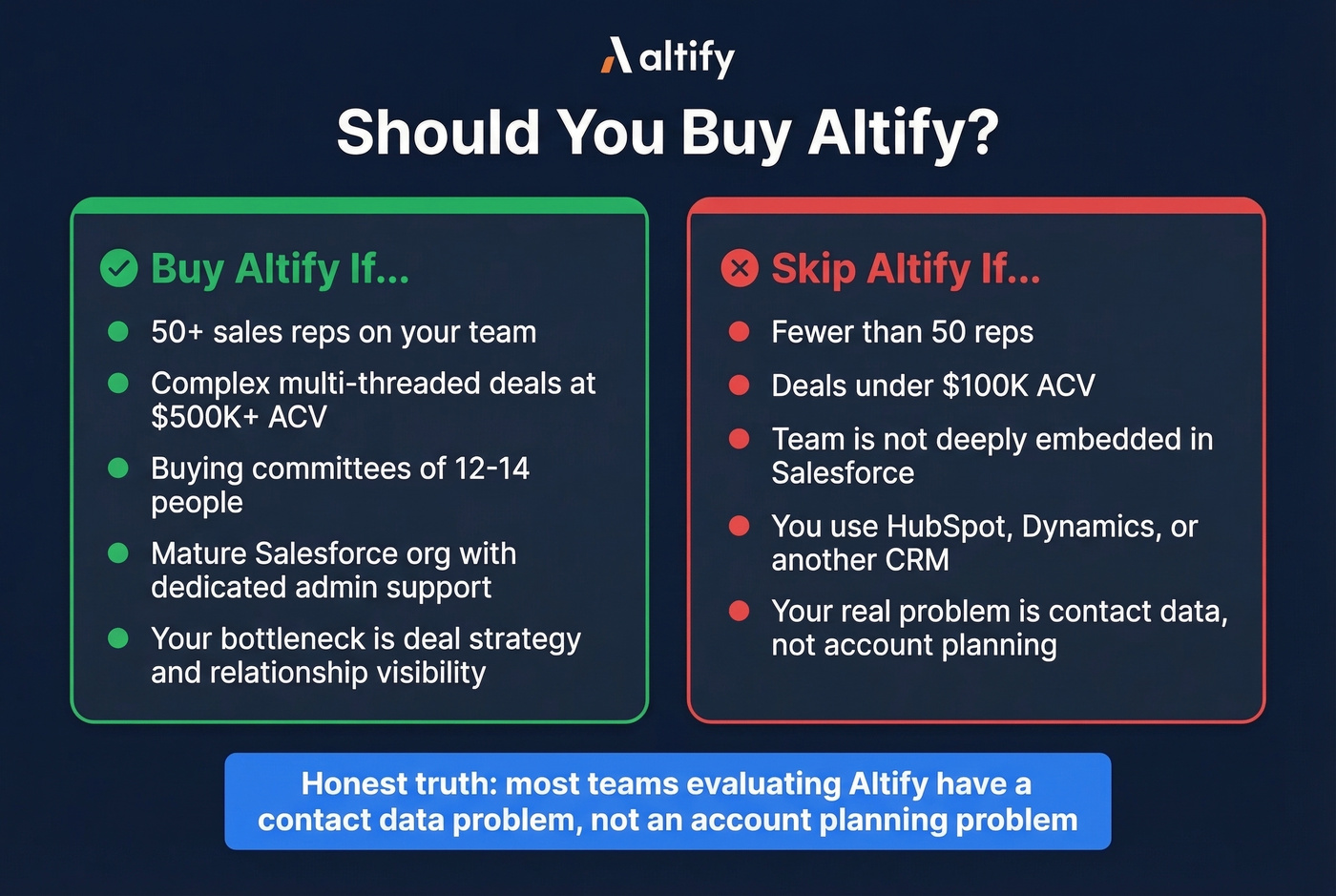
Skip if you're under 50 reps, selling deals under $100K, or your team isn't deeply embedded in Salesforce. Even if you check those boxes, expect 2-8 weeks for initial rollout and longer for full adoption.
Let's be honest about something most teams evaluating Altify won't admit: they don't actually have an account-planning problem. They have a contact data problem. Mapping a buying committee on a relationship map is useless if your reps can't reach the people on it.
Alternatives Worth Considering
Revegy is Altify's most direct competitor. Package-based pricing starts around ~$35/month, making it more accessible for mid-market teams. G2 lists it alongside People.ai and DemandFarm as top-rated alternatives in the account planning category.
DemandFarm positions itself around visual account intelligence with dynamic relationship mapping. It's a better fit for mid-market teams wanting Salesforce-native account planning without enterprise-grade complexity or enterprise-grade pricing.
When the real gap is contact data: If your bottleneck isn't mapping relationships but actually reaching the people in those buying committees, that's a fundamentally different problem. Altify maps org charts; it doesn't give you verified emails or direct dials. Prospeo fills that gap with 143M+ verified emails at 98% accuracy and 125M+ verified mobiles on a 7-day refresh cycle. It integrates natively with Salesforce, starts free with 75 email credits per month, and requires no contracts - a stark contrast to Altify's $40K+ three-year commitment.

Relationship maps are worthless if your reps bounce 35% of their emails. Prospeo's 7-day data refresh and 5-step verification keep bounce rates under 4% - at $0.01 per email instead of $40/user/month. Integrates natively with Salesforce, just like Altify, but without the 12-month contract.
Stop paying enterprise prices for data that doesn't connect.
FAQ
Does Altify offer a free trial?
No. Altify is demo-led with 12-month contracts and no self-serve signup. Budget roughly $3,000 for a sandbox POC before production deployment - that's the only way to test it with your actual Salesforce org.
Does Altify work outside Salesforce?
It doesn't. Altify is built exclusively for Salesforce. If your team runs HubSpot, Dynamics, or another CRM, it's a non-starter. DemandFarm and Revegy both offer broader CRM compatibility.
What if I need contact data, not account planning?
Prospeo is purpose-built for verified B2B contact data - 143M+ emails at 98% accuracy and 125M+ mobile numbers with a 30% pickup rate. It starts free, integrates with Salesforce and HubSpot, and requires no contracts. Pair it with Altify if you need both strategy and reach, or use it standalone if your bottleneck is getting to decision-makers rather than mapping them.