


Ampliz Pricing Breakdown: What You Actually Pay
$50/month sounds like a steal for a B2B data platform. Then you hit the part where everything runs on "credits" and nobody tells you what a credit actually buys. Ampliz pricing looks clear on the surface - the unit economics underneath aren't.
Here's the short version: Ampliz's self-serve pricing is $50/mo for 100 credits (or $480/yr), plus a free plan with 10 credits. Healthcare data is custom-quote only. The platform doesn't define what a credit buys on its pricing page, and the terms don't spell out a public credit-to-action exchange rate either. That's the real problem.
Plans and Credits at a Glance
Ampliz publishes three tiers for its Global B2B product. SoftwareFinder repeats the same $50/mo and 100-credit structure. Healthcare is positioned separately as a demo-led plan.
| Plan | Price | Credits | Notes |
|---|---|---|---|
| Free | $0 | 10/mo | No card required |
| Monthly | $50/mo | 100/mo | All features access; 25+ search filters |
| Yearly | $480/yr | 100/mo | 20% off vs monthly |
| Healthcare | Custom | Custom | Demo required; listed alongside Definitive Healthcare in vertical-GTM roundups |
The paid plans say "100 free credits every month" and "all features access," which means the gating mechanism is credits, not feature tiers. That's fine - if the credit consumption rules are explicit. They aren't.
The Capterra Discrepancy
Capterra lists Ampliz at $100/month with a "Basic $100 flat rate" line. That listing was last updated in 2021, and the reviews shown are from 2017-2018 - the feedback reads like an older product era. We'd anchor on the official $50/mo and treat directory pricing as historical noise.
What Does a Credit Buy?
This is the question that matters, and Ampliz doesn't answer it publicly. Does 1 credit buy an email reveal, a phone number, an export action, or an enrichment call? Without that answer, you can't calculate cost-per-lead or even figure out whether 100 credits supports one rep running a modest outbound cadence.
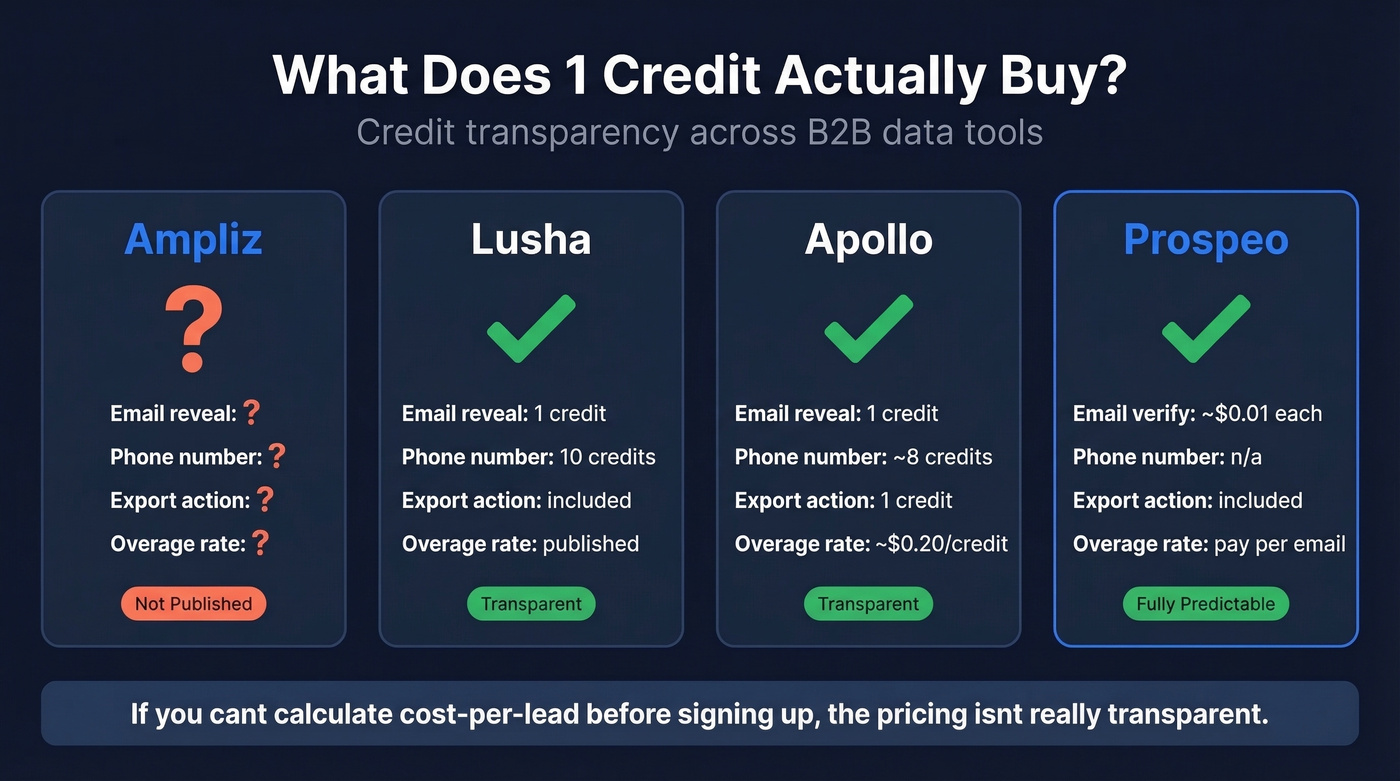
For comparison, Lusha's model is transparent: 1 credit equals one verified email, 10 credits equals one phone number. Apollo's overages run about $0.20/credit with phone numbers costing roughly 8x more than emails. With Ampliz, you're guessing.
The platform also doesn't publish overage rates. If you need more than 100 credits/month, you're likely pushed to a custom Order Form - which, per the terms, locks you into seats that can increase but never decrease. Credit opacity is where "cheap" tools quietly become expensive, because teams over-pull data early and throttle usage later when they can't forecast spend.

Opaque credits make cost-per-lead impossible to forecast. Prospeo charges ~$0.01 per verified email across 300M+ profiles - no credit math, no hidden consumption rates. 98% email accuracy, 7-day data refresh, and a free tier with 75 emails/month. You'll know exactly what you're spending before you spend it.
Know your cost-per-lead before you pull a single contact.
Fine Print and Hidden Costs
Ampliz's terms and conditions are where the real cost controls live.
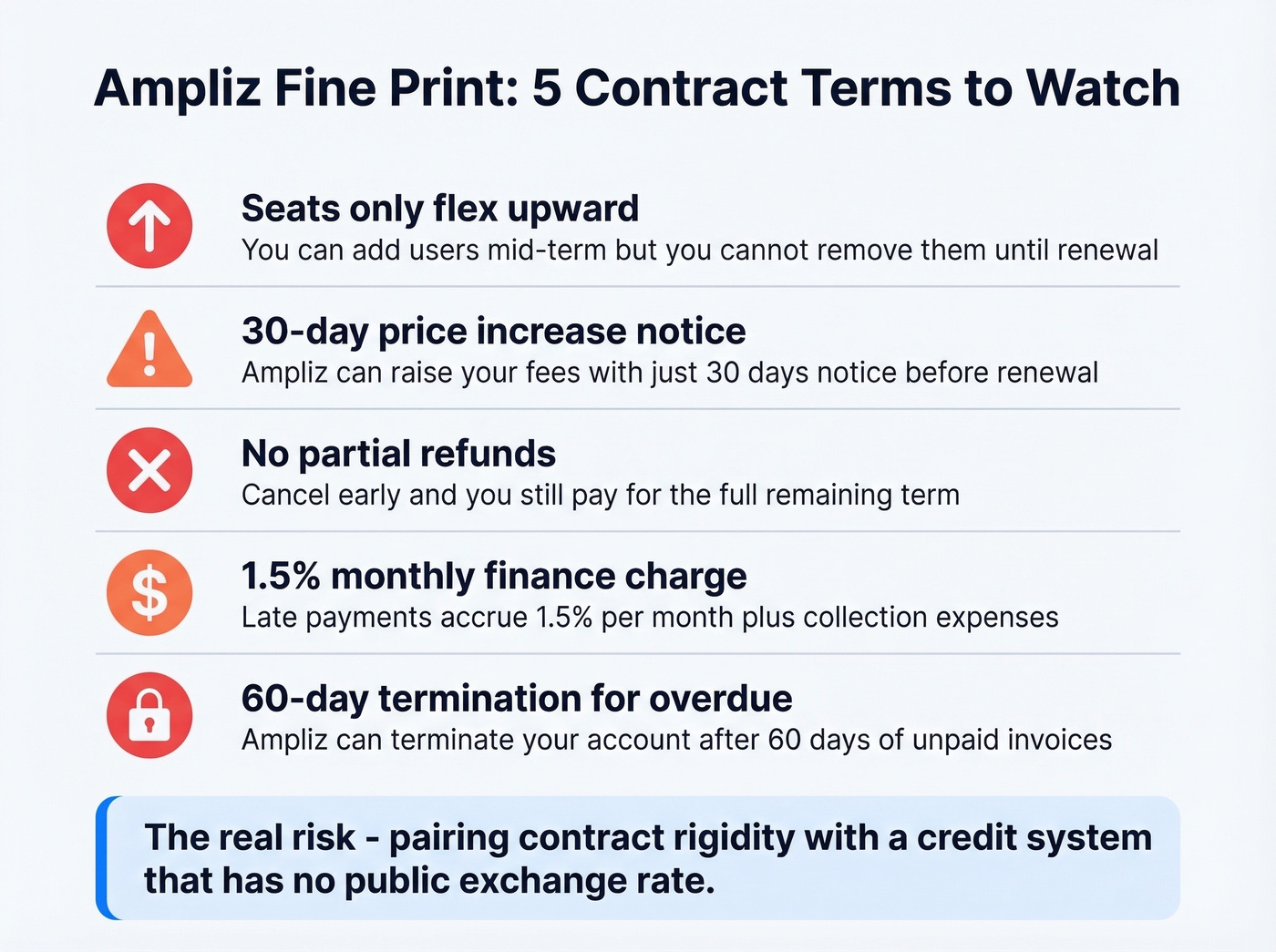
The seat policy is the biggest trap: you can add headcount during a term, but you can't right-size downward unless your Order Form explicitly allows it. Pair that with the fact that Ampliz can increase fees with 30 days' notice before a term renewal, and you've got a contract that only flexes in one direction. No partial refunds for unused time. A 1.5% monthly finance charge on overdue invoices plus collection expenses. And a 60-day termination threshold for overdue amounts.
None of this is unusual for SaaS. What's unusual is pairing contract rigidity with a credit system that isn't defined publicly.
How Ampliz Stacks Up
Ampliz pricing is low-cost entry with high ambiguity. Here's how it compares against tools that either define credits clearly or anchor you with an enterprise contract.
| Tool | Entry price | Unit model | Best for |
|---|---|---|---|
| Ampliz | $50/mo | 100 credits (undefined) | Budget APAC prospecting |
| Prospeo | Free (75 emails/mo) | ~$0.01/email | Predictable per-email costs |
| Apollo.io | $49-$119/user/mo | Credits + overage | Full outbound workflow |
| Lusha | Free (70 credits/mo) | 1 credit/email, 10/phone | Quick email lookups |
| ZoomInfo | ~$14,995/yr | Contract/modules | Enterprise US coverage |
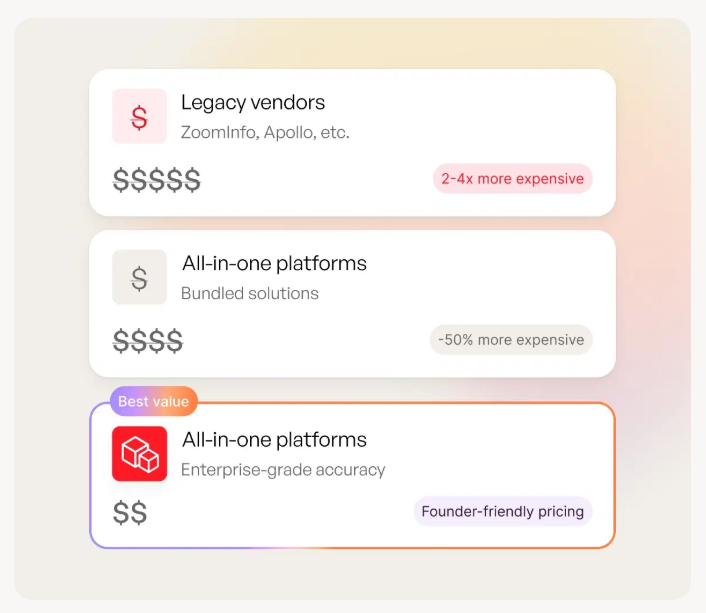
Prospeo is the pick when you want predictable unit economics. The free tier includes 75 verified emails/month, paid plans land around ~$0.01/email, and the platform delivers 98% email accuracy across 300M+ professional profiles with a 7-day refresh cycle. No contracts, fully self-serve.
Is $50/Month Worth It?
Ampliz sits at 4.2/5 on G2 with a handful of reviews. In early 2026, a reviewer praised verified emails, direct dials, GDPR compliance, bulk enrichment, and useful filtering - especially for APAC targeting. Ampliz claims 400M+ B2B contacts across 16 APAC countries on G2. The complaints are consistent too: the UI feels clunky, and coverage gets thin for smaller companies with missing dials and stale titles.
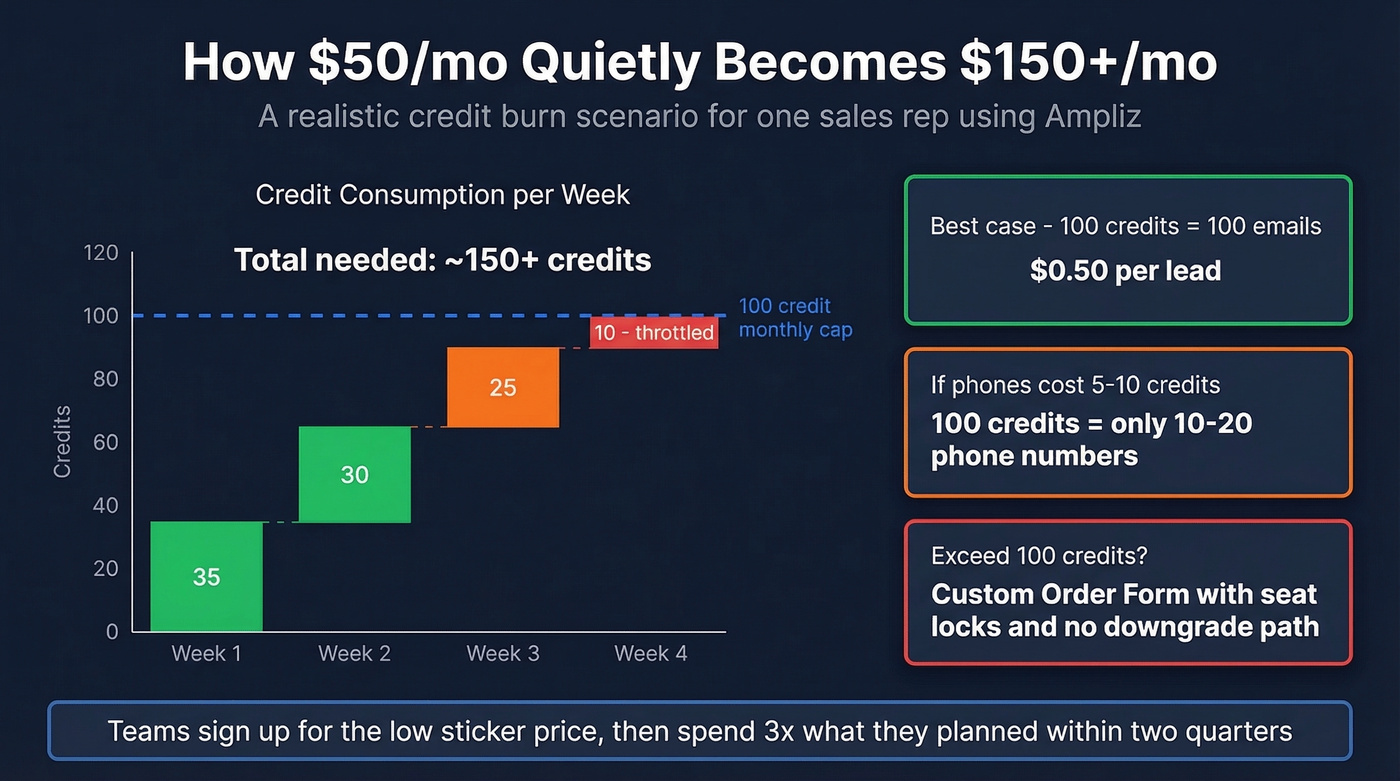
Let's be honest: the problem isn't the $50. It's that you can't budget around it.
If 100 credits/month effectively supports only 100 email reveals (best case), that's barely enough for one rep. If phones cost 5-10 credits like most platforms, you'll burn the monthly allotment in a single morning of list building. And once you exceed 100 credits, you're negotiating a custom Order Form with seat locks and no downgrade path. We've seen this pattern with other credit-opaque tools - teams sign up for the low sticker price, then spend 3x what they planned within two quarters because there's no way to forecast consumption.
Skip Ampliz if your team needs more than light prospecting volume or if you can't get a clear credit breakdown during the sales process. Ask the question directly before you sign anything.
Ampliz is probably the cheapest way to get APAC-specific B2B data. But "cheapest" and "most predictable" are different things, and for outbound teams, predictable cost-per-lead matters more than a low sticker price.
Ampliz locks you into seats that only flex upward. Prospeo has no contracts, no seat locks, and no annual commitments. Self-serve signup, cancel anytime, and 75 free verified emails every month. Teams using Prospeo book 35% more meetings than Apollo users - with data they can actually budget around.
Predictable pricing beats a low sticker price every time.
FAQ
Does Ampliz have a free trial?
Yes - Ampliz offers a permanent free plan with 10 credits/month and no credit card required. Ten credits is too small to evaluate real workflows like list building and enrichment, but it's enough to test the UI and basic search.
How much does Ampliz Healthcare data cost?
Ampliz Healthcare is custom-priced and requires a demo. Expect mid-four to low-five figures annually based on typical healthcare intelligence platforms, with the final number driven by seats, data scope, and custom datasets.
How does Ampliz compare to tools with transparent credit models?
Ampliz's credit system is opaque - you don't know what each credit buys until you're inside the platform. Lusha (1 credit per email, 10 per phone) and Apollo ($0.20/credit overages) publish exchange rates upfront, making cost-per-lead forecasting straightforward.